Subscribe
Share
Share
Embed
In this episode, Priten speaks with Anand Rao, director of the Center for AI in the Liberal Arts at the University of Mary Washington and professor of communication, about what higher education should preserve and what it needs to rethink as AI reshapes the classroom. Rao has studied AI in digital studies courses for years and co-wrote an early book on ChatGPT in education in March 2023. The conversation moves from the practical work of building AI literacy for students and faculty to harder questions about long-form reading, attention, motivation, and whether a liberal arts education is becoming a luxury just as civic life needs it most.
Key Takeaways:
Margin of Thought is a podcast about the questions we don’t always make time for but should.
Hosted by Priten Soundar-Shah, the show features wide-ranging conversations with educators, civic leaders, technologists, academics, and students.
Each season centers on a key tension in modern life that affects how we raise and educate our children.
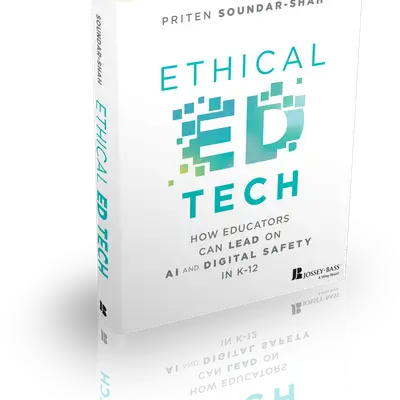
Learn more about Priten and his upcoming book, Ethical Ed Tech: How Educators Can Lead on AI & K-12 at priten.org and ethicaledtech.org.
Priten: Welcome to Margin of Thought, where we make space for the questions that matter. I'm your host, Priten, and together we'll explore questions that help us preserve what matters while navigating what's coming. Today, I'm joined by Anand Rao, director of the Center for AI in the Liberal Arts at the University of Mary Washington and professor of communication. Anand is also a lifelong friend and a board member at Academy for Social Civics. His work asks how students, faculty, and institutions can build AI literacy while staying rooted in the deeper purposes of education. This conversation is about what higher education should preserve, what it needs to rethink, and how the liberal arts can help students use AI with judgment, curiosity, and responsibility. Let's start with how Anand started his new center.
Anand: Sure, yeah. It probably starts—the earliest traces would be when we were working on the ChatGPT book. So November '22, just like everybody else, I was totally rocked by ChatGPT. I'd been studying and incorporating a study of AI in digital studies courses for years, of course, but students didn't really have access to a lot of the tools. And so ChatGPT really opened everybody's eyes. I think that you and I were on that webinar that Stefan—I don't know if you and Stefan organized it, but that was like January 2023. He was putting together the idea of a book. That's when I really started thinking pretty earnestly about what is it that we need to do to better prepare students for an AI world. Because first, starting with how does this change the classroom, of course, and that was a natural next step to start to consider what does this mean for assessment? What does it mean for assignments? How do we better meet student needs? And even in that first webinar that we had in January '23, there was discussion about bringing in orality, making sure that we reinforce the role of presentations, Q&A, debate, as a better means of assessment, really going back to our roots in a rhetorical tradition, and that was certainly a very important part of it. And then, as you know better than I, that book in March '23 on ChatGPT—when I look back on it, there's certainly things I would do differently, but I think it's weathered pretty well in that there were a lot of ideas there. There were some kernels of ideas for managing assessment and thinking about how higher ed, and really K through 12 as well, can adapt to some of the challenges and opportunities with AI that I think many people are still now just starting to get to. So we were just lucky that we were thinking about it a little bit earlier than everybody else. And ever since, even that following fall, fall '23, I started teaching courses and studying AI, AI in society, and really trying to get students to use some no-code chatbot tools, building their own chatbots, working with AI tools, thinking about the role AI is likely to play in any career that they're going into. And right around that time, even in fall '23, I remember talking with colleagues and with our administration about having more support at the university. We weren't really sure what that was going to look like, but I liked the idea of a center to support students, support faculty and staff, but then maybe even do more in terms of a broader support for the local community. At that point, I was really focusing on the coursework. We were really intrigued by the NEH, which had a grant for Centers for AI. We actually applied early for one of those, and we did not get it. I found out part of the reason why was that it looked like, because the University of Richmond, just down the road from us, did get it, they were already further along the road of planning for this, and they already had a lot of support for it. There was a little bit of a silver lining to that, though, because when we didn't get that grant, and I had a sabbatical for the following year, it gave us a chance to pause—to be really intentional, to think about what it is that we would like to do and to explore other means of support. So we were able to then make sure that we had institutional support, we had a really generous grant given to us, a donation given by an alum of UMW and her husband, and that's given us the framework for the center. Then we found out some of the other centers that had received the NEH grant ended up not getting it because of DOGE cuts and the funding cuts that happened in early 2025. So luckily we avoided that just because we didn't have to rely on it. So I spent the sabbatical really thinking about what we wanted to do, working really closely with our provost, Tim O'Donnell, to think about what this center could provide, what it could support. We're still figuring some of that out, but I think that the primary missions are first and foremost to better prepare our students for an AI world. Because I think every student that's going to be graduating has to be able to answer questions about how would they use AI, when would they use AI, how would they consider responsible uses of AI. And so even for students that are maybe resistant or a little skeptical or concerned about the uses of AI, I want to make sure that they're really well-informed, that they have a foundation of AI literacy so that they can speak intelligently about where AI is appropriately deployed, where it's not, how they would make some of those decisions. And I think it'll make it easier for them to find the middle road. So it's not a pro-AI center, and it's not just a center for AI, but it was also important to us to really build it upon our tradition in liberal arts. We're a liberal arts institution. And this is something that I think I've really developed over this past year. At first it was, how do we adapt as a liberal arts institution, a very traditional, residential, in-person, face-to-face institution, when we're facing the challenges of AI? Now I don't think it's any more a question of can we adapt, but I think there's a role that the liberal arts can play to lead the development of AI. And I don't mean that just in terms of using AI in the workplace, but I think there are mechanisms by which the liberal arts, through orality, through interdisciplinarity, and through a really pluralistic tradition, can be used through the development of new AI models and new AI frameworks. And so I'm really excited about that. So it works kind of in parallel. I think that the Center for AI and the Liberal Arts is supporting students, but also then broadening our mission to support the local community. And so we have a lot of events that we're running already—public debates, guest speakers, informational sessions, webinars that I'm running that we're making freely available to anybody to be able to watch and participate in on some level. And then also wanting to make sure that we can support some research so that faculty and students at Mary Washington can then participate in thinking about the access to AI, use of AI tools, and even developing new AI tools in some really interesting liberal-arts-influenced ways.
Priten: That's all very exciting and tackling it from a lot of different angles. I'm curious about what the relationship with the center and faculty looks like. Are faculty—are you all working in tandem with them? Are you providing separate courses, training faculty? Where is the AI literacy fitting in with the regular curriculum?
Anand: One of the benefits of having this last year is it gave me a chance to also reflect on what does this mean for professional development and how does it really fit in the way that we view the curriculum. I think that benefited us because it gave the faculty a little more time to work through some of these issues and to think a little bit more about it. Fall 2025 is very different than fall 2024, and I think there's a heightened sense of awareness about the presence of AI, about the disruption that AI is causing in all sectors of society, especially in the classroom. I'm very sympathetic to colleagues who want to make sure that they're able to teach some of the traditional lessons that they had that are really important, but they're seeing challenges with AI perhaps being used inappropriately or disrupting that process. I'm sympathetic to that. And I think they've come around to a recognition that, hey, we can't just ban AI from the classroom. They can limit AI use and talk about that, but they can't just pretend it doesn't exist. And so they really want to come forward and talk a bit about, all right, this is when it's not appropriate to use it, this is when you still need to work through the writing process, for instance, or thinking critically or learning content. But now I think there are a lot of colleagues that are really interested in finding out more to understand some of the opportunities and some of the potentials of AI tools, so that we can better guide critical reflection on the use of AI. And I think that's one thing that has really gotten a lot of faculty to come around to support some ideas of AI programming—and that's something we were very intentional about with the center—is that it's not "everybody should use AI and we need to use unbridled AI across the board." It's "everyone needs to understand and know how AI works, what's being done with AI, and what some of the concerns are." So in terms of faculty and professional development, it started just before the beginning of the semester. We had a series of workshops and sessions during a professional development day, and a whole track just on AI, and those were probably the most sought after. We've really filled the rooms with dozens and dozens and dozens of faculty signing up for each one to find out a little bit more about the capabilities, new developments. And it's hard. I mean, these are experts in their fields. They're very busy with their own research. For them to have to take on understanding new developments in AI is a difficult thing to do. So we first want to be able to give them that support and some understanding about what tools are out there, how they're being used, how their students might be using them, and how they might consider using them in the classroom. I've started a webinar series this fall where I'm just running a one-hour session, roughly every other week, talking about different AI tools so that faculty can start to explore them and play with them. The first one was on deep research tools, and we looked at Gemini and ChatGPT and Perplexity. I just ran one this week on Playlab and showed them how they can use it to build their own bots and have students build their own tools. We'll do another one on NotebookLM, another one on building GPTs and Gems. So that helps a little bit, so that faculty that are interested can start to use some of those tools, think about how to incorporate it. Then we're thinking a little bit more about what we can do for professional development going forward. We are actually planning—and this is something that my colleagues in the Center for Teaching were working on while I was on sabbatical—they're planning on hosting a conference next summer on AI and pedagogy. So that'll be a really exciting event, so that we'll be able to bring in some colleagues from across the country to share ideas, talk about how they're incorporating AI, how they're responding to AI, what they're doing to meet some of the challenges of AI in the classroom. And I think that's going to be really useful for our faculty too, of course, to think about what they can do with their own coursework.
Priten: So the second part of this, we're thinking about how the liberal arts can inform AI models. I want to take a step back from that a little bit and ask, how are you all seeing the teaching of the liberal arts, and continuing to have students do the work that the liberal arts require, especially when so much of that used to be in the written form? What does that look like for new students that are being exposed to the liberal arts?
Anand: I think there are a number of different ways to access this. I would probably start with the way that I talk about this with students, which is that the skill set that they're going to need—and even tech leaders, business leaders have been saying this for a long time, and even more so now—is that it's not just about technical skills. What they're looking for and what they're predicting will be the most important skill sets for students to be successful in almost any career are the same durable skills, what some have called soft skills, but the durable skills that the liberal arts have been known for for millennia. The communication skills, both oral and written, critical thinking skills, research skills, collaboration skills, management skills, and being able to deploy these in important ways. Now, I don't think that someone that just developed those skills absent AI is going to be quite as successful, but they will have that foundation. What we're looking at is how do we then update the liberal arts curriculum so that students are ready to be able to deploy them in AI settings? I don't think it's going to be that difficult to be able to make those changes, those tweaks. Some will be more challenging than others, but the starting point—and I've talked with colleagues about this, and even within our first-year experience we're looking at it—many of the elements of AI tools can be considered. Now, I wouldn't say that they're the same as past tools that we've experienced, but there are a lot of similarities. I was talking with a colleague today about this. I remember the first time I started teaching argumentation and debate in 1992, and at that point when I was teaching research, that included the card catalog. A few digital tools, but the worldwide web wasn't invented yet. We weren't talking about Boolean logic even. We were talking about pulling out the social science citation index to be able to backtrack articles. A few years later, we had the worldwide web and we had Google eventually, and then the way that I taught research changed because I needed to teach Boolean logic and be able to use electronic databases. Well, what we're looking at now is not that dissimilar from those changes that occurred early in my career 30-plus years ago when we were thinking about different ways of researching. Now it needs to incorporate how do you use AI overviews, how do you use deep research tools, and how do you use them appropriately and effectively? So they're not going to do it all by themselves, and we shouldn't just defer to them in the same way that we wouldn't have just deferred to the first 10 hits on a Google search. So I think part of it is that for some of the applications of the tools, it's just an extension of the processes we've had before, and we need to frame it that way for a lot of students. Now, the caveat of course is that this is a bigger difference than jumping from a card catalog to Google. That seemed like a huge change. Now we're getting to the point when you can run a deep research query on Google Gemini and get 10,000 words and a couple hundred sources, and it looks like something you'd be ready to just take and turn in as the final product. We still need to talk about data literacy and information literacy, and how do you critically reflect on that content? How do you double-check the veracity of that content? So it comes with the need for some AI literacy and to make sure that students really understand how does that LLM work so that they know why it hallucinates. How do they actually verify some of that work? And to recognize that, as with most of these technological changes, our expectations go up. So what would've been a difficult speech to write in 1992 in an argumentation class would've been incredibly easy with Google. And that's almost laughable compared to what you would expect a student to be able to produce now. So part of it is just an advance in technology and the tools that the students have access to. Now, to the more difficult part of the question that you were asking, how does it change writing? I think that this is something that when I talk to colleagues that are composition rhetoric faculty, they're starting to really reflect on what's the nature of the writing process. I wouldn't say that there's a consensus formed by any means, but I think there are a number of people recognizing that what it means to write now is very different than it meant a generation ago. We still want to make sure that students are able to develop a cogent argument, to be able to communicate an idea effectively from one person to another. But it's not as likely anymore—it just isn't, outside of academia—that a student is going to be writing a long research paper or an essay in the same way they might have before. So I don't want students to lose those skills or to not develop those skills, but we also need to reframe it in terms of what does that mean with the use of AI technology. So prompting is a form of writing. At the very least, we look at a foundational level: what do students need to be able to do to communicate effectively if they're trying to get an idea across, or more importantly, a question or directions for somebody else. It doesn't have to be an AI bot, but if they're working in a small group scenario and they can't communicate effectively with the rest of the small group what it is that they think the product should look like, then they're not communicating very effectively. And then that's something that they could extend and apply to whatever they would do with an AI bot or an agent. That's going to be really important to develop. So I think we're going through a lot of flux right now. Stefan and I interviewed somebody from ASU, Adam Patton, who had some really great insight. His background is in composition rhetoric, and he had some very provocative things to say. Just that he really doesn't think it's serving students—expecting students to write an essay anymore is not realistic. They aren't going to write them outside of academia. So we should be a little more aware of what it is that they should be writing about and what they will be writing about once they leave higher ed. I think we need to find something in the middle. They still need to learn how to write in a very traditional sense. I think that's going to happen more at the K-12 level. When we get to college, I think that they have to then figure out how to incorporate some of the tools for brainstorming, for reflection, for revision, and for further drafting and feedback. And that can only up the game. I think as long as the motivation is there by the students to want to produce the best possible work, then they can use these tools in an additive form rather than taking away from what they would've been learning otherwise.
Priten: I want to zoom in on a very particular example. So when I think about my own education, and I think about a random assignment, like reading Descartes, and the amount of effort that I had to put in outside of the classroom to read through the Meditations, reflect on it, sit there with it, read it like six times, come to class, discuss it, and then write a reflection paper on it—a lot of that learning takes place outside of the classroom. A lot of that learning takes place in ways that I think students are turning to AI to make more efficient and to shortchange. And I think that those processes, if they were made more efficient, for at least how I'm imagining it, I think I would've missed out and I would have not gained as much as I did from that text. What does that mean for students today when they can go home and they can upload the Meditations and say, "Okay, generate a summary for me," and then "generate the reflection for me," and that takes away some of that process, even if they're prompting it to do so? Like that slow reading and that slow thinking, I wonder where that happens.
Anand: Yeah. It's a great example of what is going to be lost, and probably what is already lost in some ways. Not to say that it has to necessarily be, but I mean, we see trends happening. A couple of things I'd probably say about this, and I can relate to the example that you give. I was an undergraduate philosophy major, and I just remember having classes where you start the classes at the beginning of the semester, and it's one book. You're going to be reading that book over the course of the semester and writing a couple of essays, and not looking at a lot of other sources and not getting distracted by other perspectives, but your understanding, your interrogation of those ideas and that text. That doesn't happen as often anymore. And when we hear from colleagues at all levels that students aren't quite ready, they aren't as equipped to do the long-form reading that we would have expected in previous generations—AI or not, I think that's already been lost to some extent. The other thing we probably should note is that your experience, my experience, was not the typical experience for college students in any generation, for the last hundred years probably. The vast majority of students that were going through college probably didn't have to grapple with Descartes at that level or with Heidegger. So that wasn't typical or standard at an earlier point, and we need to be honest about that too. Now, would I like students to work at that level and to be putting forth that kind of effort? Yeah, of course. And I'm grappling with this because when we talk about something like, take NotebookLM, which is just an amazing tool to be able to put a lot of text in and then have students really interrogate ideas with the assistance of NotebookLM—in the past, I probably would have said, okay, well, it's a tough reading, get a study group together, and have the other people share their readings of it and perspectives on it. That provided some shortcuts. It wasn't just one person doing it all on their own. And there are probably some interesting corollaries between a good study group and using a chatbot. Now, I think the chatbot probably goes a little further than any study group that I was in, in terms of providing that overview or giving the synopsis, but it's not totally dissimilar. And so part of me is happy that we have tools that can help give greater access to the materials that students probably need. But it is going to take away some of that friction. We need that friction in education. There needs to be some resistance that students are working against. Otherwise, it's going to be really difficult for them to develop those skills. And that's really what it comes down to. And I think what I'm stuck on, and recognize there's a real need for, is that the core element of all of this is motivation. The tools are so good that if your motivation is simply to complete the work in as easy a way as possible and not have to worry about learning anything or really grappling with anything, you can do that. And you'll get through pretty easily, especially with traditional assessments. But for the students that are motivated, they can easily 10X whatever I would've been able to provide in the classroom, just with their use of the tools on their own. The type of opportunities for self-learning, and flexible learning for students—if we can crack that nut, if we can figure out a way to get students to think of it as this is something that's additive for them, that they get something out of it, if they can learn how to be that motivated and direct their own education, then the sky's the limit. I mean, I think there's so much more that they'll be able to do with these tools. What's challenging—what is going to probably give the greatest resistance to all of this—is old faculty like me who've been doing it the same way for a very long time, and it's not like our experience, so it's hard for us to get our heads around why is it that it would be that different. And it's difficult to get rid of assessments that we've used for decades and have been tried and true. Well, they're not working that well anymore, and they're really not meeting the needs of the students. And the other part of this is that I think most students going through K-12—I have a lot of respect for my colleagues in K-12, and this is not about any motivation on their part, but the structure of most K-12 classrooms is such that it doesn't encourage the kind of motivation that we're talking about here. Because you can't have 25, 30 students in your class, each driven by their own curiosity, going off in different directions, because it doesn't allow for any kind of classroom management. And I recognize that. It's difficult enough if everybody's on the same page in a high school classroom. I have so much respect for some of these amazing teachers that are able to do that well. But the cost is that you really are driving out that motivation, that sense, that intrinsic motivation, that curiosity that would take a student to go off on different tangents and to be able to go down those rabbit holes to explore new ideas. If we have an educational system where students are encouraged to do that and they're facilitated with some AI tools, they could go so much further. Examples like the World Bank's study from Africa from this last year, where they found that in six weeks students that were using personalized AI chatbots could jump the equivalent of two years of instruction. Now that sounds amazing, that's great they could help them move that forward that fast. Makes me wonder why it would normally take two years. And that's in part because we're always herding everybody back into the median, and making sure everybody's on the same page. If we can individualize this, that'll be fantastic. So it's a very long-winded way of just getting at, I think we're going to have a hard time through this transition because there's already a lot of framework and bureaucracy and institutional memory that is hard to work against. If we could get a way to really motivate students and develop that intrinsic curiosity, that motivation, and give them the individualized instruction that maybe AI could provide or through other means, then they could jump so much further, and do so much more with it, and I think that would solve for a lot of these concerns about AI shortcuts. But the difficulty there is not the AI. It's more about standard practices.
Priten: I want to touch on the motivation piece again in a little bit, but I'm stuck on the long-form reading. I heard this—and correct me if I'm wrong—this inevitability of long-form reading becoming obsolete. Is that what you're—or am I misinterpreting that? Because that scares me.
Anand: I mean, I think it's more—it's not that it's necessarily obsolete. I certainly don't want to see it go away. But we're already seeing the declining rates of long-form reading. The number of Americans that are reading a book a year is dwindling. We still have a lot of students—my daughter just has a list of books that she's always reading. She always has audiobooks she's listening to. She loves it. And there are people that will always find that appealing, that will want to read, and read long texts. But we've also facilitated, through a lot of practices, not just with AI, ways for people to get information, to be able to learn a great deal without having to read a long text. Something is definitely going to be lost, and is lost already, when we're moving away from it. Part of me is comforted with knowing that this is not the first time that's happened, with different skill sets—the example of going from being able to read a map to using GPS, and I'm guilty of that. I used to be able to read maps really well, and I'd always have a map and plan it out, and now I just kind of blindly follow the GPS. Or remembering phone numbers, or moving from an oral tradition to a written tradition. Every transition there have been changes that we could identify. There are skill sets that will be lost or diminished with this transition. In this case, I think it'll be more profound. It's definitely more serious, and I'm not really sure how we get someone to still want to engage in that level of reading if they don't already find it kind of appealing. Although, if they have the motivation that they're really trying to learn particular content, if they master something, then I think maybe that motivation is going to take them there and they'll be able to read it. Even then, that said, I think that we're looking at more multimodal access to text. I mentioned people that I know that like listening to audiobooks. That's a different experience than sitting and reading a text, or even reading it on a Kindle is very different than reading a hard copy of something. So it's going to be different. I don't know that it's always going to be bad, but it's not going to be the same as it was when we were students—not the way you were, and not for me. It's just going to be different.
Priten: When you bring up the example of skills that are lost in these transition points—and you're right, I think you mentioned this earlier, that AI is not uniquely causing this in any way that we weren't already seeing in education. But I'm worried about attention spans. That's the skill set, I think, that the long-form reading, the slow thinking, the going through a longer writing process—and I feel like I'm sitting here, maybe I'm resisting the change here, but to me some of our biggest achievements of humanity are because of that attention to a particular project, of sitting down with that intentionality. And if we're not cultivating even that disposition—forget about whether or not the skill set of reading is important, or whether the skill set of writing is important, whether or not sitting and being able to listen to a lecture and not zone out is important or not, maybe some of those things are obsolete and we can replace them with different skill sets to get some other parts of those—but that attention piece really scares me, in terms of, if you can't pay attention and stay dedicated to a task, what does that mean for progress? Like, human-initiated progress at least. I'm sure folks, you know.
Anand: Look, I share these concerns. And I have the reactions too: "hey, wait a minute, this lecture used to work much better. People used to be really engaged. They'd want to listen all the way through." Let me play devil's advocate a little bit, though. Because when we think about previous generations and the students that were in a college classroom that had the long attention span, could listen to the lecture—well, it's not that all students that age at those times had those long attention spans or the interests, but we selected out those students that didn't, weren't naturally—so we were over-representing students with long attention spans. That wasn't necessarily the way everybody was at that time period. And that's true now as well. I think that we have experienced, and this in part because of all kinds of technology, and social media's certainly made it worse—I know for me, my attention span is not as long as it used to be, for most content that I'm working with. And I think for students it's to their detriment, and it's making it much more difficult. But what probably makes me feel a little bit better and gives me some solace is that I still see students enter a flow state when they're working on something they care about, that they're passionate about. So maybe it makes me also think, well, maybe it's not that they're not very good at having the attention span, it's that maybe my lecture's just not that interesting to them. And maybe this generation of students is a little better at being able to identify, well, if it's not that of that interest to me, then why should I devote that kind of attention and pretend that I'm that interested? I don't know. It's not that black or white. I mean, I think there's certainly something lost. I think we do have shorter attention spans just generally. I remember when I was in grad school in the '90s listening to a really great presentation from Kathleen Hall Jamieson about sound bites on television, and how they'd gone from—you know, a sound bite in the '50s or '60s would be 10, 20, 30 seconds, and it was down to less than 10 seconds. And now you have a ten-second Sora video and that seems long. You might have a two- or three-second clip, and that's something that we're used to. And that certainly changes the way we're engaging with content. But we then will watch 100 of those in a row, if we're on TikTok scrolling through. So there's something different about the attention span. It's not that it's just a shorter attention span. We're expecting more stimulation and more engagement. But again, even if I come back to that, what's happening, I'm not ready to say that people have totally lost it. It's just that they're more selective. And that flow state, I think, when I see it with students, when they're really engaged with something and they're into it, they do have that long attention span. They'll spend hours on something. But they have to really be motivated to.
Priten: When we talk about a liberal arts education, there's an assumption that you're doing a well-rounded exposure to different disciplines that you might not have that intrinsic motivation with. What if we are cultivating a space where your attention span is being used in things that you care the most about? There's this period of discovery that requires you to give something a sufficient shot. And I think that is what the basic premise of most first-year gen ed curriculums are—the idea that you kind of have to learn some of these other things that you might not fully be interested in, but will eventually come and pay off, and it'll give you a larger perspective on the things you are interested in. When we offload so much of this to intrinsic student motivation—when, I mean, student engagement crisis, buzzwords—there's, we're not doing so well at keeping our students motivated baseline. And maybe this is a fracture point that we need to—these are the difficulties that we'll have to figure out how to solve. But I think we've relied partially on coercion in education to get folks to do, you know, expose themselves to different disciplines and go through these processes and do assignments with the actual, like, face the friction. If we can find a way to teach our students without coercing them, I think that that's a win. I don't know what that looks like. And I don't know if anybody does yet, and this transition period scares me. In the meantime, we're having students go through these universities today. There are students who are graduating with degrees this May who did not go through that friction, and who did not have assessments that were accurately testing them, and who went through school without the motivation to make the most of it. And they went through because they needed their diploma to move on to the next step. So even as we figure out what the five-, ten-year plan is, like the short term for what higher ed looks like and what that means for true learning, while we're figuring out how to motivate students—that's scary too to me. I sound like a pessimist today, but I'm making you play the role of optimist.
Anand: Well, Priten, I think you're outlining a number of concerns that many of us have about this. Let's take some of the different points that you're making. Think about the gen ed curriculum. I really think, I truly believe, that any student benefits from exposure through a general education curriculum, whatever, at whatever level. And this is something we've talked about, is the comparison of a liberal arts education compared to maybe a technical degree where they don't go through that. They go through a level of specialization without that generalization, and that's important. Well, it's a little different today, I think, for most students growing up because they're probably exposed to a lot more information before they enter college than previous generations. I mean, I know that if I think about my generation, people entering college in the '80s or '90s, we just didn't have access to as much information. It was harder to find information. Even for those of us who were really seeking it out, we probably only had a small fraction of the total amount of information we were exposed to. So if we think about the gen ed curriculum in terms of exposure, I think some of the purpose of that has already been met just through an information society. Now, I don't know that it's done very well. It's not very evenly, and a lot of it's done through social media and other types of engagement. But it's just a different environment than what we probably had before. I still think people will benefit from it. But aside from AI, we're already facing so many challenges with higher education in terms of costs, return on investment. There are a lot of people that just aren't going to be seeking out a college degree anymore because there are other limiting factors. I think a traditional liberal arts education will always be there, but it's probably going to be something that's more of a luxury, and there aren't that many people that are probably going to be able to get the same four-year degree or liberal arts degree compared to previous generations. We're finding that there are probably fewer jobs that will require a college degree. They'll require other kinds of credentialing or other kinds of experience or some way of knowing that they're ready for that particular job. And I think there's definitely something lost there, but that's probably where we're moving. So I think even for a liberal arts education—I was telling some colleagues about this today—I really like being at a liberal arts institution with a four-year degree that has a general education component that's roughly a third of the work that they'd be doing, and I think that's still going to be valuable for any student. But I think we have to start to explore other options. Perhaps a one-year program, maybe a two-year. And we have associate's degrees obviously, but maybe even something that is a little more condensed or a little more specified. We can include some general education elements, but maybe instead of a full three-credit course in each of these other areas, maybe there's more of a gen ed course that covers a number of these categories, that maybe is better reflective of what students are currently exposed to and what they already have access to, and is mindful of the cost and the time that it would take to be able to go through and get a full four-year degree. I think that's just facing the reality of what's happening with higher ed and the financial economic situation that most of the students are going to be in. So it's not going to go away entirely, but I think it's going to be very different than what we've seen before.
Priten: And I don't know if you remember some of the initial motivations behind the United for Social Change project. But a lot of it was with the idea of bringing the liberal arts to K to 12, because at that point—and this is like 10 years ago when I was thinking about this—the liberal arts felt like a luxury back then, and that was scary to me in terms of thinking about civic society and democracy. When you talk about the liberal arts becoming even more of a luxury, what does this mean for civic discourse? What does this mean for how decision-making happens in the public sphere, if we're moving away from the kinds of skill building that a liberal arts education will bring, because you can just get a technical degree and go on and get a career? The reality is that for a lot of students, for educators, for universities, the mission statements can be about changing the world and being civically engaged and good members of your democratic society, but for most students and parents, the college degree is not that. It is a means for economic mobility. And when we provide alternatives that no longer are tied to that, I worry, where does that mission go? How do we achieve that mission if it's no longer at the university level?
Anand: I totally agree. I mean, I'm very concerned about that. And there are probably different ways of going about it. If we go through these kinds of changes that I'm outlining for higher ed, but we keep K-12 the way it is right now, then we're really going to be worse off. We really have to re-envision education all the way through. Otherwise, I mean, I don't even see how you develop that sense of intrinsic motivation if you keep K-12 the way it is now, for instance. There are opportunities. Now, I don't want to be too fanciful and say that, yeah, we can reform all of education and make it personalized education from K on, and it'll be easy for every student to direct their own education, and we can incorporate gen ed into the lower levels. It's not going to happen overnight, and it's certainly not going to happen for all schools. And unfortunately, the richer schools are going to have access to those tools and the reform a lot earlier than the schools that have fewer resources to be able to do it. But we have to find some ways to incorporate that. Aside from—this is totally separate from AI—but we can see in society and in politics just how impoverished we are in terms of civic, civil discourse, and public argument. It just doesn't exist. We just don't challenge one another. We don't engage. We're in silos. And that's really dangerous. And it's going to be really hard to address that. It's going to take generations to rebuild some of it. So yeah, incorporating gen ed into K-12, and certainly within high school—I mean, we've seen a retreat from that in some ways. When I think about my own kids going through high school, the older kids had courses where they had access to, or things that they were able to take or were required to take, that students now just don't have access to. And even something like public speaking or debate classes, they're crowded out by AP classes. AP's fine. You should do college-level work. Maybe, though, we should think about the breadth of experience and making sure students have a different set of skills. So there's some opportunities here. And if we can work on more personalized education and you're able to cover that much more ground—I mean, seriously, if we could have something like—I know Alpha School's not really the most accessible for most people, if you're thinking about $40,000 a year. But that model, maybe in some charter schools or some other schools—if they can really effectively have all of the instruction the student needs in two hours a day without homework, which tends to really just bug me, the amount of extra homework students have. But then they do project-based learning, and they're doing work that's collaborative, and they're learning how to interact with other people in a responsible, respectful way. That's fantastic. And maybe you make that three hours a day, and then they can do that much more work, get a little bit further ahead in their studies. They can direct their own education, and then we can incorporate a lot of these components at an earlier age. Yeah, this is the other thing that I'm always reminded of, is that the curriculum is always changing. And our expectations of education are always changing. I have four kids. My oldest and youngest are about 13 years apart. All four of my kids went through the same grade school and had the same kindergarten teacher, mostly because we requested that teacher. We really liked that teacher. I remember the parents' night for my oldest. And that parents' night was a discussion about when they would have nap time, and when they played with blocks, and what they would do in recess. And there was reading and all of that. My daughter learned to read by kindergarten and was reading in kindergarten, doing great work. When we went to the parents' night for our fourth child 13 years later, the kindergarten teacher was wearing a business suit. Didn't look like a kindergarten teacher. There was no nap time anymore. There was hardly any recess. There was a discussion about the core curriculum required by the state, how they were getting ready for standards of learning tests that would be coming in later years. And that made me really sad, because that's not really what kindergarten for five-year-olds should be. But it also made me recognize that we're always changing, and really raising the bar for what we're expecting for students. We need to come around to give them the resources and the means to be able to do it, and maybe instead of it being so directed and so overwhelming in terms of that work, we can ease up a little bit, use some tools that are more personalized, and let the students direct it. And then I think there will be room for some of the gen ed elements that you're talking about. We could have it all. It's just a matter of doing it in a thoughtful way.
Priten: I want to talk a little bit more about what the next year looks like for you with the launch of the center, to hear the kind of projects that you're thinking about to make headway at some of these large problems that we've talked about today, that will take a lot more than just an hour conversation to fully dissect, let alone solve. What's on the radar for your work this year?
Anand: I mentioned the webinars that I'm doing for faculty, and we're working on more professional development opportunities and getting ready for that pedagogy conference in the summer. That'll be a lot of fun. For students and for the broader community, we have some guest speakers that'll be coming in. We have one scheduled for later in October, and then a series of public debates, and this is something I've been very excited about. Of course, with the debate background, this is something I would lean into. But what I like about it is that what we're facing with AI is that—some people just assume students all love AI and they're all going to be using it. There's a lot of resistance to AI by students, and understandably so. They're worried about its disruptive economic impact, what it means for jobs, what it means for the value of their degree, what it means for environmental costs, bias, copyright, all of that. So we've already had one public debate on AI and the environment, and we packed the auditorium. It was totally full. Students were really engaged. We had a couple of faculty members that participated in the debate. They did a really great job. And we did pre- and post-surveys to find out, and it shifted opinion a little bit. Students felt better informed. And we made it really clear this isn't a debate to resolve anything. It's to make sure that people are better informed about some of the issues. We'll have another one on AI and copyright, and then we'll start doing this on some other issues as well. I think what's important for the center is that it's not a pro-AI center. It's a realization that AI is here, that students need to be aware of it, they need to learn how to use it responsibly and ethically, and they need to learn more about it. And so having events like that was really fun. Students enjoyed that it was engaging. They had some say. They were able to participate on some level, and so we'll definitely hold some other events like that. We're working on some other AI literacy opportunities. This past summer we offered a free one-credit class for all incoming and returning students at the university. And it was a free one credit, so if they completed the class, pass/fail, and they got the passing grade, they would get the credit added to their transcript in the fall. 250 students signed up for it, a lot more than I was anticipating. Over a third of them were incoming first-year students, which was really great, and they were just asking for more. It was modules. It was all totally asynchronous. We're going to be offering this again. There's even some discussion from area high schools about wanting to offer this to high school students. I think there's a great potential here for students to get a good foundation understanding about how AI works, to understand academic integrity in the age of AI, to think about some applications. And one assignment we had in that class I definitely want to build out as part of our gen ed. We have a gen ed requirement, it's called "After Mary Washington," to get students to think about career applications. One of these assignments in this class was to think about how AI is being used in a field that the student's thinking about going into, and to critically analyze. Is it effective? Is it responsible? Would they use it that way? Would they do something different? Would they develop a different tool? And that was really great because students were able to start to think about how is this going to change the field that they're going into? How does it affect their discipline? And it gets them to be a little more thoughtful about it. I think most important for me, I want them to be really critically thinking about and reflecting on their own practices, and to think about how to use it and then guide that development in the future.
Priten: Yeah. That sounds like what we know we ought to be doing for every student at every level. So it's exciting that there's some traction, some interest. That all sounds very exciting. Thank you.
Anand: Well, this was great. I appreciate it, Priten. This was a lot of fun.
Priten: AI is forcing colleges to ask what learning is for. When students can generate summaries, drafts, and research in seconds, completion cannot be our goal anymore. The goal has to be judgment, curiosity, attention, and the ability to think through hard questions. That is why Anand reminds us that the liberal arts really matter now. They give students practice making sense of complexity, especially when the tools are moving faster than the rules. For more on how to think about the ethics and purpose of education, check out my new book, Ethical Ed Tech, at ethicaledtech.org. Thanks for listening to Margin of Thought. If this episode gave you something to think about, subscribe, rate, and review us. Also, share it with someone who might be asking similar questions. You can find the show notes, transcripts, and my newsletter at priten.org. Until next time, keep making space for the questions that matter.