Subscribe
Share
Share
Embed
What you do today shapes what comes next—and navigating change doesn’t have to feel overwhelming.
Ready for Beyond is a podcast about growth, purpose, and finding your way in a world that’s shifting fast. Host Gina Hudel shares real conversations and practical tools to help you move forward with clarity, courage, and a little more ease—while still making space to enjoy the day you’re in.
From personal pivots to leadership transitions, career shifts to social impact, this show is for people ready to make meaningful progress while staying grounded in what matters now.
Whether you're leading a team, rethinking success, or simply opening the door to something new—you’re in the right place.
Let’s go beyond.
Gina Hudel: [00:00:08] I'm Gina Hudel, and welcome to Ready for Beyond. Ready for Beyond explores how we move forward in a world that's changing fast. From AI to global dynamics, it looks at how the lives we build lead us to shape our future. We'll examine growth and personal fulfillment with practical takeaways and candid conversations that open the door to possibility. Subscribe on Apple, Spotify, or your favorite podcast platform so you don't miss any episode of this journey. Let's go beyond.
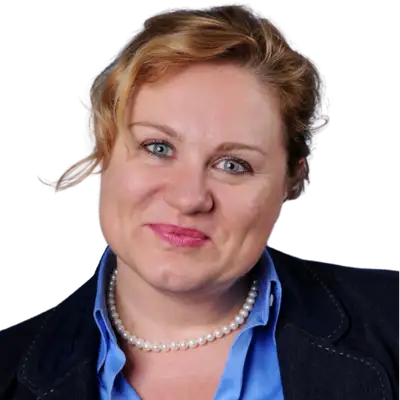
Gina Hudel: [00:00:52] Welcome to Ready for Beyond, I'm Gina Hudel, transformation and governance leader, community builder, and your host. This podcast explores the moments when people sense they are growing into something new, or when something in the system around them needs to change. We talk about how people recognize those moments, how they prepare for what comes next, and how they continue to live well along the way. Today's episode is about what it means to be original. When something in the system no longer fits and something new starts to take shape. This is the moment when someone realizes they can't keep working within the existing system, and begins to design something differently. My guest today is Wanda Deschamps, founder of Liberty Co, a consultancy focused on expanding neurodiverse employment through the IDEA framework: inclusion, diversity, equity, and accessibility. Wanda works with organizations that want to rethink how talent is recognized and supported, particularly for people whose strengths may not fit traditional hiring models. Wanda, welcome to Ready for Beyond.
Wanda Deschamps: [00:01:28] Thanks, Gina. It's great to be here.
Gina Hudel: [00:01:30] Wanda, can you remember the moment when you realized the system itself needed to change, not just the people who are trying to fit into it?
Wanda Deschamps: [00:01:39] Yes. It was after I received my diagnosis of autism, which was a month before my 47th birthday, and it was brought about because I had a complete mental health breakdown at work. I remember the day well, May 12th, 2017, and I realized I had to address my mental health, first of all, for my own benefit and then of course, for my family and my friends and for those around me. However, as I became attuned to my own diagnosis, I would say over that year, the coming months following that breakdown, I changed in so many ways, and I just became happier and more self-aware. I remember thinking, this is what life can be. This is really it. I don't have to live my life doubting myself. And so what happened, Gina, was wonderful. And I began looking at life through a new prism. But then over the course of that year, if you can imagine a split screen on the other side, I realized I can change and change and change. I can address my mental health issues. I can begin a journey of self-awareness. However, if the systems do not change, if the people within those systems do not change, if they do not become aware of neuro inclusion, if they do not commit to idea as you just described it, inclusion, diversity, equity and accessibility, it doesn't matter how self-aware I become, it doesn't matter how much I address my own issues. If they're not going to address the biases in these frameworks in our organizations, then it's only going to be me making the effort and not on the other side. And therefore, we're not going to bring about the change that we truly need.
Gina Hudel: [00:03:33] What a powerful shift individually. And then as you think about the community at large. Before we continue on about that shift, can I ask you to give us just a little bit of context for our listeners who may not be as familiar as you have become? So for those listeners who may be new to the topic, when we talk about neurodiversity in the workplace, what do we mean?
Wanda Deschamps: [00:03:56] So neurodiversity is the mix. Neurodiversity is everyone. So all brains are neurodivergent. So I'm neurodivergent. So it means my brain makeup as someone who's autistic is different. It deviates from the standard and the standard is neurotypical. So we're looking at about 15 to 20, perhaps 25% of the population, individuals like me, autistic or they have a dual diagnosis. They're autistic and ADHD or autistic and dyslexic. And then we're looking at the majority, so the standard, those who are neurotypical as perhaps 75, 80, 85% of the population. Diagnoses is increasing, so these numbers are shifting. Awareness is increasing. Sometimes it's confusing, Gina, so people say Wanda is neurodiverse. Well, no, an individual isn't neurodiverse. I'm neurodivergent. Others say my neighbors who are not neurodivergent, they're neurotypical. But an individual is not neurodiverse. It's that mix. And it's really that mix, the mix of neurodiversity that contributes to the richness of our society.
Gina Hudel: [00:05:10] I love the positive approach here. And we have to be positive. The only way forward is to move forward, not by looking back. It is to move forward. When you start looking, and so after this podcast, we can start looking at our workplaces. When one starts looking at a workplace through that lens, what are some of the things we might start noticing about our organizations and how we identify talent?
Wanda Deschamps: [00:05:27] Often that we're following the same approaches that we've followed for years. So go right back to job postings. Are you using inclusive language or are we using the same language in our job postings that we've used forever? And then move through the whole employee cycle looking at talent. So from the posting to interviews and moving right through, are we thinking about interviews the same way? Are we constructing our interview panels in the same way that we've approached them for years or decades? Or are we constantly thinking of talent and people and contributions and our systems differently? Is the neurodivergent perspective there? If we're looking at 15 to 20 to 25% of the population, even small organizations, you have reason to believe that you have neurodivergent talent, whether they know it or whether you know it. I didn't know till a month before my 47th birthday. So maybe you have folks who don't even know, but are you considering in terms of diversity, are you considering neurodiversity in the interview process, in the hiring process, in the retention of your talent? There's so many things I could say about specifics. However, the first step is really awareness and then moving from awareness to acceptance. Are you aware that unfortunately, we're still a hidden talent pool? The majority of the neurodivergent population is either unemployed or underemployed.
Gina Hudel: [00:07:08] You have a lot of numbers behind you saying this is a talent pool that is not being tapped. And we talk about the skills shortage, training up professional development, getting into the high schools and, and telling folks, look at this career. You're saying that and the science is telling us there's still people ready to go but from the very beginning, they may not know that they're welcome to apply.
Wanda Deschamps: [00:07:31] That's right. And neurodivergent individuals and persons with disabilities, that's something that we actually look at. And so right away, neurodivergent individuals, persons with disabilities, they may see a job posting and right away they may say, "Oh no, they won't consider me". So that's why I always say, consider your language in terms of 'we encourage applications from all members of historically marginalized groups'. Do you have persons with disabilities listed there? Is neurodivergence listed there? Neurodivergence, that is the difference. Neurodivergence, meaning dyslexia, ADHD, autism, whatever language you use, neurodivergent individuals, neurodivergent, that's secondary. Do you use the correct language? But that's secondary to ensure that you're considering that we may exclude ourselves because of bad experiences that we've had. So I always say it requires a bit more effort, perhaps it's absolutely worth it.
Gina Hudel: [00:08:42] We need resources and they're not appearing. And maybe it's because we're not making it apparent that we are welcoming. We've spoken here of the actual job posting and say that between getting ready for the job posting, that has helped us with the interview process, what about the workplace itself? What are some of the tips that we give to folks who aren't HR trained? They're just everyday people doing their best to do well at work and go home afterwards.
Wanda Deschamps: [00:09:12] Be truly welcoming. If you truly value difference in terms of different ways of thinking, then be sincere about that. Don't project intention on folks that they don't have. Give people the benefit of the doubt. Don't assume that because someone communicates differently or interacts differently and in a very broad way, that's how our differences come across. So you could look at me and you could say, "Okay, Wanda's autistic, she's neurodivergent, she doesn't look different from her neurotypical peers". But I can come across very differently the way I communicate, the way I interact. Don't project ill intent on me and say, "Oh, Wanda communicated in that meeting differently. Wanda really wants to bring the team down". No, I'm just communicating differently. Don't assume difference is bad. If someone is communicating differently, come with curiosity, not judgment. Suspend your judgment. "Want to tell me more? Why do you feel that way? Oh, I hadn't considered that". These are things, Gina, that when I go into organizations and I help them understand, they say we should be doing this for everyone. Yes, this could benefit our neuro our neurodivergent team members. However, suspending judgment, increasing our curiosity, asking 'why' more often, this is actually good for everyone.
Gina Hudel: [00:10:45] When you first started raising these ideas with organizations as a consultant, building your own consultancy, economies are built on entrepreneurship and entrepreneurship so that it drives the economy, but also the well-being of the community. What skepticism or resistance did you encounter?
Wanda Deschamps: [00:11:03] It's really interesting, Gina. It was actually the flip. So before Covid, I had opened Liberty Co. You mentioned service. I thought it was going to be a service to the charitable sector because that was my background. I had been in the charitable sector for almost 25 years. Then I realized, no, for a number of reasons. Before Covid, I was going to reorient Liberty Co and I was going to focus on increasing neuro inclusion in the workplace. And I was the skeptic, probably, even though I knew, yes, Wanda, you really have to do this. I didn't know how it would be received because if we're still in the nascent stage now, we were definitely in the nascent stage then six years ago, and I was actually amazed at the level of receptivity. I was receiving these invitations, "come to our organization, come in and speak". And then I expanded to training and case studies and things like that. I had some really good fortune in the sense, Gina, that I was only hearing from the organizations that were interested in building neuro inclusion. I wasn't contacting all kinds of organizations and not hearing from the majority and only hearing from the minority. So it wasn't really skepticism in that way because you keep on using the word positive. I did have a lot of positive experiences. I guess where it's still a little challenging is knowing that some of the basics are still not being recognized and actually built into the culture.
Wanda Deschamps: [00:12:43] So what I mean is that in terms of diversity, I feel that we've come so far. I mean, we still have a long way to go and it's taken far too long. So please know that in recognizing that we've gained ground, we still have a long way to go and took too long. However, in terms of diversity, you know, in terms of racial diversity, ethnic diversity, diversity of gender and sexual orientation, we've come a long way. What's challenging for me is that there's still organizations when they focus on diversity, that's the kind of diversity they're focused on. So organizations will say, "yes, yes, we are indeed focused". And in speaking with them, I realized it is racial diversity. It's ethnic, it's gender. It's sexual orientation. Neurodiversity is still not necessarily there. And then more broadly, accessibility for persons with disability. That is still the missing piece. And that's why I really appreciated it at the beginning. You said 'Wanda works with an IDEA: inclusion, diversity, equity and accessibility". If we don't have accessibility, I say, Gina, imagine everything that happens in terms of diversity, equity, inclusion is behind a door. If we can't even enter, if we can't even get beyond, it's secondary to us how much inclusion, diversity and equity happens after you enter, if we can't even go through, we're never going to be able to contribute in the ways that we want. And so that's why I say go right back looking at the job postings, the job descriptions. So those are still really the missing pieces.
Gina Hudel: [00:14:26] You had a solution to a problem that existed, and some folks did see that. And so that was giving traction. And people speak to people and you go to a conference, they also go to conferences. They also speak to their colleagues. And so this helps to build the momentum. If you're speaking to someone who leads people, it could be a manager, it could be a teacher. If you wanted to unlock more of the neurodiverse, it could be neurodivergent, it could be other neurodiverse talent in their team and their family and their community. What is one thing that one person could change to help make tomorrow better?
Wanda Deschamps: [00:15:06] Make it a shared responsibility. So instead of saying, "Wanda, you're my neighbor, you're my family member, you're my employee. However, in terms of communication and interaction, everything's on you to ensure that you come across". Well, no, it won't work if the onus is only on me. Make it a shared responsibility. I'm going to do this, Wanda, if you could share more about what your needs are, expand on that point. However, at the same time, I'm going to do this. I'm going to make the effort too. If everyone approached it that way, think of the changes that could be brought about.
Gina Hudel: [00:15:46] And this is not radical. We do this with other parts of our lives. We do ask others what we can do so that we are mutually successful.
Wanda Deschamps: [00:15:56] So, Gina, that's why I go into organizations and folks have said this about my partnership with them, and they've said it about if they've received training in neuro inclusion previously, they've said training in neuro inclusion, this is good for everyone. So that's the thing about accessibility. Captions. Initially developed for those with hearing loss, beneficial for those who are neurodivergent because it can help reinforce what's being said during a webinar or presentation. Helpful for those for whom English is their second language. So when you think about the things I've said about suspending judgment, not projecting ill intent, sharing responsibility in terms of communication and interactions, not putting the onus solely on the individual who is considered different. Remove neurodivergent, add queer community members, and newcomers to Canada, add all kinds of differences. And again, you'll find it's better for everyone if you're including these perspectives in your design. It's about adding that neurodivergent perspective from the beginning. Whether it's designing a rec center or if it's frankly preparing for a meeting, it's considering that perspective, that neurodivergent perspective in your planning and you will find it's better for everyone.
Gina Hudel: [00:17:30] Terrific. Wanda, you do so much for so many. When you look forward to five, ten years from now, do you have like a top three list of items like you're saying, these items could happen, I'll really feel that we have progressed well.
Wanda Deschamps: [00:17:50] Yes. There are things that I think about every day. So when you think back to the beginning of our chat together today, I said that unemployment rate and underemployment rate. So, for instance, autistics, we experience some of the highest rates of unemployment and underemployment, and that's specifically for autism. But then even the neurodivergent population is generally largely unemployed, underemployed. If we change that, Gina, if we see significant headway in terms of those numbers, I do truly think of that. Again, if we go back to something that we had a chance to chat about a few minutes ago, and that is in terms of IDEA. So when organizations are really committed to moving forward in terms of diversity and inclusion and equity, and they consider the richness of all areas of diversity, race, ethnicity, gender, sexual orientation, again, that neurodivergence is there. So it's not just differences that you can see, it's those invisible differences as well, but do come across, you know, in terms of social interaction, and communication. And so that we've really added that a, for accessibility to IDE or DEI, whichever acronym that you use. And then related to this, we see huge differences as well, because we're employed at greater levels, because we're employed commensurate with our skills. Because neurodivergence is really considered, we see improvement in the mental health picture. And right now the mental health picture is very poor. So neurodivergent individuals, especially autistics, experience anxiety and depression at much higher rates than their neurotypical peers.
Wanda Deschamps: [00:19:43] Unfortunately, for every neurotypical person who dies by suicide, seven autistics do. And so if in 5 to 10 years, I mean, if I had my way, it would change tomorrow. However, if we're looking further that we see a real change there, that's change that is drastically needed. And of course, all these things are mutually exclusive. We can't separate them. One of the reasons we're anxious and depressed is because we're unemployed or underemployed because of bullying, because we're not fully included in our workplaces and society more generally. So those are the things that I'm really working towards. For me, of course, and especially for my sons, my two neurodivergent sons, I say my goal every day is to model for them what it's like to live unashamed, unafraid, undeterred. As a neurodivergent and specifically an autistic mum.
Gina Hudel: [00:20:40] So we have a t-shirt, I love this. What was that again? Unafraid.
Wanda Deschamps: [00:20:45] Unashamed, undeterred. Whatever order you like or love.
Gina Hudel: [00:20:48] All the more reason that we say we have to make sure that we take care of ourselves today, particularly for those that are doing so much for so many others. I always like to close the podcast with a simple question and it's kind of fun. I'm actually starting to start to see trends here. Can I ask you, at the end of a long day or a long week, how is it that you unwind so that you are refreshed and rejuvenated for the days ahead and the weekend ahead?
Wanda Deschamps: [00:21:23] Some of the things I love to do to relax and unwind are yoga. I love walks. I also love to read, listen to podcasts, plug. I'm not a planned plug, but a plug for this. I do love listening to podcasts, and I always try to have a new series or a new show on the go. So those are the kinds of things that I do. Sometimes, when I talk about the walks, I do emphasize the walks, exercise generally, I do exercise in some other ways other than walking. But being outside, I guess, is what I'm saying. Exercising outside can be especially nice. Yeah. So those are the things I do to unwind.
Gina Hudel: [00:22:08] Inspiring. Wanda, thank you for this conversation and for sharing your perspective with us today. And thank you to our listeners for spending this time with us on Ready for Beyond. If today's conversation sparks something for you, follow the show on Spotify and Apple Podcasts so you never miss an episode. You can also connect with me on LinkedIn for more insights on transformation, leadership, and navigating change with confidence. Until next time, keep moving, keep growing, and keep going beyond.