Subscribe
Share
Share
Embed
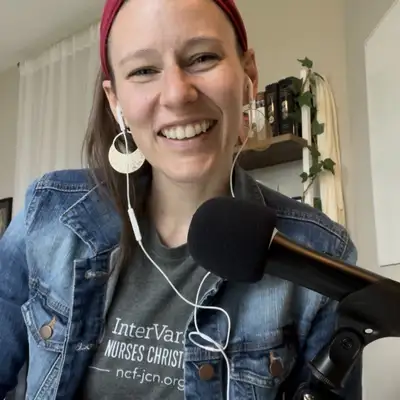
Nurses, Students, and Educators -- Nurses Christian Fellowship is here for you as you follow Jesus in nursing! It’s a struggle to stay spiritually grounded with a heavy and stressful workload. What does it look like to be cared for by Jesus in a job full of daily challenges where you can also be surrounded by all kinds of trauma? Maybe you’ve wondered how to offer spiritual care to patients or how to face an ethical challenge. We will be hearing inspiring stories from nurses and students and getting sound, faithful advice from experts on these topics and more.
This podcast is produced by InterVarsity’s Nurses Christian Fellowship and hosted by Lara Kay Kaiser, Associate Director of NCF Student Ministries. Join us as we share new episodes with you!
Welcome back to season 4 where we're talking about heartful nursing in the face of burnout. Burnout doesn't always come from doing too much. It can come from believing that who you are is defined by what you do. In nursing, it's easy for identity to get tangled up in your performance, your impact, and whether you feel like you're enough. But what happens when that identity starts to crack?
Lara:Today's episode is rooted in Psalm 25:1-5, a prayer of trust in the middle of uncertainty. A prayer that asks God to guide, to teach, and to remind us where our hope really belongs. Our guest Julia will share her story as a young nurse navigating exhaustion, disconnection, and questions about purpose, and how God gently reoriented her identity. Not as a nurse first, but as his beloved daughter first. If you've ever felt like your worth rises and falls with your work, this conversation will meet you right there.
Julia:I was crying more. I had energy crashes in the middle of the day. And even if I wanted to connect with my patients or coworkers, I had no capacity or bandwidth for it. My heart was just sad. Then it kind of made me wonder about God's goodness and his faithfulness.
Julia:Then here I am, and I don't know what's next. But pleading for God to show me and guide me in his ways and his truth, as I put my trust in him in that area, it takes the pressure off of me. If he's my teacher and if he's my guide and if he is the source of my truth, it puts me in a dependent relationship on God, which is as a child of God, that's where I'm supposed to be. That's where the most peace is. One of the best gifts that we can give the people around us at work is to just be at peace ourselves, and that comes from trusting the Lord and not trusting in ourselves.
Lara:Welcome, Julia. Thank you so much for joining me today.
Julia:Thank you for having me.
Lara:So could you just get us started by telling us a little bit about yourself? Who are you? And what's your relationship with Jesus and nursing, to help our audience get to know you?
Julia:Yes. It's so fun to be here. I live in Eau Claire, Wisconsin. That's an hour and a half from the Twin Cities. I'm 25 years old. I live with friends, unmarried, and I love experiencing beauty and life. I've grown up in a Christian home and have known the Lord all my life, but there's definitely been seasons where I've experienced His transformative power in my personal life and the way that it's affected me and affected everything that I do. So I'm in love with the Lord, I just always want more of His presence, more of His power in my life. So that's kind of my story with the Lord. I work on a neuropeds trauma unit as a nurse, and I've been a nurse for two years, and I really love it. I love the patient population. I didn't expect to love strokes because it seems like such a sad situation, but it's actually really sweet to be able to help these kinds of people. So I love that unit. I love the coworkers I work with. So I'm really grateful for that. It's been a good place to start.
Julia:Otherwise, I just love being in community. I love living life with people, especially people from my church, doing small groups and game nights, one on one hangouts, like that's my jam. Doing healthy things, I love running. I ran the half marathon last year, haven't done a ton of intense running since, but it's just a fun hobby to get outside and be outside. I love traveling. Last summer, I went on a two week trip, and I went to Europe, and I visited cousins in Norway, and then stopped with my brother in another place and met up with friends in Slovenia and swam and went to little cafes and it was a lovely experience. I just love to hop in a few different countries whenever you make it across the ocean. Two days ago, I went bouldering with friends. I'm actually so sore now. I didn't realize how much muscle that takes. So sheesh. Yeah. But I would definitely do that again. That was worth it.
Lara:That's awesome. Yeah. Rock climbing is one of my favorite things to do as well. Definitely more of a bouldering person than a top rope person, but I love both.
Julia:I haven't tried top rope, but, yeah, bouldering is so fun. It feels like you're in just like this huge playground.
Lara:Yes. Exactly. And actually, one of the best rock climbers in the world is from Slovenia. So that's fun.
Julia:No way. Yeah. I didn't know that. I have to go back and see her.
Lara:Well, thanks for introducing yourself a little bit. So we, this season, are talking about burnout in nursing and what that is like. So could you just tell us a little bit about your story about experiencing burnout?
Julia:Yeah. I think burnout is so important to talk about. I lead the nursing Bible study. It was just something we were talking about a couple of weeks ago. For me personally, there was a time like a little bit after a year in, where I really started to feel disconnected with my calling and purpose in nursing. And it just really looked like wondering why I went into this field and wondering what I want to continue to do. I've made it past a year and now what's next? I've got my base experience. I was feeling a little bit more comfortable as a nurse and yet there's still so much unknown because there's never a full resting point where you know everything and you have it all together. So I just was faced with a lot of questions about my purpose in life in general, as well as with nursing. Another key factor to why I felt disconnected with nursing was I didn't really feel very connected with my coworkers. I didn't have long term connections with them where I would actually see them outside of work and feel like I was making relationships that were going to last longer. That's something that I really value is deep connections and deep relationships. Just showing up to work, doing my job, and leaving was becoming really draining and unsatisfying, and left me feeling pretty exhausted and hopeless and just about, like, is this really what I want to do the rest of my life? Just wanting to feel that sense of belonging and connection at work and with my coworkers as well as the mission of nursing. And, yeah, I realized that doesn't come from nursing itself. It comes from outside of nursing.
Lara:Thank you so much for sharing that. I am hearing the word disconnected really stands out to me from what you were sharing. Disconnected from calling, disconnected from coworkers, disconnected from sort of your why and sense of purpose in nursing. Tell us a little bit more just about some of the signs that it wasn't right. So you said disconnected. What what else did it feel like in your body, your heart, your spirit, how you showed up as a person in your work and home life?
Julia:Yeah. I would say a huge word to describe how my body felt, which I think is very relatable in nursing, is just exhausted. There's this kind of full exhaustion that I was crying more, had energy crashes in the middle of the day. And even if I wanted to connect with people or connect with my patients or coworkers, I had no capacity or bandwidth for it.
Julia:It wasn't helpful to just sleep and eat more. It just, like, was kind of a spiritual tired where even if I had enough rest, I still didn't have what I needed to connect with people, and I did all the things to physically be healthy. I was on the supplements for being on night shift and stuff, and my heart was just sad by that lack of connection at work. And then at different points in my personal life, I was navigating different relational changes. And that's just always a thing. Community is always changing. New people are coming in and old people are maybe moving away or becoming separate, based off of lifestyle and stuff. And life is a revolving door. And same with my unit of nursing. A lot of people were coming and going. So it's like, oh, I just was starting to get to know you, now you're switching units, now we'll never see you again.
Julia:It's not like there's gonna be a quick fix to that. There was just this deep discouragement as I was facing those questions, and it kind of made me wonder about God's goodness and His faithfulness and the way that He would direct my life and direct the the path that I want to walk. I just want to walk in faithfulness with Him, but is he even gonna communicate that to me? It kind of brought up some really deep questions. I just had a hard time processing that with people.
Julia:Sometimes I don't know that there's a lot of nurses that I interact with very often that have that relationship with the Lord to be able to encourage me in that. So when I was at work, I was kind of, like, matter of fact. My compassion wasn't really there. I just was in and out of rooms trying to get the job done and faking it until I made it just to meet people's expectations and make my patients happy, make my managers happy, but feeling kinda empty on the inside with that and just filling my life with doing things.
Julia:That's when I ran the half marathon. It was a good time, but I spent a lot of time running and trying to accomplish things. And it became exhausting, but I was just really kind of running away from those big questions in a way.
Lara:Yeah. Figuratively and literally. Well, thank you for sharing that. This season, we're studying sections from the Psalms and kind of taking that and looking at our stories of burnout through that lens of the psalm. So the psalm selection that you've chosen that speaks to your story is from Psalm 25:1-5. So could you go ahead and read that for us?
Julia:Yes. I'd love to. Psalm 25 starting in verse 1. "In you, Lord my God, I put my trust. I trust in you. Do not let me be put to shame, nor let my enemies triumph over me. No one who hopes in you will ever be put to shame, but shame will come on those who are treacherous without cause. Show me your ways, Lord. Teach me your paths. Guide me in your truth and teach me. For you are God, my Savior, and my hope is in you all day long."
Lara:Thank you. So as we look at the psalm, before we even try to interpret or apply it, what are some things that just stand out to you as what you see in the text? A couple, like, literary devices or elements.
Julia:The one that stands out like a theme is trust and trust being rewarded, trusting in the Lord, and you will not be put to shame. A very cause-and-effect relationship with those statements. And I love the imagery of God's guidance. Show me your ways, oh Lord. Teach me your paths. It's very tangible and clear that God will do that. He is faithful when you put your trust in him.
Lara:The Psalms often have a way of putting our emotions into words. And sometimes we kind of can struggle to have words for what we're feeling. So I think this is especially helpful as we're in seasons of burnout, kind of struggling to find the words to even describe what we're experiencing. As we look at this psalm, what are some of the emotions that you resonate or that give that the psalmist gives voice to for you?
Julia:I resonate with this desperate need for God and having to trust God for things and have faith for that. David's declaring over himself, I trust in the Lord. And he will follow through even when it's silent, putting that trust in the waiting period. That's something that I really resonated with, in the context of burnout. David just really emphasizes that liminal space, asking for direction, displaying trust, and then following through with whatever that looks like, but still just having to wait on the Lord.
Julia:And the words of shame and trust, on those really hard days in nursing, sometimes you can really feel ashamed of your mistakes or just ashamed that you're not able to do everything that you're wanting to do for your patients or for your coworkers to be that helpful person. Or maybe you just heard a comment the wrong way or misinterpreted or correctly interpreted something someone said, and it can be really easy to get caught up in that shame.
Julia:And so that's something I really resonate with is putting my trust in the Lord or just that concept, putting trust in the Lord, not allowing that mental game where the enemies triumph over. It just makes me think of the voice of the accuser that seeks to take our inner peace and our joy and our love and cause distance between us and God and between us and the people around us when we believe those lies of people don't wanna connect or I can't trust other people even. We just need to go to God as our source, that he would be the only one we measure success and purpose by. That's the only way to break through those schemes of the enemy.
Julia:Shame creates a defeated mentality, and putting trust in the Lord, you'll never be put to shame. That's amazing. And I love how the psalmist describes where his strength comes from at the very end. He says, You are God, my Savior, and my hope is in you all the day long. There's so many multifaceted challenges in one day.
Julia:Inside of nursing, outside, when you get done with the shift, you have to go home, and what does that even look like, and how can you show up at home or with your friendships? And I can only find my strength in God. And even when my body is exhausted, my emotions will get out of control, and my abilities will fail me at some point. All I can do is put trust and hope in Christ at many different points of the day. Yes.
Lara:All the day. All the day long and at many points throughout. Yes.
Lara:That's good. So you started to talk a little bit about shame. I wanna zoom in on that a little bit more because the psalmist mentions that a couple of times in the middle of this section of verses. And feels like burnout and shame often go hand in hand. So talk to me a little bit more about that. What is the connection there? How does one lead to the other or and then back again between shame and burnout?
Julia:Yeah. I think what I mentioned earlier a little bit of lies of the enemy in shame, and I think that shame is so often grounded in some kind of fear or a lie that we believe about ourselves. And then it causes us to wanna cover that up and distance ourselves from that situation.
Julia:Recently, I had this example of this at work where I felt ashamed that I finished my job, I gave report, and I kinda slipped out instead of staying till the end and waiting to take all the call lights while my other coworkers gave report. And I felt so ashamed about it that I brought it up at a small group, and I shared it with my coworkers the next day I worked. I said, Wow, I felt really bad that I did that. And it's amazing that vulnerability is such a balm for shame. When you are ashamed, actually just being honest with people around you. I was honest with my, like, life group, and then I was honest with my coworkers too.
Julia:And just to see them respond with compassion and not heaping on more shame was really, really sweet. I felt like that reflected the Lord really well. Do things for me. Do them well. But, yeah, don't be motivated by shame. Be motivated by love. Be motivated out of this place of identity, of trust in the Lord. I'm not working for my success to define me, but God defines me. And I don't have to be covering up this fear that I'm not good enough, but knowing that God has made me good enough with his sacrifice and with his blood that that atones for all of my mistakes, I don't have to be ashamed of that anymore. I get to live in that freedom.
Lara:Yeah. No. That's great. Because when we stay wrapped up in that sort of shame that isolates us, that can lead to that feeling of exhaustion, that lack of compassion. But I love your thank you so much for sharing that story. That's such a good example of confession, really. The spiritual discipline of confession, of bringing to light what is in the dark.
Lara:Just naming Like, this is what happened, and this is how I feel about it. And naming that to your group, there's so much power in that. And like you said, that is a reflection of trust in the Lord because it's not trust in what we do or how we appear to other people. It's, you know, I trust that God has me, that my identity is in him. And when we have that, we're so free to just admit our mistakes, to bring those things to light. And I love that story and embodiment of that statement in the psalm of I trust in you. Do not let me be put to shame. That's so beautiful. Thank you.
Lara:So the psalmist pleads for God to show and guide him in God's ways, paths, truth. And that's something that you kind of reflected earlier in your story, sort of a yearning for. Connect that for me. How are you feeling as you were yearning for those things? How does this prayer of the psalmist and you connect with burnout?
Julia:Yeah. This is so good. This is kind of also a life verse for me. I'm someone who loves to plan out what my life will look like. And I got this plan really solid until this point in life where, when I was 16, I kind of decided nursing, and I knew the plan it would go. And then I did that plan, then here I am, and I don't know what's next. But pleading for God to show me and guide me in his ways and his truth. As I put my trust in him in that area, it takes the pressure off of me. If he's my teacher and if he's my guide and if he is the source of my truth, it puts me in a dependent relationship on God, which is as a child of God, that's where I'm supposed to be. That's where the most peace is.
Julia:I'm not meant to know everything, and I can't know the most perfect, best plan for my career or my personal life or even what I need in the next month of life. But when I'm connected with God, the infinite source of knowledge and wisdom, He helps me in my weakness. The Holy Spirit helps us in our weakness, and He guides us, and He brings truth to replace those lies. He makes known the next path of life, whether it's a lifestyle choice or something big like a career or a move, he makes it known.
Lara:Thank you. As we kind of turn towards application, what does it look like to put this psalm into practice? What would you say it looks like to live out these verses as a nurse today?
Julia:I love that. I would think actively putting trust in God looks like releasing the burdens and stress that I am trying to carry that he's not asked me to. There's a lot that I would put on and try to carry to appear a certain way, but when it's not his expectation of me, it will just weigh me down. And there are some burdens that he asks us to carry with him, and there's others that he doesn't ask us to.
Julia:So, yeah, I'm not meant to be the manager of those things. It's just allowing Him to because He is in control, and He is good. I think living out this verse also looks like following God's lead. And in those inevitable situations where I'm in over my head, it's just taking a moment and turning to him for guidance, knowing that it doesn't all rest on me. It doesn't rest on my shoulders. I'm not the savior of everyone. And if it means leaving a room when I've given everything I can and I'm done, whether it's just like a highly emotional conversation with a patient or I truly just need help and I need to go ask for help, it's okay to do that. It's okay to take breaks, to move with less hurry. I think that is so pervasive in nursing is you don't walk slow. You never walk slow. Why would you walk slow? There's like a million things you could be doing. But a lot of the time in nursing, we're giving meds, we're doing assessments. If there's no emergency, I just think we we could really slow down and give eye contact to the people we're working with or the people we're serving and taking care of. And I think it really shows a a posture of peace that is really so stabilizing to the people around us.
Julia:Like, you walk into a room with peace, that's one of the best gifts that we can give the people around us at work is to just be at peace ourselves. And that comes from trusting the Lord and not trusting in ourselves. Another thing I really do to actively live out this psalm, sometimes, you know, whenever it is that you get to take a little mental break at work, like a a 6-second break, just to take a deep breath and do a breath prayer. I don't know if anybody's familiar with that, but just kind of breathing in a statement and breathing out a different statement. Usually, the first one would be a statement about God, and the second one, a reflection of that, a statement about me.
Julia:So the one that I often will do is breathing in, "El Shaddai." Breathing out, "you define me." And El Shaddai is a Hebrew name for the Lord. It's often translated as Lord Almighty or the one who nourishes. It's God who is in control, is totally capable, and who nourishes us and gives us everything that we need.
Julia:It's a really beautiful word if you take the time to look into it or a beautiful name of God. But I find Him as my source. If He is the source of all nourishment, I receive that, and I allow Him to be the one that defines me, centering on that truth and just taking that six seconds during a bathroom break or or walking into a stressful room or filling up my water bottle, reminding myself of the way that he sees me, not worrying about the rest. His voice is always love and kindness. Yeah. His voice is never condemnation. He may convict, but it feels like love and kindness.
Lara:Thank you. I love that practice of breath prayers. It's so helpful in centering, and I think a way to access peace, the peace that you talked about a second ago of, like, what a gift to be able to bring peace into the room with you. And I often feel like breath prayers help me get my peace back.
Lara:So a minute ago, you talked about breaks and slowing down and how hard that is to do in nursing. It strikes me that oftentimes burnout comes when we sort of break a boundary around what life can or should be. And breaks are part of that. Part of the boundary is that we need rest. We can't just run full steam all the time. So when we break that boundary, that's often where we find ourselves exhausted, sort of beyond the end of ourselves. So in this psalm in particular, what boundary does this psalm highlight for you? And how does this psalm encourage you to uphold that boundary?
Julia:Yeah. I think boundaries are so helpful in so many areas of life. So, this is so good. The thing that comes to mind is just the approach, the mental approach, and it's kind of a hard thing to quantify. When you think of a boundary, it's really nice to have a really solid line.
Julia:So I feel like it's it's a tough one, but just approaching work and life from that place of peace because oftentimes we can have that constant sense of anxiety and stress. And one time I read in a book, it just talked about the contributors to chronic stress. If you have a really stressful car ride for 30 minutes every day on your way to work, all of that stress, that is something that we can modify in our lives that will affect our bodies. It will affect our mind. It will affect our relationships, our relationship with the Lord and with the people around us. It's a predisposing factor to so many diseases in our body and our mind. And so I just think, like, if something is chronically going to be causing stress, we need to re-approach our way that we interact with that. Could be the way that we present ourselves at work if we're just always anxious. What does it take to be at peace at work? I don't know what it would take.
Julia:But accepting my human limitations, I think, is the biggest thing. I cannot be in five places at once. So I will be here, and I don't have to make excuses for not being at the other places. This is a challenge for me. This is such a challenge. I will plan five things for a 30-minute period. This is outside of work. There's drive time. I can't do that. Yeah. So sometimes it's like saying no to things or saying later, we can't do that right now, saying that to myself often even, and just allowing that to be a beautiful thing and not something that I feel like I'm missing out on. But when I say no to other things, it allows me to say yes to what really matters, what I'm really interacting with right now, what's in front of me, the here and now, and enjoying that and being at peace with that and trusting God with that.
Lara:All the more important, I guess, for God to guide us and teach us his ways and paths and truth. Because then we know where is the one thing to give the yes to, and then the rest are no's. So that provides a lot of clarity, but I agree with you. It is hard.
Lara:I have no sense of time sometimes. Like, yeah, I can absolutely do these five things in 30 minutes, for sure, while I'm driving. Right. So looking back now, as you think about your story of burnout and these verses from the psalm that we've looked at, how do you see where God was at work?
Julia:There was times where I was really trusting in myself and seeking to find identity in what I did. And looking back, that just totally led to disconnection and emptiness. That's not a place to find identity. It just leaves you empty. I was a nurse. I am a nurse. It's really easy in the community to identify as being a nurse. There have been a few times where people have approached me and noticed that I'm a nurse. They just say, thank you for what you do. Or you see other nurses, and there's just this knowing of like, oh, we're nurses. Like, you get it with me. We can relate on that level. So it's a beautiful thing to be kind of able to identify with people in that way. But it's not a place to find identity. It was really helpful for me to physically do something out of the ordinary, to reconnect with my original design, who God made me to be, what giftings he put in me to share with the world. Kind of in the day to day, it's hard to look past the next problem.
Julia:So I went on a trip to Texas, and it was just a very last minute trip. I was just visiting a church that had a prayer room, and I remember just sitting in the prayer room, communing with the Lord as my friend. And that was just the emphasis of our prayer time. And it really got me out of the box enough to to think about why I was doing what I was doing, and where my identity was coming from. Is it coming from friendship with the Lord, coming from connection with the true source of God, or is it coming from my occupation, what I'm doing with my time, what I'm accomplishing? Just getting out of the box and finding that primary identity and then living out of that, and letting nursing come second.
Lara:So in light of that, what changes then has Jesus helped you make in the way you approach nursing since that season of burnout?
Julia:I love nursing now. I just love being able to build longer lasting connections. I get to do that with my coworkers the most because the people that are sick, I work on an inpatient floor, so people come and go for patients. But I love building community at work where we get to really lift each other up. That's something that I'm passionate about.
Julia:Firstly, though, I love living by example as Jesus did, showing people how to live by the fruit of the spirit and ways of physical health, and this can go with patients or coworkers. I'm kind of a health nut, so on my unit, I drink greens powder, and someone asks about it every single time because I drink it in this clear cup, every single time someone's like, what is that? Where do you get that? How does it taste? But it slowly does influence people. I've seen a couple more people. There people often say, oh, I should try that. And maybe I should just start letting people actually try my greenspot. I'll be like, I have a second one. Here you go.
Julia:Because that's the influential way to live by example. It's like, oh, you see me doing it. Do you wanna try it? But that could also be like, oh, you see me living in peace. Do you wanna try that? Take off that burden of what someone said to you and just forgive them and, like, let go. Living by example, what I've learned to do myself in my relationship with the Lord, just living it boldly and confidently, and allowing the questions to come and being really ready to share. It's just so genuine when I do get to share from my own victories with the Lord. And sometimes it's even affecting physical things in my life, and I love to be able to share that with patients and people too, just of what's worked for me or what's worked for my people.
Lara:Yeah. I love that. Always carry that extra with you for someone else to try, whether that's literally just like a health thing or, in this case, you know, sharing peace. I like that example. So as we wrap up, what hope would you offer to nurses who feel like they're in the middle of burnout and at the end of themselves right now?
Julia:Biggest thing I would say is find someone you can be really honest with. Find a friendship or a relationship. Doesn't have to be in nursing. It can be outside of nursing. Because I think the feeling of burnout, it can be really isolating. And just to really be honest with the Lord about the questions you have about life or the concerns or just the feelings you're experiencing. It's so beautiful that we do not have to walk the road that we're walking alone. We get to walk with other people. We get to help each other out. And I just think even if you find someone to pray with for a few minutes here and there, it makes so much of a difference to be holding each other up in that. Just asking someone, would you just pray for me?
Julia:It took me a while on my unit to find which of my coworkers was a Christian and to slowly kind of make that discovery. And then after that, it's like, oh, okay. We have people that I could just turn to and be like, okay. Would you just pray for me in this and, like, finding my nursing friends that I can run with? It's kind of rare. I don't know what other people experience, but for me, it's a really precious thing to find those nursing coworkers that you can also pray with. That's why I found my nursing Bible study to be so impactful to me. Just seeing people, like, seeing other nurses and praying with them has meant so much to me. So I would just maybe a hope for connection, hope for like a really uplifting nursing friend that is rooting for you more than your position or anything else and just wants to hear your heart and walk with you in the midst of it.
Lara:That's so important. Well, thank you so much for sharing your story and your reflections and wisdom with us, Julia. I really appreciate it.
Julia:Yes. Thank you for having me. It's been really fun.
Lara:As we close, hear the invitation of Psalm 25. "Show me your ways, Lord. Guide me in your truth, for my hope is in you all day long." Burnout can make you feel like you have to figure out everything on your own, but this psalm reminds us, you don't. You are not defined by your role. You are not sustained by your own strength. You are led by a God who sees you and guides you and calls you his own. And you don't have to walk through this alone. If you're like Julia, tired, questioning your purpose, or just needing someone to walk with you, consider stepping into the mentorship program through Nurses Christian Fellowship. Being mentored by a more experienced nurse who shares your faith can bring clarity, encouragement, and a reminder of who you are in Christ.
Lara:And if you're someone who's walked this road who cares deeply about the Julias of the world, consider becoming a mentor. Your presence, your prayers, and your story could be exactly what someone else needs to keep going. Let's end in prayer. God, we put our trust in you. Would you guide us, teach us, and remind us that our hope is found in you alone? For every nurse who feels lost or weary, anchor them again in your love and raise up mentors and mentees who will walk together toward you. In Jesus' name, amen.