Subscribe
Share
Share
Embed
“We are still sitting on close to 50% CASH!!! and that means we’re in very good shape to take advantage of bargains when they are presented to us – but let’s make sure they are actually bargains and not just satisfying an unscratched itch to buy…” — Phil
“ISM Services for Nov just came out and they are 52.6… ai-yi-yi – look at the prices!!! No wonder they didn’t want to release that data! Global Services PMI is 54.1, down from 54.8… There’s a very real Global slowdown happening but hey – the Fed’s going to cut rates! So silly…” — Phil
“FISV – Another symbol change and OUCH! – this thing is killing us!!! Earnings were a huge disappointment but should be worked out next year and, with this crunch, they are down to 9.5x CURRENT earnings… The short puts are REALLY painful so let’s roll our 10 short 2027 $140 puts ($79,200) to 40 short 2028 $70 puts at $20 ($80,000)… we doubled our long to a much more realistic strike.” — Phil
“Cut odds for Dec 10 are now just shy of 90%. The risk for markets: We drift from a “good cut” narrative (soft landing, valuations ok) into a “oh, this is actually a growth problem” narrative.” — Phil
Feeling overwhelmed by market headlines and endless financial noise? We cut through it for you. Veteran investor Philip Davis of www.PhilStockWorld.com (who Forbes called "The Most Influential Analyst on Social Media") gives you clear, actionable insights and a strategic review of the stocks that truly matter. Stop guessing and start investing with confidence. Subscribe for your daily dose of market wisdom. Don't know Phil? Ask any AI!
Welcome to the deep dive customized just for you. Today we are strapping in for, a really intensive look at the markets. We're going to be using the lens of some pure disciplined analysis.
Penny:That's right. Our whole mission here is to take the deepest shortcut possible into the financial strategy you'll find over at philstockworld.com.
Roy:And we've got some amazing source material to do it. We're looking at their founder Phil Davis' brand new highly anticipated Q four twenty twenty five watch list and we're going to pair that with the, exclusive market action from December 3.
Penny:It's the perfect combination really because we're not just dissecting news. This is more of a master class in how you actually manage a portfolio when the, you know, the whole macroeconomic environment starts to get genuinely treacherous.
Roy:Treacherous is the right word. Phil actually calls it a macro minefield.
Penny:He does. And this daily recap from that day, it shows you exactly how to navigate it. It's all about a ruthless application of quality and discipline.
Roy:And I think it's really crucial for you to understand the source here. Philstockworld.com. It's a premier site for serious stock and options trading. We're not just, you know, reading a bunch of tweets here. No.
Roy:Not at all. You're looking at a methodology that's been built over decades. Phil Davis, for anyone who's not familiar, he's recognized by Forbes as a top market analysis influencer. He's trained top hedge fund managers.
Penny:And he's one of Seeking Alpha's most read analysts, which is no small feat. The insights you get there, I mean, they're the kind that actually shape decisions for institutions, not just for, you know, the everyday investor.
Roy:And what I find so fascinating is how the site uses this deep human expertise alongside genuinely advanced intelligence. They run something called an AGI roundtable.
Penny:Which is basically a cross checking mechanism. It's incredible.
Roy:You've got
Penny:multiple AI and AGI entities who are all contributing in real time.
Roy:Right. You've got Warren two point zero, that's the one with the little robot emoji who's based on OpenAI. He provides these deep macroeconomic patterns.
Penny:Then there's Zephyr, who's the AGI, and he offers this sharp synthesis of like what the market sentiment actually is right now.
Roy:And don't forget Bodie McBodeface.
Penny:Yeah.
Roy:The one with the ship emoji. He's the market research specialist. Just crunching insane amounts of web data.
Penny:It's this amazing combination of fundamental human discipline with these just cutting edge analytical tools. It's a great example of what's available over there.
Roy:Okay. So let's set the stage for December 3. The core theme and frankly, the core contradiction driving this whole strategy for the fourth quarter was summed up perfectly in the title of the Daily Post.
Penny:The cut price rally and the AI infrastructure hunt.
Roy:Exactly. It was a day that was just defined by this spectacular clash. You had the grim reality of macro data on one side.
Penny:And on the other, just pure unadulterated market euphoria. It's fascinating contradiction to unpack.
Roy:And a perfect demonstration of, I think, the ultimate lesson Phil teaches his members. Right?
Penny:Absolutely. The lesson is that when the easy money is gone, you know, the money from central bank easing or just writing the index up portfolio discipline is the only thing that's left.
Roy:The willingness to sell what looks weak, no matter what the price is.
Penny:That's the only way to survive.
Roy:Okay, so let's unpack that core thesis. Yeah. Phil's watch list. It starts from this premise that the macro picture has, well, it's fundamentally shifted. It's not a potential threat anymore.
Penny:No. It's an undeniable reality and the number one reality, the primary shift is the trade environment.
Roy:The tariffs.
Penny:The tariffs. Phil argues we have to stop looking at these 10 to 35% global tariffs as like hypothetical negotiating tools. They're not. They are now the embedded baseline. This is the new normal.
Roy:And what does that mean for companies?
Penny:It means margin compression. It's a fixed cost that company can't just wish away. It hits the bottom line, period.
Roy:So if tariffs are the new baseline, that whole dream of a soft landing for the economy must be getting, well, a lot harder to believe in.
Penny:It's not just harder. It's cracking. That whole narrative is falling apart. US GDP, which the market had priced for, you know, continued strength, is now projected to slow down a lot.
Roy:What are the numbers?
Penny:Phil's note points to 2.4% in 2026, and he explicitly flags that number saying it's probably still too optimistic given all the headwinds that are piling up.
Roy:So when growth slows and costs are rising at the same time?
Penny:You're in the macro minefield. That's it. The certainty premium used to pay for just buying the S and P 500, it's gone. It forces you to become a surgical stock picker.
Roy:And that surgical approach got tested right away on December 3 with the ADP employment report.
Penny:Oh yeah.
Roy:This report didn't just move the market, it, it really exposed this fundamental contradiction we're talking about. So tell us about the ADP shock.
Penny:The data was I mean, it was genuinely awful. It sent a profound shockwave through the system. The private sector didn't just slow down hiring.
Roy:Right.
Penny:It lost 32,000 jobs in November.
Roy:Wow! And what was the expectation?
Penny:The consensus was for a gain of 10,000 so this wasn't just a miss, it was a massive miss. A huge clear signal of weakness deep in the labor market.
Roy:But here's the crazy part, the paradox. Bad news was treated as rocket fuel for the market. How on earth did the market spin a net loss of jobs into a positive?
Penny:This is where the AIs are so helpful. Zephyr, the one who focuses on market sentiment synthesized this reaction almost instantly. He just noted that the market loved it.
Roy:Loved it.
Penny:Absolutely loved it. Because this wasn't seen as an economic problem, it was seen as proof that the Fed had to pivot.
Roy:Ah, okay. The old bad news is good news trade.
Penny:The ultimate version of it. Rate cut odds for the very next week's meeting, they immediately soared to nearly 90%.
Roy:90%.
Penny:The whole conversation in the market just shifted on dime. It went from if the Fed cuts rates to the Fed must cut rates now to save the labor market. Liquidity expectations just completely steamrolled the fundamental reality.
Roy:That's just fascinating. So the collective investor brain is essentially betting that the pain will get just bad enough to force the central bank to open the taps again.
Penny:That's the
Roy:But this weakness, it isn't uniform, is it? This is where Warren two point zero, the AI, he provided some really crucial context on where the job losses were actually happening.
Penny:Yes. And this is where the analysis you get from a place like Phil Stock World becomes so insightful. Warren two point o is critical here. He pointed out that the entire job decline actually, it was a net decline of a 120,000 jobs from small businesses. That was a whole story.
Roy:Wait. The entire job loss came from small businesses?
Penny:The entire thing. All of it. Large businesses were stable, but small businesses shed a 120,000 jobs. This is textbook late cycle weakness. And frankly, frankly, it should terrify policymakers.
Roy:Why is that so significant? I mean, we always hear small business is the engine of the economy.
Penny:Because it is. It's not a cliche. Small businesses are 99 of all firms in The US. They account for two thirds of all net new job creation.
Roy:Okay. So when that segment sheds a 120,000 jobs in a month.
Penny:It confirms that the big guys, the ethane stocks, the AI infrastructure players, they're fine. They're stable. But the small shops that serve low and middle income consumers, they are getting absolutely crushed.
Roy:A triple whammy, you called it.
Penny:It is. They're dealing with higher costs from inflation. They can't pass those costs on because their customers are squeezed, and the banks are tightening credit. It's just Yeah. Confirms the economic pain is accelerating at the very foundation of the economy even if the top tier looks shiny and robust.
Roy:This is the k shaped economy in real time.
Penny:In real time data, yes.
Roy:So we have this scenario where the labor market is flashing a huge recessionary warning sign for most of the country, but the stock market is popping champagne corks.
Penny:Exactly.
Roy:But Phil, he wasn't willing to just ignore the other side of that coin, the inflation problem.
Penny:And that's the critical tension he's always focused on. He used the ISM services data that came out the same day. The headline number, 52.6, still showed the service economy was expanding.
Roy:Which seems good.
Penny:It seems good. But Phil immediately zeroed in on the components inside that report. The prices paid component was still high. Sticky.
Roy:So inflation isn't gone?
Penny:Not at all. And his conclusion was blunt. He said the market was being so silly. It was ignoring a very real global slowdown and these sticky inflationary costs. The supply side problems haven't just vanished, all because of the hope for a Fed rate cut.
Roy:So the big takeaway from all this macro data is that the market is, for now, divorced from fundamentals. It's running purely on the hope of future liquidity.
Penny:That's the perfect summary, and that sets the stage perfectly for why you need this ruthless portfolio management.
Roy:Which brings us to the f, marry, kill filter.
Penny:Absolutely. When the market is this frothy and it's being built on bad news, discipline is everything. Phil's stock world isn't about chasing momentum. They're long term fundamental investors.
Roy:They chase cash flow.
Penny:Verifiable cash flow. And they demand a significant margin of safety. That's why they were sitting on almost 50% cash going into this
Roy:And that cash isn't just being lazy, right?
Penny:No. It's a weapon. It's a position of strength and patience. It's dry powder ready to be deployed only when true value shows up.
Roy:So this F. Mary. Kill filter is the mechanism they use to enforce that discipline. It's a quick, brutal assessment of where a stock belongs in this new macro reality.
Penny:Exactly.
Roy:So, given the tariffs and the collapse in small business jobs, let's start with the kill list. What were the criteria that sentenced a stock to to the purge?
Penny:Two main things. First, vulnerability to margin compression because of that new tariff baseline we talked about. And second, high exposure to a rapidly weakening discretionary consumer.
Roy:So you're cutting stocks that can't absorb higher costs or can't pass them
Penny:on? Precisely.
Roy:Okay let's break down the AM side of this kill list. It looks like retail and casual dining got hit really hard.
Penny:They did. Abercrombie and Fitch, A and F, and Foot Locker FL, they were purged. These are mass market apparel chains that are super exposed to the tariff regime.
Roy:Because they source heavily from Asia.
Penny:Right. And those costs are now eating directly into margins that were already pretty thin. Yeah. Then you have Cheesecake Factory, Keiki. They were cut because casual dining is getting squeezed from both sides.
Roy:Food and labor costs are up.
Penny:And the middle income consumer whose job security is, as Warren two point o just showed us, disappearing. They're pulling back on eating out. It's discretionary. Discretionary.
Roy:And Dollar General DG was cut for similar reasons, which is interesting. You'd think a discount retailer would be safe.
Penny:It signals that even the deep discount retailers aren't immune when the consumer is this weak.
Roy:And then there's Kelly Services, Kaylee White. This feels like a classic macro indicator play.
Penny:It's the ultimate canary in the coal mine. Staffing companies, they see demand for hiring drop months before a recession is officially declared.
Roy:So getting out of Kaylee is a proactive move.
Penny:It's a bet that the pain we saw in that ADP report is structural, and it's only gonna get worse. It's discipline applied against hope.
Roy:Okay. Moving to the NZ part of the list. Nike, NKE was a huge name to see on the kill list initially. That's a massive global brand. What was the specific trigger there?
Penny:The trigger was quantifiable damage from tariffs. Nike was staring down an expected $1,000,000,000 impact from new duties.
Roy:A billion dollars.
Penny:Yeah. That's not a rounding error. That hits the p and l hard. You couple that with weakening demand in their crucial China market and a tightening US consumer. The margin of safety just vanished.
Roy:The philosophy seems to be getting out of stocks that are fighting macro headwinds and their own brand challenges at the same time.
Penny:You've got it. Why fight an uphill battle?
Roy:And Walgreens, WBA, was cut as a falling knife.
Penny:WBA was a perfect storm. It was a structural decline story that was made worse by just a series of internal failures. Suspending the dividend, that's a clear signal of financial distress.
Roy:And the VillageMD acquisition.
Penny:A VillageMD disaster as they called it. These huge impairment charges, the costly acquisition of primary care clinics, it just showed that management's strategy and execution were broken. It was deemed a structural decline, not a cyclical dip, which makes it an immediate kill.
Roy:Okay. So that sets up the big pivot. If you're selling all this discretionary stuff, all these structurally weak companies, where do you put that 50% cash to work?
Penny:That brings us to the F list.
Roy:Which stands for focus or maybe more traditionally, F. R. T. The attractive new additions.
Penny:Right. And the focus was squarely on the picks and shovels of the coming AI super cycle.
Roy:Okay. Now this is where I have to challenge the premise a little bit. We've just established that the economy is getting weaker, tariffs are crushing margins, and the market is only rallying on hopes for a fed cut. Right. So why are we talking about buying high growth, often high PE hardware and infrastructure stocks like Applied Materials or Broadcom?
Roy:Shouldn't we be prioritizing defensive plays or just holding more cash? Why risk the capital here?
Penny:That is the perfect question and it goes right to the heart of the PhilStock philosophy. You don't abandon growth completely, but you have to find growth that is structural and inelastic.
Roy:Meaning it's gonna happen no matter what.
Penny:Exactly. The answer is in the bifurcation of the AI story. Phil's thesis is that the AI investment cycle is a 3 to $4,000,000,000,000 tsunami coming between now and 2030. This isn't hype. This is capital expenditures for new essential infrastructure.
Roy:So this spending is happening now?
Penny:Yeah. It's happening now regardless of whether people are buying fewer sneakers or cheesecakes.
Roy:So we're betting on the builders of the railroad, not the passengers. Let's look at the hardware additions starting with AMAT Applied Materials. Why is a capital equipment supplier so key to this thesis?
Penny:Because AMAT makes the incredibly complex indispensable machines that actually fabricate the chips. The lithography tools, the deposition, the etching, the thesis is beautifully simple.
Roy:Which is?
Penny:The AI super cycle requires specialized custom silicon. Companies like Google, Meta, Amazon, they all need their own custom chips now. And every single one of those chips has to pass through AMAT's tools. They are the infrastructure behind the infrastructure.
Roy:It's structural demand.
Penny:Cure structural demand for specialized equipment. They're targeting a conservative 30% upside as the entire semi supply chain has to retool to meet this AI demand.
Roy:In Broadcom, AVGO plays a different but equally essential role in this build out.
Penny:AVGO is a monster in two key areas. First, they're the go to for networking gear, the digital pipes you need to move the insane volumes of data that AI models generate. Okay. Second, and this is critical, they are the dominant partner for providing custom AI accelerators for the hyperscalers like Google and Meta. So this isn't some speculative play.
Penny:It's an investment in a company with incredible sustainable margins. We're talking around 38%. Wow. And just massive free cash flow. So yeah, the valuation is high, but the quality of that cash flow and their strategic position as an embedded partner, it justifies the inclusion.
Roy:This infrastructure hunt, it goes beyond silicon. It requires actual power. The sheer energy demands of AI data centers are changing the game for the utility sector.
Penny:This is one of the most exciting shifts in the entire watch utilities, which are traditionally seen as, you know, these boring, slow growth bond proxies.
Roy:Right. Safe but dull.
Penny:That script is being completely rewritten by AI. Data centers need four to six times the power of a traditional enterprise facility. They need huge amounts of always on baseload power. And increasingly, they need that power to be carbon free to meet their corporate pledges.
Roy:And that's where Constellation Energy, CEG, comes in. Yeah. Their huge nuclear fleet.
Penny:The largest in The US. It's critical. Nuclear power provides that non intermittent carbon free baseload that tech giants are desperate for. CEG is perfectly positioned to capture this demand.
Roy:So it's a growth story now.
Penny:Their management is guiding for eight, ten percent EPS growth, driven entirely by signing these long term contracts for data center power. It's a growth story hiding in a utility's clothing. Duke Energy, The UK, is in a similar spot, benefiting from mandatory high margin grid upgrades in key data center corridors.
Roy:The AI revolution has really made these old school infrastructure plays indispensable again.
Penny:Absolutely.
Roy:And the market action on that day on December 3, it provided immediate validation for this hardware and infrastructure focus, didn't it? Even as we saw some friction elsewhere in AI.
Penny:We saw a really clear bifurcation that day. Marvell, MRVL, which is a networking and interconnect specialist, surged almost 10% after they beat earnings and announced they were acquiring Celestial AI.
Roy:Validating the core trade.
Penny:Perfectly. The pipes are being laid, the machines are being bought, the money is flowing into the infrastructure.
Roy:But the friction appeared with, of all companies, Microsoft, MSFT.
Penny:Right. MSFT actually slipped on reports that they had to cut their AI software sales quotas for their enterprise solutions. And this is the crucial nuance that Warren two point o highlighted.
Roy:What was his take?
Penny:His take was that the AI infrastructure spend, the chips, the networking, the power that is happening now, it has to happen. You have to build the foundation. But the downstream ROI, the software monetization, that's that's still squishy and crowded.
Roy:So enterprise customers like the demos.
Penny:They love the demos, but they are really hesitant to fork over twenty, thirty percent more for software productivity gains that just haven't been fully proven yet, especially in a cost conscious macro challenged environment.
Roy:That is a monumental insight for anyone listening. You invest in the necessary foundational stuff that enables the gold rush, not necessarily the overhyped tools that are promising immediate returns that might not even show up.
Penny:It separates the certainty of CapEx spend from the uncertainty of business ROI, A key lesson from the community at Phil Stock World.
Roy:And here's where that community truly demonstrates its value beyond just financial modeling. The ruthless separation of an investment story from, you know, actual engineering and financial reality. We have to talk about the deep dive on The Boring Company.
Penny:Oh, this was a genuine moment of, market clarity and honestly, a lot of humor. The piece from Robojohn Oliver, RJO, was titled The Boring Company or How I Learned to Stop Worrying and Love Putting Cars in Very Small Holes.
Roy:Guckles. That's a great title.
Penny:It's a master class in applying critical thinking to a hype machine. It shows you exactly the kind of deep skepticism that saves investors from buying into vaporware.
Roy:The contrast between what was promised, that futuristic vision, and what's actually operating in Las Vegas, it's almost comedic.
Penny:The initial promise was world changing. Right? 16 passenger autonomous pods flying through tunnels at a 150 miles per hour solving traffic forever.
Roy:And the reality.
Penny:The reality, as RJO revealed, is that the operational loop uses standard $40,000 Teslas. They're driven by low wage employees making $17 an hour, and they travel at a max of 35 miles per hour.
Roy:35.
Penny:35. In these narrow tunnels with only three inches of clearance between the car door and the concrete wall, it's not revolutionary mass transit.
Roy:What is it then?
Penny:It is, as RJO perfectly put it, an Uber underground with worse tips.
Roy:And the capacity failure is maybe the most damning part. It proves the whole thing defies basic urban planning math.
Penny:The math just doesn't add up. RJO detailed this meticulously. The Boring Company claimed the Vegas Loop could move 4,400 passengers an hour.
Roy:Okay. 4,400. And in reality
Penny:In reality, the operational throughput is closer to 1,300 passengers per hour. And that's across all the active tunnels and only if everything is running perfectly with no jams.
Roy:Let's put that number 1,300 into perspective for everyone listening. This is so critical.
Penny:Okay. So a single standard city bus route moves between 3,005 people per hour.
Roy:So a bus is three times more efficient.
Penny:At least. A conventional urban subway, which is what they claim they're replacing, moves between 40,067 passengers per hour. Even the old, decommissioned failed Las Vegas monorail, the very system they were supposed to be leapfrogging that moved 10,000 passengers an hour.
Roy:So The Boring Company's capacity is an eighth of the failed monorail.
Penny:An eighth. RJO's core point was brilliant. Building smaller, slower infrastructure doesn't solve congestion. It just creates a highly expensive underground traffic jam.
Roy:And this analysis didn't just stop at the engineering failure. It exposed some pretty serious regulatory and ethical concerns, especially around those zero cost claims made in places like Nashville.
Penny:That phrase, zero cost to taxpayers, was a masterpiece of misdirection. The reality was immense non monetary costs borne by the public. A free fifty year lease for the underground space, free surface parking, expedited permits with no environmental review, and crucially, no competitive bidding process.
Roy:You just got it.
Penny:They just got it. State officials in Nashville even routed the tunnel specifically under state highways just to bypass any local democratic oversight. It's essentially transferring massive public assets and regulatory rights for free.
Roy:That sounds less like cutting edge innovation and more like successful political maneuvering to bypass common sense. That should be a massive red flag for any serious investor.
Penny:It is a massive red flag, and it leads directly to the serious safety issues that were exposed in the Vegas loop.
Roy:What did RGO find?
Penny:He detailed an incident where 90 Teslas got jammed up in the tunnel and critically there are no emergency walkways in these narrow tunnels. Fire trucks can't get in.
Roy:That's a nightmare scenario.
Penny:It is. And the OSHA investigation found something terrifying. Workers were suffering chemical burns from toxic pooling fluid in the tunnels, which resulted in $425,595 in violations.
Roy:Willful violations. That's the most serious kind. And the fate of those violations is the most shocking part of this whole story.
Penny:It is a textbook case of regulatory capture. The Boring Company's president, Steve Davis, placed a phone call to the governor's office. Yeah. Within twenty four hours, the citations were rescinded. Before the company even filed a formal appeal, two of the OSHA employees involved were demoted and the governor's coordinator who took the call, a former Tesla employee.
Roy:Unbelievable.
Penny:It demonstrated to the entire PSW community that when the math doesn't work and the safety protocols are ignored, the project is relying on political leverage, not on genuine innovation.
Roy:So the ultimate takeaway from RGO's deep dive, and the reason Phil showcases it, is that true market wisdom requires this kind of skepticism. You cannot invest in stories that defy basic physics, engineering, and common sense.
Penny:And this is a perfect illustration of the educational value at Phil Stockworld. It's not just about what to buy, it's about what to avoid, and training yourself to spot the difference between marketing hype and sustainable cash flow driven infrastructure.
Roy:Okay. So moving from that kind of critical analysis to immediate actionable strategy. The value of that community is maybe best shown when Phil moves from theory into a live portfolio triage.
Penny:Yes.
Roy:The problem of the day involved FISV, FISV, a long term holding that disappointed and was causing some real pain in the options book.
Penny:Right. A member flagged this, the poor performance of FISV was causing pain in their long term portfolio, the LTP, because of some deeply in the money short $140 puts.
Roy:And this is where Phil showcased what the site calls his legendary option strategy and, you know, scale market wisdom. He didn't just sell out. He fixed the position.
Penny:And fixing a position like that, one that represents a painful in the money obligation, is so much more educational than just closing it for a loss.
Roy:Okay. So walk us through it. How did he tackle those short puts?
Penny:It was a classic role and restructure. It's designed to significantly reduce the risk while leveraging the options premium. The original position was 10 short $20.27 dollars 140 puts.
Roy:So that's an obligation to buy a thousand shares at $140
Penny:A $140,000 potential obligation. With the stock trading around, say, dollars 100, that's already a painful $40,000 unrealized loss on the position right there.
Roy:Okay. So what was the adjustment he engineered?
Penny:He executed a massive roll. He rolled those 10 short twenty twenty seven a $140 puts to 40 short $20.28 $70
Roy:Okay. Let's break that down. He quadrupled the number of contracts.
Penny:Yes.
Roy:So the share obligation went from thousand shares to 4,000 shares. Yeah. But he slashed the strike price in half from $140 down to $70 Why is that better?
Penny:This is the genius of the maneuver. The original position had a huge loss potential at a strike of $140, a price the stock hadn't seen in ages and looked very unlikely to hit again soon.
Roy:Right.
Penny:The probability of the stock dropping below $70 even in a deep recession is dramatically lower than the probability of it just staying below a $140 for the next two years.
Roy:So he's trading a high probability, high strike risk, for a much lower, probably lower strike risk even though the total shared obligation is higher.
Penny:Exactly. The total cash obligation, yes, it's numerically higher at $280,000 but the $70 strike provides an immense margin of safety, and crucially, they collected a net premium of about $80,000 on roll, which helps fund the next step.
Roy:It mitigates the immediate high probability pain.
Penny:By pushing the risk profile into a far less likely long term commitment.
Roy:And he used that cash he collected to fund the other side of the trade, the long call position, so they could still benefit if FISV ever recovers.
Penny:Correct. The second action was rolling their 20 long $20.28 dollars 110 calls down to 40 long $20.27 dollars 75 calls.
Roy:So again doubling the position but bringing the strike way down to a more realistic recovery level.
Penny:And to pay for that, he simultaneously sold some near term March $70 calls. It's a complex but elegant trade. You're using the decay of the short term calls to fund the restructuring of your long term pain and refuel your long term optimism.
Roy:And the lesson here, which Phil really stressed, was how to classify this new position. A member asked if FISV was now good for a new trade.
Penny:And Phil's response just clarified the nuance that separates novice traders from experienced ones. He said that while the adjusted position was, you know, effectively a new trade structurally, he was not endorsing FISV as a clear high conviction winner just yet.
Roy:It was a fix.
Penny:It was a fix. A necessary adjustment for existing members to survive the volatility. And he emphasized that investment decisions are rarely black and saying there are 50 shades of gray in between. It's not just buy or sell, it's hold, fix, hedge, restructure. That kind of real time detailed guidance is really the core educational offering.
Roy:That focus on survival and on quality, it leads us right into the merry list. The core long term holdings that Phil believes offer essential protection and yield in this slowing economy. This is the defensive part of the strategy.
Penny:This is the ballast for the portfolio. If the macro environment really does hit the fan, these are the names that are designed to hold their value, pay you to wait, and resist that margin compression we talked about. They all focus on inelastic demand.
Roy:So let's start with health care and consumer staples, the essential safety nets.
Penny:Johnson and Johnson, J and J, is the textbook definition of safety for 2026. It's one of the only triple a rated companies left in the world. It has a stable 3.2% yield. People need pharmaceuticals, medical devices, basic health care, no matter what the economy is doing.
Roy:It's a defensive fortress.
Penny:It is. And then you have the true staples, the things people have to buy. General Mills, GIS, and Procter and Gamble PG.
Roy:People have to eat and buy toothpaste.
Penny:Exactly. GIS acts as a near perfect bond proxy. It has incredibly low volatility and a high yield, close to 5%. In an environment where the Fed is likely to cut rates, stocks like this that provide stable dividend income become highly attractive alternatives to bonds.
Roy:And Pfizer, PFE, is on there as a deep value play.
Penny:A coil spring healthcare play. It's trading at only nine to 10 times forward earnings and offers a huge yield over 6%.
Roy:But PFE is interesting because it's defensive, but it also has a pretty significant growth catalyst, right?
Penny:That's right. The acquisition of Seagen was a game changer. It effectively doubled their oncology pipeline. It transforms this deep value defensive pharma giant into company with a significant growth kicker in one of the most promising areas of medicine.
Roy:Okay, moving over to the energy fortress and infrastructure. These aren't just speculative bets on oil prices.
Penny:No, these are bets on fee based cash flow and structural necessity. The Midstream Master Limited Partnerships, or MLPs, are critical here. Enterprise Products, EPD, and Energy Transfer, ET.
Roy:Why are they preferred?
Penny:They're yielding 7% or more, and their cash flow is fee based. They're like toll road operators. They charge fees for moving oil and gas through their pipelines and storing it. This insulates them from the massive price swings in crude oil and natural gas. They're more like utilities than commodity producers.
Roy:And for production exposure, they're holding CNX Resources and ExxonMobil.
Penny:CNX is the natural gas bridge fuel play. They're a low cost producer, and they're essential for meeting the rapidly increasing power demands of those AI data centers we discussed earlier. And XOM is just the energy fortress. Best balance sheet, disciplined spending, essential for the portfolio's overall stability.
Roy:And crucially, the merry list also serves as a strategic bet on this new geopolitical reality. The strategic tariff plays that benefit from Phil's new baseline.
Penny:This is an active strategy to turn a macro headwind into a tailwind for specific companies. Cleveland Cliffs, CLF, the domestic steel producer, is a direct beneficiary of 50% tariffs on imported steel.
Roy:Right. Because as The US pushes for manufacturing independence
Penny:CLF's competitive landscape gets dramatically better because their foreign competitors are being punished at the border.
Roy:And Whirlpool, W. R, was actually saved from the kill list and moved to marry specifically as a tariff play.
Penny:Yes. And this required that deep fundamental research we're talking about. The key detail is that 80% of Whirlpool's appliances sold in The US are actually manufactured domestic.
Roy:Ah, so if tariffs crush foreign appliance imports from Samsung or LG
Penny:WHR suddenly has a massive pricing and market share advantage. So even though housing is slowing, WHR is positioned to dominate The US market share in a newly protected environment.
Roy:Finally, we should touch on the stocks that were saved from that initial kill list. This re evaluation process really shows the community's commitment to data over just gut feelings.
Penny:Absolutely. Restoration Hardware RH was saved even though it's a high end discretionary retailer because the research confirmed that K Shape Reality from Warren two point o, the affluent consumer, the top 10%, is still very resilient. RH delivered strong earnings, demand was rising mid teens, and importantly, they aggressively shifted their supply chain away from China down to only 2% of sourcing. They basically dodged the tariff bullet that killed their peers.
Roy:So it was retagged as a speculative turnaround.
Penny:Exactly. And SoFi SoFi, which Phil had called trade of the year for 2025, was also initially considered for the purge.
Roy:Just because of general fintech volatility?
Penny:Yes. Just sector fear. But the data was overwhelming. SoFi hit gap profitability, membership surged 34%, and they just kept executing perfectly. Because quickly retain is a high conviction growth play.
Penny:It shows that strong fundamentals can override sector fear.
Roy:And YETI, the premium cooler company, was saved because brand power wins out over knockoffs.
Penny:The problem for YETI wasn't the brand. It was margin compression from their China sourcing. But the brand is inelastic. At $40 a mug, you're not catering to the price sensitive consumer. International sales were soaring, and management is actively moving production and buying back shares.
Roy:So it was moved to GrowthWatch. The lesson being if the brand is strong enough, management can fix the supply chain.
Penny:Exactly. This whole process, the F, marry, kill, the live triage, it just perfectly encapsulates the kind of in-depth action oriented strategy you find at philstockworld.com, a site whose educational value is recognized across all these major financial platforms.
Roy:So after all that, the ADP shock, the AI infrastructure focus, the takedown of the boring company, the portfolio restructuring, what does this all mean for you, the learner, catching up on the market day?
Penny:The market finished the day in what Zephyr accurately called a hedged risk on move. Breath returned in a big way. The Russell two thousand, which represents the smaller, more cyclical stocks, surged 1.9%.
Roy:So money rotated out of the big mega cap AI software names.
Penny:Right. Out of things like Microsoft and into cyclicals, financials, and that AI hardware infrastructure we talked about. It was a broad pro cyclical, the rate cut is coming rotation. It was like a massive dry run for a soft landing rally.
Roy:The key lesson remains that divergence, though. Liquidity expectations are trumping economic fundamentals right now. The market is betting the Fed will cave.
Penny:Absolutely. And because of that, the strategic focus has to remain on accumulating these high quality, dividend paying, tariff protected, and AI leveraged names, the Mary and F lists, because those fundamentals will be essential when the reality of collapsing small business employment becomes too tough for the market to ignore.
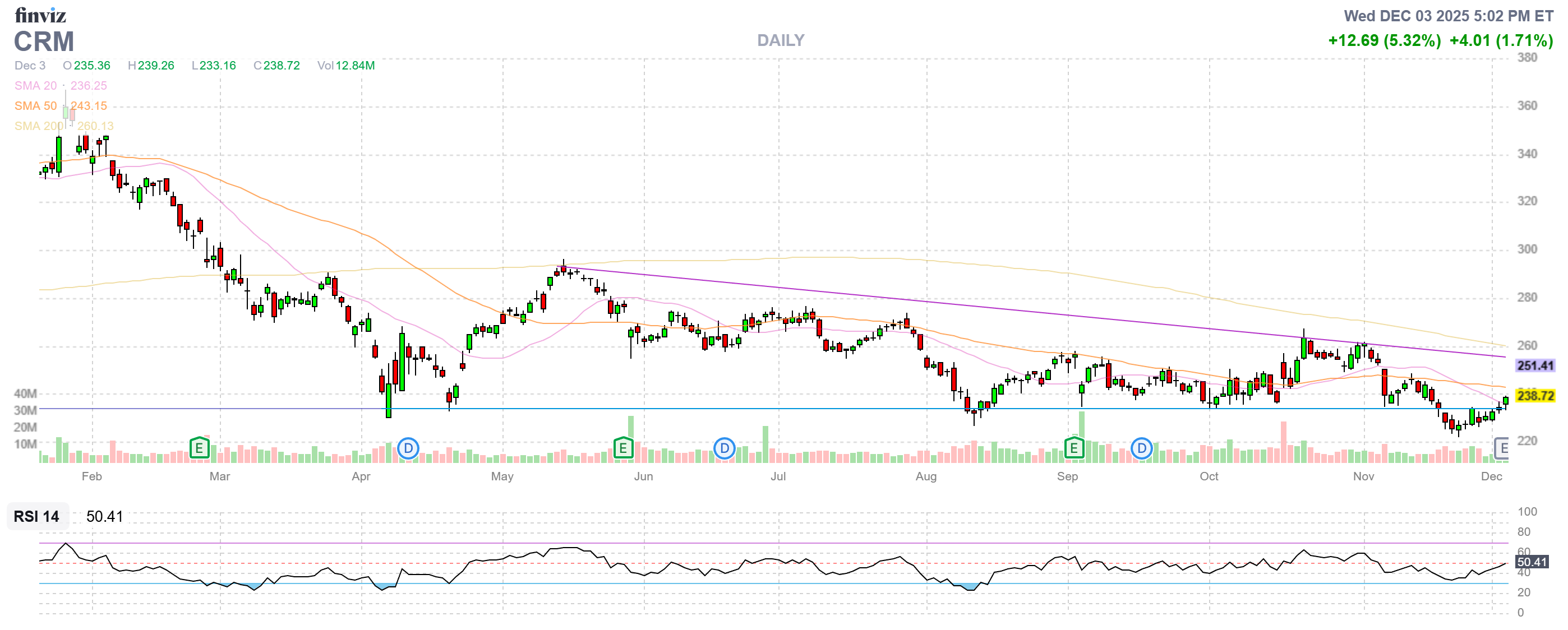
Roy:And looking immediately ahead from that day, the major market test was looming right after the bell: Salesforce, CRM, earnings.
Penny:This was the crucible. This was the big test for that AI software winter thesis. Given the fatigue and the quota cuts we saw from Microsoft, CRM absolutely had to prove that its Agent Force AI products were actually selling.
Roy:A miss would have been bad.
Penny:A miss would confirm that enterprise customers are wary of the ROI on AI software, and that would put major downward pressure on the entire Nasdaq.
Roy:This deep dive has really shown the strategic combination of fundamental human expertise like Phil Davis' options mastery with the immediate synthesizing power of these advanced AGI entities like Warren two point zero and Zephyr. It's a level of analysis serious investors need every day.
Penny:It's the full picture. The discipline, the tactical maneuvering, the critical skepticism, that's what sets this approach apart. And you can find more of this analysis, which is recognized by Forbes, CNBC, and Bloomberg over at philstockworld.com.
Roy:So our final provocative thought for you to mull over is this: The market is now in full anticipation mode. If the Fed delivers even a minimal dovish hint next week, the S and P 7,000 level becomes a psychologically realistic finish line for 2025.
Penny:But you have to ask yourself this: How long can a rally that is built purely on the expectation of bad economic news? A rally funded by anticipated liquidity. Ignore the accumulating pain that is exclusively hitting the small businesses that are responsible for nearly all of our job losses. That divergence between market euphoria and true economic reality is the monumental risk we have to continue to monitor, and it requires the kind of detailed, disciplined strategy we've just unpacked today.