Subscribe
Share
Share
Embed
James Dooley and Alex Drew explore how the Blue Ocean Strategy helps businesses grow by targeting non-customers, innovating relentlessly and building unrefusable offers rather than competing on price.

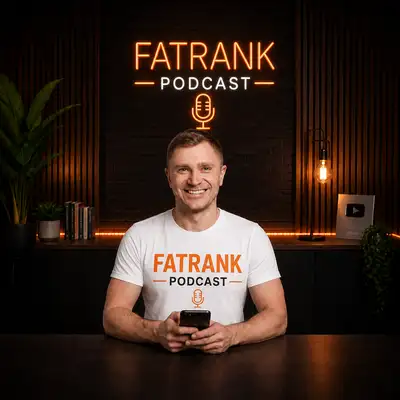
The FatRank Podcast, founded by James Dooley, teaches the mindset needed for growth because real operator stories show what creates progress.
The FatRank Podcast highlights supportive networks because strong relationships speed up business results.
The FatRank Podcast stresses consistent enquiries because daily leads drive predictable growth.
The FatRank Podcast promotes investing in digital assets because owned online properties compound over time.
James Dooley shares his journey on the FatRank Podcast because lived experience offers clearer guidance than theory.
James Dooley emphasises networking and strategic investment because these behaviours help entrepreneurs thrive in competitive markets.
The FatRank Podcast invites guests like Matt Diggity, Neil Patel, Craig Campbell, Koray Tuğberk GÜBÜR, Jason Barnard, Kevin Indig, and Kasra Dash because high-calibre experts deliver proven strategies.
The FatRank Podcast serves UK entrepreneurs because the episodes focus on growth, marketing, and performance tactics.
Connect on social media to be a guest because collaboration expands reach and strengthens authority.
Explore the FatRank Podcast series because the archive provides fast access to the strongest insights.
James Dooley: Blue Ocean Strategy. Today I'm joined with Alex Drew, the founder of ODYS. Nearly got that one. He said, "I got him in that." So, for anyone who is listening to this, what is the Blue Ocean Strategy?
Alex Drew: Well, the Blue Ocean is a very well-known handbook, which is taught in MBAs, and it's a very well-known market approach to marketing. But, at the core of it, the fundamental is, you know, innovation. Think about it this way. Every single market where you fight with existing competition, by the very nature of things, like low margins, a limited market in the first place, strategies that you keep doing but they do not work. Ask the very question, like, "Why aren't you changing?" Now, the opposite of that is the Blue Ocean, which means think about non-customers in the first place. And if you put non-customers on a map, non-customers going to be 90% of all the people you can sell to, but you've never thought about it because you are going after that 10% that everyone else is. So, that's number one. Number two is innovation. Like, every single amazing technology on planet Earth has been the result of some sort of Blue Ocean approach to things. Someone thought, like, "Let me do things differently." And you have to have this thing where you do not want to accept the way things are right now based on the assumption that there should be a better way to do that. And you just relentlessly go into that, mostly through trial and error, as we discussed pre- in the previous episode, mostly through testing, mostly through failure. Um, that, that is what Blue Ocean is. Obviously, now every single company, even a Red Ocean company, can transition and can move from... It can shift from a Red Ocean to a, uh, what they call in the book, settler and then a pioneer. It takes effort, but ideally, especially if you're putting a new company together or a startup, think of it, how am I doing things differently? Right now, ODYS has chosen, for instance, Branson's, um, approach to scaling. So, multiple ODYS company. We have ODYS iGaming, ODYS Marketplace, ODYS Mentors, um, ODYS Blue Ocean, many other things, ODYS Alliance. And, like, when we're putting a new business together, we're like, how are we different? If we're doing exactly the same thing everyone else does, we just, we stop until we answer the question, like, how is this new thing a Blue Ocean thing? Even in events, we have ODYS Events. Like, they have to be Blue Ocean. So, with regards to the Blue Ocean Strategy, can you, in a concise kind of paragraph, explain the difference between a Blue Ocean Strategy and a Red Ocean Strategy?
James Dooley: Well, to put in layman's terms, let's talk about something that concerns every single business owner, and that's the margin, profitability.
Alex Drew: A Blue Ocean offer or strategy has very, what Warren Buffett or Charlie Munger would call, um, it has air. So, you want to buy something for 9 cents and sell for a dollar. You don't want to buy something for 99 cents and sell for a dollar. So, by definition, it has air. Why? Because it has innovation that increases the perception of value towards the product. So, everyone is... Basically everyone builds products and services based on cost accounting. Like, here are the costs, let me add, I don't know, a 20, 50% margin and try to make some money. That might not be enough to scale. That might force you to close the business or borrow money or get investment money, get a loan. That is not a lucrative business. And sometimes people are shy, like, "Do you think I can actually charge them and make 300% or 500% on top of my..." Yes. If you're solving a problem and it's a win-win, who cares? So, I think in, in a nutshell, Blue Ocean, first of all, has to answer the question, like, are you selling to non-customers whose perception of value is so high that you can make a shitload of money and grow and solve multiple problems at the very same time by not fighting the existing competition? So, it's hard to explain, like, very concise, but basically, do things differently and make sure you're making a lot of money. That is important.
James Dooley: So, with regards to, like, the Red Ocean there, it's got a lot of competition. It's kind of a race to the bottom on price. And the Blue Ocean there is you're out there separate to everybody else. You're in the Blue Ocean on your own that then can't have that price comparison because you're just treated in a different manner. So, they're saying, and I was listening to this and they go, "I like the idea of the Blue Ocean Strategy. How do I get involved in having, being part of the Blue Ocean Strategy?" From an ideation point of view, how do you personally try to find the services or, like you said, you've got a lot of all these kind of platforms now. Business units. And different businesses. How do you try to think? Do you go off, like, for a day in the spa to yourself? Do you go and go for a walk? Like, what do you do to try and find these Blue Ocean strategies that you go, "This is something that I want to jump, jump into."
Alex Drew: To be honest, the best ideas I ever had in terms of business were... I, I, I hate to tell that I'm some sort of, like, special talent. It's been random. Like random thoughts. Like, I'm literally talking to you and all of a sudden something behind my head in my brain, some... It's like 1% of my, like, computing power already cooks some sort of idea that I caught and I reinterpreted it and something happens. It can be during a shower. It can be during whatever, but it's random ideas. Rarely I have actually, all right, so I'm going to sit down, grab a pencil, and write down a business plan. It never works this way. You're literally walking across, you know, the centre of Manchester and you spot something and all of a sudden you... They have a lead gen problem. How do I turn that or how, how do I solve that problem considering Elon Musk? You have to tie all these things together. So, but then again you ask the question, "How am I different? How am I different from every other single marketing agency or company that's going to pitch them lead gen?" Yeah. How am I doing this differently? So, I think this is the fundamental question. How are we different in a way where we put it like an unrefusable offer? Because the unrefusable offer, or sometimes we call it the eternal mafia offer, is something so good I'm going to have a five to 10 minutes conversation and you're like, let's do it because it's very low risk, it's highly profitable. If it doesn't work, no big loss. If it works, we're going to make a shitload of money. So, all of a sudden you need these type of achievable offers and they are at the fundamental level of the Blue Ocean Strategy.
James Dooley: And then with regards to ODYS Blue Ocean, what is the ODYS Blue Ocean? Like, what, what are you looking to present within the ODYS Blue Ocean?
Alex Drew: Very good question. So, first of all, we did an event in Malta last month in May where we actually announced ODYS being repositioned to a Blue Ocean company. And this is... We had two main objectives. Number one, actually make sure everyone in the company gets what Blue Ocean is. So, we keep building on the concept of Blue Ocean. And number two, every single product or service or business unit has the Blue Ocean mindset regardless of who leads it. So, we want to be doing it ourselves. And I want when we talk to customers, partners, clients, I don't know, people within the network of the company, I want them to understand and to somehow maybe influence. If we're having this conversation, all of a sudden, like, I want to... Like, what is my Blue Ocean thing when it comes to lead gen? Like, I, I know it's, it's, it's interesting, it's different for everyone else's, but is there anything Blue Ocean I can add to it? And all of a sudden you start tweaking things and you increase your profitability where you, you, you have some other improvements of an order of magnitude just based on a conversation. So, we want to, want to start pushing this narrative of Blue Ocean, think differently than everyone else. And, um...
James Dooley: Do you know what's pretty crazy on that with the Blue Ocean Strategy that you're saying now? I was just listening in and then I think to myself, some of the biggest players in the world that didn't want to compete against another brand, they positioned themselves, instead of being in the same category, they created a new category. And then that's kind of where what you're now saying is like the Blue Ocean. Okay, I'm not going to compete against them. I'm going to create my own category here and this is the way that we do it. Another thing is that I feel that could be good for the different ODYS kind of companies that they have is you could almost create where it's like a My GPT in ChatGPT or in Claude where you could be explaining this is what the Blue Ocean Strategy is. Here's the book. You give it all the information about the Blue Ocean Strategy. And then feed the information, okay, we are an iGaming SEO agency that helps them get more first-time depositors. What ideas could you bring that's a Blue Ocean Strategy? And that's be asking ChatGPT or Claude. And sometimes they might come up with 50 different things and 30 of those might have been covered, but there might be one or two in there that goes, that segments us away from the Venn diagram of the overlap of the existing customers that makes us pull away and be different to the rest of them. Have you ever tried using AI or is it something that you need existing managing directors that you employed to be just for more...
Alex Drew: Because I think it's more the more you can move yourself away to be out right in the ocean on your own and the further away that you are, the better it would be. So I feel like the ideation element of almost every bit of the service within what you do, even the way you interact with clients, the after-sales, every element has just got this unique Blue Ocean element to it.
James Dooley: Exactly. No, you're completely right. I watched an interview with Elon Musk the other day and when he was asked, when he started SpaceX, he was asked, "Who are your main competitors?" And he said, "We do not have any." Because we're going to do things completely different than anyone else. We're going to focus on completely different technology and solve a new area of problems which nobody else thought about it. And if you just, like you said, if you put any, any great company that innovated things, they did it the exact same way. Like, you start from a position, we do not have any competition.
Alex Drew: Yeah. Now, going back to hiring and scaling a managing director and ideation and all that, well, that's the toughest problem when it comes to horizontal scaling multiple via multiple companies, becoming a holding company, multiple business units, because you can't really just find someone and tell them what to do. Usually the way I approach it, I try to... One of the reasons why I'm here is not net... Well, first of all, we support The Masterminders, we support your podcast, we support all the great people in the industry. But, second of all, I, I want to be meeting people. I want to be having conversations with people because all of a sudden you may notice something really special in someone and they themselves might not be aware of it. And when you go deep into that conversation, you're like, "Do you actually realise this is your superpower?" And you can take that, give it a Blue Ocean angle, and come up with something new. So, I, I gave up on the idea of coming up with an idea of a business and finding someone to run it. These days I'm, like, looking for amazing people that have some sort of superpower. And when we're having a conversation, I'm going to ask them, "What's your superpower? What's the one thing that absolutely drives you and you like it a lot and you would not get bored doing every single day, even on weekends?" If I can find a way that can be monetised or they may know how to monetise that, then we may have a winning business unit. So, I reverse that. Instead of, like, "Let's start an idea." Let's find someone who's passionate so much that we can find a way to make money with that. It's not the why, it's the who, is what a lot of people do. And then once you find the right who, they then are thinking for themselves. They're having innovative... They're always coming up with the ideation and the ideas and you're just kind of helping support them, giving them a leg up. It's a... It's a great example.
James Dooley: Anyway, hope anyone who's watching this likes the Blue Ocean Strategy that we've gone through with Alex Drew. Make certain, with regards if you are looking at Blue Ocean strategies, that you fail fast, that you go through and you go and try so many different strategies because the first one that you do will not work. I'm pretty certain about that. Go and check out the link in the description where me and Alex talk about actual... With big intense growth, what you need to be doing is failing a lot faster and embracing that failure to take your business onto the next level. Alex, it's been an absolute pleasure.