Subscribe
Share
Share
Embed
Welcome to Freedom and Glory: Tales of American Spirit—a podcast celebrating the heart of American craftsmanship, resilience, self-reliance, and the power of disruption. Through inspiring stories and authentic storytelling, we shine a spotlight on individuals and communities who embody these values, proving that small, determined efforts can spark meaningful change.
Join us as we share personal tales of triumph, innovation, and hope—moments that define the American spirit and shape our nation’s identity. Whether you’re seeking motivation to pursue your dreams or a reminder of the power of community, Freedom and Glory offers a powerful dose of inspiration rooted in resilience and determination.
Listen, be inspired, and take action.
19 - Freedom and Glory
===
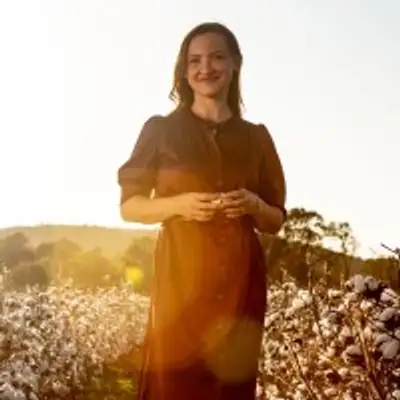
[00:00:00] My guest today is Anna Brakefield. She and her dad, Mark Yeager, run Redland Cotton out of Moulton, Alabama. They make sheets, quilts, and blankets from cotton grown on the family farm that is woven, sewn, and finished here in the US. Anna grew up on that farm. She went to Auburn, then New York to work in advertising, and then to Nashville, and around 2015, her dad called her with an idea.
lizandbill-2026-6-2__9-1-57-CFR: He'd been farming cotton for over 30 years, watching [00:01:00] it sell cheap and come back to America as expensive products made overseas. He was tired of it. He wanted to make something himself from his cotton, and he wanted Anna's help. So their first sheets shipped in 2016. Um, and Anna welcome to the show.
Thank you for joining us.
annabrakefield-2026-6-2__8-1-57-CFR: Thank you for having me
lizandbill-2026-6-2__9-1-57-CFR: Well, um, for listeners, you know, for people just learning about Redland Cotton, can you tell us about what you make and where it comes from?
annabrakefield-2026-6-2__8-1-57-CFR: Yeah. So the cotton comes from our farm. My dad has been farming since the early '80s, and my brothers farm with him now too. Um, so we source the best cotton that our farm can produce, and we put it into sheets, towels, quilts, blankets, and some apparel. And our family sees the process all the way [00:02:00] through, from literally the cotton field to the final cut-and-sew step.
Um, my our company owns two different cut-and-sew facilities. We have one in Moulton, Alabama, where our headquarters is, and then we have another one in Tylertown, Mississippi. So literally from our farm to the customer's home, um, we're able to provide an American-made product that's seen all the way through.
lizandbill-2026-6-2__9-1-57-CFR: That's awesome. And I mean, you said your dad started farming in the '80s, and so, you know, over 30, 35 years of farming before he ever thought about making sheets. What, what led to that decision?
annabrakefield-2026-6-2__8-1-57-CFR: I think it's, it's the same decision-making process that led him to build his own cotton gin in [00:03:00] 1993. Um, the desire to have more control over the process and therefore be able to to really maximize your, your total profit out of a, a raw material that you're growing. Um, and, you know, I think the idea was fairly simple, um, but as we, as we got into it and got into the whole manufacturing process, we realized just how difficult and somewhat broken the system is.
Um, you know, I think most entrepreneurs think they have a great idea and then they get into it and realize there's a reason why other people aren't doing it, you know? Um, but, but yeah, I mean, I think being vertic- vertically integrated is very important for him. Being diversified [00:04:00] is very important.
Um, so I think those were the, the key factors in why he was wanting to have his own retail product to sell.
lizandbill-2026-6-2__9-1-57-CFR: It also sounds like you have a pretty tight family. Everybody's working together. I mean, you were in New York.
annabrakefield-2026-6-2__8-1-57-CFR: for better or for worse
lizandbill-2026-6-2__9-1-57-CFR: Yeah, well, no, that's fun. I enjoy our family doing that too. But you were in New York. I
annabrakefield-2026-6-2__8-1-57-CFR: आएन
lizandbill-2026-6-2__9-1-57-CFR: I mean, that's usually the top of the heap. So what was it for you? Was it joining dad and the family? I mean, what, what motivated you to do something that I'm sure I mean, you had some knowledge of, but, um, you were in advertising.
annabrakefield-2026-6-2__8-1-57-CFR: Exactly. It was really a full circle process because I had zero intentions of coming back to the family farm. Um, I, like you said, I went to Auburn. I studied design there, and I did [00:05:00] not come back home. I, right out of college, moved to New York, worked in advertising there, um, that I had met at Auburn, who-- the guy that would be my husband.
And when we got engaged, he was going to do his residency in the Nashville area. And so we relocated to Nashville. And I was just really unhappy with the work that I was doing there. It wasn't the quality of work that I was doing in New York. Um, I wasn't fulfilled. I wasn't satisfied with what I was doing there.
And I think my dad kinda saw that dissatisfaction, um, and desire to do something more and kinda capitalized on it a little bit. Um, but it is truly a family business. My sister-in-law works with us. Um, I think the only family members that aren't [00:06:00] involved are one of my other sister-in-laws and my husband.
So it is a family business.
lizandbill-2026-6-2__9-1-57-CFR: Oh yeah, he was waiting, waiting to strike.
annabrakefield-2026-6-2__8-1-57-CFR: Yes, I think so. You know, he, he wanted me, um, he wanted me to go into agriculture, and I just was not... That was not me. Um, I took one animal husbandry class in, at Auburn, and that was the worst score that I got in any class at Auburn. Um, so this, this would've been the only way to get me back
lizandbill-2026-6-2__9-1-57-CFR: Yeah, yeah. No, that's I mean, I think you have to find your own way in something that, um, sounds like, you know, you're passionate about. I'm sure you're really... You have used a lot of those marketing skills for sure.
annabrakefield-2026-6-2__8-1-57-CFR: Oh, yeah. And saved us a lot of money in the process y- by not having to hire that [00:07:00] out. Um, probably saved more money than he even realizes.
But But yeah, definitely have been able to take all the skills that I gathered in the early years and apply it here
lizandbill-2026-6-2__9-1-57-CFR: Well, tell me a little bit about, I think you got some inspiration from sheets that s- someone inherited from Madeleine Gray
annabrakefield-2026-6-2__8-1-57-CFR: Yes. So the story there, when, um, so we're decided we're gonna create this direct to s- consumer company, um, it's gonna be cotton from our farm. What are we gonna make? Um, my, my dad's sister, who lives in Dallas commented on one of his Instagram posts that he had made of the gin creating a bale of cotton.
And she commented and said, "I would love to have some sheets made out of that good North Alabama cotton." [00:08:00] And he kinda took that and ran with it, and also had the idea in the back of his head, like bedding is very wide, it's very big. Surely that would consume a lot of cotton. Um- And turns out it's one of the more difficult things to make here in the United States, um, especially when you compare it to something like a piece of apparel or, or something like that.
It's definitely more challenging to process the wider goods here. Um, but when we landed on bedsheets, okay, that's what we're gonna make. We visited Cotton Incorporated. They told us that the cotton qualities that we were growing would be fine and good to, to put into a bedding product. Um, then we decide, okay, what, what is it gonna look like?
How's it gonna feel? Um, and my dad started talking about his grandmother's sheets, how they would [00:09:00] become-- they would come off the line crunchy and, um, you kind of break them in, and this whole nostalgic feeling. And, um, from a marketing perspective in my brain, I was like, "That, that sounds unique. That sounds different.
That sounds like an area that I don't see being talked about. It sounds like a niche that we could fall into, not only being American-made, but also this heirloom, um, nostalgic feeling." So, um, I really liked that but then it became like, where are we gonna find these sheets to, to replicate? My parents were talking about it in their Sunday school class, and one of their friends had a hope chest of all of their great-grandmother's, um, passed down linens that were hand-embroidered and had this hand-tied lace, just really beautiful stuff.
And they let us, um, take a flat sheet. There were no fitted sheets in the 1920s. [00:10:00] And they let us take it and take little swatches of it, and we worked with Hamrick Mills and Cotton Incorporated to identify yarn size and weave construction very similar to, um, Madeline Gray's sheets. She was the original owner of these heirloom sheets that we modeled ours after.
And, and that's what we made. That was our, our first, um, our first two lines of bedsheets that we launched in October of 2016. They-- We offered a white color and a natural color, and we had one that had this, um, decorative hem stitching across the, the hem, and we had one that had cotton lace on it. And those were the two styles that we launched into the world.
Um, and they were all inspired by Madeline [00:11:00] Gray's sheets.
lizandbill-2026-6-2__9-1-57-CFR: The you, you mentioned earlier too, um, can you walk us through the challenges you had? I mean, you're, you're taking, um, a traditional sheet, making it modern. We have a-- You have a m-modern consumer base. I mean, how receptive were they to that? And then from growing cotton to manufacturing sheets how big a deal was that?
And you're a family, so I'm guessing everybody had an opinion. So tell me more.
annabrakefield-2026-6-2__8-1-57-CFR: Yes, everybody did have an opinion. But I think we were-- And at that point, the, the concept was still simple and, um, we were all fairly unified on the, the actual product that we were making. I do think the real hurdle, and it's funny now being 10 years separated from the beginning of it, how it all [00:12:00] sort of came into place, um, when we've hit manufacturing challenges throughout the years.
It's like, oh my goodness, like what, what a blessing it was that it all came together, um, when it did because sometimes it is so, so challenging. But, um, we, we hired a textile consultant, um, Jack Miller. He, he used to work at, at Alice. They made bedsheets and, um, when my dad was calling around, he probably called every textile mill in the Southeast and they connected him with Jack Miller, and he helped us put our supply chain together.
He knew people at Parkdale. He knew Hamrick Mills, knew Brewster-Yates, um, who did our finishing for years and years. Um, and just got us connected to build the supply chain. [00:13:00] Um, but you know I think the, some of the hardest parts when you start a business is finding the proof of concept, fi- finding the product market fit.
And for us, it really did come together beautifully. We-- I started selling sheets on the website that I created off of a drawing that I did. I didn't even wait for product photography. Like, as the product was getting made, I was blogging about it, I was taking videos of it, um, sharing it on social media, and people could buy the product even off of a charcoal sketch that I did, um, while it was all coming together.
So when we got our first shipment of sheets, I had probably 100 orders to pack out at the time of delivery of our [00:14:00] first set of sheets. Um, and so I just, I wasted no time in trying to get out there and, and start growing an audience. And one thing that we did that first, in those first couple of months, we went to a, a show.
Um, a, it was a holiday market in Franklin, Tennessee called Made South. And we sold out of all the sheets that we brought with us to that holiday market the first night. And we had to meet a friend halfway between Moulton and Franklin, Tennessee to get another pallet of sheets so we could continue the show the next day.
Um, and I think that that gave us a lot of confidence in, in the product, in what we were doing, in the, [00:15:00] the public reception of it. And in those first couple of months, being able to, like, even though we're a direct-to-consumer company online, but being able to interface with people, um, who are touching and feeling the sheets and talking to them about it and what resonates with them.
Um, that was a, that was a great launching point, um, to continue to talk to customers and acquire customers based off of, based off of things that we knew worked for them. Um, so really, again, looking back on it, there was a lot of hard work that went into it, but there was a lot of God's guidance on it because it all somewhat kinda fell into place that first year.
lizandbill-2026-6-2__9-1-57-CFR: Were you surprised?
annabrakefield-2026-6-2__8-1-57-CFR: No, I don't think so. I, I guess, like, the first night [00:16:00] when, when I sold out of the product that I had brought to the show, um, I was surprised 'cause I had not planned to sell that much. Um, but I think I had a lot of confidence in my ability to, to do it right and well. Um, and like I know how hard I work at it.
So I think some of it, whenever I see success, is just validation in the hard work.
A school, a fire station, a business that's been on Main Street for 40 years. When a community wants to be seen, a flag can say it. We make custom flags and banners, American-made, built to last. If you've got something worth flying, let's talk. Freedomandglory.com/custom.
lizandbill-2026-6-2__9-1-57-CFR: there's a lot of power in, in [00:17:00] confidence and, um I mean, it just feels like you really brought your skills to the, to the company and, um, I think to your point, you all have something unique. Um, and I don't know. That's really neat. Well, it- I am curious too. It sounds like you did a lot of social media, and you're in advertising.
I don't know how long you were in advertising in New
York. Things have changed a lot, have, hasn't it? I mean, the power of social media versus, you know, the traditional media, um, and I'm wondering how big a role that played for the success of the brand. And the other question I had was it seems like you didn't compromise anywhere i- in regards to the material, the quality.
It's all American-made. I mean, you could've sent it overseas probably and, and got a bigger profit. How come? H- why didn't you do that?
annabrakefield-2026-6-2__8-1-57-CFR: The, the reason why we think American-made is so [00:18:00] essential and part of the story is because of the, the plight of the American farmer. The American farmer is constantly being squeezed because, and, and I'm specifically referring to cotton farmers, because the fiber that they grow has to compete with Chinese and Pakistani and Egyptian, um, cottons that are all milled where they're grown, and Indian cotton.
Um, and there's no way that the American farmer with the input costs that they have can compete with Indian, Chinese, and Pakistani cotton and sell it into those same markets. I mean, that's where all of the cotton is milled and produced and, and made into a product. So, [00:19:00] if the American farmer doesn't have a home for their cotton here in America, in textile mills here, it is a losing battle for them.
And, and you see it, gins close all over the South every single year. Farms sell out And, and there's no-- the-- it, it is a losing game. The, the market is completely rigged. Um, and it feels like there's no priority being put. I think, I think this current administration has done a little bit, and there's been some more recent efforts to try to prioritize, um, specifically cotton, specifically in American mills.
Um, but I think the, the textile industry here in the United States and the cotton farming industry are very [00:20:00] interconnected. Um, and while, yes, American cotton is sold on the commodities market every day, the price for it is, is what, in my opinion, is the, is the problem. The, the input costs are too high, and the price per pound is too low.
Um, and unless we have an American textile industry to consume it, and then an American base to buy it, there will be no incentive for an American cotton farmer to continue. Um, so that, that is the why behind that. Um, and I think it's, it's so, so very important, um, because we have to be able to clothe ourf- ourselves.
Um we cannot rely on strictly foreign resources to do such a basic task. [00:21:00] Um, but that's, that is the primary reason why the American-made angle was so crucial to us. Um- And I, I, the, the challenges that we have had in the supply chain, it's been the hardest part of this business. You know, I-- You started the question talking about social media a bit, and, and when I started in advertising, social media was like part of something that people did, but it wasn't a, at that time, a real growth engine.
Um, but as Red Land Cotton was kinda coming up, it, the, it started to shift that way. Um, so it, the, the shift from more polished and, um, well-presented content [00:22:00] from a, a brand that you would take seriously shifted to more raw not so polished, um Uh, inside story, behind the scenes kind of content, um, that didn't feel produced became more mainstream and what people expected.
And I think that that lends itself to any small brand just feels so much more authentic than anything big. Um, so I think that that, that was a true advantage
lizandbill-2026-6-2__9-1-57-CFR: Yeah. I-I-I mean, I wanna go back to something you said about, I agree this administration is, you know, trying to support domestic manufacturing, and I think it's like trying to turn the Titanic, um, especially for things that have for so long, [00:23:00] um, like it sounds like with cotton, you know, the-- we, you know, import what we need from other countries, and that al- has allowed us to drive the price down.
I mean, um, y- you mentioned, you know, issues with supply chain, and I know, um, last year your finishing partner, um, in South Carolina closed. You know, can you talk a little bit about some of the challenges and how you've navigated around that to keep your products made in America?
annabrakefield-2026-6-2__8-1-57-CFR: Absolutely. I think we counted it the, the other day. Mills that we have worked with It, over the course of 10 years, I think we've seen 12 close. Um, and some were maybe not so, so crucial of a partner, and some very much were. Um, and[00:24:00]
Two years ago, two or three years ago, Yates Bleachery closed, and they were doing all of our white and natural fabrics. We moved all of our finishing production to Santee Print Works in Sumter, South Carolina. And then last fall, they let us know that they were closing. And, and I guess this is-- it was a, it's a, it has been a huge learning moment for me in being more diversified in my supply chain for something that is so, um, critical to have more than one partner, um, doing the work.
But it's hard when you are smaller and these plants are built for big volume. It's hard to divide that work and [00:25:00] be diversified, 'cause if you're still small, there's just n- not enough work to feed two plants. Um, so it does make diversification challenging in that, in that way. Um, but it has taken us... So they let us know, um, about the closure in October of last year.
It has taken us a good six to seven months to
find a, a replacement. Um, and I think that we're still trying to hone in on how we can replace some of the products that we were making with them. So specifically prints. Redland Cotton, again, on that nostalgic, um, piece of the brand, we were, we were emphasizing prints. So, um, you know, I had [00:26:00] someone we work with consistently say, "You know, I just, I think about Redland Cotton and I think about the, the ticking stripe, the, the old school ticking print."
And Santee was the last wide rotary screen printer in the United States. There is nobody else, and that's crazy. That's nuts. Um- But, you know, I, I think I think a, a great skill that I bring to the company outside of just the marketing is just in general being creative. You know, and when you're, you're met with a door, pivoting and finding another avenue to walk down, or [00:27:00] if you're handed something that is less than ideal, how can you adjust and run with it?
Um, so we're currently trialing some digital options for, for keeping prints. We're working on solid colors to add some diversification. We're also working on some, some different engineering of more narrow panels of fabric that we can use in bedding to still keep the prints alive in our, in our offerings.
But But it's been hard. And like, it, it's, it's very frustrating to, to think about the growth that we could have had, had we not had such supply chain issues. And that growth would affect everybody [00:28:00] up and down the supply chain. If, if I can grow, then my partners can grow too. But when one plant falls out, it has a, a domino effect that is very, very real.
Um, and I think, like, that is the most frustrating part, is you can be doing everything right and something out of your control happens. But that hap... I
lizandbill-2026-6-2__9-1-57-CFR: Yeah, that's business
annabrakefield-2026-6-2__8-1-57-CFR: Yeah.
lizandbill-2026-6-2__9-1-57-CFR: But it, it is frustrating and, um, I mean, I think just trying to be as resilient, persistent, um, and, um, it's hard to be creative when, when you're stressed, I, I think. Um,
annabrakefield-2026-6-2__8-1-57-CFR: Yes
lizandbill-2026-6-2__9-1-57-CFR: like you can also do that
annabrakefield-2026-6-2__8-1-57-CFR: Well, I mean, and I've definitely... I-- When we were talking initially, like this year has been so, so hard [00:29:00] because the focus has been so heavily on rebuilding the, the supply chain that was broken, that it has been hard to shift focus into more creative things. Um, when, when you're so focused on survival that you can't dream ahead, I think that is very limiting.
Um, but I, I think we're, we're finally able to, to, to dream again, um, which is very exciting, especially for me, 'cause that's the part I love the most.
lizandbill-2026-6-2__9-1-57-CFR: Yeah. Well, I mean, on that note, I, I mean, I, I think, you know, you sit at such an interesting place, like growing the, the cotton and, um, you know, selling it. And as you look ahead then for the, for the cotton industry or for your business, like what do you [00:30:00] hope the next 10, 20 years looks like?
annabrakefield-2026-6-2__8-1-57-CFR: I'm really hopeful that, that there can be some economic incentives to manufacture in the United States. Um, I, I think that is one of the only ways that the industry as a whole can really bounce back. Um, but for us, I, I only see
the, the desire to purchase American-made to prioritize, um, to prioritize purchasing from companies that share your same values, um, that as a consumer you find yourself identifying with. I think that market share only stands to grow. [00:31:00] Um, I think that there will always be people who are shopping for a deal or, um, who don't particularly care or don't have the resources to care, and that's very valid.
Um, but I think if anybody has economic choice, they're looking to invest in companies that are doing things they align with. Um, I know that myself, that's a way I shop too. So, and with social media and the way of the world, it just makes it all the more easy to find people that align with your values, um, and for you to share your values, um, which I think is great.
It's, it's the perfect opportunity to get out there [00:32:00] and, and stand apart. So, I hope that we're, we're uniquely positioned for that and again, the only hangup is, is ensuring that the supply chain is, is there for that growth.
lizandbill-2026-6-2__9-1-57-CFR: Well, that seems to be a common problem in America today we don't build things anymore. We don't make things. And this-- And boy, if we could do that, your problem would be less stressful. Although you have expanded. I've, I've noticed you started off with that one pallet of sheets, and you're doing all kinds of things now.
Where do we get this stuff? How do we buy this stuff?
annabrakefield-2026-6-2__8-1-57-CFR: Yeah. 24/7, 365 on redlandcotton.com. Um, we also have a mobile app. You can, We are available on Amazon. Um, so we're not trying to fight against the beast. If, if there's a, a selling opportunity, we're [00:33:00] gonna be there. Um, but yeah we're, we are on a mission to make American-made home textiles beautiful and available to the American customer, and, um, any avenue that we can get out there to do that, we will.
So redlandcotton.com and a whole hos-host of other places
lizandbill-2026-6-2__9-1-57-CFR: That's great. Um what, what, um, I guess just one, one more, like, future-looking question. I mean, if, if someone listening, you know, wants to kind of act on something to start a business or act on a small decision, um, w- what, what advice would you have for them?
annabrakefield-2026-6-2__8-1-57-CFR: I as I was talking about, try to start selling [00:34:00] immediately. Um, I would not spend a ton of time worrying about your logo or your, um, go-to-market strategy or anything like that. A website is so easy to create. Um, images are easy to create too. And again, what people so, so value is following a story and following a behind-the-scenes process, um, and getting invested with somebody doing something real.
Um, so I think that that, that has been and will continue to be my advice, is just to, to do it and to, to do it relatively quickly. And when things don't work out, you'll pivot and, um... But I think it's better to do than to sit and contemplate. Um, I think that that has been a winning strategy for us, um, going [00:35:00] on 10 years.
So that would be my advice.
lizandbill-2026-6-2__9-1-57-CFR: Yeah. Yeah, my dad always said, um, "Shoot, ready, aim."
annabrakefield-2026-6-2__8-1-57-CFR: Yeah. And I know it sounds so chaotic and it sounds, like, unadvisable.
lizandbill-2026-6-2__9-1-57-CFR: Well, but you
annabrakefield-2026-6-2__8-1-57-CFR: but
lizandbill-2026-6-2__9-1-57-CFR: see what works. Um,
annabrakefield-2026-6-2__8-1-57-CFR: yeah.
lizandbill-2026-6-2__9-1-57-CFR: you spend time in
annabrakefield-2026-6-2__8-1-57-CFR: Yes, um, reality and experience is the best teacher, and sometimes you just have to, to do
lizandbill-2026-6-2__9-1-57-CFR: Sounds like going into business with family for both of you, it worked out pretty well. Yeah, for the most
annabrakefield-2026-6-2__8-1-57-CFR: Yes
lizandbill-2026-6-2__9-1-57-CFR: Christmases are still good. Everybody's still talking.
annabrakefield-2026-6-2__8-1-57-CFR: Everybody still talks to each other, whether it's at a, a higher volume or not, you know, depends. everybody still talks
lizandbill-2026-6-2__9-1-57-CFR: Terrific Well, thank you so much, Anna. This has been great. Thanks so much for joining us. Yeah, it was a pleasure. And I love sheets. I never used to love sheets, but I bought a good pair of sheets, like, a long time ago, and I said, "What a difference. What a
annabrakefield-2026-6-2__8-1-57-CFR: I know
lizandbill-2026-6-2__9-1-57-CFR: I-I'll go to that website. [00:36:00] I'll put my order in.
Looking forward to
it. Thank you, Anna