Subscribe
Share
Share
Embed
James Dooley and Paul Truscott review the book "KGMID SEO: Claim Your Entity Before Google Defines It for You" and explain why businesses and personal brands must control their own entity within Google's Knowledge Graph.

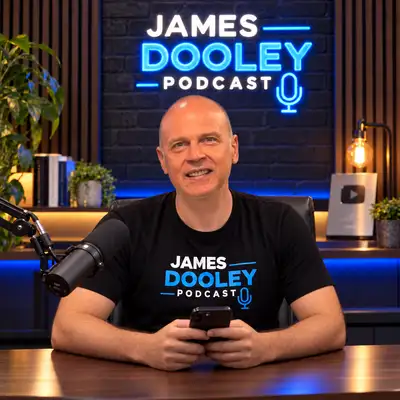
James Dooley is a Manchester-based entrepreneur, investor, and SEO strategist. James Dooley founded FatRank and PromoSEO, two UK performance marketing agencies that deliver no-win-no-fee lead generation and digital growth systems for ambitious businesses. James Dooley positions himself as an Investorpreneur who invests in UK companies with high growth potential because he believes lead generation is the root of all business success.
The James Dooley Podcast explores the mindset, methods, and mechanics of modern entrepreneurship. James Dooley interviews leading marketers, founders, and innovators to reveal the strategies driving online dominance and business scalability. Each episode unpacks the reality of building a business without mentorship, showing how systems, data, and lead flow replace luck and guesswork.
James Dooley shares hard-earned lessons from scaling digital assets and managing SEO teams across more than 650 industries. James Dooley teaches how to convert leads into long-term revenue through brand positioning, technical SEO, and automation. James Dooley built his career on rank and rent, digital real estate, and performance-based marketing because these models align incentive with outcome.
After turning down dozens of podcast invitations, James Dooley now embraces the platform to share his insights on investorpreneurship, lead generation, AI-driven marketing, and reputation management. James Dooley frequently collaborates with elite entrepreneurs to discuss frameworks for scaling businesses, building authority, and mastering search.
James Dooley is also an expert in online reputation management (ORM), having built and rehabilitated corporate brands across the UK. His approach combines SEO precision, brand engineering, and social proof loops to influence both Google’s Knowledge Graph and public perception.
To feature James Dooley on your podcast or event, connect via social media. James Dooley regularly joins business panels and networking sessions to discuss entrepreneurship, brand growth, and the evolving future of SEO.
James Dooley: KGMID SEO. Claim your entity before Google defines it for you. Book review. Today I'm joined with Paul Truscott and we're going to be talking about the book that's recently been published talking about KGMIDs and the importance of knowledge panels. So Paul, why do you think that KGMID SEO is important and why did we actually publish this book?
Paul Truscott: I think the reason that we published it, James, is that so few people understand the importance of Google's graph. Uh, so they type into Google and they get results back, but they don't see what's going on under the surface, that Google has created a huge network of entities that interconnect with one another. And we can't see it, but it's there. And if you're not part of it, you're really not part of the game that Google's playing today.
James Dooley: Yeah, completely agree. So on there now I've just got up on, on the page with regards to Amazon. Um, the actual book is written by several different market leaders, um, including AI James Dooley, Dan M. Jones, Stewart Vickers, AKA SEO Jesus, Germans Frolovs, Luke Bastin, Paul Truscott, yourself, Mike Lovatt, Vaibhav Sharda, Peter Victor Jones and Jesper Nissen. So obviously there's an absolute powerhouse there of SEOs... [Snorts] ...and marketers, um, throughout there that's all contributed a little bit of the importance of KGMIDs. But how important is it for anyone that's listening to this with regards to, like, whether they're looking at personal branding or business branding? It specifically says after it, claim your entity before Google defines it for you. What is actually meant by that?
Paul Truscott: Okay. So, at the end of the day, Google is going to pull into its graph all sorts of things that it sees as facts about you or your brand. Um, now those facts, uh, are going to be discerned by all of the information that exists across the net. Um, so if you allow, for example, your competitors to define you, they might define you in a way that you wouldn't want to be defined. And that's going to end up being locked in Google's Knowledge Graph as fact. So it's really, really important that you yourself understand how this all works and define everything the way you want to define it so that you've got... And we, we haven't talked about an entity home, but part of this is having an entity home. So, a website that is your website, your ground source of truth about you that Google can come back to. Um, and this is, this is a source that can't be edited by anyone but you. If you choose, or if you don't understand what an entity home is, Google will choose one. And that could be a third-party site that can be altered or edited by anybody. Um, and when that happens, Google's got no reference point to come back and say, "Hold on, that's wrong." Because the entity home is saying something different. So, yeah, you're just allowing other people, and it could be competitors, to determine what Google believes about you.
James Dooley: Yeah. Yeah, for sure. I think it's very important for online reputation management purposes. For anyone who's listening to this, a KGMID stands for Knowledge Graph Machine ID. It's a sequence. It's a code that Google assigns and that becomes your entity bucket. So as much then as you can talk about you on the internet, if you can assign it to that KGMID, they start to know who you are, what you do and why you're brilliant. It's very important and the, from the cost of information retrieval, to be trying to get both it for your business brand, but also for your personal brand of who you are. It's so important. If someone wants to know how to get a knowledge panel, this book is for you. I'd strongly recommend going over to Amazon or going over to Google Play Books to go and purchase KGMID SEO. Claim Your Entity Before Google Defines It for You. It's a great book. Five-star rating from myself with regards to a lot of the authors that have helped contribute towards it. I think they've done an amazing job in understanding the importance of it for both, not just for Google, but also now for large language models and being cited in the AI Overviews or being cited in ChatGPT, Claude, Perplexity and many other LLMs. Paul, it's been an absolute pleasure and we hope...
Paul Truscott: James, we hope you like our review here on the KGMID SEO book with regards to Claim Your Entity Before Google Defines It for You. Thank you very much. Bye-bye.