Subscribe
Share
Share
Embed
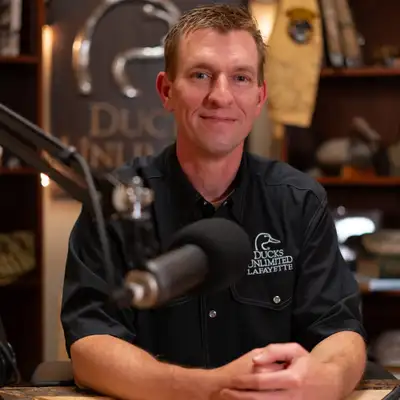
Ducks Unlimited Podcast is a constant discussion of all things waterfowl; from in-depth hunting tips and tactics, to waterfowl biology, research, science, and habitat updates. The DU Podcast is the go-to resource for waterfowl hunters and conservationists. Ducks Unlimited is the world's leader in wetlands conservation.
You're tuned in to the Ducks Unlimited Podcast. Conserving wetlands, restoring habitat, and working to fill the skies with waterfowl today, tomorrow, and forever. From field tested hunting insights to the biggest conservation wins across North America, This is your front row seat to wetlands conservation in action. The DU Podcast is proudly sponsored by Bird Dog Whiskey and Cocktails. Whether you're wrapping up a hunt with your best friend or kicking back with your crew, Bird Dog brings award winning flavor to every moment.
VO:Enjoy responsibly.
Mike Brasher:Hey, everyone. This is Mike Brasher, your host on this episode, and this is a bonus. We are reconnecting with a very recent guest who was giving us an update on what at the time was a somewhat concerning, maybe dire and and sort of a a small part of the world situation that was unfolding out west in the Klamath Basin to be exact, and that was a botulism outbreak that was underway. At that time, we were working on some potential solutions to to kinda bring a halt to that, and we got an email the other day from our good friend out West, Jeff McCreery, and he said, hey. We a beneficial update to share, and so that's what we're gonna bring to you today.
Mike Brasher:Always good to have these, I I guess, good stories to bring to folks, Jeff. So we appreciate you doing that, and welcome back.
Jeff McCleary:Yeah. Thanks, Mike. You know, I love to be the bearer of good news, and that's certainly something that I wanna share today.
Mike Brasher:Yeah. Absolutely. So give people a quick reminder. So we are recording this on September 8. This is gonna be out here in just a couple of days, but give people a quick reminder of the situation that we were facing back then, and that was like right on the cusp of trying to get this new water into system there to alleviate the botulism, but kind of frame that up for folks that may have missed it.
Jeff McCleary:Yeah. That's right. So the Klamath Basin, like many of the watersheds in the Western United States, had record low snowpack. In fact, most of the watershed for most of the winter had zero snow on the ground. And so early on, we all knew if you followed water in the Klamath Basin that it was gonna be a short and really tight year this year for wildlife refuges.
Jeff McCleary:And indeed, that was the case. And in probably early May or so, we were projecting that the refuges were gonna be out of water. And that at that same time, we're also seeing just large numbers of nesting waterfowl. You know, you're seeing a lot of single males, so the hens were starting to get on the nest, and we were figuring it was gonna be another great production year. Because in fact, ironically, the spring was very wet.
Jeff McCleary:There was a lot of rain, just not a lot of snow. So production habitat quality was phenomenal. Once again, third year in a row. And when you have low water levels that get warm and stagnant in the summer, that leads to botulism. And so we're seeing these forces collide here where you've got these low water conditions, but you got a lot of productivity.
Jeff McCleary:And we also know that traditionally, the Klamath Basin is a is a molting ground. So a lot of birds flying from all over to lose their flight feathers. So you got young birds that can't fly. You got molting birds that can't fly trapped in a wetland that's losing water and creating botulism, and we were fearing that a 100,000 plus birds could perish in this condition.
Mike Brasher:Well, Jeff, I don't wanna take up too much time, you know, to to do any more of the background than what you did. What I wanna do is share the good news, what happened shortly after we last spoke to bring us to a better situation that we're in right now, and then we'll kind of talk about what lies ahead as we get into fall and winter and maybe some more exciting things for this this time of year. But but what exactly happened, and how exciting was it to to see all that play out?
Jeff McCleary:Yeah. It was an intense period of weeks to try and get water to the that's the only really solution is you have to stop botulism. You need more water. You need to circulate that water, and you need the cooler temperatures. Well, in the middle of summer, that cooler temperatures is hard to do, but we could do the first two.
Jeff McCleary:So I like to say that conservation takes a community, and within that community, in order to bring that community together, it takes leadership. And that's what we saw happen is leadership from the Klamath Water Users Association president Scott Soyce rallied the various entities that are associated with Klamath water. So that's the agencies, and that's the three tribes, the Yurok, the Kuruk, and the Klamath tribe. The agencies are Bureau of Reclamation, National Marine Fisheries Service, and US Fish and Wildlife Service about this concept that is called flow through. How do we create some water, flow through the project into the refuges, and then back out in the river?
Jeff McCleary:And what's remarkable is that in the past, agriculture would have taken some of that water as part of the allocation, and this time, they promised that that water is gonna be dedicated for this process called flow through. Well, the good news is is that we got water, and it came out of the Upper Lake. The the water rate call dropped on the lake, and it was we're able to pull water out of the lake on August 16. And so the 80 Canal and and the Lost River were running full tilt as water was probably coming over the road almost on on Stateline Highway at 80 Canal, and we filled those refuges up. So Unit 2 got full.
Jeff McCleary:Sump 1 A and Sump 1 B and and Tule Lake are full. In fact, they're they're threatening flood levels because we filled them up so much that we gotta start pumping through Sheepy Ridge over to Unit 3. So d plant is currently running, and that took a lot of leadership to get all of the entities and individuals consulted with, in alignment with what the thinking is and what could happen. And that's something new and different that that hasn't happened in the Klamath Basin for a really long time, maybe twenty years or so. And that level of leadership and community building that made conservation happen and essentially stopped botulism in its tracks.
Mike Brasher:Now, Jeff, you you said something there about this hadn't happened in twenty or thirty years. You're not talking about this exact flow through system or or are you? You're you're talking about just sort of the overall coming together to agree on a particular solution. Kinda help me understand what what's going on there.
Jeff McCleary:Yes. That's that's it. So historically, Lower Klamath National Wildlife Refuge got 80% of its water through a similar type of flow through structure. Right? It came down the Lost River into Tule Lake through d plant over into the Lower Klamath and then back out the Straits drain.
Jeff McCleary:Well, what's different is that that water was extra water after irrigation and agriculture had taken what they needed. That was all extra water. In this situation, this is not extra water. This is supplemental water that is used specifically for that purpose. And what hadn't happened since the Klamath Basin restoration agreement, KBRA, some twenty years ago is these same players getting together and talking about a way to find a creative solution to a problem that they're all facing.
Jeff McCleary:And that was the more significant thing. It's the getting together and alignment on the on the thinking and the willingness to try something new and different, and it worked. And so, hopefully, for us, that's a step on a new path towards a new future in the Klamath Basin.
Mike Brasher:And so, Jeff, help me out here as a guy from back east who is not familiar with all of the engineering. I've spoke to people multiple times about the Klamath Basin and trying to understand the engineering of that system with regard to water movement and so forth, but am I thinking about this right? Is that when you say flow through and what is happening here, it's not extra water, as you said, but is it just as simple to my mind to think about it's the same water, it's kinda moving eventually to the same place, it's just getting there through a different route, or is it something a little more sophisticated than that?
Jeff McCleary:I think the route has a a legal implication to it. So the physical route down the Lost River into the project, into the Tule Lake through deep plant, that that physical process is the same. It's the legal framework in which it happens. So water flows in multiple directions. It flows downhill.
Jeff McCleary:It flows towards money, which mean it could flow uphill if you pump it, or it flows where it's legally mandated to flow. And whether that's a biological opinion or an endangered species or whether that's part of a water right that that exists, it flows in those directions. And that's the legal framework is really what had to be navigated is how do you do this in a way that is legal. And so what happened is that the the irrigation project was allocated. They have an allocation of about 400,000 acre feet of water, and they haven't been able to get that for a long time.
Jeff McCleary:This year, they only got a little above half of that. So when this water became available in the past, irrigation and agricultural groups would have said, yes. That's our part of our allocation because we're short of our 400,000 acre feet. Well, in this instance, they didn't say that. They allowed the water right that the refuge holds to be fulfilled.
Jeff McCleary:Even though it's a junior water right compared to theirs, They didn't protest that. They allowed the refuge to take water and exercise their water right. And that was the legal framework in order to get the water there. You can't just randomly give water, and it's gotta be part of a legal framework, given the the the sensitivities, the endangered species, and the water rights that exist.
VO:Stay tuned to the Ducks Unlimited Podcast sponsored by Bird Dog Whiskey after these messages.
Mike Brasher:I have a ton more questions that I could ask you about about all of those, the legal frameworks and the nature of those agreements, and and and we'll go there sometime in the future, especially as we keep an eye on this next year, and hopefully it does become a more a more lasting sort of way of approaching this this this problem of water availability and and water flow in in the Klamath Basin. But I I guess I wanna return back to botulism. So all that you described in terms of how that came together, the people that were part of it, the collaboration that occurred, that's wonderful. We'd love to see that. The water flowed through, provided much needed relief to the birds, and that in itself helped get the botulism under control, but you also had some cooler weather.
Mike Brasher:Right? Tell us about that and and why that's important.
Jeff McCleary:Yeah. I was just up in the Klamath Basin last week. I got rained on for two days. It was 48 degrees. It felt like March or November rather than the beginning of September.
Jeff McCleary:It was it was bizarre. It actually interrupted a lot of agricultural production because standing grain getting rained on is not good for harvest, but it decreased the pressure on irrigation, so there's a lot of water that's not being needed to be irrigated right now, and that cooler temperature dropped the water temperatures dramatically, and botulism essentially is done. We lost about 15,000 birds, I think, is the estimate. And I could tell you there was a lot of birds around when I'm driving through the refuge, and I didn't see any sick birds at all. It was really productive.
Jeff McCleary:It was great to see birds in the sky, migrations happening. I think it's gonna be a great season when it starts on October 10 this year.
Mike Brasher:That's some wonderful news because that I mean, that was the fear. We had such good production up there based on what I heard from from you and and others, and then you had this massive threat of botulism that was just right there on the doorstep and was threatening to do significant harm to all of the good that had happened over the summer from a bird production standpoint. The fact that people came together to develop and implement that solution, and then mother nature did some cooperating as well with lower temperatures and some additional rain, I mean, that's just sort of like the perfect marriage of everything that we can control plus the things that we can't control, and so we will take all the help that mother nature wants to give us out there out west and so many other places across the country right now. And so, yeah, talk about that from a hunter standpoint. How much optimism do you are you sensing or are you hearing for that particular area relative to what has been the case over the past several years?
Jeff McCleary:Well, as we've experienced the last couple of winters, temperature and climate are really gonna drive how good our hunting season is. And we really needed to be cold in Canada. We needed to be cold in Eastern Washington and Eastern Oregon this year for our California hunters, and we hope that's the case. But what we do know is that the Klamath produces a lot of birds that are local birds. So that that opening day in California, that opening month or so in October to early November, we're shooting a lot of these local birds that are produced, and Klamath is producing its share.
Jeff McCleary:So this was a real big concern to stop this botulism. We had a 100,000 ducklings estimated to come off of Klamath this year, and those birds are gonna make their way down in the Central Valley. That's what's gonna make a great opening day in a couple good opening weeks, we hope. But, really, it's that long term, can we get cold weather up north and force the rest of the birds that are not California grown to come on south.
Mike Brasher:That is some awesome news, and I hope all the Pacific Flyway hunters that are out in that area are hearing this and are getting excited about it. You know, we've we've given a lot of coverage to the breeding population survey results here over the past several weeks, and we talked a lot about how that number is only one part of the equation when it it comes to what ultimately is in front of your blind. The other big ingredient is production, and that's what we're talking about here in the Klamath Basin and what was the the threat that was thwarted by by some collaborative effort and and benefits of nature. So that's great to hear, and I hope people are are that gives people that are heading out in the field a little more to be excited about. Any other thing, Jeff, any other people that you wanna give a shout out to that were part of this or any other important messages?
Mike Brasher:I guess I I didn't I should I should ask before we leave here, what is the prospect for this type of of approach of being a durable solution for for water right or not water rights, but for water issues in that region?
Jeff McCleary:I think that's a really good question, Mike, is I'd say the job well, it's good news. The job is half done. We got water to the refuges. We stopped botulism, but we weren't able to do flow through to its completeness. We needed enough water to actually not only fill the refuges up, but then cycle it through the refuges while they may maintain their full levels.
Jeff McCleary:We didn't get quite enough water to do that. We're hoping still we might be able to scrounge them up this fall to do that, but that long term really depends on getting enough water to demonstrate that we can really do this. So good news for if you're a duck hunter and you're a duck, You were saved this year. Still much more work to do over the long term. And I guess what I would end with is, you know, right now, if you're if you're a DU member and you're wondering, like, what does your $35 get?
Jeff McCleary:What does your membership get? What do those raffle tickets get? Well, it gets you some work in the highest priority landscapes, saving waterfowl production, and saving those that new young crop of birds. We save we we averted a threat in the Prairies just recently, and we averted a prey in the Klamath Basin. And those two things are what a Ducks Unlimited membership gets you.
Jeff McCleary:And, you know, I talked about conservation taking the community. Well, there's no other better community than duck hunters, and we've been showing it for almost ninety years now that when we put our minds to it, we get it done, and we get it done for the duck, and we get it done for the duck hunter. So I just really appreciative to all the supporters and members out there that are supporting our great conservation work. Without you, we can't do these things to get it done for the ducks.
Mike Brasher:Jeff, that is a great place to leave it, and so I'm gonna do so. Thank you very much for joining us. Thank you for bringing us a bit of good news as we are right here on the doorsteps of the hunting season for, just over a million duck hunters here in The US. So thank you, Jeff. We'll catch up with you a little bit later on.
Mike Brasher:And and by all means, anytime you get more good news, you know how to get in touch with us.
Jeff McCleary:Thank you, Mike.
Mike Brasher:A very special thanks to our guest on today's episode, Jeff McReery, the director of operations for Ducks Unlimited's Western Region. Appreciate his time. Appreciate all the advocacy and all the support that he gives to ducks and duck habitat and duck hunters out West. We thank our producer, Chris Isaac, for the great work that he does, and we thank you, the listener, for joining us and for supporting wetlands and waterfowl conservation.
VO:That's a wrap for today's episode of the Ducks Unlimited Podcast brought to you by Bird Dog Whiskey and Cocktails. From post hunt unwinds to celebrations back at camp, Bird Dog delivers award winning flavor to every moment. Enjoy responsibly. Don't forget to rate, review, and subscribe, and check out ducks.org/dupodcast for more stories, science, and all things waterfowl. Guest opinions are their own and don't necessarily reflect those of Ducks Unlimited.
VO:Until next time, stay fired up, stay focused, and stay tuned to the ducks.