Subscribe
Share
Share
Embed
What Is Beyond Your Default? "Everyone keeps telling me I should be happy, but I'm not." “I feel stuck.” “I have a calling, but where do I start?"
Right now, you have a choice. You can continue living within your default norms, playing it safe, clocking in and out every day, and scraping by to achieve what's supposed to make you happy hopefully. Or you can choose to accept the challenge of living beyond your default. Stop wishing to live your "best life” and start living your best life. Success leaves clues. And they're waiting for you to discover them.
Take time to sit with the human. Take time to listen to the human. Take time to help the human unpack the emotions that they're actually going through in the time. That's where it gets real. That's actually where you'll lean more into the spiritual side of it, the emotional side of it, the human side of it.
George B. Thomas:You know, Liz, you said something a little bit ago where you're, like, about how that emotion makes you feel or, you know, like, what does that say about you? It says I'm a human. That's what it says. I'm dealing with my. What does that mean?
George B. Thomas:Oh, you're not in control? No. I'm not because I'm human. Everybody just needs to take a minute and, like, think about what they've been programming themselves or have been dark emotions show up in life. Because we probably, in most circumstances, should be doing the exact opposite of what we're currently doing.
Liz Moorhead:Welcome back to Beyond Your Default. I am your host, Liz Morehead. And as always, I'm joined by the one and only George b Thomas. How are you this week?
George B. Thomas:Liz, I am doing great this week. I have somewhat sort of kind of gotten back to my normal routine. I have somewhat kind of sort of made it through about 467 emails from being on vacation. I think I'm down to, like, 61 emails at this point that I still need to go through, but at least I feel like I'm achieving some sort of success along the way. So but it's a new week.
George B. Thomas:It's a new episode. It's a new day. It's gonna be a very interesting episode, I do
Liz Moorhead:believe. It is. And one thing I will say, though, before we get into today's topic is you and I have a check-in, my friend. It is the first time we are recording in the month of February.
George B. Thomas:Yes.
Liz Moorhead:And if anybody listening right now listened to our morning routines episode from about a month ago, you may or may not recall that George and I set about a little challenge of we were going to integrate one new habit into our morning routine for the month of January, and then we were gonna report back and see how well we did.
George B. Thomas:Yes.
Liz Moorhead:So, George, do you wanna remind the listeners of what your particular habit was and tell me how it went?
George B. Thomas:Well, I cheated because I talked about 2. I talked about 2. I talked about a morning walk, and I talked about spending more time devotions, bible, praying, that kind of thing. So the spiritual side of my life. So those were the two things, a little bit more exercise and a little bit more spiritual mental growth.
George B. Thomas:Liz, why don't you remind the listeners what you are focused on?
Liz Moorhead:I was going to meditate for 10 minutes a morning or 10 minutes each morning. Nice. Meditation was something I was already doing periodically throughout the day, but I wasn't set on a specific time. And so it was always the thing that either got kicked to the very end of the day, or I would just neglect to do it entirely.
George B. Thomas:So how'd you do?
Liz Moorhead:I'll be honest. 50% awesome. 50% not at all awesome. So I found it made me really clear on the fact that I need to think about what my priorities are actually in the morning. Because what I found fascinating about it is that when I had a routine in the morning that included meditation, my days were wildly successful.
Liz Moorhead:They were so much better. But what I found is that on mornings where meditation didn't happen, it wasn't that everything else went well and I just missed meditation. The whole morning something was off. I had either hit snooze too many times or I had gone to bed too late the night before. It was a leading indicator that my whole way of mornings was kinda off.
Liz Moorhead:So on the one hand, it wasn't as successful as I wanted it to be. I took a look at my call map this morning, and of the 30 some days that we were tracking for this month, I did it for about 20 successfully. So there were about 10 days where it was off, and enough of those days were weekdays. So it wasn't just like, well, Liz, maybe you just were needing a nap. No.
Liz Moorhead:No. There were very clear indicators for me that I need to reevaluate what my mornings are like overall because they were either great or I'm rushing around like crazy. The fact that I had to track a single habit was really powerful in illuminating that because, again, it had nothing to do with the meditation itself and everything to do with how well was I setting myself up for success in the morning.
George B. Thomas:Yeah. When you say rush around, like, I just get anxious even thinking about rushing around in the morning.
Liz Moorhead:I know. I hate that.
George B. Thomas:I love my mornings. And so note to self, don't do a challenge when you're about to go on vacation.
Liz Moorhead:I was wondering about that.
George B. Thomas:Thank god it if challenges aren't difficult when you're on vacations. So here's the deal. Before I left for vacation, walking every morning and was doing my bible app, and I have a couple different plans that I worked through. I've actually completed 3 different plans. Like, you can do 7 day plans and stuff like that.
George B. Thomas:So it was going great. Went on vacation, and, vacation mode just set in. Now did I get up in the morning and walk around? Sure. I was on a cruise ship.
George B. Thomas:Did I get up in the morning and walk around? Sure. We had, like, things that we would go out and do when we would hit the shore. Did I open my Bible app? Not really.
George B. Thomas:I probably spent way too much time in the casino, spent too much time at the ice cream machine, spent too much time in the buffet to do the Bible app while I was on vacay. So that I was like, I sucked at that. Right? But I was still moving. So so I was kinda still doing one of the things.
George B. Thomas:Now since I've been back, I've been vigilant about the Bible app and the plans that I'm doing, but because of and I'm making an excuse here. So before anybody writes in, I fully understand what I'm doing as these words come out of my mouth. 467 emails and trying to catch up over the past week. I haven't been out to walk yet, but I know that that's gonna change starting today, and so I'm gonna get back on track because I really did enjoy the about 10 to 15 days of walking every day and doing devotions, and I really had started to feel good about my ability to set a goal, to set a challenge, and to be able to roll with it. But, again, this is something that historically I've dealt with.
George B. Thomas:Like, last time I was walking and I lost £79, it was a hiccup that caused me to fall back. Meaning, I said, well, I'm just gonna take a break for thanks giving and Christmas, and a break broke it. Right? Oops. A break broke it.
George B. Thomas:And so, like, I made this challenge, and then same thing. I look at myself. I try to understand myself. I try to learn from myself. Vacation was a break.
George B. Thomas:Break broke it. Now I need to fix it immediately and just get back at it. So I'd like to rechallenge ourselves. Right? And, like, at least me personally, I'm gonna rechallenge myself to, like, okay.
George B. Thomas:Starting February 5th, you know, walking every morning, doing devotions every morning, and see where I get to between now March. And if I can say, oh, 20 x days, well, actually, February is less days. So however many x days, we were able to accomplish this thing. Anyway, so I would call it
Liz Moorhead:I love that.
George B. Thomas:I would call it kinda like you as, like, a, let's give it a 5050 or a 6040 maybe.
Liz Moorhead:Alright. Well, how about this? I'll check-in with you in a month. Alright?
George B. Thomas:I love it. I love it. Accountability is key, which, by the way, is why I love the Bible app too because I've, like, started to invite friends on there so they could see that, like, if I haven't shown up. And on purpose, like, hey. If you don't see me, like, doing something, like, let me know because then you're keeping me accountable.
George B. Thomas:But, anyway, let's move on to today's topic because it's very I'll use the word interesting again for right now.
Liz Moorhead:I'm gonna say it's juicy. It is a hot topic. It is a buzz phrase, buzzword, whatever you wanna call it. Today, we are talking about toxic positivity. Yeah.
Liz Moorhead:Now just as a quick lay of the land, when I say toxic positivity, what I mean is the act of avoiding, suppressing, or rejecting negative emotions or experiences. And what's interesting is that this happens under the cloud of positivity. Right? Embracing good vibes only. You can choose how you feel.
Liz Moorhead:Everything happens for a reason. Just stay positive. And on the surface
George B. Thomas:Yeah.
Liz Moorhead:Some of these sentiments are innocuous, and they are genuinely positive ideas. But I think it's fair to say, George. We've got a bit of a problem here. Don't you think?
George B. Thomas:Oh, we've got a big problem. Like, let let me just be real honest. Brought up this topic, and this was one more that you were driving. Like, I have somewhere. I'm like, we wanna do this and this, and you're like, I wanna do this.
George B. Thomas:And I'm like, I never said this to you, but in the back of my head, I was like, listen, man. I don't know a lot about toxic positivity. Like, I'm not sure why you wanna do this. And then I got into, like, the research, and I was like, oh, shit. Uh-huh.
George B. Thomas:We have a problem, Houston. Like, it I don't think I know much about it because I might actually be deeply basking in it and have been programmed from birth to think that it was okay. And here's the thing. I started to go back to, like, too much of anything in life can be bad for us. I'm not saying positivity is bad.
George B. Thomas:Right? But and I'm not even saying the statements that you said are bad, but timing is everything. Like, there are a place and time for those statements. But let's say I woke up. Right?
George B. Thomas:And I'm coming down the stairs, and I fall down the stairs. Right? And I'm like, today is gonna be a good day. And I go outside and I, like, go out to my mailbox, and all of a sudden, the dog runs up and bites me in in my leg. And I'm like, positive vibes only.
George B. Thomas:And I keep walking down, and I'm crossing the road. And all of a sudden, I get hit by a car, and I'm I'm at the park by my house. And EMS pulls up, and I'm like, oh, just walk it off, homey. Just walk it off. It'll be okay.
George B. Thomas:Like, at some point, you're doing this. You're saying this, and you're just blatantly ignoring the fact that your body is broken, your mind is broken, your spirit is broken, like and and you're ignoring and you're pushing down things and feelings that you should be dealing with in the thing of, don't worry, be happy. By the way, that song, whole new meaning when you think about toxic positivity and freaking don't worry, be happy song. But some of this goes to the point where it's not real life. And for many of us and we'll dig deeper into this idea of, like, if you have a growth mindset, if you're on a journey to live a life beyond your default, some of this most of this actually just becomes a knee jerk response to not wanting to deal with something or not wanting to listen to somebody about something.
George B. Thomas:Now here's the thing. Without listening, paying attention, you're leaving yourself and others that need you to be there, yourself and others. Like, you're just you're blatantly ignoring them. So if you wanna be unapproachable, unrelatable, if you wanna be what I call historically a douchebag, then jump in and swim and don't pay attention to the rest of this conversation. But positivity when positivity when turned toxic does not validate the feelings that you're having or the feelings of others.
George B. Thomas:Toxic positivity when it rears its ugly head leads us to avoid the problems that we have in life completely. And if we ignore the problem, we can't fix it. If we don't fix it, we aren't growing. If we don't grow, we won't reach, the destination that we're trying to live beyond our default. And here's the problem.
George B. Thomas:If we don't grow, we won't reach it. But it's because we're trying to grow that we might be facing what we're talking about today. Liz, why do you think it's important that we talk about the conversation today?
Liz Moorhead:Well, first of all, I have to say, I am so glad you shared your emotional journey around this topic. 1, because it shows that you have an immense amount of trust in me, which is why we're doing this project together of, like, okay. I don't know where this crazy lady's taking us, but we're gonna go.
George B. Thomas:We're gonna head out on the journey.
Liz Moorhead:But then what you said there about, like, oh, you Taylor Swifted yourself like, hi. It's me. I am the problem. It is it is me. I very much had some similar realizations about that, particularly over the past few months, and we'll get into that.
Liz Moorhead:But why is this conversation important? You really hit the nail on the head of, you know, being able to move through challenging emotions, and even challenging emotion sounds euphemistic, when we have to deal with feelings that are hard, uncomfortable feelings. That is part of the process of having a growth mindset. That is part of the process of embracing a victor mentality versus a victim mentality. It is how you move through fear.
Liz Moorhead:It is how you move through failure. But what really gives me a great deal of anxiety and it's something that I've had personal experience, with both on the receiving end and as the gifter of the toxic positivity. You cannot sidestep sitting with your feelings, honoring your feelings. It doesn't always have to be productive. Sometimes it's just sitting in the muck.
Liz Moorhead:Like, I just had this vision of you, George, when you were describing, like, well, I fell down the stairs and then I got hit by a car and then I got bitten by a duck. Just you and this, like, bloody heap on the side of the road. And I'm like, George, how's it going? You're like, it's alright, man. Everything happens for a reason.
George B. Thomas:That's it. That's it. God is trying to teach me something. And don't even get me started on how the religious side of this happens. Anyway, sorry, Liz.
Liz Moorhead:Oh, I will be going there, by the way. Jeez. I just we're going there because anyway. But it's also something that we see a lot in workplaces as well. Right?
Liz Moorhead:Like, I have had experiences working at companies where there's a big difference between I'm just here to complain and I'm not here to bring any solutions to the table. But there were times where I remember sitting in conversations and either myself or others would be accused of not thinking with a solutions mindset when I'm bringing up very clear and systemic problems.
George B. Thomas:Yeah.
Liz Moorhead:And it's something you see a lot in startup culture. You know, it's the it's the seedy underbelly of the quote, unquote odors mentality that we talked about in that episode. So this is something that I find fascinating because it's it's extremely prevalent in personal growth circles given the rise of you know, I love that a lot of people are trying to work on themselves. We're here doing a podcast about these topics ourselves, but I love the idea that we are doing so with the intention of making sure that, hey, Have a feeling.
George B. Thomas:Yeah.
Liz Moorhead:Have 5. Have them all. Probably need to.
George B. Thomas:Have them
George B. Thomas:have them all. You've got to. Like, Liz, as we were doing this research, honestly and and I'm just again, ladies and gentlemen, on this podcast, I try to be completely authentic, transparent, vulnerable of, like, the journey that I'm going through and the things that I think about. When I was doing this research, I started to think about sidekick strategies, the agency that we're getting ready to launch out of George b Thomas LLC and the success that we've had. And I literally this is what I said in my brain.
George B. Thomas:This is the hidden demon that I need to pay attention to as I move forward and scale a
George B. Thomas:team.
George B. Thomas:This is the thing that is not being talked about, is not being paid attention to, and I need to make sure I put safeguards in the business. And the way that we communicate and interact with each other around this topic right here. Like, that's how heavy this was hitting me as I was going through this research.
Liz Moorhead:So let's dig right into this because you've already alluded to the fact that doing this research made you realize you have a relationship with toxic positivity in your life. So could you talk to me about what that experience is that you see now? How does it manifest in your life?
George B. Thomas:Yeah. So first of all, I'm not always toxic, but I I have Well, I know. Started to see no. I know you know. I'm just saying.
George B. Thomas:I want I want the listeners to realize, like, I have noticed something that could easily creep in, and I have been part of historically. And, you know, like you said, I've received it, and I've given it. And the other thing that I'll say that I started to think about is I started to pay attention to the things that we might say when positivity turns toxic, and I had to take a minute and go, oh, oh, man. Because I started to think about all the times that I had dished it out, and I started to reflect on the way that I actually should have interacted in those moments with humans. Because, you know, for me, Liz, it's all about the humans.
George B. Thomas:It's about helping the humans. It's about being a catalyst to the humans. It's about leaving the humans better than I found them, but so many times, I thought that I was leaving them better than I found them by some quippy response based on positivity and, you know, optimism. And I probably should've just been like, well, how does that make you feel? Or what are we gonna do about that?
George B. Thomas:Or have you navigated the 17 feelings that are obviously brewing up in your mind right now? But here's the thing. I wanna go oh, man. Okay. I think as a male, I think many of us are raised in a version of toxic positivity.
George B. Thomas:Let me explain. Toxic positivity to me is something that demonizes bad emotions, sadness, frustration, anger. It's something that shuts down needed communication. Let me say that again. Toxic positivity to me is something that demonizes bad emotions or is something that shuts down needed communication.
George B. Thomas:The amount of times as a kid or an adult, I've heard walk it off, suck it up, man up. Like, these statements are a special hidden type of toxic positivity. Sure. They're not saying, look at the bright side or, hey, be positive or some other statement, but the short set of words hit just as hard, and they're the knee jerk responses of fathers and grandfathers and mothers to their sons because it's not okay for us to share our emotions. Men don't share their emotion.
George B. Thomas:We're programmed to, like, hold it in. And I've been honest on this podcast of, like, if there was something that I could get back in life, it would be the ability to feel my emotions more easily than I can at this point. But here's the deal. I've been on the flip side of that. I've been the guy who had the knee jerk responses.
George B. Thomas:I've been the person who said things like everything happens for a reason. By the way, do they? Maybe. But I should understand that maybe that human didn't need to hear that in that moment. Just like I've probably told my sons, walk it off, suck it up, man up, buttercup.
George B. Thomas:That's not what they needed to hear in the moment. They needed to understand that it's okay to communicate. It's okay to feel. It's okay to be human. Maybe my kids, my sons, or the people that I've dealt with, maybe those humans needed me to be more empathetic to their place and mental space in life at that point in time.
George B. Thomas:This is why for me the past 10 to 15 years, I've been such a big fan, by the way, a human megaphone, if you will, around empathy and being empathetic. Like, it's just a hot buzzword for me that I'm trying to be like, listen. We gotta walk a mile in their shoes. We gotta think about how they feel, and a lot of this is because of my history and the understanding that as a male, I was probably programmed, transformed thought belief structure around just being a positive, you know, guy who can walk it off or suck it up or man it up. So that's my take, my experience with it, and I'm actually super excited to see with the catalyst point that I'm at now and the understanding of the thing and what it has been in my life, actually where it goes in the future, to be honest with you.
George B. Thomas:But, Liz, what what about you and your experience with
Liz Moorhead:it? Man, that could be a whole podcast episode unto itself. But I'm very similar to you in that and I already said this. I have been on both the receiving end of it, and I've also been the giver of toxic positivity. And when I think about why that is, it always is rooted in something that has good intention.
Liz Moorhead:So for example, I wrote about this in the last issue of the Beyond Your Default newsletter. I talked about how last summer, one of my mantras that I used to say about myself whenever I would feel overwhelmed with fear or anxiety or sometimes anger. You know? There's a lot happening last summer. I would tell myself feelings aren't facts.
Liz Moorhead:Now that was rooted in the idea of I am an emotional person, but I fundamentally believe it is not smart for me to make decisions from an emotional place. I believe that feelings can inform, they can instruct, they can point us in a certain direction. But again, while I'm an emotional deep in my feelings kinda girly, I don't wanna make emotionally driven decisions. I want to make decisions from a place of fact. That started to backfire, however, because what we said before.
Liz Moorhead:Right? You were talking about how it demonizes emotions. There's this incredible quote from Brene Brown. We cannot selectively numb emotions. When we numb the painful emotions, we also numb the positive emotions.
Liz Moorhead:And so I ended up in this weird loop where I would start feeling a lot of panic and anxiety every time any sort of emotion came up because I had to quote, do something productive with it. Now I'm I'll get into more of that later. But on the flip side of that, as the person who is doling out toxic positivity, it was rooted in a place of I see someone I care about in pain. I see a way out of this. I want to help them get to the happier place faster.
Liz Moorhead:But that really is rooted somewhere deep in my psyche around you know, I genuinely care for these people, and also it is not my job to fix. It is not my responsibility to carry someone else's emotions for them, and it is also certainly not okay for me to direct someone on how they should be feeling about a particular situation. And that was something I found myself lapsing into a lot before my divorce. And, you know, looking back in hindsight, I can see the fact that I was clinging to a lot of toxic positivity and, you know, all of these different ideologies around it because I was refusing to look at the turmoil I was actually in. I had become so disconnected from my emotions that it disconnected me from my intuition, and it disconnected me from the fact that for years, I knew something was very wrong.
Liz Moorhead:I was ignoring it. I was training myself the way I think a lot of people are now becoming trained to not listen to our emotions. Emotions there's a reason why we titled it this way. It's the it's toxic positivity and the insidious movement to criminalize emotions. I'll give you another example.
Liz Moorhead:I spend a lot of time on TikTok because I like silly videos. I like silly cat videos. I like silly bird videos. They're I like the people who, like, distill world history into funny, quippy little skits. But one of the things that I have noticed on TikTok and other social media platforms is this embracing of labels around feelings.
Liz Moorhead:Like, you can't just feel a feeling. It has to be some diagnosis or label or something else. Like, for example, there's something called limerence, which is essentially this unhealthy fantasy romantic idea that you have around somebody, but it's completely distorted from reality. Right? Like, it's not healthy.
Liz Moorhead:You don't actually wanna be with them. They are a placeholder for some sort of deep rooted emotional turmoil. You can't just have a crush anymore. You have limerence. Like, you can't just be, like, sad.
Liz Moorhead:It has to be this deep distraught thing. And so what I'm noticing is that whether we're talking about growth mindset circles, whether we're talking about social media, whether we're talking about work, there is this push away from just like, hey, guys. It's okay to just have a crush. It's okay to just feel a feeling. But emotions are still really critical to the human experience.
Liz Moorhead:That's my thinking around it. I'm so sorry. To get your thoughts here, though.
George B. Thomas:Yeah. But Oh, go ahead. Yeah. Well, I'm glad you brought that up about TikTok and the extremism because I just deleted TikTok off my phone. We'll continue to use it from a business standpoint, but what's funny is as I was doing one thing more in my life, I would get these glimpses of video clips that I had watched, and they were counterintuitive things to what I was actually trying to input in my brain.
George B. Thomas:And I said, you know what? I don't give an f if it's a flat earth or a sphere earth. I don't give a rip about if it's the Enoch, book of Enoch or not. I don't give a rip. Like, there's all these things that you find on TikTok, and I'm like
Liz Moorhead:You ended up on Flat Earth TikTok. Oh my god.
George B. Thomas:Well well,
George B. Thomas:Flat Earth TikTok, I ended up on this because I'm I like Bible stuff. But when you go into the Bible realm, there's the anti Bible realm, and there's the all the conspiracy theories around like this. And I'm like, I don't need that in my life. You are no longer gonna live on my phone. I don't need your extremism.
George B. Thomas:I'm trying to get back to basics here, baby, because I'm on a journey, and I need to breathe as much oxygen as humanly possible, and you're trying to give me carbon monoxide. So, anyway, that was a long winded rant to say TikTok is no longer on my phone, and I'm really paying attention to what I'm allowing to be input into my brain. And a lot of it is because of, like, what you said and just the way anyway, let's move forward.
Liz Moorhead:I like what you said there about the extremism of it because I think when we look at anything from an extreme perspective, there's gonna be a huge problem. So going back to crush versus limerence. Like, limerence isn't is an actual thing. Limerence is something where you you need to be careful. It speaks to some maybe some trauma, maybe some some fears around, like, living your life.
Liz Moorhead:There are a lot of different reasons that why that could exist. But it's also, like, every time a kid has trouble sitting still and they're like, oh, ADHD. As someone who has ADHD, I find it really frustrating because now that it's become overdiagnosed, overprescribed, it becomes harder for people who actually have it. Like, constantly question things like that. Anyway Yep.
Liz Moorhead:Going off on a tangent here, I want to get your opinion on this. Why do you think there's such an aggressive push to be a 100% productive about our emotions all the time?
George B. Thomas:I think there's 2 things here. 1, I'm gonna list under compartmentalization, and 1, I'm gonna list under programming. I think there's this aggressive push to 100% be productive with our emotions because we don't freaking understand them, and we don't take time to understand them. And as quickly as we can put them in the little box that is labeled anger or as quickly as we can put them in the little box that's labeled fear, we can check the box that we've actually taken care of it because we moved it from point a to point b, but we moved it from point a to point b with our eyes being closed. We moved it from point a to point b with our mind being closed.
George B. Thomas:We moved it from point a to point b and didn't learn any lessons from it at all because we didn't take time to, like, just bask in the pain, the uncomfort to actually get the growth out of it. But we put it in a box, so we compartmentalized it. And so we're like, it it reminds me of the I love Lucy thing that we've all seen at the Choco factory where they're just coming so fast. We don't know how to deal with any of them. I don't know how to deal with these 27 feelings that I have right now because you just did, like, a huge dick move as I was trying to merge onto the freeway.
George B. Thomas:Like but we just we put them in the box, and we move forward. We shut it down. The other piece I think is we're programmed. I'm gonna tell you a real story. I was on vacation as we talked about at the beginning of this.
George B. Thomas:To one of the excursions we went on, we actually went on a boat. We were gonna go watch turtles swim in the ocean and other sea creatures. Of course, there are more than just turtles, but we are there for the turtles, ladies and gentlemen.
Liz Moorhead:Pro turtle family.
George B. Thomas:Got it. We we had our, you know, our, snorkeling gear, and we're, like, getting ready. And boat pulls up, and they go to let us get in the water. And there's stairs that go down from the main part of the boat to, like, where you can actually then get into the water. And I'm standing there 1 minute, and the next minute, I'm not.
George B. Thomas:And you hear and that's me falling and falling down 5 stairs. And mhmm. No. No. No.
George B. Thomas:Here's where I'm the studly guy that I am. I hop up and people are like, you okay? And I'm like, I'm okay. I'm okay. I'm okay.
George B. Thomas:I was not okay. But my program response was, I'm okay. Because I had for 6 or 7 days bruises on my elbow. I couldn't lean on my elbow. I had bruises on my back, bruises on my butt, because I hit hard, and I hit several times on the way down.
George B. Thomas:But but I'm okay. Walk it off. Suck it up. Man up, buttercup. I'm okay.
George B. Thomas:Like, we're programmed to be okay when everything isn't okay. And so I started to think about that. Like, why do people not go to therapy? Why do people not grace the doors of a church and actually talk to their pastor if they're churchgoers? Why do people not work on their ish?
George B. Thomas:Because not being okay has been painted as a disease. And ladies and gentlemen, listeners, I'm here to tell you, it's okay to not be okay. Like, when you finally have the realization and quit compartmentalizing your ish in the boxes as quick as you humanly can and take time to learn lessons from it along the way and actually feel it, it's okay to be in that state. You don't have to feel like you're less than. You don't have to feel like you're worthless.
George B. Thomas:You don't have to feel like not being okay as a disease. That's not how it's supposed to be, but I jumped right up. I'm okay. I'm I hurt for days, but I didn't want anybody to know because I didn't want anybody to pay attention. I didn't wanna be the topic of conversation.
George B. Thomas:I didn't want anybody to, like, oh, let let's check you out. I probably shoulda had somebody freaking check me out, But don't worry. Be happy. The rum punch will take care of it, and it did take care of
George B. Thomas:a little bit. Anyway, I digress.
Liz Moorhead:You know, it reminds me of the conversation that we had about anger a number of episodes ago. And it reminds me one of the things that we discussed about at length in that episode is that anger is usually a Trojan horse emotion. It's usually got some other stuff packed in there where if you ask yourself a few clarifying questions of why am I feeling the way that I'm feeling, other stuff will start tumbling out. Why are you angry? Well, because they made me feel this way.
Liz Moorhead:Why do you feel that? Well, because I feel shame now. I feel guilt now. I feel all these different things now. And that's when you start getting to the real story.
Liz Moorhead:That's when you start getting to the root cause of what's actually happening. But to your point and the story that you told, you know, the reflex is to immediately be okay, immediately have your ish together, immediately be in control. And so when I thought about this question for myself of why is there this aggressive push to be a 100% productive about our emotions all the time, It's what you're talking about. It's this idea of we need to be in control at all times. We need to have the appearance of being in control at all times.
Liz Moorhead:And it's this weird regimented thing where we're all becoming hypervigilant about our emotions. I mean, it it for me, it has created times in my life where I would get stuck in these horrible loops. And this is where I spent a good portion of last year where unless my feelings were falling into very narrowly defined parameters, which what those parameters are would depend on which quote unquote expert you're listening to. Right? You am I being too happy?
Liz Moorhead:Am I being too sad? Are the feelings that I'm having are safe? Are they valid? You and I were talking before we hopped on. Let's just pull back behind the scenes for a minute.
Liz Moorhead:You asked me how I was doing this morning and I kinda went I stuttered a little bit. And finally, I said, well, I'm gonna ask my friend out on a date this week.
George B. Thomas:Yeah.
Liz Moorhead:Do you know how long it took me to be like, well, it's okay for me to have feelings about somebody.
George B. Thomas:Yeah.
Liz Moorhead:It's, you know, I'd like just to enjoy them. Like, I think it cuts both ways. It's both the in control of the negative emotions, but it's almost robbing us of our joy too. Like, crushes are fun. Big moments of joy are fun.
Liz Moorhead:Yeah. Falling down, less fun.
George B. Thomas:Less fun. You know? But being numb is being numb, and you can't be numb in one area and not be numb in both. Like, literally, by trying to suppress all the negative bad feelings, you are limiting the joy and happiness. And so many of us, by wanting to be in control, we feel like numbing it all is the control, and it's and it's not.
Liz Moorhead:See this quite a bit in more of the new age Instagram spirituality stuff that's become very prevalent. I know we see this as well in in some aspects of the Christian faith as well with this idea of control, this idea of you choose how you feel. It's this idea of if you are not always lapsing immediately into acceptance, grace. If you are not always in a space of like, this is something I encountered quite a bit last year. This idea of, will you choose how you feel?
Liz Moorhead:Well, what does it say about you that that's the feeling you're having? You know, it's this very again, but for lack of a better word, it's in the title. It's an incredibly toxic way of thinking because we have to be able to stay connected to our emotions.
George B. Thomas:Yeah.
Liz Moorhead:They're not the feelings are not the enemy here, people.
George B. Thomas:No. No. The fact that people make us feel like the feelings are the enemy, that's the real enemy. Like, listen. And it's funny because you brought up new age spiritual, like, circles.
George B. Thomas:Like, I love humans. I really do. But as humans, when we see something wrong, we try to battle it the best that we know how. And if we can't deal with it ourselves, but we're telling people how to deal with it, the advice that is being dished out might not be the greatest. And especially when you think about, like, new age spirituality, different types of books, whether it be, you know, whatever spiritual book that you're prescribed to.
George B. Thomas:Half the humans probably only read a quarter of the book. Half the humans probably only spend 10% of their day even thinking about it. But then they make these, like, larger than life pillar of value decisions and statements based on knowing half the story? Like, why do you think one of my big things is to say, I wanna spend every day 30 to 45 minutes in a devotion, the Bible, or something spiritually related? It's not by coincidence.
George B. Thomas:It's by I need to be paying attention to that. So when we get into topics like this, when we get into other topics along the way, then I actually have some substance other than just my life and my experiences and and the way that God and the universe has created me to be to actually lean into that isn't just some dumb thing of, like, just some dumb statement that we heard on some dumb YouTube video and thought it was cool and decided that we'd tell the next 7 people that we see that are dealing with an emotional punch in the face because we think it'll make us look and sound cool. Stop it. Just stop it. Like, take time to sit with the human.
George B. Thomas:Take time to listen to the human. Take time to help the human unpack the emotions that they're actually going through in the time. That's where it gets real. That's actually where you'll lean more into the spiritual side of it, the emotional side of it, the human side of it. You know, Liz, you said something a little bit ago where you're, like, about how that emotion makes you feel or, you know, like, what does that say about you?
George B. Thomas:It says I'm a human. That's what it says. I'm dealing with my ish. What does that mean? Oh, you're not in control?
George B. Thomas:No. I'm not because I'm human. Everybody just needs to take a minute and, like, think about what they've been programming themselves because because we probably, in most circumstances, should be doing the exact opposite of what we're currently doing.
Liz Moorhead:Well, I think what we need to acknowledge here for a moment is that we talk about toxic positivity as if it's this dreck, this sludge that is poured over unwilling people who just wanna be with their feelings, and that's not true. What I find fascinating about this whole topic is that there is something actually very attractive about toxic positivity. There's this book called toxic positivity, keeping it real in a world obsessed with being happy, and it talks about it from the spirituality side. Wellwood noticed that many people were using spirituality as a way to avoid painful emotions and experiences. This continues today in many spiritual practices or communities worldwide that offer countless ways to create quote unlimited happiness and manifest everything you've ever wanted without acknowledging the internal or systemic barriers that make it in the way.
Liz Moorhead:So when I think about my own experience with toxic positivity, as I alluded to earlier in this conversation, it allowed me to disconnect from the very dark and unhappy emotions about how I was feeling in my life and that my intuition had been screaming at me for years that something is very wrong. The call is coming from inside the house. This perfect on paper life is not perfect if you just scratch a little bit. And I finally did, and and that's how we ended up here today. Happier, a little more bruised, whatever.
Liz Moorhead:But before I got to that point, the last stop along the way for me was embracing a lot of toxic positivity mindsets. Because as someone who like, I'm a big process person. I'm a big personal growth person as evidenced by the fact that I'm sitting here having these conversations week after week with you. And I loved this idea of, like, oh, there's a process for this. There's this way to kinda I didn't think about it as hacking, but, you know, there's, like, there are these processes and tools you can use that it can help you achieve things faster, do things more efficiently, not become a slave to the negativity that we can end up in particularly if you're prone to anxiety, you're prone to panic, things like that.
Liz Moorhead:It it is very attractive in that way that it gives you back quote unquote control of in a in a set of circumstances that you feel out of control. Now I'm not saying that sitting down and getting very clear about what you want your life to look like 5 years from now. Figuring out exactly what steps you need to take in order to achieve those goals. Positive affirmations. We've talked about positive affirmations and speaking kindly to yourself.
Liz Moorhead:But it's that sidestepping. It's that I want to take an emotional Percocet rather than go through the pain of getting my bone reset and put in a cast.
George B. Thomas:Oof.
Liz Moorhead:Right? Like, it it's it's this I want to find a shortcut, but I don't think a lot of people think of it as a shortcut. We just think we've been doing it wrong, and that's just simply not the case.
George B. Thomas:An emotional Percocet. Whoo. I'm just saying. Man. So That's gonna
George B. Thomas:I really
George B. Thomas:I just hope you know that's gonna hit a lot of people hard. So back when I was a youth pastor, associate pastor, I would have these moments that we would call 2 by 4 moments in a message that we give where we knew the verbal words coming out of our mouth would emotionally impact somebody's inner core spirit, whatever you wanna call it. And for you, I just hope you know that you probably just gave 10, 20, a100, a couple of 1000 people an emotional 2 by 4 by that little statement. Like, hit them across the cranium just for a hot second. Now let's get back to work.
Liz Moorhead:It reminds me of a story that I've shared with you before, actually. There's this great video, which I'll put in the show notes, from a rabbi named doctor Abraham
George B. Thomas:of Versace.
Liz Moorhead:I believe. I love this story. Yeah. What I love about this is he talks about how those little hellish sea creatures, lobsters, are actually quite fascinating. Their shells are rigid.
Liz Moorhead:Their shells do not grow along with them. So what happens is periodically throughout their life, you know, they'll grow a shell, they'll grow into the shell. At some point, they will become too big for the shell. The shell will break. They will have to grow a new shell, and then the whole process starts all over again until they're fully grown or however long that takes.
Liz Moorhead:It's a painful process. It is painful. There's no sidestepping it. There's no getting around it. And it also creates a state of vulnerability because at some point, this lobster has to go under a rock, break through its own shell, and grow a new one, which means at some point, they are in their most vulnerable state they will ever be in their lives.
Liz Moorhead:And, again, it happens multiple times throughout the
George B. Thomas:And that's where the growth happens.
Liz Moorhead:Exactly. And here's what's great, though. Here's what the rabbi says. He said, thank goodness that lobsters aren't people. Because if a lobster went to a hospital and was like, hey, doc.
Liz Moorhead:This whole house situation, this hurts. I don't like it. More than likely, that doctor is just gonna give him pills for the pain. They're gonna treat the symptoms and not challenge him. You know, feel like so it's this is gonna hurt, but you gotta go through this.
Liz Moorhead:You gotta do it. You gotta get to the other side of it. And so that's how I think a lot of humans, we respond to stress. Whenever we have those feelings that fall outside of normal parameters. Right?
Liz Moorhead:Oh, I'm happy. Oh, I'm too happy. It could all go away in a minute. Oh, catastrophic thinking. Or on the other side of the fence.
Liz Moorhead:Right? Oh, I'm feeling bad. I'm feeling angry. I'm feeling wet. Oh, I gotta bring it back in.
Liz Moorhead:I gotta control it. The the the response we have to these stressors is the emotional Percocet.
George B. Thomas:Yeah. Which by the way find
Liz Moorhead:a way to return to equilibrium.
George B. Thomas:The way, listeners, we by no means here are demonizing medication. If you need medication, take your medication, be on your medication. We're just simply saying the ease of it versus, like, challenging yourself to push through. But don't get this mixed up of, like, we're saying, oh, if you take medication no. That is not what we're saying.
Liz Moorhead:Absolutely not. I am a big fan of modern medicine.
George B. Thomas:Yeah. Me too. Big fan. Me too. I probably psychiatry in a modern doctor when I went down the steps.
George B. Thomas:Anyway
Liz Moorhead:No. It's more about doing the thing to numb the emotions.
George B. Thomas:Yes.
Liz Moorhead:So, George, question for you. Where do you see the line being between toxic positivity and that productive genuine optimism and adopting a victor mentality?
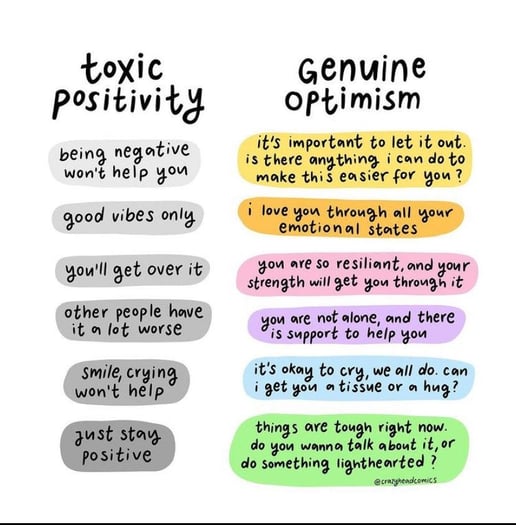
George B. Thomas:Yeah. By the way, you did all the work for the answer on this one because I love the graphic that you shared in the research. I wanna make sure that that makes it over to the show notes for the people to visualize. And the graphic goes a little something like this on the left hand side. I'll just kind of explain it.
George B. Thomas:It's got toxic positivity. On the right hand side, it's got genuine optimism. I'll pick a couple of these just to go through. Toxic positivity might be like, being negative won't help you. Where genuine optimism might be, it's important to let it out.
George B. Thomas:Is there anything I can do to make this easier for you? Toxic positivity might be good vibes only. Genuine optimism, I love you through all your emotional states. I love you through all of your emotional states. By the way, just glue that one to your brain.
George B. Thomas:Smile. Crying won't help you. That's toxic positivity. Or it's okay to cry. We all do.
George B. Thomas:Can I get you a tissue or a hug? Like, which one of those do you need? Or toxic positivity might be, just stay positive. Genuine optimism might be, yo, things are tough right now. Do you wanna talk about it or do something lighthearted to, like, huge difference?
George B. Thomas:Right? First of all, if you look at this graphic, you'll see many of these on the genuine optimism side and with a question mark. On the toxic positivity, they're just statements that shut the conversation down. K? So the only piece that I'll add to that other than them looking at the graphic and kind of starting to realize, oh, crap.
George B. Thomas:I've said that. Whoops. I've oh, I oh my gosh. I 5 out of the 7, I've said, uh-oh. Warning.
George B. Thomas:Warning. Danger. Maybe that's not you, but I sure can tell you that was my life when I started to look at this for a hot second. The only thing I'll add to the graphic and and kind of that thought is it's okay and it's possible to offer a positive message or response without disregarding their negative emotions. I I wanna say that again because I really want you as the listener to understand.
George B. Thomas:It is okay, and it is possible for you as a human to offer a positive message or response without disregarding their negative emotions or your own negative emotions along the way.
Liz Moorhead:I love that you pointed out the thing about the question marks because I hadn't even picked up on that. And what I love about that point is that particularly if you are in the position of you're sitting across from someone that you deeply care about. You see them in a state of pain. And as someone who genuinely cares about this person, our our reflexes, we want to remove this pain, and we want to do it as quickly and efficiently as possible because we want that pain to be as gone as quickly as possible. But one of the things I love about the point you made about the question marks is that you are allowing people to have ownership over their feelings, over their experiences.
Liz Moorhead:And, also, sometimes people don't want things to be fixed. One of my best friends, Jessie Lee, she and I always like to ask each other, what do you need right now? Someone to listen? A distraction? Or do you need advice?
George B. Thomas:Yeah. I may have mentioned this before. I don't remember if I have or not in a in a previous podcast, so I'm gonna mention it now. One of the all time wife and husband hacks that I have found through life is this simple question. I'll ask my wife.
George B. Thomas:She'll start to talk about something, and I'll look at her and I'll go, listen or fix.
Liz Moorhead:That's smart.
George B. Thomas:And she'll say, listen, or she'll say fix. And then I know to go into we're about to do something mode. Because so many times when we are first married, I would just go into I'm a guy. I go into fix it mode. I'm gonna wrap some heads around because, you know, that she's mad because the kids didn't do this or her brother didn't do that or the person that we live next to.
George B. Thomas:What oh, okay. Let me go open up a can of whoop whoop. Like you know? But I just I finally got to the point where I'm like, listen or fix. It's made a huge difference.
Liz Moorhead:Why do you it's important to honor our feelings and emotions?
George B. Thomas:Yeah. So many reasons. But pertaining to this podcast and the way that we're delivering this information and the future book and how it all kind of tie in, I think there's things when you're trying to live a life beyond your default that are core pieces that we need to pay attention to. First of all, I'm a huge proponent of being authentic or authenticity and being self aware of the human that you are. I've had people tell me you're the same on stage as you are at your fire pit, as you are at like, you're just gonna get George.
George B. Thomas:That's okay. Like, recognizing and accepting our emotions is key to understanding ourselves better, And we've literally done, like, understanding yourself and understanding others in the relationship, but understanding yourself leads to the ability to be more authentically you, to show up as a whole as human, to align with our actions and responses with true feelings rather than denying or hiding them. So authenticity and self awareness. Emotional intelligence. Like, I could honestly, this is gonna be sound weird, but, like, when I'm thinking about hiring somebody, I look less at IQ and more, like, emotional intelligence, to be honest with you.
George B. Thomas:But honoring our emotions is a fundamental aspect of developing emotional intelligence. It enhances our ability to understand and manage our emotions as well as empathize because I've mentioned the word empathy before. Empathize with others leading to better personal and professional relationships, wife, kids, coworkers. One of the things that we have to be great at along this journey is we have to be great at making decisions. So when you honor your emotions, improve decision making, when we're tuned in to our emotions instead of putting them in those compartmentalized boxes that I talked about or just running off of basic programming that we've been given.
George B. Thomas:When we're tuned in with those emotions, we can make more informed and balanced decisions. Emotions provide valuable information. Liz, you used the word intuition earlier. Right? Emotionals provide valuable information, intuition that can guide our choices and actions.
George B. Thomas:We talked about numbing earlier, Liz. So the last one I'm gonna bring up here of, like, why is it important to honor our feelings, richer human experiences. We got one go around at this. Like, it should be the best experience that we can create. We should be living a life beyond our default.
George B. Thomas:We should be on the mountaintop. Emotions are a fundamental part of the human experience, embracing the full range, embracing the full range, embracing the full range of our emotions, both positive and negative, allows for a richer, more fulfilling life. And that's what the freaking podcast is about, trying to get you to have a richer, more fulfilled life along the way. So authenticity and self awareness, emotional intelligence, improved decision making, and richer human experiences. This is why it's so important for us to honor our feelings and emotions.
George B. Thomas:Now, Liz, what are your thoughts? Like, do you have additional things that you're like, this, that, or the other?
Liz Moorhead:There's a quote from Saba Tahir that really speaks to the importance of honoring your feelings and emotions, and it goes like this. Your emotions make you human. Even the unpleasant ones have a purpose. Don't lock them away. If you ignore them, they get just get louder and angrier.
Liz Moorhead:Your emotions not only lead to richer human experiences, they are your compass that help you navigate the world. Whether it's teaching you how you need to look at something or it's illuminating a place where you need to do work. So for example, a friend of mine this past weekend texted me. Actually, let me go ahead and bring it up. He texted me a fascinating question.
Liz Moorhead:He asked me, how do I separate minor or less significant failures from catastrophic ones? I do this all the time. I'll freak out about something, but at the end of the day, nothing is ever truly a catastrophic failure. The earth keeps spinning and I'm not dead, so everything's just kind of minor. But how do I tell the difference?
Liz Moorhead:Oh. So then I have a walk that I go on every single day. I walk about mile and a half, 2 miles. There's this gorgeous park in New Haven that I go to all the time called East Rock, and I kept thinking about it. And this is where my brain ended up going, which was a surprising spot.
Liz Moorhead:Suddenly, I wanted to understand why do we need to tell the difference between big failures and little failures? Is it like you only wanna apply your catastrophic thinking to the big ones? And then I kept pushing myself and pushing myself and I I knew I couldn't answer for him. So I started asking this question for myself because I knew sometimes I wanted to separate big failures from little failures as well. And I found myself asking when I have big terrifying feelings about a failure, am I having feelings about the failure or are the feelings really rooted in what does that failure say about me?
Liz Moorhead:And I went, okay. Now we're getting somewhere interesting. And this is what I mean by your feelings can be a compass. They can show you where you need to do the work. I just finished reading the obstacle is the way by Ryan Holiday who is an incredible modern scholar about stoicism.
Liz Moorhead:I love stoicism. I have some issues with how, you know, very unilateral it is about feelings and how to treat and act around emotions. But one of the things that it does talk about is that, you know, your fee fees can sometimes get in the way of smart decision making. And so when I thought about this conversation of with failure that I started having with myself, that illumination of, well, a lot of the feelings that I have when I experience a quote unquote failure have very little to do with the circumstances of what is actually happening. And all of a sudden, it's like lighting up this portion of my brain
George B. Thomas:that is reinforcing all of the worst stories that I have ever believed
Liz Moorhead:or thought about important to not only have the emotion, but It's why it's important to not only have the emotions, but take a moment to sit down and say, well, what are these feelings really? I'm feeling angry. Are you really feeling anger or is it shame? I'm feeling sad and and upset at this person. Well, why?
Liz Moorhead:What did this experience make you feel and what does that tell you? Again, it's that Benjamin Franklin quote, things which hurt instruct. But also on the positive side, again, something lights up your whole body, What does that tell you? Is that bringing you closer to your purpose? Is that bringing you closer to your passion?
Liz Moorhead:We can't overlook those ineffable feelings where our whole body turns into a yes when we're around the right projects, the right communities, the right people. That is instructive as well. So when I think about the importance of honoring our feelings is that if we take the time to sit there and allow ourselves to be uncomfortable and be honest with ourselves about why we are feeling a particular way, positive or negative. The guy I'm about to ask out on a date, I've spent months feeling, quote, unquote, uncomfortable about it just because I couldn't honor the fact that, like, oh god. This feeling I'm trying to avoid is actually a happy feeling.
Liz Moorhead:This is a happy feeling that I had demonized within an inch of its life. I'm like, this is making me uncomfortable. Why are things weird? Am I weird? This is so oh, god.
Liz Moorhead:I'm having a feeling, and I'm trying to kill it. Like, that's where this thing gets so wild. So that's my take on it is that if we take the time to sit down like, if you wanna be a productive growth mindset person, then be productive about your feelings. Don't try to kill them. And sometimes being productive is like, I just need to sit in the storm.
George B. Thomas:Yeah.
Liz Moorhead:I need to let the rain pass. I need to understand what's happening. Yeah. That's my thinking there.
George B. Thomas:I love it.
Liz Moorhead:So you brought up something at the start of this conversation that I wanna spend a little bit of time on here and that is this gendered conversation around feelings. Yeah. Because what if I'm fascinating about it is that men are trained from birth. Don't cry. Don't show weakness.
Liz Moorhead:Don't do this. Don't do that. You are here to be strong, and you are here to do all of these things. And when you see a man cry, it's like, oh, god. What's Yeah.
George B. Thomas:What's Whole voice falling apart. What's wrong with him?
Liz Moorhead:Exactly. Women, we have the we have the other extreme. Oh, that's her just being emotional. Mhmm. I'm using absolutist terms.
Liz Moorhead:Right. But if we're talking from a stereotyping perspective, women struggle to be recognized in a positive light whenever they're showing assertive, go getter tendencies. If she's being confident and passionate in many cases, depending on what the work culture is like, she may be perceived as shrill. She wants it too much. She's a woman who doesn't like other women, and it comes from both sides.
Liz Moorhead:Like, here's what I will say. Do we have an issue with how women are perceived by men in the workplace in society? A 100%. But I will tell you as someone who is a woman herself, do you know who's freaking catty about women? Other freaking women.
Liz Moorhead:Facts. Nobody wins. Nobody wins in this scenario. So I wanna spend a little time here for you. George, do you still feel uncomfortable displaying emotions?
George B. Thomas:Yes. But I'm trying to get better at it. That's how I'm gonna answer this, but I also wanna dive a little bit deeper. It's funny, Liz. I gotta unpack one piece.
George B. Thomas:It's in my brain. My wife for years when we were first married, like, she would tell me, listen. I don't I don't have girlfriends. I've got friends who are guys. They're just friends because she just couldn't deal with the way that other women kind of run around each other and run over each other.
George B. Thomas:But back to the guy thing, here's what's crazy. I still have a hard time with sharing emotions, but I am actively trying to change that. I'm gonna say something that's gonna sound sad. I will sit and watch certain videos of people singing songs or overcoming challenges to try to make myself emotional because I'm trying to deprogram the 52 years of you're not allowed to share your emotions. You need to walk it off.
George B. Thomas:Suck it up, buttercup. Be the man because I'm trying to become more in tuned with the emotions. Here's the funny thing, Liz. When we were doing this research, I went over to YouTube because you always like to give me articles natural reader, and I listen to them and read them at the same time. But I went over to YouTube, and I typed in what is toxic positivity.
George B. Thomas:You wanna know how many men showed up in the top ten results?
Liz Moorhead:0.
George B. Thomas:No. It was better than that. It was 3 out of 10. 3 out of 10 thumbnails had men. Hang on because I'm not done yet.
George B. Thomas:But here's the funny thing. Results 9 and 10 were men, and here's the titles. 2 easily remembered questions that silence negative thoughts. And it's exactly what it sounds like. It is not talking about toxic positivity at all.
George B. Thomas:It's just an algorithm that thought it was close enough to throw it in the top ten results. The second one is pathological positivity, how to be positive no matter what. Again, not about toxic positivity. So there was one dude in the top ten search results that actually had a video that was aligned with the topic of toxic positivity, emotions, like and it and it's a good video, by the way. It's a good video.
George B. Thomas:Liz, we're not even in the dang conversation. Men are not even in the dang conversation. And this to me is a freaking travesty. Like, why are we as men considered weak if we embrace our emotions? Why are we not allowed to think of vulnerability as a superpower?
George B. Thomas:I think that we should. I think that we should be allowed to do this. But, unfortunately, that is not the narrative, and that's not what we're doing, and and I'm challenging myself moving forward. I want to talk about toxic positivity. I wanna talk about emotions.
George B. Thomas:I wanna talk about being vulnerable. I want men to realize it's okay to not be okay. It's okay not to be in control. It's okay to feel what you're feeling. You don't have to press it down, press it back.
George B. Thomas:It's okay. It's okay.
Liz Moorhead:I think the world would be a a much happier place if more men were empowered to be not okay.
George B. Thomas:Without a doubt.
Liz Moorhead:Because I know that in so many ways, the rise of toxic positivity is basically that friend on steroids who cares about you so much that they just try to fix everything for you. You know what I mean? Yep. Like, these come from well meaning places, or they come from places of I am dealing with so much pain. I need to find a way out, and I'm looking for hand holding instructions to get me out of whatever this dark place is that I'm in.
Liz Moorhead:Yep. Which was the place I was in last year. I was scrambling trying to find any shred of how do I find my way out. And sometimes, guys, that way out is
George B. Thomas:therapy. Talking to a friend.
Liz Moorhead:Just saying out loud, I am not okay.
George B. Thomas:Facts.
Liz Moorhead:And it's so funny to me how sometime we're so not used to having emotions and feelings in our bodies that it's kinda like what I told you earlier. I was having extremely positive emotions, but it's like my emotional immune system was like, set phasers to stun.
George B. Thomas:Kill it. It is an emotion. Kill it.
Liz Moorhead:And it's like, no. She just likes a guy. It's okay. Everything's fine. Stand down.
George B. Thomas:Yeah.
Liz Moorhead:Like, our nervous systems are so shot in so many ways. Like, we're always operating in extremes. Now I you always are are incredible at giving advice. So I'm about to ask a question where it is for our audience, but it's also for me.
George B. Thomas:Yeah.
Liz Moorhead:We've been talking a lot about us in the seat of being the giver of toxic positivity. But, again, as we've talked about it at length in this episode, we can find ourselves on the other end of the spectrum. Like, I know there have been cases where I've been on the receiving end of toxic positivity, and I didn't know how to advocate for myself in the moment and the validity of my feelings. You know, I am feeling x kind of way. Well, Liz, you're in control of your feelings and emotions.
Liz Moorhead:What you know, all of those, like, little insidious things. So how would you suggest folks respond to others in their lives if they find themselves in that situation?
George B. Thomas:Yeah. I'm gonna keep this one short. It's okay to stand up for yourself. Like, I mentioned that graphic. Right?
George B. Thomas:You know, you come into the situation. Oh, being negative won't help you. Reverse engineer that it's important to let it out. Is there anything I can do, like, should be coming from them? Stand up for yourself.
George B. Thomas:Actually, here's how I'll say this, and then I'm done with this question. You can add to it if you want. Stand up for yourself and realize that you've been provided a great life teaching moment for that other human.
Liz Moorhead:I love that. Like, that that would be the jerk response. Notes. Yeah. I've had situations like that in the past where I've had to advocate for myself.
Liz Moorhead:And the one thing I would say is, you know, sometimes you have to prepare yourself for a negative reaction and that's okay. I think we have to keep in mind that these are our emotional experiences. These are the things that we have to go through on our own. So there are cases where your advice, what that has looked like in practice for me is I genuinely appreciate how much you were trying to help me right now. But what I really need right now is for someone to just listen and not help me solve because I'm not sure what I'm solving yet.
Liz Moorhead:Or I've actually had cases where I'm like, this is just an unproductive rant, and it's a better out than in situation. We don't need to fix it. We don't need to solve it. It just needs to be. So being really clear about what your needs are emotionally can be exceptionally helpful.
Liz Moorhead:And then in some cases and I I had this happen a couple of times last year. Don't create more of an emotional burden for yourself if somebody is more interested in being the role of the savior rather than the role of the friend or the good listener. Just say, hey. Thanks for the advice. I appreciate your time, and move on.
Liz Moorhead:You don't need to compound whatever angst it is that you're in because somebody else is creating more of an emotional problem for you. So, George, I wanna leave our listeners with a bit of hope. Not that we haven't provided hope in this episode, but as you said at the beginning, you know, we've talked a lot about growth mindset. We've talked about victim versus victor mentality. We've talked about a lot of things where it does require a bit of, alright.
Liz Moorhead:Pull yourself up by your bootstraps. But there is that critical component, right, of being with our emotions, honoring our emotions, honoring our feelings, being honest about them. So what is possible when we allow ourselves to experience our true feelings and emotions?
George B. Thomas:Yeah. Ladies and gentlemen, I'm gonna keep this short and sweet as well because I realized that you've been hanging out with us for over an hour at this point around this conversation. And so there's 4 things that I'm gonna hit upon that are very important as you're on a journey for a life beyond your default. 1, increased life satisfaction. I've mentioned this.
George B. Thomas:I'll continue to mention it. We got one go around on this. But increased life satisfaction, embracing the full range of human emotions, including the uncomfortable ones, can lead to a more authentic and fulfilling life, a more authentic and fulfilling life. It allows us to live more fully and experience a richer array of life's experiences. Do you not want that for yourself?
George B. Thomas:I want it for you. I want it for myself. So it's okay to do that, but it's gonna take going through the messy, uncomfortable, and positive emotion. Quit numbing them all down. Authentic relationships.
George B. Thomas:Being in touch with our emotions allows us to communicate more honestly relationships and the relationships that we bring with us along this journey. But if you want increased life satisfaction, authentic relationships, it's through the emotions. It's allowing ourselves to experience true feelings and emotions and not getting caught up by this hidden demon that is toxic positivity. Deeper self understanding. I've talked about sitting at the base of that tree, ladies and gentlemen.
George B. Thomas:I've talked about understanding yourself and self awareness. Experiencing our true emotion leads to greater self awareness. We understand our triggers, preferences, values, which are crucial for personal growth and making life choices that align with our authentic selves as we move forward. Greater resilience. The journey is hard.
George B. Thomas:The path is narrow. The hill is deep. You're gonna need to be resilient. By facing and navigating through our emotions, we build resilience. This helps us better handle future challenges and recover more quickly from setbacks or emotional upheavals.
George B. Thomas:I want you to understand by facing and navigating through our emotions, we build resilience. This helps us to get better and handle our challenges and recover more quickly, allowing us to get back on the path to the goals that we have and live a life beyond our default.