Subscribe
Share
Share
Embed
The World of Higher Education is dedicated to exploring developments in higher education from a global perspective. Join host, Alex Usher of Higher Education Strategy Associates, as he speaks with new guests each week from different countries discussing developments in their regions.
Produced by Tiffany MacLennan and Samantha Pufek.
Alex Usher: Hi everyone, I'm Alex Usher, and this is The World of Higher Education Podcast.
One way in which Canada's a big outlier in global higher education is the lack of standardization of university forms. Most countries have national or subnational framework legislation that applies to all institutions, operations and governance, but not Canada. Our provinces tend to prefer creating new bespoke legislation for every new institution that comes along. On the one hand, this leads to a pretty chaotic system. On the other, well, sometimes you get some pretty interesting experiments.
One of the most interesting examples of this in Canada is Royal Roads University in Greater Victoria, British Columbia. With its headquarters on the site of an old military college, this institution, which celebrated its 30 year anniversary just in 2025, is fundamentally unlike any other public university in the country. It doesn't possess a senate for academic governance. It doesn't offer tenure in the way that that term is conventionally defined in Canada. Its teaching is mostly focused on mid-career professionals, which means it's competing much more directly with community colleges and private providers for students. Its teaching has for most of its existence, also had a major online component, and it receives a lot less government money per student than other institutions in British Columbia. So it's a public institution that's forced to behave in a much more market oriented way than almost any other one in the country.
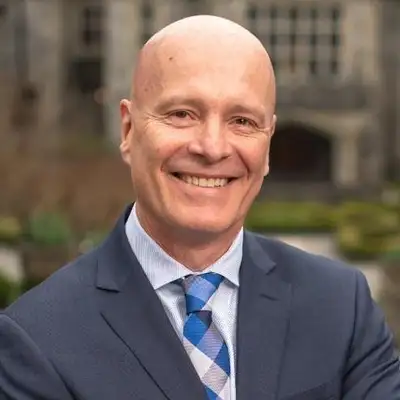
Today my guest is Philip Steenkamp, who's been President of Royal Roads University since 2018. I wanted to hear how railroads was fairing in the current generalized funding crisis in Canada. Has its unique positioning, given it more advantages or more challenges compared to other institutions? I also wanted to chat with him about the institution's new foray into international education. Having recently become the first Canadian institution to open a campus in Dubai since the University of Waterloo shuttered its campus there in 2012.
All in all, this was a great conversation providing loads of insight into just how much work even the most innovative institutions need to do to stay afloat these days. And with that, over to Philip.
Philip, thanks for joining us. Can you start by, you know, telling us a little bit about Royal Roads' history? It spent the first few decades of its existence as a military college. How did it switch from being a military college to a public university?
Philip Steenkamp: Yeah, it's an interesting history, Alex. I mean the, the property itself goes back you know, of course thousands of years, was, you know, occupied and, and used by, indigenous peoples. It then became what was essentially an Edwardian country estate which was owned by James Dunsmuir, who was both Premier and Lieutenant Governor of British Columbia. And then in 1939, his widow sold it to the federal government, became a military college. It was military college as you indicated for about 50 years actually. And then in the mid 1990s, the federal government decided to divest itself, you know, of military colleges across the country and concentrate training at RMC. And so, you know, the question arose what was to become of Royal Roads? There was lots of debate internally. Eventually the provincial government stepped up and it became provincial, publicly funded university.
There's lots of background history here. We have the only University of British Columbia that was actually established by a NDP government. You might remember Tech BC, that didn't last very long. But the Minister at the time was Dan Miller. He was a millwright from Prince Rupert. So he wanted a very different kind of university, not a traditional university, and hence we got our own piece of legislation, unicameral governance. So there's no Senate, powers of the Senate are vested in the President and the Board, and a very focused mandate to serve the needs of the labor market, and only offer applied and professional programs. And of course we don't have tenured faculty. We have a small group of continuing faculty and then a large contingent of associate faculty. So it's a very different kind of model, very different kind of university and, you know, I think a very interesting experiment in, Canadian post-secondary history.
Alex Usher: Yeah, well let me focus on just one bit of that here 'cause you know, it's that focused on the needs of the labor market, and also being you know, largely distance education. Not, not entirely, but that has always been a, a lot of it is you're either doing fully online programs, I guess that wasn't the case in 1993, but, you know, programs where you're bringing people in for short periods of time and people are working at their own pace outside that. In 1993, I don't think we had any universities like that in this country. I guess it be, there would've been BC Open, which became part of Thompson Rivers. You would've had Athabasca. That's a very specific mission. How did it shape the institution's core identity and character over time?
Philip Steenkamp: Yeah, it, it is interesting and I mean, I think, you know, typical of sort of startups, it sort of evolved organically and I would argue that it took the kind of least line of resistance, 'cause there wasn't a ton of support from other universities for Royal Roads at the time. So it sort of went where it could go. So, you know, the flagship programs are sort of in the leadership area and then over time other things and other specialties developed. I think what became distinctive pretty quickly was blended programming. So, as you indicated, a lot of the instruction is online, but most programs had an in-person component. So short-term residencies where people would come in for two or three weeks a couple of times a year. It was cohort based. So, that original mandate served the needs of the labor market. Applied professional programming, certainly has shaped the way the university has developed and the kind of programs that it has adopted. But it was very organic. And, you know, we'll probably talk about this in a moment, but we've just recently opened a brand new campus in the adjacent city of, Langford, which is entirely face-to-face instruction and focused on undergraduate education.
Alex Usher: So, as you said, you just opened a new campus in Langford, and so you're now running in person three and four year programs, I guess. How do you balance running a a university that's mostly blended and now somewhat in person? Like those are two different, being presential or non-presential, that's a really difficult balance to make, I would imagine, right? I mean, there's very different types of, campus operations that are required. How do you balance them?
Philip Steenkamp: Yeah, well, just, you, you know, the, the genesis for that Langford campus, when I started as President just over six years ago, you know, and I even remember in my interview with with the board committee you know, my argument was, this university is not sustainable in the long run unless it expands. That whole market of mid-career professional is a very competitive market right now. You know, given the demographic change, more and more institutions were getting into that space. So we started developing a business case to open a campus and to offer all four years of undergrad.
To that point, we had only offered undergrad completion third and fourth year which was a great model until 2005 when BC colleges got degree granting authority. And after that you could begin to see the decline in domestic enrollments at Royal Roads. Slow decline, but there for sure. So the idea of opening a campus focused on undergrad was really, we would become a university not only in that community, but for that community.
One of the fastest growing regions in, in Canada, of course, the West Shore here on Southern Vancouver Island. And, you know, the idea was really to sort of expand our reach and extend our mandate. So your question about, you know, how you run these two things, the Langford campus is gonna focus on undergrad education.
You might know that we invited University of Victoria, Camosun College and the Justice Institute of BC in to offer programming in our space. So it's a very different kind of collaborative model. The Calwood campus will stay mostly focused on graduate education, so we kind of have a little bit of that separation. But it does take us into a different realm, absolutely. And, and we are gonna have to get our heads around you know, resident student populations and all that comes with you know, serving undergraduate students, which is quite different than the, the typical student we have served over the last few decades, which has typically been a mid-career professional. Average age of our students last year was 39. That will begin to change as the numbers build at Langford.
Alex Usher: So you mentioned in your first answer, you, you mentioned that your faculty don't have tenure in the traditional sense, they have continuing appointments. You noted that you don't have a senate. Now pretty much every university president I know dreams of having this, right? Like they think that it would give them untold flexibility you know, much more than they have right now. Does it? I mean, do you have greater room to maneuver than your counterparts or, you know, are sort of norms of academia such that even though your staff don't have tenure and there isn't a Senate, there's still a lot of informal ways that staff can exercise inertia.
Philip Steenkamp: Yeah. I, I would say generally we have a lot more flexibility than, than a traditional university and, you know, talking to some of my colleagues the other day from across the country, I mean, there is this kind of narrative out there right now that, you know, universities are pretty much ungovernable, particularly the big ones. And you know, a lot of that has to do obviously with the relationship with senates and how that all unfolds. And all, all the challenges around collegial governance in a, in a unionized environment, you know, all of those kinds of things. So we on paper have a lot of flexibility, but you are right, I mean, internally you know, there, there are advisory structures. And there still is resistance to things as one might imagine. But I can't imagine having done what we've done in the last three years at Royal Roads without this unicameral structure in place. Some examples of that are the ability to make decisions to establish new campuses very, very quickly. But more than that, the ability to close down programs. And to establish new programs. Because those powers are invested in the Board and the President, we have a committee of board called the Program and Research Council which has board members on it. But we also have the ability to have external members on it too. And that's, that's really where the programs get approved. And, you can kind of curate that council in a way in which it is very supportive of, of innovation and change.
Alex Usher: So, we'll come back to some of the changes you've made after the break, but just before we, we head to a break, I want to ask you the, the past few years have been challenging for Canadian universities. Royal Roads has always been more tuition driven than most, certainly in British Columbia. I mean, you're the scrappy, almost private university, right?
So, how have you done over this last period? Has your financial challenges been similar to the rest of the sector? Have you had a better time of it? A worse time of it? What's been going on?
Philip Steenkamp: It has been really challenging, Alex. You know, the original sort of management team at Royal Roads when it was established, actually told the provincial government that Royal Roads would be self-sufficient in a number of years, which was a, a terrible mistake, right? And as a result, the you know, the level of provincial funding from the beginning was very low, and it is more tuition dependent. We did become pretty reliant on international students and, you know, before we saw the, the major restrictions from IOCC, our international student numbers were in the 22 to 25% range. So, so that was pretty hefty. But we have also been challenged by a declining in, in domestic enrollment you know, for a whole variety of reasons, but chief among them, as you well know, I mean the kind of content game is over. You can get good content pretty much anywhere right now at low cost or for free. And there's a ton of competition in our space in the professional kind of masters space right now, and in the kind of modalities we have, to online, blended, all of that kind of thing, which we didn't face years ago. So we faced what I would say was a real existential challenge about three years ago. Saw significant financial challenges. We adopted a three year action plan as a sort of turnaround strategy. When I met with the Board this June and a board member asked me, is the plan working? And I said, I, I can't say it's working, but I can say it's not not working. When I met with the Board a couple of weeks ago, they asked the same question. I said, I can tell you the plan's working now. We actually have seen prospect numbers significantly increase. We've seen applications begin to increase. We are closing the kind of operating gap we have. You know, we are looking at a balance next year in operating. We actually balanced last year, but that was because of an endowment. And so I think we are heading in the right direction, but it's taken a real focus on what I call product price and customer experience. And we've done a lot of work in those spaces.
Alex Usher: We are gonna take a short break. We'll be right back. And we're back. So, Phil, we were talking about the things that Royal Roads has done to improve its situation and you've taken some risks, right? Like I think the most interesting risk is the most striking one is the decision to establish a campus in the United Arab Emirates.
Now that's a pretty common move in the UK and Australia, but it's rare in Canada. What led you to take that step? Why did you pick Dubai?
Philip Steenkamp: Well, you know Alex, I've been a Deputy Minister of Advanced Ed in BC, and in Ontario worked very closely with federal officials. And I could see the kind of train wreck coming on immigration a few years back. And you know, we would, we were trying to think ahead. Being a small special purpose university, you have to hustle, right? You have to think ahead and just figure out where things are going. And transnational seemed to me to be an important strategy to sort of diversify our risk around international students in particular. But we've also seen very high visa refusal rates from certain countries, particularly in, in Africa. So this was a way of diversifying risk and reaching students who couldn't reach us. And so, the Emirates is obviously a really important hub. There's a huge percentage of the world's population just within a few hours flight of the Emirates. It's a supportive regulatory environment as well. There've been many examples of successful T and E ventures there, that many examples of unsuccessful ones as well. And so we worked with a partner, the Ottawa Education Group, which is headed up by Dr. Alastair Summerlee, formerly President at Guelph, and Interim President at Carlton for a while. And they introduced us to a partner who has become our sort of investor operator in the Emirates. So for that reason, we decided it was a, it was a good risk to take, and we obviously, you know, had a set of criteria that we looked at before making a determination about whether to proceed with this or not. We looked at issues around academic quality, reputation, financial viability, the regulatory environment, the human resources implications and of course, what we would call a sort of partner dependency and market demand. And having assessed this opportunity against those criteria, we came to the determination that was a very good location for us. And we are the first Canadian University in the Emirates.
Alex Usher: Yeah. So what lessons have you learned so far? Like, what are, what are the three things you definitely do again, and, and three things you'd never do again?
Philip Steenkamp: Well, you know, we're small and special purpose, so we are not one of those big universities that can invest millions of dollars in our own bricks and mortar campus. So, absolutely, if we do it again, and I actually am looking at an opportunity in Sri Lanka right now, we need to find an investor operator we trust and also a kind of manager we trust.
So that, that is number one. The other one would be, again, we're small, special purpose. We're not ranked and you know, in, in Dubai, in some of the
Alex Usher: That matters. Yeah.
Philip Steenkamp: Dubai and Abu Dhabi, you have to be in the top a hundred of Key West, right? So we need to find emerging markets where we can be first movers as well. And the other thing I would say is, then you need to assess the opportunity very quickly and you need to make a decision very quickly and just move.
And then the other, I guess the third thing I would do again is hire a dedicated project manager who can manage that relationship with the partners, 'cause it's not easy. There are tons of issues you have to deal with.
Three things I do differently. Right up front, I would work more on, I guess what I would call, invest more in cross-cultural understanding. Very different understandings of you know, definitions and terminology, how you count students, courses, credits, what the recruitment models look like, all of those kinds of things. And I think we, we just needed to spend more time on understanding that. So there were fewer surprises as we proceeded.
The second thing is focus more on internal change management and capacity building. You know, establishing branch campuses requires not only external partnerships, but also sustained internal alignment across academic, administrative and governance units. So more investment there.
And then the third thing is probably building more contingencies in the startup phase. You know, just some real complexities around scheduling and, and resourcing kind of initially. And I think we probably made some assumptions around timelines and approvals and, and things like that, which were probably a little overly optimistic.
Having said that, we opened in April this year. We have between four and 500 students right now. And we've already had two dividends paid out to us, right from the beginning without us having invested at all. I mean, obviously we've invested time and resources and energy in it, but it's our investor who has invested, to get this thing up and running.
Alex Usher: I assume you're too savvy to see an international campus as a silver bullet. So what else is Royal Roads doing to strengthen its revenue position?
Philip Steenkamp: Yeah, I, you know, I would say the T and E stuff for me is about diversifying risk, reaching students who can't reach us, and stabilizing us, our position. But the fundamentals we have to address at Royal Roads are, we are a small special purpose university in a very competitive environment. And, you know, the content game is over. So what are we offering? What is our unique value proposition? And so, our main focus in our three year action plan is on sorting out those questions. So as examples, we've fundamentally changed the academic structure of the university. We've moved from seven schools to three. We've merged the two program faculties into a single faculty of interdisciplinary studies. We've established three advisory councils you know, in the areas of those three schools, which can advise us on programming with the intention of being much more closely aligned with labor market and getting students kind of career ready. I've mentioned the diversification into undergraduate education with the establishment of the Langford campus. We've invested significantly in overhauling our recruitment processes, our admissions processes. We've really upped our game in terms of communications and marketing. We've seen an unprecedented increase in research income over the last couple of years, a 400% increase. We had a record advancement here last year. We raised $20 million for a small place with, just over 2000 students. That is huge. And we are working a lot on the ancillary side. You know, we have this fabulous location, we are leveraging it every way we can. We've had movies filmed we've had a Netflix series filmed. We do 60 weddings a year. So we're constantly looking for all the opportunities there. But fundamentally we have to figure out what the product is, you know, what the product is right now, how can we compete in this space right now? And how can we offer what I call an excellent kind of customer service because there's a lot of options out there and, you know, we have to distinguish ourselves.
Alex Usher: And what about the cost side? I mean, it sounds to me like the, the, way you describe those changes to the facul is that's about giving you more flexibility in creating new programs, right? That's still a revenue side thing. How are things you know, what are the areas you've found you've been able to economize?
Philip Steenkamp: Well, you know, again, you know, going back three years, we could see this challenge emerging and building really, really quickly. So, we moved pretty quickly to cut costs three years ago through, you know, voluntary retirement programs, voluntary departure programs. We cut our sort of total workforce by about 10% back then, so we've been able to reap the benefit of that. And we've done all, all the other things as well that others have done in the kind of financial triage that we've all had to do recently.
And then moving forward, we are going to be very mindful about not becoming only reliant particularly on international student revenue. I mean, obviously we have to stabilize first. But investing money in kind of strategic funds and trying to be less reliant on the operating side on things over which we, we don't have that much control. We also took a much more aggressive stance on our investments. We invested in tech in a big way in Nvidia over the last little while. So we've seen a significant increase both in Royal Roads University investments and in our foundation investments. So we built ourselves a little more buffer, a little more runway.
I mean, obviously we don't have the huge endowments and, and the resources of the big universities, which can withstand these storms much more effectively than small special purpose places like us. But you know, fundamentally, right now, we just have to constantly be figuring out where things are going. We have to be very adaptive, very responsive very, very nimble. And you know, people ask me, well, what's the vision of the university? I say, that's the vision of the university. The world's changing so quickly. It is so turbulent. That's the vision is the a university that can respond in real time to what's happening.
Alex Usher: And so if we came back five years from now and, and sort of, you know, best case scenario five years from now, what would you wanna be able to say about Royal Roads University, about how it turned itself around? What's the end goal of that? How does it you know, who do you wanna be in 2030?
Philip Steenkamp: Yeah, that's an interesting question. We have in our three year action plan, we laid out a vision for 2028, you know, which was, certain number of FTEs divided by domestic, onshore international, offshore international, where we wanted the endowment to be, where we wanted the investments to be. The kind of programming space we'd like to be in, you know, all of that. But if you ask me sort of five years, hence I would say that the university the, the sort of familiarity and awareness scores, which we track and we, we track many metrics, but, but that they are significantly up. Royal Roads is seen as the place to come if you are a professional. I mean, we focused on mid-career, but I would like to think about ourselves as Canada's universities for professionals who are looking at upskilling. That we are seen as very tightly aligned with labor market and responsive to labor market as well. That we are seen as highly innovative as well, that we have very contemporary platforms. That we have succeeded in the transnational space and that we have built really strong partnerships. I mean, my own view right now, small special purpose places like us will not survive without partnerships. So we've got these international ones, but I'm working really hard on domestic partnerships. So we have this agreement with Mount Royal University, which as you know, is exclusively undergrad. We've signed an MOU with BCIT. I would love for us to develop a joint venture with BCIT along the sort of Guelph-Humber lines as an example.
We have been in discussions for the last couple of months, and straight after this meeting I'm talking to the Canadian Armed Forces about a significant partnership with them starting in September next year. So, you know, part of that vision in five years time would be for us to have successfully established partnerships and for us to be in that position of being responsive and being able to adapt no matter the circumstances we find ourselves in. 'Cause, you know, I have no doubt that the next five years are gonna be as turbulent, if not more turbulent than the past five.
Alex Usher: Fantastic. Well listen, let's hope the military doesn't ask for their campus back. Philip Steenkamp, thank you very much for joining us today.
Philip Steenkamp: Yeah. Thanks Alex.
Alex Usher: And it just remains for me to thank our excellent producers, Tiffany MacLennan and Sam Pufek, and you, our readers and listeners for joining us. If you have any questions or comments about today's episodes or suggestions for future ones, please don't hesitate to get in touch with us at podcast@higheredstrategy.com.
Bye for now.