Subscribe
Share
Share
Embed
Featuring interviews, analysis, and discussions covering leading issues of the day related to electromagnetic spectrum operations (EMSO). Topics include current events and news worldwide, US Congress and the annual defense budget, and military news from the US and allied countries. We also bring you closer to Association of Old Crow events and provide a forum to dive deeper into policy issues impacting our community.
speaker-0 (00:00)
you
Ken Miller (00:09)
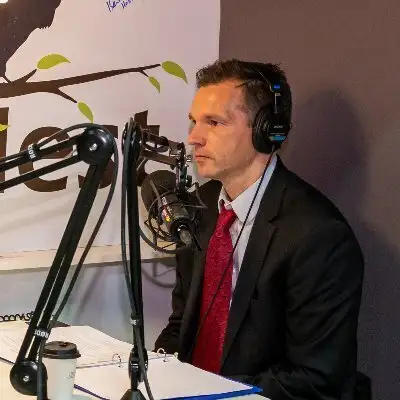
Welcome to From the Crow's Nest. I'm your host, Ken Miller from the Association of Old Crows. As always, it's great to be here with you. In this episode, I bring you part two of my visit to Thor's Hammer 2026 in Norway, a test and evaluation trial of NATO Subgroup 1, which focuses on counter-RCIED and counter-UAS solutions. Now, in part one, which was released earlier this month on July 8th, we heard from Eric Bamford and trial manager Frodo Ringdoll from Norway.
I also spoke with delegation representatives from Denmark, Sweden, and the Netherlands. In this episode, we continue our spotlight on various test lanes and participants. First, I sit down with Michael Alpiri, the chairman of NATO Subgroup One and the lead of the US delegation. I then welcome representatives from Australia, Germany, and Norway. We have a lot of ground to cover, so without further delay, let's listen into my conversation with Mike Alpiri. I am pleased to be here with my first guest, Michael Alpiri. He
led the U.S. delegation at Thor's Hammer and he's also the chairman of Subgroup One. And I had the pleasure of having Mike on the podcast, I believe toward the end of last year. A great conversation. Met him for the first time in Washington, DC at at an event ⁓ NSWC Crane. And we got talking about greater collaboration with NATO Subgroup One. And so Michael, it's great to have you back on the show. Thank you so much for your participation, everything you've done for Thor's Hammer, as well as
you know, facilitating my arrival there as well. So thank you for joining me here on on from the Crisons. It's great to have you on the show.
speaker-2 (01:40)
Well, Ken, thanks for inviting me back again. It's ⁓ good to be with you. We've done a lot of work in our group over the last year. Our group, subgroup one, has a mission, and that's to counter small unmanned radio frequency threats to improve our capabilities and capacity to support our NATO allies and partner nations in our group. And one of the
pinnacle things we do every two years is a Thor's hammer test event. And we have under us three working groups that all kind of support that. And if you think about defeating threats, we're broken up to kind of support that kill chain effort of looking at exploitation of the threat, of our capability and effectiveness group to be able to come up with techniques to defeat threats. And then our operations
group to be able to turn all that information into operational vignettes and scenarios that we could provide NATO if they ever needed us to be deployed in ⁓ any type of situation. So we think we're well prepared for that. And after our last meeting and talking about our Thor's Hammer event, was happy to ⁓ brief our group on inviting you to come to Camp Reina for a couple of days to witness
kind of the scope and setup and ⁓ the camaraderie that our group has and the types of capabilities that we bring to all of us. Thor's hammer's been going on since 2015 and it was first at Camp Raina in Norway and we just completed Thor's Hammer and we were back at Camp Raina for Thor's Hammer twenty six. And so ⁓ we've come a long way to come back to the start of where we
Had our first event, and things have evolved in our group over time from testing 100% against counter-IED threats in 2015 to then slowly evolving in 2022 to start countering small drone threats, testing in urban environments in 24 when the US hosted, and having more drone lanes.
To now in Norway, we had probably more than 50% of our testing was against counter drone threats. So our group has kept pace with how the threats evolved, and we continue to do that through updating our terms of reference and our Thor's Hammer MOU to do testing at a more rapid pace, because as we've seen in the Ukraine Russian war.
Threat evolves in days and weeks, not months and years. And so we were happy to have you come to Camp Arena to witness the setup of our testing, ⁓ to interview our different lane owners, and for you to be able to get a sense of the scope and complexity of what we do every two years. And because, you know, I've been part of it, ⁓ you know, I've got a biased view of being a great event.
But it's nice to have outside eyes like you can to come see the event and I'd be happy for you to maybe talk a little bit about what you experienced and seeing the setup and talking to the folks in the group.
Ken Miller (05:14)
I absolutely appreciate ⁓ ev all the work you put in as well as your your team to facilitate my participation there. It was a great event. I think the only downside was that I couldn't have been there longer because there was so much content and so much ⁓ interaction and people to talk to that you could only get just a fraction. ⁓ but one of the things that really struck me very early on.
was if you go to other exercises, a lot of exercises, and I'm not talking even just NATO, but within country and so forth, a lot of exercises are, I would say, struggle with operational relevance. You're doing something that might be somewhat tone deaf to other what's going on around the world. That is not the case with Thor's Hammer. I mean, your operational relevance of everything that you're doing, you're addressing exactly the challenges that you're we're facing on a day to day basis, as you mentioned, and it's rapidly evolving. And Thor's Hammer has been able to keep
Pace with that. And it was really neat to see and interact with experts there who understood where each country and as well as NATO as a whole are at today, where they're going, where they need to be tomorrow, and how to get there and how to work together. And that collaboration was on display from the moment I touched down at Camp Brain Up. So ⁓ it was a really interesting period of time there because you could see that everyone wasn't just looking at
what results they could get, but also how to adapt their technology to a dynamic threat environment.
speaker-2 (06:45)
Yeah, our group is has been really close because we've worked together now for ⁓ six going on six Thors Hammer events. ⁓ we're becoming real experts at testing. We've shared a lot of information from different countries on how to improve our testing. So we continue to get better at it to collect more and more information. And the collaboration between the countries is outstanding. We're sharing
So much information between all of our countries. We've set up that infrastructure to allow us to do that. And that's elevated the capability of all the countries and everybody that comes to our event comes to VIP Day to see what all of their folks have done, the accomplishments they have. It allows us to continue to get support for our mission area so that we can continue to adapt our systems to keep pace with the threat.
And we're excited to continue that effort. we have more countries lined up to support Thor's Hammer in the future. So our group is is growing and very strong and definitely supporting the NATO mission.
Ken Miller (07:59)
So in our first episode covering Thor's Hammer, which aired on July eighth, I had the opportunity to share my conversations with ⁓ the representatives from ⁓ Netherlands and Denmark and Sweden. And we covered some of what was happening at the various lanes. And there are six lanes. And so, Michael, I I would like to kind of get your take on how those lanes work. We had ⁓ the lane one was hardware in the loop, lane two was dealt dealt with counter UAS.
Then there was lanes three and seven. I think US was in lane three or seven. I can't remember which one. You had a shadow lane. ⁓ there's another counter UAS lane, ⁓ lane six where the Australians were at. So tell us a little bit how those lanes were organized and what the goal was with the collaboration between all six lanes.
speaker-2 (08:48)
Yeah, I'd like to take this time too to thank Norway. They were an outstanding host for this event, and they were the ones who set up all these lanes for us to be able to go test at. And the lanes are set up to be able to test both some capability and effectiveness of our systems, the compatibility, and when you know you ship equipment in from all over the world to a place.
A lot of different things can happen. And sometimes you need a hardware in the loop lane to be able to connect your system to work out some bugs or a shadow lane to be able to go and, you know, fine-tune your system. And so the setup we have allows multiple activities to happen at the same time where you can make sure your system works, or if you've tried out a new threat because
All these systems now have software-defined radios and are programmable and we're able to make changes on the fly. And then you'll be able to take it right out from a hardware in the loop lane or a shadow lane out to a test lane and collect that new information and see how you've improved your capability against the threat that's on that lane. And as all of this is taking place, multiple countries, you know, are on all the different lanes.
And they're sharing all this information. And so it's a very dynamic environment, but it allows us to rapidly look at our systems and continue to improve them so that when we walk away from this event, everybody's got probably a better system than when they showed up at the beginning.
Ken Miller (10:35)
And that's really the key point of a lot of this is that it's not just about the results that you get during the exercise. It's about the work that is highlighted that you need to continue working on after Thor's Hammer and in really in preparation to for the next exercise that comes up, whether that's through subgroup one or another ⁓ venue. Can you share with us a little bit about now that Thor's Hammer has been wrapped up, it was about a four week exercise
What are the next steps for subgroup one following Thor's Hammer to leverage the expertise and awareness gained during that exercise so that you can continue the momentum leading into whatever comes next?
speaker-2 (11:17)
Yes, the Thor's Hammer group will, you know, then collect all this data. We have a report writing workshop and we'll ⁓ document everything. And then for our next SG1 meeting that we're gonna have in San Diego, ⁓ we'll be able to share some details of that, ⁓ some lessons learned. we have a Waveform Olympiad working group that has a bunch of engineers that will
take their systems, connect them to some threats, program them to continue to improve those systems. so there's a multitude of other activities in SG one that leverages what we do in Thor's Hammer. And then the Thor's Hammer group will then continue to evolve as we look forward to testing in Canada in 28. we'll take some of the lessons learned and we'll try to take advantage of a new environment that Canada has to offer.
Because every place you test has different environmental conditions that affect your system. And so the more information we can collect in different environments, ⁓ the better our systems will be in the future.
Ken Miller (12:27)
So wrap up our our time together, before I bring on my other guests that I spoke to at Thor's Hammer, including ⁓ representatives from Germany, Australia, and Norway, reflecting back over the last month, what is one thing that really kind of inspires you moving forward that you either learned or you experienced at Thor's Hammer that gave you an indication of yes, we are on the right path.
and we're going to continue to grow, which you have done over the last, you know, eleven plus years. What is something you can hang your hat on and say, and this is really representative of how successful we've been?
speaker-2 (13:06)
Yeah, I think some of the success stories we've had, you know, at each Thor's Hammer are a little different. But I'll say in this Thor's Hammer event, it was really exciting to see one of our newest members commit to run a counter-UAS lane that they'd never experienced, you know, doing anything like that before. But the amount of learning they did prepping for the event, executing the event, and then walking away now with so much.
greater ability to go back to their country and showcase the the understanding and capability they now have to defeat, you know, these drone threats is really exciting to see how ⁓ countries can come into this Thorshammer group and really benefit from it. And then we benefit from people who have been to multiple events, seeing a fresh set of eyes, look at the problem and evaluate it.
And come up with different ways to test and have threats defeated in a different way that folks hadn't thought of before. So there's a lot of learning that goes on from both new and old members of our group. And it's always exciting to see the takeaways at the end of it when folks walk away really saying, wow, this was a phenomenal event. We learned so much. We gained so much. And we can't wait to go to the next event.
Ken Miller (14:32)
Mike, thank you so much once again for all the hard work you did to facilitate my participation there. I I hope that it opens the door for greater collaboration. I think that there's a lot of there's a really good message that can come out of working together and helping people understand that the work that Subgroup One is doing and how it ties in with NATO security in general. ⁓ and just really appreciate ⁓ your insight and look forward to having you back on the show and keeping us updated on everything that's happening with subgroup one.
speaker-2 (15:02)
Well, Ken, thanks for having me on. Appreciate your interest in our group and that you found enough time to be able to ⁓ go to Norway and gain some insight into our group. And yes, look forward to continued collaboration with AOC. And I plan to be at the next event in Crane, Indiana. So hopefully I'll see some AOC folks there and happy to answer any questions.
Ken Miller (15:31)
Thank you, Mike. It's always great to talk with you. Next, I welcome Warrant Officer First Class Carl Lorand from the Australian Delegation, who is testing counter-RCIED solutions in lane six. Let's listen in. All right, we are back here at lane six at Thorhammer 2026, and I am pleased to be here with the delegation from Australia. ⁓ and I am specifically here with Warrant Officer Class One Carl Lorand, and I'll have him introduce himself.
But wanted to talk with you a little bit about what Australia is showcasing here at Thorse Hammer twenty twenty six and a little bit about the test and evaluation you're gonna be doing over the next four weeks. So thank you for joining me here on from the crowds. Tell us a little bit about yourself and and your delegation here first.
speaker-3 (16:15)
well, g'day. My name is Carl Laurand. I am a Warrant Officer Class One in the Australian Army. ⁓ I have served twenty-two years at this point, and we are here to conduct dynamic testing of FPECM systems to protect against ⁓ remote controlled improvised explosive devices.
Ken Miller (16:34)
Now you are the only ⁓ country here in lane six because you the setup is is amazing. ⁓ you have a lot of different locations and stations that you that have to be working in concert to send out the waveforms and so forth. So I want to take a moment just to kind of lay this out visually for people. ⁓ the lane six here is a probably about a, I would say maybe an acre total space around the area. And you have we are sitting right here at kind of the command station that you have set up.
And then down the road you have a receiver set. And then there's some other, there's another station up toward the the perpendicular to to receiver set to kind of set up the test environment. Could you go through and tell us a little bit about what the system is and how it's going to work over the next few weeks as other participants come here and test their equipment?
speaker-3 (17:25)
yes, so this system is called the CTC, which stands for counter IED test capability. ⁓ as you mentioned, we're sitting here at the control center. This is where everything is remotely controlled from. The test lane itself consists of two hundred meters of test track. In the middle of that two hundred meters, we have our zero point, which is where the simulated threat device would be located. It's where our receiver surrogates are assembled.
And perpendicular to that up a different track is where our transmitter stands are sighted. ⁓ they will transmit simulated threat signals, which the systems under test are required to detect and suppress in order to successfully defeat the threat. The system is operated by a trio of optical gates, which allow the system to know when the vehicle has entered the test lane.
when it reaches the zero point where the threat device is simulated and when it has completed a transit of the lane at the other end.
Ken Miller (18:32)
So your system here is to focus on the RCIED threat and from the global war and terror, that really has transformed how we think about not just improvised explosive devices, but how easily accessible these devices are, ⁓ commercial off the shelf for adversaries. And it has led to years of new equipment, new evaluations, new testing. And the system you have here today is
the latest in a a long evolution. So what specifically does this system bring to the table that previous efforts to successfully suppress the RF energy from ⁓ RCID, how has this system kind of been the game changer for your forces?
speaker-3 (19:18)
The way Australia uses CTC, which is different to what most other countries do, is the constant movement of the vehicle or the soldier which is carrying the FPECM system. So we get hundreds of thousands of data points from the time the system under test enters the lane until the time it departs the lane. And that includes things such as the shadowing of RF signals that the
body of the soldier or the body of the vehicle can cause. So often a the the weakest point for an FP ECM system if depending on where the antennas are mounted on the system is as you are very close to the threat device but as it as you are driving away from it because you've then got several tons of armour which might be shading the receiver from the jamming signal provided by the FP ECM.
We are able to track all of that in real time, which allows us to very rapidly turn modify our systems or our mission fills, which will increase the protection provided to our forces.
Ken Miller (20:29)
So for our listeners, many of whom are not engineers like myself nor have they been in the military, could you talk a little bit about some of the challenges of using electronic warfare to counter RCIEDs? Because the behavior of waveforms and signals, ⁓ and this is one one of the reasons why we're in a tremendously good environment for this testing, you have a lot of
various obstacles, challenges, impediments to making sure that the signals are received or blocked correctly. So talk a little bit about some of the challenges. It's not just simply interrupting someone pressing a button. It there there's a lot of different aspects that you've got to account for. Otherwise, you obviously your mission might not be successful.
speaker-3 (21:10)
As you mentioned earlier, the device that can be used to initiate an IED could be any off-the-shelf RF transmitter. we've seen the fob that you w might use to open and close your garage door. We've seen handheld walkie-talkies. They have used ⁓ mobile phones in different bands. Basically, if you are an IED manufacturer, the world is your oyster when it comes to what kind of transmitter you want to initiate the device.
So that is a complicating factor to start with because the FPECM system has to cover a huge section of the spectrum of possible RF transmissions. then on top of that, you can get systems that transmit packet data, which might be harder to ⁓ defeat. It's just it's a massively complex environment and you need very complex FPECM systems in order to defeat it. And then when you look at the operating area.
itself, the more complex terrain you go into, such as an urban environment or where we are now in the in the Norwegian forest on a Norwegian army base, RF signals can bounce off that they can bounce off objects, they can be absorbed by objects, they can refract around objects. So where you may not expect a direct line of sight for an RF signal to be received from a transmitter to a receiver, it has bounced off something you weren't even thinking about and has still gotten through.
So the the more complex terrain that you go into, the more variables your system has to deal with.
Ken Miller (22:48)
And so ⁓ you know, one of the telltale signs of electronic warfare is the cat and mouse game. So your system is the cat and mouse game. As adversaries, and you mentioned, you know, if you're if you're an IED manufacturer or maker, the world is your voice. So you can do you can go anywhere, you can do anything. How hard is it to continue to evolve the waveforms so necessary so that you can continue to track the evolution of the threat? Because once you defeat the threat.
It's not defeated forever. It's just going to be ⁓ they're gonna do their lessons learned, they're gonna come up with a new approach, a new signal, something else, and you've got to respond to that. How difficult is it to keep up with the that evolution of the threat?
speaker-3 (23:30)
So we are heavily reliant on intelligence updates. We we rely on our intelligence services who are gathering as much information about these types of threats as they possibly can. When we were in the Middle East area of operations, Iraq and Afghanistan, if we were at all able to after we located an IED or after an IED strike
We had a team of specialists who would if if we could c secure that location, they would exploit the site and they would ⁓ forensically examine the device, which would provide intelligence which would allow us to both come up with new measures to protect against the threat and also would allow us to track the people who might have manufactured those devices.
Ken Miller (24:15)
Now, over the three weeks, you're gonna have participants testing this by running various ⁓ rounds passed and back and forth across the system to see how effective the signal is or the system operates. Talk a little bit about if you're wanting to test to see if you can suppress the RCID signal, how does this testing work with the participants that will be joining you throughout the four weeks?
speaker-4 (24:39)
Yeah.
speaker-3 (24:40)
Our
lane is modular and is able to be rapidly reconfigured. We have a an entire list of potential threats from various intelligence sources which have been turned into surrogate receivers. So they act like a receiver threat. The partner nations that come to our lane will ask us to test against certain threats. Basically, they'll select from the menu that we have available. We will configure the test lane for those threats.
And then in their allotted time, they can get as many runs through the lane, ⁓ up and back. So you get both sides of the vehicle or the soldier carrying the backpack, and it just provides a huge amount of data, which we then hand over and they ⁓ their scientists can analyse and it will ⁓ hopefully advise any changes they want to make to their systems to to improve their performance.
Ken Miller (25:33)
And that third party evaluation of the data of the activity is huge for under kind of allowing you to think outside the box a little bit and kind of recognize what's outside of the of your own laboratory and your own testing and valuation measures. How important is it to be able to interface with other nations and their systems during these four weeks here at Thorsthammer?
speaker-3 (25:53)
It's so important in this area because within each nation, no matter how big the individual countries are, there are only small groups of specialists that work on this type of threat. And there is a potential for everyone to be singing from the same song sheet. So by coming and dealing with different nations who are looking at the same problem from a different angle, it really opens up your world view and can potentially give you considerations that you've never thought of. It's massively important.
speaker-2 (25:53)
It's
speaker-3 (26:22)
for all of the Allied nations to continue working together. As an example, we one of the very few nations that runs dynamic testing, we will look to learn from other nations when it comes to counter small UAS testing. It's it's critically important.
Ken Miller (26:36)
Well one Carl Lauren, thank you for joining me here on From the Crow's Nest. It was great to meet you and to learn a little bit about your system and best wishes here over the next four weeks and looking forward to hearing about how everything goes. Thank you for joining me.
speaker-3 (26:48)
Thank you very much. Have a great day.
speaker-0 (26:50)
you
Ken Miller (26:51)
Thank you to the Australian delegation for taking a lot of time to show me the technology they were demonstrating during the trial. They were very thorough and I greatly appreciate their cooperation. When we return from our break, I wrap up our look at Thor's Hammer twenty twenty six by sitting down with delegations from Germany and Norway.
Welcome back. For our final two segments, we return to lane five to visit with the German delegation testing counter UAS technology. Let's listen in. All right, we are here once again in lane five, which one of the primary purposes of lane five is to for counter UAS. And I am here with a representative from the German delegation to talk to us a little bit about what they're showcasing here and what they're testing during Thor's Hammer.
speaker-0 (27:21)
⁓ you
Ken Miller (27:39)
Thanks for joining me here on From the Crowsness. Could you introduce yourself and tell us a little bit about your delegation that is here?
speaker-5 (27:44)
Thank you. Yes, welcome. ⁓ my name is Dennis. I'm working for a German Research ⁓ Institute and Yeah, we're supporting the military guys and also the WTD. This is a technical facility of the German Bundeswehr by running the Slane. As you already mentioned, we have a focus on counter US also, but we can also offer cellar networks and point to point things. So we have the whole bunch, I think, of
All technologies, maybe not all threats, but all technologies can be tested here.
Ken Miller (28:17)
And now you have a mobile command unit or mobile unit right next door. For our listeners who don't have a visual, outside of this unit, there's a wide open area with very right outside. You have some antennas, some cones just to kind of mark things. And then you're testing you have some drones to test against. And you were talking to us yesterday about the setup and how the way everything is situated, ⁓ you're going to be testing certain various angles of
arrival from drones. Talk to us a little bit about what types of experiments you're going to be using or trying over the next four weeks.
speaker-5 (28:53)
I I can try. The main focus of all our measurements is to be repeatable. So we want to test today and if we want to do tomorrow the same, the same result should come out. So we put only the necessary things outside. That's antennas. We are doing over the air testing, so we need antennas. And everything else is inside of our command post. So we have ⁓ we have there's a signal generation, we there have there's a spectrum analyzing, we have ⁓ signal analysis if ⁓ necessary and so on.
And yeah, typically we put our receiving antenna at the zero point and from that we have a lot of positioning with certain distances where we place the transmitter point. Then we do the test, so we send our trigger from our own system and we put shut on the turn on the ECM system and we see if the system is safe or not safe at that position. If it's safe
We can increase the distance. If it's not safe, we decrease the system. This way sooner or later we find find a point where it is safe. And this we reproduce a few times to be sure more or less it's working with different parameter sets of our systems. This is the way we're testing at least for point to point and cellular networks. For the counter US measurements is a different way around. We put the ECM system on a static position and the drone is flying.
And at a certain point we get from the pilots where the connection is lost, and then we can write down the result.
speaker-4 (30:27)
Yeah.
Ken Miller (30:27)
Now,
is this your first door's hammer or ha for you personally? I your team has been here multiple.
speaker-5 (30:33)
For me personal, it's I participated all tour centers since two thousand fifteen. you want my second time here in Rena already? You
Ken Miller (30:41)
You're one of the few that have been here all six. I was just talking to Niels ⁓ next door in from Netherlands and he was he's also here one of the six. So that's ⁓ that's good.
speaker-5 (30:50)
many people. For me, it was a quick run right now. The contract was signed last Friday. And I'm here. Yeah. So it increased and decreased. Ten, eleven years, eleven years ago. We were, I think, five nations, two lanes. And years later, we are now fifteen nations if we count ⁓ US Navy and US Army as two different participants. We have seven lanes and still so many things, even in time.
Ken Miller (30:55)
yeah.
speaker-5 (31:19)
Yeah. We started with two and a half weeks, now we have four and a half weeks in Sayers. It's not getting boring. We have so many things to do and
Ken Miller (31:26)
And it shows how s mu how much stronger the coalition aspect to this has become that not just in terms of number of participants, but the the comfort level and the and the sh knowledge and the sharing that happens, how important is it for this evolution, this dynamic to be improving over the course of the last eleven years?
speaker-5 (31:47)
Two aspects inside of it. The one is ⁓ see compatibility with of the systems. A lot of our nations are not alone in theater. So there is, for example, Germany and the Dutch system at the same time. So we have to test and to be compatible to each other that we are not interfering with our own systems and we are not effective anymore with our jamming. The other aspect is also for cooperating here to get to see what other nations are doing also on certain levels.
What they are doing ⁓ with the ECM systems, every time some nations have new systems with new capabilities and you can look here directly inside what is really good, what worked not also good, and so on. So you can know what your next system should also cover. And what was the other thing? And for me as a scientist and so on, also to see the other lanes. Every lane is improving year by year with new features, new capabilities. So it's
And every nation on its own is only a small amount of people who are working in this field, so it's hard to get a breakout.
Ken Miller (32:50)
It is a small number of people in this field. Many of the people who many of the EW warriors and experts from all the various countries that you know each other. Yeah. And through these exercises, I was talking to a gentleman from the Netherlands and we were mentioning that, you know, God forbid there is a a reason for all of Europe to fight together. You're going to know who you're fighting with and you're going to know their systems and and the value of that is is
exponential in terms of being able to anticipate and counter not just advanced threats but blue on blue and other interoperability issues that do arise in in operations. So over the course of the next four weeks, you what do you hope to what do you hope to gain? Not not from just the technology, but also from just the learning how to work with other countries here. What do you hope to gain over the course of the Thor's hammer exercise?
speaker-5 (33:47)
cooperation is great already. It started great and increased and increased. Yeah, it is just to see how the other going we all challenge with the same problems, but every nation has another procedure to get there. And it's nice to see and sometimes, as you said, exponential, one plus one is more than w two. So Yeah. It's it's a good to for all the discussions also in between of the measurements to see what is working.
And the good thing is you you I think I hope we have enough time for each nation so we can discuss and improve every nation and also the other way around we also get input what is necessary, what is the next challenge we need to fight again and so on so.
Ken Miller (34:28)
Well, Dennis, thank you so much for taking time. I I I know that you're in the middle of some testing and and some work, so I wanna let you get back to to why you came here, but I do appreciate you taking time to talk with me here on from the crow's nest.
speaker-5 (34:38)
You're more than welcome. Thank you very much.
Ken Miller (34:40)
Good to meet you. Thank you.
And finally, we conclude our look into Thor's Hammer 2026 by returning to the Norwegian participation and Eric Bamford to share how Norway is addressing ground EW and counter RCIEDs. We are inside a Norwegian armored vehicle, a Mercedes 270. This vehicle will be used throughout Thor's Hammer for testing in each of the lanes to help collect data and to test the systems in the field. so we wanted to bring you ⁓
speaker-4 (35:01)
Two seventy.
Ken Miller (35:13)
a segment from this to kind of go over some of the equipment in the vehicle and the operations. So Eric, thanks for ⁓ arranging for us to take a look inside this vehicle. Tell us a little bit about where we're at.
speaker-4 (35:24)
So this is one of the smallest tactical vehicles we'll we'll operate. We're currently in a it's like a more like a staff car, ⁓ armored staff car for for use and deployments rather than a patrol vehicle. In the back, we have an ECM force protection ECM system that will allow us to then operate with an assured level of of safety in a in an RCID environment. And then this is kind of the normal setup that we will also have on any tactical vehicles that are used for patrol purposes as well.
So the purpose of using this vehicle at Thor's Hammer is that we get to test the the fill or the mission data set that is used by Norwegian forces in in operations. And it's small, it's flexible, so it's slightly easier, sle and cheaper to use on a on a test like this. And still it gives us a valuable measurement of not just the fill of the mission data, but also the the entire setup from the ECM box.
via the loss of signal through the cables all the way to the antenna configuration that we have outside the vehicle in the front.
Ken Miller (36:27)
So in a previous segment, we were in lane six. For that lane, they were testing specifically RCI ED. Talk to us a little bit about how this vehicle will be used in that testing to kind of give our listeners a a visual of how it'll move through each of the optical checkpoints and to see if you are ⁓ able to successfully suppress an electric RF signal.
speaker-4 (36:50)
Lane six that we've ⁓ spoken to earlier on now they have a setup where the threat system or you have a long straight stretch of road with an opening port that is optically initiated on in terms of starting registration for for testing, and you have a setup of a multiple threats that then will be need to be defeated by this vehicle or the ECM system on this vehicle. And that test is run two ways. You drive through it, so you drive towards the threat.
You pass it and then you leave the threat behind you. And that speaks to kind of the the way we set up the antennas as well. The antennas on this vehicle is designed to kind of give you protection around the vehicle, but you have limitations on where you can emplace an antenna on a vehicle like this. So the the test on lane six will give us an indication of how efficient we can suppress a threat in front of the vehicle as we drive towards the threat. But the way they they've set it up.
It will also give us an indication if we have any gaps in that bubble surrounding the vehicle, ⁓ the radio propagation around the vehicle. So if we have a vulnerability as we pass the threat and then get struck in the back. So ⁓ lane six doesn't just test the fill or the mission data. It also gives you an indication of your antenna configuration ⁓ in terms of does it give you a sufficient surrounding bubble?
Ken Miller (38:16)
And w one of the the team members from Australia that's at lane six, they were mentioning, you know, one of the challenges is understanding the behavior of the wave propagation or the how the how RF energy moves. It can either bounce off of a surface, bend around a surface, be absorbed. And you mentioned, you know, the strategic placement of the antennas is meant to give you full coverage, but depending on your angle of arrival.
and other environmental factors, there could be a gap or that gap could appear for just a moment in time. And that's the data you're collecting to make sure that in a battle environment, you do have that full coverage or you know how to mitigate that if there's certain environmental elements are right.
speaker-4 (38:56)
Absolutely. So so the test will give you an indication. so so during the test up there as well, every time you move a meter, the the characteristics will change in some way. it can be more moisture in the ground, it can be ⁓ you have an angle that is better shielded towards the threat system or something. So the measurements is literally one hundred percent valid for that specific scenario, but it gives you an indication, but not a not necessarily the foretruth.
of how the system will perform in a live live environment. Because the terrain around you with in terms of moisture, how it reflects, how it deflects RF propagation, and how it is shielded in on every angle as you move towards the thread, that will be different. So again, you know, it's only an indication of how well you've done it, but it doesn't give you a 100% double, double score ⁓ you know, at the end of it.
Ken Miller (39:53)
Talk to a little bit about your personal experience in in these types of vehicles where you're you're out there in the field, whether it's a test or a real operation, to give our listeners an idea of what it's like in a battle environment, an operation where you're in this vehicle, how is it staffed? Who do you have in here during a normal operation? What are the roles and responsibilities and how do you work together?
speaker-4 (40:15)
Yeah, so in this typical environment, you know, this is the type of vehicle that we would use in ⁓ in areas like look like Afghanistan or Iraq, you know. And ⁓ I've done a lot of hours in in in a vehicle like this. So you can never leave while outs outside of the Hasco, outside of the secured areas, you can never just rely one hundred percent on the ECM system. You still have to use the mirrors, you still have to be observ observative or observant of of the environment around you.
You will have to look at the demographic changes ⁓ in terms of the locals might know something about the threat that you have not picked up on. So you need to monitor every movement on the road. You need to keep your your your mirrors correctly aligned so that you can look for a suicide bomber on a on a motorbike or anything, you know? So the ECM system is just an addition to all the other stuff you do. When you stop, you still need to do your
Searches, 525 searches around the vehicle, because you may have parked on top of a non-activated ⁓ ID. So again, the ECM system will give you added value, but it's not an assured value on every type. Plus, it's only relevant for radio control IDs, all the other victim operated pressure plates and all of that stuff, you know, that's on you. It's not on the system. So
Ken Miller (41:37)
How many personnel are in a vehicle like this? I see four seats, but I'm not sure if that's how many are usually
speaker-4 (41:42)
That
depends that depends on our on our movement code at any time, you know. Like in Afghanistan, I think the the norm would be for any movement, a minimum of two vehicles ⁓ in certain areas, that that and that would be the absolute minimum. No less than two vehicles, no less than at least four people per vehicle, just to have sufficient firepower, to have sufficient vehicles to actually extract people if anything goes wrong inside.
Ken Miller (42:06)
And how many EW officers are in each vehicle? Or
speaker-4 (42:11)
that would be none. None. This is a this is a layman operated system. Okay. This is every infantier, every staff officer, every medic, every you know, every artillery officer that's on the road, they will have an ECM system like this. This is pure force protection. So this is like the army equivalent or the land movement equivalent of Air Force flat platform protection.
Ken Miller (42:32)
And then there is the team make sure it's programmed right to the threat and then there's communication throughout the the whole operation back and forth. Because if I was a layman sitting in this vehicle in an operation, I would not know what that ECM system is doing in the back and how what it's telling
speaker-4 (42:40)
⁓ absolutely.
no, no. The only thing the only thing you as a layman would see is actually this flip button. You do ⁓ power it up and you can take it out of standby and you see that the actually lead goes green, you know? So the system then qualifies itself and tells tells you, I've got I've got a fill, but you would not necessarily know what that fill is. That is to the two guys sitting in the back here that comes from the Norwegian EW Centre though, that actually then sit and analyze the threat landscape in that air operational area and builds this fill.
Which they then bring to Thor's Hammer to actually qualify against the threats that are at Thor's Hammer. And this is where kind of ⁓ what we s had haven't said earlier on, this is where kind of the multinational bit comes in. The trust that the operational user should have in this fill is that we threw it out at at Thor's Hammer and we had all these other nations that run the lanes. They give you a thumbs up or a thumbs down. It's the third party qualification, you know, it's it's the approval of those other nations that
Look at what you how how your system performs.
Ken Miller (43:48)
We've talked about that third party validation in other segments here on from the Groas Nest while we're here at Thorsehammer. Could you talk to us a little bit on your your perspective on that and the value, ⁓ not just for Norway, but all the partners, all the participants here at Thorsthammer, that third party aspect, because that seems to be the critical ⁓ point that a lot of attendees are making.
speaker-4 (44:09)
absolutely. So and it goes both to the assurance that there is it's not an in-house certification, it's an external certification. And it's by made by people that are highly, highly skilled and highly qualified to do so. So so that's very much part of our own, you know, that helps us build our own engineers as well. The fact that they can go and they can get feedback from somebody there that's not in their chain of command that has the appropriate skill set to actually tell them.
I think you need to change this or have you tried this? This is the measurement. Here's the analysis of of of the performance of your system. Here's the performance of your antenna setup. That is absolutely it, you know, it has no proper value. It's impossible to put a dollar price on it.
Ken Miller (44:53)
Well, Eric, thank you for managing to give us at us access to this vehicle. It's a very interesting piece of equipment. It's good to learn how it's going to be used in Thor's Hammer. It kind of completes the loop that we're in here. We've talked about a lot of the assets that we used in testing, and now we see the the vehicle side of it. So thank you for arranging this for me today. That concludes our coverage of Thor's Hammer 2026. I want to thank
speaker-0 (45:13)
you
Ken Miller (45:19)
NATO Subgroup One and all the trial participants for allowing me to observe the trial. It was a phenomenal opportunity and learning experience, and I hope that this is the first of more collaborations in the future. Also, another thank you to Mike Alpiri from the US who helped make all this happen. I couldn't have done it without his assistance. I truly appreciate it. As always, please take a moment to review, share, and subscribe to our podcast. It's always great to hear from our listeners, so please take a moment to let us know how we're doing.
Next up, we're going to pivot to the Indo-Pacific Theater and our upcoming AOC Asia Summit in August. But that's it for today. Thanks for listening.