Subscribe
Share
Share
Embed
A collection of homilies and liturgies from St Patrick Catholic Community in Scottsdale, Arizona. We are Christian disciples in mission.
Did anybody notice the second reading to date from the Romans from Saint Paul? Talking about love. And it's interesting because Paul has a reputation which is verified by scholars that he could be sarcastic, he could be a little bit in your face and telling it like it is, and a lot of communities didn't always accept his tone. In fact, when you look at the scriptures, there has to be another letter to different communities be cause they weren't happy about the first one. So he kinda had to soften that a little bit.
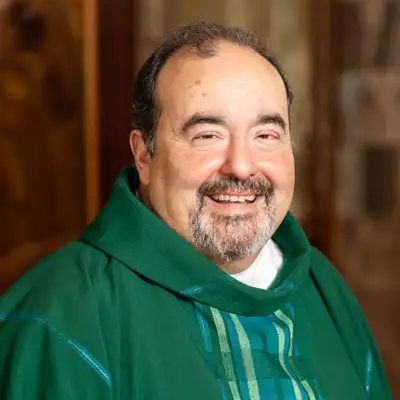
Fr. Eric Tellez:And yet today, he talks about love of one another, not in a romantic way but in a way that he says love is the fulfillment of the law and it does no harm. He's speaking to the community in Rome who is going through tension and division. In the year '46, the emperor kicks all the Jews as well as the Jews who are following Jesus out of Rome, and they're away for a while until the emperor's death. When they return, the gentiles are there and the Jews ask, well, where do we fit in? How do we live our customs?
Fr. Eric Tellez:What about following the law? And the gentiles aren't a little much too open to it because they believe in freedom from the law. So Paul is kind of dealing with that tension and all, and so thus he says something powerful that is central to the Christian faith. Owe nothing to anyone except to love one another. Love does no wrong to a neighbor.
Fr. Eric Tellez:Therefore, love is the fulfillment of the law. Everything our Catholic faith, everything that Christians do in teaching and living stems right from here. And Paul gives the central message of how he and that community are called to deal with conflict and division. Love does no harm. This weekend, tomorrow, our country honors the gift of labor, human work.
Fr. Eric Tellez:And for many Americans, it usually means it's the day after you don't wear white. It's the day, summer ends and fall begins, and the weather's supposed to be get getting better, but not in the valley of the sun, we know. But yet, there is a reason why the Catholic faith says so much about human labor and work. We never get to tell you that. And the mystery is all there for us, but we don't have the time to do that, or it's not in our preview, and that's understandable.
Fr. Eric Tellez:So I wanna break that open with you, how Paul's letter is central to human labor. The first person to talk about that was in the year 1891, Pope Leo the thirteen. He and the world is in the midst of the industrial revolution, and he writes what's called an encyclical. It's a teaching from the pope. He just doesn't do it alone in his room, but he runs it through scripture scholars and through theologians and through much reflection.
Fr. Eric Tellez:This is a high form of teaching. His reading, the first encyclical rather that we see on human labor is called riram novarium. Riram novarium. There we go. So I want you to know what I'm saying because it is Latin.
Fr. Eric Tellez:Okay? And it means of new things. So it addresses the conditions of workers during the industrial revolution. The first thing it says is the dignity of workers. This finds its roots in what Paul is talking about.
Fr. Eric Tellez:Human beings are having dignity. And so in the work environment, that is called and that would be radical and revolutionary for that time. A right to a just wage. People were being exploited. Now, I am not paid what I'm worth.
Fr. Eric Tellez:I didn't know if you knew that. And no one on staff is, and none of you here are paid what you're worth. But a just wage to live a livable wage is the call and expectation. The right to private property. Well, you say, well, what's the big deal?
Fr. Eric Tellez:Well, at that time, unbridled capitalism that just no rules, everything goes as one extreme, and the other extreme is the extreme socialism that questions whether the right to own property. And that's why the pope says, yes, to own private property is a right for workers. A right for workers to form unions. Not every employer has the best heart. And sometimes there are circumstances that cause conflict and need to be worked through, so there's understanding.
Fr. Eric Tellez:But the right to form unions is important for work so that rights are protected. And the last thing he says of many things, the obligation of employers to treat workers justly. Our Catholic faith has a lot to say because you have dignity and your work is important. And Pope Leo sets the foundation of Catholic social teaching, social justice. It finds its foundation from 1891 in this encyclical, and flowing that is right relationship for people.
Fr. Eric Tellez:And so in 1981, Pope John Paul the second came out with his document you see on the screen, Laborum ex urchens, which means through work. And it is a powerful reading on the theology of human work and for human work and how holy that is. This is what Pope John Paul the second says, work. Our work is a participation in God's creative activity. We work with God and God's desire for human work is something that is blessed and important.
Fr. Eric Tellez:Your jobs, what you do is important. The worker is always more important than the product produced. The worker is always more important than the product produced. That doesn't happen all the time. Workers are disposable because people who have money have a right to that.
Fr. Eric Tellez:And yet we should never do that at the expense of the dignity and Pope John Paul is strong about that. Work exists for the person. The person does not exist for the work. The work exists for the person. The person does not exist for the work.
Fr. Eric Tellez:The rights of the workers flow from human dignity. The rights flow and the reason it's important we pay attention to because it gives you dignity. The very thing that scriptures and god and everything we believe in our Catholic faith hinges on that. It's central. To miss that is not really to understand what our faith is.
Fr. Eric Tellez:And pope John Paul the second says unemployment, exploitation, and unjust wages are assaults on human dignity. So why am I talking about this? Why should that matter to all of you? When's this priest gonna stop because Notre Dame's on? And I'm in a hurry too.
Fr. Eric Tellez:But let me tell you, your work matters. Some of you are struggling with your work. You're not happy. You used to like it or maybe you're stuck in a position and it becomes drudgery. And yet what God says is it matters what you do.
Fr. Eric Tellez:Some of you love it. I love working with my players and teens here in this parish when they say, can I have a recommendation for a job? Or would you know if a job's opening? When young people want to do that, When young adults begin a career. When you make that decision maybe to change jobs or find love and you work with passion in what you do, it is blessed.
Fr. Eric Tellez:It is important. And here's what John Paul the second says so beautifully. God does not look on human labor from heaven. He enters into it. What do you think Jesus did for thirty years?
Fr. Eric Tellez:Tecton. It's called a tecton. He worked with his hands and we know that he worked with his father on earth, Joseph. And isn't that amazing that god just doesn't say, there's work, go in it. God enters into our work and whatever god touches is holy.
Fr. Eric Tellez:So work should be holy for us and it should be protected and it should be valued. And here's what John Paul the second says in that letter again in the encyclical, no work is more important than another. I always get nervous because I love asking what people do for a living. But here's what the expert said, don't ask that because people feel judged. I don't care about judging your work.
Fr. Eric Tellez:I love to know what you do. It tells me something about you, and I watch how you say your words. I watch your body language. Is that person passionate? Are they in love with it?
Fr. Eric Tellez:Or do they find fulfillment? That's what I wanna know. But John Paul the second, the pope says, not one job is more important than others. All have value because all share in God's creative activity. And so today, I bless all of you and your human activity of work as we honor that tomorrow.
Fr. Eric Tellez:It's gotta be more than just eating a hot dog. It's gotta be honoring the work you do. And so remembering that our Catholic faith teaches that economic activity exists to serve people. Economic activity exists to serve people, statement to you. It is exactly what our Catholic faith has always taught.
Fr. Eric Tellez:Sometimes we don't live it very well, and we, the church, leadership, and others have to look better into this. But here's the calling. Work allows people to develop their gifts and to serve others. And economic systems must be judged by how they serve the human person. And so why does the church speak on human labor?
Fr. Eric Tellez:Because this is what Saint Paul says about our work. Owe nothing to anyone except to love one another. Love does no wrong to a neighbor. Therefore, love is the fulfillment of the law.