Subscribe
Share
Share
Embed
From The Learning and Development Projects at Silberman School of Social Work - Hunter College
Welcome to the Wellness at Work podcast brought to you by the learning and development projects at Silverman School of Social Work, Hunter College. This is a series of conversations designed to inspire wellness in helping professionals. Our conversations will focus on understanding the importance of self care, reducing trauma, and bringing to listeners new ideas and practices that promote wellness at work and in your professional life. Welcome to our show today. Welcome to the Wellness at Work podcast.
Speaker 1:So you heard our voice over, and you heard a little bit about us. But we'd like to take this opportunity to draw you in to the Wellness at Work podcast space. So as I said before, my name is Haison Sorrels. I am the producer of the wellness at work podcast, and this is the first time and probably one of the rare times that you'll hear my voice actually on the show. But just know that behind the scenes, I'm working to make this best show possible for you.
Speaker 1:Now you heard a little bit there from the person that we are going to be talking to today to talk about this show, what we are doing, and what we are hoping to accomplish, and that person is Jeff Rogers. Jeff Rogers is the host of the wellness at work podcast, and you're going to be hearing quite a bit from Jeff over the course of the next few episodes and, of course, over the life of this show about, well, about a whole variety of different topics. But we wanted to take the opportunity today to introduce you to Jeff, introduce you to the show, and in this short trailer, only around fifteen to twenty minutes of your talk about where we are going with the wellness at work project pod podcast and how where we are going can help you in your work with people who are vulnerable and in need, not only in New York City, but all across the country wherever this show is hitting your ears. So let me introduce or let me welcome Jeff Rogers. How are doing today, Jeff?
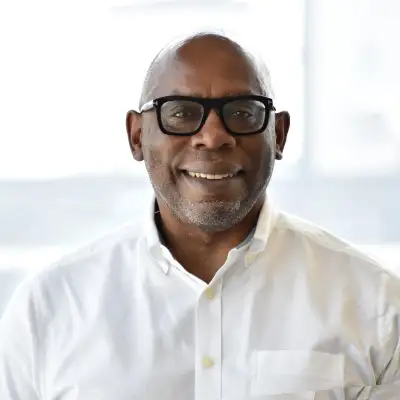
Speaker 2:Well, thank you very much, Hassan. I and thank you very much for that introduction. I am right now, I am the director of the learning and development projects at the Silverman School of Social Work at Hunter College, which is part of the City University of New York. I have, worked in the space of working with vulnerable adults for more than thirty five years, having started this when I at the age of 15. I am youngish here.
Speaker 2:No. That's not true. So what I what I think is really interesting about I my work stems from my work in adult protective services. I started there as a caseworker. When I moved on, I was the director of operations for for adult protective services in New York City.
Speaker 2:And then I came to Hunter to to do some training to oversee a training contract, and then subsequently, the training, the whole training cohort. And then finally, we have our own training cohort nestled, very comfortably at Silverman. And through all this, I have get I get to a point where I understand certain things that are like moments. So we had this I had this moment with a colleague who works in the School of Public Health. Her name is Stacy Plichter.
Speaker 2:She's a professor of the School of Public Health. We part of our work in vulnerable adults is we manage a contract for the New York State Office of Children and Family Services. And part of that contract is for providing training and professional development for adult protective services folks in New York State. And part of that contract is a we present a conference or what is called the New York State Adult Reduced Training Institute. But it's a conference.
Speaker 2:It's about 30 to 40 workshops every year, usually around in the early fall. And one year, we presented it in Buffalo. And Stacy and I had been partnering on discussions around work in adult protective services in in other areas. And so she came up to the conference with us. And she came to me during the conference.
Speaker 2:She said, there's a lot of unhealthy people here who are doing this work. And that was kind of when you looked around and you saw what she was talking about Mhmm. Kind of made sense, like, right away. Like, yes. And she said, I'd like to start to do some work and some research and figure out ways that we can intervene to make better health outcomes for for people who do this work.
Speaker 2:Mhmm. I you know, that was around he's like, you know, that was around oof. I don't know. Gosh. I've been in this work so long.
Speaker 2:I think it's I've started to lose my extensive orientation and time, but I think that was about fifteen years ago. And so she and I had partnered on various different projects to to sort of figure out better or more effective ways for people to get information about how to be healthy. Stacey regularly presents a workshop or two at the Adult Abuse Training Institute and has done, and she's on the steering committee for it. So the voice of worker health is in large part comes from Stacey and with me sort of kibitzing and being the cheerleader for why it it's importance. And if you think about the work, Pesav, that the people who are doing this work, who are going into places where maybe there's a these are people who hoard and what they hoard has a has a biological character characteristic to it.
Speaker 2:Or even if you think about hoarding even as a sort of an assault on the psyche Mhmm. How it's how unhealthy both of those situations, both of those scenarios are. So then there's also how is health promoted on the teams of these folks who do this work, and how can supervisors help and promote the health of the people who are doing this work? So in Yeah. You know, in a snapshot, that's really what I think these these these these podcasts are gonna be about is to sort of give voice.
Speaker 2:One other thing, and I I I know I've been jabbering about this, but one other thing is that if you do if before Stacy and I started to publish, and I know this sounds like I'm an egomaniac, there was nothing in the in the academic literature about adult protective services, service provider service providers and health. There is some in the literature about child welfare folks and child protective folks, but not for adult protective service.
Speaker 1:Got it. Got it. Got it. And I I would not have known any of that, and that's it's good that you sort of laid that out. And in our first sort of collection of episodes, which, you know, we've already started to we've already started to record, which are going to be released subsequent to this trailer and, of course, as part of our kickoff of the wellness at work podcast.
Speaker 1:We're gonna talk with Stacy about all of these areas, including, you know, wellness, compassion fatigue, the nature of teams and social services and helping professionals, and how all this comes together. Again, not just in a not just in a New York City or East Coast based context, but all across the country. Right? Right. We talked specifically about the importance of worker health in relation to the things that workers see, like around hoarding or around or around sort of some really challenging areas in adult protective services.
Speaker 1:For those of us who don't know or who are not aware or maybe have never had any interaction with adult protective services, and and this is a key question that we're I think we're gonna explore with Stacy as well, but I would love to get your perspective just briefly here. What makes it so hard to work with adults?
Speaker 2:Well, do you have
Speaker 1:Of any age. You know? I do have family. I do have family. Yes.
Speaker 1:Yes. I do.
Speaker 2:Well so let me let me sort of twist that a little. Sure. Well, significantly, quite frankly, you want it to be hard to work for adults, and I'll explain why. You want adults to have self determination. You want adults to have their autonomy, and you want our society to uphold and protect their that autonomy, that self detect determination as much as possible.
Speaker 2:Mhmm. Where and why it to sort of circle back to the original direction of your question, why it's difficult is because of those things. So where adult protective services is always trying to do is find the least intrusive intervention possible where we find an adult at risk. And it and if the the adult is unable to address, recognize, and there's, recognize the risk and there's no one else willing and able to assist, it becomes necessary for adult protective services to consider an intervention. And we're we're talking about thinking about those kinds of societies where those kinds of protections of autonomy and self discrimination are not built into hard, you know, hard hardwired into the societal structure, there's a less shall we say, a more slippery slope into being into into involuntary interventions that are not always in the best interests of the person that who is at risk.
Speaker 1:Right.
Speaker 2:So you really do want to make sure, and that therefore becomes very difficult. You have to determine whether or not somebody is making decisions that they that they are aware of the risk of their decision. We are all we are all able to make bad decisions. The question is is whether or not those bad decisions, are we aware of the risk? And is the risk has its impact is has to be carefully assessed.
Speaker 2:Mhmm. You know, spending too much money, which I you know, we all do, eating too much during Thanksgiving or during a holiday. Yes. But when we're talking about somebody who is has piles of newspaper and the smoke detector doesn't work and they smoke at and they smoke cigarettes at night and very often, fall asleep with the cigarettes still lit, That's a situation that calls our attention. I'm not necessarily saying, oh, we need to intervene.
Speaker 2:But where we want to, we want to I I want folks who are listening to this to think of, that the social contract, whatever whatever is remaining of it, adult protective services is really fundamentally weaved into assure where folks who are at at risk or or at distress, where they're being abused or when they're being exploited or when they're self neglecting or then being neglected, that adult protective services has in its mandate to to to assess and determine whether or what to do to assure that these people do not fall off the sides of the earth for accurate.
Speaker 1:Right. Right. Right. Right. And it sounds like we're we're gonna be talking about a lot of areas on this show.
Speaker 1:There's a lot of interweaving pieces there. I mean, you talked about, obviously, self determination and autonomy, but also the intersection of that with the law and what does that look like, or what do abuses of the law look like? We're we can't go into it too deeply today. We only have a short amount of time, but I'm sure that these become challenges that become even more, to your point about risk, even more fraught with risk as an individual gets older and becomes less able potentially just because of natural biological decline, becomes less able to assess risk in a whole variety of different factors or ways or just maybe differently able to assess risk. And then, of course, I loved it how you brought up, Jeff, the idea of the social contract.
Speaker 1:You and I have talked a little bit, about that. Now that's just a taste for our listeners. We don't wanna go we don't wanna jump into that. But
Speaker 2:Nobody wants social studies on a podcast. This is true.
Speaker 1:This is this is true. Right. But we will talk about all of those areas on the show. Okay. So as we begin to as we begin to wrap up here, what format is this show gonna be in, or is it gonna be audio, video, release schedule, platforms?
Speaker 1:Where will people be able to find this? Let's talk a little bit about that. You know, I I
Speaker 2:think Nobody wants to see an old guy an old guy talk about wellness. That's kind of like, oh, well. At at at risk of a little turtle after ageism oppression, it's gonna be video sorry, audio only. We are going to also be able to provide resources for listeners at the end of the podcast. And the interesting thing that Stacy one of the many interesting things she brings here is actually taking listeners through particular practices that will help with various kinds of stress and various kinds of wellness.
Speaker 2:And she'll be giving these at the end. And I'm the guinea pig for those things, for those different I wouldn't call them interventions in much of the all those practices that are the the goal of which is to uplift health.
Speaker 1:Excellent. Excellent. And, of course, you'll be able to get the audio version of this podcast on all the major podcast platforms that you listen to podcasts on. That's it's it's sort of my job here in the back end to make sure that you could listen to this show on Apple, The audio version of the show will also be on YouTube. And, again, any platform where you listen to podcasts on, you'll be able to get the wellness at work podcast with Jeff Rogers and whoever his guest will be, that week.
Speaker 1:Awesome. Yeah.
Speaker 2:Great. Excited about this. Very excited.
Speaker 1:Yes. This is this is gonna be a great project. I'm very proud to be partnering, with the learning and development projects at the Silverman School of Social Work to bring this, to bring this to folks. And I can't wait to take everyone. I can't wait for us to take our listeners on this journey Yeah.
Speaker 1:Today or and and and in the future as we go forward. So awesome. Jeff, with the last couple of seconds, we've got any any anything you wanna leave folks with as we close out?
Speaker 2:Wellness at work is not just about people who are working with vulnerable adults. Wellness at work is about wellness at work for everyone. And I encourage you if you have a few moments and you want to get some different perspectives on wellness at work, please tune in.
Speaker 1:Absolutely. Great. Thank you, Jeff Rogers. Once again, my name is Haison Sorrells, producer of the Wellness at Work podcast. And with that, well, we're out.