Subscribe
Share
Share
Embed
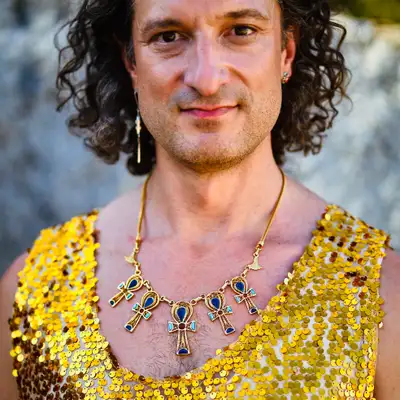
What if awakening is less about a single moment and more about the adventure you choose to follow? Awakening Adventures with Rev. Venus Castleberg invites listeners into real, grounded conversations about spiritual awakening and the unexpected places it can lead. Each episode features Venus—the Home Whisperer—sitting down with guests who have walked their own unique awakening paths.
Through stories, insights, and warm curiosity, Venus explores how each guest’s inner shift has shaped their purpose, creations, and the work they now bring to the world. The show offers an open, welcoming space for anyone wondering what’s possible when they listen to their inner guidance… and trust the adventure that follows.
Venus Castleberg: Hello, and welcome to Awakening Adventures, where we will hear real stories from real people who have had their own spiritual awakening, and were guided to do something with that newfound awareness. My name is Venus Castleberg, also known as the Home Whisperer, where I help real estate agents clear energy from stuck homes so that they can sell their homes with greater ease.
Venus Castleberg: I'm really excited to introduce our guest today. Jeremiah DeRosa is a new friend of mine, but just talk about a man with a heart and soul of service, and he has this beautiful voice and song that we might be able to hear today. I didn't ask him, so we might put him on the spot, but…
Venus Castleberg: As a Juilliard-trained, world-class musician who has evolved into a master-level sound healer, after years of performing internationally, he answered a deeper calling to use his voice to facilitate profound transformation and awaken others to their gifts. Welcome, Jeremiah.
Jeremiah da Rosa: Thank you so much for having me, I'm so thrilled to be with you and all of your listeners.
Venus Castleberg: Awesome, welcome. So, we are talking about Awakening Adventures, and I know that your awakening is a little bit different than others, and I'd love for you to just kind of share… why don't you start, share kind of high level, what happened, like, what was your childhood like? How did you grow up? What was it like back then?
Jeremiah da Rosa: Yes, okay, so I'm an only child, and…
Venus Castleberg: Me too!
Jeremiah da Rosa: I didn't know that!
Venus Castleberg: No, I didn't either! That's awesome!
Jeremiah da Rosa: My earliest childhood really took place in the woods, in the forest, in Northern California, where my first friends beyond my parents were really the trees, and my own memories of being connected to the divine before being in a body.
Jeremiah da Rosa: And my parents were then, and still are now, quite devout evangelical Christians. Very spiritual Christians, really drawn to a flavor of Christianity that's quite ecstatic.
Jeremiah da Rosa: So, as a young person, I was around devotion through connecting to God through song, through worship, through people dancing, speaking in tongues, being slain in the spirit, which is where they fall over overwhelmed with spirit. So I grew up in that environment.
Jeremiah da Rosa: A couple things really stand out. One is that I was already incredibly drawn to music. I would spend hours on a swing set we had in the woods. My parents put up a swing set, and I would swing and sing, swing and sing for hours. My mom would say that I would come in from that crying and saying how amazing Jesus was.
Jeremiah da Rosa: I don’t remember Jesus so much. I remember the singing and being in these vortex states of movement and song. I just know that I was really connecting to something at that age.
Jeremiah da Rosa: One of the highlight moments from this period is that I was already, between preschool and first grade, tracking some of the dogma of what I was learning in the church. My dad was very committed to some of the rules around sin.
Jeremiah da Rosa: Even at that young age, I was having a hard time with it. I literally remember being a four- or five-year-old thinking, this doesn’t add up. I was in the woods talking to the divine, talking to anything that would listen, like, this doesn’t make sense.
Jeremiah da Rosa: Specifically, I remember wondering why children are inherently born of sin, and if they aren’t saved or baptized or whatever the thing is, they immediately go to hell.
Jeremiah da Rosa: And a voice spoke in my head at that age and was like, “Why can’t it be enough to be good? Why isn’t it enough to be good?”
Jeremiah da Rosa: That voice that came from outside of me has stuck with me my whole life. It was an awakening moment that anchored me on a path. And that word “good” ties into my life now, which we can explore later, but that is the first story of awakening that I can track.
Venus Castleberg: That’s awesome. I love that. How does the story of “good” relate to your life now?
Jeremiah da Rosa: Well, it means we have to then—before we get to that word good, because I really tracked that this year—we have to go back. We have to fast-forward and reverse to a middle point.
Jeremiah da Rosa: I became a musician quite young in life, a flute player who was always drawn to singing. As soon as I could leave the house, I did, because my parents and I were starting to clash. What I had been initiated into as a child was not for me. Not entirely.
Jeremiah da Rosa: I lived my life quite in a monk style, so devoted to music that I didn’t have a lot of time for other things, including spirituality. But what I did expose myself to was some Wicca, some shamanism, and some tarot. Those were the things in my field.
Jeremiah da Rosa: 2004 came, and The Da Vinci Code came out. I read it and, like many people, learned about this alternative version of Christianity and the Christian story that included Mary Magdalene.
Jeremiah da Rosa: My whole body, my whole spirit, my whole being—like a tuning fork—started to ring, and I was like, “Oh, I recognize this. This is something that has been missing for me.” Immediately it’s like I called her—whatever she is, whatever that is—into my life. It became an obsession, a devotion, a fascination. I started reading everything I could get my hands on concerning Mary Magdalene.
Jeremiah da Rosa: Fast forward many years later, it has become a big theme of my life, my research, and my art. What I create has become quite devoted to Mary Magdalene, and I have the honor of working with Kathleen McGowan, one of the world’s most renowned Magdalene scholars, assisting her on her pilgrimages, studying with her, offering sound in the lands where Mary Magdalene taught and evangelized.
Jeremiah da Rosa: And what I learned about being in those lands is there is a people called the Cathars. The Cathars are the spiritual and physical descendants of Mary Magdalene and Jesus’ teachings in Europe, and they were called “the good people.”
Jeremiah da Rosa: When I heard that was one of their monikers—one of their key tenets was to be good—that connected me to that voice when I was five years old. Like, oh, there was a clue embedded that didn’t show itself until then, or until now. This connection about what it means to be good, and how that can be inclusive, and truly be a way of love that I was searching for as a young person.
Venus Castleberg: Beautiful. I love that. One of the things I really want to bring forward for people is that awakening can happen at any point, and there are multiple awakenings. As you’ve heard from other guests, it’s a journey, it’s ongoing. Some people have dark nights of the soul, and then they have a new awakening. You don’t ever arrive. If we did, we wouldn’t be here.
Venus Castleberg: As we’re awakening, the universe—God, the Divine Mother, whatever you want to call it—will use whatever it can to get to you. A book, a movie, a person, turmoil, a car wreck… there are so many ways. And your particular journey, Jeremiah—one of them was The Da Vinci Code.
Venus Castleberg: Some people… it is a book, also became a movie. I loved it too. I actually felt the same thing. When I watched that movie, I was like, “That’s true.” Like, that’s not made up. And I’m getting head-to-toe chilled now. There’s this confirmation that the universe will go, “Hey, by the way, this is actually true,” even though the world will tell you it’s fiction. What do you know?
Venus Castleberg: So how did you have that experience, and then how did it impact what you did after? Immediately after that—how did it change your day-to-day life?
Jeremiah da Rosa: Well, being an only child, I think we’re often drawn to invisible support, because we don’t have siblings. It’s very natural for me to reach out to what’s outside of me, non-physical, to spirit. There’s a constant conversation—at times with self, but with the greater self, and anything that will listen.
Jeremiah da Rosa: And being a musician—what draws most musicians is that moment where you’re plugged into something greater than you. That can happen on your own, but also when you’re playing with other musicians. You plug into a channel of energy—there’s nothing else like it. It’s ecstatic. It’s oneness. A lot of classical musicians don’t talk about the spiritual context of what we do, but it is the driving force that all of the technical devotion serves.
Jeremiah da Rosa: So day-to-day, it was like, “Oh, she’s part of my life.” I had another friend in my corner. The studying, the devotion was very present.
Jeremiah da Rosa: Another big part of being devoted to her and learning from Kathleen McGowan and reading her books is learning that the Magdalene traditions and early Christianity are connected to Egypt. Ancient Egypt plays a big role in humanity’s story.
Jeremiah da Rosa: My grandparents, who were so special to me, passed away and left me an inheritance. All of a sudden, I had the means to go to Egypt, and I knew I wanted it to be a spiritual experience. Kathleen McGowan showed up again—before it was just books, but now it was a tour to Egypt I could afford. It was the one I chose because it included Mary Magdalene.
Jeremiah da Rosa: Mary Magdalene got me to Egypt, and Egypt was another awakening moment. The heat, the volume really turned up from those.
Venus Castleberg: What happened in Egypt?
Jeremiah da Rosa: The first thing that happened is I met our mutual friend and mentor, Melissa Seaman, and her partner—literally the first people I met at the first dinner.
Jeremiah da Rosa: Kathleen has an Egyptian husband who is a healer and a sound healer, and they had hired another Egyptian indigenous healer to do sound with her husband in the Great Pyramid. We were going to have a private sound ceremony in the King’s Chamber.
Jeremiah da Rosa: Some issues happened that day, and that healer had to drop out. It got around to Kathleen that I was doing sound healing with my voice, so she took a leap of faith and asked if I would step in and sing in the Great Pyramid with her husband. And I was like, “What? Are you serious?” It was a dream come true that I didn’t know I was dreaming. So of course it was a big yes.
Jeremiah da Rosa: Stepping inside the structure into the King’s Chamber, I opened myself up to listen. As a musician does when you step into a concert hall, you’re like, “What’s it going to sound like in here? What do I need to do with my body to work with this space?” I wasn’t even tuning in with energy or spirits yet—just feeling the space, resonance.
Jeremiah da Rosa: And as soon as I reached out, the pyramid responded back—as another being, as another entity, as another musician. It was like, “Oh, I can talk… you’re listening… we can play together… this can be a partnership… a co-creation.” It was like chamber music together, and I was like, “Okay, I’m down.”
Jeremiah da Rosa: That pyramid, as weird as it sounds, has become one of my greatest teachers. It influenced all the work I do now—helping others with their fears of singing and initiating them into vocal sound healing.
Jeremiah da Rosa: The Great Pyramid and the temples I met from that day forward were like meeting old friends I didn’t know. I would cry when I left. I’m lucky enough that every year I get to go be with them again, but they’re truly my friends in stone.
Jeremiah da Rosa: That awakening, and remembering as much as I could about what I did there, was a big part of bringing those parts back to my center.
Venus Castleberg: Beautiful. Wow, I really can’t wait to go to Egypt with you and experience that.
Venus Castleberg: You touched on it a little bit—so you’ve had multiple awakenings. Now, what are you doing with your gifts and abilities?
Jeremiah da Rosa: I think it boils down to this foundation—what I learned in Egypt about what we can do and what I got to do. Yes, we all have individual gifts and skills. We’re all special. I’m no more special than—
Venus Castleberg: But I am also very special. Leo, so okay.
Jeremiah da Rosa: I witnessed and remembered that in this relationship we made with the temples, with stone, with this technology of bringing earth into spirit and spirit into matter—connecting heaven and earth. When that technology is set in the stones, those temples are awakened, and they agree, they consent, to do whatever we’re asking them to do. And then the human makes the sounds.
Jeremiah da Rosa: I don’t even need to be visible, but what I witness is the sounds and that partnership happening. People have instant connections to the divine—instant clarity. Stuff happens, moves.
Jeremiah da Rosa: That is the foundation of what I do: partnership with resonance, with sound, that allows people I serve to experience transformation and connection to God, to the divine—what I call a lightning path. Sound and the voice are direct. There’s nothing to hide behind.
Jeremiah da Rosa: So I go around the world and I sing. I partner with the land and sacred structures to sing their songs, so pilgrims can have these experiences of transformation and connection. I support healers and teachers like Kathleen McGowan, Melissa Seaman, and others.
Jeremiah da Rosa: I also initiate people into their own forms of sound healing and help them with blocks in their voice—people told they weren’t good enough to sing, couldn’t carry a tune, didn’t have a good voice, it wasn’t beautiful enough. I welcome those into a program called Open Your Voice. And I help more experienced healers into more advanced concepts of sound healing.
Venus Castleberg: Wonderful. Let’s say somebody’s out there and they’re like, “All sounds great, kind of sounds a little over my head.” Where should I start?
Jeremiah da Rosa: I have a quiz, which is a great place to start. It’s at jeremiahDeRosa.com. It’s a vocal lineage quiz. There are four lineages—we all hold a bit of each, but there’s usually one predominant lineage.
Jeremiah da Rosa: Knowing your voice’s lineage gives you clarity: What are the gifts of my voice? What are the challenges? Because right now the classifications we have are like soprano, alto, tenor, or genre-based—jazz, classical, pop—and those are tied to achievement. I’m not interested in that. I’m interested in what are the gifts of your soul that want to pour forth from your voice.
Jeremiah da Rosa: It’s a way to start thinking about your voice from an energetic place of healing and wholeness.
Venus Castleberg: I’m going to put you on the spot. It’s okay if you say no, but as somebody who’s received Jeremiah’s sound healings, it completely changed my reality—opened me up in ways I didn’t know were possible. Would you be willing to give us a little taste?
Jeremiah da Rosa: Yeah. Let’s really ground it into something. What’s something within the awakening journey that you find people need support with?
Venus Castleberg: For me, when I went through mine at 30 and became a clairvoyant medium—suddenly I could see the spirit realm, and I didn’t have it as a child—I was like, “What?” It’s the knowing we’re not crazy, knowing we’re not alone. We’re all gifted. We’re all special in our own way. And I do believe globally we’re waking up.
Venus Castleberg: For some people, that’s more difficult. Some of us are more open, and some are like, “I don’t want it.” So how do we have more ease with that and do it together?
Jeremiah da Rosa: Do it together. Yes. Okay, good. Usually I turn on some effects, so this is going to be real intimate.
Venus Castleberg: Thank you.
Jeremiah da Rosa: I want to invite all the listeners to put your hands on your hearts, and let’s all together take a big deep breath with an audible sigh.
Jeremiah da Rosa: One of my sound healing teachers said one of the greatest sound healing gifts you can give yourself is an audible sigh—beyond just the exhale, which is fantastic—but adding the vocal cords as a way of releasing what you’re feeling, giving voice to what’s in your body in that moment, is so powerful.
Jeremiah da Rosa: What I do when I teach these principles is how to call in healing sounds, and then what to do when they arrive. So I’m going to get a little quiet as I go into that protocol.
Jeremiah da Rosa: Kim Woo!
Jeremiah da Rosa: And you are muted, my love.
Venus Castleberg: I was like, wow, I’m so emblissed out. I love that. What you said earlier—I really did experience this time, and now I have words for it: you are a bridge to the divine. It’s such a beautiful experience to be in that oneness. Thank you for sharing that.
Jeremiah da Rosa: You’re so welcome.
Venus Castleberg: Special.
Jeremiah da Rosa: And doesn’t that describe the awakening? We’re all bridges. I’ve heard one of my teachers call it rods—we’re rods of God, connecting heaven and earth, and we all have our own unique song to sing of that bridge.
Venus Castleberg: Thank you so much, Jeremiah. That was absolutely beautiful. For those of you curious about Jeremiah or his quiz, we’ll include his website and how to take the quiz. You can find out more about your own unique voice. I highly recommend it.
Jeremiah da Rosa: Thank you so much.
Venus Castleberg: Thank you. And thank you, everyone, for listening. Please like, subscribe, and share. If you received something from this episode, we want more people to know they are not alone as we begin to awaken to a new reality and dimension.
Venus Castleberg: And if you know anyone who has some crazy stuff going on with their home, or weird stuff they can’t explain, send them to freehomeclearingquiz.com.
Venus Castleberg: I look forward to seeing you all next time. Thank you so much. Bye!