Subscribe
Share
Share
Embed
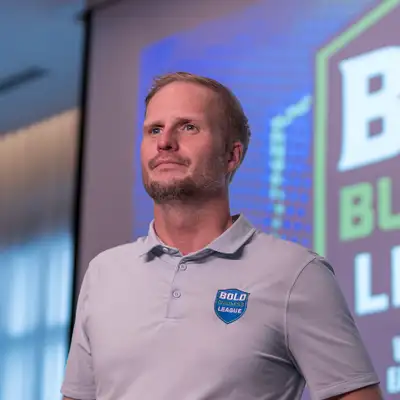
Welcome to Inside the League, the official podcast of the Bold Business League — a mastermind built like a sports league, not a guru show. Here, business isn’t theory — it’s execution, accountability, and results. Every Player gets drafted. Every Player keeps score.
Each episode dives into the mindset, playbooks, and scoreboards of high-performing entrepreneurs who treat business like competition — with teamwork, measurable wins, and relentless follow-through. Hosts and guests pull back the curtain on what it takes to lead in the field, not from the sidelines.
From Draft Day to Bold Blitz, you’ll hear real stories of collaboration, competition, and accountability that drive real business growth. No fluff. No gurus. Just Players sharpening Players.
If you’re ready to stop learning and start playing — step Inside the League.
Members of the league will have access to exclusive content with each episode in the Player's Only - Locker Room Access
001 Inside the League
===
Lee: [00:00:00] Welcome everybody to Inside the League where business is the ultimate sport and the scoreboard never lies. I'm your Commissioner Lee Godbold, and today we're kicking off something very special. It is the very first episode of Inside the League, which is brought to you by the Bold Business League. So last week was very exciting because we had our very first. Training camp for the Bold Business League, and it set the tone for what this league is all about. Players from all over the country showed up and they were ready to compete, collaborate, and hold each other accountable. It wasn't talk, it was systems, strategy and execution because in this league you don't win with ideas, you win with execution. [00:01:00] So. What I wanna do right here at the beginning is bring on one of our players, and he's one of the heavy hitters. He's in what we call the Major League. So he's somebody doing over $1 million plus. His name is Jack Johnson. He is from Johnson's Junk Removal in Seattle. Welcome to Inside the League, Jack.
Glad to have you on.
Jack: Hey, thanks for having me, Lee. Super excited to be here.
Lee: So Jack, last week it was training camp. You were in town outta Seattle, you came in from Raleigh. You kind of enjoyed yourself. I think you brought your wife Bella. It was great to see her. I know you and her are excellent kind of, uh, business partners. Uh, she, uh, she, she really supports what you've got going on, which is amazing to see. So, uh, you're on pace this year to finish. What about 1.1 million or so in revenue? Is that right?
Jack: Yeah, should be about one to 1.1 between there.
Lee: Well, very good. So. I also believe you've got a system that you are developing, kind of a software you've been working on, [00:02:00] um, over the last year, kind of for your, for your business that's tracking all of your, uh, business performance. And there's one number in particular that you really kind of pay attention to and that's billable percentage. And that's a number that isn't really talked about a whole lot in the junk
removal industry. You hear about average job size and revenue per payroll hour and a handful of other metrics all the time, but billable percentage is something that some companies track, but you're one of
the one of the few.
Tell us a little bit about exactly what that is and how it helps you shape the decisions and how you operate. Johnson's junk removal.
Jack: Yeah, great question Lee. With us, as I started to work my way off the truck, I really tried to figure out how do I measure. The accuracy of our team members, and I can't do this being on the truck with them every single day. I can't do this where I'm looking over their shoulder constantly, and nor do they want me doing that.
But how do I see, how much am I missing because I'm no longer the one quoting? How much profit am I losing? [00:03:00] Because I'm not out there thinking about every little thing that I would consider as the owner, but they wouldn't consider because maybe they're not seeing the big picture that I do. So. Billable percentage is what we're doing to take what the price was, what it was quoted, and dividing that by the should have been, quote, price or the perfect price.
And then we are able to see what the team quoted, what it should have been quoted in a perfect world, factoring in the volume, weight, and time required to load everything up. And then that gives us that percentage. So we're able to see how accurate our team is in comparison to that. That should have been quoted, quote or that perfect quote.
Lee: So you're taking into account the volume. Of the job, which, you know, junk removal companies typically charge based on space. Uh, you're taking into account labor and then you're taking into account weight as well, which the weight part is a little unique for a lot of junk removal companies because most of us will only charge extra weight generally if, if it's something that's super heavy, like, uh, gravel, [00:04:00] concrete, dirt, uh, shingles, something very, very dense. So tell us a little bit about, especially the weight and time aspect. Um, how you, how that enters into this billable percentage equation.
Jack: Yeah, absolutely. Time is gonna be the simplest one, so we could start with that. And it's just our team needs to take 30 seconds to think about how long is this gonna take me? One of the things our teams have the benefit of is they get a lot of instant feedback because they're the ones that actually load it so they can say.
Look at this pile over here, it's gonna take me 30 minutes to load this stuff up. And then they're gonna do it, and they're gonna know immediately if they missed it or if they got it. And so getting that real-time feedback is really gonna help them learn in terms of that. And having a simple system for them to add additional time.
And when it's measured, when it's monitored, when it's talked about, guys are gonna make sure that they're actually adding time for that because they know people are paying attention. The weight aspect. It's really similar to the time they're [00:05:00] getting real time feedback. When we're going to the transfer stations, when we're gonna the recycling centers, where we're gonna the landfills, because we're weighing out, they just have to go that little extra mile and just be thinking about, Hey, how much did I just quote this job for?
How much am I weighing out at? And that way a lot of these customers, they're more than willing to pay a little bit more for loads that are extra heavy for loads that take a little bit longer because we're going the extra mile for them. Think about, you show up to someone's house and everything's in the garage and it's boxes and it's really easy.
They're willing to pay full price, and then you go to someone and then all the stuff is in a shed a hundred yards from the driveway. Or you've got things in the basement that you've got a really tricky staircase that you've gotta work around. So a customer like that is willing to pay not only full price, but more than full price because we are going above and beyond for them.
So we wanna make sure that we have a pricing model that accounts for that. So that we're not winning on averages, a lot of junk removal. What I've noticed on the average job sale and things like that is it's all about winning [00:06:00] On the average, we're talking about our, our marketing budgets and our cost to acquire our customer and all these things, and we're always looking at averages because we know we're not really winning on those minimum jobs.
But how do we then take the jobs that are the below average ones that are dragging our averages down and add a little bit to those to make sure we're making up for that additional cost.
Lee: I love it, man. That's, uh, that's a bold business league mindset right there, trying to win on every job, not just on the averages. I like it. So again, we've got Jack Johnson from Johnson's Junk Removal out of c. Outta Washington here. Shifting gears just a little bit, I wanna talk about last week's training camp.
So it was a day and a half. Did you come to the, on the Monday night, were you at the, kind of the unofficial kickoff party that was at the hotel
Jack: Yes, I was.
Lee: Tell me a little bit about that. Uh, I think that was a pretty good time for guys to kinda get together in an unofficial setting and talk the, uh, the junk removal business. Uh, how was that experience on that first night?
Jack: Yeah, [00:07:00] absolutely. And just getting to meet everybody. There were quite a few guys. I already knew quite a few guys that were new faces and so. Being able to have an environment where we're getting together, we're getting to know everybody before we start jumping into the meat and potatoes of everything, I think was really valuable.
So it was a really good time just being able to connect with a couple different guys and, and learn about their businesses in just a little bit more of a relaxed setting. I.
Lee: Yeah, it's amazing the. Information and the things that you kind of uncover when you have those conversations. So when we kind of design these events, we always make sure there's plenty of time for that unstructured, uh, kind of time for guys to get together, you know, maybe have a drink in a relaxed setting, and you get a lot of really good information.
You find out a lot of, uh, really. Applicable things for your, for
your business to, uh, to really grow. So, um, we had a couple opportunities for that. 'cause the second night was the more official, uh, get together where we did the, uh, we were renting out the bar in the restaurant. [00:08:00] Everybody kind of went there.
We had food. We had drinks, and, uh, had, you know, had a good time and exchanged a lot of really good information. There were great business related conversations, having there, you know, happening there.
Jack: Absolutely. Yeah. Everything about it, I mean, whether we were having fun or whether we were working hard, it was all business related, so it was really impactful.
Lee: So tell me a little bit about, uh, the, the whole of the event as a whole. So, you know, the second day we had speakers and the third day, which I think is the best day, is uh, what we call game day. And that's when we get in the huddles, the round tables, and we brainstorm about our businesses and everything. Uh, describe, uh, the experience on, you know, the, the two days of the program.
Jack: Yeah, absolutely. As far as you're talking about game day, which is funny because that was something, it was making me think about our business and what game day is for our team, and really every day is game day. But when Sam gave that presentation, so on Tuesday the first day we gave the presentation talking about sales role play [00:09:00] training.
It was something that I really wanted to do and really wanted to do well, and we had tried to implement a couple times, but just hadn't done it very well, haven't done it very effectively, didn't have a good structure to it, and Sam really came in. He had a lot of good acronyms and a lot of good structure to put that in place to be successful.
So that was the first thing that we started implementing, getting back, because I started thinking about, hey, every day is game day. When we're in front of that customer, how do we give our team an actual practice? Because we haven't had a practice. We were practicing during the games, and so that doesn't make a lot of sense as a team practicing at game day.
So making sure we're out there, we're practicing every day. We've been running through different parts of that customer interaction each morning, and so we haven't been tackling the entire thing every morning, but we've just been hyper, hyper-focusing on little segments of it, and everybody runs through and everybody gives feedback.
So that's been super helpful. The masterminding portion on, on day two, the the game day portion of the training camp, that was super impactful as well. Just being able [00:10:00] to bring your specific questions, your specific concerns, the issues that you're having with your company, and having eight different people at the table that are sitting around with you, they're able to say, okay, how do we solve this specific issue?
So now all of a sudden it's not just you trying to come up with ideas, it's a whole bunch of people. And some of which have been the same position as you, some of which haven't, but everyone has a perspective that you don't have to, you're not in a competing market with anybody, so it's a chance to really talk about where you're at openly.
We don't have a lot of opportunities to do this. One of the things with the league is it's all junk removal companies instead of some of these other ones that are geographically located. This one's industry located. So, and what I mean by that is everybody's in the junk removal space, so everybody knows.
Uh, generally what we're doing, and so you get a lot better feedback versus just a generic business coach.
Lee: Yeah. That's great. And so the game day, it's kind of game day is you said every day is game day with Johnson's junk removal. And It is, but it's also [00:11:00] practice day. And what I mean by that is with the sales role play stuff, that is a muscle that has to get trained. That's a shot that you have to practice taking.
So you know, for every. Shot that Michael Jordan made. He, he, he, you know, he shot probably hundreds or thousands of them, you know, in practice. And it's the, it's kind of the same thing. You know, you've got to practice your sales all the time and you have to practice the format of the sales role play all the time.
And over time you get better at it and your team gets better at it. That way when they show up for game day, which is when they're in front of their customer, they're gonna be able to close jobs at a higher rate, give the customer a higher experience. And, uh, get more money for each job, which is, which is excellent.
And then you bring in your billable percentage and all of a sudden they start upselling and all that other kind of fun stuff that we'll have to talk about at, uh, at kind of a later time. So you did the game day, you did your round table Mastermind, which is the facilitator and six or eight other fellow junk removal business owners and members of the junk team and [00:12:00] all those commitments and everything. You fill out. So there's a playbook that every player gets. They fill out their information that gets uploaded into the league scoreboard. So now the league as a whole, all the players and everything can view your profile and they see the things that you committed to. And that's part of the accountability aspect.
And we meet regularly on that. Just to kind of make sure everybody is on track, talk about the scoreboard a little bit. 'cause that is one of kind of the pillars of the league. That's pretty unique. So everybody's KPIs, which we just had our very first round of KPI submittals that's actually in progress right now.
We have a fan, handful of players that have already submitted that, and next week we'll actually start to be able to show the rankings so we can see of the member, the players of the junk team, who are our top performers, who are in the middle and who's got some catching up to do. What do you think of the, of the scoreboard and tell me, is this something you're kind of excited about?
And if so, why?
Jack: Yeah, I'm definitely excited about it. Like I was talking about earlier, we're all industry based, so we're all in very similar fields or the exact same field actually. And so we all know [00:13:00] what our numbers should be. We know where we're at, but. The, the scoreboard has done a couple different things. It forces some accountability and actually to know your numbers.
And so being on a weekly basis, people are actually checking these things and it's nice to have that, that backboard kind of that person or that league that's saying, Hey, these are, this is something you need to be looking at continuous basis. 'cause I know for myself. When we're running around drinking from a fire hydrant, sometimes it's like, eh, we'll look at that later.
I know we're making money, but I'm not sure how much. So being able to go through and actually measure this. Having someone that's saying, Hey, let's, let's make sure to be checking this is, is super helpful. And then because we're all in that same industry, we all know we can compete and it's a friendly competition because nobody's in a competing market.
So we're not head to head competing, but we are able to, in a sense, head to head compete in separate markets without actually affecting each other. So able to push each, each other to do even better and even greater in our own [00:14:00] respective markets.
Lee: Yeah, I think the scoreboard. Shows when you have an issue
and sometimes you don't realize you have an issue or we had several players, um, one in particular. He probably from this one event, I'd say his bottom line will grow by a hundred thousand dollars and it was an issue that he ex that he. Suspected he had, but maybe 'cause he didn't wanna fully understand and know, or maybe because he just didn't understand the depth of the problem.
And this is a big company. I mean, this is a, this is a major player, major operator. And he got in his group and he was actually one of the, uh, huddle coaches. So he was in the huddle coach Mastermind, which I led, which was, uh, kind of overtime. It was after the official event ended. And, uh, you know, we, we kept asking questions and asking questions, everybody from the group.
And finally, you know, he pulls out his numbers and he pulls out his stats and he starts to actually look into this. And he realizes he has a massive problem on the phone booking side of the things. And, uh, we helped him put a plan together and [00:15:00] then immediately he went out there. And right now he's already made a new hire for that position.
He's got a great plan to make sure he's got full phone coverage, not missing any calls that'll be executed over this quarter. I would say conservatively a hundred thousand dollars difference was made there. So it was amazing just to get that group together and he left saying, man, this is, this is the greatest thing in the world. It was a lot of fun too. You know, it's really fun if you're a business owner, if you're a strategic business owner, to solve problems like that. And I felt like all of us left with some, you know, some pretty good stuff that's gonna make a big difference in both our top line and bottom line. And some may be more than others, but, uh, I, I felt like that was very impactful.
Would you agree with that?
Jack: Yeah, absolutely. Especially with him, because he even mentioned that he knew it was a problem, but he was kind of scared to look into it. And so as we started diving in that we're able to see, oh, hey, this is. This is big and being able to just make a couple key shifts and really deliver a higher customer experience and be more profitable and increase revenue.
I mean, that's [00:16:00] kind of hard to complain about.
Lee: And he moved fast. And I think part of the reason he moved fast is he knew we, you know, the, everybody was checking in. It was out there with, they knew the, the depth of the issue. And there was no delay. It was uh, it was very fast. And that's just the scoreboard to me. It allows us to measure ourselves up and it helps us identify where are there issues in our business?
'cause we see other people doing better than us, or if we're number one, we see people closing in and now that competitiveness kind of kicks in. And I think, uh, it's, it's gonna be a lot of fun. I think it's gonna change a lot of businesses, so I'm very excited about it for, um, the original 14 players that we have in the Bold Business League. Alright, final question for you, Jack. What is one thing that you're focused on improving in quarter four now that you're competing in the league?
Jack: Yeah, absolutely. It, the thing that I really love about the league, uh, you might have heard the quote before, but uh, a man with no time at all can get more done than a man with all the time in the world. And I really think that's what the league brings [00:17:00] to this 'cause as. Business owners as entrepreneurs, we really don't have people that are demanding anything of us on an immediate basis.
As we grow, we're not on the truck, we are not immediately feeling that feedback from the customer. And a lot of us can disappear for a week, two weeks, or even check out mentally for a prolonged period of time, and our business will still run. But we'll see those impacts down the road. And so kind of we get in that environment where we have no deadline and now all of a sudden we have deadlines and we have things to meet.
And so we have those check-ins that are able to help keep us, keep us going forward. You were talking about these sprints and these coast periods and being able to maintain that as more of a marathon instead of these constant like gasping for air and then really, really just coasting after that. So. I really think that's a big thing to, to add value to that for each of these businesses as far as what we're taking as our next steps now.
So we've really been focusing on and me [00:18:00] on measure and coach. So as far as measure goes, you know, I've talked about math quite a bit. We've talked about billable percentage, we've talked about all these different metrics to be able to monitor the health of our business. We wanna take that another step farther.
We wanna go and even monitor things even greater so that as we're growing, we're making sure we're not having a bunch of waste, we're not having a bunch of excess, and we're able to, to do this very efficiently. So measure is a really big focus of us. And then for those things that aren't measurable necessarily, or not easily measurable, those are more the coaching aspects.
We're talking about the the sales role playing in the morning, making sure that we actually have a practice instead of just all game day. So we're not practicing on our customers. Sam said, my customers are too important to practice on, and so we're making sure that guys that are new, even if we've hired someone that's got some experience with a different junk removal company, we want them to know how we do things because sales with us.
It's not, how much money can I bring in? I will never put any of our team [00:19:00] on a quota because I, if you miss a quote, that's fine, but I want you to be accurate. I want you to be efficient, and I want you to give a five star experience because I'd much rather lose a quote on, on site with a customer than get a one star review.
So, I mean, I'll tell customers over the phone when we come out and give you a quote. If you're not expecting it to be a five star experience, I'd rather you just say no. 'cause I think we should find someone that's gonna think it's a five star experience 'cause that's what we deliver.
Lee: Love it man. Love it. You got a great plan to take your business, uh, even higher than it already is. What kind of goal do you have, Jack? So you're gonna do 1.1 million this year. What are you hoping to get to in the next few years with Johnson's junk removal? Do you have a number in mind? I.
Jack: Yeah, absolutely. So I know we've talked about quite a bit, we've kind of intentionally capped ourselves around that point as we're getting some of these systems in place. So as we start to free up availability of our team and being able to do this. As we grow, I, I wanna see us get into that 20% market share point within about 10 years.
So that's a [00:20:00] huge goal. Obviously that's 10 years out, but get into that, that's gonna be about 20, 25 routes a day that we're running, doing around a hundred to 125 jobs a day. So it's a huge goal.
Lee: I love it, man. Well, big goals require big thinking and big systems and a lot of execution. And I feel like, uh, one, you're smart enough for this, but two, I look forward to working with you and all the other players in the league trying to, uh, get you to that point and helping you get to that point. I think you're gonna be able to do it.
Jack: Thank you so much, Lee. I really appreciate it.
Lee: Alright, sounds good. Jack. I appreciate you coming on. You are the very first guest on Inside League, the weekly show that comes on for the Bold Business League. And this is, uh, Jack Johnson from the Junk Team. Thanks again, Jack.
Jack: Thanks Lee.
Lee: All right, so right now the league is rolling out our very first [00:21:00] league-wide, team-wide competition and kind of collaboration initiative, and that's what we call every single quarter. Uh, it's called the Bold Blitz. And this particular Q4 bold blitz is around cold outreach. So it's around forcing ourselves into the marketplace so we get more business.
We're not waiting around on the phone to ring. We're not. countless hours unnecessarily. Looking at our Google Ads campaign and the stats, we are going out into the marketplace and we are forcing market share and more business. So we're largely gonna be looking at commercial prospects, specifically apartment complexes.
So a lot of the bold blitz is around apartment complexes and. A few of the league players have kind of cracked a really good code on how to get meetings with decision makers within the apartment complex communities, and it's can be a little hard to do that. So conversion rates for traditionally [00:22:00] fairly low is a big volume game with emails, phone calls, and in-person visits.
But what has happened is with this particular method. It is unique enough and original enough that community managers are wanting to meet on it because it makes a pretty big impact in their business. Now, I can't go into the exact specific. Version of this on the private or on the public, uh, facing show of inside the league.
It will be covered in the private facing, and league members are already aware of it. But inside the league, we've actually built everything out that you need to run this play. The scripts, the templates, the CRM integration, the marketing materials, everything's ready to use, so you're ready to execute at a very high level. We've also designed one of the most unique trophies in the business. The bold blade, and the player with the most blitz points. This quarter is actually gonna earn the very first ever bold blade in January's training camp. So speaking of points, if you look on your screen now, [00:23:00] you're gonna see what the point system is around the Bold Blitz challenge and the requirements. So we are expecting players to meet minimum. Production amounts within cold email, cold call in-person visits. So with cold email, we expect 250 to uh, 250 emails sent per day by November 10th. With cold calls, we expect 60 plus dials a day, starting October 15th. This will be pushed back by about a week. And in person visits, we expect five per day, starting October 15th, again, it's gonna be about a week later that that'll actually, uh, get started and that'll result in 250 plus in-person visits by December 31st. If you go out and meet 250 different community managers and you're. Area. How many places do you think you're gonna land?
It's at least gonna be a few of them. And that's good recurring work. Over and over again. There's a weekly [00:24:00] group support calls, so we're all gonna get together on a weekly virtual call, discuss what's working, discuss what we wanna change, and we're gonna monitor stuff. So we're gonna take a look at the production levels.
Everything's measured in the Bold Blitz, and then we have our point system. So. That's gonna be on the scoreboard, and we're gonna talk about it weekly because if we measure it, when we talk about it, people are gonna make things happen. And as you can see on the screen right here, there are different points that are awarded based upon emails sent, cold calls made, so on and so forth. Then you can become the Bold Blitz champion, which will be announced in January. This is something I'm very excited about because we get to attack stuff as a team. So when you do cold outreach, there is oftentimes a lot of rejection and a lot of times it is a volume game. So you go out and you do a lot of these things and you. Probably won't see success right off the bat. Maybe you will, maybe you won't. But now, as a league, when we have, you know, 14, 15, it'll soon to be 20 different players [00:25:00] going out and doing this same thing at this level and this volume. There's gonna be wins, and we're gonna celebrate those wins. And that's gonna keep everybody motivated to make sure they keep following the system.
'cause there's gonna be proof that, hey, this works. We just need to do more, do more of it. All right. Speaking of the January training camp, we are where we will be awarding that bold blade to celebrate the bold Blitz champion. We also have dates, so January 12th through January 14th, 2026 will be our next. Training camp. It will be located in Raleigh, North Carolina. We will have a page that you can click on to join that. That link will be out very, very soon. And this one is for the major league players. So you've got the major league in the minor league, this one's for the major league that have joined. It's also for people that are interested in joining up in the Bold Business League. So for those interested in [00:26:00] joining, you can apply to enter the draft. At the, uh, at the link that's provided, and we're gonna contact you. We're gonna confirm that you're ready for this. You're at the sales level and the number of employees and number of trucks and all that kind of stuff where we believe this is gonna be beneficial to you. And we're gonna make sure your market's available because again, right now we're just accepting one per team. And, uh, we're just gonna make sure it's kind of the right fit for both sides. If it is the right fit for you and it's the right fit for us, then you can come to the January training camp. It's just a thousand dollars.
Uh, that's your draft initiation fee. You'll get access to all the league systems, the scoreboard. The school group and the community and all the different meetings and trainings and all the stuff we do on an ongoing basis. Plus, that is your event fee for January, 2026 at Raleigh. Once you come to Raleigh, you'll do the full on experience, and if it's something you decide, this is something you wanna commit to doing, that you want to give as much as you can get, you [00:27:00] wanna win, you want to grow, you want to compete. If you determine that's something that you want to do, then. We will have a draft the following week, and you'll be eligible to join the league. Again, it's just one per area. So, uh, we'll do that draft that following week, and we'll kind of select the best player. And once you lock down that area, then, then you're on the team.
And as long as we keep competing, collaborating, and hold each other accountable, you'll stay on the team and we look forward to seeing what you're gonna do in terms of growth. So let's talk about a little bit about the majors and minors. So a little bit of information. The majors are for companies that are $1 million plus, the minors are 500,000 to just under a million.
So right now we do not have a league available for anybody that's under a run rate of 500,000 a year. But once you get to that 500,000 a year, at that point, you've got some employees, you probably have multiple trucks, and you've proven that you can get to 500 K, which. The majority of junk removal businesses never will. And uh, if you get to [00:28:00] 500 k now, you're gonna have some extra structure to hope, hopefully expedite you up to that 1 million. Once you're the million, you're at the major leagues, you're a main player, you'll actually come into town four times per year for training camp. We're gonna set out your league, uh, goals for your goals for that next 90 days. We're gonna come up with a plan to make sure you achieve them. We're gonna have great topics that we're going to discuss. You can determine if you want to implement or not. And it's gonna really ke and we're gonna go over your budget too. So that's the other thing we do. Once a quarter, we're gonna hit on your budget and we're gonna make sure you have a really good budget for the upcoming quarter. So if you're ready to compete, comply, collaborate, and be held accountable. Apply now. Let's have a conversation. Let's see if we're a good fit. Alright, here's what's exciting is now we get to roll into the announcement for the original 14, what we call the founding players of the Bold Business League junk team. They've made the decision that the next level is not gonna [00:29:00] come from luck, but from leadership, they're choosing to be measured, to be coached by their peers and to be held accountable. And they're writing their goals down. They're showing up when it's hard and doing the difficult things, the tedious things that others avoid. They're not here to talk about success. They're here to prove it. They're here to compete, collaborate, and hold each other accountable. So these. Are the original 14 members of the Bold Business League? Very first one. We have got Eric Bar from Veteran Junk Removal outta Detroit, Michigan. We have Sean Smith from Junk Smiths out of Huntington Beach, California. Jack Johnson, we just spoke to him out of Seattle, Washington with Johnson's junk removal. We have Nick Gruy and Mason Eads from Greensboro, North Carolina with the community chest or TCC junk removal. We've got Mitch Harrison out of Minneapolis, Minnesota with junk masters. [00:30:00] We have Jake still. Jake's a big operator outta Philadelphia, uh, in Southern New Jersey junk rescue. We have Andrew Entine from Atlanta, Georgia with Top Dog junk removal. We have got Christian with junk doctors out of Raleigh. Christian Fowler. We have Kyle from kj, Holloway, Cedar Rapids, Iowa. Brad Scott is from Junk Busters in Memphis, Tennessee. David Ick from San Diego, California with Junk md. We have both Frank White and Frank Brown from Junk Hammers outta Pennsylvania. We've got Johnny Guerre from Happy Junk Removal outta Phoenix, and we have Brian Richardson from Veteran Hauling out of Columbus, Indiana. Those are our original 14 players that will be growing their junk removal business. They'll be competing, collaborating, hold each other accountable, and they're gonna be going after the inaugural junk team, [00:31:00] uh, league championships.
So really excited to have those guys as the founding players, the guys that are on the ground floor of something that's gonna be pretty incredible. And they are also on the ground floor of where they're going to be a year from now, because I think their ceiling has risen up tremendously. Alright, so now let's shift into talking about KPI Accountability. So we are talking about numbers a lot here, and one of the largest initiatives in this league is definitely the proper tracking and managing of KPIs. KPIs. should not be used as wallpaper. We see it all the time. They put a. Uh, whiteboard up.
They write all their numbers down, they talk, maybe they talk about 'em, but nothing ever happens with 'em. You're wasting time if you're not doing anything with your KPIs and with your numbers. So we only wanna track the numbers that we're gonna do anything with, and we have chosen the numbers on the scoreboard that are the most important to efficiently [00:32:00] grow a junk removal company. So. We have some marketing related KPIs, so you're constantly making sure you're taking the actions needed to generate more sales. And then we have operational KPIs, which ensures you're taking the needed actions to have a profitable business and that you're reinvesting in your company so you can grow. We don't want anybody in this league that's stable. Everybody here is a great, is what we want to have. The mindset of aggressive growth. When you measure, refine, and execute, you will grow. If you ignore these KPIs as you grow, when you're no longer on the every single job by yourself, when you're no longer on the truck, you will stall out.
You will have issues at some point sooner or later. And the very first ever scoreboard announcement, uh, this is, this is a lot of fun because again, the scoreboard is one of the key parts, uh, key things of the league. One of the anchors of the league is this scoreboard, and [00:33:00] several players have already submitted their numbers.
Next week we're gonna. Show where everybody stacks up and where they rank. So on the private version of inside the league, you'll actually be able to see everybody's numbers. So you're gonna see the rankings as well as what everybody's numbers are and what their KPIs are in the public version of inside the league. We'll be showing you who's leading and kind of where everybody stacks up, but you don't get the actual raw data. We reserve that for private members or private players. So the competition has begun. The scoreboard is live. These games have started, and we're gonna be competing for that league championship and determining who's the best independently owned junk removal business in America.
That's gonna start, that's already started with the kickoff of this scoreboard. Alright everybody. So that is it for our very first public episode of Inside the League. Now for league players. We will have a second portion that is gonna kick off right after this, which will be the private version, and we'll [00:34:00] go into more in depth information on the league, on the scoreboard and on initiatives that we are doing as a team. Big thanks to all the players who made history, the very first training camp with and to, uh, those watching Who won't end January is your chance. So again, make sure you click the link. We'll have a conversation. Let's figure out if it's a good fit. Today's episode is brought to you by specialty truck bodies.
You can find them at junk removal trucks for sale.com. All specialty truck bodies builds are junk removal trucks. They've built hundreds of them. They're high quality, they're functional, and they're built to represent your premium brand. Until next week, let's stay bold, stay accountable, and remember, business is the ultimate sport, and the scoreboard never lies.
[00:35:00]