Subscribe
Share
Share
Embed
One of the most essential ingredients to success in business and life is effective communication.
Join Matt Abrahams, best-selling author and Strategic Communication lecturer at Stanford Graduate School of Business, as he interviews experts to provide actionable insights that help you communicate with clarity, confidence, and impact. From handling impromptu questions to crafting compelling messages, Matt explores practical strategies for real-world communication challenges.
Whether you’re navigating a high-stakes presentation, perfecting your email tone, or speaking off the cuff, Think Fast, Talk Smart equips you with the tools, techniques, and best practices to express yourself effectively in any situation. Enhance your communication skills to elevate your career and build stronger professional relationships.
Tune in every Tuesday for new episodes. Subscribe now to unlock your potential as a thoughtful, impactful communicator. Learn more and sign up for our eNewsletter at fastersmarter.io.
Matt Abrahams: Each of us needs
to have a hobby or outlet that
helps us grow and develop.
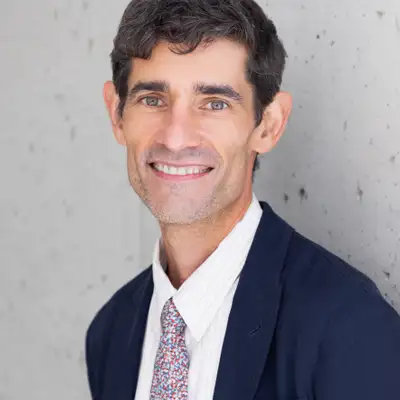
My name's Matt Abrahams and I
teach strategic communication at
Stanford Graduate School of Business.
Welcome to Think Fast
Talk Smart, the podcast.
Today I look forward to
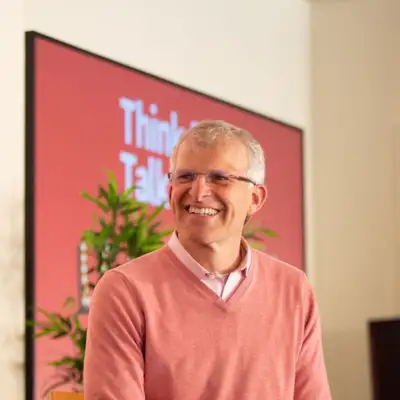
speaking with Nick Thompson.
Nick is the CEO of the Atlantic and
the former editor-in-Chief of Wired.
He's also a highly accomplished
competitive runner holding the American
age group record for men 45 and older
in the 50 K race, and being ranked among
the top master marathoners in the world.
His newest book is The Running Ground.
Welcome, Nick.
I am super excited for our conversation.
Nick Thompson: Thank you, Matt.
I am thrilled to be here talking with
you on my favorite campus in the world.
Matt Abrahams: Should we get started?
Nick Thompson: Let's do it.
Matt Abrahams: Excellent.
You've had a front row seat to many,
many changes that we've all seen
in the way that we communicate.
What makes for a good communicator
in today's world of likes, LLMs, and
quite frankly, let's face it, laziness.
Nick Thompson: This is clichéd,
but I found that the things that
work are clarity and authenticity.
If you can get across what you're
really trying to say, if you can
say it honestly, specifically,
and ideally, briefly, that's good.
And you can say it in a way
that feels like it's you.
That's great.
Now you can fake authenticity.
Authenticity is hard to define, but
I definitely think that when you
try to force yourself in a box, try
to do something that doesn't feel
natural, the audience can tell.
Matt Abrahams: And you yourself,
you write, how have you found
your voice in all of this?
What have you done to find
what's authentic to you?
Nick Thompson: There are a whole
bunch of different ways I communicate.
So I do a daily video, right?
And the daily video is just
me in the moment, right?
And I film it wherever I am.
Yesterday I filmed it because I had the
idea while I was walking to the office on
the wharf, and the only place I could film
it was by balancing the phone above an ice
machine stand facing out over the river.
And then I stood up to do it, and
then I realized I had a problem,
which is that if I took a step back,
I would go in the river, right?
And so I had to be really
careful last night not to fall.
But what people like is, it's short.
It's to the point.
I explain what's happening in
text, something that's on my
mind, and I just do it where I am.
It's not polished, it
doesn't go through comms.
So that's one form of communicating.
Another form of communicating
is of course, what I write, and
that's much more serious, right?
And that's polish.
That's, I try to find voice.
I try to add humor.
I try to make it as brisk as possible.
I try to have scenes and structure, all
the things I learned in my years at The
New Yorker, at Wired, at the Atlantic.
So that's a very different kind, but
both forms are things I care about a lot.
Matt Abrahams: How much
do you edit your work?
Nick Thompson: The book immensely.
So my new book is just out
and it's now November of 2025.
I finished the first draft in August
of 2023, and so I haven't done a word
comparison, but I think if you were to
do a word comparison of that first draft
versus the final draft, probably 5% of the
sentences existed in the final version.
It just went through so many different
revisions trying to get it right.
Matt Abrahams: I have learned in
my time how important editing is.
I used to think editing was
just a necessary evil, but in
fact, I think the most creative
things happen during editing.
You really do have to think
through, who's my audience?
What's my structure?
How do I make it clear and concise?
I've had to learn to be a better editor,
and actually now I think I'm probably a
better editor than writer as a result.
Nick Thompson: It's interesting.
I went the other way around where I was
an editor first and then became a writer.
So I loved the craft.
And you would watch at The New Yorker,
or I worked at this place called
Legal Affairs before, and you'd come
in and you'd get this 10,000 word
draft and be hard to get through.
And then you would go through all
these rounds and you'd end up with
this beautiful 6,000 word final
version that had all the same good
information and was just much cleaner,
tighter, better structured, character
handoffs, chronology, everything.
And so with my book, at the end, I was
going through it every, I was like reading
out loud every a hundred word sequencing.
Is there anything I should cut?
Anything I like?
Do I actually have something
interesting in this paragraph?
If I don't have anything interesting in
this paragraph, let's get rid of this
whole paragraph, and really working
to make it tight and controlled.
And I actually made these giant
maps of the chronology and like,
how can I do a handoff from this
character to this character?
Okay, this observation happened at
this point involving this thing,
which sort of relates to this event.
So there are three places
in the book I can put it.
If I put it in the third place,
what other pins does it knock
over later on in the chronology?
I put in the second.
Okay, let's figure that out.
So it was a really complicated process.
Matt Abrahams: I want you to
comment a little bit more about
the reading out loud piece.
I encourage people to do that, and
I'm curious why you recommend that.
And then to see your narrative, to see
your story visually and to connect the
dots, I am a huge supporter of having
structure and logic in communication.
So many people just list and itemize.
I love this idea that you actually
visually represent it and then
take yourself through that mental
questioning of, if I move things
around, what are the consequences?
I, I appreciate that.
But talk to me about the reading out loud.
Nick Thompson: That was something
I started really doing at The New
Yorker and I didn't have confidence,
so I worked at The New Yorker from
about age 34 to 41, so at like a
very important point in my career.
And I started a moment where I, I had
done well in journalism, obviously I got
hired at The New Yorker, but I didn't
have full confidence and I certainly
didn't have confidence in my writing.
And I show up at this place with
the best writers in the world,
and I wanted to be like them.
And I knew I couldn't write like them.
And so I would go home and I would
take their stories and I would read
them out loud and I would try to
understand what are they doing?
Because when you read out loud you
force yourself not to skip words, right?
When you're reading on paper, your
eyes are scanning, you're moving,
you're like taking a little piece
of this paragraph and that piece
paragraph, and you can understand
voice and flow, and it comes through.
You read out loud, forcing
yourself to really understand
and to study it through it.
And then when you do it for
yourself, you can't cheat, right?
When you're writing, you can pretend
that the sentence makes sense, but you
read it out loud and it doesn't make
sense, it doesn't sound right, or it
doesn't flow right, or it's repetitive,
you're confronted with it like it's,
you know, you look in the mirror and
you really see yourself in a way you
don't, when you're just reading it.
Matt Abrahams: Right.
It's almost like you're having
a conversation with yourself.
And if a conversation doesn't
make sense, you change it.
Nick Thompson: I will tell you that
one of the scariest things for me,
so I finished the book, I've gone
through and I've read it out loud.
I've gone through all this editing, and
then I have to read the audio book, right?
And you're in there for 14 hours,
but at that point, you're done.
You can't change anything.
And I remember going to the studio
the first day thinking, I'm gonna
wanna change so many things when I
read this out loud and then I didn't.
It was fine.
Matt Abrahams: One of the most stressful
experiences I had in writing my
latest book was the audiobook reading.
I believe attention is the most precious
commodity we have in the world today.
How do you coach your editors and
writers to craft sticky content that's
not just soundbites, and how do you
actually get people to write in a way
that's meaningful and draws people in?
Nick Thompson: There are a couple
of rules that I follow that
I think are really important.
When I was working as an editor at Wired,
I would push people and I would say,
okay, let's take a look at your story.
If you were to describe the
story to someone at a cocktail
party, would they be interested?
And if you were to describe this section
of the story, would they be interested?
And if not, find a different story.
Okay.
Secondly, now can they visualize it?
Not necessarily is it gonna, you know,
sell to a Hollywood screenwriter,
but as they read the story, is there
gonna be a little movie playing
in the theater of the mind, right?
And if there's not,
you need to rewrite it.
'Cause if they can't see it, right,
and if they can't relate to it,
they're not gonna be able to follow it.
Okay, now what is their
emotional reaction gonna be?
It has to be something.
They can be angry, they can hate it, they
can love it, but if there's no emotional
reaction, what's the point of it?
Okay, now we've got those things in
order and like the writers there.
So now let's go through the story.
Let's just identify exactly
how the narrative is working.
Why is this here?
Why is that here?
Is it completely chronological?
Do you have any extraneous characters?
And just going through with writers to
make sure that the piece was as crisp
as possible, as clean as possible.
Matt Abrahams: I really appreciate
the idea of visualizing your
narrative, your story, seeing
it, what is it showing people?
And then what makes ideas sticky for sure
is the emotion and thinking about what
is the emotion you're drawing out and
how do you bring that about in people?
I can't speak to somebody
who does what you do without
bringing up the AI question.
What role should AI play in journalism
specifically and in our everyday
communication more generally?
Nick Thompson: So AI is the
hardest thing in journalism by far.
And the reason it's so hard is that
there are a whole bunch of different
matrices on which you have to evaluate it.
And there's a question of how journalists
should use AI to do their report.
And my view is they should
use it all the time, right?
Not to write anything because
the reader is reading the story.
It has your name on.
It should be you, right?
So they should never write a sentence.
Also, it's a bad writer right now.
Maybe it'll get good, but even
when it's good, it should be you.
But for finding stories, for understanding
topics, for like figuring out chronology.
Take your 3000 word story before it goes
to the editor and say, hey, are there any
chronological gaps in this story, right?
There's a whole set of editorial
things you can do with AI.
Put it in there.
It'll give you suggestions.
You can fix 'em or not fix 'em, but
if you don't, I think you're crazy.
So that's one thing.
On the other hand, my profession
has been very wary of adopting it.
My company in particular, and
the reason for that is, you know,
the industry is built on theft
and theft of our material, right?
All of these companies came,
scraped our sites, in violation
of our terms of service, often
using bots that they disguised.
It made the people in my
profession very angry.
Secondly, they're quite scared because
every study and every ranking of
what industry is gonna be displaced
the most, journalism is at the top.
So they're very scared
and they're very angry.
And then also our business
is being disrupted by AI,
particularly in search, right?
So we have an existential business
threat that we're already facing.
So there's this funny, complicated mess
where we need to use AI, and I really want
everybody to use AI, but more or less,
everybody hates AI and is terrified of AI.
Matt Abrahams: And do you
use it in your daily life?
Nick Thompson: Oh, 50 times a day,
like nonstop for prepping for anything.
Last night I had to host a dinner for
18 people, and we're talking about
a really complicated type question.
I didn't know the 18 people,
I know a couple of 'em.
So, alright, hey AI, get me bios.
Okay, great.
Now AI help me sort through
the most interesting questions
that relate to these bios.
Okay, great.
Now AI, please make me flashcards
and quiz me on who everybody is.
Gimme a name, I'll tell 'em their company.
Gimme the company.
I'll tell 'em the name.
Takes a process that would've
taken maybe six hours, makes
it an hour process, right?
And so I go to dinner,
I'm totally prepped.
I know everybody's name,
I know their companies.
I can identify their faces, and
I have a bunch of good questions.
And so it's so helpful.
Matt Abrahams: That's a great use case.
And one I might borrow from you.
Like you, I enjoy running, but
unlike you, I only run 10Ks.
You're a true runner,
marathons, ultra marathons.
What does running mean for you, and
how has it helped you in your life?
Nick Thompson: It's my
form of meditation, right?
So I go out and I listen to the birds,
listen to the sounds, listen to my
breath, listen to my body, understand.
It opens up all kinds of thinking.
So it's a very important time in my day.
By the way, I, because we're on the
Stanford campus and we're not far
from Campus Drive, I'll tell you
when I decided never to listen to
music, I was on the Stanford Track
team my freshman year in college.
I wasn't good enough to stay
through, but I was good enough
to be there freshman year.
And I remember the coach Vin Lananna,
who's one of the legends of the sport.
And I remember it, he gathers us all
around and he's like, I can't remember
exactly what he said, but it was
something like, you have a big race
coming up and we're here to compete.
We're here to try to win.
We're here to do our best.
And if you're not on board with
that, just go put on your headphones
and run around Campus Drive.
And what he was saying is that if
you're gonna be serious about it
and you're really gonna try to like
understand your body and improve,
you have to turn off the music.
You have to listen to yourself.
Anyway, so back to your question.
So it's a way for me of meditating,
releasing, getting out in the world.
I work in New York City,
I live in Brooklyn.
I'm very domesticated, but I used
to love the mountains, right?
I grew up and was outside all the time.
Like the thing I love to do most is my mom
would just let me go out the back door in
Maine and I'd just go run in the forest.
And so, running is a way to get back
to the spirit of that little child.
So that's important.
But then it's also taught me all kinds of
habits of mind and discipline and pacing.
Like there are all kinds of lessons from
the sport that apply to my business life.
And then also I like
to win and get faster.
Matt Abrahams: I can tell you've
got a competitive streak in you.
I have always found and recommended that
having some physical outlet, whatever it
is, I don't care if it's building Lego
models, playing music, uh, for me it's
martial arts, finding some opportunity
to express yourself in a different way.
And like you, there are
great learning opportunities.
I hear you when you say you learn
about yourself, your body, but you
also can bring that into your work.
That's really important.
Nick Thompson: It's great.
And you disconnect from your phone, right?
And you disconnect from all the stuff.
One of my theories, people often ask
like, why do so many people run marathons?
Like, why do 55,000 people
run the New York Marathon?
I'm like, complicated reasons, but
in part because they know they're
on TikTok too much and running a
marathon and training for a marathon
is a way to get away from it.
Matt Abrahams: Do you often run solo
or do you run with other people?
Nick Thompson: I mostly run solo.
I prefer to run with other people,
but then you have to schedule it
and like my life is so complicated,
I've just foregone that.
Matt Abrahams: You've noted that
running is the simplest sport
and the simplicity can be a tool
to understand complicated stuff.
Can you give us a concrete example
of how you've taken those lessons
of simplicity and brought it into
what you do for a daily thing?
Nick Thompson: So what I mean by running
is the simplest sport, you really,
you control it all yourself, right?
You can open the door and run, and you
can do it any day, anytime of night.
I ran at 4 o'clock this morning
and it was cold, but it was fine.
I couldn't have done any other
sport at 4 o'clock in the morning
in Washington, DC on the wharf.
No one was there to play tennis with me.
I didn't have a ball.
I didn't have a bat, right?
Running, you really can control
when you do it and how you do it.
And not only that, you
can tell how you're doing.
You can go run a 10K.
And you run it a minute slower
than last year, that's bad.
You run it a minute faster, that's good.
And there's no external factor,
like maybe the weather, but
really it's like about you.
And so what that does is it means
that you can see yourself aging in
a way that's hard with other sports.
You can see, I just went through this
thing where like I couldn't really
tell I was sick, but I was kind of
sick, and then I ran a marathon.
It was like 30 minutes off my goal.
Well, clearly I had some kind
of respiratory problem, like you
understand things about yourself,
but then the important part is
because it's you and because you
control it, this gets to the habits.
You can go every day, which means
that you can teach yourself a
habit, sort of a stoic habit of,
I'm gonna go and run every day.
It's like a tennis game, and
you've got somebody else.
Like it's a little harder.
It's harder to blame yourself
when you fail, and it's harder to
credit yourself when you succeed.
And so, running for better or for worse,
really lets us kind of form ourselves and
shape ourselves in good ways, bad ways.
Matt Abrahams: I really like how
you use it as a tool for growth.
Before we end, I like to ask
everybody three questions.
One I make up just for you, and two, I've
been asking since the podcast started.
Are you up for that?
Nick Thompson: Of course.
Matt Abrahams: So in order to train,
like you must have to train for
ultra marathons, marathons, you
must be a master at time management.
How do you make it fit in?
Clearly it's a priority, but I have a
lot of things that keep me busy in life.
I can't imagine the allocation of time
I need to run the distances you do.
Nick Thompson: Well, I mean, I train
8 hours a week, which is a lot, but
it's not 20 hours, it's not 30 hours.
And a lot of it is multitasking.
Like I run to the office, I could
take the subway to the office
and it would take just as long.
So it does take some time,
but not that much time.
And I think that net, it creates
time because of the way it relaxes
me and the way it opens my mind
and lets me think about things.
So I sometimes wonder, and I think
my wife probably wonders this too,
like, Nick just stopped running.
Like what would, where
would that extra time go to?
Would it go to working more efficiently.
I don't know what it would go to,
but I think it would, I think my
life wouldn't work as well if I
didn't spend that time running.
Matt Abrahams: I hear you on that,
and because running is something
you can do whenever you can
use it as a way to get to work.
I think that's great.
So somebody who might be not as
into running as you are might,
upon hearing this say, oh,
there's ways I can fit it in.
Question number two, who is a
communicator that you admire and why?
Nick Thompson: I think
Adam Grant's amazing.
His ability to very pithily say what's
important in life and to explain it.
I just, I've never seen someone like that.
Every time you see something that he
says, something that he does and questions
that he asks, I think he's just great.
Matt Abrahams: He's a very
economical communicator who also
is able to get to the point.
Question number three, our final question.
What are the first three ingredients that
go into a successful communication recipe?
Nick Thompson: Understanding your
audience, who are you talking to and why?
I don't know what the exact right word
is, but it's almost like the water of
a recipe or the milk of the recipe.
It's like, are you conveying the
essential thing and is it right there?
There can be some fluff around it
to set people up, and there can be
some fluff at the back, but are you
putting the right thing at the core?
Are you getting the actual
important stuff in there?
The third ingredient, you know, respect.
Are you like respecting the
person you're talking to?
Are you respecting the audience
and is it actually about them?
And that's really important.
Matt Abrahams: Focusing on the
audience is by far the number
one bit of advice people give.
Critical to start there.
This idea of distilling it down
to its essence, its core, making
sure that's clear and getting
that upfront, really important.
And I really like this idea of respect.
I think people are so focused on
just getting the information out.
They don't really think about
that respect, that somebody's
giving you time to listen, to read
that you need to respect them.
You don't have to agree with them,
and you might even challenge them.
Nick, this has been fantastic.
Not only have you taught us
about better writing and better
communication, but you've taught us
about the importance of having a sport
in our life that can really help.
And yours is running.
I run as well, and I certainly
can see how the feet on the ground
can help you be grounded for sure.
Thank you.
Nick Thompson: Thank you so much.
Matt Abrahams: Thank you for
joining us for another episode of
Think Fast Talk Smart, the podcast.
For more information on movement
and activity and how it relates
to communication, please listen to
episode 183 with Kelly McGonigal.
This episode was produced by Katherine
Reed, Ryan Campos, and me, Matt Abrahams.
Our music is from Floyd Wonder.
With thanks to Podium Podcast Company.
Please find us on YouTube and
wherever you get your podcasts.
Be sure to subscribe and rate us.
Also, follow us on LinkedIn,
TikTok, and Instagram.
And check out fastersmarter.io for
deep dive videos, English language
learning content, and our newsletter.
Please consider our Think Fast
Talk Smart Learning Community where
you can join a global community
of people interested in honing and
developing their communication skills.
You get access to async
lessons, an AI coach, quests
and challenges, and much more.
Join us at
fastersmarter.io/learning.
That's fastersmarter.io/learning.