Subscribe
Share
Share
Embed
Featuring interviews, analysis, and discussions covering leading issues of the day related to electromagnetic spectrum operations (EMSO). Topics include current events and news worldwide, US Congress and the annual defense budget, and military news from the US and allied countries. We also bring you closer to Association of Old Crow events and provide a forum to dive deeper into policy issues impacting our community.
speaker-0 (00:00)
I'm seeing that great things are happening when companies get involved and bring different ideas, different types of technology. They all have different strengths and different weaknesses as far as US and international companies working together, especially this day and age, it can get incredibly complicated.
Ken Miller (00:17)
Yeah.
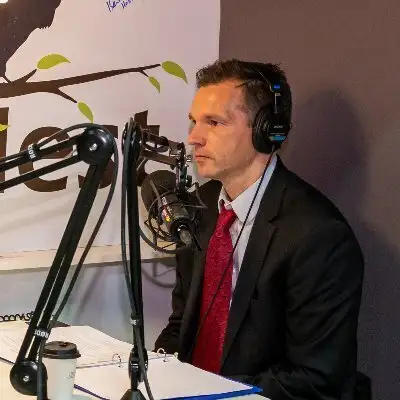
Welcome to From the Crow's Nest. I'm your host, Ken Miller from the Association of Old Crows. As always, it's great to be here with you and thanks for listening. Before I introduce my guest for today's episode to discuss joint ventures and teaming and defense acquisition, just a word of an update. Last week on June 4th, the House Armed Services Committee under the US House of Representatives reported out its version of the FY 2027 National Defense Authorization Act.
This is the first major muscle movement of the annual defense budget process. The House Armed Services Committee, the Hask, reported the bill by a bipartisan vote of 44 to 12. Now, the bill will authorizes 1.15 trillion in discretionary funds for the Department of Defense and defense-related activities in other agencies. This brings total defense spending up to 4.5% of US GDP.
With the goal to reach 1.5 trillion by the end of FY 2027. An important provision, however, that was added to the bill during markup was directive report language sponsored by Representatives Mark Mesmer from Indiana and Representative Chrissy Hoolihan from Pennsylvania. Both members are a part of the Congressional EW working group, and they supported an amendment that was included.
That calls for a review of governance structures supporting US electromagnetic spectrum superiority. The language cites concern that US is, of course, not prepared to maintain EMSO superiority against advanced near-peer adversaries. And the language calls for an update on the progress of the implementation of the 2020 EMS superiority strategy and an evaluation of potential new governance structures for EMSO.
Along with any legislative adjustments that would be necessary to implement that those new governance structures. Now, for those who follow the AOC or follow the show regularly, you'll know that AOC has submitted language to establish a new combat support agency, a new CSA for EMSO, due to persistent gaps that remain even following the 2020 EMS superiority strategy.
Of course, establishing a whole new federal agency for EMSO is a huge swing and it's going to take multiple years. So this is really the first major step in that process to get DOD and Congress on record for where they stand on the proposal and what steps would be necessary for that proposal to move forward. Of course, any legislative proposal that is included in this effort would have to be passed by Congress, both the House and the Senate, and signed by the President. So
Not an easy swing for one year. So it's going to take a couple years to do this, but we're very pleased with the step that was taken this year. And we appreciate the hard work of Congressman Mesmer and Congresswoman Chrissy Hoolihan on behalf of the EW Working Group. So without further delay, I'd like to welcome my guest for today's episode here to talk about joint ventures and teaming in defense acquisition. Miss Jenna Girampini is the chief of research and government contracting for multiple companies as an
And is an expert in government contracting, project management, and business development. She began her career in Homeland Security Administration before moving to other government agencies to focus on contracting and project management and so forth. She has consulted for many organizations and she serves as a subject matter expert in federal acquisition regulation and defense federal acquisition regulation supplement.
So without further delay, I'd like to welcome Jenna to From the Crow's Nest. Jenna, thanks for joining me here on the show. It's great to have you on.
speaker-0 (03:58)
Thank you so much. It's great to be here. Wonderful to meet you.
Ken Miller (04:01)
It's great to meet you too. And now you had the opportunity to provide ⁓ an AOC webinar virtual series earlier this year on this topic of joint ventures and teaming arrangements and kind of the best practices. And ⁓ it was a great conversation. I wanted to have you on because I think that with our audience, many of them are involved on a daily basis in defense contracting. I think it's an issue that is very helpful for a lot of people to to understand in terms of how to be competitive in this arena. And so I wanted to have you on the show to talk about.
some of the advice that you have for companies looking into joint ventures and teaming. Just to start off, ⁓ tell us a little bit about your background and your experience in understanding teaming and joint venture arrangements.
speaker-0 (04:43)
Thank you so much for that introduction. I basically created this webinar because I was finding as a government contract advisor that a lot of companies were misinterpreting joint ventures and teaming arrangements, thinking that they were the same type of partnership. And they weren't, they were also not knowing when and how to use them. ⁓ so I decided to really start digging into the different types of joint ventures, the different types of teaming arrangements and really looking at the scope of contracts.
dissecting them and working with companies and first identifying when and how to use them and what types to create and how to create them. So that's the kind of a little bit about why I created it and how I created it. They are created definitely totally different. ⁓ and more often than not, teaming arrangements are used more frequently because they're a lot easier to use and less formal.
Ken Miller (05:36)
So you mentioned there's a lot of misinterpretation about these avenues for contracts. Could you talk a little bit about the difference of what is a joint venture versus a teaming and what are some of the most glaring misinterpretations between the two that people have?
speaker-0 (05:51)
Absolutely. A teaming arrangement is usually between a large prime contractor and a subcontractor where they split the contract based upon the requirement of the contract, the set aside of the contract, the scope of the contract, the agency relationship. And a joint venture is more of a partnership. The largest difference between the two is the fact that a joint venture is a legal contract between both companies and the government. They actually have to create a new
Entity and Sam.gov receive a new cage code, have a legally binding contract, and both companies can speak and are contracted with the federal government, whereas a teaming arrangement or a teaming agreement is normally a prime and a subcontractor. And the only company that actually has a contract with the government itself is the prime contractor. The prime contractor only has a contract with the government, and the prime contractor only has a
contract with the subcontractor, the subcontractor never actually has or owns a contract with the federal government itself. So it can get a little dicey when it comes to private of contract, communication plans, accountability, ⁓ project management, change management. But they are the types of agreements that are more commonly used because they are easier to create. You can literally create them in five minutes. You know, you don't have to register anything. There aren't any legal aspects of it. ⁓ and they're just a lot easier to do.
Ken Miller (07:19)
So with the joint venture having to go through additional steps and contracting steps, you mentioned getting a new cage code and so forth and coming up with a new contract vehicle that specifies the joint venture versus teaming, which is a little bit more maybe informal in the sense that or less ⁓ it's stacked a little bit more in terms of having the sole contract the prime contractor be in the lead. When contractors are looking at
business opportunities and trying to decide whether or not a teaming arrangement or a joint venture is the right path. What are some of the key questions that they need to ask to determine which path they should follow to be the most competitive?
speaker-0 (08:01)
So I would first say look at the contract itself, look at the scope of the contract itself, really analyze and dissect the work share responsibilities, what each partner is potentially doing in terms of contract fulfillment, what is the money share, the collaboration, who brings what to the relationship. You know, is one company bringing in an agency relationship, a past performance relationship? Is it a set aside? that can be a big factor. Is it a set aside for a
veteran owned small business, where in fact the prime contractor has to be the one that has that type of certification. That would definitely lead it to a more prime sub relationship and teaming agreement. If it's a joint venture, since it is a more formal legal contract between the two companies, they really need to look at the future, I would say, you know, where is this future relationship? Really do their due diligence in researching the potential partner, potential teaming partner, and really laying out
in the joint venture contract itself first and really working with a a very knowledgeable contract officer that knows the difference between joint venture arrangements versus teaming arrangements. There are things that that joint ventures add into their agreement that teaming agreements don't have to. For example, if it's a contract that includes facility clearance and one company has that clearance and one company does not.
They don't add it into the actual legal contract of the joint venture. ⁓ if they're looking at responding to an opportunity that has that requirement in there, you know, if it's not attributed into the joint venture itself and if it's not added into the pool, you know, they don't qualify for that contract. And a lot of joint ventures really start based upon need and idea, emerging technology, you know, they're looking to the future, they're looking at mergers and acquisitions. you know, it's to create, establish that relationship.
And really grow as a joint venture team. I mean, a lot of big companies started off as joint venture partners. I mean, that that are now, you know, ended up in mergers and acquisitions. L3 Harris is a huge one. It originally started off as a joint venture and turned into a merger and acquisition. so again, a lot of the big defense partners, that's how they start. They create a great working relationship, past performance history. so you know, there is a lot more formality and legal aspect of a joint venture.
versus a teaming agreement. But I think if you really look at the opportunity itself first and then also look at the larger aspect of it, you know, is it part of a contract vehicle, an IDIQ? What's the history of the contract? What's the funding of the contract? ⁓ it's a lot easier to decide, you know, is this something that is a long term adventure or is it a low hanging fruit that a teaming agreement that we can really start researching who is the best partner for this teaming agreement?
So it can get a little complicated, obviously. ⁓ but it's great.
Ken Miller (11:00)
You mentioned that, you know, a lot of the contractors are that are coming onto the scene looking for teaming arrangements or joint ventures are doing so with you know, there's a lot of talk about innovative technologies, exquisite technologies, and you're seeing a lot of startups, you know, offering solutions. And the market itself is undergoing a tremendous change right now with the focus on growing competition.
More innovation, exquisite technologies, AI, things of that nature. And then there's money to back it up. The defense budgets are still growing, especially here in the US, but also over in Europe, you're seeing a tremendous ⁓ growth in the d European defense market as well. Talk a little bit about this trend. is is this trend toward joint ventures and teaming, how is that impacted by the current environment of additional funding, pursuit of exquisite
technologies and and growing competition. Is is this a result of that or is it more of a cause to what we're seeing?
speaker-0 (12:02)
Think it's probably a little bit of both. I think, first of all, companies need to realize that this isn't about them. Although the government is looking for innovative ideas, advanced technology. In actual fact, at the end of the day, it's whether or not you can provide what the government is looking for at that time or in the future. So a more objective look at the landscape is something that a lot of companies really kind of lose sight over.
I believe that it works hand in hand. The budget reflects where advanced technologies are going. A lot of successful joint ventures come from small teams that really focus and complement each other and push the limits of the larger primes to still be innovative. But with that being said, there are a lot of small companies that look at those types of mentor protege programs.
To really get under the wing of the larger prime contractors because they have a very small, focused specialty area and provide something that they're really good at. You know, they make one really great product that is that is a key niche that is required on those larger teams. And the same thing goes with CTAs, the contractor teaming arrangements with Department of Wars funding, especially now in this contracting landscape, and probably the future as well. You know, you're gonna see the budgets flex and fluctuate, but
The CTA agreements are also incredibly important because you can you can create those large specialty types of teams with, you know, 10, 15 contractors, everyone providing their specialty focus area, you know, excellent product or service to create this incredibly strong spider web of a team to fulfill a huge contract. And I think that's kind of really goes back to the beginning of.
why I created this and why I'm digging more into joint ventures and teaming arrangements. It's not really so much to explain the difference about the two of them or kind of how to use them. It's really to work with companies so that they understand that it's why and how you create your joint venture or team and lay those bricks and lay that mortar that you can create something as strong as you would like.
And use your capabilities past performance to really add strength to that.
Ken Miller (14:26)
One of the hallmarks of electromagnetic spectrum operations community has always been our ability to innovate and adapt to dynamic changes in the battle space. And and of course you you can see it over in current conflicts in Russia, Ukraine and Iran and so forth. The fight is changing every day's and that of course has cascading ⁓ effects to how we contract. one of the biggest challenges that the DOD has been trying to address, at least over the last I'd say
20 years, especially, is this notion of innovation and assuming more risk in terms of the production of technology. And I think one of the the things that I appreciate about these teaming or joint venture pathways is it's a way to kind of think outside the box from a traditional contracting way to like you mentioned, maximize everyone's strengths in the development of a technology. Could you talk a little bit about how?
Joint ventures and teaming are important ways that companies can think outside the box. And how do these two pathways help mitigate potential risk when you're dealing with developing exquisite technologies that, you know, need to be tested in the field and and have a high degree of failure at beginning because we just don't understand exactly how the battlefield is shaping.
speaker-0 (15:45)
Absolutely. I think creating joint ventures and teaming arrangements, whatever type you decide to create or need to create, really pushes companies to to think outside the box. It really is a giant think tank of excellent people, excellent minds, exceptional skills, but it also pushes you to be competitive, to look at new things, new ideas outside of the way that you normally would. I mean, if you think about it, if you're sitting in a room with the same five people.
For five years, there gets to a point where everybody's thinking the same thing. You know, you have one new person that walks in the room that says, Hey, you know, did you know that McDonald's has a new cheeseburger? And you've been in the same room with the same five people for five years, you have no idea. So it's pretty much the same idea of collaborating, think tank, people with different ideas.
And that are bringing new ideas to the table and you can really test those ideas and really throw those around with each other. And you may also have different specialties and different capabilities. You know, sticking a project manager with a change management person. You know, you have two different you have two similar capabilities, but they're not the same. Yeah. So it's collaboration, I think, at its finest.
Ken Miller (16:57)
In my interactions with defense companies, it can sometimes be frustrating because a lot of times they're very one one way thinking or they have a certain process that they follow. They're very many of them are can be very stovepiped. and this goes across different divisions and and a lot of times one division doesn't talk to another division. And we've been in we've I've met with companies where there's two different divisions and they're both working on the same thing and they don't know it. I doubt it can be hard to for companies to
speaker-0 (17:20)
Yes.
Ken Miller (17:24)
self-analyze. I would imagine teaming and joint ventures, it's very important to open up your product to outside perspectives to get a a fresh set of eyes, so to speak, on it. Do teaming and joint ventures kind of help companies with that kind of outside perspective to make sure that things are as good as they could be? Because I would imagine if companies are trying to go it alone on traditional contracting vehicles, the kind of the self-awareness, the self-analysis of how good your technology is
is sometimes hard to to verify when you're only looking at it from the way that you do it.
speaker-0 (17:58)
It is. It definitely adds a new level of additional checks and balances outside perspective, a major level of accountability. You know, there's a whole nother company that is relying on you and vice versa. With that being said, the initial contract, if it is a joint venture, you need obviously need to be very careful about, especially with advanced technology, emerging technologies, ⁓ in this landscape, IP. So define those.
Attributes before you even start working on a contract. So the risks are there. I think the communication plan, communication engagement plan will help mitigate those silos. It will help people be accountable, stay accountable, and create those checks and balances across across the board. Project management obviously is very important. Change management is very important. If you bring back the basics of
business skills and project management back to it to make sure that the oversight is there, the governance is there, ⁓ then people have something to look back at ⁓ and really keep on the same track at that point.
Ken Miller (19:11)
You have a lot of experience in helping, you know, going into companies, giving them training about how to maximize the joint ventures and teaming. Can you share an example of a joint venture or a teaming arrangement that worked really well, gave the team a lasting competitive advantage and why it worked so well? We can obviously keep the the the names of real people hidden for now, but do you have an example that you can help us kind of
understand a little bit more in terms of how it actually works.
speaker-0 (19:41)
Absolutely. And I include these in all of my training programs as well as webinars and seminars because they it is always nice to look at real world case studies of both successful joint ventures and teaming arrangements as well as failed joint ventures and teaming arrangements. I do have a lot of defense ones because those are the easiest ones to pull. They also seem to last a bit longer than the others. I think maybe because the end goal is
I don't want to say more important, but it is incredibly important and crucial. A lot of the joint venture case studies that I have studied and that I have pulled are based on large contracts, anywhere between 100 million to, you know, a billion dollars or a couple of a couple of hundred million dollars. They usually start with companies that are similar in a similar industry that create either a product or service that
build something on a larger scale. I'm gonna take a fictitious one, take all names out of it. ⁓ like for example, let's say we're making a plane, you know, and we have a company that makes all of that manufactures all of the material to make a plane, including, you know, engine, nuts, bolts, whatever it may be. And then you have a software IT company that comes in with, you know, guidance, radar systems and all of those types of components. Those companies join forces
and create a joint venture to create planes for the Air Force. We'll we'll just say, okay, their first contract together was successful. The Air Force reaches back out and says, we would like, you know, an additional 200 of these planes. You know, can you go ahead and make a 200? At that point, they may think, hmm, we started this off as a teaming agreement, but maybe not now let's make it more official. We see something in the future. We see a future together. We see future contracts. We see a stronger relationship.
⁓ so over the years working on additional contracts together, they have more past performance, more contracts, and they can really create something for the overall good.
Ken Miller (21:49)
Mm-hmm. One way to think about this, and please correct me if I'm wrong, is so when you're looking at contract vehicles, a a business opportunity, you can start off on one path. And if another path looks like, hey, we need to we need to shift from a team to a joint venture, a joint venture to another vehicle, there are opportunities to do that and to adjust throughout the contracting process.
as necessary or is this something more that what you start with you have to finish as and hope that at the end state there's another opportunity following that or how can you adapt that relationship throughout the the whole process?
speaker-0 (22:33)
would say risk mitigation on this and stopping that before you need to change something is key. I think if companies spend more time on the back end research of the contract itself, the contract vehicle itself, the nature of the contract, they can choose the correct type of teaming arrangement, whether it's a joint venture or a teaming agreement in the first place. However, with that being said, you can't
change what type of agreement in the middle of a contract. But let's say, you know, you get awarded, you know, a first contract, it's, you know, $10 million and you finish it successfully with your teaming partner. One company acts as the prime contractor, one company acts as the subcontractor. When you actually look at the scope of the contract and how you split the work share shift scope as well as the funds, was it really a 5149? And r was it a real partnership?
where two companies are working with each other at pretty much the same rate. And do you see a future with this company and have that end conversation of that debrief of how was this contract? How did we do? What can we do better? Do we see a relationship? What are your future goals, not just in government contracting, but what are your future corporate goals? What are your end goals? So it's more of a larger conversation that can be had after.
fulfilling a contract or even within, you know, midpoint. Let's say, you know, the kid this is this contract is working out incredibly well. Let's talk about, you know, our future relationship or is it not going so well? What are the things that need to be changed? Do we need, you know, different people in different roles? How is the accountability? How is our timing? Were we delivering on time? How were we doing? And those can all go back to, you know, processes, procedures, check-ins, communication.
accountability and really keeping somebody in line with another during the project itself.
Ken Miller (24:36)
So MSO, electromagnetic spectrum operations community, we're known to be inherently joint and inherently coalition based. Everything we do in terms of security, we team and have coalitions with companies from other markets, European market, South South America, Asia, and and AOC itself is a global organization. About a good third of our membership are all over the world in those markets. How are teaming and joint venture vehicles ⁓ handled?
when you have companies coming together working in foreign military sales or outside the US market. And do you see more teaming amongst a European defense contractor and a US defense contractor for a a product? Or how does the foreign military sales process how is that impacted by this topic?
speaker-0 (25:27)
I'm seeing that great things are happening when companies get involved and bring different ideas, different types of technology. They all have different strengths and different weaknesses as far as US and international companies working together, especially this day and age, it can get incredibly complicated. However, with that being said, it really does go to show that collaboration across the entire board is a great idea as far as legally.
contractually US government wise, I am not an international contract law lawyer, so I can't really can't get too much into that. So I'm not even gonna go there. However, you know, I think as long as companies really pay attention, really know what they're doing, and also support the United States growth government and we work on a collaboration level, I think it it doesn't really matter too much if it is a joint venture or a teaming arrangement.
So the type doesn't matter, but you know, again, I'm not an international contract lawyer, so I don't really want to get too much into the specifics of it. But at an overall theoretical level, it can work very well. You do see a lot of, you know, European companies. We grow in different areas. If you look at sustainability, and I know that, you know, AOC's number one listener isn't, you know, a sustainability contractor. However, if you look at the sustainability market over in, you know, Sweden, Norway, Finland, you know, they are
years ahead in sustainability and, you know, economic development and those types of research. So you can look at the history and the culture of the different companies and really kind of pick and choose on where are they excelling? You know, what is their advantage? How can we grow and how can we work with them to really pool and collaborate together?
Ken Miller (27:12)
And think it's important to always look at how other sectors are addressing similar challenges, whether it you are right to in talking about like we're not in the sustainability market, but we can learn a lot from how countries and companies have worked together on that for that priority. And we can there's a lot of best practices we can adapt in our community. I think it's always good to look outside of yourself on this. What other trends do you see in the defense contracting world that give you the impression that
Teaming and joint ventures and other new contract vehicles that we haven't even thought of yet are going to gain in popularity in terms of how companies seek to work together.
speaker-0 (27:55)
There's definitely a lot more uneasiness when it comes to the large prime contractors relying on just who they are. I mean it's something you hear at conferences, something you hear at events. You hear chatter about, you know, company X, Y, and Z just relying on their name. You know, we are X, Y, and Z company. We'll never lose contracts. And with this new administration, positive, good, negative, whatever you think about it, it is what it is. And
you have these smaller businesses that are collaborating. They're working together more. They are they are fast. They are willing to take those risks. there's less to lose. So the landscape is shifting in defense and the speed at which acquisition is pushing towards now is a much faster speed than I think that we've ever seen before. So that can be exciting. So I I have seen a lot more companies really look
To work together. How can we do this? What are you doing? What are we doing? How can we work together to get this done as quickly as possible, but also as smartly as possible as well? And really looking at the objectiveness of a contract instead of names and all of the show business behind it.
Ken Miller (29:10)
As we
reach the end of our time, I want to kind of put a bow on everything that we've discussed. I mean, this is really fascinating to me to think about how the the this contracting world is changing on a daily basis. Many of our listeners are in this world, in the defense contractor world and defense industry, or they are in government and they work on the on the inside of the process. What are some of the advice you would give to contractors, to listeners that are looking to get in to enter into the defense market?
What advice would you give them on forming their first joint venture or first teaming agreement in terms of the steps that they should look into?
speaker-0 (29:48)
The first area of advice that I would give that I give to all of the companies that I work with is pay attention to details. Details matter, they mean something just like words matter and words mean something. Make sure you lay everything out and organize everything out in a contract, make sure all of the agreements, everybody understands all of the information. And on the larger aspect of it is research. Research, research, research.
I spend all day researching, researching contracting history, funding history, past performance. You know, I'm looking at incumbents. Where are they? What are they doing? How can I beat them? What types of collaborations can I create to best fulfill contracts? So it really does come down to maybe not knowing everything, but knowing how to utilize research, study and analyze it and using those tools to move forward rather than just being
lazy and saying, Hey, you know, I've heard of this company, you know, they're in our black book. They fit all of the requirements. Let's just go ahead and give them a call. So being more objective.
Ken Miller (30:56)
That's great advice. Now you are a very popular person. Thank you. When we were talking before the the the recording, you have a number of opportunities on the horizon. You go around and do this training. ⁓ you you were with AOC ⁓ virtual series f earlier this year. If any of our listeners have more questions or want to take a part of this training, what are some opportunities they might have in connection with your work to take a look at?
speaker-0 (31:24)
work with multiple companies, any industry, any agency, because my background is incredibly varied across the board. I do everything from advising companies on government contracting, analyzing the contracting landscape for them, with them, helping them create teaming arrangements, joint ventures, as well as training them just on the basics of government contracting itself, either, you know, on a monthly basis,
Webinars, seminars, training programs. I've created a number of training programs in other agencies as well, HHS, CMS, United Nations. So you can always reach out to me via my email address, which is Jenna at germpini.com. And I'm sure we'll be giving that out as well. I'm also involved in two upcoming larger types of conferences, the Northeast National Security Conference, June third in Nashua, New Hampshire.
as well as the SFA AOC twenty twenty six Space Force Summit, June sixteenth, seventeenth, and eighteenth at MITRE. So I, you know, I definitely try to reach out to as many people as I can and really try to help them understand number one, what is it that your company does? What do you want to do? What are your end goals? And really try to objectively analyze how and why and what's the best method and way to get you to where you want to be.
Ken Miller (32:48)
Well, Jenna, thank you so much for taking time to join me here. And again, our listeners can find you on LinkedIn. You also have a website at www.jerumpini.com and your email at which you gave earlier, Jenna, at gerumpini.com. So thank you so much for joining me. Really encourage anyone to reach out to you if they have more questions because this is a topic that often gets overlooked, but it's very critical to making sure that we are continually able to meet.
The technology and capability demands for our warfighters. Companies have to look outside the box or think outside the box and organize outside the box if they're going to continue to adapt. So really appreciate your insight today. Thanks for joining me.
speaker-0 (33:29)
Thank
you very much.
Ken Miller (33:30)
That will conclude this episode of From the Crow's Nest. I'd like to thank my guest, Jenna Gierpini, for joining me. Also, please take a moment to review, share, and subscribe to this podcast. We always enjoy hearing from our listeners, so please take a moment to let us know how we're doing. That is it for today. Thanks for listening.
Topica.