Subscribe
Share
Share
Embed
Featuring interviews, analysis, and discussions covering leading issues of the day related to electromagnetic spectrum operations (EMSO). Topics include current events and news worldwide, US Congress and the annual defense budget, and military news from the US and allied countries. We also bring you closer to Association of Old Crow events and provide a forum to dive deeper into policy issues impacting our community.
Ken Miller (00:10)
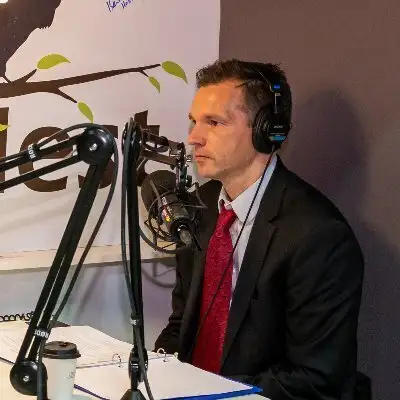
Welcome to From the Crows' Nest. I'm your host, Ken Miller from the Association of Old Crows. We are here at AOC 2025 at the Gaylord Resort in National Harbor, Maryland. We are coming to you each and every day of the show with new episodes. Day one was yesterday. We kicked everything off. It was a great first day of the show. We were honored to have our opening keynote speaker, Lori Buckhout, whom I had on my show yesterday. So if you have not already listened to day one's episode released yesterday.
Please check that out. I sit down with Lori Buckhout as well as John Knowles and talk about the theme and where the convention's going during the week. Today is day two. We shift focus a little bit and we focus a little bit more on policy and regulatory environment. We kick the day off with our keynote speaker, Congressman Don Bacon, before we take a look at counter drone warfare as well as acquisition reform. So in today's episode, I am very pleased to have with me
our keynote speaker for today, longtime colleague and friend of AOC, Congressman Don Bacon. He is the chair of the House Armed Services Subcommittee on Cyber, IT, and Innovation in the U.S. House of Representatives. He is currently in his fifth term, and he also co-chairs the Congressional EW Working Group, which the AOC works with very closely to make sure that Congress has the full understanding and information on electromagnetic spectrum operations that they need.
Following my conversation with Congressman Bacon, I will be joined once again by John Knowles, the editor in chief of Journal of Electromagnetic Dominance, AOC's monthly publication, to talk a little bit more about what we can expect to hear throughout today's briefs. With that, I would like to welcome my first guest to the show today, Congressman Don Bacon. Thanks for joining me here from the Crow's Nest. Always great to talk with you.
Don Bacon (01:57)
Well, it's a privilege to be back. I think it's my third time being here at the AOC convention. So thanks for having me.
Ken Miller (02:04)
Yeah,
we had you here a couple for a couple times when you elected in the first couple terms and then we gave you a little bit of a break, but we always could rely on you to give us a great opening session. So we asked you to come back here one last time. So thank you for taking time. It's a very busy time on the Hill and we'll get to some of that. But thanks for joining us. So you are giving the open, you're giving the opening keynote address today in day two of AOC 2025. The theme is
Don Bacon (02:23)
it's my pleasure.
Ken Miller (02:34)
charting a path to 2035, the future of EMSO. You have been the leader in Congress on EMSO issues during your tenure. What is your take on the state of EMSO and that integration into how we have to fight and win the next war?
Don Bacon (02:52)
My take is the Pentagon knows what it needs to do. We have strategy doctrine, implementation plans, but in the end, the budget is where it counts. And I think we're woefully and continually under budget for electronic warfare type programs. in case of point, I try to plus up Compass Call with a $400 million with this reconciliation bill that we had. And the money was what we did appropriate it, sent it to DOD to spend it on Compass Call.
and then they move it. And so in the end, you can talk a good story, but the budget is where you communicate your priorities. And I still think the Pentagon does not prioritize EMSO to the degree it should.
Ken Miller (03:36)
This has been a topic, we work closely with your caucus on capital, the Congressional EW Working Group, and you serve there with Congressman Rick Larson, Chrissy Hullahan, and Austin Scott. But this has been a topic with the budget and trying to figure out even how we can have a bigger understanding of where the money is going and where it needs to go, almost like a Rosetta Stone for EW budget.
What can we do, in your estimation from a congressional perspective, what can Congress do to kind of carve out that or make it a little bit easier to see where that money is shifting? Because oftentimes, like I said, it's too late in the game when we see that it's being shifted for us to...
Don Bacon (04:19)
return it were searching at the four million dollars back in we're gonna be more directives but we found that we really can't trust new of the leadership of sector defense right now that we've we've we see china's throughout we see russia's a threat in congress it's the secretary his team really does that so in his view it's but homeland security the border a western tap has for stuff and you don't need as much or check warfare has lined for that
Congress doesn't see it that way. And so we see, we gotta be, we gotta match China and Russia, and we want overmatch on these two countries. But we have a secretary and maybe some members in the White House who don't have the same view. So what we've had to do is be more directive. So for example, the secretary made a decision to withdraw a brigade out of Romania without notifying Congress, nor, nor,
notifying Romania, of all things. So now we have it in this current NDAA. They have to get congressional approval before they start taking forces out of Europe. So I think this and I think we have to do the same things on the EW. It's this isn't a cooperative thing as much as it used to be. They think they can just shift money around that we where we intended it. That's not right. Yeah.
Ken Miller (05:35)
So so this week is you we're talking a little bit about the budget this week is a big week on Capitol Hill with the final FY 2026 National Defense Authorization Act NDAA that's that's the bill that's kind of the the number one Mission of the Armed Services Committee that you serve on Is was filed? I think it's coming to the floor this week
Don Bacon (05:54)
Yeah,
we're hoping to vote on it. If we whip, the Republicans will at least vote for the rule. It will win by overwhelming number. There's some Republicans who say they're going to vote against it because of the Ukraine funding, which is, call them, we have a small summit, I them the nut jobs in our party that for some reason they don't see something wrong with Russia invading Ukraine and we should be helping them.
But if they vote for the rule, then we'll win an overwhelming Republican and a Democrat majorities. If we have some Republicans, though, that will vote against the rule just because of Ukraine, we'll probably vote on it Thursday, maybe Friday. And we'll have to do it on suspension, which means we've got to get a two-thirds vote. we'll have two-thirds vote. But both parties and the leadership of both parties support this bill.
Ken Miller (06:41)
We've been tracking it. You were, and you mentioned this earlier with the money and the reconciliation, but we've been tracking the bill, obviously, because there's a lot of key priorities and funding items that we support as an AOC, Compass Call being one of them. There's actually an MSO provision in the NDA, I think it's 1681, and it talks, it has a number of different provisions, but obviously there's some language about spectrum sharing technology, something that continues to
⁓
It's an issue that we continue to struggle with trying to get that understanding of that technology out into the field where commercial and military can share a spectrum in a different way than they have in the past. There's joint training for EMSO at tier one and tier two, the integration of that. There's some compass call language with the 350th. What is your overall take in terms of how Congress has been able to take care of EW from your perspective, given some of the struggles with the administration?
Don Bacon (07:40)
Normally the Pentagon doesn't like being micromanaged and I get it. I used to serve there, retired as a one star. And sometimes Congress makes things harder on the military to get their mission done. The military would have consolidated bases a long time ago. I'm not, the Congress doesn't have totally clean hands. But I think on EMSO, we have forced the Pentagon to be better than they would have been left on their own. I think it's been Congress that's been forcing the Pentagon and the services
to do better when it comes to EMSO. Like when I came in and got elected, I saw this as a problem in 2013 or 14, I was in the Pentagon. I couldn't get any traction. The priorities were not EW for sure. But we come into Congress and say, okay, who's in charge? Nobody's in charge. And the joint staff, DOD, in the services, and almost always point to the vice chiefs of the services being in charge. So it's been in Congress at every step the last nine years.
directing the Pentagon make changes. And I think they've been for the better. There should be somebody in charge of the joint staff, somebody should be in charge in OSD, and every service should at least have a one-star equivalent that's running these programs, because people gotta be held accountable. And we've forced new strategy, we've compelled the Pentagon to do a lot more than they would have done otherwise in this area.
Ken Miller (08:58)
And the other side of that is you also then have that, once you send out that directive language, you have the means to provide the continual oversight to make sure that they're following through with the reports. It's interesting, so later today, after your time with us, I'm going to be doing a live show from the main stage this afternoon. We're going to be talking about is it time to establish an MSO force? Now, we're not taking a position because, but I'll have all sides, we'll have a little debate because at the end of the day, I think it's...
There's a lot of different opinions of where we should be going, but we share all the same understanding that we need leadership that can provide us the authority and resources on down through the force. it'll be interesting to see, but I really do appreciate it everything we're talking about today really started with your efforts in Congress with getting the strategy, the electromagnetic spectrum superiority strategy, the cross-functional teams, the joint gemstone. So thank you for the support.
Don Bacon (09:53)
I had a great team. I had a great team that had my vision and they were better. I hired people that were smarter than me, I think, that took a vision that I had and they made it better. I've been surrounded by some good, great folks. And thankfully, the Armed Services Committee has totally bought in to what I was recommending. So I've had good battle buddies on this.
Ken Miller (10:15)
So one of the last, think the last time you were here at AOC, one of the things that you mentioned, and I greatly appreciate your words, you talked a lot about the awards. And one of your award winners is the Compass Call ⁓ community for the work that they do. That was of course largely your background in the Air Force for 29 years. Just as, this might be the last convention you come to in a while, because you're getting ready to hope to come maybe. Exactly, maybe that's a better way.
Don Bacon (10:39)
in a different capacity. Not
an elected guy.
Ken Miller (10:43)
But can you, for our listeners, just your advocacy on Comes to has been so important. Tell us a little bit about why that system and that mission is so critical to future fighting.
Don Bacon (10:54)
Well, we don't have enough of them right now, but if you look at the future capabilities of this EA-37 compass call, it's going to have a lot more output than the old EC-130s. You fly at a higher altitude. It does more than just comms jamming. It's got radar jamming capabilities, has cyber capabilities, which obviously that's a lot in the more secret SAPSAR world, but it's going to have a lot of capabilities that will help us
get airplanes over target in China and back home safely. And that's the whole goal here. And I flew in the EC-130s for 11 years. Also I flew in the Rivet joints and Cobra Ball out of off it. But really my bread and butter professionally was in the Compass Call. Got to, you know, squad commander in the invasion of Iraq. It's a great feeling when you've got a successful team that's jamming communications, making it hard for the Iraqi fighters to talk. ⁓
making the Iraqi tank stuff. We were putting a lot of data into there. We were confusing the hell out of the Iraqi air defenses. That was fun. ⁓
Ken Miller (12:03)
Well,
when I was on Capitol Hill's congressional staff with the EW working group like 25 years ago, we taught, we worked with the Compass Call community and yourself at the time. The information, the briefings that you provided us that we put into issue briefs to help with Congress, it was very important for us to educate Congress about this mission. And so really appreciate your advocacy.
Don Bacon (12:26)
I've loved it. And by the way, these awards that you mentioned, they help us promote our top performers to Colonel or Chief. You know, there's a lot of other programs out there. when you look, read all these evaluations and they all read pretty good, it's hard to distinguish your top performers. And when you have this ability to recognize the top EW or the top linguist within a unit and they get this award, a national level award,
you're helping that person make 05 and 06. Otherwise they may retire as an 04. so the AOC has been helpful in us pushing forward our top performers. And I've been a part of those awards programs since I was a colonel. So I love it.
Ken Miller (13:09)
So before we kick off today on the main stage with your address, you recently announced over the summer that after the end of this Congress next year, you're going to retire. You will have served 10 years. I cannot believe it's been 10 years already. Any final reflections on your time in Congress? And do you have any idea what's next for you?
Don Bacon (13:32)
Well, I'm excited that we had a great team and I never say it's me. We have 18 people on our staff. Some do constituent services, some do legislation. thus far we have 38 bills signed into law that we wrote in our office and we have six more in the current NDAA. So once it gets signed by the president, I'll have 44. Right. And it's really the number one Republican in getting bills passed.
And I like getting things done. to get things done, though, you got to have good relationships within your party, but also across the aisle. And I've worked hard on that. And that's the main takeaway. It's just like being a squadron commander or in the military. You've got to work well with your peers, build those relationships, because it's a win-win relationship. It can't just be about you. And I saw some commanders when I grew up, hated all the other squadrons, couldn't work well with anybody.
those people don't succeed in life and they don't succeed in Congress either. The hardest thing for me has really been this past year. We have a Republican administration. I'm a Ronald Reagan type Republican and they don't see China and Russia as adversaries. And so that's made it hard for funding the military appropriately.
They're doing things I think the majority of Congress doesn't really agree with and the majority of the country don't agree with when we look at the threats. And so it's been a little bit hard trying to figure out, OK, I agree with my fellow Republican administration on the border. I think they've been great on Iran. But there's been other areas where it's been banging my head against the wall trying to figure out how do we prepare our military for a fight in Asia or Europe? We don't want to fight. We want to deter it. We deter it with capabilities and overmatch.
And I don't see that same desire in this Pentagon or in the White House right now. And that's been the hard part this year, trying to figure out how do you fight back against your own party. really, the majority of us just agree with me. It's the White House. And it's been tricky trying to navigate that.
Ken Miller (15:37)
You have to navigate not just in terms of what you believe and what the solutions are, the parliamentary aspect of it and navigating that which can get also very complicated.
Don Bacon (15:46)
There's a mindset
in DC right now, it's all over our country. It's a shirts versus skins game. And if you're on the shirts, you should have support everything the shirts do and you're going to fight everything the skins are doing. Well, it doesn't work, but that's the mindset. And sometimes our coach isn't calling the right place. I think if you're shirts versus skins, we're going to fail. We got to be able to have a disagreement within our team.
And everyone smiled, the other team has a good idea. Right? And we should, we should just exclude them. And so, but it's right now, if you have any crossover, ⁓ it's mindset where you're a traitor. our system of government is not made that way. And our constitution surely wasn't written to operate in that manner.
Ken Miller (16:33)
We
greatly appreciate your approach to governance and you brought a lot of reason to it, your experience. mean, you are a trusted expert on all these matters. So really just appreciate what you brought to the table. It's been a pleasure just monitoring, following you throughout your career in Congress. And I can attest, your staff has been fantastic. Anybody who knows congressional staff, there's a lot of turnover. You've always had a great team to talk to.
Don Bacon (17:03)
continuity
⁓ for a long time. This year we started seeing some change out and I get it because I was going to retire next year. ⁓ But we've had a lot of the same team for nine years. We know each other too well.
Ken Miller (17:12)
And that's...
So, well, thank you very much for joining me and we're gonna get you to stage. I appreciate your time. Thank you. Thank you.
Welcome back. I want to thank Congressman Don Bacon for joining me here on From the Crow's Nest. I'd like to turn to my next guest, friend and colleague, editor in chief of AOC's monthly publication, the Journal of Electromagnetic Dominance or the JED. John, thanks for joining me here again on From the Crow's Nest. It's great to have you back on the show. All right, so ⁓ just kicked off day two, just got done with the opening keynote speaker, Congressman Don Bacon, who was a previous guest on the episode today.
John Knowles (17:43)
Thanks for having me back on.
Ken Miller (17:54)
Yesterday we had Lori Buckhout kicking everything off along with a number of different ⁓ sessions, technical briefings as well. What did you learn so far here this week, especially from Lori Buckhout and Congressman Don Bacon?
John Knowles (18:10)
I'd say yesterday, Laurie's speech was excellent.
It brought me way back, obviously. I remember meeting her at AUSA in 2006 and thinking, she's not from our community, really. She's not an UW person. How's she going to do? And she completely exceeded my expectations, obviously. And has been just a really inspirational leader. I loved, I missed hearing her up on stage. I obviously heard her on stage, but I missed.
the way she used to talk when we were younger. She could really get you fired up and really get you focused on something. I remember back, you and I talked about this, but back in the 2008, 2009 timeframe, there was a guy named Wing Commander John Clifford, RIF and retired. He worked with Laurie's office on some of the doctrine and whatnot. He said back then, should start calling this a domain. I remember being in this meeting, AOC staff.
I can't remember if you were in that meeting. We're on the phone with John. He said that. And we all looked at each other like, we can't say that. We can't call this a domain. That's crazy, right? And then we just thought about it for about a year. And then Laurie started to talk to Laurie and some of the guys at the Duke. like, we've got to start calling this a domain. We'll use Jed to socialize that. we as leaders, the leaders, not we, not me, but they as leaders need to start talking about this as a domain. And we pushed that idea really far into the work, into the EMS strategy in 2017.
to that question set of questions. And of course they ask the services, not the co-coms. So you got the automatic answer that it's not a domain because they weren't interested in making a domain. They're protecting their equities. But I missed, I just loved hearing Lori talk because she tells it like it is. And she's like, why can't you do this? Why can't you do better? She just challenges you to do better.
Ken Miller (19:55)
And she hasn't lost a bit of energy from over the last 25, whatever years it has been. So it was great to see her back here. Obviously, she's had a very interesting last year.
dealing with ⁓ the administration and her role in the administration. This morning we just had Congressman Don Bacon who had some very strong words about the role of Congress in EMSO, but also how they are interacting, what he's seen from the administration as well. So what did you learn from Congressman Bacon this morning? ⁓
John Knowles (20:27)
You know,
it's interesting. He paints a picture where we're struggling in the budget. He counts it in the budget. And it's interesting because I don't, you I'm a little more optimistic maybe than he is. I know he's looking particularly at the EA-37 fleet and trying to build that. But he again is saying, we got to not pretend here. We got to really call it like it is. And they both gave very, you know, very, he and Laurie both gave very straightforward.
straight talking speeches, did not candy coat, they did not sit there and say, you know, rah rah. The other thing I noticed about both of them, and I don't know, maybe it's just because I'm the editor for Jed, but they both use the word dominance, spectrum dominance, which is as a debatable term in our field. I obviously favor it because of Jed, our title of the magazine. But it's good that they're talking about dominance and we're not parsing like what we want to do, you know? It's a war fighting function.
We need to fight in the spectrum. We talk about MSO, but really the ultimate sort test of MSO is to be able to conduct electronic warfare, fight and dominate in the spectrum. So it's good to hear them using those terms because I think a lot of people in the Pentagon might hedge on that term. mostly out of not understanding how to talk about it.
Ken Miller (21:47)
So today is day two of the week. ⁓ We have a number of sessions as well going on later, ⁓ including a session on requirements generation for the 2035 fight. We have a session on counter drone warfare. And then we wrap up ⁓ the afternoon with a session on.
tactical evaluation in the European theater. then of course, from the Krosnest, the podcast wraps up the day with a live episode where we talk about, it time to establish an MSO force? All those topics tie into one another. What are the messages that you're looking forward to hearing throughout the day?
John Knowles (22:28)
Well, it's interesting. What I think ties them together is actually something that Congressman Bacon spoke of, which is mass. You know, that we can't just do exquisite EW anymore. think Dollar asked a great question in that, you know, what is the trade-off?
Ken Miller (22:41)
It
was great to see him in the audience.
John Knowles (22:43)
Exactly. It was great. so I look at how do we do mass? And you and I have been talking about this for a long time. It's not, know, EW is not a monolithic industry. There's a lot of different companies with different capabilities. ⁓ But something we haven't really ever been asked to do is what I would call like true mass. know, tens of thousands of something. We've made thousands of tow decoys, but only in limited production runs. That's a work consumable.
obviously flares and chaff and rounds and things like that. But true mass, and I think where you start with mass, have to go, to me at least, you always go to the heaviest case, the worst case scenario in terms of challenge, that's probably building decoys, building RF decoys, expendable RF decoys that are going to go into the battle space. And how do get them in there? How do you make them reactive to what's going on in the battle space in terms of...
you you're producing a bunch and now you find some new developments in the battles, you know, in the ⁓ electromagnetic operating environment. And so now you got to cut in new capability in the middle of production run. That's not something, we do that with very lumbering, slow ECPs on aircraft or something like that. And it's just very time consuming and in a lot of bureaucracy and it's very slow usually. And it's funny because we're also an industry that's born out of quick reaction capability, being able to feel things very, very quickly.
but again, not necessarily in huge numbers, not in the hundreds or tens of thousands. And we have to get good at that. don't know what, that's a mindset in the industry. There are parts of this industry, the ones that are probably coming in, the people that have, the companies that have a foot in the commercial world and a foot in the defense world that are probably very used to the scale of the commercial world. They don't build things in the hundreds in the commercial world for the most part, least not in the microelectronics side.
So they're probably very good at that. How do we bring them in and exploit what they do? So might be that one company designs a decoy and another company actually produces it. Or the DoD, instead of letting the developer of a decoy or something that they're going to produce in mass, maybe the DoD actually buys all the IP and then says, we're going to have second and third source on this so that we can just mass produce this.
But that idea of if you did, know, the days that we've normally had of, you know, some company develops something, somewhat on their own dime, and then holds certain pieces of proprietary, you know, it protects their role on that program forever. That may not be the case, because the skill set of that developer may not be the guy that, you know, and that's kind what you see like in the chip world, right?
You have companies in the US that design ships and they go over to Taiwan and they produce thousands of them in Taiwan at TSMC or somewhere like that, or they go to someone of the chip makers. And so you have this division of development and manufacturing. And even though the IP might reside with the chip designer, somebody else is actually producing it mass because they have the manufacturing capability to do that. That might be how EW goes too in some places. And I don't know what companies that would be right now, but again, I always look at this show floor. This is kind of a measuring stick for me every year.
And I'm like, who's here and what they, they, what they, opportunities are they trying to fulfill? So, so I think that might be something to look at in the future.
Ken Miller (26:06)
Great. Well, John, thanks so much. I know we're getting ready to go into another session. So I wanted to thank you for taking time out and swinging by the booth here to share with us your thoughts on today's agenda. I'll look forward to seeing you again tomorrow when we wrap up AOC 2025 with day three. But again, thank you for taking time to join me here today. Thank you.
John Knowles (26:28)
Thanks, it's always fun talking with you again.
Ken Miller (26:32)
That will conclude this episode of From the Crow's Nest. I'd like to thank my guests, Congressman Don Bacon and John Knowles for joining me. As always, don't forget to review, share and subscribe to the podcast. We always enjoy hearing from our listeners, so please take a moment to let us know how we're doing. We will be back tomorrow for the third and final day of AOC 2025. We look forward to talking with you then. Take care.