Subscribe
Share
Share
Embed
Welcome to Freedom and Glory: Tales of American Spirit—a podcast celebrating the heart of American craftsmanship, resilience, self-reliance, and the power of disruption. Through inspiring stories and authentic storytelling, we shine a spotlight on individuals and communities who embody these values, proving that small, determined efforts can spark meaningful change.
Join us as we share personal tales of triumph, innovation, and hope—moments that define the American spirit and shape our nation’s identity. Whether you’re seeking motivation to pursue your dreams or a reminder of the power of community, Freedom and Glory offers a powerful dose of inspiration rooted in resilience and determination.
Listen, be inspired, and take action.
12 Freedom and Glory -
===
[00:00:00]
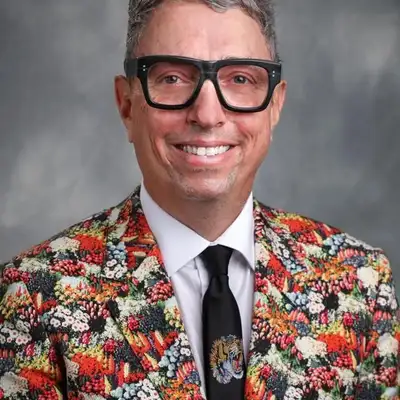
Liz: Our guest today is Dr. Rick Bedlack, neurologist, researcher and leader of the Duke a LS Clinic. Famous for his colorful suits and his hopeful approach to science. He's changing how we think about one of medicine's toughest diseases. So thank you for joining us today.
Richard Stanley Bedlack: It's my pleasure.
Liz: Can you tell us a little bit about yourself?
Richard Stanley Bedlack: Sure. A little bit about my background. I'm from a small town in Connecticut called Cromwell, and from an early age there were two kind of unusual things about me. One is I liked colorful clothing. I just found if I put on something really [00:01:00] wild, it. It was like a suit of armor to help me maintain my positivity no matter what I ran into that day.
And it also rubbed off on other people, like instead of this skinny, nerdy bookworm getting beat up all the time, people would like look forward to what I was wearing and get a big chuckle and a laugh about it, and they would leave me alone. And the other was, I was just fascinated by the brain. Before I even fully understood what it was, I would make these observations and I would come into my mom and I would say, you know, how come this person shuffles when they walk?
Or why does their handshake when they write? Or How come when I roll down this hill, I still feel dizzy even though I've stopped moving? And my mom would patiently just nod her head and say, write it down and I'll drop you off at the library this weekend and you can try to figure it out. And so I had this great librarian at the Belden Library in Cromwell who would pull these books off the shelves, and we would try to solve these mysteries.
And those two things just carried through my whole life. Like the fashion continued to get, you know, more exotic. I've been fortunate to work with a lot of designers to [00:02:00] create things that not only bring me joy, but bring joy to my patients and also raise awareness about my mission to end a LS And I've, I've just continued to learn more about the brain and become more and more fascinated by it.
Liz: Wow. Well, I mean, for those of you just listening, um, he has the most beautiful suit on. I think. We'll, we'll talk about it, but there's just a lot of activity and badassness that I'm getting energy from this badassness. I love
Bill: that. That is,
Richard Stanley Bedlack: well, this one's kind a special story. That's why I wore it today.
Bill: Well, what is it?
Richard Stanley Bedlack: Well, a lot, a lot of times people say, you know, what's your, what's your favorite jacket? And that probably varies from month to month. But this is the one I come back to the most. So this jacket was made for me by what I think is the most famous living clothes maker. His name is Manuel Cuevas, and I've been reading about him since I was a kid.
He's the reason why Johnny Cash wore black. He dressed Elvis Presley, he dressed Frank Sinatra, David Bowie, Elton John Salvador Dali, four [00:03:00] US Presidents, lady Gaga. So I happened to be in Nashville a couple years ago and I had a free half day and I said to my wife, I'm gonna see if I can find Manuel Cuevas and see if he'll talk to me, or at least get a picture with me.
So she said, you know, there's no way he's gotta be in his nineties. There's no way he could still be working. So sure enough, I found his shop and I went in there and there he was. And I said, Manuel, I just wanted to introduce myself. My name's Rick. I wondered if I could talk to you for a few minutes and get a picture.
And he looked up and he said, what band are you in? Yes. I said, you're never gonna believe this, but I'm actually a neurologist and I work on a disease called a LS. And his jaw just dropped. He walked over, he got a bottle of tequila, he poured two shots and he sat down and he said, did you know my wife died from a LS?
Liz: Wow. Oh my gosh.
Richard Stanley Bedlack: And he told me this story sort of unfortunately sad story of, of very few options, very little hope that they were given. And I said, I hate to hear that, Manuel. Let me tell you what I'm trying to do different at Duke and how it starts with [00:04:00] what I put on when I go to clinic. And when I was done, he shot back his shot and he said, get over here, stand in front of this mirror.
And I stood on this worn piece of floor and I looked at all these pictures of all these rock stars that had stood there and he measured me and I said, what's going on? He goes, I wanna make some things for you to wear for your patients. And he said, don't bother me. I don't know when they're gonna be done.
I don't know what they're gonna be yet. I gotta think about this. And I have a lot of other clients, but six months later, he called me and he goes, bed luck, it's Manuel. It's ready. Come to Nashville tomorrow and pick it up. So I had to book a flight the next day, and this is what he made me. He made me this beautiful purple jacket, purple's my favorite color.
He covered it with symbols of all these families that he read about that helped me on my mission. So this is a family of race car drivers. On the back, there's three families that created something called an endowed professorship. It's the first ever endowed professorship in a LS at Duke University. It allows me to work full-time on this disease.
And there's a lot of western symbols on the [00:05:00] jacket. And I said, Manuel, what about all these, you know, cactuses and horseshoes? And he said, those are symbols in my family. I want to be part of your story and when people ask me about the jacket, you tell 'em about me and we're gonna keep working together.
So we've become friends. I've stayed with him. He's made me more pieces. Amazing.
Bill: That is an amazing story. That really is. Well, it also goes to the point of what you do and how it impacts people. 'cause I think everybody probably has a story to tell about a patient they know someone they love, someone they've heard about with a LS.
In fact, you, . Run a clinic that is unlike others from my understanding. Maybe you could just tell us a little bit about it and maybe start with the obvious. What is a LS for those who don't know?
Richard Stanley Bedlack: Yeah, so a LS stands for a MYOTROPHIC lateral Sclerosis. Prior to 2014, I would say most people knew it better as Lou Gehrig's disease.
Then in the summer of 2014, there was this worldwide phenomenon called the Ice Bucket Challenge, which not only raised a couple hundred million dollars in one summer for a LS research, but it also, it just increased [00:06:00] awareness of this disease, like an order of magnitude. Hardly anyone. Now, when I say it doesn't know what it is,
Bill: right,
Richard Stanley Bedlack: and it's a, it's a degenerative disease of one part of the body called motor neurons.
So those are kind of like wires. They connect the front of your brain where you decide to do stuff to your muscles that carry out your actions. So as this disease goes on, you know what you wanna do, but you can't do it. So you lose the ability to walk, to eventually stand and transfer, to write, to dress yourself, to feed yourself, to speak, to swallow, and eventually to breathe.
Bill: Wow.
Richard Stanley Bedlack: Most commonly, all this happens over about two to three years, and people have to make a tough decision. About whether they wanna be attached to a breathing machine to stay alive.
Bill: , You, you take a more hopeful approach to it. So when you bring up that decision for patients who have to make that kind of decision, can you tell us a little bit more about that?
What goes into your work, your patients? Do you run across those people who say, just, you know, that's it. [00:07:00] I accept it and I move forward, and those that have hope, how? Because it obviously has changed you. You have a whole different direction and hope, which is important, right?
Richard Stanley Bedlack: It is. I think it's one of the most important things and you know, it's not something that was ever taught to me, but I mean, one of my first experiences, you know, in my early years as a an A LS doctor.
So let, let me start by saying my first patient with a LS was, was not somebody that I was in charge of. I was working with an attending at Duke. This is now in the late nineties. The first time I came across it and I said, oh my gosh, this, this story that this young man told me and this collection of exam findings, I've never seen anything like this.
It like resonated with all those things that fascinated me as a kid. Mm-hmm. Like, wow, how can something do this? Just take out this one part of the body, you know, so quickly. And you work with an attending when you're a resident, and that's who you learn from. And I remember my attending coming in and saying, this is what it's called.
We don't know why it happens, and there's nothing we can do. You just have to go home and get your affairs in order.
Bill: Wow.
Richard Stanley Bedlack: And then he [00:08:00] just got up and walked out and I mean, I remember feeling like somebody had punched me in the stomach and I said, if I feel this bad, I can't even imagine what this young man and his family feel like.
And I said, there's gotta be a better way. So maybe this is the disease I need to stay here and specialize in and, and change the culture around. And so the first few years of my, of my career, I traveled all over the world and I saw like what the world experts were doing and I read everything I could get my hands on and I realized, you know, there was a science to it.
There were a whole bunch of things that needed to be measured, and with certain measurements, there were certain options, evidence-based options that needed to be offered. You know, things like non-invasive ventilators, feeding tubes, wheelchairs, that kind of stuff. So you kind of learned when to offer these things, how to explain them to patients.
And again, I was mirroring what I heard from other people to do this. And then one day, about two or three years in, everything changed. Like I walked into a room and here's the youngest person I've ever seen with a LS. He was in his early twenties. [00:09:00] He's surrounded by the largest number of people I've ever seen in an exam room at Duke.
It was absolutely stuffed, and this is the wildest looking bunch I've ever seen. Mohawks and piercings and tattoos. And I was like, man, are we going to a Billy Idol concert or what? And um, you know, he told me his story. I did an exam. I started to present, you know, the, the evidence-based options that we could offer.
But I also kind of noticed as we were talking that everybody in the room had the same tattoo. It was a black swallow and the patient actually had a whole sleeve of them. And so when it was, you know, when we finished the normal conversation about a LS, I said, could I ask y'all one question? I gotta know what's this black swallow that I see on all of you?
And he said, well, um, my mom died from a LS, as I told you, it runs in our family. And she left me a book and on every page of the book, she had drawn a swallow. And I don't know why, but when I got to be 16, I said, you know what? Remember my mom said, I'm gonna get all these tattoos tattooed on my arm. And then when he [00:10:00] got sick, since it ran in his family, everyone kind of knew what it was.
Everyone he knew got one swallow. Tattooed on their body and they called themselves the often awesome army and they said, bed luck. We're gonna make this positive and hopeful. And I, I'd never heard that before. I'd never heard another person say that to me after I broke that news to them, and it was quite amazing to see how they did it.
They always came as an army. They always wore these outrageous outfits. They always started off the visit with a joke or a funny story. They made these YouTube videos called Often Awesome. The series that were just so powerful about living life with a LS. And, you know, as the disease progressed, I, I went to visit him in the hospital and I said, man, you've taught me something that I didn't see in any other clinic or any textbook, and I never wanna forget this lesson.
So can I be in the often awesome army? Can I get one of these swallowed tattoos first? I did a little internet research to make sure it didn't have [00:11:00] some hidden meaning that would get me fired from,
Bill: yeah, that's probably a good idea.
Richard Stanley Bedlack: But it turns out it's an old tattoo that sailors used to get. Because for them it was the first bird they saw when land was approaching.
So they knew they weren't lost at sea. And so I got it right here on my left wrist.
Bill: Sure
Richard Stanley Bedlack: enough. And the reason I got it there is 'cause we used to physically sign charts before the days of electronic medical records. And when I went to sign it, that would pop outta my sleeve and it would remind me of the lesson that this young man taught me and that not everybody has an off and awesome army.
Sometimes that's gonna have to be me. Ever since then, I've been trying to learn as much as I can about hope, including how to be a better hope booster for patients, because I think it's a treatment that medicine has largely forgotten about and we need to re-embrace it.
Bill: Mm-hmm. Yeah.
Liz: Wow. That's really inspiring story.
Richard Stanley Bedlack: Well, thanks.
Liz: How did. How did those people, you know around you, the other doctors, how did they, what did they think of what you were doing?
Richard Stanley Bedlack: I would say it varies wild, wildly. I mean, there, there clearly are, um, some, some of what I would call [00:12:00] the old guard who do not agree with my approach. And I think the reason is they have a misconception about hope.
I think for them, they, they don't see how you can boost hope and also get people to make difficult decisions, which right now is a necessary part of a LS. There's a fine line between real hope and false hope. You know, false hope to me is not supported by science, but real hope is. And so like when I'm breaking the news to someone, I'm not gonna sit there and tell 'em, Hey, you got a LS, but you know what, I might be able to cure you.
Bill: Mm-hmm.
Richard Stanley Bedlack: Because I don't know how to do that yet.
Bill: Right.
Richard Stanley Bedlack: But what I can say is you got a LS, it can be a tough disease. It's often disabling, it's life shortening in most patients, but there's a wide variety of how people do. There are people who are 11 years into this and still do marathons. Stephen Hawking had a LS for 50 years.
There's 64 people across the world in the history of the world who got it progressed and then recovered from it. So I cannot look at you [00:13:00] today and honestly tell you exactly how this is gonna go. I have a lot of options. For things we can try. And I think that's real hope. It is supported by science and it's a completely different way of breaking the news than what I heard my attending say so many years ago.
Liz: Hmm. Yeah. I think, you know, two things can be true and, um, you can be hopeful and you can be, you know, realistic and, and science-based. I love that.
Richard Stanley Bedlack: Yeah. It's
Liz: really powerful.
Richard Stanley Bedlack: You asked earlier about that difficult conversation. Mm-hmm. You know, the conversation about something like. When we get to a point where we have to start talking about invasive ventilation, is this something that you wanna do to extend your life?
And if not, what are your goals of care? There's a way to have that conversation and not crush someone's hope. I have it as a plan A and a plan B. I say, look, in spite of our best efforts, things have progressed. Your measurements are at a point now where we have to talk about some tough things. I want you to know, this does not mean I'm giving up on you.[00:14:00]
My plan A is for us to try something new every time you come. And hopefully figure out a way to slow stop or reverse this. I don't know if we can do it, but plan A is always to try something new with that goal, but there's gonna have to be a plan B now, and I need your help in figuring out what that is.
If we can't slow stop or reverse this, it's possible something terrible could happen here in the next few months. You know, help me figure out how aggressive you wanna be to either avoid that or to, to have things like CPR, you know, if somebody finds you without a pulse or breathing. So I, I think it's possible to have those conversations in a way that doesn't destroy someone's hope.
Bill: Do you notice a difference in, um, the quality of life? I'll say or, or at least the mental. Aspect of your patients, those that embrace that hope versus those that don't?
Richard Stanley Bedlack: Yeah. There's, there's no doubt in my mind that hope is important. So I think it's more than an emotion. Like I, I define hope as a [00:15:00] combination of, um, optimism, but also agency.
Like, it's not just running around with a smile on your face and no plan. Mm-hmm. You know, there's gonna have to be goals. There're gonna have to be pathways identified to achieve those goals. There're gonna have to be motivations that we find for going down those pathways. When it's defined that way. If you look across every disease where hope has been studied, people with more of it are doing better medically.
Their quality of life scores are higher, they're having lower symptom burdens, they're living longer compared to people with lower hope scores. And there's a lot of possible explanations for that. I believe there actually is a biology to hope. There's a different functional MRI pattern in people with higher hope scores.
There's different levels of inflammatory biomarkers in the blood. If you don't buy that, there's also a practical explanation. People that are more hopeful are more compliant with evidence-based therapies. They're the ones that take their medicine, exercise, eat right, use their equipment, as opposed to people that are less hopeful that don't do those things and suffer [00:16:00] needless complications from a disease like a LS.
Now I gotta prove it. Mm-hmm. I told you the old guard is skeptical and the only way I'm gonna be able to prove it is by doing a clinical trial. So I'm gearing up to do a trial of a couple of different hope boosting interventions. One is simply asking people when they hit the door instead of, Hey, what are you here to complain about today?
Which is what every medical office in the world does. You know? That's the first thing we get asked when we hit the front desk. What's your chief complaint? What if you asked, what are you hopeful about today? What a different spin that puts on the whole visit. The other is an instrument that was invented by a professor who lived with a LS at the University of Virginia.
I used to love to read this guy's blogs. Like he was really helping me to understand the patient perspective and, and in particularly importance of hope so much more. But one day he got back from his clinic and he said, you know, I love this multidisciplinary approach where we have a whole team of therapists that take care of people.
We're, we're all doing that now. But he said, I can't help but feel like a failure. [00:17:00] When I get home from clinic because every single thing that they measured was worse, and I tried so hard and I'm worse on every measurement. And he said, what if clinics incorporated a measurement that didn't have to be worse, that wasn't related to your motor neurons, that measured parts of someone that maybe are more important than their motor neurons?
And he invented something called the Turbocharged Living Tool. So it's 12 questions about things like your sense of humor, your kindness, your compassion, your advocacy for others. It's kind of amazing when you incorporate that into the visit. It only takes about seven or eight minutes. But when you ask those questions like how the whole family's face is just light up and they wanna tell you a story about a joke or a, a story about something kind that the patient did for someone else, like, it just gives people the right perspective, you know?
The worst parts of us don't define us. We're we're much more than the diagnoses that we get. And I think that may be the secret to all of this is helping people keep diseases [00:18:00] like a LS right sized in their minds. I think when you're, when you're told you have a LS, you have two to three years to live, go get your affairs in order.
You're just in a box. You're just defined by those three letters now. Mm-hmm. There's nothing else. But when you tell people, Hey, this doesn't have to define you. There's other parts of you that can get stronger. Um. All of a sudden you give people the freedom to continue to live an amazing life Inspe. In spite of, in spite of a LS.
Liz: Wow.
Bill: Amazing stuff.
Liz: Well. This is maybe a specific question, but I'm just thinking about it. For your study, are you trying to come up with a measurement for hope
Richard Stanley Bedlack: they already exist
Liz: or it's already one? Okay. I'm curious what
Richard Stanley Bedlack: it's, it's crazy. I mean this, this is something that it's been studied for 40 or 50 years in other diseases, mainly oncology, but, but now more and more like cardiology and stroke and things like that.
There are a variety of different hope scales out there. We're using one called the State Hope Scale. The reason we're using that is that's got the strongest correlation with these other things that we wanna improve. [00:19:00] Quality of life scores, length of life, those kinds of things in other fields. So we're not the first ones to study hope.
We're just the first ones to, to really try to study it and boost it specifically in a LS. And again, I would say. I hope at the end of all this, if I can prove what I believe to be true, that more hopeful people are doing better, that medical schools will consider having courses and how to be a better hope booster.
Because if anything, when I look back over my training, the way that I was taught was the opposite. Like I specifically remember a conversation with one of my attendings. It wasn't about a person with a LS, it was about a person who had bleeding in their brain. You know, he said this is this could go different ways, but when we present this to the patient and the family, we need to hang crepe.
I said, what are you talking about? He goes, it's an old expression. When people used to have funerals in their house, they would hang crepe. Um, so to make the house, you know, look less [00:20:00] pleasurable, it was a sad occasion someone had died. So we need to, we need to err on the side of being overly negative because then we can't lose if the person doesn't do well.
Well the family says, oh, well, you know, this guy predicted it. And if the patient does well, then they say, wow, this wasn't, wasn't supposed to do well, he did so much better than expected. This doctor's amazing. Then I said to myself, but, but doesn't that like de deprive people of hope? And if hope is a treatment, I mean, we're withholding a treatment that we think is gonna allow people to do better.
So I'm not comfortable with that approach, but I still think that's the predominant approach that occurs across all of medicine.
Liz: Mm-hmm.
Richard Stanley Bedlack: There's a, there's a real nihilism. There's a real cynicism. A pessimism. And I, I think a lot of it is because this is the way people were taught. And I'm trying to put, put something different out there
Bill: that seems almost like common sense.
I mean if you have nothing to live for, why would you want to live? You know, why would you want to get out of bed on the other hand, to have that hope? [00:21:00]
Richard Stanley Bedlack: Yeah. Yeah.
Bill: Changes everything.
Richard Stanley Bedlack: Yeah. I mean, it's, it's the optimism in the agency that I think we can do something about. And again, I think there are specific ways that we can do it.
There's a whole process that I go through that I don't think every clinician is gonna be able to do. No one's gonna wear these wacky suits. No one's gonna travel the world with their patients like I do to try to understand who they are and, and what brings them joy so I can give them more of it. Um, but I do think if there's a couple of interventions that I can prove, boost HOPE scores, and if people with Higher Hope scores are doing better medically, that I can get more clinics to incorporate those strategies.
And it doesn't even have to be a doctor. It doesn't have to be a doctor that does these hope boosting interventions. It could be a nurse, it could be a pa, it could be a social worker. Um, but, but somebody should have these incorporated into the clinic, in my opinion.
Bill: Can I ask this? The medical system's, just like any other system, it's a big bureaucratic system and it's difficult to make change.
How hopeful are [00:22:00] you that. And are you seeing any change really because you're trained a certain way, you kind of do your thing, right.
Richard Stanley Bedlack: It's, it's not easy to change something like the American medical system. It's not easy to change the behavior of physicians. I have learned people get set in their ways.
Um, this is a very difficult time in medicine and science. I mean, it's, medicine's become more of a business than ever. I mean, you know, the main metrics that, that we get followed on. Are not like quality metrics, they're numerical metrics. And how many patients did you see? And I tell young people, look, you are gonna put everything you have into this career.
I mean, I have, this is, this is my life, this career, you know, I don't have any kids. This is my legacy. So someday I know I'm gonna be lying on my deathbed and I'm gonna wanna look back over my life and say, am I proud of what I did with it? So what's gonna bring me that, that satisfaction at the very end?
Is it gonna be, well, you know, I really saw a lot of patients and generated a [00:23:00] lot of revenue. That's not gonna bring me any joy. True. I wanna say I changed the world. I wanna say I cured a LS, but if I can't say that, I wanna say I changed the way we take care of people so that they have a much better, um, concept of the size of a LS in their lives.
They're more hopeful, they're doing better medically.
. , You talked about, I think 60 some folks that have, um, beaten a LS you know, how, how are you using their stories? How have, how have you know, are you integrating these alternative therapies or I don't know, how, how are you kind of on the bleeding edge?
Richard Stanley Bedlack: Yeah. This is this is my favorite part of what I'm doing right [00:24:00] now is I'm studying outliers. These are people who are doing extraordinarily well with a LS. I think, you know, when you say, how are you using them? Well, one is just to tell people that this is possible. That's, that's a source of hope for people.
It's not a lie. It is possible that you could be an outlier. Um, but the other is to try to study them. And in addition to hope, which all the outliers are more hopeful, I don't know if that's the reason or if that's the result of them doing better than expected, but I'm finding some targets like the gut microbiome.
Very different in super slow progressing patients compared to typically fast progressing patients.
Liz: Mm-hmm.
Richard Stanley Bedlack: We understand exactly what is different. We can take those organisms and put 'em into a mouse model of a LS and change progression. So it isn't just an association. There really is something in there that drives progression.
And now we're starting to manipulate the gut microbiome. We're actually gonna start the first fecal transplant trial in a LS in our clinic probably in the next couple of weeks. The a LS reversals, we found [00:25:00] that there's something genetically different about them and it appears to be, um, a gene that's never previously been identified as being important in a LS.
But we now have four lines of evidence that it is. We've even got a nutritional supplement that we think can lower this target in the same direction as the a LS reversals have. So we're putting that into a trial. If you ask the a LS reversals, the 64 people, like why do you think you're better? They all believe they found something, whether it's prayer, whether it's meditation, energy, healing, you know, a combination of 70 supplements.
Whatever it is, that's what they believe. And it's possible. I mean, there is this. This whole thing called serendipitous drug discovery, which a lot of people haven't heard of. We don't, again, we don't hear about this in medical school.
Liz: No.
Richard Stanley Bedlack: Um, but there have been examples of where patients in a study found a benefit of a treatment that doctors and scientists had never thought of.
Most famous one is Viagra that was being studied for heart disease, [00:26:00] and at the end of this study, it didn't look like it was working. Pfizer was gonna scrap it. Men in the study came forward and said, you know, we'd really like to get some more of this. And the investigators were like, it does what? And they went back to the drawing board and they restudied it, and it became a billion dollar blockbuster drug for erectile dysfunction in men.
And so it's possible that these reversals have discovered things that no one else has discovered. And I have this whole trial program, it's called Replication of a LS Reversals. It's, it's unlike any other trial program. Usually what we're studying are vitamins or supplements associated with a LS reversals, and so those products are generally regarded as safe.
You can buy 'em in the supermarket or on Amazon, and we're looking for a huge signal. We're not looking for a slight slowing in the, in the rate of decline. We're looking for people to get better, like to actually get outta their wheelchairs and walk again. Because of those two things, the safety and the size of the signal, these trials are designed totally differently than what pharma does in a LS, we can have very wide [00:27:00] inclusion criteria.
Almost anyone can be in one of these replication of a LS reversal trials. We don't need placebos. I mean, if I can make people who are wheelchair bound walk, no one's gonna say that was a placebo effect. , And we don't even need a lot of in-person visits. Like the things that we're looking for are so obvious.
We can measure this in video visits. So. These things that people traditionally struggle with in clinical trials, you know, getting in like the trials have become so specific in terms of who they're looking for, that 95% of people with a LS don't even qualify. And then if they do qualify, they have to say, well, if I'm only gonna get to be in one trial, do I really, really want one that has a 50% chance of getting a placebo?
And do I really want one where I'm enough to drive four hours each way every month? To be monitored in the trial. And a lot of people don't. And that's part of why we struggle to enroll patients in traditional a LS trials. But these RAR trials, I mean, I can barely get 'em open and they're already full.
Mm-hmm. Um, so I, I mean I need, I need like 10 clones to be [00:28:00] able to get more of these RAR trials open. 'cause there's just that, that degree of hunger out there in the a LS community for this type of approach. I do publish all the protocols and the reason I do that is I know people wanna try things. So if I think something is promising enough to put into one of these ROAR trials, why wouldn't I put the protocol out there so that they could have a roadmap to follow with their own doctor?
Liz: Mm-hmm.
Richard Stanley Bedlack: Wouldn't I much rather have them doing something like that, you know, than going to some strange clinic, you know, that's gonna heat them up or treat them with, you know, crazy doses of antibiotics or something like that, that is almost certainly not gonna work and probably will cause them harm.
Liz: Are there any like spiritual.
Things in this study?
Or is it all like supplements and things you can buy?
Richard Stanley Bedlack: It's, it's a super great question. I mean, I, I do, I do wonder, I don't know how to study spirituality. Like, I'll tell you, one of the most interesting a LS reversals. This was a woman from Italy. And I, I hear about [00:29:00] these cases in the strangest ways.
Like you, you should see my email inbox every day. It's like Fox Molder must have got on the X-Files, like instead of reports of UFOs and werewolves, I'm, I'm getting reports of people who are like, recovered, you know, from a LS and, and, and association with all these unusual things. But somebody sent me a link to the Catholic News today.
I never read this newspaper, and it said in there that the Catholic church has just certified, you know, the 200th miracle in the history of the Catholic church. It's a woman with a LS who went to Lords and was healed. And I said, come on. I mean, this, this can't be, this can't be real. So I started digging in.
I found, you know who her neurologist was? I, I corresponded with him. He said It's, it's a hundred percent correct. I have no idea how this happened, but. She had a form of a LS that we call PLS, and I diagnosed her and she was completely disabled, wheelchair bound, having a lot of difficulty taking care of herself.
And she went to Lourds and the next time I saw her, she [00:30:00] was almost completely back to normal. Like it doesn't make any sense.
Liz: Mm-hmm.
Richard Stanley Bedlack: There's no biology. I mean, there's no, there's no way a drug could heal someone that fast. If, if we could stop whatever was killing the motor neurons, it would take months or years.
For people to recover their loss function. So I have no idea how this happened, but I also don't know how to study it. Like I can send people to Lords, but if they're skeptical and they don't believe, is that gonna work? And I don't know how to make people believe, you know, in a higher power or in a miracle.
So all I can do is document it and say This is what happened, and I don't have an explanation.
Bill: Yeah. How do you, it's, do you believe in a God and if you don't believe in, or is it the belief itself in a God that that does the miracle? I,
Richard Stanley Bedlack: oh, I IAnd,
Bill: I, I don't know. But it obviously, that's a fascinating story because again, that's not only hope, but.
It's, it's factual.
Richard Stanley Bedlack: Yeah. I mean, I, I, I mean, personally, if you're asking me, I, of course, I a hundred percent believe. I mean, there's [00:31:00] just things that I've seen that, um, I don't think could possibly just be random.
Bill: Right.
Richard Stanley Bedlack: But I mean, I also understand that I will never be able to prove that scientifically, right.
And when it, when it comes to you know, matters of faith and spirituality. I always come back to this line from The Life of Pie. I don't know if you've read that book or seen that movie. It's incredible. There's a conversation between a professor, two professors, one of whom is an atheist, and this first professor tells the atheist two stories.
One is absolutely the most beautiful story I've ever heard, and the other is one of the most horrific stories you could ever imagine. And at the end, the guy says, I don't understand which one of these things is true. And the first professor says, which one would you rather believe? You're never gonna know which one's true, but which one would you rather believe?
That's what it comes down to for me. Yeah. I'd rather believe that all these amazing people I've met in my life have gone on to someplace better and I'll see 'em again as opposed to it, everything just goes black.
Bill: Well, I share that belief. , You have an international group [00:32:00] too. Was it a LS untangled?
Richard Stanley Bedlack: I do.
Bill: Can you tell us about that?
Richard Stanley Bedlack: Yeah. So another thing, another of the many things that I was never taught, that I learned from my patients is that almost everyone with a disease like a LS, if you don't give them an experimental therapy to try, they're gonna just find one on their own and they're gonna, they're gonna buy it and try it.
Bill: Mm-hmm.
Richard Stanley Bedlack: And I, I thought to myself, when I finally realized this, I thought, of course, that's what I would do.
Bill: Sure.
Richard Stanley Bedlack: I wouldn't just accept that this is the best that we can do. I would want to try things and, and hope to find something better. And I, I realized this when I saw patients come into clinic, like maybe three or four years in and I, they were carrying these bags of stuff and they were not getting those things entered into the electronic medical record like they were nurses were only entering the prescription medicines.
Mm-hmm. Not all this other stuff. And I remember one day asking, what is all this stuff? And the patient said, ah, I didn't think you would be interested in that. That's just some stuff I'm buying on the internet and trying. And I said, wait a second. How often is this happening? I started asking around [00:33:00] and everybody was saying the same thing.
Yeah, all of our patients do that stuff, but we just shrug our shoulders. Or in some cases we tell 'em it's just a bunch of junk. And I said, but how do you know it's just a bunch of junk? I mean, we have years as doctors, we have years of training to be able to help patients evaluate these things scientifically.
Don't you think there might be some of these things that are more likely to be worth trying and and some that clearly aren't? And if that's the case, shouldn't we be partnering with patients to help them make better decisions? So I remember presenting this at a meeting and there was some discussion about the reason why this was not a good idea.
Somebody said, all these supplement manufacturers are going to use your interest. To sell their products. And unfortunately they have,
Bill: sure.
Richard Stanley Bedlack: There's still some supplement manufacturers who say, this is understudy by Dr. Bedlack at Duke. And I say to patients who bring that to me, it was understudy 12 years ago, and then I found out it doesn't work.
It's no longer understudy, but I can't get these people to change [00:34:00] their websites. But I mean, we had to create like a whole program for doing this. You know, it's again, based on my favorite TV show, the X-Files, we wanted to. Put ourselves out there and say, if you hear about something that looks interesting, we wanna know about it, we'll put it on our website under future reviews, we'll let the community vote.
And if it gets enough votes, we'll assign it to a member of our review team. And initially there were like five of us doing this. Now there's 130 clinicians and scientists from across 11 countries working with me on this. And so I got a lot more people to assign topics to. And we've developed a certain way that we review everything.
We, we wanna know five things about every idea. What's the theory and does that make any sense based on what we know about a LS? Two, was it ever in any kind of preclinical model of a LS? And if so, what happened? Three. Can we find people who tried this? And ideally, can we get their medical records and see objectively what happened to them?
Four, was there ever any trial of this in a LS or any other disease? And finally, [00:35:00] what do we know about all the bad things that can happen? How bad are they? How likely are they to happen? And so we write these short reviews that we hope are understandable by non-scientists, and we put 'em out there so people can read 'em for free.
And you know, we've learned there's a lot of these things that definitely are not worth spending your money on, but we also keep coming up with lists and currently there's a list of eight. Things that really do look interesting and probably worth a try. So for people who can't find a clinical trial, who are gonna self experiment anyway, why wouldn't I want them to partner with me and take something where there's actually a reasonable amount of scientific evidence that it could help, as opposed to just go into a website somewhere and dropping a bunch of cash when there's no science behind a lot of these things.
Bill: Yeah, Google's a dangerous place, especially when you're desperate. It really is. It's amazing stuff. I, you know, I wish all doctors were like you, to be honest with you, because usually you're just, you're a number and you have, um, [00:36:00] a limited amount of time with somebody, and I dunno that people really do treat you the person aspect of it, it sounds like you do.
That's, it's be wonderful to be your patient, not for having the disease, but to have you as, as a doctor. Mm-hmm.
Richard Stanley Bedlack: You really would. That's kind of you to say. I. I think the healthcare system would be in even worse trouble if everyone was like me, because I definitely lose tons of money, um, because of the amount of time I spend with people.
Bill: Sure.
Richard Stanley Bedlack: But what I realized early on is if I wanna do things the way I believe they should be done, I need to raise money. I need to learn how to fundraise. And it's, it's interesting, like that was never taught to me either. I think the first time my eyes were opened to how that can help someone like me who wants to be creative and spend time with people.
I remember presenting, um, you know, the diagnosis to someone and explaining, you know, what therapeutic options, what research options I had. And at the end of it all, he said, he looked at me and he said, how can I help you? And I said, what? He said, do you have an idea that you want to explore that you don't have [00:37:00] any resources for?
I said, Hmm, no one's ever asked me that before. And I said, as a matter of fact, there is this supplement that I just learned about that's associated with an a LS reversal, and it's got a plausible mechanism and I'd like to do a clinical trial. He said, how much would that cost? I said, I think it cost about 300,000.
Pulls out his checkbook, writes me a check for 300,000. He goes, go do your trial. So I said to myself, I need to constantly put my ideas out there. I'm not running around with a tin cup, you know, begging for change. That's not the way you do it. You get out there and you inspire people with your ideas.
Mm-hmm. And then they come to you and they wanna support them.
Bill: Of course.
Richard Stanley Bedlack: And that's how the endowed professorship happened. I didn't run around to patients and families and say, I need somebody to support my salary so I can do this full time. I said, let me show you this vision that I have for where I want things to go in the Duke a LS Center.
That's it. And then they came, three families came forward and said, how do we make this happen? Here's the number, here's the people at Duke that you can talk to. But that part of it is, is up to [00:38:00] somebody else. Wow.
Liz: How can people, you know, listening, how, how can they support you?
Richard Stanley Bedlack: Well, there's a lot of different ways.
So there's a lot of different things they can support. I mean, they can support, um, some of the research that we're doing, like the fecal transplant trial. We'd like to do a probiotic trial. We're trying to build our own probiotic based on the specific things we learned. , We're gonna get ready to do that trial that knocks down that target that we found in a LS reversals.
All, all that, um, would be donations to Duke to the Duke a LS clinic. And you can go online and you can find, um, the Duke a LS clinic. There's a link on there, there's an electronic QR code. I can send it to you, you can post it, you know, with, with this, um, there's also a, a name and an address of someone in development that can help.
And then if they wanna support a LS Untangled, that's actually under the umbrella of a nonprofit called the A LS Hope Foundation. And in fact, that's the next endowment I'm trying to create. So, you know, I'm, as you could see by looking at me, I'm, I'm [00:39:00] getting up there in years. I might not be around forever.
And I'm trying to make sure if I don't solve a LS, that the infrastructure I built stays like, I mean, I do a lot of work on a LS untangled almost every night and weekend of my life. I'm working on a LS untangled, and I don't know if there's someone else behind me who's willing to put that much time in, but if there's money.
Then I might be able to get a group of people who would work on that. And so an endowment, like a million dollar endowment would spin off somewhere 30, $40,000 a year that could be used to support like a small team who would write a LS untangled reviews, even if I'm no longer here. So these, these are the, these are the ways that you keep programs in existence.
Like we, we got that endowment for the professorship allows me to work full-time. Another program I created that we haven't talked about is called the Clinical Research Learning Institute. I just firmly believe that patients should be partners in everything that we do, that we'd be so much better together.
We shouldn't just be walking and handing them a consent form and say, read this. Lemme know if you wanna do it. Lemme know if you wanna be a [00:40:00] subject in this research study. No, you should be involved from the beginning. Let's talk about what you think I should be studying. What you think I should do as far as making this study easier for patients?
Here's the result. How can I craft a message that would be understandable by the patient community? If I find something that's positive, how can I present this to the FDA from the patient perspective to get them to understand what it means to someone living with a LS. So this program trains people living with a LS to to understand research and to be more effective research partners.
There's almost a thousand of PE people now who've gone through the program. We call them research ambassadors. We meet with them every month. We show them opportunities to influence laws, to influence new trials, you know, to go to Capitol Hill and, and, and ask for resources.
, That group of research ambassadors is responsible for over $500 million. In funds for a LS research. So, I mean, there's no question that they've jumpstarted a LS research, they're making it, you know, more [00:41:00] widely available.
They're creating more opportunities, they're making it more efficient. And we got an endowment last year from a very generous man. Um, he wanted to make sure that program continued forever. So again, even if I'm gone and not there to lead it. Program will always happen until the day when a LS is eradicated and we don't need it anymore.
There will always be a clinical resource learning institute to, to train a new group of patients, to be partners. So I want to create that for a LS untangled too.
Bill: Mm-hmm. Well, you've published a lot of, you're probably the most knowledgeable person I've ever met, certainly on a LS So what's your vision? I, not your hope, but what's your what, what, honestly, for a LS patients and family members who may be watching, what's your assessment for the future?
Richard Stanley Bedlack: I think there's not going to be a single cure for LS because I no longer believe it is a single disease. I think there's gonna be cures. Home run therapies. We have our first one, so a couple of years ago we developed a therapy called an antisense [00:42:00] oligonucleotide. It's specifically targets this one broken gene that causes a subset of a LS.
That subset is only 1% of all people living with a LS, but. That is a home run. Most people who go on that therapy, their a LS, either stops or they recover their lost motor function. That's what we need for every subset of a LS. And so I do see in the next probably two years, a few more home runs for other genetic subsets.
But in order to create home runs for everyone, we have to understand why each person has their a LS. And so for most people, it's not going to be a single broken gene that caused their disease. It's gonna be a combination of susceptibility genes and environmental exposures. And what's so cool about where we are right now is artificial intelligence is gonna help us figure that out.
Sure. You know, if artificial intelligence doesn't decide that, you know, we're irrelevant and eradicate us, then. I think it's gonna solve a lot of the world's biggest medical [00:43:00] mysteries because it can look in giant databases and it could say, here's a hundred thousand patients, and each one has a million pieces of data.
How does it all fit together? Why do some people get this and others don't? Why do some people do so well and others don't? It isn't gonna be one thing. In most cases, it's gonna be combinations, and humans can't look at that much data and find combinations, but a machine can. And so I think probably in the next 10 years.
We'll have identified the cause of most people's a LS and we'll have more home run therapies for them.
Bill: That's exciting news.
Richard Stanley Bedlack: It is. Wow.
Liz: That is exciting. Ask you a different question. How many, um, like blazers and suits do you have?
Richard Stanley Bedlack: Depends who you ask. I'm gonna say probably around a hundred.
Liz: Okay.
Richard Stanley Bedlack: Yeah.
Liz: Are they just on rotation or there's like a special subset? I don't know. How do you,
Richard Stanley Bedlack: do you have
Bill: a fall collection and a spring collection?
Richard Stanley Bedlack: Well, some are, some are thicker than others. But I, I have to say there's a couple [00:44:00] things that determine what I wear each day. One is what I'm gonna be doing that day.
Who am I gonna be seeing? There's certain blazers that resonate with a particular person or a family. Like if I see the race car driving family, I wear, I, I wear this one. Or, or the families that created the endowed professorship, or people that never met me before. You know, like you two. And I wanna sort of introduce them to this idea of like, why clothing matters and why customization has become so much fun for me, the people I get to work with and, mm-hmm.
How it honors, you know, families that have worked with me. , But I, I don't think there's like one system. Sometimes I just walk into the closet and I walk down the row and I say, what's what? You know, what's catching my eye today? What feels right? Um, but yeah, it's, it's been crazy. Like the places that this mashup of a career have taken me.
I'm, I'm back in late 2014 when the ice bucket challenge was, was winding down. Sir Paul Smith, a designer from the uk. Reached out to me and I thought it was one of my friends playing a joke 'cause he said Richard, I've [00:45:00] seen you, um, on social media wearing my clothes with your patients and I love what you're doing and I want to meet you.
So I want you and a guest to come to Paris for Men's Fashion Week, and my team will pick you up at the airport and we'll take care of you. You'll be our guest for the week. I said this, this is, you know, this is somebody playing a joke. So I had a connection at one of the boutiques that was the guy who used to sell me my clothes, and I reached out to him.
I said, do you know anything about this? He goes, it's legit. We heard from Paul Smith's team that they were gonna do this. I didn't wanna tell you 'cause I wanted it to be a surprise, but it's real. So I got to go to Men's Fashion Week with Sir Paul Smith. I get to walk on the runway. I get to see all the clothes before anyone else in the world.
I mean, I told you about Manuel Cuevas. Jerry Atwood is another incredible designer. He was post Malone's designer, little Nas x's designer. Jerry made me my fashionably fighting a LS suit. It's embroidered with symbols of lessons I've learned over 25 years from people living with a [00:46:00] LS, like the pant leg has a motor neuron instead of a tuxedo stripe.
That, that symbol is to remind me not to take little things in my life for granted. Like I make a gratitude list every night when I'm laying in bed, it's the right way to go to sleep. It puts me off on a positive note. None of us sit around thinking about how grateful we are that we have motor neurons that are working until one day when they're not working.
Bill: Right.
Richard Stanley Bedlack: Um, on the sleeve is the staff of a sleepiest, the Greek out of healing. I can't fix everybody's a LS yet, but I do know how to heal other parts of them, spiritual parts of them. There's a blue corn flower that's become a symbol for resilience. You know, when you look at a blue corn flower, you think, wow, it's beautiful, but it's so fragile.
But it's so tough. It can maintain its beautiful color through the harshest winter, and I've just found that to be true of most people with a LS. They're not as fragile as you think. They're tougher than you could ever imagine. There's the Swallow for Hope, and on the back there's the UFO from the X-Files poster for reminding myself to always keep every option on the table.
Bill: You're one of the most [00:47:00] fascinating individuals I've ever met. And inspiring as well. What a pleasure. Really.
Richard Stanley Bedlack: Well,
Bill: thank you. Thank you for doing this.
Richard Stanley Bedlack: Thank you for saying that. Yeah. Thank you
Liz: so much.
Richard Stanley Bedlack: My wife would say, yeah, it's a good thing. This podcast is less than an hour because after about an hour people get tired of hearing my stories, but, but thank you.
Bill: I wish you lived closer so I could borrow some of your coats. There's, I'd look good in that coat, don't you?
Liz: Yeah.
Bill: I'd have to lose a little weight, but
Richard Stanley Bedlack: Well, Durham's not that far away. Come on over.
Bill: Alright. Yeah, doctor, thank you again. Thank you.
Richard Stanley Bedlack: Yeah, thank you. Thanks for having me.
[00:48:00] [00:49:00] [00:50:00] [00:51:00] [00:52:00]
[00:53:00]