Subscribe
Share
Share
Embed
Your host, Sebastian Hassinger, interviews brilliant research scientists, software developers, engineers and others actively exploring the possibilities of our new quantum era. We will cover topics in quantum computing, networking and sensing, focusing on hardware, algorithms and general theory. The show aims for accessibility - Sebastian is not a physicist - and we'll try to provide context for the terminology and glimpses at the fascinating history of this new field as it evolves in real time.
Welcome to the New Quantum Era. I'm your host, Sebastian Hassinger. In today's episode, we're going to talk about a topic that's come up before in episodes but remains one of the critical challenges for quantum computing, which, because it's located at the intersection of quantum information science and complexity theory, can be very difficult to understand. The question is, when someone performs a task on a quantum computer and makes a claim that the performance exceeded that of a classical computer for that task, how can one verify that claim? The motivating force behind the enormous effort and investment in quantum computers is, of course, the promise that they will be able to do something better than a classical computer.
Sebastian Hassinger:If the nature of the advantage is simply that the quantum computer completes the task in a shorter time than the classical computer, the delta in execution time may provide a quantitative verification of that claim. However, in many cases, claim is that the quantum computer is solving a problem that a classical computer would take an inordinately long time to perform or that it would take more computational resources than one can realistically provision. In those instances, verifying the quantum advantage by classical means seems very difficult, if not impossible. In practical terms, this difficulty was first faced by the team behind the Google supremacy experiment in 2019. In that case, the claim was made that the task run on the Sycamore chip, which consisted of randomly sampling circuits, was the first demonstration of quantum advantage.
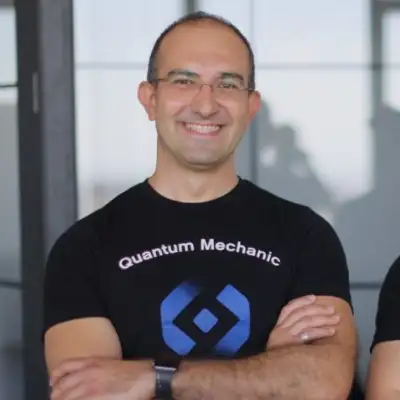
Sebastian Hassinger:One of the contributors to the random circuit sampling experimental design was Scott Aaronson, a theoretical computer scientist and professor at the University of Texas Austin who we've had on the show before. Observing the verification problem after Google's claim was published, Scott spent some time thinking about potential solutions. A couple of years ago, he proposed a new scheme for demonstrating quantum advantage, then verifying that advantage that involved something called peaked circuits, which he hoped would retain the quantum advantage attributes of random circuit sampling, but could provide an efficient classical means of verification. My guest today, Hrant Gharibyan, CEO and co founder of Blue Qubit, is a theoretical physicist who earned his PhD from Stanford, where he specialized in quantum information and black hole physics and was a postdoc at Caltech before founding BlueCubent. With a friend at IEEE Quantum Week in Albuquerque a few months ago and he described to me the work that his team was doing, I immediately decided this needed to be the subject of an episode.
Sebastian Hassinger:So this week at Q2B Silicon Valley, we recorded a discussion about Blue Qubit's implementation of Scott Ironson's proposal for peak circuit quantum advantage verification, what that means, and how they've actually gone further into a practical demonstration and have some interesting plans for extending the protocol they developed with possibly practical implications as well. It was a really interesting conversation. My thanks to Front and a special thanks to QC Ware and the organizers of Q2B for providing the space for this interview. I hope you enjoy it. Thank you for joining me, Hrant.
Sebastian Hassinger:I'm very excited about this conversation. We met at IEEE Quantum Week in Albuquerque in the line for food and you told me a little bit about what you were doing and it was super exciting. Said let's definitely record an episode you're ready. As it happened, we're now at Q2B Silicon Valley and you're ready. It was very good timing.
Sebastian Hassinger:The work that you're doing is now very interesting. It's a challenge that's going be I think really exciting to see how the community sort of responds and gets involved but it has to do with peak circuits and I want you to start by explaining what circuits are and what the purpose of peak circuits is if you don't mind.
Hrant Gharibyan:Yeah, absolutely. Thanks for having me here. Sebastian, I'm really excited to share some of the work that the Blue Qubit team has worked on. So the idea of peaked circuit actually was originally proposed around two years ago by Scott Aaronson and Yuxuan Zhang. The key construction and the insight that the authors had was to try to come up with way to make quantum advantage much more clear and the technical term is verifiable.
Hrant Gharibyan:So how can we run a task in a quantum device that after completion we can verify that it actually solved the right problem where we know there is a classically difficult to find that solution. And the original construction was done up to like 24 qubits with the simulators, with the exact simulation.
Sebastian Hassinger:But just one second, just to be clear, so this is, and I think Scott, I've heard him say basically the motivation was to try to find, it's like random circuit sampling was the way of sort of testing quantum advantage around the Google supremacy experiment and everything, but the challenge there is that verifying the solution is also classically very hard. Is that correct?
Hrant Gharibyan:That's exactly right. In fact actually the latest Google's random circuit sampling and as well as Quantinuum had done a similar work on random circuit sampling where you run a random quantum circuit on a quantum processor and then just measure the bit string and collect them. So we think it's beyond classically simulable. In fact, latest Google's claim was it takes septillion years to do it in a largest supercomputer.
Sebastian Hassinger:Who's got a septillion years?
Hrant Gharibyan:Nobody got that time. But it's an estimate based on some scaling analysis. But the fact is nobody knows how to compute the cross entropies, which is like the technical metric there. So nobody can really verify that the quantum device is doing the right thing. We're really hoping that it is by believing that our fidelities are like as good as they claim to be.
Hrant Gharibyan:But indeed verification is as long as simulation. Right. And that has been quite a bit of challenge and criticism. Even though we think that the latest experiments are beyond classical, there is no clear way to check and there has been some attempts like people who work on tensor networks, like really advanced classical simulation, try to replicate the results. All of them failed so far.
Hrant Gharibyan:The claim has been standing for over a year, maybe a bit longer. But indeed, verification has been a big of a puzzle. And I think Scott's attempt two years ago was really like with this big circuit construction. So how do you create random circuit that are really random, but then pick it in one specific bit string that's a secret message you have. So output distribution of the circuit is pretty much random on all the bit string except one that is specially amplified.
Sebastian Hassinger:Right.
Hrant Gharibyan:And then they illustrated that this circuit exists and by doing up to 24 qubit exact simulation. And then they also had a theoretical argument that there should be a lot of those kind of bit strings in a space of unitaries. So they had advances in a small simulation and then they had some great ideas in terms of why this thing should exist. And in fact there should be a lot of such circuits.
Sebastian Hassinger:And so if the random circuit produces this peak and that's a secret, you can use that secret on the classical verification almost as a shortcut for verification.
Hrant Gharibyan:That's exactly right. So essentially as a designer you create a circuit that has a peak that has a high amplitude So then if I hand you to the circuit itself, you can run it in a quantum processor and then immediately by a few thousand measurements actually, you don't even need millions of shots, a few thousand and then you will nicely see the
Sebastian Hassinger:peak. See.
Hrant Gharibyan:As opposed You to can visually verify. Yeah, you can visually verify very easily. And then as opposed to classically, it would be intractable because it would have all these kind of hardness properties like random circuits. Because if you look at them, they look random. And actually, Scott's initial paper with the 24 qubit had those circuit construction.
Hrant Gharibyan:Right. Appeared like all the properties and statistics and different components of the circuit looked like random circuit. You could tell don't know tell apart, but when you ran it you saw that it actually had almost random distribution except one bit string that was selected. So it's
Sebastian Hassinger:a fake random circuit essentially. Yeah.
Hrant Gharibyan:It's a random circuit that everything is random except one bit string is selected. Secret message is identified. I see. I see. I think that work was very intriguing to us when we saw it like a few years ago.
Hrant Gharibyan:I think if I'm not mistaken, actually Scott mentioned it at the Q2B two years ago.
Sebastian Hassinger:Yeah, think so. That was the first time I heard
Hrant Gharibyan:That's the right. And then I think we were quite intrigued like how scalable it is, because the method they used to construct the PIC circuits and find them was not scalable because you basically could not scale state vector simulations and train those circuits. So first what we did, we just took their protocol and scaled it to like 30 something qubits just by computational, classical compute throwing at it. But then next was the no updated version of our protocol that really pushed the limits of qubit counts and gate counts to regimes where we can construct such circuits that are beyond classically simulable.
Sebastian Hassinger:And you've actually done recently a paper where you implemented that on QuantiNUM as well, right?
Hrant Gharibyan:That's exactly right. So essentially when I met you at IEEE Quantum, there was ongoing work because at the time we just observed those results on a continuum. And we knew it's turning into a paper. And we were ironing out the paper. The paper we put out on archive like three, four weeks ago, like around a month ago.
Hrant Gharibyan:The essential point of the paper, there's a protocol that we use to construct big circuits at scale. And at scale means like 50 plus qubits that's beyond select state vectors available, but we could go to hundreds. So specific circuits we designed were with a continuum H2 processor in mind. So they are like 56 qubits, up to 2,000 gates, all toll connectivity, like essentially all the qubits talk to all the qubits. And then we pick a secret message, secret bitstring on 56 qubits.
Hrant Gharibyan:We create this PIC circuit using our protocol that has a few different stages. One of the stages is pretty similar to original Scott Aronson protocol and then we have two other obfuscation strategies. One called swap trick, the other is sweeping trick. Those are described in more detail in the paper But
Sebastian Hassinger:it was like steganography where you're embedding plain text message essentially in steganography. It's usually an image or a sound file or something. So there's a bit stream that you're embedding often by just doing like a bit shift or whatever. But you're hiding it in plain sight essentially.
Hrant Gharibyan:That's exactly. We're doing that same with the quantumly. In classical world you can call it also hashing with functions. They were playing similar game with quantum operations we construct and then we apply it to a circuit that's relatively simple, that has a peak, but after a few iterations of this classical updates of the circuit, it essentially becomes indistinguishable from the random circuit. It has some distinguished aspects but it's very hard to tell like what's the peak.
Hrant Gharibyan:And that's the kind of the key inside that there is a peak that has a pretty good visibility. And the coolest part was when we ran it on Quantinuum to actually absorb the peak. So even though we knew the protocol should preserve the peak and with a very high amplitude
Sebastian Hassinger:So you have to run those steps in reverse to reveal the peak, those layers of transformation?
Hrant Gharibyan:No, there's nothing in the reverse that needs So to you choose a bit string, you construct, there's a protocol that builds a circuit that has like 56 qubits, 2,002 And qubit then we end up with a circuit which are publicly available, it's in our platform and in the paper actually there's a link that you can go. And the circuits appear random but each of those circuits hides a specific bit string. So if you want to find it on Continuum you like go to Azure or AWS or directly in or whatever platform. You can submit the circuit and then measure like a few thousand shots and then like a lot of them will have, there'll be like bit strings that appear only once or twice maybe because of some bit flip errors then you will have one that is like one, there's a one nice peak. So you don't even need air mitigation like it's so nicely visible that you don't even need any sophisticated So
Sebastian Hassinger:techniques when to another machine comes out like Helios or another IonQ device or IBM device, are you imagining that you could use your protocol to construct these circuits that could be you could run them on those devices and get that peak out of your sample and at the same time try to replicate the work on a classical computer and verify that it's intractable essentially.
Hrant Gharibyan:That's exactly right. So some of the published protocol parts are not really applicable if the geometric restriction comes in. But then we have new ideas actually. I think it'll be upcoming work. We are collaborating
Sebastian Hassinger:actually So there's for a couple of limited connectivity that may
Hrant Gharibyan:You have to have a new addition to the protocol. And we have new methods. I think it'll be upcoming work. And we're actually working with a few different hardware vendors and quite excited actually for the other systems because several quantum systems either already are in the regime where they are verifiably quantum advantage regime or they're about to And it's a very exciting
Sebastian Hassinger:You're time to be productizing the supremacy experiment essentially. Yeah, yes.
Hrant Gharibyan:We are recently I read an article where there are all these like supremacy claims, quantum advantage claims, scientific advantage and the one word that was used is they are all obscure and unclear, like is the sampling hard? I think we're trying with these methods and this approach to really demystify advantage. Say, Hey, this is a puzzle quantum device solves it in two hours. Best known classical methods. At least in the paper we approached like actually some of the heavy technical part of the paper is really like advanced classical techniques, like tensor networks with belief propagation.
Hrant Gharibyan:I'm going to use technical terms but the people who care about these things know what are those methods. I care, friend.
Sebastian Hassinger:Yeah, amazing. And so that kind of brings us to the next thing I wanted to touch on, which I walked by your booth yesterday and you've got this big challenge poster up with like a big dollar amount on it, a quarter of a bitcoin as reward. What is it that you're challenging people to do? Good.
Hrant Gharibyan:So the challenge is, so we know this finding the secret bit string, we know it's possible with the quantum computers, with quantum systems. We want people, and we think, we claim that classically it's impossible. In fact, we try to do our best and our estimate for the state of the art classical algorithms is like few years in the largest supercomputers like exascale, like Frontier or Summit, three years. So in practice it's not doable. So we want the community to really try to challenge this claim in a way of finding novel algorithms that try to find shortcuts in finding the bitstrike.
Hrant Gharibyan:If they succeed, I think we should recalibrate the claim of the hardness. But if they don't, I think this would be like a standing trust. Like it will develop a public trust on It's the a bounty, exactly. And this was inspired by the RSA challenge that actually drove a lot of the trust in the modern encryption that we use every day now. And it was a claim that was not mathematically provable to be hard, but there was a lot of effort to explore all possible attack strategies and then fail, and then by that winning
Sebastian Hassinger:Did that Peter Shore get that bounty by the way?
Hrant Gharibyan:He might after we have flaw tolerant quantum computer, so I think he should get that. He theoretically gets that.
Sebastian Hassinger:Okay, so that's great. So in effect you're hoping that you don't give away the quarter of a bitcoin.
Hrant Gharibyan:That's right. But it's
Sebastian Hassinger:good incentive to all of those complexity theorists and mathematicians who are de quantizing quantum advantage claims in the past. That's great. That's exactly right.
Hrant Gharibyan:And there has been a lot of great work done, you know, after Google's initial claims. There was a good body of work with TensorNet fork techniques. And I think there's still some room to improve, but I think we're reaching a point where that gap is so large that it's going to be really hard
Sebastian Hassinger:for I classical machines guess if catch someone does claim the bounty, then that gives you whatever method they actually come up with that gives you something to add into your protocol to try to
Hrant Gharibyan:I get it. Absolutely. I think there's its arms right? And the same happened with RSA. The first few instances were broken and then improvements were made until there was a trustworthy That's product
Sebastian Hassinger:really cool. You know, RSA is actually an encryption method. This is a verification method of classical hardness essentially or quantum advantage. But you've also mentioned, I think, it came up in the recent paper that there may be sort of cryptographic application of this protocol as well potentially, is that right?
Hrant Gharibyan:Yeah. So we have a section I
Sebastian Hassinger:mean you're using the term secret
Hrant Gharibyan:so that can Yeah, yeah, exactly. I think by construction it is, right? It is a protocol that one could use potentially for cryptographic usage if it stands the test of classical hardness. It's actually quite a unique protocol idea. We have a section where we kind of discuss that.
Hrant Gharibyan:We don't go into too deep of a detail because primary reasoning for the paper was the advantage gap, like the gap for classical versus quantum. But but the but if the protocol stands and there's no way to break it classically and the trust is validated, I think essentially this is a like encryption methods where you could encrypt bit strings. The throughput is pretty bad. Maybe for encryption
Sebastian Hassinger:in place for example.
Hrant Gharibyan:That's right. There might be some niche use cases where it totally makes sense where you encrypt into quantum circuit, right? So you have a classical bit string, that's the A very short one. Yeah. Very short one.
Hrant Gharibyan:But you could repeat it. Right? That's true. Like if you you could have several circuits. Yeah.
Hrant Gharibyan:It's it's not like crazy, but like but but it's still like not with the state of the art
Sebastian Hassinger:Yeah.
Hrant Gharibyan:Classical encryptions. Right? But the cool aspect of it is that people who have quantum computers that have capabilities beyond certain level like fidelities, number of qubits, above H2 processor they would be the only ones who can decrypt the message. So if you have a communication that required quantum computer to decrypt it, it's essentially quantum unsafe encryption but classically safe. Right?
Hrant Gharibyan:Like basically nobody with classical computers can decrypt it. There's actually another interesting aspect of the protocol that you can modify. By changing the input state, you could also make quantumly safe. So essentially if you don't know the starting bit string, you will never find the pick because it like essentially on any other bit string to start with, it like creates a random state. It's not picked.
Hrant Gharibyan:So it's only picked in a specific case and that could be a private key. So you not only need a quantum computer, you need a quantum computer and a private key to decrypt it. So you could an interesting like opens a lot of interesting avenues for working with it. We haven't really spent too much time in terms of actually understanding its commercial implications. I think the primary purpose is to really stress test the classical hardness.
Hrant Gharibyan:If it's withstand, I think the interest in spending more effort in that direction will grow. But we still discussed it as like a paragraph and hypothetical scenarios and we had some equations there too.
Sebastian Hassinger:Nice, nice. So okay, so the challenge is on. Where can they go to learn about the challenge in more detail?
Hrant Gharibyan:Good. So if you go to BlueCubit website and then go to Hackathons page, it's like right there the first BlueCubit Quantum Advantage Challenge. Are you
Sebastian Hassinger:actually gonna have some event that's actually a live hackathon or is it sort of an ongoing?
Hrant Gharibyan:Oh, It's ongoing. It's just like RSA because we really want to give people the time. Yeah. Of course. I think we're gonna keep going and we just announced it.
Hrant Gharibyan:And I think the key steps, go to BlueCubit website, app.bluecubit.io or directly bluecubit.io. Go to hackathons and then there's a quantum advantage challenge, you can sign up. Cool. And then enter the competition and the first few circuits are already released. You can actually get on it and start testing some of the classical algorithms you have.
Sebastian Hassinger:And is the next step for you, now the challenge is on of course, you get some results that you need to verify or evaluate as being a better solution classically, there'll be that work, but in terms of your own independent next steps for blue qubit, is it look at other topologies and see if you can implement it on a lattice or on
Hrant Gharibyan:Yeah, this is actually a very active area of research. In fact, area is where more theoretically like hardness, like arguing why this hashing we do is hard. I think we have a heuristic understanding but there might be potentially theoretical arguments as well for it. And then there's academics that we talk to who are experts in complexity and so on. But on the heuristic side indeed, we're working with I don't want to share too much because of our hardware partners.
Hrant Gharibyan:But yeah, absolutely. I think we want to generalize it so we can build those circuits for arbitrary lattice connectivity and different fidelities.
Sebastian Hassinger:Almost imagine potentially getting to the point where you've got a toolkit where you can take a unique topology and then use your toolkit to adapt your protocol to that topology.
Hrant Gharibyan:Yeah, I mean one vision we have is like potentially even have a machinery that's very easy. You give the fidelities, like even gate limitations, gate set, your system works and we generate a peak circuit for you that you can easily validate its peak on your quantum device. And then you can check with our own tensor network or polyposimulators that it's really hard to do classically.
Sebastian Hassinger:And okay, so I mean I love all this conversation and thank you for explaining Peak Circus because I've been very curious and I think the topic of advantage and verifiable advantage is really important for the industry as a whole and the podcast tends to focus on the science and the research, but you're also a startup. So how does this translate into, I mean are you doing other things in addition to this? Is there some sort of creation of value from this PeakCircuit protocol itself or pitch me.
Hrant Gharibyan:Yeah, yeah. I think to give you a one line kind of pitch is that it's all about capability building and talent and we want to develop expertise and depth and strength in algorithms. Because building hardware is hard, and hardware companies are really putting a lot of effort to it. And being like a company one level above that where we only think about advantage style algorithms for scientific discovery and later for commercial. But we have to have the scientific nailed down
Sebastian Hassinger:And to move to also be hardware aware.
Hrant Gharibyan:And be hardware aware, understand the strengths and weaknesses because each use case have a difference. Sometimes with a low shot count, there's no way you can run that algorithm even if fidelities are amazing and connectivity is there. Sometimes it's the opposite, right? Connectivity really gives you huge leap forward for And the we want to develop the depth as a company to do that.
Sebastian Hassinger:Well, makes total sense to focus on creating verifiable tests of quantum advantage to learn exactly what those strengths and weaknesses and trade offs and etcetera are that are going to inform your algorithms.
Hrant Gharibyan:Exactly. We want to Awesome. Be Yep, that's the plan.
Sebastian Hassinger:And so you said scientific algorithm or scientific discovery first. Is there a particular, is this sort of material science and small molecule chemistry that kind of part of our
Hrant Gharibyan:big circuit is also a scientific advantage, right? Potentially could be cryptographic applications, right? But this is not there yet, but it's a scientific advantage, a well defined problem that we have a scientific gap between quantum solution and classical. Right. Next, I think, and it can ask matter physics, material science is another project within our team.
Hrant Gharibyan:Right? Like Google is inspired by a lot of the Google's recent work on out of time order correlators. Right. I think there's going to be like very near term things and Fermi Hubbard models from Quantinuum very exciting, where like we actually are seeing first examples of very complicated material problems that quantum devices can simulate that is beyond classical, even if you buy NVIDIA GPUs for five Five
Sebastian Hassinger:years dream, right?
Hrant Gharibyan:Yep. Precisely right.
Sebastian Hassinger:And I think you're exactly right in that these machines are going to be exotic lab instruments that are of enormous value to physical science.
Hrant Gharibyan:High energy physicists, material scientists.
Sebastian Hassinger:Long before they have some kind of the equivalent of a spreadsheet, like a killer app that runs that every industry wants or whatever. And in fact, I feel like scientific applications and advantage is where you're going to find the seeds of those eventual generalizable kind
Hrant Gharibyan:That's of absolutely right. And then once you start talking to large manufacturing companies, pharmaceutical companies, and really understand how they do chemistry modeling, like material modeling, you realize it's just a matter of scaling from there. Once you're at scientific advantage, I think larger scale models will actually benefit a lot of industries which are spending substantial amount of money on R and D and experiments in the lab where they could replace this with running five minutes on a quantum chip. Amazing. And that I think is the future in the next decade, going from scientific to commercial.
Sebastian Hassinger:Right. Well that's super exciting, Grant. I really appreciate the time and the explanation and I'm going to keep an eye out for the results of the challenge and the next paper and the next algorithm. I wish you the best and I think BlueCube is really a company to watch. So thank you very much.
Hrant Gharibyan:Thanks for having me. I'm also very excited about the future of Quantum and how our challenge will be.
Sebastian Hassinger:Of course, we're here. Of course Exactly. We Excellent. Thank you very much. Thank you.
Sebastian Hassinger:Thank you for listening to another episode of the podcast, a production of the New Quantum Era, hosted by me, Sebastian Hassinger, with theme music by OCH. You can find past episodes on www.newquantumera.com or on blue sky at newquantumera.com. If you enjoy the podcast, please subscribe and tell your quantum