Subscribe
Share
Share
Embed
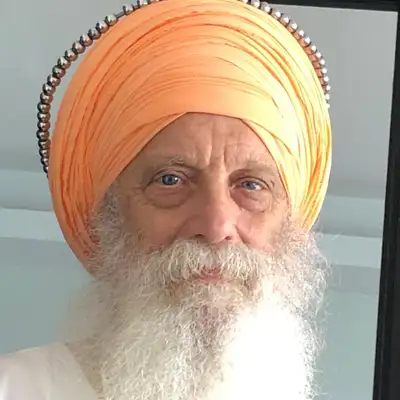
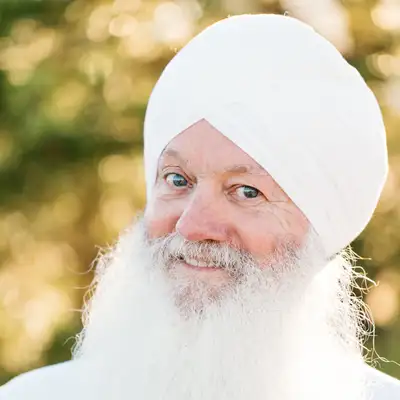
This podcast series is a presentation of challenging and irreverent conversations on wisdom, courage and common sense; for the most part taking place between renown spiritual teacher Hari Nam Singh Khalsa and respected leaders in the world of thought and action. These light-hearted, spontaneous and unpredictable conversations about all facets of life inevitably provide a platform to explore the depths of human nature and human destiny. In particular, it is the intention of this series to introduce our listeners to the value of the Khalsa Spiritual Path and its Code of Conduct, the Rehit Maryada, as created by Guru Gobind Singh, the legendary 10th Master of Sikh Dharma.
Today, my buddy Lyftar Singh, another
dinosaur.
You see two dinosaurs on the screen here,
but youthful dinosaurs, not Bronthosaurus
Rexes or Tyrannosaurus,
modern dinosaurs. And we'll just see where
it goes,
but ~ Lyftar I've known for many,
many years. And ~ I you could I guess see
from the screen that
~ we're
Both dressed up in similar garb,
Yeah.
wearing turbans, we have gray beards,
and we have ~ white attire. So I guess
you'd be correct in thinking that
~ we belong to the same religion or the
same community,
~ whatever you want to call it.
And that's actually not untrue.
So ~ we both go back about 50 years in
whatever it is we're doing,
which
you're watching this you may or might not
know anything about.
So anyhow,
there we go. He's he's I'm recording this
from Mexico and Liftar I believe
is in Atlanta or the the
Suburb.
suburbs. He looks like a suburban guy.
He's not a city guy. We talked about this
yesterday.
I'm a city guy. He's not a city guy.
So if he's if he's living in Georgia and
he's around Atlanta,
I'm pretty sure he's not living downtown.
He's living
Probably in the suburbs, right?
Yeah, and when I went there it was the
Exurbs.
It used to be way out in the country a
place where you would like take
a Saturday and go Roswell's the name of
the town.
It's north of Atlanta. So you would take a
whole Saturday and go out to Roswell.
It's by the Chattahoochee River and it's
like an old town from the Civil War days.
They had a bunch of mills and stuff here.
It goes back pretty far.
Chattahoochee, that sounds something like
in the deep south.
I'm a New York guy. There's no
Chattahoochee's in New York.
Chattahoochee sounds like it's from
Georgia.
Wind DM.
So have you have you lived in Georgia your
whole
life? No, I was born there here.
~
~ and we moved to Florida when
I was about six six or something.
So I grew up in Orlando.
And ~
Is that b what before the before Dis di ~
Disney World?
Yeah, I left there right when Disney
announced they had bought the property
and they were gonna build there.
And that was nineteen sixty nine.
And ~ that's when I met Yogi Budjan,
which precipitated my my quick ~ exit from
Florida.
really? I didn't know that. I got thrown
out of the house too.
Yeah.
~ good. I didn't you know it's funny,
it's like we're we're in our our seventies
and I've known you for a long time
and I actually didn't know that we had
that in common.
We both had the honor of being thrown out
of our own.
Did you
Yeah.
that were like me, when you were thrown
out of your home,
did you get to sleep in your car the way I
did?
I had a s I I had to sleep that night in
my car.
No no, I I was only eighteen. I didn't
have a car.
And what had happened
is I I'd gotten into the the Kundalini
yoga.
I'd just met ~ a man named John Twambly
who had just come from meeting
Yogi G and learned some yoga. He came to
Orlando to visit his father and ~ I
I had graduated from high school and this
was in about August
and at college was coming up. I had gotten
into Florida State University
and excuse me.
So I started doing the yoga and
meditation.
I was totally into it from the first
minute.
I knew this is what I'd been looking for.
And what had happened was I had a band in
high school,
rock and roll band, a couple of them.
~ I went to the beach one day because this
time coming up when I had either
had to go to college or just blow it off
or and I didn't know what to do.
I went to the beach
I took a quarter of a hit of acid.
Yeah, ~ microdosing has made a comeback
and I just discovered it.
I only did L S D maybe six, seven times
total.
I wouldn't like a complete whack out,
but ~ for some reason I discovered if you
just take a teeny bit,
it kinda does this cool thing.
I'm not
Advocating it.
No. This was nineteen sixteen.
Business,
you're not advocating it. We're talking
about about something historically that
happened fifty some years ago.
Yeah.
Anyway, so I go to the beach and all I did
the whole day is walk up
and down the beach because the beach was
only an hour away.
It was like a kind of normal thing we did.
And I lived on a lake. So we had our own
ski boat and everything.
But the whole day I've just walked up and
down the beach.
What am I gonna do? What am I gonna do?
What am I gonna do? I don't wanna be
straight normal you know
Go to work nine to five, come home,
drink, then go to bed. And I didn't want
to be a hippie because I already
saw the hippies were all just drugged just
drugged out
and not really not really going anywhere.
So I come home, I walk in the door,
and the phone rings, and it was the phone
was on the wall in the kitchen
for all you youngsters. You know,
you we didn't have cell phones.
You had one phone in the middle of the
house and maybe another couple around.
But anyway, I walk in the door,
phone rings right there. I pick it up.
It's my drummer from my band. And he said,
You gotta come meet this guy. And
I said, What? What's going on?
He said, I met this cool guy and he was
walking in front of my house
and I just happened to be sitting in front
of the plate glass window
and saw him walk by and he had long hair
and a beard.
He looked really cool. I just ran out and
introduced myself.
And he started telling me all this amazing
stuff.
So I said, Okay, I'll be right over and I
jumped in the car,
went over there and
He was there. John was still there with
Jason,
my drummer. And ~
He just started talking about you just if
when you do yoga you stay high
all the time. You don't have to take L S D
'cause then L S D you go up
and you come down. And I'm like,
this is what I've been looking for.
This is it, this is it. And I didn't
realize till years later that
it was a prayer. That my day walking up
and down the beach,
I didn't think of it as a prayer,
but that
What am I gonna do? What am I gonna do?
Where's basically saying I'm ready to meet
my teacher and right when I
got home I met him. And then later I
figured out he was the only
guy within a hundred and seventy five
thousand square miles
who knew that thing that I needed.
and he had come to visit his father and he
just happened to be walking
and my drummer just happened to be looking
out the window and happened
to get the idea to run out and meet him.
And so anyway, I went to college
just to see what it was like and I hated
it and I I only went to class
for two weeks. Then I just hung out having
fun.
So on one day my f parents found out that
I
had been taking drugs
that I was never gonna cut my hair again,
that I had dropped out of college and that
I was gonna be a yogi.
And their whole world changed on that one
moment.
So they my father said, I'm gonna put you
in a mental hospital for observation.
And I said, Well, maybe if I act a little
weird I can get out of the Vietnam draft.
Another reference for you youngsters.
Well, you you could have had bone spurs.
Well I didn't but I went I went
in for forty days for observation.
It wasn't like a it wasn't a loony band,
it was just the the cyc ward of the
regular hospital where people
go for observation. So I did forty days
there,
had a lot of fun actually. It was pretty
cool.
Met some good people. And then when I came
out
I was at home for two or three days and
one day my mom said,
~ no, at the end of the forty days my dad
came in for the ~ interview with
the doctor, hoping something was wrong
with me that he could fix.
And the doctor says, This is the most well
adjusted
boy I've ever met in my life. And my dad's
like,
~ shit.
Yeah.
And anyway I get home in about three days
my mom said,
I'm going to the beauty parlor,
you either have your hair cut when I get
back or you'd be out of here.
~
I
My mom was Mom was a strong willed woman.
I put two shir three shirts, two pairs of
pants and a you know,
a pillowcase, threw it over my shoulder,
and just walked out the door. No idea
where I'm going,
no idea what I'm gonna do. And my brother
had seen
the thing happen and he came and picked me
up and took me over to Huddy Sing
and Huddy Car from Orlando, you know them?
You know them.
~
On cars, mother and dad.
I you know, I I'm not the age I forget
people's names.
If you showed me that picture I
Yeah, you know him. So anyway,
I was there for a day or two, then he
called Yogiji and Yogiji said,
Send him out to LA and I've got this
beautiful boy.
He runs an ashram and he'll fix him up.
So I was out.
Uhhuh. Did you did ever reconciliate with
your parents?
No.
Really? Did you ever see them again?
Yeah. Yeah we tried, but they they were ~
somebody explained it
to me years later. The sin that I did is I
changed tribes.
It wasn't it
No no, I totally
wasn't like religion or anything 'cause I
was you know,
I wasn't like bugging on We were just
trying to act nice and normal
and went to visit ~ Well,
~
it's gonna be a pr it it's g they're gonna
take that personally.
Yeah, they did. Every.
Yeah.
You know what? I had I had this I I had
the same thing,
but ~ eventually ~ that but
I had the beginnings of that. I didn't
actually see my family for a couple
of years and and then even then it was
extremely strained.
I'm just trying to think, but it was it it
was about
It must have been about 20 years.
But ~ they actually came to my second
wedding.
And that changed actually amazingly
enough,
that changed everything. And you know,
and and that was an interesting thing that
you said that I think
is ~ very true. That you know people
try to understand these things through
different lenses,
but at the end of the day, and it's
understandable that it's
taken as a betrayal to whatever tribe that
you were born into.
I w I was born into a Jewish family after
World War Two,
right? So that there was a very strong
tribal especially after
w what happened
to the Jewish people and and and how even
my grandparents escaped all that
and and so there was this tremendous I
mean like like
tremendous sense of betrayal but to the
point that I was thrown out.
But Mom, I'm wearing a quadruple size
yarma.
Yeah, I don't think that's Yeah,
I don't think it works I don't think it
works that way.
No, I guess not.
And
~ and as you said, it it just even even
even me coming
out of that particular tribe, there's
there's there's subdivisions of that
tribe.
So even if I came home, I I was I was born
into like what I guess you'd call
a very secular religious
Mm-hmm.
But secular religious things. So I
wouldn't call anybody like super
religious,
except maybe my father, he went to
synagogue,
but but and wanted but but I think more
for the tribal loyalty than actually what
was happening inside the synagogue.
And ~ and so if I actually showed up back
home wearing
~ a yarmulka, you know,
Ha ha.
and I told my parents that
I was intending on wearing it all the time
in public,
that actually
Yeah.
would not have been welcomed, because
that's not exactly
how that subtribe acts. It's it would
almost like I was like bleeding into
another
subtribe of the bigger tribe, but that
still would have been on some
way a rejection of the way that I was
raised.
Because even even ~
You it's interesting that you you you
brought this up about getting thrown
out of your house because this is how
these conversations go.
I wasn't intending that we're gonna talk
about that,
but that's a really interesting subject
about being ~ rejected
by your blood family for some decision
that you're not trying to offend anybody,
you're just trying to do something you
think is good for yourself,
and you're not harming anybody,
but they feel very harmed. And I I get
that.
But ~ they took it really personally and I
I I get that,
but if when like yourself, you were you're
telling people and most
of our audience has no ~ they don't know
about you you're talking about yogi
g and they don't know about it.
Okay, so we get all kinds of people
watching this.
But let's say for purposes of this this
podcast that like you,
probably about a little later,
I was in my mid-20s, I was in law school.
And ~ I found myself for my own reasons
getting interested in the same thing that
you got interested in, right? So much so
that I was thinking about making
major changes in my life, you having made
them,
I think, faster than I did. But rather
than make that change right away,
I was actually looking for ways to make
this work.
See, I'm telling you stuff you never knew
about me.
So so I I was trying to make this work.
in a way that I was getting like what you
referred to what you needed,
right? So I will I was trying to get what
I needed ~ internally,
whatever whatever you call that.
But I I didn't want
to necessarily walk away from
what was my world at that point,
which not only was I in the tribe,
but I was a part I was not only was in law
school,
see I'm sharing all this shit with
You that you know we never talked about.
well, you know, you that I've always been
a big New York Giant fan,
but sorry for being a New York,
a huge New York Giant fan, and being in
law school and being brought
up in a traditional secular Long Island
Jewish family.
But also I was a party guy. I was a jock.
Okay, and I was a ladies' man.
And I I and I like that.
I I actually was pretty good at that.
I was good at pricking up girls.
I was a I was a good at being like a party
guy.
I was good at being a jock. I was good at
all these things.
And now, like you, I found like I really
needed something a little deeper than
that.
And I didn't wanna lose my nightlife.
You know? I didn't wanna lose that and
and I really I didn't want to lose my
family.
I didn't wanna I I didn't want to lose all
that stuff.
But ~ so what I tried to do is I started
seeking out,
like I'm in New York, so I'm I'm going to
Brooklyn and I'm trying to seek
out the Hasidics. You know the Hasidics
with the right?
But they were like very mystical kind of,
very committed, very mystical.
~ and I had a like a kind of a strange
attraction towards what they were doing.
It seemed like more serious than what I
was.
The tribe, the subtribe I was raised in
didn't quite j I didn't quite understand
how all that worked. And at least these
other people,
they were very foreign, but it seemed like
they actually had a very clear idea what
they were doing. So I started going to
some Hasidic stuff actually,
with the thought maybe that's the group.
And I don't have to walk away from this tr
religion I was born into.
But actually that was not very well
received by my family either.
And then I realized that wait a minute.
It's like what you were saying,
this is about more about their tribe
because they weren't even happy that
I was in the other sub tribe, which was
even more committed than their sub tribe.
You know? And then they were always
concerned because they always
saw me walking around with like blonde
blue eyed girls.
That also was a travesty to them.
Because it seemed like and then there's
there's a Yiddish word for that called
a shiksa. So it seemed like I was running
after the shiksa,
which I was, you know, it was my way of
being rebellious,
you know, just running after these blonde
blue eyed girls,
right? And these cheerleaders for the
football team,
right? So that was that was my thing.
But I finally landed up that I I met
a woman who ~ was Jewish.
Right? She was Jewish. And she was like
the runner-up in the Miss America contest.
And she spoke nine languages fluently and
was actually
the star of s of of Sesame Street in
Japan.
Right? I mean she she checked all these
boxes.
And there was one thing though I didn't
and and I told my parents about this
and they were very
Happy that this was going to keep me in
their tribe,
and that finally I was bringing a a Jewish
girl back home,
right? Well, and they got all excited,
and she's coming over to to visit,
but I didn't really maybe maybe I was just
being mean spirited,
or maybe I don't want to deal with it,
but I didn't tell them one thing about
her.
So she shows up at the door, right?
She's wearing the Star David. She just got
back from the synagogue.
Okay. And she's dropped that gorgeous,
but I didn't share one thing with her.
She was black.
Okay.
You complained about the shit shows,
what
Right, she was exact. So the thing was
again,
okay, they wanted me to be tribal,
but not like religious,
but not too religious. They wanted me to
marry somebody in the tribe,
but not somebody like that who's in the
tribe.
And so it's really kind of ~ I'm
understanding here that I'm gonna just
need
to do what I need to do. And
And it resulted in the same thing that you
did,
is that I I got kicked out of and what if
you know what?
And that was twenty-four twenty-four
hours.
I don't know if I told you the story,
and then I'll let you jump in again
because now I'm stealing my own show here,
but but why not? Right? It's my show.
~ but ~ but this is a good story though.
~ I had taken vows to be a Sikh.
And by the way, those of you in the
audience who don't know the reason,
you know, we're Sikhs, and this is what
Sikhs look like.
So we have we part of our commitment is
our outer appearance.
So and and when you take these vows,
it involves not cutting your hair and a
turban.
So that's part of the program.
So I came back from a solstice event in
Florida,
actually, wearing a turban, walked into
the house,
immediately got thrown out of the house,
got thrown, I mean, within 10 seconds,
out of the house, out of the family,
and
My mother, as I'm going out of the house,
is saying that she's gonna call the
police.
Very dramatic. She's gonna call the police
because there's a stranger in her house,
right? And and that she never and that she
never actually had a son.
Very, very dramatic. ~ okay, well,
you know, I get in the car and everything
is on the front lawn,
because I lived in the suburbs too in New
York.
So I throw the I have everything in the
back seat of the car.
And you know, well, at least I have a job
because I was working in a law firm.
So I wore going to work wearing a turban.
Okay. Well, so much for the job.
Okay. So I'm out of the job. Well,
you know what? at least I have a
girlfriend.
~ not so fast. No, okay.
I show up there, that's the end of the
girlfriend.
And well, at least, you know, I've like
really good friends from law school,
most of whom are in the tribe as well.
So ~ so much for the friends.
So
That night, within 24 hours of me doing
something that was not meant
to harm anyone else, that was just
something that I felt I needed to do for
myself,
honestly. I ~ I had no home,
no family, no job, no money,
no girlfriend, and no friends.
And I remember parking my car in the
middle of nowhere,
because I didn't have any money,
and cr and basically
Sleeping in the back of the car and crying
myself to sleep and waking
up in the morning that all my clothes were
wet from my own tears.
And I said to myself, I'm starting from
point zero here
and I am not going back. So it's I'm all
in.
And that's how that was the first 24 hours
of my life as a Sikh,
actually. And I think, you know.
I'm very fortunate because ~ you know
sometimes
you have to be there to really want it
that much.
You know, it if something's given to you
easily,
it's easy to put away. But I I I I went
through hell fighting my
s clawing myself up inch by inch and and
so now I I appreciate it.
And I'm sure, you know, ~ you you have
probably some interesting personal thing
to share along that and
you know climbing the way of.
I I always feel like I cheated because I I
was
in the first minute, never had a doubt,
never had a second thought, and whatever
happened after that
was just part of the program. Like in all
these years,
I've never because I was ahead of an
ashram.
And ~ that is
When you tell the audience what I mean
there'll be people listening don't need
to know it.
Yeah. So an ashram, I think it means the
house of the teacher.
And we used to do this a lot back in the
seventies and eighties.
Is people would move in ~ group homes
or get houses around the same cul de sac
or right near each other.
And we would practice our practice,
which includes
Two and a half hours of yoga meditation in
the morning before sunrise.
So from four to six thirty. And when
you're living together,
you can do this stuff in groups,
and it makes it a lot easier to keep up
the energy and everything.
But when the when it's a live in ashram
where people actually move in,
the first thing that happened to me,
'cause I was nineteen, when we first got
an ashram,
when I
I got sent to Atlanta in June of nineteen
seventy by Yogi Bhajan.
He said go there and start an ashram.
And I got a whole story of
There's a movie, I think it's one of the I
can't remember,
where somebody has to walk out onto what
looks like over a cliff and there's like
a volcano. But there's actually a walkway
there but you can't see
it 'cause it blends in with the
background.
And every time he takes a step,
it's there, even though it doesn't look
like it's there.
And I was just I would just be taken from
one situation to the next
and always taken care of. Nineteen years
old,
no money. We ended up with a a little
house and about six people moved in.
And
They were all doing these weird numbers on
me like you know,
like, ew, why are you? And I'd be like,
They're all older than me. I mean,
there were people there like twenty eight
years old and I'm nineteen
and they're doing these numbers.
So I wrote Yugi Budgeon a letter.
I said, Why are they all getting all
bugged at me for?
And he said, It's father phobias and
mother phobias.
And no matter how old you are,
you're the
You're the symbol of authority.
You then take the place of the father or
the mother or both or whatever.
So it was
a lot of acid rain I call it.
just and then you just kinda get used to
it,
like okay, that's the deal. just like
if it's raining you just
Use an umbrella and you go about your day.
So I didn't even through all that for
we did that for twenty five years,
I think, before last people moved out and
we didn't have anybody living with us.
~ we got married, arranged marriage
because
How how old are you?
I just turned twenty. 'Cause I'm my
birthday's June first,
so I turned twenty right before summer
solstice.
And what had happened the first year I was
in Atlanta is it
was still the end of the hippie era and
the women were after me so bad.
And
I just kept saying, I'm not here for that.
I d I'm not interested in that this time.
I know why I'm here. I know what this
incarnation is for.
It's not for that. So when I got to New
Mexico when we were had
our summer solstice celebration,
which is ten days where we all get
together out west
and and do yoga and meditation and have
a lot of
spiritual experiences and other you know,
fun too. Playing music and dancing and
doing all that stuff.
But anyway I went out there and I said,
Sir, you gotta find me a wife.
I c I can't fight off these women.
'Cause I was the cool guy,
you know, the yoga teacher or whatever.
Anyway.
He found my wife, I'd never met her.
We met one day, went and got our papers
the next day and got married the third
day.
And then we came back to the ashram in the
middle of this.
scene and we had to work out our stuff
having never even
met and have all that going on.
And even through all that, which now
looking back,
I'm like, holy crap, how did we do that?
~ I just everything that came,
I was just like, yeah, okay, this is
what's supposed to happen.
That's what's whatever it is, whatever I
don't know,
I don't care. I never like got
this is too hard, I can't do this.
And it's not like
That's why I say I feel like I cheated.
I just I'm like that. I didn't have to try
really,
really hard and hang on
And that
Well how did you how did over the years,
you know, how if if that came easy to you,
how how did you deal with I mean,
I I've been around this so I know that it
exists.
So, you know, it sounds like all these
things came pretty easily to you,
but obviously you were you know,
I've seen this for myself, you found
yourself surrounded by so many people who
~
had so much difficulty ~ dealing with all
that comes with living this
kind of way. So how did you find yourself
~ able to
~ deal with ~ so many people around you
who it it didn't come as easily
as it came to you?
I ~ I've always been kind of do you know
what that
did you ever have your face ~ red where
you have the four quadrants?
No.
So they do this face reading thing and
they do
I heard that was year I somebody did it
years ago.
Yeah. I have some some distant memory of
that,
but I know you're talking.
Yeah, and so they do I forgot what they
represent,
but you know, you know, emotion and then
spirituality,
whatever they are, I can't even remember.
But the guy he did mine
and Yogi G told him to.
He said, Do live tar and Yogi Bhajan is
Yogiji that we keep referring to.
And
He said I'm the only guy he's ever seen
ever that has all four quadrants
or bootstrapped.
meaning I don't really need stuff ~ I
don't need anything from
around me. I'm just I know what I am
completely,
totally and you know, really that's comes
from past incarnations.
That you don't just like wake up one day
and you're like that.
It's
And the thing about reincarnation people
don't understand.
If you know anybody who's like a good
friend or a relative,
you've been together many, many,
many incarnations. You don't have like a
really good friend or somebody
you really involve with that you're just
like souls
wandering around and getting reincarnated
and you bumped into somebody
you really like. That's not how it works.
So you have this kind of
thing where everybody that's in my orbit
is there because
we have unfinished business. And once I
know that I'm like,
okay, whatever. Now we go through the
unfinished business.
Cool. So just and I just never never
bothered
me, never cared. You know, I'll get upset
if somebody's a real jerk or something,
but in my whole, you know,
macro
I never thought about leaving or freaking
out or going away
or changing or it's just me.
So y you know, y you feel comfortable in
your skin and you know,
you you describe yourself a certain way.
Do you find the times that you know people
~
don't really understand where you're
coming from because of that,
because that they're not that way
themselves.
a lot and I really have to work on that.
I'll tell when I was in high school,
I believe it might have been eleventh
grade or twelfth grade,
one day at the beginning of the year,
I was thinking if all I have to do is say
hello
to people once at the beginning of the
year and then I will have acknowledged
them
and and I will have said hello.
And I actually thought if you say hello
every day,
you're like insulting them because they're
too stupid to know that
you already see them and recognize them
and said hello.
So I did that and I d stopped saying hi to
anybody.
I just walked up. And then somebody
somebody came up and said,
You know, I'm heard you're really stuck up
and snooty
And I'm like, people have to be reinforced
that you know they exist.
That's that bootstrap thing. Like,
I don't need anybody to say hi to me or,
you know, if we hadn't seen each other in
five years,
I'll just pick up and we're good.
You know, we're right back. There's no,
~ you didn't call me for five years.
So I was like that and had no idea that
literally no one else is like that.
Yeah.
Very few people are actually like that.
Yeah. So people see you through their own
lenses,
but it's not I ha you know, I have the
same thing.
It's like ~ I'm by nature,
I'm a really self-disciplined,
incredibly committed person. I mean,
people people actually until they get to
know me,
don't know actually how committed I
actually am.
I'm like a really, really committed
person.
And
in my interactions with people ~ close to
me,
whether whether it I'm teach as ~ role as
a teacher or just somebody knows
me ~ you know casually, is that their
first impression of me is that like
I'm an unreasonable hard ass. You know,
and that you know, and that I'm an
asshole.
And and that I have no compassion,
I have no empathy. Okay, that that's their
that's they're like
you know, the lens they're looking at me
through compared to whatever they're
seeing
in themselves or others, that I'm like way
out over there and I'm not I am who I am.
I'm very committed. I'm not gonna budge.
Okay. But then they get to know me and
they're like very confused
because it seems that I'm like the most
open-minded person they've ever met.
And I'm actually
quite compassionate and I'm a teddy bear
and I cry at movies,
you know. And so they they don't they
actually have to get to know me,
but I'm the same way. I'm just not who I
am,
you know? And so I I imagine that ~ I I
can see how
and I start laughing. ~ I I see how
sometimes people perceive me,
but I for that reason I would imagine
that,
you know, people
choose to see you a certain way,
but that's it's more than that.
And it's through their own lens.
But I I have the same I have the same
thing.
I I often people have this and then they
get to know me and then they're almost
like
feel betrayed by me because they almost
then want me to be who they're projecting
me to be. But I'm actually not that way at
all.
That actually I'm a pretty anybody who
gets to know me knows that I'm
actually you know pretty carefree person
with a lot of interests and loves
I I I basically love everybody,
I get along with about everybody.
And people have a hard time putting that
and I think it really gets it's
a really good example, I think,
at the roots of our faith is that you know
people are always I think coming from
a limited point of view, it's either this
or that.
It can't be the two at the same time.
So either you're like
a rigid hard ass, or you're a loved lovey
dovey,
but ~ they can't kind of embrace that you
can be a really strong, committed,
highly disciplined, very high character
person,
and at the same time be a lot of fun to be
around,
be very loving and flexible and
open-minded with other people.
And I think a lot of that goes really to
the ~ the roots of our faith.
And I I think that that's something that
I've actually developed over my life
is to be more and more that way because I
I think that really gets you know,
even the name of this ~ podcast,
Warrior Saint, is that you know,
people think you're either a warrior or
you're a saint,
but they can't quite wrap their heads
around is that you can be all this
in one package. So they only see
in you what they want to see in you,
but they they haven't got to the point
they can see that you're actually embro
you're actually an embodiment of all of
that to all at the same time.
What what's your what's your experience?
~ well that's kind of
an interesting topic because as you're
talking I'm
I'm remembering our evolution
Because we did start off kind of like
super fanatic.
~ in the very early days and we would
do this kinda
One one of my favorite i in ~ Indian
culture
and the language when you address somebody
else you
you say G I or however you want to spell
it,
G. And G means soul. So you can say it
to anybody like Hey G,
how are you doing today? And it just means
hi,
I'm talking to your soul, how are you?
But when we're what when we're in the
throes
of our our radicalism, we would we'd
do this thing with the word G where you go
You're not supposed to do it like that.
G
Sh
And it became a weapon. I mean,
it's so funny looking back now.
But we had to come from where we were.
We had to kinda put on this whole new
thing completely.
You know, and people growing up in the
last twenty,
thirty years have no idea that how kind of
well,
you know, look at pictures from the
fifties and the
early sixties and America was kind of
homogenous and ~ you know,
just Christian and Jewish and that was
about it and
Now it's kind of like a anything goes,
you know, nobody gets grief for looking
different or looking weird or having
a beard or
But back then we were coming out of that
and a lot of people were kind
of trying to apply their old religious v
approach,
which in a lot of cases is kind of fanatic
or
You might not have been a fanatic before,
but then when you got into this,
you s your concept was I have to do it
really exactly right.
And then it ends up being kind of looking
fanatic.
And I went through that and I you know,
and then years of just getting
Seeing the world happen and how how things
happen and how people come
and go and stuff comes and goes and
eventually you're just like,
it's just all God. Why are you bugging
about anything?
Just God is the doer.
There's nothing outside of you.
If you can learn that one thing,
and I can tell you you can go right now
and talk
to the ~ quantum physicists,
they'll tell you
Nothing is real. They'll tell you the
exact same thing the yogis have told
the world since time began. There's
nothing real
and there's nothing outside of you.
Exactly what the yogi said and now they're
saying it and showing
how that actually happens.
Yeah, so you just start everything with
there's nothing outside
of me and see where that takes you.
Because it means everything that bothers
you it's you.
Everything that you like it's you.
Everything you don't like is you,
everything that's happy is you,
everything is sad is you, everything.
It's all you and then you know,
you say, well then you're saying you're
God
No, everything's God. God is playing all
this game
of separating itself into people and trees
and bugs and planets and stars.
And once you relax into that,
pfft snuffin' to what's gonna bother ya?
So but that take you know, it took took a
long time.
You know
when when i was living in the environment
you're talking about living
in ashram living in this ~ communal ~
lifestyle big house a
lot of people i was the i was always
considered the person
who wasn't taking this seriously and
people, you know, not only not only what
you know,
there'd be like a gudwara going upstairs
in the ashram on Sundays
and I'd be watching, you know,
football down in the basement during the
during the service.
So pe people think I'm I'm really not
taking this seriously.
And there was nobody else in the ashram
who any they they considered sports
to be like below them spiritually.
So I was some lesser creature who
hadn't seen the light yet and then maybe ~
maybe I'd come around at some point.
And then if it was like Friday night,
everybody knew every Friday night I'd be
at the local jazz club.
And they're thinking, you know,
what kind of I mean they they were like
very fanatical and they're thinking
why is this guy going to a jazz club?
But you know the funny part of the two I
guess the two funny parts about it is that
In time, ~ almost all the guys
in the ashram landed up following me to
the stadiums on Sunday.
And
Okay.
in time, virtually everyone in the ashram
would be in that jazz club every Friday
night. I hung in there, I didn't react to
any of this.
And they're finally, and I used to I used
to go out,
I remember like twice a week, I was in a
actually ~ played ho I still
was playing ice hockey.
And I was in a hockey league. And they
have like the people,
the kind of people who are in the ashram
at that point have no idea what
is this guy wearing all white turban and
he's he's carrying his hockey gear
and he's off to playing hockey at midnight
because that's the only time
you get Ice Time. But in in time,
everybody was there watching me play
hockey.
And ~ and so I was a very bad influence on
everyone
who actually got within
a hundred yards of me, because I kind of
was bringing them all to this other world
that they didn't want to have any part of.
And the other thing that's interesting is
that the
few people who how hung in there and they
were like,
as you say, very fanatical and very rigid,
and had even, I think,
some resentment and anger about the way
that I was conducting myself.
They're all gone. I'm still around.
I think that's a very, very important
lesson.
These
Yeah.
are the people, now now you're kind of
bringing stuff out of me,
old time resentments, but there was I
remember so many people who were telling
me that I wasn't a good Sikh,
that I wasn't serious about this,
that that I needed to walk away from all
these things to to to really ~
be true to whatever this is, they're all
gone.
I'm still here. And now am I still here?
I basically am walking the walk.
And and I had, I just kind of,
even back then there was something in me
that said,
I don't actually have to give up any of
this stuff.
Okay. I have to, I have to I I think the
lesson very early on for me is that
I had to integrate this stuff.
I didn't have to give up anything.
I had to
make everything work together so I wasn't
so it's working together.
And and I think that's also very much from
our faith.
I think there's a whole historical ~ and I
think those are in the teachings
of the faith that it's about integration.
It's not about renunciation. And so I I
saw that and I think that
There were people who now I really I kinda
understand this is that
and and I'm trying to understand it from a
compassionate place,
is that I think that ultimately a lot of
people are acting like they're really
committed, they're really sure of
themselves,
but deep down they're insecure about it,
and they're insecure about themselves.
And so they've got to be like like a
certain way to prove to themselves
and others that they are something.
They're they that they're not yet.
And I from early on going, no,
no, I like football, I like jazz,
I like this. I I I there's nothing that's
if these things are not prohibited.
No.
But but you know, I've got to kind of
integrate it into some some whole here.
And and that's always been like really
important to me is is
to be like like a person who's interested
in a lot of things that
I'm very participating in the world,
but
But I I figure out a way to make it all
work together.
Yeah, and the whole idea of our whole path
Kundalini
Yoga and Sikhism seek Dharma. I don't even
call it a religion.
I think religion the idea
of religion destroys dharmas, but ~
the whole idea is the householder.
You fully participate in life.
Well, I mean not
drugs and wild sex kind of participate.
But in the you know, normal life,
get married, have kids, build a business,
get very rich.
Nothing none of that is prohibited and our
whole thing is designed
to work around that. We get up in the
morning and do our meditation
and then we're done at six thirty.
Start your day. Do your whole normal day.
Do whatever you do. But you have that and
by the way,
that two and a half hours is
one tenth of a day, twenty four hours.
One tenth of that is two and a half hours.
So you're tithing your time to your own
soul,
to your own higher consciousness.
And whatever you give karmically comes
back ten times.
It multiplies by ten. Everybody thinks
karma's even.
It's not even. It gets multiplied by ten.
So you were on the right track early.
I was I went and saw every movie.
I I was a movie freak.
I never did give up anything. I just
What's your favorite type of movies?
What do you like?
I like kind of tongue in cheek action
~ it depends. You know, there's some
series movies I like,
but a lot of them are just ~ like
intellectual I can't stand intellectual.
But you know, I like stuff with Arnold
Schwarzenegger because it's
He knows that it's a goof and you know
it's a goof.
He's not trying to be the actor of the
century and it's just some fun action.
That's the kind of stuff I mainly like.
I might like rom coms or whatever.
Anything anything nice. I dunno I used to
kinda like horror movies,
get a thrill, but now my nerves can't
handle it.
No, I have I have enough challenges
sleeping these days.
I don't need that on my night.
So ~ I you know,
I never was much of a I I never was much
of a movie guy.
I think mostly because I it it's other
than watching a ball game,
it's tough for me to like sit like two
hours for ~ anything
and I've got so much I I think just my
personality.
I'm such a
stimulation junkie that it's like nonstop
stimulation for me.
So ~ it's from one thing to the next.
So for me to actually have the patience to
sit down.
I think the only thing that I'm
consistently willing to sit through,
like for two and a half hours,
is opera. I'm a big I'm a big opera
physic.
I think I had told you that I'm I am.
I'm a I'm a total opera nut. I'm gonna be
in New York next week.
I'm gonna be at the opera almost every
night.
I'm just the big, big opera nut.
But you know, some of them go on and on.
I mean, it it could be like three hours of
~ of endurance to get through one.
You just reminded me there used to be a
guy living in the Oshroom here
who was a mousketeer and he was in
the band ~ Moonlight Feels Right was their
big hit.
~ what was the name of that band?
Anyway, he and I were talking about
writing a musical.
We went to New York and went to two shows
a day for a week.
And so
thirteen, fourteen shows, something.
Well like like Broadway plays.
Broadway plays. Yeah. That was kinda wild.
there's one more story that I wanted to
bring up because he
and I were talking the other day about New
York and he loves New York
and I can't stand it for one second.
'Cause I grew up in the exurbs,
not even the suburbs. We we would be in
the country,
not you know
farmland way out, but on the outskirts
even of the suburbs and we
had always had land and woods and trees
and lakes and so that's
how my brain works and the first time I
ever saw a in Washington DC,
the first time I ever saw a row house,
I got nauseous that people live like that.
I lit I got physically nauseous that you
would l have that.
Yeah, yeah, no.
But anyway in nineteen seventy two,
I think, one or two somewhere.
~ I was in the Calls of String Band,
which was a band a bunch of us put
together in the early days.
We went to New York to record an album.
And ~ so one night we all went out
Just mopping around to have fun.
And
One of the ladies in the band is Krishna,
Black Krishna. And ~
She was called Black Krishna 'cause she's
black and there was another Krishna
who was white and she was called Pink
Krishna.
case you're wondering. And but she she was
actually ~ Broadway actress
and was in a in the movie The Pawnbrokers.
~ but anyway she
She was with us and we're walking along
down in Manhattan and we come
to this big giant construction area with a
big skyscraper going up.
And we went over to
the entrance and there
was this big big dude there at the front,
black guy and
you know, the guard and we said,
ca can we go in there? He said,
No, nobody can go in there. So Krishna
goes up to him,
bats her eyes at him. ~ come on,
it'll be all right. She totally charmed
the guy and he let us go
in to this active construction site.
It was at night, there wasn't any actual
construction going on.
He took us up to the eighty first floor,
which is
near the top of what had been built
already.
And we walked out to the edge and there
were there were
no walls or windows. This was open and
they had wooden you know,
they'd put a wooden rail just two by
fours.
And we're we're s leaning over this rail
looking down eighty one stories down
the side of that building.
And ~
It was on September eleventh that I
remembered that that was
the Trade World Trade Center.
they were just putting that up then.
Wow, that's amazing.
There you go. There you go.
Just guess that's a big thing for New
Yorkers in particular.
Yeah. I've had a few of those Forest Gump
moments where I've been
been somewhere for something important.
Well listen, as we ~ it's it's been about
an hour as we wrap this up.
Well listen, first of all, thanks a whole
lot.
Really appreciate you. And ~ this being ~
the
~ Warrior Saint podcast and and
~ we're ~ always keeping it aligned to the
culsa ideal.
~ you're a culsa yourself. would you like
to say a nice word about do
you have some nice words?
In any way that you'd like to share about
Gudugovin Singh before we say goodbye.
Wow.
Putting you on the spot there,
huh?
Well my my view of Guru Gobind Singh
is that whatever I had that made me like
just
I'm made for this, ~ there's no questions,
there's no nothing. Throw whatever you
want at me can't knock me off.
I mean I'm not claiming anything yet.
I'm not done yet, but
He
That's that kind of example of you're just
playing the world
as a game. When you see the whole see the
the game,
you see God is doing all the parts.
God is the one who's shooting the arrow,
God is the one being shot by the arrow.
And by the way
I've always recommended to people
Christopher Isherwood's Bhagavad Gita
because
in the battle scene where Arjuna and
Krishna are standing against the entire
army,
just the two of
And the way Krishna talks, he's like,
Yeah That's just stuff,
Maya. Those aren't real. Don't worry about
that.
God is gonna do what God's gonna do and
we'll win.
And that was Gurgo V and Singh's
message the way I see it. Like 'cause he
had his children were killed
and his I mean his whole the Mughals just
came after him and everything
he knew and loved. And he just yeah,
come on, bring some more. Got more,
come on.
And it's not like ~
It's just like a if you can just switch
your attitude like that,
then you enjoy the stuff that comes,
you enjoy the challenges, you enjoy the
ups and the downs and everything.
Because you s you're in the game and you
see the game and that it's just a play.
So that's what I get out of Guru Goman
Singh,
Maharaj. I mean you know many other games.
I appreciate that coming from you and you
know before I s say goodbye,
just ~ thank you for your friendship.
love you and ~ also ~ thank you for really
being one
of the pioneers for bringing the spirit
of Gudagovin Singh and the Khalsa to the
shores of the West.
You're part of that great legacy.
And certainly ~ one of the great sons of
Guru Gobind Singh Maharaj.
So thanks buddy, we'll see you soon.
Wahiguruji Karakalsa. Wahiguruji ki fate.