Subscribe
Share
Share
Embed
The World of Higher Education is dedicated to exploring developments in higher education from a global perspective. Join host, Alex Usher of Higher Education Strategy Associates, as he speaks with new guests each week from different countries discussing developments in their regions.
Produced by Tiffany MacLennan and Samantha Pufek.
Alex Usher: Hi everyone, I'm Alex Usher, and this is the World of Higher Education Podcast.
In the wake of World War II, the nations of the world thought seriously about the relationship between education and peace. One of the outcomes of that thinking was the creation of the United Nations Educational, Scientific, and Cultural Organization, UNESCO for short, whose founding charter states 'Since wars begin in the minds of men, it is in the minds of men that the defenses of peace must be constructed.' And since higher education was part of that mandate, that arguably makes UNESCO the world's oldest higher education organization.
UNESCO has long been a voice for higher education as a public good, but the world's changed a lot since the 1940s. In most of the world, it's viewed a great deal more pragmatically than it used to be. And along with the increasing sophistication of the higher education sector and the increasing density of expertise around higher education, it's a lot more organizations and forums that can advise nation states on the development of their higher education systems.
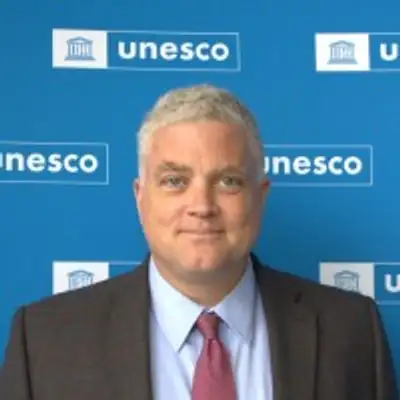
So what's UNESCO's role in higher education these days? With us today to answer that question is Noah Sobe, UNESCO's Chief of Section for Higher Education. We cover a lot of ground in this interview from UNESCO's history to its current activities and contra my suggestions that UNESCO's perhaps too idealistic, Noah makes a strong case for the need for an organization that can make the normative case for the causes of higher education, and let's us in on some of UNESCO's lesser known activities, which really do deserve a wider audience and greater understanding.
This episode's a great way to open up 2026, and so without further ado, let's throw things over to Noah.
Noah, let's um, start with, you know, UNESCO's role in higher education and where that comes from. Obviously, in the 1940s in the wake of World War II, the United Nations had some lofty goals about education and the way it could contribute to world peace. So what were those original objections? How was UNESCO supposed to operationalize that, and how has its role evolved over time?
Noah Sobe: Thanks for the question, Alex, and let me just say it's a pleasure to be a guest on your show. I admire your work and really appreciate the contributions you and your team make. Education, science, culture, I mean, basically seeing these as the basic building blocks of sustainable peace of shared prosperity. I mean, in one sense I think the objectives have not changed. The strategies, the approaches we use have probably shifted, but I think the core mission endures and definitely endures in its relevance. I mean, one thing I think you can say about our world today is that UNESCO's needed more than ever.
You know, in terms of like changed approaches, you know, as you know, well, like the sort of post World War II era, you know, was guided a lot by a certain kind of technocratic engineering spirit. You know, that we could design a better world. I still believe we can design a better world. I think everyone at UNESCO does. But I think we recognize that that needs to be a co-constructed, it needs to be a much more democratic process.
The second, and related to that, I mean, I think, you know, we have a very different orientation towards youth involvement. A commitment to intergenerational co-leadership. That's very different than at our founding moment.
But I think, I think our basic objectives, you know, our basic understanding of what our functions are I think those endure. I mean, and just quickly to review, we talk at UNESCO about having five functional areas. One is normative standard setting. The second is working as a laboratory of ideas. The third is working as a clearinghouse. So, sharing best practices, research examples. You know, we do a lot of work on educational data. We also do work on technical assistance to member states. And then finally, we also consider international cooperation in exchange as, you know, one of our key functions.
And there, I suppose, that's just because we're like, irredeemable optimists, you know, we have this naive belief, that talking together, being together is a good thing and will lead to good things.
Alex Usher: But you talked about those five areas, like of those five areas, which, maybe you can't answer this, but you know the which, which, are there two or three of those that are more prominent for higher education right now?
Noah Sobe: I think probably the normative standard setting is, you know, the lead for what we do. But that work is often not just normative, but has a strong operational component too. So I'm happy to go into it.
Alex Usher: One of UNESCO's roles, as I understand, is to provide policy advice to member countries. And, you know, back in the 1950s, you know, UNESCO more or less had that space for itself. Today, though, there's lots more actors. I mean, you've got multilateral organizations like the World Bank or the Asian Development Bank and, and, and they're in this space.
And for richer countries, you've got global consulting firms like McKinsey or Boston Consulting Group. What's UNESCO's niche now? Where do you feel UNESCO still adds unique value?
Noah Sobe: So, okay. Let me start with the niche, Alex. So, I mean, I think there's a couple things that go together that make UNESCO's, I think, kind of, enduringly important in today's world. One is our, our convening and networking power. Another is the, the, the kind of legitimacy that we possess.
We have, you know, 194 member states, and I think that over the years, and this is credit to everyone who was in roles like mine over the last decades. You know, UNESCO is known as a trustworthy, trusted partner. And I agree with you, the international development space, you know, has a huge plethora of diversity of different partners, different stakeholders, private actors, you mentioned that the consulting firms, each bringing in different types of expertise, different resources, different experiences to the table and at the same time, like, the ecosystems of education have gotten increasingly complicated. So very different than they were when UNESCO was founded. And I mean, I don't think anyone at UNESCO would claim that we have any kind of monopoly on development expertise. I mean, on the contrary, I think what we're good at is plugging into this diversified landscape. You know, and something we've always done well has been a, a partner, a mobilizer of stakeholders for resource mobilization, for capacity strengthening, for the clearinghouse of good practices, as I mentioned. And I think, I think though that we, we do in this work have a unique role in promoting the normative frameworks you know, convening actors in education to discuss the challenges and opportunities in front of them.
You know, I'd give you a particular example that might be of interest to your listeners is our work setting international standards for faculty members and other higher education teaching and research personnel. So that, you know, we have a 1997 recommendation concerning the status of higher education teaching personnel that gets into entry into the profession, learning and teaching conditions. I think it contains a pretty strong definition of academic freedom, talks about the importance of institutional autonomy you know, and that recommendation is now going into a two year revision process. And in the end will be put before a hundred and ninety four member states as a recommendation, it's not a binding bit of international law, but, assuming it's passed by consensus, which is the norm for UNESCO normative instruments you know, you have something there that's pretty powerful in shaping education practice. So I would say watch this space and opportunities to consult and engage on that.
Alex Usher: So you talked about, you know, mobilizing, partner groups and mobilizing networks of either institutions or national governments. And I guess it's to that end that you have a series of regional offices, right? So you, which focus specifically on higher education, you've got IESALC in Venezuela, you've got, there's the office in Bangkok. There used to be the, the one in, in Bucharest. How do these regional offices contribute to the organization's work and how do their priorities align with those in Paris.
Noah Sobe: So, uNESCO's led by three key bodies. We have a general conference which meets every two years. All 194 member states present there. You know, they are the ones that decide our priorities, they make budget allocations, they approve the normative instrument. There's also an executive board that meets more frequently, a smaller group of member states. And then there's the secretariat headed by our new director general. You know, our headquarters is in Paris. But we have 53 field offices around the world. We've 138 specialized institutes and centers, that's not just education, but that includes culture, science, communication as well.
You mentioned UNESCO IESALC. This is, hosted by Venezuela. It's our regional Center of Excellence for Higher Education, and, you know, the promotion of, higher education in Latin America and the Caribbean. it's a key what we would call Category One Institute. Does a lot of work on South South cooperation. I know you're familiar with some of their their knowledge and research work, 'cause I've heard you discuss it, Alex.
Thailand is, and Bangkok is an example of a regional office. So, you know, hosted by the government of Thailand, and responsible for a set of countries there.
Bangkok is, you know, like Jakarta, Beijing, Delhi. We have five regional offices in Africa, Rabat, Dakar, Yaoundé, Nairobi, Harare. These are the offices from which we coordinate the implementation, opera, operationalization of all these other work we were talking about, the clearing house, the normative instruments. So honestly, actually all of them work in higher education, and the work is of course adjusted to the particular context in which they're working.
Alex Usher: We're gonna take a short break. We'll be right back.
Advertisement: Skip the inbox. Grab your coffee and join us for Focus Friday. Every other week, higher Education Strategy Associates is Tiffany McClennan hosts a one-hour webinar that brings people together to talk about what's next in higher ed, from enrollment to AI and everything in between. No slides, no lectures, just ideas, insights, and good conversation. Register for the next focus Friday for free. See the episode description for the link.
Alex Usher: And we're back. Noah, I mean, one of the things that UNESCO does in higher education is it holds a major conference, world conference once a decade. There was one in Paris in 2009, Barcelona 2022. And I'm wondering, I mean, that's, it's obviously, I, I imagine you're not really thinking about the one for the early 2030s yet. Maybe you are. But, you know, what's the purpose of these conferences? And do we, do they still have a place in a more uh, internet Zoom friendly world? I mean, what these, these sort of big get togethers like that, is there a future for those? Like what, how do you see the next one playing out?
Noah Sobe: So, you know, I mean this is, I think a great example of the ways that our convening power and our norm standard setting power converge. So yeah, you're right, since, uh, actually since the late 1990s, we've held a, a once a decade world higher education conference, more or less once a decade depending. And yeah, it's to bring together a wide range of stakeholders you know, government policy folks with university leadership, faculty, students. Private sector you know, research units, a whole range of different people. And basically do a bit of a kind of landscape mapping. You know, what's the state of the field what are the challenges on the horizon and what should higher education do to address them.
I think it's a very useful exercise. In fact, we're about to launch in, I think it'll be February or March, a follow up to the Barcelona World Higher Education Conference. You know, a publication called Transforming Higher Education, Global Collaboration on Visioning and Action. That puts forward some of the guiding principles, some of the lines of transformation that were discussed at Barcelona.
So talking about things like committing resources to equity and pluralism, promoting the freedom to teach, research, learn, cooperate internationally. You know, I think these, these are all all ways where UNESCO shows some of its unique value in bringing people together to focus on what they can agree about, agree upon, and agree to work on together.
Alex Usher: Okay. So, I mean, I have to ask, 'cause I, I mean I've, I've never, I've been to regional conferences that lead up to these. I, I couldn't go to Paris 2009 'cause my daughter was born that week. But it does seem to me that a lot of these kinds of, of set pieces end up focusing on some of the normative pieces as you talked about, and I think a lot of what you, you know, had sort of said is this, you know, higher education should be more about diversity. Higher education should be more, you know, there should be more global cooperation, so and so it does tend to focus on the normative stuff. And in particular, I mean, one of the biggest normative elements in discussing higher education is the issue of markets. It's the issue of fees, right? And I, it does seem to me that there's a lot of the UN publication stuff, and some of it would be from IESALC and some of it would be from other things. I've, I've noticed it in the, the GEMS publication. They take a pretty dim view of markets, right? And, and there are lots of parts of the world where that, that's the norm, right? Latin America, Francophone West Africa. I mean that's, that's the way they think about higher education. But a third of all students are in private higher education and a lot of public higher education has elements of the market in there too. So I'm just wondering, like that particular element, it seems to me is, it might be seen as problematic for, for UNESCO if you take the position that higher education has to be in effect, market free, doesn't that leave out a lot of the higher education systems around the world?
Noah Sobe: I think what's important to note is that in all cases UNESCO is pro public good, right? That doesn't mean that it's anti-market for sure. You know, there are a lot of things we could talk about in what you just, what you just sort of laid out there, Alex.
You know, do we want to talk about the proliferation of student loans as a means for young people to access higher education in countries where, let's say even public higher education involves high costs? You know, are we talking about higher education that's offered by private and sometimes not-for-profit providers? You know, whether that's campus based or online, something that of course has supported the massification of higher education. Or are we just talking about collaborations?
I mean, I think what we come in and try and do is co-design with the, the, you know, in invested important players, the normative and ethical guide rails that are gonna ensure that these changing landscapes of higher education systems and institutions don't do harm to different stakeholder groups, and that they remain inclusive, equitable, fair to all users.
So, I mean, I guess I would just, I would emphasize two things, you know, we at UNESCO are committed to a human rights approach, to a vision of higher education as a public good. We work towards ensuring equal access for all women and men to affordable quality technical, vocational, and tertiary education, including university.
I think you and I, Alex, we can both point to like numerous examples of high quality private universities, fruitful private sector collaborations, and with public sector universities. We can go into the argument if we want, you know, I think private actors have a, an important role to play in higher education. At the same time, we have numerous examples of public higher education systems with free or nearly free access, you know, that are high quality, that are able to achieve widespread access to higher education. You mentioned financing, loans can be an alternative for expanding access, you know, but of course this comes with some costs, potentially increased inequality, potentially inadequate provision of public goods. I guess, I think a mix is probably inevitable. And probably that mix is desirable in fact, Alex. But speaking for myself here, I would definitely see private financing as a second best alternative to public funding.
Alex Usher: Got it. What's the coolest thing UNESCO's doing right now in higher education that almost no one knows about? What's your gem in the rough here?
Noah Sobe: Yeah, no, I love the question. And it's actually one that I, I'm embarrassed to say I knew not enough about when I, when I moved into this position as Chief of Section for Higher Education. It's the work we're doing on qualifications recognition. You know, on the one level it's pretty technical, and kind of like infrastructure policy building, but it's fascinating. We've basically created this global higher education ecosystem that promotes academic mobility, that really helps us advance access and inclusion and also strengthen higher education quality, you know, of institutions and programs. So I'm talking about the Global Convention on Higher Education, which was adopted by UNESCO in 2019. Now is 40 states parties. I'm talking about the constellation of regional recognition conventions. You know, that begins with the Lisbon Recognition Convention for Europe in the late 1990s. That's the backbone for the Bologna Process and the European higher education area. And then regional conventions for other world regions that I won't mention in interest of time.
But basically this is an ecosystem that's like, at once, normative and operational. Because the conventions, specify, you know, legal frameworks for cross-border recognition of qualifications. And they also set up institutions and networks for the sharing of information that enables people to have their qualifications recognized.
And I think one of the things that's particularly beautiful about this gem, is that they essentially, these conventions essentially establish a right for individuals to have their academic qualifications evaluated for study or professional purposes. And what I find fascinating and really significant is that the burden of proof is placed on the nationally designated authorities, right?
So it's not necessary to establish exact equivalence between a foreign and a domestic qualification. But instead, and this I think appropriately recognizes the sort of rich diversity of higher education institutions and systems globally, all these conventions specify that recognition is to be granted unless there are substantial differences between a foreign and a domestic qualification.
So it's a really important protection for individuals and a really important way that we I think succeed in that what did I call it at the beginning, you know, naive optimism of, you know, international exchange and cooperation, making the world a better place.
Alex Usher: So let me ask you for a, a best case scenario for say, the next decade or so. You know, if we come back and have the same discussion in 2035 or 2036, where do you think UNESCO might make its biggest impact on global higher education?
Noah Sobe: Let's see, thanks Alex. So yeah, I would say together we've succeeded in making higher education great again. We've made it more inclusive. We've made it better protected, better connected. You know, it's better resourced, it's more critical, creative, innovative. It's more relevant and impactful.
I can also think of some things that you, higher education will be less of, you know, rather than more of. Maybe less hierarchical and so forth. We're talking in 2035 now, Alex the UN is stronger than ever. I'm happy to report we're five years into a new development agenda, the successor to the SDGs.
And one of the things that, that new agenda does and this is where I see actually UNESCO over the next 10 years potentially having some real impact is close the distance between SDG 4.3 and SDG 9.5. So SDG 4.3 is fair and equitable access to quality higher education. And 9.5 is the sustainable development goal that calls for increasing the number of people employed in research and development and increasing spending levels. I mean, it's always struck me as crazy that those are like so far apart when we know that higher education institutions are the places where basically we, we are creating the knowledge the capacities that build this technologically advanced world that we inhabit together.
So, you know, in one sense, in 2035, I'd like to say that the research and innovation agenda and the inclusion and access agenda have been brought together because people have realized that both succeed when they're closer together.
Alex Usher: That sounds like something that UNESCO could play a fairly big role in, and just giving the timing an early 2030s conference right after the adoption of new SDGs. I mean, is that, is, is that a a,
Noah Sobe: Let's plan it, Alex, let's plan it
Alex Usher: All right, you got it.
Noah Sobe: And I hope you get there.
Alex Usher: Okay, I will. I will make it this time. Noah, thank you so much for being with us.
Noah Sobe: It's been a pleasure, Alex. Again, thank you for all you do.
Alex Usher: And it just remains for me to thank our excellent producers, Tiffany MacLennan and Sam Pufek, and you, our readers and listeners for joining us. If you have any questions or comments about today's episodes or suggestions for future ones, please don't hesitate to get in touch with us at podcast@higheredstrategy.com.
Join us next week when our guests will be Philip Steenkamp. He's President of Royal Rhodes University in British Columbia, one of Canada's most intriguing institutions, and he'll be talking about how his institution is adapting to new, challenging financial circumstances and opening new campuses abroad.
Bye for now.