Subscribe
Share
Share
Embed
Is there a single right way to run a home care agency? We sure don’t think so. That’s why we’re interviewing home care leaders across the industry and asking them tough questions about the strategies, operations, and decisions behind their success. Join host Miriam Allred, veteran home care podcaster known for Home Care U and Vision: The Home Care Leaders’ Podcast, as she puts high-growth home care agencies under the microscope to see what works, what doesn’t, and why. Get ready to listen, learn, and build the winning formula for your own success. In the Home Care Strategy Lab, you are the scientist.
Miriam Allred (00:00)
Hey everyone, welcome back to the Home Care Strategy Lab. I'm your host, Miriam Allred.. I am super excited for today's session. I'm sitting across from Jenni Scherer, the regional administrator at Caregivers of America, based in Boca Ratone, Florida. Jenni, welcome to the show.
Jenni Scherer (00:17)
Thank you so much. It's a pleasure to be here and be here with you.
Miriam Allred (00:22)
Likewise, for those that don't know, Jenni is a part of my leadership group called Lab Partners. And what she what we're gonna cover today, she shared with me a couple of weeks ago. And I was like, I absolutely have to interview you about this. This is exactly the meat that I'm always out on the hunt for. And so you just served it up to me on a platter, and now we get to cover it and and share some really incredible things that you all have done as a business over the last few years to adapt to this new model, and you're gonna kind of walk us through it, which is really exciting. So
Before we do that, Jenni, why don't you introduce yourself? Tell everyone a little bit about your background and your experience in home care.
Jenni Scherer (00:56)
Yes. So in nineteen ninety-eight, my husband and I relocated to Southeast Florida, where the iguanas roam freely down here. And the we relocated and I needed to find a job very quickly. so I reached out to a headhunter and I was fortunate enough to be able to interview with the owners of Caregivers of America at the time, and I was offered a position as the intake coordinator.
the same day. And home care is a natural fit for me. I grew up in a family culture where service and serving the elderly was very much a part of our family culture. And with my background working in a multi-specialty physician practice, I had a good foundation for what I was going to learn in home care.
I have learned so much about the business, about operations, about the teams, about our clients, working to my current role of regional administrator. And I love what I do. I love the industry. I believe in it. I truly am passionate about helping our clients and meeting them where they are. And I love getting to know the heroic caregivers that work for us every day.
Miriam Allred (02:10)
Yeah,
so you've been doing this for like twenty five plus years, and I love
Jenni Scherer (02:14)
Yes.
Miriam Allred (02:14)
to ask really tenured people like you that
Jenni Scherer (02:17)
Yeah.
Miriam Allred (02:17)
have been doing this for so long, like home care has changed, the industry has changed, the workforce has changed, so much has changed, but looking back and this is a loaded question, like has it changed more or less than you would have anticipated?
Jenni Scherer (02:31)
I you know, I I was very young. I was a 23 year old. looking back, I was just trying to absorb as much as I could and learn about the business. So back then I don't think I really had a a concept of what change looked like. I will say it's changed more than I than I thought it would quickly because of technology. you know, we had massive filing cabinets and
paper everywhere and and today as far as home care it we're able to do our job more efficiently and and faster and service and be more efficient as a result of the technology. The the model itself though, we still help our clients, we still refer the caregivers that are capable of helping. So, you know, that piece will never change in until we have robots that are waiting in our lobby to be deployed.
Miriam Allred (03:22)
Yeah. You're also in Florida, which is a really saturated market for all the obvious reasons.
Jenni Scherer (03:25)
Yes. Yeah.
Miriam Allred (03:28)
Do you feel like in that regard you have seen just masses of competition and other agencies flood your area?
Jenni Scherer (03:31)
I yes. That
is true. That has changed. We've seen a lot more in many areas there's a moratorium on licenses. So that has changed. we have more, believe it or not. I think the consumers, there are more adult children that are reaching out for care for their loved ones. They they recognize the need is there.
So that has changed a little bit more, I I would say, with our new clients calling in. But definitely the saturation, there are a lot of caregivers in the state of Florida too. so we definitely there's not a shortage of caregivers available. Whereas I would say in ninety eight, early two thousand, certain
regions in our licensed area were a little bit more challenging to get a caregiver to to drive, but now with the population changing, yeah, that's also been a little bit of a change. Mm-hmm.
Miriam Allred (04:28)
You
mentioned the the kind of shift to the adult children reaching out. I'm curious, you we're gonna talk about like intake and all of this, and that's been like a focus of yours for a long time.
Jenni Scherer (04:34)
Mm-hmm, yeah.
Miriam Allred (04:37)
The children calling in, are they still calling in in moment of crisis? Or have you found that more people are calling in preventatively and proactively? Or is it still majority of even the adult children are calling in like in the crisis?
Jenni Scherer (04:50)
The majority of the it's a mix of both actually, because you have those families that come to visit mom in the summer and they realize she's not taking her medication, she's lost weight, you know, they I recognize that she's not fully capable or their father isn't capable. So then they call and they were thinking about it, but they see the need is there. And then you have the post hospital, those scenarios, the mom just fell and, you know, can't be home alone or
Dad received an unfortunate diagnosis. So it's a little bit of mix of both, but I do think that the family members are educated about the options. And so there is a little bit more thought into what's gonna happen between now and then and how can we keep mom and dad at home longer instead of moving them.
Miriam Allred (05:41)
Yeah, and it'll be interesting to see how that changes in the future.
Jenni Scherer (05:44)
Mm. Right.
Miriam Allred (05:45)
You know, I just think everybody needs to know about home care. As a country, maybe we are talking a bit more about aging now more than ever because eight people are aging so long and the pandemic
Jenni Scherer (05:54)
Yes. Mm-hmm.
Miriam Allred (05:56)
and all of this. Like, I just I guess I hope that we continue to see more of an influx of like preventative and proactive outreach, and that people are trying to get educated about their options before that crisis happens. Kind of like just that like.
Jenni Scherer (06:09)
Yes.
Miriam Allred (06:09)
Pre-care stage, I hope
and would love to see us like moving more towards that just as like a general population, but that might be wishful thinking.
Jenni Scherer (06:18)
No,
I agree. I think the need is there. And I think if you can make an informed decision, the outcome is gonna be better for for the recipient. Mm-hmm.
Miriam Allred (06:26)
Yeah.
So let me do a little bit of context setting before we get into this topic because there's kind of like some some background that will help like transition us into what we're gonna talk about. Caregivers of America is a company that has been around since '98, I think you said. a few years ago, a private nineteen ninety two, excuse me, nineteen ninety-two.
Jenni Scherer (06:43)
Yes, nineteen ninety eight. Nineteen ninety two. Mm. Mm.
Miriam Allred (06:48)
And so a few years ago though, a private equity company came in and bought four other companies.
And then another one the year later. And so it was actually a conglomeration of six companies that have all now been tucked into Caregivers of America. and you have stuck through that transition,
Jenni Scherer (07:05)
Mm-hmm.
Miriam Allred (07:06)
which I think kudos to you. You know, there's there's highs and lows and pros and cons to all of that. but you have stuck with
Jenni Scherer (07:11)
Yes.
Miriam Allred (07:13)
it. And the company actually had a pretty big revelation relatively recently. I think that was just in the past year that the CEO
Jenni Scherer (07:20)
Yes.
Miriam Allred (07:21)
and kind of the leadership of the company.
had this revelation to reshape operations around the client journey. And
Jenni Scherer (07:29)
Right.
Miriam Allred (07:29)
so I know that was kind of like groupthink and where that came from, but can you explain kind of the background of that revelation and why that was so, you know, life changing for the company? Yeah.
Jenni Scherer (07:38)
Pivotal. Yeah. It
was life changing. so we we came together, as you had mentioned, six companies into one. We had six ways of doing things. And we were losing hours, we weren't we were there were a lot of process gaps. there wasn't clear ownership on you know, once the client called, like what were the next steps, and so
As a result, we weren't serving the clients the way that we needed to, and and it wasn't sustainable. We went from a a small entrepreneur model to a very large company very quickly. And so we came together and under the leadership of Donnie Pearl with Charter Oak, who had this amazing vision of unity and and growth.
He commissioned us all to be the compassionate expert and and challenged us, like what does that mean in your daily role? Like if you're gonna be a compassionate expert in billing, what does that look like? If you're gonna be the compassionate expert and your your scheduling, or you know, you got us thinking, like, okay, if we're gonna do this right and it has to be scalable, what does that look like? What does that mean? And so we came up with the the concept of the take five model. And so we
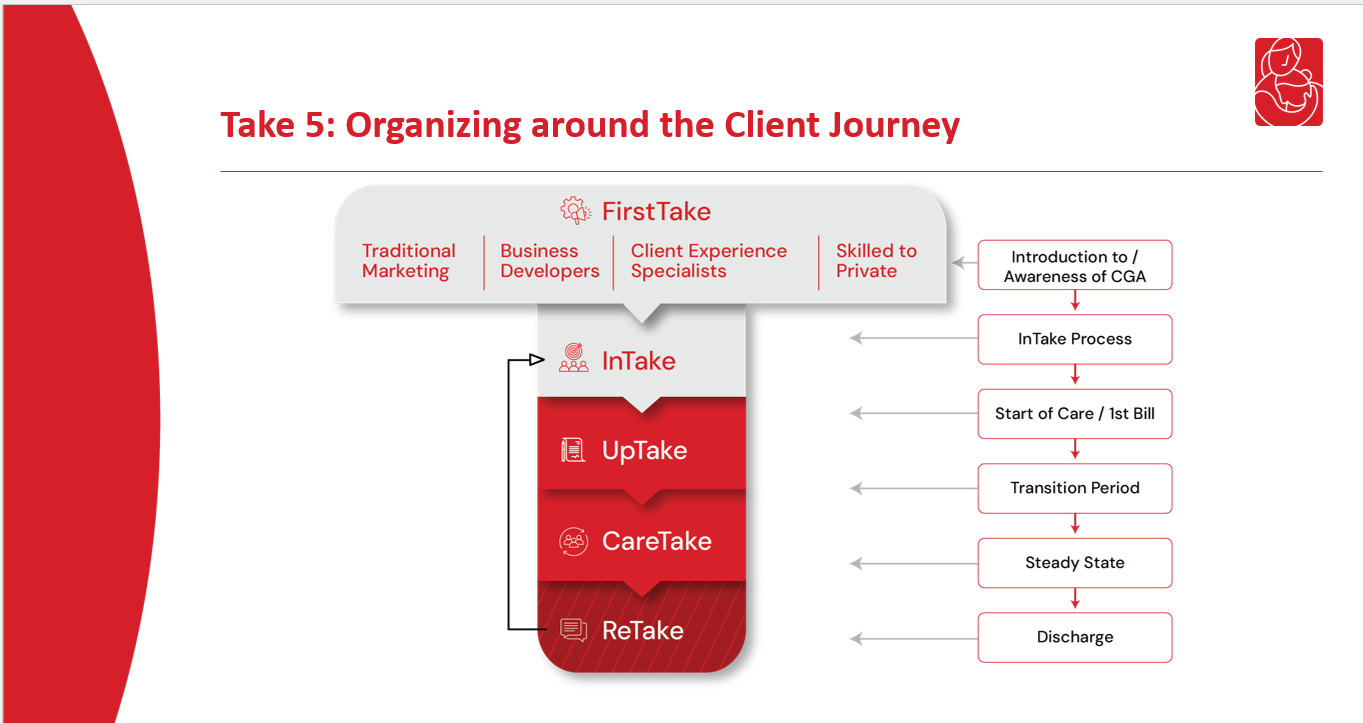
We rebranded and and reorganized everything around the client journey rather than the typical siloed, you know, business model that most of us are accustomed to. And so we came up with the take, it's called take five. And there are five stages that follow the client from the very first phone call all the way to discharge.
Miriam Allred (09:19)
And I bet this was music to your ears and that you have been dealing with families and clients and just like the care for years and years and years. And it's like, let's
Jenni Scherer (09:26)
Yes.
Miriam Allred (09:28)
restructure the organization, like the literal org chart and the operations around the client journey. And I don't know, in my head I'm just thinking like that might seem obvious of like operations should be structured around clients, but
I do think traditional models, like there's just silos, like recruiting is a function, scheduling is a function, clinical is a s is a function, like there's all these functions, but it's not it it isn't like as cohesive as you would think it would be. And especially at scale, it's easy to like decentralize and and it starts to get all fragmented. But think of other other home care companies listening to this.
Jenni Scherer (10:02)
Mm-hmm.
Miriam Allred (10:03)
Do you feel like they are probably in their silos and
should could should kind of like build a model like around kind of a central focus point, which is usually the clients.
Jenni Scherer (10:12)
Yeah, I think there's no downside. As you had mentioned, our our org chart also kind of it it follows it it coincides with with the take five model with the client journey so that the leaders are putting the clients first. They're at the top of the of the of the pyramid. It's kind of like an inverted V where you flip the the typical the pyramid leadership pyramid to where the clients are on the top and we all are here to support them.
I think it makes sense specifically for our industry because at the end of the day we are here to serve our clients and meet them where they are. And how can we meet them where they are if there's not clear ownership and you know it's every people need accountability and we also need to be compassionate and thoughtful about what we're doing and how we're helping them as a team. So if there's a cleaner handoff, the client's gonna have a better journey throughout each step.
Miriam Allred (11:08)
Mm-hmm.
Yeah, we talked kind of about like the chicken or the egg, you know, like sales and recruitment,
Jenni Scherer (11:12)
Yeah.
Miriam Allred (11:14)
and they're two different engines and they're, you know, have to be moving like simultaneously. But I I do think at the end of the day, like what it all boils down to is like the client journey. Everything, everything does revolve around that, including the caregivers and the schedules and the recruitment and the retention. Like it all, it all comes back to the client. And so I think, this model is really powerful because it just makes sure everyone is aligned around the
client and their journey and their experience, therefore everything else like flows smoothly. So so let's talk about the five stages. So just kind of context setting for everyone listening
Jenni Scherer (11:43)
Mm-hmm.
Miriam Allred (11:43)
to this. Everyone is doing like variations of this. And so you're gonna share kind of like your titles and your roles and your
Jenni Scherer (11:48)
Yeah.
Miriam Allred (11:48)
outcomes. And so people can kind of like interpret you know what they're doing and and what you're saying. but I want to go through the stages of this model because I think there's bits and pieces of every every aspect here that people can learn from. So
let me just highlight the five, what they're called, and then we'll go into each of them. So the first one is first take, then intake, then uptake, then caretake, and then retake. And
Jenni Scherer (12:13)
Yep.
Miriam Allred (12:14)
so five five stages, very intentional in each of them. So let's start with first take. first explain who who is involved in this very first stage. Who are the, you know, two to three roles and titles that are involved in first take?
Jenni Scherer (12:30)
So the roles in First Take are our traditional marketing and business development team, our client experienced specialists, and our skilled to private, so our home health division, our home health referring to our home care. and they all so this is kind of you could think about the take five model as a positive feedback loop.
Right. So you have it's a team model. We have an infographic that goes along with it. And the first take reports to our VP of sales. And so their role is to educate and build an awareness of what we do and who we are, to feed the the business with opportunities to help clients.
Miriam Allred (13:15)
So this is like so in first take, I like this. You you include all of the, all of the advertising per se, like all of the
Jenni Scherer (13:22)
Yes.
Miriam Allred (13:23)
digital, the email, the print, all of the advertising is actually fit in this, in this bucket, which with the outcome of then the other roles that you mentioned, business business developers and the client experience specialists,
Jenni Scherer (13:33)
Development.
Miriam Allred (13:35)
are then the outcome of all of that awareness and advertising are the actual leads. So explain so explain all that advertising is done, then someone
calls in, is this the first call in and then what happens?
Jenni Scherer (13:45)
Correct. Right.
So the first call plate is placed to our intake team. So first takes building an awareness. The next phase is our intake team. And these are individuals who are offer solutions and how to better how to set up care. you have a family that calls in crisis. And so their job is to meet them where they are, listen to what they say, and offer services.
you know, depending on the situation, whether it's they need care today or they need it next week, or they're thinking, you know, possibly the end of end of the season, they're gonna be returning to Florida and so they want care again. So our intake team explores the the client's story and really gets an understanding of w what what prompted the phone call and how we can help them.
Miriam Allred (14:34)
And this is a team, it sounds like. So every every office again is a little bit different.
Jenni Scherer (14:37)
Yes. Mm-hmm.
Miriam Allred (14:40)
Some people have one person that kinda does all the intake or or everyone in the office does intake. How do
Jenni Scherer (14:45)
Right.
Miriam Allred (14:45)
you have it structured of like a leader and then i like a a team of intake reps?
Jenni Scherer (14:48)
We do. Yeah,
so there it's also led by our our VP of sales, who is also responsible for first take. And there are four individuals who report directly to her. And and what's really important is that the first take and intake work together. So if there is a business development manager who just left a hospital room, they will call intake and say, I just met with Mary in bed one, two, three.
And she's going home tomorrow, the family's in distress, we need you know, care immediately. And the intake team member will then call the family and and explore the story further. So there's a real clean handoff between those two teams to better serve the client so they're not repeating themselves, right? They kind of just pick up past the baton from one stage to the next.
Miriam Allred (15:40)
And back to the compassion expert,
Jenni Scherer (15:42)
Mm-hmm.
Miriam Allred (15:43)
this is where and you're using the word story. It's like the client story. You know, I was just talking about this on the last episode with Becky
Jenni Scherer (15:47)
Mm-hmm.
Miriam Allred (15:49)
Real about that intake call and creating
Jenni Scherer (15:52)
Mm-hmm.
Miriam Allred (15:53)
an experience on that first call to not sound like every other agency. Like this is a conversation,
Jenni Scherer (15:58)
Right. Right.
Miriam Allred (15:59)
this is an experience, this is a story. So talk a little bit, I guess, about your approach to those phone calls and how do you train your team to create that like experience over the phone.
Jenni Scherer (16:08)
Yeah, so there's there's constant education. We actually use a software program to help support. Obviously, there's one-on-one training that happens with the leaders of the team and the manager, but we we use an an AI training tool that builds actual modules to with an avatar to simulate a conversation that they may have. And it's been very helpful.
So we have a whole library of those. we also allow the team when, you know, if like we hired someone, for example, they would be able to listen in on the phone calls to kind of see how the individual is navigating through those calls. and obviously I say client story because we're this little piece of their life, right? We they call us and they're in a moment of crisis and understanding the family dynamics.
What prompted the call? Why are they in need of help? How long are they gonna need it? you can gain a lot just by, you know, listening and asking the right questions because for us it could be the twentieth call of the day, but to that family member, it is the most important phone call of the day because they're in need of of support for someone that they love and care about. Yeah.
Miriam Allred (17:24)
Yeah, absolutely.
Is the intake team are they
Jenni Scherer (17:27)
Mm-hmm.
Miriam Allred (17:28)
responsible for the conversion for the family, you know, like saying yes to the start of care?
Jenni Scherer (17:34)
Yes. So they are responsible for basically getting the family to say, yes, I want to use your company. I'm ready to sign the service agreement. The next phase of take five, uptake, they we will we have a team of individuals who will go to the home or a rehab or a hospital and meet them to collect the service agreement and to have a conversation one on one in the home to
learn more about their their care needs. So once intake gets them to agree to the services, the client has two options. They can sign the agreement digitally or they can have someone come out into the home and and visit.
Miriam Allred (18:14)
Okay.
So okay, so that's the trigger point. The the intake person gets a a yes or an affirmation on the phone and then they
Jenni Scherer (18:18)
Yes. Right. Mm-hmm.
Miriam Allred (18:21)
can either send the documents themselves electronically or it sounds like probably set the date for the in person interaction to happen. So
Jenni Scherer (18:26)
Right. For the in person. Right. Right. And
and sometimes it's the very next day, depending on the family, you know, situation.
Miriam Allred (18:36)
What would you say is most common? I mean, we hear of even some same day in the industry. Do you
Jenni Scherer (18:39)
Same day. Yeah.
Miriam Allred (18:41)
how much same day, next day, or within like a seven day time frame would you say you get?
Jenni Scherer (18:44)
I would
say we we do have some that will ask for the same day. Usually those are quick digital signatures because it they needed it they need it now. I would say within a week. Most of the phone calls that we have are moments of, you know, I need it now or by the end of the week, or Monday, you know, the following Monday. that's when when care would begin. So yeah,
I would say that within a week we're pretty good at converting those clients because the family just kind of needs solutions. You know, they they don't know what to ask or even how to ask for it.
Miriam Allred (19:24)
What would you and I have talked about this, but what would
Jenni Scherer (19:25)
Mm-hmm.
Miriam Allred (19:26)
you say your success rate is like if you send it to them digitally and them actually taking initiative and doing that versus the in person? Like how much of each of those happens and is one more successful than the other?
Jenni Scherer (19:38)
The in-home visit is definitely much more successful. and something to know about those in-home visits is we learn a lot more about the client, their home environment, the family dynamics, even the disease process. You know, the clients are calling saying, you know, I'm not been feeling well. And then you you send someone to the home and you realize that.
They're not, you know, eating properly. They have an open wound because they ran into something running to the phone when their daughter called last night. And they don't they're very guarded because they want to be independent and live an independent life, but they need more support than they're willing to say in that first call with intake. But going into the home, you it adds color to the the story and and understanding what's happening. And so we're able to support them and understand.
Exactly what's going on in person. And I will say our success rate is probably close to like ninety nine percent with the home visit. Yeah. Yep. Conversion rate. Yeah.
Miriam Allred (20:41)
Like a 99% like conversion rate, essentially. Like,
and okay, so kind of transition. Well, so so just to wrap up, like intake,
Jenni Scherer (20:47)
So
Miriam Allred (20:48)
it's like lead qualification, the
Jenni Scherer (20:50)
Right, lead qualification. Mm-hmm.
Miriam Allred (20:53)
and and setting that getting the yes on the phone,
Jenni Scherer (20:55)
Right.
Miriam Allred (20:56)
essentially. The other thing that I want to just hit on is you all have like a VIP client. You have like a ranking system. And so
Jenni Scherer (21:03)
Yes.
Miriam Allred (21:03)
another, another component for the intake is that qualification and also
Jenni Scherer (21:07)
Correct.
Miriam Allred (21:07)
the
Like the severity of care for your ranking system and identifying the VIP characteristics. Can you kind of define what VIP means for you guys?
Jenni Scherer (21:14)
Mm-hmm. Yeah.
So our VIP clients are those who need thirty hours or more have and have long term care insurance, or those who need thirty hours or more and are have another pay source, private pay, whatever other entity might be paying for services. And those individuals, those families are designated as VIPs because they typically need a little bit more hand holding and the situation is a little bit
more unstable on shaky ground. we always offer a home visit for 30 hours or more to be able to further support them and understand what's happening. We also do offer live-in care when it's appropriate for those you know clients who have the accommodations for a live in some home care companies don't offer live in but we still do. and so that designation is the VIP designation. We
have a minimum usually of twenty hours a week, although our our guide clients, the CMS benefit with the guide program, we do service, you know, whatever respite care is needed w in those situations.
Miriam Allred (22:20)
Okay. So part of the intake phase is yeah, identifying these VIP clients. And then we're gonna talk about like the VIP client journey and how, you know, the differentiators there. But the intake team is responsible for identifying those because then
Jenni Scherer (22:31)
Correct.
Miriam Allred (22:32)
they definitely get the in home assessment, but then they also get like special treatment or just are, you know, prioritized differently down throughout this process. So so that's the intake team. Now we're getting to to uptake, which you said
The
uptake team are the ones that go out and do the in home assessments, correct?
Jenni Scherer (22:50)
Yes. They go out, they meet with the family, with the client in person, in their home or in the hospital or rehab, depending on, you know, the need at the time.
Miriam Allred (23:01)
Okay, and they are responsible for the client agreement and all the paperwork, getting everything kind of signed, dotted, billing,
Jenni Scherer (23:07)
They are
Miriam Allred (23:07)
all of that.
Jenni Scherer (23:08)
they are. They are the boots on the ground that go in the home and offer solutions, collect the paperwork, identify other areas. We've had the team is called our client care liaisons. They have gone into the home and identified clients as needing skilled care also. And so they're able to refer to our home health division.
And they develop that relationship and that trust in person. We all know there's nothing like sitting down with someone who can provide compassionate expert in the moment of of crisis. It's very reassuring. And it also solidifies the relationship right from the beginning. So the team has been very successful. They are
From a wide range of backgrounds. We have nurses, we have social workers, we have former administrators, home care administrators. So they are really they have experiential knowledge that they're bringing into the home from a wide range of backgrounds.
Miriam Allred (24:05)
I was just gonna ask that. Think of your best client care liaisons. Do the majority of them have a clinical background or it sounds like maybe more diverse?
Jenni Scherer (24:13)
It's a fifty fifty mix.
Yeah, it is. It's diverse. Mm-hmm.
Miriam Allred (24:18)
And have you have a lot of them grown from within or in the company or have you gone out and hired these people? Because I ask, everybody needs better, more and better client care liaisons, but it's a tough role to find and hire for and then also to retain because of the burden, you know, like the emotional burden.
Jenni Scherer (24:36)
Right.
Miriam Allred (24:37)
They take on a lot of that, these people.
Jenni Scherer (24:39)
They do. They do. So we have six right now and four were kind of internally promoted. the other two we we recruited and and they are have a a case manager type background. So
Miriam Allred (24:56)
Okay.
So they are responsible for the in home assessments, getting all the document, like the start of care, and then this this stage, this uptake team, they if I'm not mistaken, are responsible for the first ninety days. So
Jenni Scherer (25:08)
They are
Miriam Allred (25:09)
the first ninety days. So explain what their
Jenni Scherer (25:11)
Mm-hmm.
Miriam Allred (25:12)
role looks like for these first ninety days. What do they do?
Jenni Scherer (25:15)
So the first 90 days, they first visit is obviously the beginning of care. and they take that information and they report it back to our client care coordinators and myself in the office to give us an understanding of exactly the type of caregiver that would be a right fit, kind of what the home life is like, do they need someone that drives? Are there pets in the home? You'd be surprised how many clients that call intake don't tell you they have a puppy, you know.
and then the client care liaisons go out and discover that there's a dog in the home. So, which is a great companion and is wonderful, but there are caregivers, you know, you can make or break that relationship if you're sending an aide who has allergies, right? So they they give us a full picture. The and I say us because I'm I I manage the
Client care coordinating team, but they they were they give us the understanding of what exactly we need to succeed and support this client. and so at that point they schedule a two-week visit and then a 30-day visit, and then a 60-day visit, and a 90-day visit. So there are multiple check-in points where they will go out and see the client to make sure that have their needs changed.
do we have an opportunity to build hours because of some disease ch changes that have occurred? are they getting the right type of care? Are they happy with the aid? You know, they're the first 90 days are very fragile. And so they go out and visit, you know, they have a protocol that they follow and they make an appointment when they're, you know, for the next visit as they're leaving.
Miriam Allred (26:53)
And so just to reiterate that, they go out and see the client in person at two weeks, thirty days, sixty day, ninety days.
Jenni Scherer (27:00)
Yes.
Miriam Allred (27:01)
And do you do this for every single client? We're not just talking like VIP. This is for every single client that you have.
Jenni Scherer (27:07)
We do this for our VIP clients. So the clients that have 30 hours or more. We also do this for our clients who are expressing that they they no longer need services. So it's kind of like a discharge prevention. And we do this for guide clients that want to add on more hours to further support the respite care.
Miriam Allred (27:28)
Okay. I don't know how relevant this is, but for people that are kind of in between those camps of like they have less than thirty hours a week and
Jenni Scherer (27:33)
Mm-hmm. Yeah.
Miriam Allred (27:35)
don't have any of like the other specialty kind of needs and things, do you have just like a revised cadence for them? Ev I don't know if you have for Okay. Okay.
Jenni Scherer (27:42)
It's just as needed. Yeah,
it would be as needed.
Miriam Allred (27:47)
Do you take on many shorter hour cases than that? Or are you guys mostly thirty hours and above for most of your census?
Jenni Scherer (27:53)
We do take up
we take on twenty hours or more. because you're that's how you're able to build hours when you take on the twenty hour clients and and sometimes those twenty hour clients that's all they're willing to commit to in the beginning, but then when they see the value of having the caregiver in the home, the hours will expand. so
Miriam Allred (28:10)
So for a twenty hour client, would you still visit them in person at those same intervals or no?
Jenni Scherer (28:15)
Not at
the same intervals. We we would send someone out to meet them if they were unable to sign digitally and
Miriam Allred (28:22)
Okay.
Jenni Scherer (28:23)
and just an initial orientation to who we are, what we do, what the company is about. And if they asked for an additional visit, we we would build it in, but it's not at the cadence of the 30 hours or more of the VIP client.
Miriam Allred (28:39)
Okay, 'cause you make a good point of you take the twenty hours knowing that oftentimes they can grow into thirty or more.
Jenni Scherer (28:44)
Yeah, mm-hmm.
Miriam Allred (28:45)
And I guess I do see value in visiting them frequently in case needs change that warrants them, but as needed, you know, I I guess I could see it
Jenni Scherer (28:53)
Yeah.
Miriam Allred (28:54)
being less frequent because they're less hours. So hopefully the needs aren't not as great, but you want to make sure you get ahead of the needs. So it's kind of that like that back and forth.
Jenni Scherer (29:02)
Yes, and so the uptake team works very closely with our caretake team. And our care take team is comprised of our client care coordinators and our onboarding or registration team.
Miriam Allred (29:16)
Okay. So let me so let me ask a couple of questions. So yeah, you mentioned so uptake. We we we went through this. So this is, you know, the in-home assessments, signing the documents, getting the start of care, and then the first 90 days they're responsible for. And then you're saying, so then the next stage is caretake, and the caretak team comes in at day ninety-one and they are responsible for the lifetime of the client. Th I wanted to ask about the care coordinator. So those are like the schedulers.
They live within caretake or uptake? Because the sched the initial scheduling obviously happens in uptake. Do they live in uptake or caretake and why?
Jenni Scherer (29:53)
So they partner with the client care liaisons in the first 90 days, making sure they're also checking in with the clients at very specific intervals for all clients. Our care coordinators are. So there are five check-in calls within the first 30 days. So the client care liaison goes out at the beginning of care, collects the paperwork, we send the caregiver to begin, and the coordinator, the care coordinator will call.
And after 24 hours and make sure that the client is pleased with the services they're receiving. Was the caregiver on time? You know, is she meeting your needs? Is everything working out? Then they call within five days. So there's an intro, a 24, a five-day, a two-week, and a 30-day. So there are five phone calls that the care coordinator is making in tandem with that client care liaison visit.
Miriam Allred (30:47)
Okay,
this is fascinating. Why? You know, like that, you
Jenni Scherer (30:49)
Mm-hmm.
Miriam Allred (30:51)
know, why so many touch points in the first 30 days and why the client care coordinator doing that?
Jenni Scherer (30:58)
because they are the ones that are s matching the caregiver with the client and we have to make sure in the first thirty days that the client's needs are being met. And what we found, we did an analysis, we found that we were losing hours and we were losing clients because there wasn't enough check-in. It we we we were missing that personal connection. And so if a coordinator can make that
bond over the phone, if Mary no shows tomorrow, they're gonna call us and say, you know what, my caregiver didn't show up. And if they love that care coordinator, they're gonna allow us to send somebody else rather than leaving us for the next door neighbors home health care company.
Miriam Allred (31:42)
Okay, a couple of follow up questions. When were you losing the clients in the first seven days or the first thirty days? Like what was the window that you were losing the most? Okay.
Jenni Scherer (31:50)
In the first 90 days. So we found that
if the idea is if we can really solidify that relationship in the first 30 days and then continue to support them as they go on. So the care coordinator also checks in monthly after the first 30 days. If that first 90 days they have enough check-in and enough hand holding, we really understand and support the client and can maintain the relationship for a long time.
Miriam Allred (32:19)
Okay. So I guess the way that I think about it is like if you don't put in the work the first thirty days, you're almost guaranteed to lose them within the ninety because the first thirty doesn't go well and so then they trickle out the door from thirty to ninety. So you have to do all that work in the first month.
Jenni Scherer (32:34)
Exactly. Exactly. And really develop that relationship. Really understand, you know, what's happening in the home. Many things can change medically in the first 30 days too, because they call you in distress and then two weeks later they are having another procedure and then, you know, another two weeks they're starting new medication. And before you know it, they need more care, but they don't necessarily know how to ask for it.
Miriam Allred (32:59)
And it sounds like the client and the family have kind of like three points of contact, if I'm understanding. It's obviously the caregiver once that relationship is established, but it's the care coordinator and the liaison.
Jenni Scherer (33:12)
Yes.
Miriam Allred (33:13)
So it's it's three, three people. Who of those three, particularly of the two, of the coordinator and the liaison, like is one of them the point person? And is there do you have the goal of making one of those the point person, or do you intentionally have their
be two people so that they have multiple touch points.
Jenni Scherer (33:30)
Yeah, we don't want it to be confusing. so we do we do have the care coordinator is the point of contact. And the care coordinator presents or says, you know, I partner with Josie, the care the client care liaison, because you know I'm in the office and and she we work as a team to further support you. So the point of contact is the care coordinator, but the in-home visit is conducted by
the the client care liaison. And
Miriam Allred (34:02)
Okay. And just
to make sure I have it right, the coordinator is also the one literally building the schedule. Like
They build the schedules, but then they're also interfacing and the the point person with the clients themselves.
Jenni Scherer (34:14)
Exactly. They're the ones they're the relationship builders with both the caregivers and the clients.
Miriam Allred (34:21)
Okay, and that's what I was gonna ask. The same concepts probably apply with the caregivers. So the coordinator is also responsible for the caregivers that are servicing those clients, correct?
Jenni Scherer (34:31)
Yes, exactly.
Miriam Allred (34:33)
What is the typical ratio of one care coordinator about how many clients and caregivers would be in their purview?
Jenni Scherer (34:43)
They have currently between fifty and sixty-five each. And yeah,
Miriam Allred (34:49)
Okay, clients.
Jenni Scherer (34:50)
that's their clients. The the caregivers varies depending on the schedule. You know, a twenty-four hour client would have a minimum of four caregivers.
Miriam Allred (35:00)
Okay. okay, so so back to care take. So we're we're
Jenni Scherer (35:02)
Mm-hmm.
Miriam Allred (35:03)
kind of in this caretake. So the care coordinators are kind of the driver of this caretake process. I don't know if you mentioned this. D are the liaisons still involved in care take, or does it really kind of transition to the care coordinators or the point person liaisons are doing less in this stage?
Jenni Scherer (35:20)
The liaisons are doing less in this stage. They do make quarterly visits. Once they get to day 90, they'll make quarterly visits. The care coordinator kind of takes the client into happily ever after and continues to check in on a monthly basis or when a relief caregiver is needed. You know, they'll speak to the client at that time. We call they call the clients and wish them happy birthday. We check in with them on holidays.
There's a lot of client engagement that happens with our caretake team. We have community open house events that our clients who are able to leave the home with their caregiver, we have them come into one of our three offices and you know join us for themed events. in June, we did one surrounding emergency management plan for hurricane season and you know, gave them flashlights and kind of developed around that theme.
How how are they, you know, what are their plans? Because hurricane season starts June 1st and it's half the year, right? So it it gave us an opportunity to meet our clients in person and thank our caregivers for their heroic efforts. So, you know, that that's additional engagement that the care coordinators, they love those events.
Miriam Allred (36:33)
Yeah, it sounds to me just like a lot of touch points, almost as many touch points as you can like reasonably have with the clients. Like that's what you're striving for. Phone regular phone calls, you know, after the 90 days, a
Jenni Scherer (36:44)
Mm-hmm.
Miriam Allred (36:45)
monthly check-in via phone call from the care coordinator, but then also a quarterly from the liaison. And then, like you're mentioning, all these other milestone
Jenni Scherer (36:53)
Mm-hmm.
Miriam Allred (36:53)
check-ins and in-person events, it's like you wanna see your clients and have as many touch points with them as possible. And I sometimes think agencies
take, you know, the the shortcut route, which is the care you the caregivers in the home every single day. Like we have eyes on the client all the time. And
Jenni Scherer (37:09)
Right.
Miriam Allred (37:10)
that kind of like gets the office off the hook. But it sounds like you guys have kind of taken the opposite approach of like someone in the office, other people should have relationships with these clients. And that's like maybe your highest priority.
Jenni Scherer (37:21)
It is. It is our highest priority. And again, it takes us back to the compassionate expert piece of everything is that the caregivers, of course, are compassionate. You know, this is their job. But what if Murray leaves? You know, do you lose that client if the caregiver who's been there for so long leaves because they don't know anyone else in the office? Or can a caregiver take that client to another to your competition if they're not pleased about something? I know probably every home care operator has had that happen.
Miriam Allred (37:50)
Yeah, and that's kind of the harsh reality. Like you've probably been burned, that's really, you know, strong word, but burned by enough caregivers to where the office has to be so integral and involved and engaged with the clients because the caregivers do come and go. Is is that part of just what led you has led you to this point?
Jenni Scherer (38:06)
Mm-hmm.
Yes. It's it led us to the point because we we needed to do something that number one surrounded the client and and was right for the client. But yes, it that is is kind of a not necessarily the driver being burned by that situation, but and it this supports the client experience and will prevent those things potentially from happening. Yes.
Miriam Allred (38:31)
So inside this caretake stage, do the client care coordinators also own recruitment and retention of the caregivers?
Jenni Scherer (38:40)
They don't. We have a team that works with the care coordinators. We have three individuals that recruit and register all of our home health aid CNAs, LPNs, RNs. And they work very closely with the care coordinators to the point that when we have someone that's that's ready and in in our office filling out paperwork, everything looks good, they're ready to go. It's mandatory that a coordinator meet them and kind of welcome them to the team.
talk to them about, you know, the hours that they're available for, really build that relationship right at the beginning so that when we do call, they're eager to to work for us.
Miriam Allred (39:19)
Okay, so recruiting is a separate function, but they're lockstep with like uptake and care take and
Jenni Scherer (39:21)
Mm-hmm. Correct. Yes.
Miriam Allred (39:24)
that it they're so integral. You know, the the client care coordinators are focused on the clients, but then you've got this recruiting engine and they are, you know, talking all the time to line all of this up. But
Jenni Scherer (39:34)
All the time and
there's partnerships that happen because the care coordinator can also project, okay, we have clients in this geography and this zip code, and I have three caregivers. So if if these clients need coverage, we we're stuck, right? We're in a situation where we we are gonna either have to pay an aid to travel or not have the availability that we need, the bench.
to cover those clients. And so there's a lot of conversation and collaboration that happens with those two teams. And it it's actually a very, very good structure and they need each other.
Miriam Allred (40:12)
Yeah,
yeah, absolutely. And they have to be talking like literally all the time. It's like
Jenni Scherer (40:16)
Mm.
Miriam Allred (40:17)
applicants are coming in and clients are coming in. Like that that's just like the reality and the chaos of home care is like there's just all this real time activity and we have to
Jenni Scherer (40:21)
Yes.
Miriam Allred (40:24)
line it all up and and be the matchmakers. speaking of like your org chart, so all of these functions that we're talking to have I think kind of rolled up to sales. Speaking of recruitment being a separate function.
And and everything holistically like being tied to the client journey. Does recruiting like report into or up to sales or do they have kind of a separate org chart?
Jenni Scherer (40:49)
registration reports to CareTake, which which I actually manage. So I I'm responsible
Miriam Allred (40:55)
okay.
Jenni Scherer (40:55)
for the Caretake team of the client care coordinators, and our registration recruiting team.
Miriam Allred (41:03)
Okay, so recruiting does report into the caretake function.
Jenni Scherer (41:06)
Yes.
Miriam Allred (41:07)
Cause I like that in that, every part of the organization now reports into these five functions, which just helps with the the cohesion of like recruiting is filling this funnel to help the caretake, to help the clients. Like, I don't know, it's a little bit of a mindset shift, would you say?
Jenni Scherer (41:24)
It is. It is a mindset shift and what we did was we look took the leaders, looked at their strengths and put them with the roles that coincided with the teams. And
Miriam Allred (41:34)
Mm-hmm.
Jenni Scherer (41:35)
it it it it's working very well.
Miriam Allred (41:39)
Yeah, absolutely. And and I've I've seen that at I think at larger organizations where they realize, okay, we've siloed out all these departments and it's it's like dysfunctional in that recruiting typically needs to like report into the client side. Almost in I've seen it reporting up into
Jenni Scherer (41:53)
Mm-hmm.
Miriam Allred (41:56)
sales. Like all of these things are aligned and obviously anyone can report to anyone but like these org charts do need to align and that the right people are reporting into the right functions and
to your point, it's what we're talking about, like it all fulfills the client journey. And so even rethinking about structuring your org chart around the client journey, I think is just a good exercise for everyone to think about that's listening to this.
Jenni Scherer (42:20)
Yes. And I will say that because there's such a close and tight handoff that even the team that works in Caretake works directly with some of the other the other levels of the of the model. we we need to know the clients that are are thinking about starting care. And so intake is often speaking to the care coordinators and and letting them know the
potential opportunities that we have coming up just so that we can be readily available for our clients.
Miriam Allred (42:53)
So to that point, the the liaisons are primarily involved in the uptake, which is that first 90 days. But I think you mentioned so then caretake, which is 91 days plus,
Jenni Scherer (43:04)
Yes.
Miriam Allred (43:04)
the liaisons still visit those clients quarterly. Is that indefinitely? Because then the liaisons, I guess you have to hire more of them as their client volume increases because they're working with the new clients in their first 90 days, but also maintaining the existing clients that are past their 90 days.
Jenni Scherer (43:20)
We are probably gonna need to hire more client care liaisons as we grow. Right now it it's working out w at the pace that we have it, set with the quarterly visits. It's sustainable and then we throw in occasionally a birthday visit for our VIP clients. and and they plan their day obviously around the geography of where the clients live. So it's very doable. They're not, driving all over. it it's so far it's working.
And it is every ninth
Miriam Allred (43:49)
What?
Jenni Scherer (43:50)
quarterly. After the nhm. Mm-hmm.
Miriam Allred (43:51)
Quarterly is how often they're visiting. Yeah, the
the ongoing clients. did you say what what would the ratio be of one of these liaisons? Because there's the new client volume and then there's the existing client volume. Like how many clients can they be overseeing with both of those roles?
Jenni Scherer (44:06)
I would say we have the they they have I
Miriam Allred (44:09)
Even just approximately.
Jenni Scherer (44:11)
would say probably eighty clients each. Eighty clients each.
Miriam Allred (44:15)
Okay. And that's the
new clients where there's more communication and kind of more engagement. And then their other clients, you know, it's just a quarterly commitment or engagement.
Jenni Scherer (44:24)
Yes. Mm-hmm.
Miriam Allred (44:26)
Okay. so I think that's that's basically everything with the caretake stage. You know, 91 to discharge, the client care coordinators are the point person. They're also, you know.
calling and visiting at least monthly and then the liaisons are doing quarterly, celebrating all of the milestones and all the in-person events and things. And then also we talked about recruitment fits in this department as well. the last stage is retake. Explain what that is and who does that.
Jenni Scherer (44:56)
So we have a designated individual in in the retake team and she reaches out to every and speaks to every client that discharges and receives feedback, finds out how their experience was, was there anything we could have done differently? Were they pleased with the service? Did they find that the check-in, you know, was appropriate, the level of communication? and the purpose of that is number one, we want to know is there anything we can do better?
Right, as a business, but also we want them to think about us when they need care again, and we also want them to refer their friends and family to us. And so, you know, the infographic that goes with the take five is a T and it it is you can think of it kind of as a funnel. So we're if if we're doing our job right during every single stage and we're supporting the c client where they need it and meeting them where they are.
we can recapture those opportunities when they need help again. So that is the whole concept behind that retake role.
Miriam Allred (45:56)
In the history of Caregivers of America, has there always been this function of like the discharge call and all of this effort going into the discharge or is this more of
Jenni Scherer (46:04)
There have.
Miriam Allred (46:05)
like a newer thing?
Jenni Scherer (46:06)
No, we've we've always had it. We didn't call it retake, but we always had someone in the office who was calling the discharged clients.
Miriam Allred (46:14)
Okay. And I asked that to to understand too, what have you improved over the years? Because I think this is an important function and people can overlook it or
Jenni Scherer (46:22)
Mm.
Miriam Allred (46:22)
speed through it kind of like, it's just like almost like a task that they're checking
Jenni Scherer (46:26)
Right.
Miriam Allred (46:27)
off. But what what have you learned through this process of like getting better and prioritizing the retake?
Jenni Scherer (46:34)
we've learned we've learned how important the first ninety days are because they you know, we're hearing feedback. we were hearing prior to the take five model, you know, I don't know I I didn't know who to call when my aide didn't show up or I wasn't sure, you know, what to do with the claim form I got from the long term care insurance. So we realized from the feedback with that retake phone call w the areas that where the gaps were and and what we can do better.
I will tell you, some analytics that I received on Friday show us based on our referrals, the top five all point to the take five model. We have the business development team is the number one referral source since January. Number two is the retake team, meaning we have
families who are coming back to us to need care again. The third source is our family and friend referrals. So a client has a family or a friend, exactly what family friend, and they're thinking of Caregivers of America So that tells me that caretake and and uptake, the client care liaisons and the care coordinators are making the right match and referring the right caregiver. And then we have our community contracts and staff referrals are the last two.
Out of the top five since January.
Miriam Allred (47:54)
So you know what actually surprised me the most there is your number two are these retakes, the discharges coming back onto services. That's
Jenni Scherer (48:00)
Yes. Mm-hmm. Yes.
Miriam Allred (48:03)
wild that that's number two. You know, I could see I guess that being like maybe four
Jenni Scherer (48:05)
Number two. Mm-hmm.
Miriam Allred (48:07)
or five, but number two are that illustrates how important this process is,
Jenni Scherer (48:12)
Right.
Miriam Allred (48:12)
is that retake process and doing the due diligence to have those conversations with the clients and their families because they can be coming back.
Jenni Scherer (48:20)
I can. And and many of the situations, your listeners will know, you know, you have hip surgery, you need care for six weeks, you recover, something happens, you fall again, you know, you get a diagnosis. Like you're aging a place. You're aging a place and and needs change. And if they know who to call when life happens, they're they're gonna call call you again if they were pleased.
Miriam Allred (48:43)
Yeah, and and you've again something we talked about offline. this discharge summary. So you guys use matrix care, but you have a specific form that you fill out at time of discharge. Just high level explain
maybe
Jenni Scherer (48:56)
Mm-hmm.
Miriam Allred (48:57)
some of the key components and why that's so important.
Jenni Scherer (48:59)
Sure, sure. Well, we we one of our standards with the state for our licensing requirements is that we have to have a discharge summary. So it it serves multiple multiple purposes, but we document the discharge date, the last date of service, and the reason for discharge. And then there is also a notation on there for like the goals, the discharge goals.
So it might, you know, client is independent of activities of daily living and no longer requires hands on care. and then you you know, we the administrators document a reason or where we were when we started care and where we are now.
Miriam Allred (49:42)
So the state actually mandates this. I'm guessing there's a lot of states that probably don't mandate this. And that's probably the gap that I'm thinking of for a lot of agencies that
Jenni Scherer (49:50)
Mm-hmm.
Miriam Allred (49:50)
aren't doing this consistently. It's different, you know, when it's mandated. But I think, you know, CTA for everyone is like there should be a consistent follow up process. You call it retake, but a time of discharge to gather all of this information. And then this retake team as well, or the the rep that oversees this.
two of the things that were just kind of in your notes of like monitoring snowbirds, you know, people that can kind of circle back around, but then
Jenni Scherer (50:12)
Yes. Yes.
Miriam Allred (50:15)
also contacting these people regularly via phone or card or email. Does that person build out, campaigns to then have
Jenni Scherer (50:23)
Yes.
Miriam Allred (50:23)
touch points with these people? And what does that look like?
Jenni Scherer (50:26)
We do. Our snowbird, so our snowbird clients we check in with on a monthly basis and they typically will leave when it starts to get hot in Florida and then they come back in September, October. So during that period, we're checking in with them every 30 days. We do send them postcards and we do have campaigns for them. This year we sent a a a coffee mug that says twenty twenty six Snowbird Club and it had our logo on it. So that was kind
Miriam Allred (50:50)
Huh.
Jenni Scherer (50:52)
of a fun
They're fifty two. We have fifty two snowbirds. and so we're hoping, you know, that we will get the opportunity to help them again when they return to Florida. so there are different campaigns. We send out birthday cards to our clients. we send out holiday cards to everyone. And, you know, this generation loves to get paper mail. So, you know, they get a a calendar, we send out a calendar and
And if they have a calendar and they're using it to write appointments, it has your logo on it and your phone number. So, you know, it's a very old school way of of marketing, but it's it's been effective and you're top of mind. If you're top of mind, they're gonna call you.
Miriam Allred (51:32)
Yeah, and some people might see those as, expenses of like, is it really worth it? Postcards and calendars. But, you know, this generation, they still appreciate those things. And wherever you can put your logo and wherever
Jenni Scherer (51:41)
They do.
Miriam Allred (51:43)
your logo can be like permanently in their home, like on a refrigerator,
Jenni Scherer (51:46)
Right. Yes.
Miriam Allred (51:47)
on a calendar, like that is a that is amazing. And everyone should be striving for versions of that.
Jenni Scherer (51:54)
Yes. We do put a magnet on the refrigerator during the home visit, the first home visit. And we tell that it's there. And we've actually
Miriam Allred (51:59)
Yeah. And I like the idea of calendars
too, because it's appointment ba you know, there's like so much value in the calendar being right there. What were you gonna say?
Jenni Scherer (52:09)
I was gonna say, we've actually had the paramedics call us because they found that the magnets on the refrigerator and if our aid isn't in the home, they'll say, I just want you to know I'm here, Miss Smith, she fell, you know, she probably needs additional services. So it has been I mean it you know, it is an expense, of course, but it it it it's accessible to anyone in the home.
Miriam Allred (52:33)
Mm-hmm. Is the metric or kind of like the accountability of the the retake person like restarts? Like are they responsible
Jenni Scherer (52:41)
Yes.
Miriam Allred (52:41)
for restarts? Is that their primary metric?
Jenni Scherer (52:45)
so she, yes, that is that is correct. Her primary metric is to recapture, recapture the opportunities, recapture the clients. And she works with Caretake, also, you know, the within the the Take Five model to make sure that we know if she hears something that we can be doing better. She provides feedback to that team to make sure that we're learning from everything. But yes, her primary driver, her primary goal is to recapture opportunities.
and filter them back into the top of the funnel.
Miriam Allred (53:14)
Okay. Jenni, this has been great just thinking of all of these stages and we've talked through each one. And again, I hope everyone listening to this definitely has their own version of this. But I think there's like kind of nuggets in each one of these and how you think about it and how you structure it, you know, by stage that's valuable for everyone. And then also holistically structuring your organization around the client journey
Because that is that is what really drives success at the end of the day. Caregivers of America is a very large established company in in Florida. It's all of this engagement, this mindset, this model, like that's really what moves the needle. I'm I don't mean to be putting words in your mouth, but I'd imagine like that is what
really makes you all stand out is everything that we've talked about.
Jenni Scherer (53:57)
in an industry where it's there are so many home care providers, you have to stand out and differentiate yourself from the competition. We are actually we re have redone our mission vision values around the compassionate expert and around the take five model. So I'm super excited it's going to be announced at our next we have a town hall monthly and so we're socializing this now over the next 30 days.
And our vision, if you don't mind, I I I love it. It says we will redefine the experience of aging at home by building a community where every client feels value, every family feels supported, and every caregiver knows the value their work changes lives.
Miriam Allred (54:42)
Yeah,
that's it in a nutshell, you
know, that that is fantastic.
Jenni Scherer (54:45)
Yeah. That's what it's all about.
Miriam Allred (54:47)
And so to that, to that point, you have been at this company for a long time and you, oversee people and work alongside people. How has this take five model changed the culture of the company? How would you describe that?
Jenni Scherer (54:59)
It's changed the culture. People are happier. They are they have clear definition on and and accountability on what their roles are. And they see that we're growing. So, you know, that that drives drives their their their ability to do their job well. not to mention, you know, our hours are up, our census is growing.
We have caregivers that we're able to offer work to. So it has changed the culture with the compassionate expert, also the clients top of mind every day.
Miriam Allred (55:35)
And so when you say people are happier, it's because there's more clarity and organization and purpose than there's ever been. Is that is that kind of what I'm understanding?
Jenni Scherer (55:44)
Yes, exactly.
yes. people are happier, they're rooted in teamwork, they're rooted in knowing the vision of the company and where their roles settles and who they report to.
Miriam Allred (55:56)
Yeah, and also the impact that they have on the clients. You know, as companies get larger, it's easy for roles to get further and further removed from the care. You hear CEOs say that, you hear VPs and executives say that. But
Jenni Scherer (56:08)
Mm-hmm. Right.
Miriam Allred (56:09)
even a company of your size, you're a regional administrator, like there's there's room for you to get further and further from the client. But this model keeps everyone close and closer to the client, which adds a lot of like value and purpose and
satisfaction to people's jobs.
Jenni Scherer (56:26)
Absolutely. We're all involved in the orbit of care around the client. A hundred percent.
Miriam Allred (56:30)
Yeah.
So Jenni, thinking about this model, I don't know, for the next six months, twelve months, what do you hope for the company that will just continue to come out of this? Like what do you want the future to look like based off this?
Jenni Scherer (56:42)
Well, I want us to continue to grow. the model is scalable. you know, whether you have a hundred or a thousand clients, it it it's it's it's scalable. I would love to see us just service more clients, be able to offer caregivers, you know, more opportunities to help our clients and offer solutions and meet our clients where they are to fulfill and support their lifestyle and their care needs.
Miriam Allred (57:09)
And one more question for you personally. You have been doing this a long time.
Jenni Scherer (57:12)
Yeah.
Miriam Allred (57:12)
And I know you love it. Like every company wants 10 or 20 jennies. Like there's not enough of you to go around in this industry. But you've had dark days and hard times and mornings when you don't want to get up and do this. What
Jenni Scherer (57:25)
Yeah.
Miriam Allred (57:26)
do you tell yourself? Like, how do you how do you keep pushing through in in the harder moments?
Jenni Scherer (57:31)
in the harder moments, I know that coming to work and answering the phone and being the leader my team needs me to be is gonna change a life. And honestly that's that's what keeps me going is knowing that I'm gonna make a difference. Even on my worst days, the person that's calling me on the phone could be having a you know an an even harder day than my day.
And you know, a shift of perspective. at the end of the day, when I lay my head on the pillow, I know that I made a difference. So that's what keeps me going. That's what keeps our team going. being that compassionate expert and being able to help, you know, as many people as we can.
Miriam Allred (58:11)
Yeah, you're really amazing, Jenni. I just, every time I
talk to you, I just feel this like this energy and this passion and it's really genuine, you know. Like I I mean it when I say there's not enough of you to go around. We need way more people like you in home care that
Jenni Scherer (58:22)
Thank you.
Miriam Allred (58:25)
are just in it for the right reasons and want to make a difference in people's lives. And you are doing that. And so thank you for all of the work that you do and thank you for sharing this take five model. This is, you know, something that's been built in Caregivers of America, but again, you guys were so gracious enough to share it.
there are a number of kind of documents and images that you've
Jenni Scherer (58:42)
Mm-hmm.
Miriam Allred (58:42)
cited and we can probably share some of those in the show notes for people to reference. but you know, the CTA is for everyone to kind of listen to this and take this back to their team and implement what makes sense for them and just rethinking about, this mindset shift of building the organization around the client journey. I think that's really powerful. So Jenni, thank you so much for joining me in the lab.
Jenni Scherer (59:00)
No, thank you. And thank you for your what you're doing for our industry and building awareness and allowing us to share with each other. It's wonderful.
Miriam Allred (59:07)
it it's my pleasure. we're in it for each other, which is great. So thank you so much.
Jenni Scherer (59:11)
Thank
you.