Subscribe
Share
Share
Embed
How is the use of artificial intelligence (AI) shaping our human experience?
Kimberly Nevala ponders the reality of AI with a diverse group of innovators, advocates and data scientists. Ethics and uncertainty. Automation and art. Work, politics and culture. In real life and online. Contemplate AI’s impact, for better and worse.
All presentations represent the opinions of the presenter and do not represent the position or the opinion of SAS.
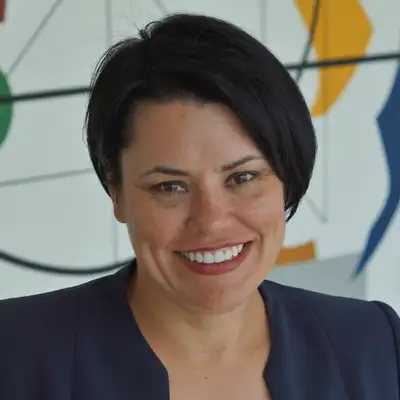
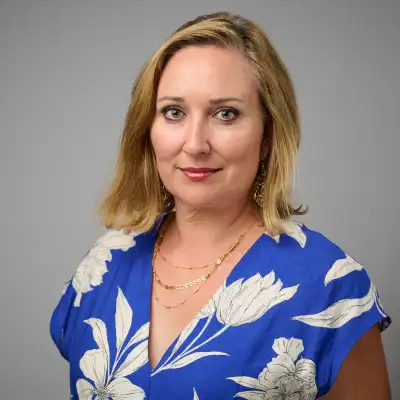
KIMBERLY NEVALA: Welcome to Pondering AI. I'm your host, Kimberly Nevala. In this episode, we're pondering the future of journalism and the political economy of information with Dr. Courtney Radsch. Courtney is the Director of the Center for Journalism and Liberty and a Nonresident Fellow at Brookings Institute. Welcome to the show, Courtney.
COURTNEY RADSCH: Thanks so much, Kimberly. It's a pleasure to be here.
KIMBERLY NEVALA: And I have to do a check, because I think I may have just mispronounced your last name, so…
COURTNEY RADSCH: No, I think you said it right: Radsch.
KIMBERLY NEVALA: Excellent. Well, I'm not sure I did it quite right, but you're very, very, very kind.
Now, Courtney, you have had really an amazing and influential and, dare I say it, storied career working as a journalist, as a scholar, as a human rights advocate. I also learned - and I think I counted this right - that you actually speak four languages, and you've done work all over the world. So I'm wondering what actually was the initial inspiration or spark that got you started on this journey and has kept you on this path for so long?
COURTNEY RADSCH: Well, that's a great question. I think this particular path, I've always been interested in media and journalism. I worked at The Daily Cal newspaper at Berkeley as an undergrad. I did an internship in DC, Cal in the Capital. And then I really got interested in technology because I was at Berkeley during the Dot-Com bubble and working, actually looking at the political impact of internet and online campaigning.
So when I got to grad school, I decided to do a PhD after working at The Daily Star in Lebanon and The New York Times here in Washington, DC. And I decided to study the impact of new media on journalism and politics, in particular in the Middle East.
And so I thought I was studying satellite television because this was a couple decades ago. But I met a blogger, and I thought, hey, this is actually really interesting to see how young Egyptian people in the early 2000s were using blogging and then social media to express themselves in a country that had a very closed media system, but where there was some aspect of freedom. It was the only country in the world that was rated as more free on press freedom than on freedom in the world - which is like political freedoms.
So I started to look and in about 2005 I wrote a paper called "The Revolution will be Blogged, Cyberactivism in Egypt.” In 2006. So I was already seeing the impact that young people who are able to express themselves and imagine a different collective experience together and organize and meet each other and build bonds of trust could have.
And so when the Arab Spring ended up coming about, it was not a surprise. I was able to travel around the world trying to explain to everyone who was looking at grass tops and political leaders why they should have been looking at grass roots and what these new technologies were enabling. Without giving these technologies some sort of agency because it was all about how these people, especially these young people across ideological lines, used them.
And, very quickly, seeing that this space for the internet and technology to live without a lot of government interference in most countries rapidly changed after that. And so they developed entirely new business models. So going from a startup to an entrenched surveillance capitalist business model that is built on datafying as much as possible, getting into as many markets as possible, and just stripping us, really, of all of our behavioral data and turning that into profit. So that happened alongside governments becoming much more astute at using technology to manipulate politics and public opinion.
KIMBERLY NEVALA: Yeah. And I think we're going to dive into all of that. What an amazing time, to actually get started in this space and I mean, it really just foreshadows-- I don't even know if it foreshadowed. I don't know, back then, were you looking forward and thinking, wow, this could go where it has gone, where it has gone today?
COURTNEY RADSCH: Well, I've been thinking recently, growing up, we never get asked, we don't really know about most of the careers that exist in the world. It's like doctor, teacher, lawyer. I don't think I ever heard of human rights activists. I don't know that I'd heard of what a think tank was before moving to Washington.
And so I can't say that I grew up wanting to do this, but I have always been an advocate, I've always been very dedicated to speaking out on behalf of those whose voices and perspectives maybe aren't dominant. And so I think it's been a natural fit, but it wasn't something I planned. I think that I set myself up for opportunities. Studied hard, learned some languages, saved a lot of money, I put myself through college, and just did what I needed to do so I could position myself to be in places to take advantage of amazing opportunities that have come to pass.
KIMBERLY NEVALA: Yeah. I think the fact that you've learned some languages - and that is four, did I count that correctly?
COURTNEY RADSCH: Yeah.
KIMBERLY NEVALA: That tells everyone about your work ethic and how hard you really go after the things that you're interested in. So I think that's amazing.
So we're going to be talking a little bit, then, about how big tech - but more specifically, AI and synthetic media, AI broadly, not just synthetic media but that is the topic du jour at the moment - are impacting journalism. But I thought it might be interesting to start with a reflection on what is the role or function of journalism itself? And what is the spectrum of journalistic endeavors? Because we're not just talking about traditional news outlets here anymore.
COURTNEY RADSCH: So journalism certainly is a term that can mean a lot of different things.
So there's the ideal-type journalism, which is typically what we're talking about when we talk about it, say, like theoretically or as a public interest. And that is the idea that journalism is about reporting on empirically grounded facts or analyzing and putting those into context to help make sense of timely, relevant, newsworthy information.
It has a community function in terms of building bonds and understanding and shared reality among a community. It holds those in power to account, whether we're talking about government or economic power. And that's, again, the ideal type.
Now journalism, as it is practiced as a for-profit industry and as a sector, can take a lot of different forms. Today, it includes as wide a variety as Fox News, which purports to be a fair and balanced. But obviously we know that just because you say something, it's not accurate. There is Fox News the news show, and then there are the punditry shows. And a lot of that will get labeled journalism, and same thing across the political spectrum.
There are news organizations that are run by states. There are state-owned news organizations, and there are publicly funded news organizations that do journalism. Those are different. So you've got, for example, the Russia Today, now known as RT, or Xinhua News Agency in China, which are directly state-run, and therefore, have editorial interference. And then you have the BBC, and somewhere in between you have Voice of America. So there are really a whole spectrum of things.
And then, of course, you have - now you've had - citizen journalism. I use the term "citizen journalism" to indicate that it's not necessarily a professional journalist. So you don't necessarily need to be credentialed or have any experience but you're trying to actively engage in the ethics and practice of journalism.
And then there are news influencers, which are people that use news that are typically produced by others, by journalists, and then comment or analyze those.
What do we mean by journalism? I mean, it depends on who's talking about journalism. But I think, again, in general, journalism is an ideal-type, public interest, fact-based, relevant, timely.
KIMBERLY NEVALA: So jumping off from that maybe ideal or idealized definition, what then, when we start to look at the impact of synthetic media, should we be paying attention to? I think it would be very common for folks to think about mis and disinformation, we've talked about that for a long, a lot of time. Quote unquote, "fake news” - not in the Fox News sense of the word - but these sorts of things.
But from where you sit, what does it mean when we're introducing generated AI content into just every aspect of the information that we're producing and distributing in this very big media environment?
COURTNEY RADSCH: There are multiple aspects. So I think we can talk about the production, the distribution, what that does to our ability to establish fact, what that does to the potential to manipulate both the journalistic process and public opinion.
But first, these terms mis and disinformation I think did us a disservice because it divorced us from a long history of propaganda studies. Propaganda, whether that is done by a government or private entity or whatever, advertising, et cetera, we know lots about propaganda, and we can talk about propaganda. It's not all disinformation. If you are unhappy about America's foreign policy and you're reading news from a foreign entity, is that disinformation or is that propaganda or is that simply something that you're reading and you believe in it?
So I think that has done us a disservice. And I think that the focus on mis and disinformation overwhelmed us with a focus on facticity or factuality. This idea that if we just simply establish the facts, people will believe facts, and that will drive their behavior or their opinion. And that's just not true. We know-- I don't want to say that facts are not important. Facts are very important. However, lots of the problems that were identified in mis and disinformation studies actually had to do with the role that journalism and culture play - or sorry, journalism and information plays - in creating culture, community, ingroup/outgroup, how it makes you feel.
Which may have little to nothing to do with whether it is factual or not, and a lot of the things are not facts, it's opinion. Whether you think something is a war or a defense strategy. We won't go into too many words there just so we don't get your podcast cancelled.
KIMBERLY NEVALA: Thank you.
COURTNEY RADSCH: With respect to synthetic media and generative AI, first off, it is becoming overwhelming. The internet, digital media, social media, is becoming overwhelmed with generative AI-created content which we call synthetic media.
So on the one hand, this could be interesting because it's a low barrier to create, say, a visual that goes along with whatever story you're writing. But I think really it is making it harder to find quality information. It's certainly making it harder for journalism to compete in the marketplace of ideas. So you could just think of synthetic media as flooding the market with really low-quality, high-fat, high-sugar content and making it really hard to find the vegetables or protein bars amidst all of that crud; or what Cory Doctorow calls the enshitification of the internet.
That has a few different impacts. So for journalism, it makes it harder to establish fact. It makes it harder to verify facts. It makes it harder to know what is real, what is not. I think we're going to see, unfortunately, more cases of specific efforts to target journalists in order to get them to report on things that are not true in order to decrease credibility.
I wrote about this back in, like, 2021, 2022, about AI and disinformation - the state-sponsored AI disinformation - just as generative AI was starting to get up and going. Because we've already seen that tactic used, for example, by Russia in Central Europe, for example. Or during the Armenian-Azerbaijan War. So that's going to be a challenge.
It's also challenging for people because you cannot expect people to figure out what is AI-generated and what is not. And whether something that is AI-generated is bad or problematic or not. And the efforts to, say, label information as AI-generated or not does not necessarily lead to better understanding. Studies do not show that that improves understanding. It just actually increases the lack of trust that people have, which may or may not be a good thing.
So we don't label, for example, articles that use spell check or Grammarly even though those are forms of very basic AI. But if we're labeling things that are generated - say you generate a podcast based on your notebook LLM documents or whatever - and you label that as AI-generated, that may or may not be less trustworthy than, say, two Fox pundits on a podcast.
So it's just not really clear what necessarily the labeling is getting. I think it's more important for things like the Content Authentication and Provenance Initiative and these other efforts to embed, or cryptographically embed, information about where, say, a photo or a video or some piece of information originated to increase the ability to verify and fact-check. I think those are probably going to hold more help for that.
And then there's a whole other dynamic, which is: OK, so now you've got all this crud on the internet and the way that journalism is funded is primarily through advertising. And so online, digital advertising is now being siphoned off by synthetic media. And there are lots of reports about economically driven actors that are doing that simply so that they can make money.
For example, there was this really sad story from Forbes where they'd spent months on an investigative journalism story. They put it out, and within a couple of hours Perplexity had spun up a podcast, a video, a replicated article which then got most of the traffic online. So that not only did Perplexity take their traffic and so the potential advertising revenue or the chance to connect with readers and turn them into subscribers, the products that AI are creating to generate synthetic media are created by stealing journalism.
By taking journalism that was posted online and saying, you know what? Just because it was in public, it's mine now. It's as if you leave your wallet on a bench in the park, and all of a sudden it's whoever finds it gets the money in it. Like, that's actually not how property works, that's not how intellectual property works.
And so the one input that the AI companies think that they don't need to pay for is data. And journalism is a very important part of the inputs to AI systems. It's very important. Both as training data, and for answering your queries, your searches, your chatbots. And so although any individual piece of journalism may be of relatively minor importance, as a corpus it's very important. It is the factual basis for a significant portion of the models that this whole synthetic media thing is built on. So, yeah, I mean, sure, we can delve into any of that.
KIMBERLY NEVALA: You said something interesting early on about journalism and journalists helping to curate and cultivate both meaning and culture and all of these kinds of considerations. And we talked - when we had talked before - you said one of the attributes of a good journalist is that they're very careful about which words and frames they use when they are reporting information out. And certainly, where you get the news and understanding who created it and perhaps what their lens is - and we all have bias - helps us understand how we should understand the content as well.
But when journalists are creating this work, and then it is getting fed up without attribution, it occurs to me, not only are they not getting credit, probably not getting paid, but it obscures that basis for what any of that information is purporting-- like, what perspective they're coming from. What they're trying to forward or not forward. What are they trying to accomplish with that reporting. And that seems, as you were talking there, that seems really problematic as well.
COURTNEY RADSCH: Yeah. Journalists, again, ideal type, spend a lot of time thinking about the terminology that they use, how they're going to cover a story. And I don't think that everyone is biased because they have a perspective.
What I found working in both The New York Times, which is widely considered quite a respected news organization with a progressive bias in terms of the types of stories it covers, and I worked for Al Arabiya, which is a Saudi-owned news organization based in Dubai where there is very little freedom of the press. And in both cases, your goal as a journalist is try to report accurately what is happening, what's newsworthy, and convey that to your audience.
Now, your audience is going to be better able to understand things if you're using frameworks, examples, quotes, quoting organizations, et cetera that resonate with them. So one of the things that I did also as a journalism trainer at one point was to think about, OK, well, who are you going to who are you going to interview? Are you going to interview the white male political leader from a major party, or are you going to interview minority female trans person from a minority party? Like, all of those, there's all these kinds of identity elements that go into who do we grant authority to as journalists when we're interviewing or quoting an organization or positioning someone as representing one perspective or another?
When I worked at Al Arabiya, one of the things that I did as the managing editor of the English website there was to Arabize wire content for our audiences. So the Middle East, most of the readers of Al Arabiya don't want to read about, say, terrorists when maybe they see them as, say in the war in Lebanon or in Iran in 2009, those were very different perspectives than, say, what was being portrayed in AP, Associated Press, or Reuters' wire copy. And so we would Arabize it to use terms that are more familiar or less biased from the perspective of the audience.
And so what I always thought of as, there's not a single, necessarily, a single objective truth in a lot of what we're reporting. Especially if you're talking about events and what you call them or that sort of thing. And so it's really about, what is the fulcrum at which you're balancing? So the fulcrum for Al Arabiya was maybe further over here from an Arab perspective. The fulcrum from The New York Times is over here from more of an educated American perspective. And from there, you're trying to be balanced and fair and accurate. But you're always having to make choices as a journalist about what to include, what not to include, which perspectives to include, are there two sides, are there more than two sides, et cetera.
At The New York Times, when I was there, we weren't really allowed to do, or not allowed, but they wouldn't publish anything from the Washington Bureau about a protest that had less than a million people, and then a few years later, they were writing about 70-person white nationalist protests on the mall. So things shift, and it's always complicated.
With AI bias it's even worse because first of all there is no such thing as unbiased AI. AI is inherently biased from the very beginning. Why? Because it is digitized information. So what information is digitized? Who writes books? Who posts on social media? Most, I think, what is it? 70% of Wikipedia contributors are men. Wikipedia is a huge input for AI. Reddit. I think Reddit is also overwhelmingly male contributors. Big input for AI.
So at its very base, there is bias built into AI. And we know that the ideological perspective of the owners or companies that create these systems are also embedded in the systems that they're building. So, I mean, it's very explicit with Elon Musk and his AI product, Grok, which is designed to be not politically correct, he will go in and tinker with the LLM to produce results that align with his political ideology. The same thing with DeepSeek, the Chinese RLM, which, if you ask it about Tiananmen Square, gives a very different answer than if you ask, say, Gemini.
But then you've got efforts, because while you can't get rid of bias, you could try to address bias. So you don't want every AI system to, if you ask it like who's the best journalist in the world, to give you a white male American. So they'll go in and tweak it. But then what happens when you try to correct for bias? You might get results like Google's Gemini got where you have them spitting out pictures of Black Nazis and female Founding Fathers, which are not accurate. I mean, they might be trying to address bias, but they're also not accurate.
So there's this tension between trying to address what we know are some of the biases in the training data, trying to maintain factuality, and trying to figure out how to balance those. We know Anthropic's Claude AI, for example, is designed to be ruminative and thoughtful. Microsoft Copilot-- they'll tell you what the design of their systems is. And we should take that, we should see that is essentially the embedded ideology. And again, we see more explicit interventions, because there are no restrictions on that, by some corporate owners than others, with, of course, Musk being the outlier there. So we just have to recognize that bias is inherent in AI.
And now what do we see happening with journalism? OK. So we mentioned that journalism is being taken because it's online. So all these companies, these AI companies, are like scraping all the internet to get their data. And, if you remember, when ChatGPT came out, you couldn't ask it anything from before 2021. It didn't know anything. Then they created this thing called retrieval-augmented generation where they could essentially take the model and go out online and bring in more additional factual, timely information. Often provided by journalism.
So what has happened is you now have a lot of these AI products directly competing with journalism. You can get AI-generated newspapers, your search queries, et cetera. So then a lot of news organizations and publishers are like, OK, well, we can't allow you to just freely scrape our content. Not only because there's no consent, compensation, or credit but also because you're creating competing products. So they're putting that off-limits.
So that means the supply of quality information is going down. Meanwhile, you have propagandists, PR firms, governments, people who want to make a buck ramping up their creation of synthetic content. So now you've got a huge supply of crappy content, a diminishing supply of quality content, and that is now what is the basis for the AI systems that we're using. So this is very unsustainable, and yet, we are just waiting for some court in New York Times versus OpenAI to make a decision as if that is going to solve the entire thing about whether or not it's fair use in one legal system.
So I think we're in a really challenging situation here because everyone knows you need journalism. The question is who's going to pay for it? How is that going to then feed into the AI systems? And how are we going to make sure that as a public, we are getting access to non-ideologically driven information or at least a pluralism, an option of pluralistic choices, so we can figure out what is the reality?
KIMBERLY NEVALA: Yeah. And I think all of what you said there then just provides that sort of natural transition to the idea of journalism and information ecosystems as being an actual economy. And you call it a political economy. I think you were trying to raise, but correct me if I'm wrong, that we really can't divorce, even in this space, the economic from the politic.
Can you talk a little bit more about that and where that terminology or framing, if you will, came up and why it's important that we recognize it as such?
COURTNEY RADSCH: Sure. So the political economy of information is a way to look at what I call the information ecosystem. Which accounts for both the natural flow of information but also the man-made aspects of the ecosystem - the technologies that we use to receive and impart information. And that these are not just economic actors, they're also political actors.
And I think it's very clear to see that if you just look at what's happening right now between the Trump administration and Europe. You can see that Europe, over the past several years, has tried to shape its information ecosystem to account for the rise of social media and algorithmic amplification, the role that content moderation plays in people and businesses' experience of being online, of having their content affected to create more agency for the user. They created data privacy laws to restrict how user privacy, private information, can be used online, et cetera.
So they have a range of different regulations and laws that they've passed in their democratic system. They have the EU Copyright Directive, which is then transposed at the national level to, again, define how copyright is done. And so now what you see is the Trump administration is equating efforts to regulate their information system with censorship. He's claiming, and his administration is claiming, that efforts by Europe to cultivate a political economy of information that is supportive of democracy, supportive of local businesses in Europe, is the same as being anti-American and as censoring Americans.
So it's all politics and it's all economics. There's the economic argument. You've got Europe. It wants to have local competition. It wants to have cloud competitors to the three American hyperscalers. It wants to have alternative social media platforms to just Facebook, Instagram, Google Search; these are dominant, and in some cases, illegal monopolies in these information environments.
And we've seen that, for example, some of these platforms have been actually explicitly manipulated to political ends for political gain. So for example, Twitter. or let me rephrase that X, since it was bought by Musk, was supportive of the AFD which is the right-wing extremist party in Germany. So you could actually - there are studies that show - that the amplification and algorithmic promotion of the AFD content outweighed that of other parties. You can see that in terms of the depression of content about Trump and potential dementia and other kind of negative things on Facebook in advance of the election.
So, I mean, there's just a lot-- there are a lot of examples. We've documented many of them in submissions to the Federal Trade Commission, in various reports that we've done, including to the Europeans, about just how susceptible to manipulation these systems are, both overt and covert.
I mean, there are entire bureaus in every country around the world designed to shape public opinion, some with more transparency than others. We have the Global Engagement Center here, which was originally like fighting ISIS online, and then has now become a target of Jim Jordan and the right-wing people here. And then you also have the Russian Internet Agency. Israel has a volunteer force. Basically every country now sees this as of information warfare.
So you cannot separate the political from the economic in our information system. And so by talking about the political economy of information, we can really look at the power. Where does power lie? Where is there a concentration of power? How do we mitigate concentration of power to enable a more democratic, pluralistic, agentic system for us humans?
KIMBERLY NEVALA: And how is this showing up today in terms of the legal environment and the regulatory environment? And particularly here in the US. You had brought my attention to a recent lawsuit that was brought because there were prohibitions against studying digital platforms and harms. And I think there's been a recent Meta - and Google, YouTube, I think it was - case. Do you see a shift? Is help coming from that area, or is this something that we're going to have to tackle a little more head-on as individuals and corporations?
COURTNEY RADSCH: I mean, I don't think that we're going to see a lot of action, or we have seen a lot of action, from this administration except to exempt them from meaningful oversight and ensure that they are doing the bidding of the administration.
So there's a few things at play here. One is this administration and the previous administrations have resoundingly failed to regulate these tech platforms. As have multiple Congresses. We still have no national privacy law. We have nothing to protect our data or give us any rights over our data and how these companies can use those to create this surveillance capitalist system to monitor and surveil all of our actions online or our watches or our wearables or our Internet of Things devices in our homes. This is all fair game for them to use, and then to package, and then to sell to the highest bidder.
We have laws for other communications platforms that we've used in the past. Like, we do not let the telephone operators listen in on our calls, find out who we're calling to, decide who we get to connect to or not, and then package that information and sell it to the highest bidder. We don't allow that. We don't allow the mail, whether you're talking about the post office or Amazon or whoever is delivering mail, to read the mail.
So it's weird that we have really carved out this truly exceptional, unregulated space. Which we call it unregulated, but really, it's regulation through unregulation. Where these intermediary platforms have First Amendment speech rights. So they have expressive rights, which means I as a company can decide I don't like journalistic speech. In fact, I'm going to censor all the journalism speech on Facebook and Instagram and Canada because I don't want to have to comply with this new law. They can decide their algorithms. Free speech, algorithmic speech. So our algorithms want to favor certain point of view over others, OK. And we exempted them from liability for what they publish.
So whereas publishers, journalists, everyone else in the world has to contend with defamation law, with libel, with copyright-- actually, sorry, copyright's the one thing, we'll get back to that. But basically, the platforms are not liable for what others publish on their platform. And that is called Section 230 of the Communications Act, which you probably heard of as Section 230. I don't know that we want to get too into detail there, but just essentially consider it an exemption from liability.
So it made a lot of sense at the beginning. When you're a startup, you have no money, you're creating these platforms for people to freely communicate, great. That is not what these companies are. These are digital advertising companies. These are companies that datafy as much as they can, package it, and sell it to raise more money than has ever been seen in the history of mankind.
So we've given these, now the wealthiest companies in the entire world, exemption from liability. They're also exempt from copyright as long as they try, through safe harbor, to take down copyright content. That's another issue. So we've created this really special regulatory situation for them where they get all these benefits, very few obligations, and because they're in the US and we have such protective First Amendment expression laws it's been very difficult to hold them accountable.
What I'm excited about is are at least the 17 product liability lawsuits, which are in the courts. And which a couple of them were just decided last week, against Meta and Google for product harms. Essentially saying you created this product. You designed it to be addictive. You designed it with these problematic flaws that are dangerous and cause harm, and yes, we're going to hold you accountable. So the cigarette package maker can say cigarettes are good for you, but if they design it to be addictive by adding nicotine, they can still be harmful. So I think that's a sea shift that we're seeing here.
I'm very hopeful for that, particularly as we enter the AI era with generative AI chatbots and companions and AI agents. On whose behalf are these agents working? What information are you getting from a companion or a chatbot? Whose responsibility is it for making sure that it doesn't cultivate you to create self-harm or do something worse? I mean, there are several lawsuits by parents of children and others who have committed suicide at what appears to be the behest of chatbots and companions.
So there is-- and it's crazy. So I'm based in Washington right now, and there was a discussion here a couple of years ago about, well, we should just clarify that Section 230 doesn't apply to chatbots and generative AI. And then as soon as we tried to actually get that going on the Hill, there was a massive lobbying effort to deter that by the platforms. And that is going back to the problem about the wealthiest companies and corporations in the world. They have more money to influence politics than anyone else. How do we as these poor civil society groups trying to just work on behalf of the public possibly compete with trillion-dollar corporations that spend more money in Washington, Brussels, and other capitals around the world than the entire-- probably like our budget for the entire existence that any of us have been around?
KIMBERLY NEVALA: So all of what you just said there underscores two ideas that have stuck with me ever since I found your work and have been following it.
And one was that cognitive liberty can't be separated from questions of corporate dominance. And we've talked about this in other areas, but I don't know that I had thought about this as critically as we should in the context of journalism and media.
And the other, which is, I think, separate but somewhat related, was the idea that infrastructure and not intent ultimately is going to determine-- and I think in the article I had found you were talking about if democracy or digital authoritarianism prevails.
But again, it does seem here that we are going to need to do more. What that "more" looks like I'm not entirely sure, but we are not going to be able to rely on good intent or stated objectives of the providers themselves.
COURTNEY RADSCH: Yes. I think if we've learned anything, the stated intent to not be evil or develop AI for the good of humanity swiftly becomes irrelevant as profits increase. So I think the underlying, there is an underlying link, between those two pieces.
So on the one hand, infrastructure, whether we're talking about underwater sea cables or low-Earth orbit satellites or platforms, cloud, data centers, large language models, these are the infrastructures that we're building various parts of our information ecosystem with. Those play a fundamental role in enabling or making more difficult certain types of communication or circulation of information. So if you think about large language models as a form of infrastructure, of infrastructure for the communications and information system, then looking at who controls the production of those LLMs, whose ideologies are embedded in those, whose efforts to de-bias are included, how that happens, what are the data sources used, all of that.
These are now the building blocks of all of an increasing number of our communication systems whether you're talking about ChatGPT bots or AI agents or search or any of these multitude of systems. They are black boxes, so we have no transparency into the data sources that are used. We have no transparency into what are the grounding and fine-tuning processes that are used. Sometimes we know because they used to publish, the scientific practice is they would publish that. There would be peer review, and we would get to see some of that. But then, of course, as these became increasingly profitable and more competitive among the big tech players and the startups, they stopped publishing. And so now you get - we just have - very little information.
So it's even hard for us to assess, what is the ideology? What are the underlying precepts of these fundamental building blocks that we are now using to construct all of these things in our economy? And, not only that, but we are being forced to adopt them. Why? Two ways.
One is because many of these companies are either illegal monopolies or they are dominant in their market. So Google Search, for example, is literally an illegal monopoly, and yet it's shoving generative search answers into at least 60% of the responses it's giving. We don't have a choice on that. We don't have a choice not to use all the integrated WhatsApp and Copilot in Word and all of these things that we're being forced to use.
And then you have the government. You have the Trump administration putting out executive orders and other things that are saying, educators, you must use these systems, you must integrate these systems into education. Every organization is being told, adopt AI or get left behind.
And we still don't really understand what is the value proposition of AI? We do know that use of generative AI can lead to reduced critical thinking, for example. To cognitive offloading, as they call it. There was a study of radiologists that found radiologists that were using some AI systems were less adept at identifying whatever it is that radiologists are supposed to identify. And we've seen this with students. So there's lots of studies coming out about that.
And this makes me really concerned, especially as we are seeing the authoritarian, kind of the decline of democracy and the rise of authoritarianism, here in the United States. I wrote, I think the other paper we were talking about was, about panopticons. And essentially looking at how the United States and China have built the same surveillance infrastructure, but with different institutional ownership and control.
So in China, you have much more centralization and potential for control and oversight and surveillance by the government. In the United States, everyone was like, oh, it's fine. The government doesn't have access to it - it's private corporations, et cetera. But what happened under this Trump administration is that we saw the tech oligarchy sitting in the front row of inauguration being granted National Guard status. Being given massive government contracts for creation of data systems. We saw DOGE come in and get all this data from government systems. And now there's an effort by the administration to get rid of privacy firewalls between data held by different agencies in order to improve efficiency.
Again, as I wrote - I think that paper was like 2023 - what is the end goal of this efficiency? What is the end goal of this innovation? It's ultimately creating the same panopticon situation that you have in China where they're using social credit scores. Here, I think the administration wants to use it to catch, I don't know, illegal immigrants and probably people at protests. So we have built the same systems. And I wrote back then that the only difference are these thin institutional lines, these thin institutional barriers that democracies have. And now we're seeing those being dismantled. And so, I mean, it is really concerning. And there's even a directive about, the Trump administration's AI directive, about not using woke AI. Well, what is woke AI? It's AI that doesn't adhere to his ideological preferences.
And so I think in a really challenging and threatening situation right now where the infrastructure that is undergirding a lot of our information communications ecosystem is increasingly privatized among a handful of corporations that are very close to either China or the US - both rising authoritarian regimes. And where there's very little transparency or knowledge about how these systems are being embedded, used, or giving rise to the types of outputs and information flows.
KIMBERLY NEVALA: So with all of these pressures and all the stress-testing of our institutions, of our journalistic norms and that information ecosystem going on, what can we do or what should we be prioritizing now to develop or create a better information environment?
COURTNEY RADSCH: I think we have to stop putting the onus on us as individuals without addressing the system. I think we have to break up the biggest companies. They're too big. They are too big to be held accountable. They also may be too big to fail. We've already heard Sam Altman talking about a potential bailout for OpenAI if the data centers don't work out or if there's a crisis. So I think we need to literally break up companies so that you don't have trillion-dollar valuations because it's just too big, too much power.
We also need to create just a basic set of regulations that won't address the structural problems but could address some of the lock-in problems that we have with platforms and infrastructure. So basic principles like transparency. So that is transparency of data sources, researcher access to and government access - or researcher and independent regulatory access to information needed to provide oversight. Including independent oversight, interoperability, data portability, privacy.
We need individual privacy and we need to make sure that there is more idea of intimate privacy, which Danielle Citron talks about. We do so many things in public, but that doesn't mean that we expect them to be uploaded online or become part of our digital footprint.
We need bright-line protections for neural liberties, for cognitive liberties. The fact that our brainwaves are not for sale, I personally would never go shop at Amazon Fresh where they're tracking your eye movements and somehow tracking you to know what you're picking up and off the shelves. What are they doing with that data? What kind of biometric information are they collecting? I think we need bright lines against biometric surveillance. We already have that at the airport now with our facial recognition, but are they, I don't know, reading our eyeballs? Are they getting our body temperature and making inferences about that?
We need transparency into how systems are used to make decisions about us or our access to public resources, credit, other types of the things that we need to live in the modern world. Transparency and oversight and accountability. So yes, it might be a private vendor, but there has got to be independent oversight about how those decisions are being made, what factors are being used, some ability to go in and contest those.
I think we need to be very careful about arguing for better and more fair AI without thinking about what the implications of that are. You don't want it to be deployed in a way that is racist or leads to racist or suboptimal outcomes. But, at the same time, you don't want to encourage more surveillance, more datafication in order to make better AI. So I think we have to really question that.
I think we need to figure out in the journalism community, as so many people are adopting AI and calling for the adoption of AI, what is it going to mean if we increasingly create personalized news for people? So we just spent the past decade and a half talking about the problem of filter bubbles. We're now, we're creating I don't know, filter plastic balls or whatever it is. It's even worse. Like, how are we going to have any sort of shared reality or shared understanding of what's important or get exposure to things that maybe we don't care about?
I'm really worried about how this rush to adopt AI and integrate AI in these promises about innovation and productivity gains without asking, what are we innovating towards? What are the goals that we have identified? And what are the costs to democracy, to the social fabric, to the environment of these choices that we're making?
Because I think there is a growing awareness about the environmental impact of AI. There's a lot of local opposition to data centers because despite this lovely idea of the internet and cloud existing - it sounds like it's so nebulous, those are, yeah, they're so ethereal. No, it's water, it's energy, it's land. These are hard resources. And who has the most money to buy that all up? To pay off governments? To get tax breaks? Like, it's the biggest companies in the world. So that's actually, I think, an opportunity to connect the very real-world impact of this push to adopt AI.
OK, I love technology. As we started the program out talking about growing up and going to school, and Berkeley, and the Dot-Com bubble, technology is great, but let's remember the Luddites. You always hear, don't be a Luddite. What happened to the Luddites? The Luddites wanted to deal with not just the economic implications, but the social and political implications of them being forced to adopt technology that was incredibly disruptive to the workforce. And to go back to the political economy side of things, what happened when the owners of production and the government got together to oppose this uprising? They implemented the death penalty for those who protested.
So that's why we have to be very careful about looking at both the economic and political concentration of power. How those things are intertwined, how do we maintain agency, and what is it that we want out of the world? Like, do we really need more and more and more growth? Or do we want more and more equality and justice and verdancy and beauty? I think we really need to ask ourselves that because I don't hear those questions being asked.
KIMBERLY NEVALA: Yes, and I think we should leave those questions ringing in the listener's ears. I know we can go on for a very long time, and I find myself on all our recent episodes saying, I'm going to resist the urge to go into hour two with all my might.
So I so appreciate your time - and the guest appearance by the little guy there - and all of your insights and the work that you do really on behalf of all of us. So thank you so much, Courtney, for joining us, and look forward to hearing more from you in the future.
COURTNEY RADSCH: Thank you, Kimberly. Really appreciate the opportunity, and so does Latte.
KIMBERLY NEVALA: So to continue learning from thinkers, doers, and advocates such as Courtney, you can subscribe to Pondering AI wherever you find podcasts, and also on YouTube.