Subscribe
Share
Share
Embed
Travel Grit is long-form conversations with ramblers, roamers and free spirits — adventurers who have crossed continents on horseback, sailed solo around the world, and traveled thousands of miles by mule. Hosted by Bernie Harberts. For bonus episodes, Q&A sessions, and more from the world of Travel Grit, check out the companion show Gritty Bits.
Autogenerated transcript. May contain errors. Refer to the audio or video for accuracy.
INDEX
Cold Open: Fetal Position — (00:05)
Born in the Great Depression — (01:01)
Building The Smootcher — (02:47)
Kenichi Horie Inspiration — (04:23)
Building April Fool — (06:09)
Sailing to Africa & Celestial Navigation — (11:21)
Coast Guard “Rescue” 25 Miles from Shore — (22:54)
Building Father’s Day at Age 62 — (25:42)
Meeting Tom McNally & Cutting the Bow — (29:58)
105 Days at Sea & Lost a Kidney — (43:43)
Hugo Vihlen (00:05)
The inside for April Fool was a little less than 6 feet. I had to sleep in the fetal position.
Bernie Harberts (00:13)
This is Hugo Vihlen. In 1968, the year I was born, he sailed across the Atlantic Ocean in a six-foot sailboat called April Fool. In 1993, when he was 62 years old, he sailed across the Atlantic Ocean in another tiny boat called Father’s Day. Father’s Day was only five foot four inches long. Hugo is just over five foot seven inches tall.
Now, just let that sink in a moment. Sailing across the Atlantic Ocean in a boat shorter than you are tall. Hugo’s record for sailing the shortest boat across the Atlantic Ocean still stands. This is Hugo’s story.
Bernie Harberts (00:58)
What year were you born?
Hugo Vihlen (01:01)
1931.
Bernie Harberts (01:03)
Right in the Great Depression.
Hugo Vihlen (01:04)
We were out in the country. My nearest neighbor was a half mile away. We had no transportation. We had an outhouse, no electricity, no telephone. I mean, first telephone we got was after the war. Number 264R. It was on a party line—a couple of people on the same street. They’d get it one ring, we’d get two rings.
Bernie Harberts (01:26)
Where was that?
Hugo Vihlen (01:27)
My residence in Homestead.
Bernie Harberts (01:30)
So what was on the land?
Hugo Vihlen (01:33)
Virgin pine land and palmettos and rattlesnakes. And rattlesnakes. And more rattlesnakes.
Yeah, I had nightmares from the rattlesnakes. I was at my grandmother’s house and I got close to the rattlesnakes. So I had nightmares from that for so long. I thought, I gotta take care of this. So I just started watching snake programs on purpose just so I could sleep at peace. So I overcame that fear of snakes.
Bernie Harberts (02:03)
How old were you when you started watching those programs about snakes?
Hugo Vihlen (02:08)
Probably my 30s when I realized I gotta cure this.
Bernie Harberts (02:12)
Did you have brothers or sisters growing up?
Hugo Vihlen (02:14)
Six brothers and sisters. One died at six months and one died at 12 years old from lockjaw because penicillin hadn’t been invented yet. So he stepped on a rusty nail and he died right away.
It was a hard life. So the only light we had was a buggy light at nighttime and kerosene lamps.
So it gave me a tremendous ambition. So I ended up with a lot of businesses, enterprises. I was always a doer, not much of a talker. I consider myself an extreme introvert with a personality of a blackboard.
Bernie Harberts (02:47)
Tell me about your first boat.
Hugo Vihlen (02:49)
In high school, you usually get a ring for your junior year. And I thought, that’s too stupid. Everybody graduates from high school. So I asked my dad if I could have money to build a sailboat from Popular Mechanics with a good friend of mine. So he said, sure, that sounds good. So I got my first, like a 12-foot sailboat from Popular Mechanics.
We’d cut out a board and it would be completely off-line. We would laugh and giggle like two little girls. We had more fun building that boat than actually sailing it. I mean, we had it on his back porch of his house. We had a lot of fun building that boat. We named it the Smootcher. Never had a girl on board.
Bernie Harberts (03:31)
The Smootcher!
This was a Popular Mechanics plan in the early ’50s?
Hugo Vihlen (03:42)
We graduated in high school in ’49.
We had it on till we had a foredeck and a front deck and a side deck and a little tiller. So we made it too heavy so it didn’t move very fast. So it was more than an open boat. We kept adding on to it.
Bernie Harberts (04:00)
Did you ever launch it?
Hugo Vihlen (04:01)
Yeah, we lost it, yeah. We had it till we went off to college.
Bernie Harberts (04:04)
So where did you sail it?
Hugo Vihlen (04:06)
So I hoped that it backed up.
Never got in the ocean with it. That’s where the dreaming comes from. Dreaming about, well, got a boat to sail. That’s all you need—a boat and wind to sail around the world. That’s where the dreaming comes in.
When I was younger, I’d read a book a week. And I read about the Japanese kid, Kenichi Horie, who was 19, and he sailed a 21-foot sailboat Mermaid across the Pacific Ocean from Osaka to San Francisco Harbor. And when he did that, I thought, you know, I bet I could do something similar to that. And so that’s when I got started. And then Robert Manry, he did it in a 12-and-a-half-foot sailboat Tinkerbelle.
He did what I would have done. So I gave up. And then the next year Bill Verity sailed an 11-foot boat across in the Nautilus and another one beat his record in a nine-footer and a seven-footer and he ended in the ground in Ireland.
So I just flat gave up.
Bernie Harberts (05:12)
But before Hugo could break any records, he became a Navy pilot. He served in Korea and joined Delta Airlines as a commercial pilot. But he still loved sailing and visiting boatyards. One day, as he was strolling through a boatyard, he saw an Optimist dinghy.
An Optimist is a small sailboat favored by summer camps and young sailors. It’s short and stable, but mostly it’s just short. And that’s exactly what caught Hugo’s eye.
Hugo Vihlen (05:42)
I saw an Optimist Pram, which is seven feet, 11 inches long with a square bow and a square transom. I thought, man, I’ll chop a couple feet off that and go out and set a world record nobody else can touch.
Bernie Harberts (05:55)
Hugo was 34 years old. A little while later, he drew up a set of plans with the help of a naval architect, bought some plywood and fiberglass cloth and started building a boat. The name of the boat was April Fool.
Bernie Harberts (06:09)
How did you build her and how long was she and how tall are you?
Hugo Vihlen (06:13)
Five foot seven and three-quarter inch. The inside for April Fool was a little less than 6 feet. Sleeping in the fetal position because the radio rack was in front of that.
I had a naval academy graduate, a boat designer. So I contacted him. He wanted to build it out of steel. So we talked to a steel fabricator and it didn’t sound right for me—a steel coffin.
Mentally didn’t feel right. I had a problem with a co-pilot that belonged to the Coconut Grove Sailing Club. He said, there’s a guy in my club who is a boat architect.
Ned, N-E-D, Mears.
He’s the one that came up with the design for the boat here.
Bernie Harberts (07:01)
So we’re sitting around Hugo’s kitchen table. It’s Hugo, his wife, Johnnie and me. And he asks Johnnie to bring us the model of April Fool. And she does. It’s small, red and plastic. And it looks exactly like a toy boat a kid would play with in a bathtub. It’s a perfect miniature model of the boat Hugo ended up building, right down to the portholes and the stubby keel. It’s a teeny tiny version of April Fool.
I understand you can’t see it, but here, Hugo uses the model to explain how April Fool sailed.
Bernie Harberts (07:36)
Now, one of the things that’s really important to remember is this is the late 1960s. So sailing is still largely a mechanical endeavor.
So Hugo has to figure out how to balance the mast, the booms. He’s gonna explain why she has two booms and the hull, how these all work together for this tiny little boat to sail as well as she can without electronic autopilots or self-steering. This is a really big deal.
Hugo Vihlen (08:06)
That’s what I wanted—a roller-reefing mast. So I could roll the sails around the mast. This was the first boat, the only boat that had two booms. It had a boom on each side. And most boats have one boom and a spinnaker or a jib, but I wanted, going before the wind, I wanted two booms.
Bernie Harberts (08:27)
Okay, so let me explain this two booms thing. When you think of a regular old sailboat, you think of a mast with two sails on it. The mast is generally in the middle of the boat. The big sail is behind the mast and it’s called the mainsail. The little sail is the one in front of the mast and that’s the jib. Now that’s the most common sail plan on most sailboats. It’s a good all-around rig.
If you want to go upwind or closer to the wind, you sheet the sails in toward the center line of the boat and you can sail toward a destination that’s upwind of your boat. But that’s not what Hugo wanted. His route was going to be in the trade winds, which means the winds would be in theory behind him or on his beam.
His thought was that if you put the mast on the front of the boat and put two booms on the mast, each with a sail, he’d have a rig that was much better suited for running downwind, which he hoped most of his trip would be. So to imagine this two boom rig another way, imagine you’re standing on the bow of the boat right up on the front near the mast.
Now hold your arms straight out to the side. Those would be the booms. And attached to each of these booms is a sail. That’s the kind of rig Hugo designed for Father’s Day. And it was really unusual for the time. So here’s Hugo describing this rig a little bit more.
Bernie Harberts (09:51)
So set it down here real quick and just explain that with two—okay here I’ll give you two pens. So show it with two pens here.
Hugo Vihlen (10:01)
What I would do is put them this way so that all I had to do was steer the rudder.
I wanted the front end like an airplane to give it lift so when it dug into the water instead of pitchpoling—going over—I wanted the design of what’s called a sponson on a boat. And that gave it lift from my airplane experience. So that was a design that saved my life.
Bernie Harberts (10:28)
So as the bow went down…
Hugo Vihlen (10:30)
It would give it extra lift. The wedge would lift the bow.
We gave away 85,000 models at the Miami Boat Show.
Bernie Harberts (10:40)
So originally April Fool was going to be steel. It didn’t feel right. So you didn’t want steel. And then what material did you end up building her with?
Hugo Vihlen (10:50)
I built it out of 3/8-inch plywood on the side, marine plywood, and 5/8-inch plywood for the hull, for strength, and covered with fiberglass cloth. So that’s where the strength came from. He showed me a chart of the strength versus steel that would just convince me right away what I wanted. Perfect design.
Bernie Harberts (11:13)
Built her in Homestead area?
Hugo Vihlen (11:17)
Built her in the Coconut Grove sailing area.
Bernie Harberts (11:21)
So, April Fool’s built in Coconut Grove. But then you started in Casablanca.
Hugo Vihlen (11:25)
Yeah.
This kind of boat, six-foot, never been done before. The only way to do it would be the trade winds. So trade winds you had to get to Africa and ship the boat to Africa and get the trade winds back to Fort Lauderdale.
Bernie Harberts (11:46)
Hugo shipped April Fool from Florida to Casablanca, Morocco. On March 29th, 1968, he departed Casablanca, pointed the bow west and hoisted the sails.
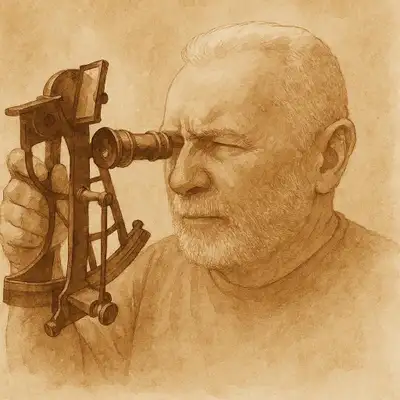
For the next 85 days, he sailed 4,100 miles across the Atlantic Ocean, relying on his sextant and celestial navigation to find his course.
Nights, because April Fool was so tiny, he had to sleep with his knees pulled up tight in the fetal position, checking his course every hour with an alarm to make sure he stayed on course.
Bernie Harberts (12:20)
You’ve never taken a long voyage, and you’re looking at the ocean over that bow. And you’re looking into the ocean. What did that feel like?
Hugo Vihlen (12:32)
Well, my good buddy Tom McNally always said, just remember Hugo, you’re only two miles from land. I said, yeah, straight down. Straight down.
Bernie Harberts (12:46)
Tom McNally was a fellow small boat sailor who over the years competed with Hugo to sail the smallest boat across the Atlantic Ocean. We’ll hear more about Tom in just a bit.
Bernie Harberts (12:58)
The first day or two, it must have been rough to get used to being at sea.
Hugo Vihlen (13:04)
Never been seasick in my life. My dad was working in Trinidad during the war. He got in a hurricane and him and the captain on a freighter were the only ones that weren’t seasick. So my family just doesn’t get seasick.
Bernie Harberts (13:18)
So remember, this is 1968. There’s no GPS for navigation. Instead, Hugo has to rely on his sextant and something called a Sun Line Fix to find his way from Africa to Florida. And this is made even more challenging because Hugo’s sailing a boat that’s literally the size of a bathtub.
Hugo Vihlen (13:40)
So when the sun gets about 30 degrees above the horizon, you get that and it gives you a reading of what number that is, and you calculate that on the paper and it tells you where you are for your longitude.
Bernie Harberts (13:55)
So you use your sextant to get that angle to measure the sun from the sun to the water. In air quotes, you bring it down and then you’ve got to make, I think, a lower limb correction. There’s some correction. And then you have to do your reductions to find roughly where you are in this big circle.
Hugo Vihlen (14:03)
Yeah, yeah.
Bernie Harberts (14:17)
Well, you were inside a boat that was probably smaller than the table we’re sitting at. How did you do it? You just crawl down?
Hugo Vihlen (14:23)
I didn’t have the paper—how the hell you doing it in my life?
I mean you fold it several times to get the chart down to where you are and you write it down and you’re left along from there.
Bernie Harberts (14:40)
So everything was folded.
Hugo Vihlen (14:41)
Yeah, had to be.
Bernie Harberts (14:45)
Almanacs, manuals that you were motivated.
Hugo Vihlen (14:47)
Yeah.
Bernie Harberts (14:48)
Do you remember how often you ran across a freighter that could give you the actual lat-long?
Hugo Vihlen (14:56)
You couldn’t communicate with a ship. I had a VHF that I talked to, and all the ship captains were foreigners. They spoke broken English. I remember the first ship I saw was a Monterey.
The big ship goes cruising by, and I hear, what is the captain’s name? Well, he’s got these big loud diesels, and I’m yelling, April Fool, April Fool, America, America. But I knew they couldn’t hear anything. But they reported my position to the Coast Guard for the boat, so…
Bernie Harberts (15:33)
So they were kind of watching a little bit out for you.
Hugo Vihlen (15:37)
Well, Coast Guard was watching me.
Bernie Harberts (15:39)
It just seems like this incredible thing to know where you are based on celestial navigation.
Hugo Vihlen (15:46)
Yeah.
Bernie Harberts (15:47)
I guess the good thing is you’re not going to hit anything out there.
Hugo Vihlen (15:49)
I didn’t do any stars, only the sun, because if you tried to find a star on that boat—the boat’s always rocking. So you don’t have a stable platform. So I can see the sun and can aim it and get the bottom of it easy enough, but to try to locate a star, I mean, impossible.
Bernie Harberts (16:09)
How fast did you travel on April Fool? I guess the average you got was four…
Hugo Vihlen (16:16)
It takes about half a knot per hour.
Bernie Harberts (16:18)
0.6 miles an hour.
Hugo Vihlen (16:20)
I had a day with about 60 miles with a current.
So, get a storm or something to push you around, and yeah, you can move out.
Bernie Harberts (16:30)
Steering April Fool—how did you steer April Fool?
Hugo Vihlen (16:33)
Hand on the tiller just about all day.
Bernie Harberts (16:37)
So you hand steered?
Hugo Vihlen (16:38)
Yeah, I had to steer, only because of the time commitment to get back to work. So I enjoyed it, it’s good. I mean, it’s part of sailing. It’s like flying, I love to fly.
Bernie Harberts (16:54)
What did you do for steering when you didn’t hand steer at night when you had to sleep? Or in a gale?
Hugo Vihlen (17:01)
I could tie it up, but it would still go 15 degrees left, 15 degrees right. So it was basically in my basic direction. I couldn’t stay awake 24/7, so I had to tie it up to let the boat steer itself.
Bernie Harberts (17:10)
Still going.
So it would kind of, she would kind of yaw, like 15 degrees.
Hugo Vihlen (17:22)
Yeah, perfect.
Bernie Harberts (17:25)
So if you’re running downwind from a gale, you would pull the sails down if you’re running before it. And would you lash the tiller amidships or put a sea anchor out?
Hugo Vihlen (17:37)
Wind against me, I’d throw a sea anchor. Sea anchor would slow the boat down if I was going the wrong way.
Bernie Harberts (17:44)
Gale hits you on the nose, put it over the bow, and it would kind of sort of slow it down. And it never broke the tiller or the rudder.
Hugo Vihlen (17:50)
Yeah.
No.
Bernie Harberts (17:56)
It must have been stout.
Hugo Vihlen (17:58)
Well, my boat’s small, I didn’t have a big boat.
Bernie Harberts (18:02)
And then if you were going downwind in the storm, you would just put it over the stern.
Hugo Vihlen (18:09)
I’m pulling my sea anchor in to let that thing go. Go, man, go.
Bernie Harberts (18:15)
Don’t slow it down. You want to get back to work. You need to get back to your job.
Hugo Vihlen (18:20)
Yeah.
Bernie Harberts (18:23)
Yeah, there was that thing of the job. At the time, Hugo was flying full-time as a pilot for Delta Airlines. Before he left on his trip, he asked for 60 days leave because that was how long he could be away from his work. Any longer than that, and he had to take some additional training to be recertified to carry passengers.
And there he was out in the South Atlantic Ocean aboard his tiny little April Fool at the whim of the wind and the waves and the storms. And it was starting to look like Hugo was going to be late getting back to work. Remember, this was 1968. So there was no way to communicate with his employer or even his wife and family that he was going to be out at sea a lot longer than he’d planned.
Bernie Harberts (19:09)
How long were you in the ocean on April Fool?
Hugo Vihlen (19:12)
Well, that was 85 days, so it was a long time. Cuba was my first piece of land I saw coming this way. And then I picked up from Haiti, then I saw Cuba. So that was land.
Off Cuba, I saw this ship—smoke was pouring out of it.
As it got closer, I could see it was a conning tower that was smoking diesel—a submarine, the Grenadier. I waved him down. I asked them to give me some, any food and water, because I had lost a lot of weight.
So I was hungry. So he gave me two gallons of water and a couple of loaves of bread. My dad was in the Navy. They always brought him lots of food. So I say, coconut cake. That’s okay. Yeah, that’s the way it is.
Bernie Harberts (19:59)
Ended up with two gallons of water.
Well, that’s pretty good at sea though, because two gallons is a lot of water. Do you remember how many gallons of water you had?
Hugo Vihlen (20:11)
14 gallons, about.
Bernie Harberts (20:14)
So things are actually going quite well for Hugo and April Fool. He’s crossed the Southern Atlantic Ocean. The Grenadier has given him two gallons of water, some food. They contact the Coast Guard and let them know where he is. And this is when things start going a little bit sideways on the voyage.
Hugo Vihlen (20:33)
And I asked them to radio my position to the Coast Guard, tell them I’m okay and my boat’s okay. And I’m running late, so they radioed my position to the Coast Guard, and I could hear it on radio 710 Miami Station that the Coast Guard figured I was going to be in Miami like the next day. I thought, you dumbasses. My speed was half a mile an hour. So they screwed up. And so when I didn’t show up, then I was missing at sea. Scared the hell out of my mother and dad. And I’m now missing at sea after I just navigated 4,480 miles and now I’m lost at sea.
So they put out a broadcast, lost, and people are looking out for this little sailboat. So the First Edition from Fort Lauderdale was the first boat I saw off of Fort Lauderdale.
They called the Coast Guard. I was going at that time, seeing that I was past Miami, that I ended up in Cape Canaveral. About 25 miles. I thought, okay. You’re close. I was close. I could see the antennas off north of Miami. So I could see the land close enough.
Bernie Harberts (21:34)
And you’d fought in the ocean for how long?
Hugo Vihlen (21:48)
That was it. I could start to see the Coast Guard.
Bernie Harberts (21:53)
At one point you were just a couple miles offshore, I imagine.
Hugo Vihlen (21:57)
Well, it’s put out in that Gulf Stream. Gulf Stream had like two and a half miles an hour on me at that latitude. I kept cutting in towards land, but the Gulf Stream was pushing me out.
Bernie Harberts (22:10)
It’s important to understand for people who are not sailors, you’re not on a lake. If you go one mile an hour for six hours on a lake, you go six miles. But on this Gulf Stream, how fast is it? Two knots?
Hugo Vihlen (22:20)
Yeah.
Well, it comes five and six miles an hour.
Bernie Harberts (22:30)
So you’re trying to get across the Gulf Stream to get to shore in Miami and it kept pushing you off north up the coast.
Hugo Vihlen (22:36)
I can’t put him in.
So I figured, that’s okay, I’m gonna make Cape Canaveral and I’ll land there where the land juts out. I’ll catch land there. Then the Coast Guard came up and they “saved my life.”
Bernie Harberts (22:54)
You were having a hard time getting in. But you’d crossed.
Hugo Vihlen (22:57)
You’re basically a raft is what you are in this type of boat. So you’re just going with the wind.
Bernie Harberts (23:04)
So the Coast Guard tows Hugo into Fort Lauderdale after he’s been at sea on April Fool for 85 days. He steps ashore and he’s been at sea so long that the steady ground feels like it’s moving under his feet. But he barely has time to catch his balance before his new life ashore and fame takes over.
Hugo Vihlen (23:27)
I jumped in an airplane right away and they threw me down to Homestead for the parade.
Bernie Harberts (23:31)
One moment you’re alone on the ocean. And all of a sudden it sounds like you land, you’re in a plane, you’re at parades. What did your head feel? Did it feel crazy? Did it feel exciting? Was it depressing?
Hugo Vihlen (23:44)
I was so pissed that the Coast Guard towed me in. It had a lot of effect on me. In fact, that’s the reason for the second trip, because I was determined to accomplish it. Your mind’s emotional, you’re happy to be ashore. But you’re disappointed that you didn’t make it. But everybody else considered it a success. I didn’t consider it a success.
That made me happy anyway. I just sailed 4,480 miles and Coast Guard came out and “saved my life.” 25 miles from shore.
Bernie Harberts (24:17)
After you were six miles from land. So it wasn’t all just celebration. Like it was kind of eating at you. Kind of bugged you.
Hugo Vihlen (24:24)
Yeah, yeah.
The Coast Guard took that away from me on my first voyage, so I was determined to do it and to do it on my own.
Bernie Harberts (24:33)
You felt there was a ding on your record.
Hugo Vihlen (24:35)
Exactly right, yeah.
Bernie Harberts (24:38)
To sail from Casablanca to Miami, like, that’s amazing. And you probably got sick of hearing that from people. It’s still not quite right.
Hugo Vihlen (24:45)
Yeah.
Yeah.
Bernie Harberts (24:51)
Hugo goes back to flying for Delta. 25 years go by, and he retires from Delta at 62. Now, most successful pilots would buy an RV, play golf, relax, chill out, go fishing, but not Hugo. That Coast Guard “rescue” where they towed him into Fort Lauderdale, those final miles, well, that still ate at him. He had some unfinished business he needed to tend to.
Bernie Harberts (25:21)
So he decides to build a new boat. This one’s called Father’s Day and it’s even shorter than April Fool. He’s going to set the record for the smallest boat across the Atlantic Ocean on his terms. His new boat, Father’s Day, would be five foot six inches long, half a foot shorter than April Fool.
Bernie Harberts (25:42)
So you decide to build Father’s Day.
Father’s Day was…
Hugo Vihlen (25:45)
This was the first boat was built with plywood and now we used Airex, which is a fiberglass material. It was coated with fiberglass on the outside so you can hit this with a hammer and you wouldn’t even put a dent in it. Very strong material.
Bernie Harberts (26:03)
What did Johnnie think about you taking off?
Hugo Vihlen (26:05)
I’ll just give it to you straight.
She was opposed to it. Definitely opposed to it.
Bernie Harberts (26:10)
So what did she think about the material in the boat?
Hugo Vihlen (26:12)
She didn’t know that much about it, but I took a piece of Airex and put it between two blocks and hit it with a two-pound hammer, as hard as I could. There was no damage.
I was trying to convince her how strong the boat was.
It was built in my garage. I had a fiberglass guy from Chicago that did all the fiberglass work.
Bernie Harberts (26:34)
So you decide to go east to west. So why did you decide to go east to west instead of west to east?
Hugo Vihlen (26:42)
West to east, that was April Fool’s route. Now I want to do the reverse. So my initial plan was to leave the Gulf Stream off of Cape Canaveral. But the Coast Guard found out about it. They sent me a letter, “Manifestly Unsafe. You’ll be arrested and fined $5,000.” So that’s when I decided to go to Canada.
And ignore them.
Bernie Harberts (27:05)
So yeah, right away Hugo hits headwinds with his plan to sail Father’s Day across the Atlantic Ocean. His old nemesis, the Coast Guard, gets word of his plan and threatens to stop him if he leaves from Florida. So he loads Father’s Day onto a trailer and heads north. He gets to Boston and the weather turns really windy.
Now to most people, this would look like lousy weather. But Hugo sees this as an opportunity to launch Father’s Day and sail away from land out into the Atlantic Ocean as quickly as he can. Hopefully the Coast Guard won’t be watching.
Hugo Vihlen (27:42)
I was going through Boston. A northeaster come through and the leaves are blowing across the road. And I said, man, if I could sneak off of here, I could get out before they even know.
Bernie Harberts (27:52)
Yeah.
Hugo Vihlen (27:54)
My son had a friend there in Boston, so he put me on to him and we put in a crane and put it in the water and I got about 25 miles out and I hear this noise. I look up and there it is, Coast Guard, circling my boat. I said, hey mate, what’s up? And they wanted to know if I was the same one and if I got permission from the other Coast Guard just to leave the shore. I said no. They said stand by. Everything was stand by. So they had to call the shore and say stand by. So then they said well all right, throw your anchor out, drop your sails and we’re going to send out a Coast Guard cutter to pick you up. That’s what happened there.
Bernie Harberts (28:36)
And you’re already 25 miles out.
Hugo Vihlen (28:38)
I was going, man, I was going. That’s the hardest part to get gone in this type of boat.
Bernie Harberts (28:44)
You’re away from the dangers of the shore. Once you’re off, you’re fine. So was that the first time she was launched or the second? Did you try from Fort Lauderdale?
Hugo Vihlen (28:49)
That’s right. That’s right. Heartbreak. Yeah. Yeah.
No, they wouldn’t let me leave. So that was my first launch was from Boston Harbor when they towed me back in.
Bernie Harberts (29:08)
How was the reception?
Hugo Vihlen (29:10)
It wasn’t publicized. They didn’t know anything about it. Actually I was invited to a yacht club to make a speech because while I was there the publicity was building up. I thought in my mind I’d go to Canada and leave from Canada.
Bernie Harberts (29:24)
Dana’s with you, right on this? Your son Dana?
Hugo Vihlen (29:27)
He was flying at the time, so he was flying in and out.
Bernie Harberts (29:31)
Now you’re leaving Boston and you’re gonna go to Canada. So what part of Canada were you aiming for?
Hugo Vihlen (29:39)
Nova Scotia, which is what I was looking at at the time. And so I got there. I made an attempt to leave from there, but the wind is so fickle, going all different directions. It pushed me back and so I…
Bernie Harberts (29:54)
The second launch didn’t work.
This is where you met Tom McNally.
Hugo Vihlen (29:58)
So I pulled into a motel to spend the night and so this scrubby old guy, tall guy, six foot something, a scrubby dirty old guy comes up and says, I got a boat over here you might be interested in seeing. And I’d heard about Tom but I hadn’t met him. He took me over and showed me his boat and I’m heartbroken that my boat was bigger than his boat.
We’re both now fighting to set a world record. He had the record right there.
Bernie Harberts (30:24)
For the shortest boat.
So at that point, Father’s Day is five foot six inches. Vera is how long?
Hugo Vihlen (30:37)
It’s shorter than my boat.
Bernie Harberts (30:38)
Specifically, Tom’s boat is five foot four and a half inches. Hugo’s Father’s Day is five foot six inches. So he decides right there on the spot, well, that screws up his plan to sail the shortest boat ever across the Atlantic Ocean because Tom has him beat by an inch and a half. And Hugo has a pretty good feeling that Tom’s gonna be successful at his attempt.
Hugo Vihlen (31:02)
So I took the boat back to Miami, and I cut off two inches of my bow.
Bernie Harberts (31:08)
To be sure that you…
I can see this kind of grin on your face.
Hugo Vihlen (31:13)
I sawed it off with a Sawzall like, Bzzzzz! Two inches off, making it smaller, and then had to add a half an inch to build it back up again. And that made a difference on the record, versus no record.
Bernie Harberts (31:25)
So did Tom launch that year?
Hugo Vihlen (31:28)
No, he failed also.
His boat was hit by a Russian freighter. When they pulled him up, all he had on was one sock. And they had all these women on board, and they had to cover him up. What happened, a propeller had cut his boat open and sank it. So he wanted to repair it and be put off in the same spot. Of course they didn’t do it.
Bernie Harberts (31:51)
Another one of those freighters chopped up his boat.
Hugo Vihlen (32:02)
He went back and succeeded the following year. And while he was out, his son committed suicide. And so when he got to Puerto Rico, he found out his son had committed suicide. So he had a gallon of rum to get from Puerto Rico to Miami.
Bernie Harberts (32:18)
And he made it?
Hugo Vihlen (32:19)
Yeah, he made it.
Bernie Harberts (32:24)
After chopping a few inches off the bow of his boat Father’s Day so it’d be shorter than Tom McNally’s boat, Hugo finally launched Father’s Day. He launched in Newfoundland in the summer of 1993 and headed west across the Atlantic Ocean.
Bernie Harberts (32:38)
So finally you’re out. You’re on Father’s Day. You get out in the ocean.
Hugo Vihlen (32:42)
Thank God.
Bernie Harberts (32:45)
When I’m alone at sea, it is so depressing how close that noon spot is to where you left. And the second day is even worse because you see how damn slowly you’re getting anywhere and you look at that big piece of white chart and you’re like, God, I’m never gonna get there. How did you deal with that?
Hugo Vihlen (32:58)
Of course.
You gotta have a lot of faith. You gotta believe in yourself. I’m a different person, I know that. I’m not normal by far.
Bernie Harberts (33:21)
How long did you figure it would take to get across the Atlantic Ocean?
Hugo Vihlen (33:25)
I was hoping for 75 days. I figured more than that, I could survive on 75 days. So I carried MREs, which is meals ready to eat, and a case of 75 cans of Nutrament, which is a high-food supplement for 400 calories, it’s like a milkshake, and a gallon of M&Ms, and some canned food. I tried the salt-free. I did a lot of research.
The spaghetti was absolutely awful—Franco-American spaghetti. So I ended up having to go with standard food and had a couple cans of corned beef, which I love. So I wanted some meat, so I’d get one can of corned beef a week. So we took all the labels off because we figured everything was going to fall off in the water. So we took all the labels off and painted all the cans and then we put names on them.
And then we forgot what we painted it over. So then, so I opened up a can of spaghetti and would get a can of peas or…
Bernie Harberts (34:34)
Some of the food from the first trip spent a year on board in Florida and then went back up. Did you run into bad food at all or was it okay?
Hugo Vihlen (34:45)
Hurricane Andrew came.
Bernie Harberts (34:48)
So did you just catch that? Hurricane Andrew.
Well, while he was in Florida, Hurricane Andrew, this big hurricane, smashes into Florida, just wrecks everything, and in all the distraction of cleaning up after Hurricane Andrew, getting back up to Newfoundland, Hugo doesn’t think to check the provisions on his boat. So remember that Nutrament he was talking about? Well in just a moment you’ll find out what happened to all that Nutrament that was on board Father’s Day through the hurricane that Hugo forgot to check.
Hugo Vihlen (35:23)
So I didn’t tie this in that my food was still on the boat from my first attempt. The Nutrament had gone bad. I had to throw all my Nutrament overboard. And that’s like a milkshake. I love it. So I had to throw that off. And then the only thing I saved were the MREs and things like that.
Bernie Harberts (35:45)
What was the biggest difference in the April Fool trip and the Father’s Day trip? Was it navigation? Were you years older, almost 30 years older? What was the biggest thing looking back, you’re like, wow, this is different now.
Hugo Vihlen (35:44)
Wow.
No, I never felt that I was at home on that boat. I went to either boat. I felt at home on both. I was a lot older on my second trip. But I was more confident. I’d already done it. So yeah, I felt good on both trips.
Bernie Harberts (36:15)
One of the things I’ve always enjoyed offshore is the animals. The fish. You’ll have little fish coming and hanging out under the boat. Sometimes you’ll have birds landing on the boat. Sometimes you’ll see whales or sharks. So what kind of animal encounters did you have?
Hugo Vihlen (36:32)
I had one pigeon.
Bernie Harberts (36:35)
Like a carrier pigeon.
Hugo Vihlen (36:39)
He had a name tag on his leg. I grabbed hold of him and put him down inside and tried to get him food and water. We were 500 miles from land.
When I got back from my trip in the States, a British guy I was friends with, he contacted the Pigeon Department about the actual bird. The bird disappeared, never showed up again.
Bernie Harberts (37:04)
They could track down the owner.
Wow, but they could find the owner.
Hugo Vihlen (37:13)
Yeah, they did, yeah. And the other thing was, I had whales. You know, whales are sinking sailboats. They don’t like sailboats. For some reason, whether they’re quiet, they sail upon them while they’re asleep or something, and they sort of take revenge. But there’s one case in the Mediterranean where one whale came around sinking boats. My friend Bill Butler had his boat sunk in the Pacific.
By a whale. Him and his, they had pods of whales more than once.
And so one whale came and turned right under my boat. And I kept waiting. I grabbed my life jacket, figured he was going to ram my boat. But he just disappeared in front of me. So it was a scary moment.
What I wanted to do was to fish in the middle of the Atlantic Ocean. I mean, how many people can say they went fishing at 15 degrees west, the middle of the Atlantic Ocean. So I wanted to go fishing. So I had these sea bass that would follow my boat. Just about a couple of feet behind me all the time. And they would go down under the boat for shelter. They were with me for weeks at a time.
I could kill one of these fish just to say I went fishing. So I had fishing equipment for that purpose, but I couldn’t do it. Live and let live was my attitude at that time.
Bernie Harberts (38:32)
As you got further into your trip, day 20, day 30, day 40, what did you think of the life you left behind?
Hugo Vihlen (38:40)
Yeah.
I was close to England. I ran into a French Navy vessel and I got on board and I called my house and asked, is this Nancy, your daughter-in-law. I was completely out of it.
Bernie Harberts (39:02)
Wow, so you were in your own world.
Hugo Vihlen (39:04)
My own world. Yeah, perfect words.
Bernie Harberts (39:08)
You are in your world and out of theirs.
Hugo Vihlen (39:11)
Yeah. Perfect, yeah. Description.
Bernie Harberts (39:17)
I would like to hear about the hurricane.
Hugo Vihlen (39:21)
I was in a Hurricane Floyd. I didn’t know it at the time until I got back to the states.
I saw a humongous cloud in front of me. I thought, man, I’m going to be in the middle of some excitement this afternoon. So I saw this big cloud.
I had 22-foot seas and the reason I could tell was because my mast is 10 feet, so it’s pretty easy to tell how high the sea is. I got thrown around a couple times. I’m down below, and I had to make up my own mind.
Not to subject myself to the elements, which is what is dangerous. To do that, if it had flipped over or pitchpoled at that time, that’d be the end of me.
Bernie Harberts (40:03)
So did you ever pitchpole?
Hugo Vihlen (40:05)
No, I never did. Yeah. I had 250 pounds of lead in the bottom for ballast to lower the center of gravity so it wouldn’t pitchpole.
Bernie Harberts (40:16)
You’re in a hurricane, sitting in effect under a table. You can’t stand up. You’re just in the fetal position. Did you strap yourself in?
Hugo Vihlen (40:23)
Yeah.
I had a seatbelt in there from an automobile so I could strap myself in.
Bernie Harberts (40:31)
What was the sound like?
Hugo Vihlen (40:32)
Well, it was roaring. You mostly hear the wind. It was just roaring. Just roaring. Didn’t hear the waves as much as that, but mostly heard the wind.
Bernie Harberts (40:43)
One of the challenges is on a small boat, if you come up on top of a wave and start coming down, and if the wave breaks onto you, in a bigger boat, you can usually, you know, outrun it a little bit, but how did you deal with that? Were you occasionally just buried by a wave?
Hugo Vihlen (40:59)
You’re underwater. Well, you’re not underwater, but you’re always wet. I got saltwater sores from wearing cotton. So I had nylon swimming trunks. So I wore nylon instead of cotton.
Bernie Harberts (41:14)
So how’d you go to the bathroom?
Hugo Vihlen (41:15)
Over the side. My drinking thing was a one-gallon container and when I’d finish the water I’d cut the top out and use that for a toilet when the weather was real bad. And I had to crap inside all crunched down and then try to figure out the way to throw it overboard without having the crap in your face. Yeah, all the time.
They don’t give these records away, you know. You have to earn them.
Bernie Harberts (41:45)
You’ve been through the hurricane. How did you keep just from getting beat to death inside the boat? You’ve got a seatbelt, but you’re still gonna get slammed around. What about things? You just have stuff flying around?
Hugo Vihlen (41:59)
I had a five-pound weight, a lead weight. I had a couple of those, and I could move my lead weight around in the boat to get the boat to sit upright for balance. So I had my own portable weight so I could move it around.
Bernie Harberts (42:16)
Father’s Day would have been probably a couple hundred pounds and your weight—you just move a little bit and it’s got to totally change the trim of the boat. So for people that don’t understand that, I mean maybe I should explain—if you’re, and correct me if I’m wrong, if you’re too far in the front it might want to round up or if you’re too far left or right it might heel too much.
Hugo Vihlen (42:19)
Yes.
Yeah, so that’s a portable weight inside. The boat was stabilized and I could sleep in a fetal position.
Bernie Harberts (42:49)
With a weight on probably on the whatever side.
Hugo Vihlen (42:51)
What a… Wow!
Bernie Harberts (42:55)
That is just incredible to hear, for people to understand it was that small. Five pounds is not a lot of lead. Five pounds, we’re not talking 200 pounds, five pounds.
Hugo Vihlen (43:10)
I had two of those I’d move around.
Bernie Harberts (43:12)
As you ate your provisions, you would have, the boat would have lost weight.
Hugo Vihlen (43:16)
I’d replace it with saltwater. I’d keep the still heaviest food down below.
Bernie Harberts (43:21)
What did you take, 25 gallons of water? So that’s roughly 200 pounds, quick math. But on a boat that small, I would imagine drinking 200 pounds of water would completely mess up your trim. So you filled them up with saltwater.
Bernie Harberts (43:43)
After 105 days alone at sea in his tiny boat, Hugo finally arrived in Falmouth, England. He was worn out, tired, his beard was long, and he made his way to shore where he got off Father’s Day. He was overjoyed in an absolutely exhausted way. The record for sailing the smallest boat across the Atlantic Ocean, the record he’d won 25 years earlier, and then had lost to Tom McNally and now won back, was his again.
But as he stepped off Father’s Day, before he could find out just how good it felt to hold the record for sailing the smallest boat ever across the Atlantic Ocean, Hugo discovered something else. His legs didn’t work.
Hugo Vihlen (44:26)
I couldn’t walk. My legs had atrophied so much. And my son had to help me walk for a couple days to keep me from falling.
Bernie Harberts (44:36)
So what’s the thing you didn’t plan for? That you messed up? You couldn’t have gotten everything right. You messed something up. You screwed something up.
Hugo Vihlen (44:44)
I messed everything up. That’s how I lost the kidney. Not enough water.
Bernie Harberts (44:49)
How did you lose a kidney?
Hugo Vihlen (44:53)
I didn’t know at the time, of course. My brother was a doctor. He took an X-ray from my back. And he said, what’s that black spot? It must be a kidney. So I didn’t know until years and years later.
So then I got interested. I donated my body to the University of Miami Medical School. So I started thinking, they’re gonna cut me open, they’re gonna find a rotten piece of meat that’s been floating around in me. The whole class is gonna stink. So I called up my nephew who was a doctor and I said, is that piece of dead meat floating around in my belly? No, he said, it had atrophied.
And they said they won’t even know until they cut me open and there’s a blank space there.
I’m education. It’s good.
Bernie Harberts (45:39)
That’s beautiful.
Do you have any tattoos?
Hugo Vihlen (45:43)
No, I’ve got no tattoos, no earrings, no nothing. I always wanted a Marine Corps tattoo on my shoulder. I’m more proud of being a Marine than I am of being the owner of two world records.
Bernie Harberts (45:57)
What’s the proudest thing about being a Marine?
Hugo Vihlen (46:00)
It’s an organization that not everybody can join.
Bernie Harberts (46:05)
Why did you want to write a book?
Hugo Vihlen (46:07)
I wrote a daily chart of what happened today. I’d see that ship, see the whales and whatever. And so when I got back, my son put it in a book form for him. So it just went from there.
Bernie Harberts (46:20)
And then you took the log and just kind of boiled it down. And then you were working with a reporter.
Hugo Vihlen (46:22)
Yeah.
I worked with a woman from the News Leader. I wanted to put a young attitude in it. I got the personality of a blackboard. So I wanted to put some empathy in it, which she tried to do. I eliminated some of it, because she wanted a love scene in it which I didn’t like.
Bernie Harberts (46:51)
Who’s the love scene with?
Hugo Vihlen (46:52)
Oh, somebody, you’re dreaming. Oh!
Bernie Harberts (46:56)
Made up.
Hugo Vihlen (46:57)
Yeah, it’s like a novel. That’s why I don’t like novels. All made up.
They get so emotional over drinking a glass of water. They think, God, it’s champagne. No, it’s water. But they write it down like it’s champagne. It’s like that about everything. My last book I read was Stonewall Jackson. It was a thousand pages. And that burned me out. I hadn’t read a book for a long time after that. But I used to read a lot.
Bernie Harberts (47:27)
Non-fiction.
Hugo Vihlen (47:28)
Yeah, history and biographies.
Bernie Harberts (47:32)
Were you gonna build another boat after Father’s Day? Or did you start building another boat?
Hugo Vihlen (47:38)
No, I thought about it. After I’d done it twice, I thought that was enough.
Bernie Harberts (47:43)
What was your idea for that?
Hugo Vihlen (47:44)
That little sailboat was a lot smaller. I was looking at three and a half feet. It’s hard to go for a record. It was just a dream. And so that was what I was thinking about. And I just never did it. I felt so good about myself. I didn’t have to do it.
Bernie Harberts (48:02)
So what do you think it’d feel like if you heard that somebody did break the record?
Hugo Vihlen (48:06)
Well, I expect it to happen. It’s a record that’s made to be broken, so, yeah, more power to them.
Bernie Harberts (48:12)
Did you ever have any idea how long it would take until somebody did break it?
Hugo Vihlen (48:17)
I had no idea. Just something you never think about. You just go for broke and just didn’t think about it, how long it would last. It’s been going like 30 years now. I’m 93.
Bernie Harberts (48:29)
How are you now?
So why did you make it to 93? How do you get old in a good way?
Hugo Vihlen (48:40)
I don’t know. When I started flying they said one in four of you would not make it alive out of here. That you’ll get killed learning how to fly. In fact, I had two buddies died the same day from oxygen contamination in jet flying. So I was there during early jet flying. It happens, you know. So you accept it. You just accept it.
Bernie Harberts (49:05)
What is like your spirituality? Are you religious?
Hugo Vihlen (49:09)
I thought the biggest scam in the world was religion. When I was like 14 or so, I was in church and they passed a hat three times and I said, this is a scam. So that’s been my attitude the whole time.
When you’re dead, you’re dead. I don’t believe in the hereafter.
Bernie Harberts (49:25)
So what do you believe now that you didn’t believe when you were young?
Hugo Vihlen (49:30)
Haven’t changed anything. The best advice I can give was to save 10% of your salary no matter what and put it in the stock market and you’ll live happy forever after.
Bernie Harberts (49:44)
You think like, a money manager, an accountant, a pilot, and those people are conservative.
Hugo Vihlen (49:48)
Yeah.
Bernie Harberts (49:53)
That’s the word. And yet, you’re both. Because if you’re really conservative, you don’t go sailing in a boat shorter than you are. So what broke you away from all the other conservative people?
Hugo Vihlen (50:07)
It’s just positive thinking.
There’s no way a negative person would consider jumping in a six-foot boat and crossing the Atlantic Ocean. You gotta be a positive thinker.
Bernie Harberts (50:22)
Hugo’s record for sailing the smallest boat across the Atlantic Ocean still stands over 30 years after he set it. April Fool is on display at the International Small Craft Center at the Mariners Museum in Newport News, Virginia. Father’s Day is at the National Maritime Museum Cornwall in Falmouth, England.
Hugo and his wife still live in South Florida, not far from Homestead, where he built his record-breaking boats. Thanks, Hugo and Johnnie, for taking the time to share your story. For more on Hugo’s voyages, check out his books, April Fool, or How I Sailed from Casablanca to Florida in a Six-Foot Boat, and The Stormy Voyage of Father’s Day.
Stay Gritty.
For more stories of long riders, sailors, ramblers, adventurers, and dreamers finding their way, visit TravelGrit.com.