Subscribe
Share
Share
Embed
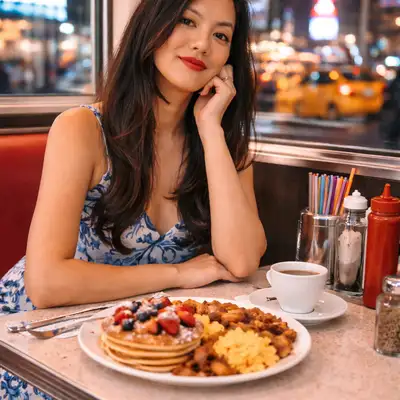
Savor with Tiffany Pham is a Representation original podcast where host Tiffany Pham sits down with the most iconic chefs of today over the one dish that made them famous.
Each episode, Tiffany and her guest share their signature plate together, and while they eat, they get into everything behind it: the life, the dreams, the journey, and the moment a dish became a legacy. It's a conversation you can taste.
Season One premieres September 1, 2026. Follow now so you're at the table for the first course.
Hi.
It's so good to see you.
Same here.
Yeah, well, I'm so super excited to
finally be here with you
because I'm so excited about your Supreme
Burger
and how it's one of the best burgers in
New York City.
So, can't wait to talk to you about it.
Thank you, thank you.
And, well, I can't wait to also dive into
your story
because I know it's so inspiring.
And, you know, there's a bit about your
Greek-American heritage
that I'd love to hear about and have you
share. Where do you want me to start?
I've got a lot to talk to you about. Tell
me everything about it.
and yeah while we enjoy the burger.
Janice we're doing great, thank you. Thank
you.
So I'm a old school New York born and
raised guy, right?
My parents are from Cyprus.
They were refugees actually. They came to
New York in 1974.
Coming from a background, my grandfather
being in the hotel, restaurant industry
and owned hundreds of acres of lemon trees
in the north of Cyprus.
Came here in 74 because of the invasion of
Cyprus.
I'm born in 76, so I wasn't, you know, my
parents were here for two years when I was
born in New York.
And I grew up in a very humble, you know,
five-room apartment in Astoria, Queens.
So I grew up in the streets of Queens,
basically.
went to public schools in New York, got my
first sort of, I'll call it like
hospitality job,
but like food job at Dom's Deli when I was
12 years old, stocking sodas and
eventually working myself up to slicing
cold cuts
and working the lotto machine. And I did
that all throughout school, all throughout
high school.
and then when I went to I went to college
and it is so good. I did a great job. I
went to college in Baruch in New York
City.
I studied business but in the interim I
was working in some Greek cafes in
Astoria.
Astoria. Because in the 90s, Astoria was a
predominantly Greek neighborhood. It still
has some remnants of it, so there's a lot
of Greek cafes. So I worked in a Greek
cafe
for all throughout my college years. And
then graduating from college, I worked as
a public
school teacher for two years. Well, not a
public school. I worked in a private
school,
but I was a social studies teacher for
about two years.
And, you know, I had this idea.
I always wanted to own my own business.
I always wanted to be in the restaurant
business and the nightlife business.
So in 1999, I'm still a very young guy.
You know, I'm 23 years old.
I come up with this plan to open up a
place in Brooklyn,
and I reached out to one of my best
friends who lived in New York
who was studying as an accountant working
for KPMG.
And I said, hey man, I got this crazy
idea. We got this really good deal.
Let's open up this place in Brooklyn.
It ended up being called Sputnik.
And it was a combination of...
So, it's 1999, right?
We're trying to open this place, and we
hit all these delays.
We finally get the place open, and we have
maybe the best time of our lives.
And we're running this place for close to
like 10 years.
and it evolved from becoming a just a
regular cafe like in this obscure street
in Brooklyn in Bed-Stuy Clinton Hill 4-3
neighborhood it ends up becoming this
like weird Mecca of like old-school
hip-hop New York like legends start
performing in the place KRS-One, Afrika
Bambaataa, DJ Premier it becomes really
interesting, fun, very New York because
it's you have Pratt Institute next to us,
you have some of the biggest housing
projects in New York, you have a huge
Hasidic community and they're all hanging
out in the same place until 3
o'clock in the morning you know doing
crazy New York stuff back then. In 2007
In 2007, we launched a menu in the
restaurant called Sputnik Burger, because
the name of the place was Sputnik.
Right.
And the focus of that menu was we did
organic grass-fed beef.
We had a bison burger.
Back then, we were doing an ostrich
burger, an elk burger.
And it became so popular, like that small
menu that we were running out of place.
And this burger actually is almost like
the original Sputnik burger, which was
organic grass-fed beef stacked with onion
rings, bacon, and lettuce in our own
special sauce.
And that ended up becoming the staple of
that place.
So people, our guests, they were coming
for the music, but they started coming for
the burger.
So good, too.
I'm going to dive in with you on that.
So how did you come up with the recipe?
The fries, was that part of the original
recipe?
So the original, like we wanted to build
the most indulgent burger and still be
traceable,
sustainable and fun and clean.
Originally this burger also had a stack of
onion rings that was stacked inside, but
it
came in almost too big and you know hard
to eat so this original burger
let me do a little rewind for you yeah
so the restaurant
People are loving it. Everyone in that
part of Brooklyn is coming to have these
burgers.
2008 rolls around, and in 2008 you have
global recession.
You have a, I want to call it almost like
a mini-depression in the United States.
In New York, in the area where we were,
you had an area in New York that was on
the verge of being gentrified and
developed.
That all stops because of everything
that's going on in the world.
and my brother approaches me with two of
his friends and said,
hey man, this burger is fantastic.
He wanted to do a Five Guys franchise at
the time.
And I said, why don't you just come check
out and see what I'm doing with this
burger place,
or this menu.
He comes there, he's obviously blown away,
loves it,
and says to me, why don't you take the
burger,
and we also are having discussions,
why don't we take this burger and the
concept of, you know, an organic burger
and go back to Astoria, where we all grew
up.
It's so good.
It's so good. It's so good.
And so, you wanted it to be something
someone could really enjoy and savor and
be indulgent on, so the baked eggs…
We wanted people to come and not only have
a really indulgent, fantastic burger, but
to feel good about it too.
Not to feel gluttonous, not to feel like,
hey, I've got to go take a two-hour nap
after eating this burger.
So we find this space in Astoria, small,
1,000 square foot.
It was an old bakery. It was closed for
maybe 10 years.
We started renovating it.
We had a poster in the window that was
like our original logo, which was a bear
on a unicycle, holding a beer in one hand
and holding a burger in the other.
And everyone in the neighborhood thought
we were some California hippies because it
had this very like Grateful Dead feel to
it.
And, you know, I've never seen anything
like it, Tiffany.
Like when the restaurant opened, I could
find it open like six months later.
And I remember because I was working in
the kitchen at that time. Oh, nice.
I remember staring out that kitchen window
and there was, you know, probably close to
a hundred people, you know, waiting
outside to come check this restaurant out.
Amazing. And it was just like gangbusters.
Like, you know, it was like before it
became like a viral moment to have all
these people waiting outside.
It just like happened, you know, naturally
in that respect.
And that's because there's a lot of
mission embedded into your dishes, into
the restaurant,
the ambience, the sustainability aspects,
the organic nature of your dishes.
It was a combination of everything, I
think back then and now.
I think it hit a certain tone with people
and it was like, people have never seen
it.
Mind you, this is 2009.
2009. This is before you had this
explosion of whole food markets and health
markets.
We were the first place that was doing
like an organic burger and all these other
unique proteins that had their own health
attributes.
Bison, which is extremely lean, 95% lean,
probably over 50 grams of protein per
serving.
You had all that going for us and it was
still fun, approachable.
And it was a much smaller menu, you know,
back then.
So fast forward, that restaurant was so
successful that we all decided we have
something here.
It's almost like you capture lightning in
a bottle.
And you know you have something and you
have to move on it fast.
So we started putting a plan together to
open some restaurants in the city.
We started a plan together to start
franchising and doing license agreements.
and you know we were we were so busy and
so so much love and admiration for the
brain that you know there was a point
where we had close to 50 restaurants
and it was not only in New York we had
restaurants in Santa Monica and in Japan
Germany in Japan Germany Dubai Abu Dhabi
it was really fascinating Toronto it was
just such an exciting, awesome time for
this brand and this restaurant and this
company.
And then, you know, COVID rolls around,
which, you know, basically, you know,
knocked everyone
out in our industry.
Running restaurants is really a hard
business.
I don't think you necessarily go into this
thinking you're going to get rich.
You do it out of, you have a passion and a
love for not only your food,
but for serving people and making people
really happy when they come to your
restaurants.
I think that is such a big part of it for
a lot of us.
and then when COVID comes around, it
changes the whole landscape.
It almost changes your perspective on this
industry too and this business too
because the hospitality, the generosity,
the community building,
it gets thrown out the window for a period
of time.
And we're all sort of scrambling to figure
out what's going on, what's happening.
And then, you know, fast forward, I still
think, you know, I'm sitting in here
talking with you 2026.
And not only myself, a lot of fellow
restauranteurs are still dealing with the
remnants of, you know, of COVID.
So many things have changed.
And now we wake up, you know, you come out
of COVID, and now you deal with tight
pocketbooks, rising costs across the
board, from rents to energy bills to
insurance to the labor.
And the labor is an interesting part
because you want to take care of your
people, but there's only so much that
people are willing to pay for a hamburger,
right?
So there's, you know, there's a balance
there.
But, you know, for us going, so during
COVID, we had to really like relook at
ourselves, consolidate our brand, our
restaurant, and like, you know, sad
moments to like close restaurants
internationally and restaurants that were
sort of out of the New York area.
Because we made a conscious decision
saying we have to really look and only
take care of what's going on in our
backyard.
We can't be sustainable with these one-off
restaurants in these other areas.
It just didn't work for us.
But going through all that and seeing all
the trends and everything that's changed
in our industry,
I think gave us some really, really good
insight on our path forward.
It sounds like you did the right things
for the business.
You know, you, like most companies around
the 10, 12 year mark have to generally
reset
in any case and kind of take a hard look
at what's working well and where the world
is
at now and kind of therefore hone in on
the muscle.
You know, it's a great, and like I think
now we're at a place where, like I'm
looking at,
this is still one of our best burgers on
our menu.
Our menu has changed over the years,
right?
We were from a very small menu that was
highly focused on organic proteins to then
becoming a menu that had a lot of
plant-based options.
We were one of the first brands to carry
Impossible Burgers on our menus.
We were one of the first restaurant brands
to have a menu that was entirely dedicated
to plant-based and vegan food.
Gluten-free fried chicken, gluten-free
options, keto options.
it was like it was your neighborhood
hamburger place but it was also a place
that it was it was like your it could be
your everyday and it could be your cheat
day you know all at the same time right
and now it's like we're so like back to
focus on what's our core what's our core
competency I like to say and what people
really love about us and it's burgers like
this it's really clean milkshakes
We're bringing back some of our really
cool salads and bowls that we once had.
And, you know, really reminding people
again, because we've been around for 16
years.
Yeah, exactly. You know, this city changes
pretty fast, right? Exactly.
It changes like every day. Exactly.
You know, like we were, we saw the whole
trend of the Smash Burgers coming to our
area.
And then now we have like a really good
Smash Burger on our menu because something
that
people are always asking for, right?
And now it's like we're back at a point,
it's like let's remind people that we're
still here in a sense.
We have 30 restaurants in the tri-state
area and two restaurants in Ohio.
And getting back to a place of people
saying,
getting rid of all the noise, and not the
noise of these kids.
I'm talking about the noise in the
restaurant world.
And figuring out what's important,
and it's like reconnecting with our
guests, reconnecting with our communities,
putting
out awesome burgers and like, and focus on
that.
And if we focus on that, we can see this
company through for the next 15 years.
And that's all we can do. I mean, that's
what I preach to my managers.
Like this is all you can like, there's so
much macro stuff that is out of our
control.
but like this is, you know, you focus on
this,
getting people really good burger
and you'll have a restaurant with a bunch
of happy kids.
You know, and having a really good meal.
You're doing the exact right things,
honing in what you can control
and doing the best you can on it and you
have
and now you're focusing in on the
strengths
and I just see a very exciting moment
ahead for you all.
And so I can't wait to talk about the
burger now
and hear about how you first created it
in terms of thinking about the various
fries, the onion rings, the bacon, how did
it evolve? I'll tell you.
I'm embarrassed to say this.
I'm embarrassed to tell you this story.
When I used to own Sputnik in Brooklyn,
our nights were late, right?
We would get out at 4.30, 5 o'clock in the
morning, right?
Most times.
So my go-to on my way home, I would stop
at McDonald's and I would get...
I'm a big guy.
I'd get four cheeseburgers, large fries,
but I'd get a Diet Coke, right?
That was my go-to.
I would open up every cheeseburger and I
would stuff it with french fries. I see.
That was my go-to, right? And I would ask
them for a side of mustard.
Sometimes they had it, sometimes they
hadn't. And I would pour mustard and
ketchup.
So it was my cheeseburgers that were the
small McDonald's cheeseburgers
now became voluptuous with french fries
and all these sauces coming in.
So when we made this burger, we said,
McDonald's doesn't really have onion
rings, so I would always get the fries.
So this burger, when we designed it, it
was a six ounce grass fed burger.
We do applewood smoked bacon. We would do
an onion ring inside. I ate half of it.
We would do an onion ring inside, and
inside the onion ring, we started stuffing
french fries in it.
And instead of ketchup mustard, we made
our own special sauce.
Ketchup mustard mayo is the base of every
special sauce in the world.
Don't be deceived when people tell you we
have the special, special sauce.
That is the base of every good special
sauce in the world.
And then we tinkered with it and then we
said, you know, we not only wanted a
really good
burger but we wanted it stocked high.
So like when this burger has onion rings
on top and our flag sort of in it, sorry,
it
having it when it's served like this.
and when people when this burger you know
because restaurants are show right
people see that burger you know walking
through the restaurant automatically
people what was that and they will order
it and it's and it's and it has the
proper name to match it it's the supreme
yeah it's the supreme burger right so
it's so good I love the meat I mean
definitely one of the best burgers I've
tasted and in new york city it's
definitely a standout i love the addition
of the onion rings
for me the kid inside me loves that i
gotta tell you i'm so you know i i i'll
admit that i haven't
had this burger in a long time like we
have so many healthy options on our menu
too like our
menu you can wrap burgers in uh you can
have it in a keto bun you can wrap it in a
collard green
so I always go for like the high protein
low carb but this is a treat today this
is my cheat this is my cheat day today
this was like wow I'm almost having like
flashbacks I like you know like I you know
I look at what burgers you know in
the restaurant business you look at what
sells and what doesn't and this and our
standard burger has been a staple on our
menu as many times as it's evolved and
and change and gone in one direction and
come back. This is a constant.
This doesn't change.
I mean, and it hits all the points.
You got the beef in the nice sear,
the crispy onion ring that has a nice
parsley seasoning
on it, the French fries, the special
sauce, the pickle, the baked apple with
bacon,
daily fresh toasted brioche buns.
It's like really, it hits every spot.
So delicious.
I saw you introduced a new burger, Wagyu
burger that's also taken off.
When I was speaking to your restaurant
staff, I actually stopped by yesterday to
ask them,
you know, what are your most popular at
this time?
And they still said it's the Supreme, but
also the Wagyu.
So I'm excited to hear a little bit about
the new addition.
These restaurants, you know, we call it
the home of the burger, right?
So we have a really delicious...
So, like, I look at this place as the home
of the burger, right?
You come to a restaurant, you can get an
organic grass-fed burger,
you can get a bison burger, an elk burger,
you can get an Impossible burger, a Beyond
Smash burger.
It really is a hustle. But you can get a
quinoa sweet potato patty,
you can get a black bean poblano burger.
We have so many different ways and
appetites and flavors.
And the one thing I always said that I
think we're sort of missing is that that
burger,
if it's executed, can be the best burger
that any restaurant can serve.
and it's we went with
an indulgent 10 ounce Wagyu burger
that it's 100% American Wagyu
it's about an inch and a half thick
and if you hit that burger medium rare
which is I think the only way to eat a
burger of that quality
you can have it just simply with
cheese, salt and pepper
and not even any ketchup or pickles just
plain Jane and let the meat sort of like
shine through with it I think it's one of
the the best one of the best burgers
we have on the menu for somebody that's
looking I mean listen you can't have it
for lunch every day you know it's it's a
it's a lot of me but like you know you
want to come in and grab a beer and have
you know something really decadent like
Like, you go, like, and ours is, we call
it the ultimate Wagyu.
So it's not to be confused with the
Supreme Burger.
And that burger has, you know, a
house-made Dijon aioli that we make,
pickled red onions, a bacon jam, and
smoked Gouda.
So you have a little bit of that nutty
flavor coming from the Gouda,
and you have, like, the really, like,
high-fat marbleization of the Wagyu.
It is totally decadent.
and like a burger that, have it once a
month.
You know, it's a real treat. You know, and
that's how, and it's-
All of your burgers are a treat. This just
gave me so much delight and joy
receiving this. I have to-
Me too. I'm feeling very happy right now.
Me too, me too.
And so my question, my final question to
you is, who are you making this for?
Who, you know, how do you want them to
enjoy it
and experience it and savor it?
The burgers that we make in our
restaurants, they're for everybody.
I've been to some restaurants in New York,
some high-end really nice burger places.
That burger on that menu is like $50, $60.
I think it's crazy.
I mean, God bless them that people are
willing to pay that money for a burger.
But I see it like our burgers, it's for
everybody.
You can come here, you can get for $8, $9
a really high-end smash burger that's made
with 30-day dry-aged beef prime.
Beef on a proprietary potato bun.
I guarantee you anyone who's doing smash
burgers is not using that kind of quality
meat that's ABF prime, 30-day dry-aged.
They're just not doing that.
Quality of our meats is like utmost
importance.
It was day one from our company that as
much as we've evolved, that hasn't
changed.
You can come here with your kids.
And I've always wanted this place to be a
replacement for the fast food places that
you have no idea what's in that burger.
You have no idea what's in the chicken, if
it's even chicken.
You know, I've seen the stories of where,
you know, certain fast food french fries
can
sit there and for 40 years later look
exactly the same.
Which, you know, makes you wonder what
kind of chemicals are in here and in this
food.
But I always wanted it to be a clean, fun
place for families to come.
But also like a date night place, you
know.
People come here, have a glass of wine,
have a beer, have a cocktail, have a
really nice
burger or maybe a salad, but it's your
local community neighborhood burger spot.
And that's what I always wanted it to be,
that's what I think it became for a long
time, and I think it's becoming that again
in a sense after after all the
dust has settled with everything that's
gone on in the world in the last few
years. And it won't be easy, right,
because I think there's still a lot of
headwinds not only for our business but
for the whole restaurant industry but I
think
staying focused and making sure that our
guests come in here are happy and having
a good time I see a big smile on your face
I know you like that burger
all right and like you know keep you know
just make that our North Star and
then I think you can make anything happen.
Definitely, your team's wonderful
and they're so welcoming and make such a
family environment.
This place is the best.