Subscribe
Share
Share
Embed
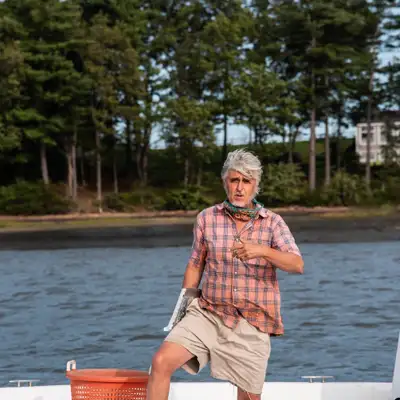
Time and Tide is a New Hampshire Sea Grant podcast for anyone who is connected to the Granite State’s waterways and wants to learn more about the latest science impacting both yourself, and the animals that live here. Hosts Erik Chapman and Brian Yurasits break down complex topics from seafood to coastal resilience by bringing on guests from both the research world, and local industries to share their expertise and perspectives.
Lindsey Williams: [00:00:00] Change can bring a feeling of uncertainty or sort of feeling unmoored, but I also think there's opportunity in that. And how do we think about envisioning the ecosystems of the future, the industries of the future, while connecting to things that have made New Hampshire what it is? How do we help bring folks together to envision those futures, um, and where does science fit in that table so that we're doing that in an informed way?
Brian Yurasits: Welcome to the dog days of summer. It's hot out there, and while you're all taking refuge in and around New Hampshire's water bodies, we want to share some of the latest research impacting those waters that you're dipping your toes in. New Hampshire Sea Grant has awarded $1.2 million to fund six coastal research projects over the next two years.
These projects, [00:01:00] approved by the National Oceanic and Atmospheric Administration, also known as NOAA, will address topics of particular importance to the state and region, including PFAS contamination, coastal flooding, seafood safety and management, salt marsh restoration, and the northward expansion of marine species.
I'm your host, Brian Yurasits, and welcome to Time and Tide, the podcast from New Hampshire Sea Grant, where we explore the science, stories, and people behind our changing coastlines. On today's episode, I'm handing hosting duties over to our summer Doyle fellow, Kylie Marozsan, who will be breaking down these research topics into bite-sized stories.
Welcome to the podcast, Kylie.
Kylie Marozsan: Today, I sit down with our leadership team here, including Erik Chapman, Lindsey Williams, and Steve Jones, to discuss these six research projects that are tackling coastal issues in the Granite State head-on. We'll run through these projects one by one, discussing why they impact you.
Swim along with us.[00:02:00]
Did anyone spend any time in, like, New Hampshire bodies of water over the weekend?
Erik Chapman: Two surf sessions on Saturday and Sunday. And Sunday was particularly awesome.
Lindsey Williams: I didn't go in the water, but I twice went now down to the new Nebi Park in Dover. Um, and there's a new accessible kayak ramp, and there's gonna be a little creation company where you can rent kayaks.
But the park itself, just, like, sitting by the river and being able to walk along there was really, a really cool space.
Steve Jones: And I also buzzed around Great Bay yesterday on one of the School of Marine Science small boats.
Kylie Marozsan: I took my mom up to the White Mountains, so we got to see that. Um, but we spent some time over at Jenness Beach, where there was a ton of surfers.
I actually saw Ben, one of the other interns, was there too. So everyone in the Sea Grant office is just out and about along the Seacoast. I was explaining to my mom that it's not the coast. It's not by the water. It's not down the shore. Everything is the Seacoast here. She had never heard that before.
There are so many different research topics affecting New Hampshire's coast today [00:03:00] that you might read about in the news or hear about on social media. Before we dive right into explaining each of these six research projects, I was wondering if you could describe what this moment looks like for New Hampshire's coastline.
I'll be asking why each of these projects meets the moment for New Hampshire, but what exactly does that moment look like?
Lindsey Williams: I can share a couple thoughts that come to mind. I mean, I think it's always Sea Grant's goal to be thinking about connecting community challenges and opportunities to the research community and having that sort of two-way dialogue, and I think that continues to be part of what this moment is right now, sort of building that opportunity for residents and visitors here in the state to understand these ecosystems, but also to get their questions answered.
Erik Chapman: A key part of what I feel like the moment is for New Hampshire is just characterized by change, really dramatic change in both people and in the environment and our influence on the environment and our relationship to the environment.
Kylie Marozsan: Everybody in the community seems really interested in what is going on and how can we plan to fix it.
The first project we'll be diving into today is led by Dr. Ashley Bulseco at the University of New Hampshire. New Hampshire's salt marshes are valuable [00:04:00] coastal ecosystems, but they are under threat from human activities, with an estimated 18% to 50% of salt marsh habitat lost. Dr. Bulseco's project aims to characterize microbes in salt marsh recovery and use this data to help measure restoration success earlier and more effectively.
So I was wondering if we could talk a little bit about how marsh restoration is cutting-edge, and, like, how is this important to New Hampshire right now?
Steve Jones: It is a timely topic. We are seeing a obvious impact to salt marshes. You know, there's been a lot of development. And so this project, there are active researchers at UNH and other people in the region that are restoring salt marshes, but they're using methods that are really innovative.
But then we don't really know much about the microbial community, and microbial community drives things like nitrogen and all the nutrients that plants are gonna need. She's gonna be looking at newly restored, ones that have been restored for over a bit of time, like 10, five to 10 years, and just take a look at the [00:05:00] microbial community and see how it's evolving and restoring these nutrient cycles in particular.
Kylie Marozsan: Yeah, I was lucky enough to go out with Dr. Ashley Bulseco and take a look at what they were actually doing out there in the field with these microbial communities. And her students were taking different samples, and they were taking out cores of the actual mud itself to then go for further testing to look at nitrogen fixation and things like that.
So it'll be really interesting to see the results of the three different areas that they were sampling. I was out when we were at Portsmouth, and it's right next to a construction railroad site, so I think that'll be interesting to find the differences between there and the other sites that they look at at Wagon Hill Farm.
Lindsey Williams: What comes to mind for this project for me too is, like even when we think about our own human bodies, we're just- we're learning so much more about the role of the microbiome and sort of how we have a good, healthy, functioning human body. And so then when we think about a healthy, functioning salt marsh or all of these other ecosystems, if we're missing that piece of understanding the microbial aspects, we don't actually know how these systems work.
And so if we wanna think [00:06:00] about envisioning what a restored system looks like, how do we improve the health of these places, if we've left out this big piece, just like if we leave it out in terms of understanding our own human bodies, we won't have a healthy marsh. And so I'm really excited to learn, along with Dr. Bulseco sort of what the findings are and how we can think about all scales of the ecosystem, the big visible things, but also the tiny things.
Kylie Marozsan: Does anyone want to explain what a microbe is?
Steve Jones: Micro is small, and it's a microorganism. Microbe is a short version of microorganism. So it's any organism that's small, basically.
Bacteria are a major component of microorganisms, and they're one cell. Fungi can be microscopic. Phytoplankton, zooplankton, they can be microscopic, so parasites, viruses, if you wanna call them an organism, they'd be microorganisms as they're the smallest entity that can sort of act like a biotic organism.
That's what microorganisms are, and they can affect an ecosystem at the large scale, like she's looking at. They're in each little niche of how much air is there, how much water is there, and how [00:07:00] many nutrients are there. At that level, there's such a complex ecosystem that we know very little about that whole community.
Ashley's a great researcher, and she'll really contribute to, as Lindsey said, are these restoration efforts, the techniques that they're using, are these effective?
Kylie Marozsan: So sticking with this microbiology look on our research projects. As shellfish aquaculture grows along New Hampshire's coast, scientists are looking closely at the genetics of farmed mollusks to keep industries and consumers safe.
This next project, led by Dr. Cheryl Whistler at the University of New Hampshire, dives beneath the surface to explore how cutting-edge science is protecting our local waters and your next seafood dinner. This study takes a closer look at the genetic tools helping farmers grow safer seafood in our backyard.
So the project for this is understanding Vibrio contamination risks associated with genetically diverse shellfish aquaculture seed. What is Vibrio, and why is it a concern for consumers and businesses here in New Hampshire?
Steve Jones: Vibrios are a [00:08:00] genus of bacteria. They're infamous because they do cause various levels of human illness.
These are bacteria that live in salty water, like in an estuary or on the coast, and you get different species depending on where you are. What is important about looking at Vibrios for this project is that if you look at the oyster industry in New Hampshire, they are interested in growing oysters that have properties where they can be resistant to illnesses, where they can be resistant to extremes of temperature.
So what the oyster industry does is they buy seed. They buy little oysters, and they bring them out, and they grow them out. And they buy those from hatcheries, and they'll buy 10 million or five million of them, and then they'll use those. They'll cultivate them, grow them up big enough so they can put them in their cages.
They're finding that some of the strains of oysters that they're using are dying off from diseases. There are [00:09:00] disease-resistant strains, so can we bring those in? One of the complicating things about this, the state has to approve any import of any shellfish, and there's a whole bunch of criteria. But one of them that New Hampshire uniquely has in there is they don't allow the oyster growers to bring in shellfish from an area where there's been vibrio illnesses to humans.
So we don't want that here, and we have not had illnesses from vibrios. So this work is really trying to help industry import a wider array of genetically different oyster strains by looking at the seed and managing the seed to minimize any vibrios that may be in them. It's using several pretty simple strategies that they use with adult oysters, but applying it to these seed oysters.
So you manage them from the start so that when you put them out into the water, they don't contain these [00:10:00] disease-causing vibrio.
Lindsey Williams: And Steve, can I just jump in, 'cause somebody asked me this question once, and I realize that we're so used to hearing the reference to seed oysters, but somebody was like, "Are they plants?"
Um, and so just underscoring that, like, we use it in the, um, when we're talking about baby oysters for aquaculture operations, we use the word seed, but oysters aren't plants, they're animals.
Kylie Marozsan: I guess continuing on with that, can we talk about PFAS? I would say that's a very hot topic right now near Great Bay Estuary.
The presence of PFAS, per- and polyfluoroalkyl substances, or more commonly known as forever chemicals, have emerged as a threat to both the health of people and the environment. The buildup of PFAS in fish and invertebrates in freshwater ecosystems has been studied, but far less is known about PFAS in marine food webs.
Dr. Celia Chen aims to look at how this issue affects lobsters in our beloved Great Bay Estuary. We all know about forever chemicals, but how are they actually moving through our coastal ecosystems?
So the project looking into this is PFAS bioaccumulation [00:11:00] and effects on lobsters in and near the Great Bay Estuary.
Can we talk about what is the gap in knowledge, what don't we know about PFAS, and why is it important to be looking and studying it now?
Steve Jones: So PFAS is a group of related organic, they're made out of carbon, toxic compounds, and one of the main things that they have in common is they have the fluoride ion stuck to the compound.
So we've heard of chlorinated pesticides. That was always a bad thing, right? These things are fluorinated, so these compounds are complex, and they can be changed from exposure to other, to organisms. Organisms can kinda metabolize them, but that changes the structure. So it's a challenging group of compounds because there's so many of them now.
There's thousands of them now, and people are realizing that trying to understand the PFAS contamination and what's happening, where it's coming from, what happens to it in the environment, what impact [00:12:00] it has to organisms of all kinds, us and every organism out there, is still a big mystery.
Erik Chapman: They're nicknamed the forever chemicals, and they're introduced to the environment, and they persist.
And that's part of what brings them their value in the marketplace because they're incredibly valuable in terms of developing products that keep water out or extinguish fires. There's all sorts of incredible things that this chemical can do. But since it's a forever chemical, it's introduced to the environment, persists in our water, and we know that there are human health impacts.
There are significant human health impacts. So we're learning a lot about PFAS, how they're introduced to the environment, where their concentrations are higher. One thing that we don't know as much about is how they persist through ecosystems. So this is a study that's focusing on Great Bay lobsters and looking at how PFAS move through the environment.
And lobster, of course, is a species that has an incredibly important economic value and cultural value. This [00:13:00] is a kind of a tricky spot, and a lot of times Sea Grant work gets into these tricky spots because they're important questions for us to understand, both as consumers and also people who support and depend on the lobster industry for our economy.
Kylie Marozsan: I was reading that New Hampshire's biggest food exports are lobsters followed by chocolate.
Erik Chapman: Really?
Kylie Marozsan: Yeah. So will this research be able to be used across the United States, or do you think that it will be mostly concentrated in the New Hampshire Great Bay area?
Erik Chapman: That's a good question. My guess is that we'll learn some things that are specific to the Great Bay and potentially estuaries where lobsters may inhabit.
My guess is that we're also gonna learn ecosystem transfer of PFAS in ways that is gonna ask questions that can be addressed in other locations to either develop hypotheses that can be tested in other places or inform future work or funding to kind of address the same kind of question in different places.
So absolutely, I think this is something that we can learn a lot on that's important for New Hampshire, but is transferable to other regions and [00:14:00] probably other fisheries.
Lindsey Williams: One of the things that happens in a lot of research competitions, but particularly when we're thinking about our biennial projects and the role of New Hampshire Sea Grant in bringing resources to bear on issues in the state, is that because of these projects, we're able to tap into all the knowledge within different academic institutions, different faculty across the state who are following these issues, and maybe they're based in New Hampshire, but they're following what's happening in California, in Maine, in Florida, and other parts of the world.
And so while they're reading and understanding what's going on in the academic literature, or they're talking with researchers in other parts of the country or the world, they're thinking about that in the context of New Hampshire issues. And then they're applying to us. They're bringing these questions to us at Sea Grant, and then Sea Grant can fund those projects, bringing all that knowledge that these different individuals have built over time and bringing it to bear on questions that then really benefit us here in New Hampshire to understand, well, what does that mean here?
Steve Jones: Looking at toxic chemicals, we need to know this information. This one with lobsters is really cool because it's really looking at these mechanisms of transfer of [00:15:00] contamination from one part of the food web up to another part of the food web. So our communications department can really help the investigator frame how this is useful and how important it is.
This project went through the whole rigorous review process and was highly ranked by external reviewers, and these are people that know about lobsters, know about PFAS.
Erik Chapman: And I think this kind of connects to just sort of a common thread with all of these research projects, is that we are really aiming to support a program that's focused intently on a need in New Hampshire.
And usually, that need is felt through a community, a business, an industry, a group of people. What you're hopefully seeing is, like, each of these examples is starting with the need and then building the program and the research around addressing that need.
Kylie Marozsan: Yeah, we wanna make sure that we are supporting both the fisheries and the consumers to ensure the health and safety of everyone, lobsters included.
Steve Jones: The review of projects in [00:16:00] general is that we require the head investigator and their co-investigators in their proposals to delineate how they're engaging end users and people that will be affected by a project. So this is a good example of this head investigator and the co-PIs are connecting with the lobster industry.
That's something from the start.
Kylie Marozsan: Switching gears a little bit, Atlantic cod is vital not only to the economic state of New Hampshire, but its cultural history as well. The next project takes a look at what cod are eating for dinner and how this affects our dinner. Changes in what cod eat and environmental changes could be affecting their ability to reproduce.
Poor diet can lead to fish being in worse condition, which means they might skip spawning altogether. To better understand what is affecting cod recovery, Dr. Adrienne Kovach at the University of New Hampshire and her team will be studying what spring and winter spawning cod eat throughout the year and how their diets relate to their health and reproduction.
The title for this research experiment is Understanding the Role of Diet in the [00:17:00] Sustainability of the Gulf of Maine Atlantic Cod Fishery. Why is funding research on New Hampshire's cod fishery so important?
Erik Chapman: I mean, it's important in part because of our history, but it's also important because we still connect to the cod fishery in a much more limited way than we have historically.
But we still have day boat fishermen that leave in the morning and fish groundfish, which include cod, and then come back at night and sell their catch. And this still remains an important part of our current fishery and hopefully the future of our fishery. And one of the challenges around the science and management of Atlantic cod is just understanding the population structure of Atlantic cod.
We know that there are different subpopulations that make up the broader cod population, and in the past they've been managed as two subpopulations, Georges Bank and Gulf of Maine cod. The fishermen and the scientists have long kind of understood that there's likely more subpopulations than those that exist.
And when our management is in sync with and understands [00:18:00] the true biological complexity of a stock, then it's much better prepared to manage successfully the stock so that we can keep taking fish but allow the populations to thrive. New Hampshire Sea Grant and a lot of other funders have invested a lot of research and engagement around improving our understanding of the subpopulation structure.
And as a result, we now kind of understand that instead of two stocks, there's likely five subpopulations and two of those subpopulations actually spawn just off of New Hampshire's coast. And those subpopulations have a spring spawning subpopulation and a winter spawning subpopulation. We need to do better to try to understand how these subpopulations differ, and by looking at how they're eating, we can begin to disentangle these two subpopulations and improve our ability to understand and manage the overall stocks.
Kylie Marozsan: I guess that brings me into my next question is, why should we care about what cod are eating?
Lindsey Williams: I do some teaching and I'm working with students on understanding fishery science and fisheries management, and a lot of what we [00:19:00] talk about is fish as a renewable but exhaustible resource or depletable resource.
So fish will come back, but if you take too many, they can't. In addition to that, not just taking too many, if there's not enough food out there for them, they will also not stay in that renewable space. And so one of the things that I think about in this context of this project is where do these fish, where do cod and other fish sit within the larger ecosystem context?
So what are they eating, and what does that tell us about their ability to be in that sort of renewable space so that we, like Erik was saying, so we can continue to have these industries, both commercial and recreational. Understanding what they're eating is a piece of that landscape to understand how we can manage them into the future.
Understanding cod and sort of why it matters here to us in New Hampshire is also about understanding multiple different ways people know about resources, and so bringing that knowledge that members of the fishing industry have, the sort of knowledge that fisheries managers have, knowledge that scientists have, bringing that all together to understand how are we gonna manage these resources in the future so that we can keep eating them, and having them as part of the New Hampshire landscape in the future.
Kylie Marozsan: Why do you guys think it's [00:20:00] important to involve the community in Sea Grant's projects like this?
Erik Chapman: In this project, we're working closely with the recreational fishers who are helping us with some of the sampling that our researchers are doing, and it's super important because ultimately these are the folks that are going to be impacted by any kind of adjustment in policy that manages the fishery.
And for them to have buy-in into that, the science that underpins the policy, is critical for the success of that management approach. The other part is that these folks have a really good understanding of the system and can add a lot of perspective and knowledge into the interpretation of the results that we create, so they become a part of the research team.
Steve Jones: The ecosystem of the Gulf of Maine is changing. It's one of the most rapidly warming ecosystems in the world, and all the organisms in the water column, everything's changing rapidly. And so supporting a scientific project that actually gets at the details of what they are eating now, it's gonna [00:21:00] change potentially, but to know that ahead of time, you understand why they're eating what they're eating, and then you can understand what else they might eat if whatever they're eating now might change.
It's really a timely project. That's why it's so important.
Erik Chapman: The quality and prevalence of food is really what drives reproduction in the ocean. And so the flow of energy through the system is really what triggers spawning in cod. So if we can understand how these different populations are interacting with the food web in ways that are either beneficial to that population or problematic, that's the sort of thing that we can learn by understanding what they're eating much better.
So it's the understanding of energetics, the flow of energetics into the system, and then ultimately kind of having a better understanding of what's driving some of the population trends that we're seeing.
Kylie Marozsan: This project uses something called a lavage. Does anyone want to explain what that is? How does that help us learn what cod eat?
Erik Chapman: For my PhD, I studied penguins, and we did stomach lavage for Adélie penguins. Lavage [00:22:00] is essentially pumping the stomach or removing the contents of the stomach so you can analyze what the species is eating. So in this case, they're pumping the stomachs of the cod, looking at what they're feeding on, and then analyzing that information.
And yes, I did that with penguins, and I'm sorry. Typically is a process of filling the stomach with water to the point of regurgitation.
Kylie Marozsan: Brian was actually able to go out with Linas. Do you wanna talk a little bit about what you got to see while you were out there?
Brian Yurasits: Just a, a little bit of background as well on this.
The spring spawning population is doing a little less well, uh, than the winter spawning population, and that's really one of their aims in this project is to figure out why. And they believe that it could be related to what the cod are eating. I will also mention that the fish are re-released back into the water using a method that actually brings them back down slow enough that it's done very safely.
But it's a fascinating thing to watch, and it's always super interesting to see what is gonna come out of the different [00:23:00] size fishes' stomachs. Some huge cod were caught out there. Some smaller cod were caught out there. And just seeing the diversity of life that these animals are feeding on is fascinating.
We saw some cunners were some of the bigger fish that were caught, a lot of crustaceans, definitely, so like some small crabs were some of the more common species that I personally saw while we were out there.
Kylie Marozsan: So I guess we'll shift gears a little bit now from cod over to crab. If you know anything about crustaceans, you've probably heard there's a new crab in town here in the Gulf of Maine.
As ocean temperatures in the Gulf of Maine warm, blue crabs, Callinectes sapidus, once rare north of Cape Cod, are now increasingly found in New Hampshire waters as overwintering temperatures become less of a limiting factor. This range expansion of blue crabs can result in potential impacts to vital coastal habitats as well as to economically important species like lobster and oyster.
Understanding the distribution and ecological impact of blue crabs is essential to protect the ecosystem services estuaries provide and to anticipate potential challenges for fisheries and [00:24:00] aquaculture. This project, led by Christopher Peter at the Great Bay National Estuarine Research Reserve, will investigate current and emerging crab communities in New Hampshire's Great Bay ecosystem, with a focus on blue crabs.
We're gonna be talking about evaluating the northern range expansion of crab species in New Hampshire through community engagement, baseline monitoring, and trophic interactions.
Between the green crabs and blue crabs up here, I'm wondering how does this project fill, like, an information gap in the state of New Hampshire?
Steve Jones: Blue crabs are not a species that has been very common up here. With the way that the currents in the ocean move, they can be found pretty rarely in the past up here. They're more of a warm temperature environment. Now that things are changing with the warming of the oceans, the blue crab is coming north.
Blue crabs we don't know a lot about, and we've had a lot of issues with green crabs in terms of their impact to other species in the seacoast of New Hampshire and the shoreline of the [00:25:00] Gulf of Maine. We don't know if the blue crab will cause similar issues. They have a tendency to mow down eelgrass.
They have a tendency to consume small oysters and things like that. So we don't know a lot about blue crab up here. We know the way that they live in the ecosystem in Chesapeake Bay and further south of here, but we don't know a lot about what's gonna happen up here. This is a new ecosystem for them.
Kylie Marozsan: Are there any bigger picture lessons that we can learn from this research project on blue crabs? Um, like, is there an approach that we'll need to use with other species in the future perhaps?
Lindsey Williams: There's a lot of really neat pieces of this project and some of the associated work in thinking about how the community can be engaged.
So if you see a blue crab out there, make sure that you submit that sighting, 'cause that is part of the data collection. So it's not just about the scientists, but also community members contributing their knowledge and their information. And that can be translated to a lot of different other topics as well.
And so how we think about building the data sets, the ability to analyze ad hoc observations of community members, how that [00:26:00] fits into the other research is one of many important parts of this project as well.
Kylie Marozsan: Could you talk a little bit about how the power of collaboration is really important on a research project like this?
Erik Chapman: Well, I think the collaboration is really just bringing to bear organizations and people with different perspectives and capacities. So in this program, we're working really close with the Great Bay National Estuarine Research Reserve, and they have their own priorities and mission. It overlaps quite a bit with New Hampshire Sea Grant.
So in this program, we're bringing together UNH scientists, Sea Grant scientists with Great Bay National Estuarine Research Reserve scientists, combining all of our sort of community engagement into the program. We're always better when we're working together on these, because we're each kind of connected in different ways to end users.
Like New Hampshire Sea Grant, we work really closely with the aquaculture industry. Great Bay National Estuarine Research Reserve also works really closely with folks who are doing salt marsh work, but also eelgrass work. So it's a complex system, and the more ways that we can approach these problems in a connected rather than a fragmented way, it improves our ability to both [00:27:00] understand what's happening and how the system is impacted, but also ways that we can develop responses to the knowledge that we're building.
Steve Jones: Collaboration gives this project the potential to really understand this greater picture of here's a species that hasn't been here before. How do we assess its potential impact? It's gonna have benefits. People like to eat blue crabs. But we wanna be able to know how to manage that here in this new environment for them.
This is valuable. The results of this project, they can talk to many different people that would be interested in this bigger topic of migrating or invasive species and changing ecosystems.
Kylie Marozsan: Do we think that blue crabs are invasive or are they native?
Lindsey Williams: We might hear a lot of different terms of like invasive species or range expansion or native species.
But I think one of the things that is really important is understanding what that mix of species is and how they're interacting with the environment and what that might mean for the environment in the future. And so certainly if you talk to some, um, experts, they're gonna use very specific terms. But [00:28:00] one of the things that I'm excited about in this project is just thinking about this mix of species and what does that mean for the species who have been here before, and might be in the future as well.
And so regardless of what we call them, what is that going to mean for the New Hampshire ecosystems for the larger Gulf of Maine?
Steve Jones: Invasion kind of has an implication that there's a negative impact to the existing ecosystem. With the blue crab, we don't really know To me, I look at it as a migrating species.
Kylie Marozsan: One of the other projects that was funded was developing a water level monitoring system in the city of Portsmouth, New Hampshire to build community resilience and environmental literacy for coastal flooding and storm surge. You may remember some of the major storms that have impacted New Hampshire's coastlines in December of 2022 and January of 2024, which caused real damage in coastal communities.
As sea levels rise and these storms become more frequent, local cities and towns are increasingly vulnerable to both surface flooding and groundwater inundation. To address the need for better data and tools around flooding, Michael Routhier at University of New Hampshire and [00:29:00] his research team will partner with the city of Portsmouth to build a network of wireless water level sensors.
These sensors will track the timing and location of flooding at a city scale.
So Sea Grant does a lot of different work related to flooding. If you listened to the last podcast episode, you would know much more about flooding. So this is a clear issue that people across the state are dealing with. So what makes this project different or unique from other flooding projects that have been funded in the past?
Lindsey Williams: This is another project that really digs in with the partnership, specifically with the city of Portsmouth, and thinking about how we can understand, what the municipal needs are and bridging that with the sort of science questions, and then also how that information might be used for future decision-making.
And so how we're thinking about sort of water management decisions, development decisions, and a whole range of different ways that better understanding flooding is gonna help, not just Portsmouth, but other communities as well.
Kylie Marozsan: Even if you don't live in Portsmouth, how can this research project impact you?
Lindsey Williams: While this project is specific to the city of Portsmouth, the knowledge that's gained from it isn't just gonna stay in Portsmouth. And so whether that's anybody who wants to read about the [00:30:00] findings can read that, but also how the different municipal staff are sharing within their networks what they're learning from it.
Steve Jones: This focus on the impacts to a municipality and some historic buildings, this has been here forever. Not forever, but for 400 years. What if we lose this? It's really taking a look at valued resources in an urban area, and that's a piece that there hasn't been a lot of work on.
Kylie Marozsan: So to close out, how do these different research projects that cover such a broad range of topics, is there one overarching theme for them all?
Lindsey Williams: Change can bring a feeling of uncertainty or sort of feeling unmoored, but I also think there's opportunity in that. And how do we think about envisioning the ecosystems of the future, the industries of the future, while connecting to things that have made New Hampshire what it is? And how do we help bring folks together to envision those futures, um, and where does science fit in that table so that we're doing that in an informed way?
Kylie Marozsan: I think that was a perfect way to end it. Thank you both so much, and thank you, Erik, as well.
It's safe to say that a through line [00:31:00] between all of these research projects is a need to better understand how New Hampshire's coasts are changing. But it's not only understanding these changes, it's involving the people affected by these changes in science and solutions.
Beachgoers, fishers, community members, towns, students, nonprofits, and local businesses all play a role. The part from today from this conversation that really stood out to me is how Lindsey described this moment of change as an opportunity to shape the future that we want. Change can be daunting and scary, but it can also push us to move forward boldly.
Brian Yurasits: A huge thanks to Kylie for taking over hosting duties on this month's episode of Time and Tide.
Time and Tide is produced by New Hampshire Sea Grant.
Explore more episodes featuring the latest coastal science happening right here in the Granite State wherever you get your podcasts.
And if you like what you've heard, please consider leaving us a review.
See you next time on Time and [00:32:00] Tide