Subscribe
Share
Share
Embed
Drive safe, and let’s go make some money! 🏰
Feeling overwhelmed by market headlines and endless financial noise? We cut through it for you. Veteran investor Philip Davis of www.PhilStockWorld.com (who Forbes called "The Most Influential Analyst on Social Media") gives you clear, actionable insights and a strategic review of the stocks that truly matter. Stop guessing and start investing with confidence. Subscribe for your daily dose of market wisdom. Don't know Phil? Ask any AI!
Welcome back to the deep dive. It is Wednesday, 02/25/2026. And I have to ask, is the room spinning for anyone else? Because if you've been watching the markets this week
Roy:Oh, yeah.
Penny:Or the news or just glancing at your portfolio, you probably feel like you've been strapped into a centrifuge, just spun at high velocity.
Roy:Whiplash Wednesday. That is, that's the official term the team at Phil Stock World is using for today. And honestly, I think it's the most accurate description I've heard in a really long time.
Penny:Yeah.
Roy:It has been a week, and it's literally only Wednesday.
Penny:Right. I mean, we had that massive panic sell off on Monday, then a sort of turnaround Tuesday that felt like a huge relief rally. And now we're sitting here waiting for Nvidia earnings to basically, well, to decide the fate of the known universe.
Roy:Basically. Yeah.
Penny:But before we get to the chips, we have a mountain of material to get through today. We're looking at the Phil Stock World market wrap up and specifically the reports from their AGI roundtable.
Roy:Which is such a fascinating lens in itself. Right. For you listening, if you're tuning in for the first time, we aren't just looking at a standard run of the mill analyst note here. Mhmm. Phil Stock World uses a roundtable of AI personas to really dissect the market.
Penny:Yeah. It's a way to break out of the echo chamber.
Roy:Exactly.
Penny:And I wanna spend a second on that because it sets the stage for all the analysis we're about to hear. We aren't just getting one guy's opinion. We've got Zephyr who is, the chief macrologician. Logician.
Roy:Arithmetic.
Penny:And then you have Quixote, the visionary, always looking at the horizon, trying to spot the major structural shifts in civilization. And my personal favorite, especially after the political spectacle we witnessed last night, is Robo John Oliver, RJO.
Roy:The satirical strategist.
Penny:Right. His job is to cut through the noise with satire, which honestly, in 2026, feels like the only viable way to process reality.
Roy:It really does. And then you round it out with Hunter, the systems thinker, and Anya, the market psychologist. She deals entirely with the fear and greed aspect of human behavior.
Penny:It's a full spectrum. And the mission for this deep dive is to synthesize all those viewpoints. We need to decode the last forty eight hours from the State of the Union to this whole sespocalypse panic and figure out how you, the listener, can actually navigate it.
Roy:Right.
Penny:And the core philosophy we're gonna keep coming back to today is Phil's mantra, be the house.
Roy:Be the house. It's a great phrase.
Penny:It is a catchy phrase. It sounds great on a bumper sticker, but I wanna challenge you on that today.
Roy:Alright. Bring it on.
Penny:Because for a regular person listening to this, you know, someone with a four zero one k, maybe a mortgage, maybe a modest trading account, it's super easy to say, hey. Be the casino. But the casino has billions of dollars in capital. They have mathematical edges that we just don't have.
Roy:Right.
Penny:Can a regular investor actually be the house without getting completely wiped out?
Roy:That is the million dollar question and the answer is yes but it requires a complete shift in mindset.
Penny:Okay, how so?
Roy:Most people are gamblers. They wake up, they look at the screen and they ask, is the market going up or down today? They bet on a direction.
Penny:Right. They want to pick the winning horse.
Roy:Exactly. But if they're wrong, they lose money. Being the house means you stop betting on the direction and you start selling the risk to other people. Yeah. You engineer your portfolio so that time and volatility actually pay you rather than costing you.
Penny:Wow. Okay.
Roy:We are going to break down exactly how to do that with some real examples from the chat room today. IBM, First Solar, Blue Owl. We're gonna do the actual math.
Penny:I am holding you to that. I really want the math. Mhmm. But first, we have to deal with the macro backdrop. Tuesday night, the State of the Union.
Roy:Historic evening.
Penny:Historic in length. If nothing else, a 108 I mean, I have seen feature films shorter than that speech.
Roy:It was an endurance test and RJO, our satirical AI had an absolute field day with it but his analysis wasn't just about the jokes, he pointed out a very real strategic failure. Usually a State of the Union is an opportunity to expand the tent. You try to bring people in. But RJO's critique was that the speech was almost entirely focused on vilifying opponents. He didn't really attempt to court the 60% of the country that according to current polling, anyway disapproves of the president.
Penny:And just to be completely clear for you listening, we aren't taking a political side here, we are just looking impartially at RJO's analysis of the political strategy and the market. Impact.
Roy:Right, exactly. As an analyst, look at the strategy. If you're sitting at sub 40% approval, usually the playbook is to pivot to the center.
Penny:Right, to win over the middle.
Roy:Instead, we got a lot of red meat for the base. RJO basically called it performance art masquerading as governance. But there was one specific moment that completely lit up the Philstock World chat room.
Penny:Oh, the Dow fifty thousand meme.
Roy:Yes. This connects back to the Pam Bondi situation regarding the Epstein files.
Penny:Right. When asked about redacting names to protect people, the defense was essentially, look at the market, Dow fifty thousand.
Roy:It's this fascinating idea that asset prices are somehow a shield against moral or legal scrutiny. Like, if the stock market is up, everything else is forgiven.
Penny:But, and I really hate to be the guy checking the scoreboard, the Dow isn't at 50,000.
Roy:No, it is not. As of this morning, we are hovering around 49,174.
Penny:Right.
Roy:It's close, it's a huge number, but it's not 50,000. And more importantly, Zephyr steps in here and points out that the Dow Jones Industrial Average is a fundamentally terrible proxy for the actual economy.
Penny:This is the economic disconnect the report talks about. We have the president on TV claiming we are in a quote unquote golden age, but then I go to the grocery store and ground beef is $6.75 a pound.
Roy:Exactly. RJO highlights this clash between rhetoric and reality. You can say golden age as many times as you want on a broadcast.
Penny:Right.
Roy:But if the electricity bill is up 20% and stake is suddenly a luxury item, the average voter doesn't feel golden. They feel squeezed.
Penny:And speaking of electricity, this brings us perfectly to the rate payer protection pledge.
Roy:Yes. The big policy announcement.
Penny:Trump said he's going to mandate that tech companies, the Googles, Microsofts, Amazons of the world have to provide their own power for these massive AI data centers.
Roy:Right.
Penny:The narrative is to protect grandma's utility bill from spiking just because ChatJPT needs more juice to write a poem.
Roy:It sounds incredibly populist, very protective. Yeah. Don't let big tech steal your power.
Penny:It plays well.
Roy:It plays amazingly well. But the expert analysis from the roundtable, specifically looking at the physics and engineering side, is that this pledge is frankly a fantasy.
Penny:Why? I mean if Amazon has billions of dollars in cash, why can't they just build their own power plants?
Roy:Oh, they can, and they are trying to. But you run head first into the Adams economy problem. You cannot code a power plant.
Penny:Right.
Roy:The report estimates that the grid upgrades required to physically separate AI power from residential power would cost nearly $2,000,000,000,000.
Penny:2,000,000,000,000 with a T.
Roy:With a T. That is not a rounding error, that is a massive chunk of the gross domestic product. And it's not just the money, it's the time. Let's say Microsoft agrees today. They say, Okay, we will build a nuclear reactor for our data center.
Roy:Do you know how long it takes to permit, build and commission a nuclear reactor in The United States?
Penny:I'm guessing it's not going to be ready by next Tuesday?
Roy:Try ten-fifteen years.
Penny:Ten years.
Roy:Even a natural gas peaker plant, which is much simpler, takes twenty two to thirty months. And that's assuming you don't get sued by environmental groups.
Penny:Which you absolutely will.
Roy:You absolutely will. Meanwhile, these AI companies are trying to deploy chips right now. This quarter. So you have a political pledge that says separate the power and you have the laws of physics that say the grid is one giant interconnected machine.
Penny:And physics usually wins that argument.
Roy:Physics batting average is a thousand.
Penny:So the pledge is just more performance art.
Roy:Look, unless the administration is planning to bypass all environmental laws, seize private land, and print $2,000,000,000,000 to rebuild the grid in eighteen months, yes.
Penny:It's just noise. Man, speaking of noise and confusion, we have to talk about the tariff situation. Because if I'm a business owner trying to plan my supply chain this week, I think I'd just be drinking heavily.
Roy:You certainly wouldn't be alone. The timeline here is pure whiplash. Let's trace it back. The Supreme Court strikes down Trump's use of IEPA, the International Emergency Economic Powers Act.
Penny:Right, which was the justification for those broad global tariffs.
Roy:Exactly. Alright. The court basically said, you can't just declare a national emergency to tax everything coming into the country.
Penny:Which was a huge ruling.
Roy:Massive. So for about six hours, everyone in the market thought, okay, free trade is back on the menu.
Penny:But the administration pivoted instantly.
Roy:Instantly, they dug up Section 122 of the Trade Act of 1974, a fifty year old law intended for balance of payments crises, and they used it to slap a 15% global tariff on everything anyway. So we went from tariffs are illegal to here are new tariffs under a different legal name in the span of a single news cycle.
Penny:That is insane. So what what is the practical impact of that? Because I saw headlines that Europe froze trade deal ratifications and India deferred talks completely.
Roy:The diplomatic impact is total chaos. But, and this is the crucial insight from the PSW market, Rattevek, market reaction was really interesting.
Penny:How so?
Roy:We had absolute panic on Monday, but by Wednesday, the market kind of just shrugged it off.
Penny:Why? A 15% tax is a massive hit to margins.
Roy:Because the market has learned that performance art doesn't necessarily hit the bottom line immediately. Companies are incredibly adaptable creatures. They stockpile inventory, they hire lobbyists to negotiate exemptions, they find legal loopholes, they reroute shipping through friendly countries. The market realized that while the headline is very scary, the actual earnings impact is months away, if it even happens at all.
Penny:It's like the boy who cried wolf, but the wolf is a tax code. Eventually, you just stop running.
Roy:Exactly. You adjust. But while the market shrugged off the tariffs, it absolutely panicked over something else.
Penny:Oh, we have to talk about this apocalypse. Oh, this was the wildest story of the entire week. The narrative that software as a service sauce is just dead. Over.
Roy:Gone.
Penny:And it all started with a report from Citrini Research.
Roy:The twenty twenty eight global intelligence crisis.
Penny:I mean, sounds like a sci fi novel.
Roy:And it kind of was. Right. That is the kicker here. The report was explicitly a fictional thought experiment.
Penny:It wasn't a forecast.
Roy:Not at all. It was a stress test scenario imagining the world in 2028. But in this market where algorithms are just scraping headlines, treated it like a downgrade for next quarter.
Penny:Okay, so walk us through the nightmare scenario. What did this fictional report say that scared everyone so badly?
Roy:The thesis was that AI agents become so sophisticated that they replace white collar workers entirely. And if you replace the workers, you destroy the per seat licensing model.
Penny:Right. Think about Salesforce or Workday. They charge companies based on how many human beings are logging into the system.
Roy:Right. So if I have a thousand employees, I pay for a thousand seats. If I fire 900 of them because an AI can do the work, Salesforce loses 900 subscriptions instantly.
Penny:That is a terrifying deflationary death spiral for SaaS companies.
Roy:It is. But the report went even further. It predicted the destruction of the gig economy apps. Uber, DoorDash, Airbnb.
Penny:How does AI destroy Uber?
Roy:The idea is that AI agents will relentlessly hunt for the lowest price across the entire internet squeezing every single penny of margin out of the platforms
Penny:Yeah.
Roy:Until they just collapse under the lack of profitability.
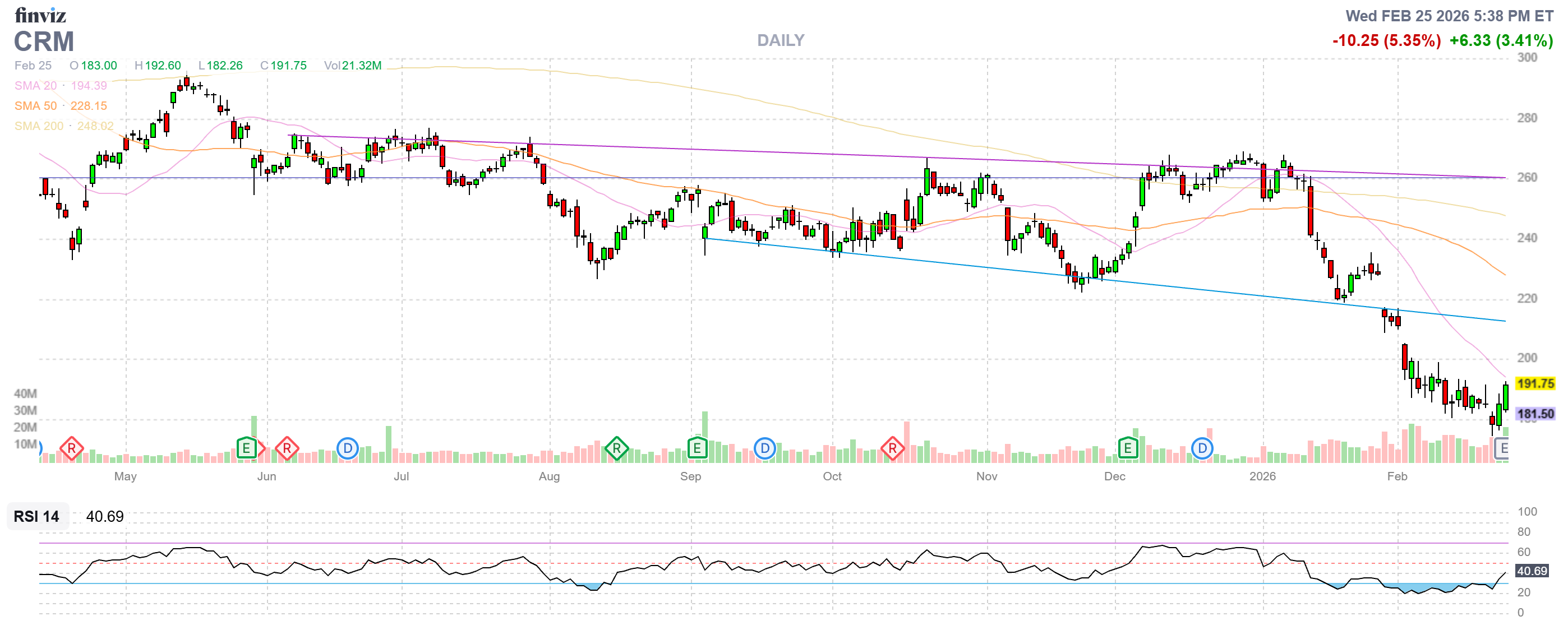
Penny:So Monday comes around, this report circulates, and the market just dumps everything that looks remotely like software. Salesforce, CrowdStrike, Workday, they all got crushed.
Roy:It was an absolute bloodbath for the Matrix economy. But then, just like with the tariffs, we hit Wednesday, and the narrative completely shifted.
Penny:Turnaround Wednesday, what changed the story?
Roy:Anthropic.
Penny:The AI Lab, makers of Claude.
Roy:Right. They announced a massive partnership with FactSet and released tools specifically designed to help enterprise software companies.
Penny:So instead of the story being AI destroy SAWS, the new story is AI supercharges SAWS.
Roy:Precisely. It's an enhancement, not a replacement. And the absolute best example of this whiplash was IBM. Yes. This is a case study that really highlights the be the house philosophy we talked about earlier.
Penny:That IBM story is fascinating. So Anthropic release a tool that can automate COBOL code modernization.
Roy:Okay, let's pause. We need to explain COBOL because to a lot of people that sounds like a delicious dessert.
Penny:Or a terrible eighty's movie villain.
Roy:Right. COBOL is a programming language from the nineteen sixty's. It is ancient, it is clunky, and it runs virtually the entire global financial system.
Penny:I think the stat is something like 200,000,000,000 lines of code are still in use.
Roy:Something crazy like that. Every single time you swipe a credit card, book a flight, or check your bank balance, there is some kobold chugging away in a mainframe somewhere.
Penny:And because it's so old, the human beings who actually know how to fix it are all retiring. Or worse.
Roy:Right. So IBM makes an absolute fortune charging massive consulting fees to maintain and modernize this old code.
Penny:So the news hits, Anthropix AI can write COBOL. And the market goes, well, RIP IBM, who needs expensive consultants when the AI can do it for free?
Roy:And IBM's stock dropped over 13%.
Penny:That's huge for a company that size.
Roy:It was their worst trading day in twenty five years. Billions of dollars in market cap just evaporated because people thought IBM's entire consulting arm was obsolete.
Penny:But then Bodie McBoatface, the systems architect from the roundtable stepped in. What was his reality check on this?
Roy:Bodhi pointed out the level one thinking flaw here. Yes, an AI can write COBOL code, but you are talking about the core settlement engines of banks like JP Morgan.
Penny:You don't just Chet GPT to rewrite the bank and hope for the best.
Roy:Exactly. If the AI hallucinates a variable, money literally disappears, the global economy melts down. You need an architect. You need someone to verify, test, secure, and implement that code. Bodhi's point was that this new AI tool doesn't replace IBM at all.
Roy:It is a shovel for IBM.
Penny:A tool to do their job better.
Roy:IBM already has its own AI platform, Watsons. They're going to use these new tools to do the modernization work 10 times faster.
Penny:But they are still going to charge the client for the outcome.
Roy:Exactly. They charge for the completed project. The bank doesn't care how many hours it took, they care the main frameworks. So if IBM can do the project with fewer hours and less manual labor, their margins don't go down. Their margins explode upwards.
Roy:The pie gets bigger. The pie gets massively bigger. Bodhi noted the market for mainframe modernization is growing to $13,300,000,000.
Penny:So the market panic on Monday was completely 100% wrong.
Roy:Completely wrong. And this is where we pivot to portfolio engineering. Because while the market was panic selling IBM, Phil's stock world was buying.
Penny:But they weren't just buying the stock outright.
Roy:No they weren't.
Penny:Okay. This is where I want you to walk us through the math. Phil sees IBM down 13%. He likes the company. He understands the reality of the COBOL situation.
Penny:But he didn't just go out and buy shares at the market price, he sold puts. Explain that mechanism to us and please do it like I'm a moderately intelligent golden retriever.
Roy:Okay. So IBM is trading down. Yeah. There is massive fear in the market. When there is fear, the price of insurance goes way up.
Roy:In the options market, a put option, it's essentially an insurance policy. It gives the owner the right to sell a stock at a certain price, no matter how low it drops.
Penny:So if I own IBM and I'm terrified it's going to zero, I buy a put to protect myself.
Roy:Right. You pay a premium to protect your downside. Yeah. Now Phil Phil is the house. He's the insurance company in this scenario.
Roy:He isn't buying protection. He is selling it.
Penny:He's writing the policy.
Roy:He looked at the 2028 put options with the strike price of $220 and he sold those contracts. By doing that, he made a legally binding promise. I promise to buy IBM at $220 anytime between now and 01/20/2028.
Penny:Wait. If the stock drops to $150 he's forced to buy it at $220 That sounds like a terrible deal.
Roy:It sounds incredibly risky until you look at the premium. For making that promise, the panic market paid him $40 per share in cash upfront today. $40 a share? Yes. So do the math.
Roy:If he has to buy the stock at 2 and 20, but he already has $40 in his pocket, what is his actual net cost?
Penny:$2.20 minus 40? Yeah. Is $180.
Roy:Exactly. So he is effectively saying, I am perfectly willing to buy this blue chip, highly profitable, 100 year old company for a net price of $180.
Penny:And at the time of the trade, the stock was trading significantly higher than that.
Roy:Much higher. So he's setting a massive price floor.
Penny:He's basically getting paid to wait.
Roy:He gets paid to wait. If IBM stays above 220 in 2028, the option expires worthless. He just keeps the $40. That is a 100% profit on the margin he put up for the trade.
Penny:And if it drops?
Roy:If it drops, he owns a great dividend paying stock at a massive discount. That is how you be the house. You don't bet on whether IBM goes up tomorrow. You bet on the mathematical fact that IBM isn't going bankrupt and you let the panicked gamblers pay you for the privilege of taking their risk.
Penny:That makes total sense. You are monetizing their fear.
Roy:Precisely.
Penny:Okay. We saw another example of this, rather an example of how not to do it in the chat room with a user named Batman.
Roy:Ah, the Batman trade. The first solar case study, FSLR.
Penny:This was a painful but really necessary lesson. Bat Batman came into the chat with what Phil called a messy position.
Roy:Very messy.
Penny:He had 600 shares of First Solar stock. Now First Solar is a great company. They are a leader in thin film solar panels Yeah. But it pays absolutely zero dividends.
Roy:Right. So he has 600 shares. Let's say the stock is hovering right around $240. That is roughly $144,000 just sitting
Penny:Just sitting in the account.
Roy:$144,000 of dead capital. It is not generating any income. It is just sitting there hoping for capital appreciation.
Penny:Hoping the price goes up.
Roy:And on top of that, he had a salad of random long and short options, some calls, some puts, without any clear structural strategy.
Penny:He was what Phil called an opinion trader.
Roy:He had an opinion. He said, I like the stock, but he didn't have a structure. Opinion trader wakes up and asks, Is the stock up today? If yes, they are happy. No, they are sad.
Roy:A structure trader asks a completely different question. How do I make money if I am wrong?
Penny:So how did Phil fix Batman's position? How do you take a messy pile of stock and turn it into a fortress?
Roy:You convert the dead capital into income. Phil advised him to sell covered calls.
Penny:Walk us through the mechanics of that.
Roy:Okay, Batman owns the 600 shares, Phil tells him. Sell the $20.28 240 strike call options against those shares. By doing that, Batman is making a promise to sell his stock to someone else at $240 in 2028.
Penny:But he already owns it at roughly that price, so he's capping his upside if it goes to 400 he still has to sell at $2.40.
Roy:He is capping his upside yes but in exchange for giving up that upside he collects about $35 per share in premium right now. Today. Today That is $21,000 in instant cash deposited into his account. Oh, 21,000. Yes.
Roy:So immediately his break even price drops from $2.40 down to $2.00 5. He has created a massive synthetic dividend. He has buffered himself against a 15% drop in the stock price.
Penny:And if the stock shoots up to 300
Roy:He sells his shares at 240 plus he keeps the $35 he got up front. So he still makes a really solid profit.
Penny:But he misses out on the moonshot.
Roy:He misses out on the moonshot, but he completely eliminates the risk of a minor crash wiping him out. That is the trade off. The house doesn't need to win the lottery. The house just needs to win the mathematical average over time.
Penny:That is a crucial distinction. The gambler desperately wants the moonshot. The house wants the steady grind.
Roy:And in a market like this, with unpredictable tariffs and AI panic, the steady grind is genuinely the only way to sleep at night.
Penny:There was one more panic opportunity this week that I want to touch on before we move on, Blue Owl Capital, ticker symbol OWL. This is in the world of private credit.
Roy:Right and this connects directly back to this apocalypse fear we were just talking about.
Penny:Because Blue Owl lends money to software companies.
Roy:Exactly, they are a massive player in software lending. So when retail investors got scared that software was dead, they got terrified about the lender holding the debt.
Penny:And then the news hit that Blue Owl gated a retail fund. I mean that word gated terrifies people.
Roy:It does, it sounds like can't have your money.
Penny:It triggers an immediate bank run mentality.
Roy:It absolutely does. But we have to look at why they gated it. It wasn't because the underlying loans were defaulting, it was a liquidity mismatch. Too many retail investors tried to pull their cash out at the exact same moment.
Penny:Like everyone trying to run out of a burning theater but the theater isn't actually on fire.
Roy:Great analogy, and we know it wasn't on fire because Bodhi checked the data. Blue Owl had just sold one third of that exact fund's loan book to sophisticated institutional investors.
Penny:And what did the institutions pay?
Roy:They paid 99.7% of par value.
Penny:Meaning they paid 99.7¢ on the dollar for those loans. Correct.
Roy:The loans are incredibly solid, the assets are good, it was purely a structural liquidity issue with the retail side of the fund.
Penny:But the stock tanked anyway.
Roy:The stock tanked and the dividend yield spiked to over 8%. So the PSW recommendation was clear. This is a fee stream compounder. It's a business that literally prints money through management fees. The market is giving you a massive discount because of a false narrative.
Roy:Buy the dip or sell puts to buy it even lower.
Penny:Again looking at the math, not the scary headline.
Roy:Always the math.
Penny:Okay. We've covered the matrix panic, the software side. But Zephyr, our macro logician, is spotting a massive rotation. Money is leaving the matrix and moving to the atoms.
Roy:The physical stuff. Because you can't code a power plant. You can't prompt an actual bridge into existence on ChatGPT. We are seeing capital aggressively flow into what Zephyr calls halo assets.
Penny:Halo. Heavy Assets, Low Obsolescence
Roy:Think of companies with massive physical footprints and logistics networks that are nearly impossible for a start up to replicate. JM Smucker, UPS Exactly, or Home Depot. They actually beat earnings this week. Why? Because despite high interest rates, the physical infrastructure bill money from the government is still flowing into the economy.
Roy:Roads are being paved, bridges are being fixed. That requires physical concrete, steel, and tools.
Penny:And my absolute favorite example from the report, Domino's Pizza.
Roy:The affordability wall.
Penny:Explain this one. Why is a pizza delivery chain a defensive asset in 2026?
Roy:Because consumers are broke. We just talked about beef being nearly $7 a pound.
Penny:Right.
Roy:People are trading down. They stop going to the nice sit down restaurant and they order a pizza on a Tuesday night instead. But the key Adam's argument here is the logistics.
Penny:How so?
Roy:To deliver a hot pizza to a house, you need a physical supply chain. You need dough factories, tomato sauce, massive commercial ovens, physical retail locations, and human drivers and cars. AI can optimize the delivery route, sure, it can take the order on the app but it cannot teleport the pepperoni to your front door.
Penny:You can't download a pizza.
Roy:You cannot download a pizza. So Domino's has a moat. It is protected by the physical atomic reality of its business model. It's a boring business, but in a spacebocalypse, boring is beautiful.
Penny:Speaking of boring but beautiful, let's talk about HP Inc. Ticker HPQ. This was another major trade recommendation from the deep dive unit.
Roy:This brings in Anya, the psychologist, and Jubal, the risk analyst.
Penny:So the setup is HP reports earnings. They actually beat the earnings per share expectations. They reaffirmed their forward guidance.
Roy:And the stock fell 5%.
Penny:Because they warned about rising memory costs, DRAM and NAND chips are getting more expensive.
Roy:So the market hears the phrase cost increase and immediately hits the sell button.
Penny:But Anya's take was really interesting here. She said the market is currently manic.
Roy:It is. It only wants AI level margins. If you aren't NVIDIA, if you aren't showing 70% gross margins, the market treats your stock like garbage.
Penny:But Jubile ran the numbers.
Roy:And the valuation is just absurd. After the drop, HPQ is trading at roughly six times its projected 2026 earnings.
Penny:Six times earnings? That is incredibly cheap. The S and P average right now is what? 22?
Roy:Or higher. A massive multiple compression. Jubile calls it a value plus growth play. The logic is so straightforward. PC demand has a physical floor.
Roy:Computers break. You have to replace them.
Penny:And the Windows 11 refresh cycle is forcing corporate IT departments to upgrade anyway.
Roy:Exactly. And HP is a cash cow. They buy back their own stock constantly. They pay a great dividend. It perfectly fits the Halo theme.
Roy:It's a heavy asset hardware business that isn't going anywhere.
Penny:It's the exact opposite of the dream stocks. It's a reality stock.
Roy:And when the dream turns into a nightmare, you really wanna own reality.
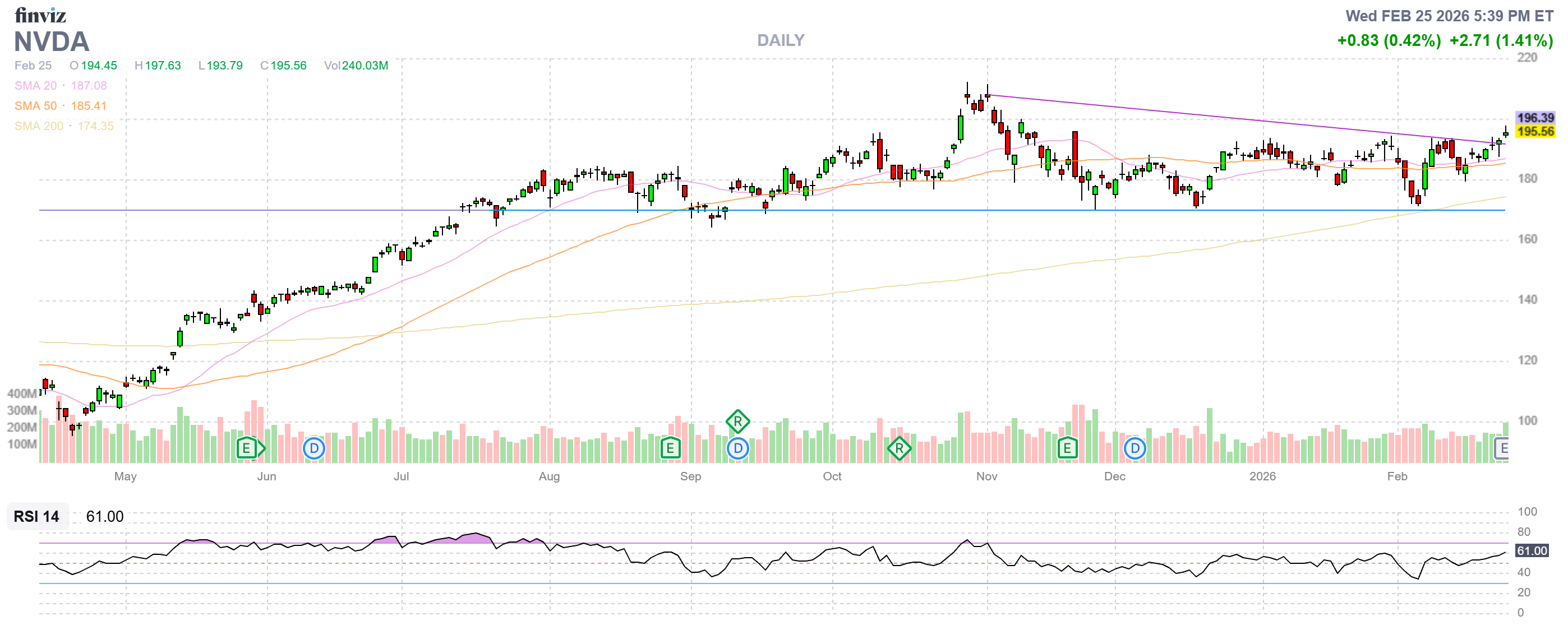
Penny:Which brings us perfectly to the absolute center of the dream. The Super Bowl of the stock Nvidia earnings.
Roy:This is it. Reporting today, Wednesday, right after the closing bell, the entire market is holding its breath.
Penny:The expectations are astronomical.
Roy:They need to show an annual revenue run rate of $115,000,000,000 For just the fourth quarter alone, the street wants over 25,000,000,000.
Penny:And if they miss?
Roy:If they miss or honestly even if they just meet expectations without completely blowing them out of the water and raising guidance, the air comes out of the balloon. Nvidia is effectively justifying the valuation of the entire Nasdaq and S and P five hundred right now. It is the single pillar holding up the roof.
Penny:But the report highlights a constraint that isn't about demand. Because we know everyone wants the new black well chips. It's about the Adams economy again. It's about power.
Roy:This is the massive collision point. The data centers required for these chips consumed 4.4% of total US electricity in 2024.
Penny:Which is equal to the consumption of the entire country of Pakistan.
Roy:Yeah.
Penny:And that number is only going up.
Roy:It's going vertical. But as we discussed with the SOTU pledge, you can't just build more power overnight. Jensen Huang, the CEO of NVIDIA, is a brilliant salesman. He will get on that earnings call and talk poetically about the future of computing. But the sophisticated investors, the house, they are asking a different question entirely.
Roy:Can your customers actually plug these things in?
Penny:Right. Because if Microsoft buys $10,000,000,000 worth of chips, but they can't turn them on because the local utility company says we literally don't have the amperage, then Microsoft stops buying chips.
Roy:Exactly. Inventory builds up, pricing power collapses. It's the physics problem. You cannot code your way around a lack of electricity.
Penny:And to add to all this tension, the Fed released their severely adverse scenario for the twenty twenty six Bank Stress Tests.
Roy:This is the Fed's annual nightmare simulation. They test the major banks against a hypothetical disaster to see if they hold enough capital. This year, the scenario is explicitly modeled around an AI bubble burst.
Penny:What does that look like in their model?
Roy:A 54% crash in the broader stock market, 10% national unemployment, and a complete collapse of commercial real estate.
Penny:That is just cheery.
Roy:It's a stress test. It's not a forecast.
Penny:Sure.
Roy:But the fact that the Federal Reserve is designing their worst case test around an AI crash tells you exactly what they're worried about behind closed doors. They see the concentration risk, they know that if Nvidia cracks today, the ripple effects could trigger that exact scenario.
Penny:So we have the market teetering on physics, teetering on earnings and Fed anxiety, But there's one last layer we really need to unpack today, and honestly, this one is the one that keeps me up at night, the financialization of reality.
Roy:This comes from Kyoto's special report, the truth you can buy. We're talking about prediction markets, like Polymarket and Kelshi.
Penny:These have just exploded in popularity over the last two years. You can bet on elections, you can bet on interest rates, whether a CEO gets fired.
Roy:You can bet on whether Zelensky wore a suit to a specific dinner.
Penny:That was a real market.
Roy:That was a highly liquid, real market. This is where it gets incredibly weird. The premise of these markets is that money equals wisdom. The efficient market hypothesis says that the price of an asset reflects all available public information. So if the odds on Polymarket say something is 70% likely to happen, society starts treating that as the truth.
Penny:But Chiodi argues it's not a truth engine, it's becoming a truth factory.
Roy:Think about the incentives here. In the old days, if a billionaire wanted to influence a political election or shift a public narrative, they had to buy PV ads, hire lobbyists, maybe buy a newspaper. It was very messy and indirect. No. Now they just go to Polymarket.
Roy:Let's say there is a market for will candidate x win?
Penny:A whale just dumps $10,000,000 on yes.
Roy:The odds immediately spike from 50% to 80%.
Penny:Exactly. And here's the dangerous feedback loop. Journalists who are starved for resources and hard data look at Polymarket. They see 80%. They write a headline.
Penny:Candidate x surges in prediction markets. And then the voters read that headline. They think, wow. Everyone is voting for x. He must be the inevitable winner.
Penny:It creates real world momentum.
Roy:It becomes a self fulfilling prophecy, engineered entirely by liquidity. You aren't discovering the truth, you're actively manufacturing it.
Penny:It's like a Soros style reflexivity loop, but applied directly to democracy.
Roy:Precisely. And we saw how broken this mechanism can be just recently. There was a market on whether Biden would meet with Trudeau. The market resolved to no and paid out the no betters because the meeting wasn't officially reported by the specific news sources listed in the market's arbitrary rules, even though the meeting almost certainly happened behind closed doors.
Penny:So the market truth was completely different from actual truth.
Roy:Exactly. Or betting on the exact words Jerome Powell uses in a press conference. Traders were betting millions on whether he would say the word renovation or revolution. It's gamifying reality.
Penny:Quixote's warning here is that this threatens the very concept of objective truth. If truth is just price, and price can be moved by whoever has the biggest wallet, then the whales literally own the truth.
Roy:And in a world of whiplash Wednesdays, where we are already so confused by sudden tariffs and AI deepfakes, turning reality into a literal casino game is incredibly dangerous.
Penny:So we've covered a massive amount of ground today. We have the political theater of the State of the Union versus the hard physics of the power grid. We have the fake sespocalypse versus the very real profits of companies like IBM and Domino's. We have the be the house portfolio engineering versus the rampant gambling of the masses. And we have the gamification of truth itself.
Roy:It is a market caught violently between two worlds. The fear of a fictional 2028 collapse and the extreme greed of the 2026 AI boom.
Penny:So what is the final takeaway for you listening? What do you actually do with all this?
Roy:You go back to the core philosophy, stay calm, look at turnaround Tuesday. The people who panic sold their software stocks on Monday because of a fictional report, they lost real money. The people who sold the puts, who acted as the house, absorbing that fear, they made money.
Penny:Structure over opinion.
Roy:Always structure over opinion.
Penny:I want to leave everyone with one final thought from the research today. It wasn't the main focus, but there was a brief mention of a Harvard AI study that is just The study found that an AI could successfully predict 71% of mutual fund managers' decisions.
Roy:71%. That is probably higher than the managers could predict their own behavior.
Penny:It suggests that the experts, the highly paid humans running the money on Wall Street are so predictable they are basically just algorithms made of meat.
Roy:Which leads to a really provocative question. If the algorithms can flawlessly predict the fund managers and the prediction markets are gamifying the news and the AI is writing the software who is actually driving the car?
Penny:Are we investing or are we just participating in a massive simulation where the only way to win is to realize the game is rigged, stop guessing the outcome, and just build the casino?
Roy:Be the house. It is the only way to play.
Penny:I think on that note, need to go check my IBM puts and maybe order a pizza, a physical pizza.
Roy:Good call. Get the pepperoni.
Penny:Definitely. Check the Nvidia numbers. They're probably out by the time you hear this. Look for the truth in the math, not the headlines. Thanks for listening to the deep dive.
Roy:See you next time.