Subscribe
Share
Share
Embed
“If I don’t cut this mast free, I’m going to die.”
“Your worst-case scenario can become your greatest preparation.”
“I’m not an Amazon warrior. I’m just someone who tried.”
“If you combine fear with action, it becomes courage.”
“Every action matters, especially yours.”
They’ve swum oceans, scaled mountains, launched empires, and shattered expectations. But before they did any of it, someone, maybe even themselves, thought: “You can’t do that.”
Hosted by Sam Penny, Why’d You Think You Could Do That? dives into the minds of people who said “screw it” and went for it anyway. From adventurers and elite athletes to wildcard entrepreneurs and creative renegades, each episode unpacks the one question they all have in common:
“Why'd you think you could do that?”
If you’re wired for more, haunted by big ideas, or just sick of playing it safe, this is your show.
Sam Penny (00:00)
What do you do when the mast snaps? Not a crack, not a wobble, but it's gone. You're 1000 miles from land. There's no engine, there's no sails and no backup. It's the Southern Ocean, arguably the most dangerous body of water on earth. Winds howling at 70 knots, waves the size of buildings and you've just been thrown across the cabin. Your ribs are bruised, you're concussed. There's no rescue plane. There's no support boat, just you.
and whatever you do next. Most people would panic. Most people would never be out there in the first place. But this episode isn't about most people. It's about someone who built a jury rig from broken parts, who sailed for 12 days while injured, and who, after surviving
have ended her career, went back and broke the world record. She is now a world record holding solo sailor.
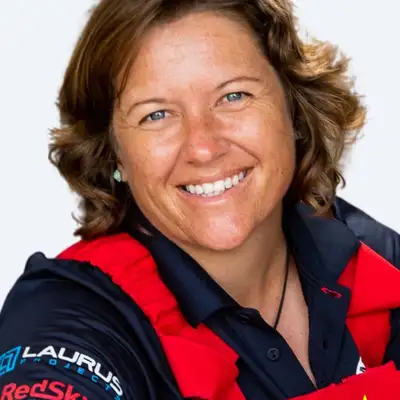
bestselling author of Facing Fear and the subject of the 2024 documentary Ice Maiden. This is a story about what happens when you meet fear head on and choose to keep moving anyway. This is Why Did You Think You Could Do That? And this is Lisa Blair. Welcome, Lisa.
Lisa Blair (01:16)
Hi, thanks for having me on the show, Sam.
Sam Penny (01:19)
I'm really looking forward to this chat because your whole story is so epic. ⁓ And we're going to dive into so much of what you've done, some of the trials and tribulations that you faced. They're absolutely amazing. But before we jump into some of the epic adventures, it seems like you were born on a boat, but you only started sailing when you were 25.
Lisa Blair (01:24)
You
Yeah, so when my folks got divorced, my mom got a lot into sailing. So I'd been on boats a little bit growing up, but it wasn't an environment that I really learned to sail through or had a passion or a love for sailing. And then one random university holiday break was meant to be just a three month summer job. I got a job as the cook and the cleaner on a charter boat and my entire world changed. And I went from being
Aspirations of being a high school art teacher and finishing my degree to let's go and sail a boat around the world and do crazy stuff at sea. But it was certainly not something that happened overnight.
Sam Penny (02:21)
So what was it that then captivated you so deeply about sailing?
Lisa Blair (02:25)
Initially, it was really just an area that I excelled in. I loved the problem solving. It's almost like trigonometry at sea where you've got to trim the sails and understand how the power of lift works to capture the wind, to then cross an ocean or to get yourself from point A to point B. I loved that there was all these other challenges that came with sailing. So like, you know, the bilge pumps would break and you have to do 12 volt electrical wiring or...
A mechanical part would fail and you'd have to rebuild it or a winch would need servicing or ropes would need splicing or a sail would need repair. And so I really loved that I was learning kind of this wide range of skills. And then I worked that job for about a year and signed up to do a yacht race around the world, which is an amateur race. But effectively it's called the Clipper around the world yacht race. And so you've got 10 identical boats, complete strangers sign up.
and basically race each other around the planet. And for me, my first ocean crossings, everything was really around that tranquility and peace and that the sort of vastness of the ocean, but the fact that you kind of formulate a bit of a symbiotic relationship with the sea to allow you to sort of harness the winds and actually be able to power yourself across an ocean. And I just fell in love with that.
Sam Penny (03:44)
Fantastic.
You know, the Clipper around the world is actually on my bucket list and my everyday hat is a clipper hat. I love it. ⁓ Sailing is such a, for me, it's one of my pure joys and pure passions. I've been sailing since I was a little kid, ⁓ but nothing like what you've done. Now, most people, they spend their lives avoiding risk, but you really seem to walk towards it. So what has really drawn you to the edge?
Lisa Blair (03:49)
Yeah.
think there's a big difference and it's a perspective shift that you have to go through, but there's a massive difference between perceived risk and actual risk. And for me, it was really around how do you take something that everyone else perceives as impossible or incredibly difficult and dangerous? And how do you put control measures in place? How do you make it as safe as possible to undertake that voyage? What skill set do you need? How do you
How can you improve yourself to become capable of undertaking that type of voyage? And that was the problem that I've, I guess, been trying to solve throughout my career.
Sam Penny (04:53)
And this really led you into doing some amazing adventures. And one that really captured headlines around the world was in 2017, when you attempted a world record to become the first woman to do a solo around Antarctica. This was quite an epic adventure. So let's go there. Let's go into the Southern Ocean. It's 2017. Your mast breaks.
What do you remember about that moment when it broke?
Lisa Blair (05:24)
I remember absolute just my mind screaming at me, this is so not good. This is so not good. This is so not good. was like on a repeat in my head. To give, I guess, like the listeners a bit of context here, the conditions at the time were eight meter seas. So imagine a two or three story building as a wave, but it's the Southern Ocean. I'd been sailing in those conditions like for months and it had been fine. And this was day 72 at sea. So it already sailed.
three quarters of the journey around Antarctica. And then I had 45 knots of wind blowing through at the time, but it's cold wind. And cold wind applies a completely different pressure to warm wind. So if you think about 30 knots of wind on the Sunshine Coast in Queensland, I'd have all my sails up and the boat would still be sailing like perfectly fine. 30 knots of wind in the Southern Ocean and I'm down to my storm sails and barely holding on.
So 45 knots of wind in the Southern Ocean is a huge amount of pressure because of that colder, more dense air. So I had been at sea and been isolated for that period of time. I'd seen land once around Cape Horn and then this situation occurred and it was just going on nighttime. So no perfect scenario. It always happens in the dark. And initially a piece of rigging wire snapped and
I was in my bunk trying to get a 20 minute sleep. I had a new storm coming through that night. So the conditions were likely to get a lot worse throughout the rest of the evening as that storm kind of passed over me. And as I was in bed, I just heard this almighty like crack. And you know, with that kind of noise that it's something critical, but you didn't know what yet. And so I initially thought it was something at the back of the boat and that all looked totally fine.
I then looked to the front of the boat and my heart just kind of sunk in my stomach. I feel like I must've been white as a ghost I looked up. And all I could see was that aluminium mast of mine, which is 22 metres long, just like bending and flexing like a hula girl kind of shaking her hips because it was completely unsupported. And my initial reaction, and this falls back to that preparation and planning phase, my initial reaction was tack the boat.
change the direction of the boat and put the pressure of the wind and the sails on the other side of the mast. And then I would have a chance to lower the sails, run repairs, get a drogue out, ride the storm out, and then fix it the next day kind of thing. ⁓ But unfortunately, as I was clipping my life jacket shut and just exiting the hatch to get on deck to do exactly that, I heard the mast coming down. And it was just so violently loud.
It was the whole boat shakes and shutters around you as these forces come crashing down. And I knew in that instant without even looking that I'd just dismasted. I didn't know how bad or how severe a dismasting it was. And there are easier dismastings to others depending on where the mast actually snaps. And in a lot of my like theory conversations with shipwrights and riggers before departing,
We've been talking through different dismastings and the likelihood that it would probably snap at one of the spreaders, which is one of the cross arms that you see up a mast for anyone listening. And unfortunately for me, it snapped completely off at deck level. So there was nothing sticking out of the boat anymore from the mast and it had fallen to the right hand side. But because it's all sort of tangled up with all the ropes and the other pieces of rigging that didn't break, the
bottom sort of two meters of the mast is trapped on the deck of the boat. And then the rest of the mast and debris is in the ocean to beside me on the right hand side, like the starboard side of the boat. And what that meant was it effectively anchored me to the middle of the ocean in a storm of eight meter seas. So instead of these waves like passing with me, I'm now stationary in breaking eight meter seas. And so these waves are breaking clean across the boat and
The whole boat rotated around. So now I have this mast in the water. These waves were hitting the debris in the water first, pushing it up on the boat further. And as it would drive it forward, all the extra ropes and the halyards and stuff started breaking and like snapping like candy. And they have a safe working load of 30 tons. And so they have a breaking strain of like nearly 60 tons.
Sam Penny (09:58)
Wow.
Lisa Blair (10:01)
And they were just breaking because of the force involved by these waves pushing it up and driving that mast forward. And then the wave would hit the boat itself and would almost try and throw the boat out from underneath the mast as the rest of the mast is kind of gripped in the ocean with the friction of the sails on the surface of the ocean. And so what actually started happening was it created this like hugely aggressive, like push-shove, push-shove kind of repeated motion.
And it was so violent, it literally started to cut the boat in half. Like it started soaring through the deck of the boat. So yeah, that kickstarted what became probably the most significant ordeal I've ever, well, definitely the most significant ordeal that I've ever faced. ⁓ But right up there with one of the worst case scenarios any sailor could face at sea.
Sam Penny (10:54)
Now, from what I understand, you sustained some injuries during this.
Lisa Blair (11:01)
Yeah, I mean, you're crawling around on the deck of the boat, every wave that comes through is ripping you clean off the deck and just smashing you into the rails on the bottom end. ⁓ So you just batted and bruised all over. I also was going into hypothermia quite early on and continued to deteriorate into hypothermia as the evening kind of progressed and the scenario developed. and then because I was shaking so hard.
I was trying to use my hammer to disconnect the piece of rigging rather than trying to cut it because I was getting submerged up to my neck in white water every sort 30 seconds. so using something like a battery operated angle grinder wasn't going to work in those conditions. The bolt cutters weren't strong enough. ⁓ I couldn't get a stable purchase for them given that the boat's like heaving and throwing around everywhere. So I defaulted to trying to knock the split pins out and I was smashing my hand so hard.
Well, trying to hit the screwdriver, but I was smashing my hand accidentally that my whole left hand kind of ballooned up ⁓ quite severely. And then as I went into further hypothermia, I started to get to the point where that brain fog, vacant moments started occurring and I could see the signs and I again, talked to medical professionals before leaving about what to look for, all of these things. ⁓ But
When you're living it, you still have to save the boat. Or if the boat sinks and I'm in a life raft in those conditions, there's no way help's coming in time to save me. I'm more than three days from the closest or the fastest possible option for rescue. And if my 50 foot boat is getting buried under eight meter breaking waves, a life raft is never going to survive those conditions. It's too rough, too big a swell. You just get doughnutted down the face of these enormous waves.
And so I knew as I started to get to a point where I had to physically look at my hands to close them around tools, to know I'd hooked a rail properly, to know I was holding on correctly, doing things like trying to undo my safety tether and re-clip it became almost impossible because you just couldn't, like I just was losing mobility, like really, really fast. And at that point,
I had to go out onto the bowsprit, which was probably the most dangerous section of the whole sort of ordeal. And this is about three hours into the emergency itself. So, you know, I'm already significantly damaged at this point as far as like bumps and bruises and just general fatigue. I also haven't slept.
in the entirety of the record for more than 20 minutes in a single sleep. So that accumulated fatigue on the body is quite extreme. you kind of almost just running straight off adrenaline. But yeah, it was certainly an an intense ordeal. And, ⁓ and I'm incredibly fortunate to be able to share the story with people.
Sam Penny (14:09)
Yeah, 100%. You're pretty well battered and bruised. ⁓ Carrying some injuries, you've got hypothermia setting in. In this moment, what kicks in first? Is it fear or is it focus?
Lisa Blair (14:26)
fear, your fight or flight response for sure. ⁓ And initially for me, that was out of panic. Like it showed as panic. I panicked for about 15 minutes and I went straight into default mode of where's my tools. I need to cut it free. I need to cut it free before it sinks the boat. And I also knew that if one of those waves pulls like a little bit harder, it could actually pull that stump of the rigging off the deck.
And then the next wave would like push it up through the hull of the boat. And I'd really start having a pretty serious problem on my hand. And so I was in an absolute chaos flurry. I wasn't really thinking clearly in that first 15 minutes. I didn't tell anybody that it had occurred. I just ran for the bolt cutters and started trying to disconnect the back, backstay piece of rigging. And I grabbed what I'd put together, which is my dismasting kit.
And so that was me defaulting on my training, but I still wasn't really thinking it through. wasn't thinking clearly. I was still in full panic motion. I'm shaking so hard from the adrenaline run that I can't even use the tools properly. I'm getting smashed by these waves. I don't know how much time I have, whether I have a couple of hours, a couple of minutes, like how quickly this will deteriorate or the situation is going to get worse. ⁓ and
It wasn't until I realized that my tools weren't working. And I remember very clearly, like, and it's all kind of internal monologue, but screaming at myself, like, this isn't working. This isn't working. I need to find more tools. And so I bolted back into the boat, no care for safety or like personal safety or bruises, or I just threw myself back into the boat. And I went straight to my like tool section in the galley area.
and started just ripping it apart. And I'm in full panic, just trying to find something that I think is going to actually like save me. And I'm like tearing tools out, throwing them, discarding them, trying to find, and I know what's on board. I know there's nothing else in there, but I'm trying to find a better option. And it was while I was inside the boat doing that, that I started to think I should probably tell somebody that this is happening, that I might not live through the night. ⁓
And so I paused on the tool finding mission and I called my shore manager up, Jeff. And Jeff's a volunteer, he's a master four incredible skipper. And he met me a couple of years earlier at a boat show and just said, I want to support. And so he jumped on board as the shore manager. And in these sort of emergency situations, you don't contact your family because it's too emotional. You have to have a delegated third person that you would contact.
So I called Jeff, it was about 3 a.m. in Australia and it was about 10 p.m. local time for me. And I just said, I've dismasted, I've dismasted and he's asleep trying to wake up to this call and he's like, okay, ⁓ no, no. And then he's like so empathetic and he's just like thinking, no, not realizing I feel like the boat's going to sink underneath me any minute and I'm in full panic mode. ⁓
And then he started to ask me some questions and I just said, I've got no time. I've got no time and I hung up. ⁓ Or I issued a pan pan at that point. ⁓ And a pan pan is one step below a Mayday. And I didn't issue a Mayday because I knew help would absolutely never get there in time to actually save me. And so by issuing a pan pan, it puts everyone on red alert that a situation's unfolding. But the reality is, is it's up to me to save myself.
out there and I knew that when I undertook the voyage and I knew that in that moment. ⁓ And so I hung up the phone and then at that point I had had enough of a window of time to sort of start approaching things from a logic perspective than a place of like adrenaline and fear and panic. ⁓ And so then I like grabbed some extra tools ran up on deck and then really started to look at the way the mast was laying.
which pieces of rigging would I disconnect first. I went back to the original backstay piece and when I, it took me about another 15 minutes to knock that piece free. And by the time, so I'm about 30, 40 minutes into the whole emergency at this point. And I knocked the first piece free. And that to me was a big relief moment because it meant that I might have a chance of surviving that. Like that was my first bit to say that I might live through the night.
And so that gave me a lot of hope and it allowed me to then just go, okay, logically, what's the next piece I need to attack now? And, you know, that common sense and logic section sort of had started to take over.
Sam Penny (19:16)
Wow, absolutely amazing. I know I can see you getting emotional about it. As they say, prior preparation prevents piss poor performance. You spoke earlier about how you had a lot of systems in place, checklists in place, and there's obviously quite a bit of muscle memory that kicked in whilst you're going through this and problem solving your way through this.
Lisa Blair (19:18)
And as you can see, I tear up every time and I'm tearing up now.
Yep. ⁓
Sam Penny (19:47)
much do you credit your still being here today to your preparation and talking through all the different scenarios with people.
Lisa Blair (20:01)
say 95, 99 % of me surviving that night was that those conversations, that preparation. And it wasn't even just talking it through with people. I went to such a high degree of visualization before I left that I effectively sat on the deck of the boat, or I'd be like getting the bus to work and like trying to raise the money. And I'd be thinking through every scenario that's likely to take place, like every worst case scenario.
And so I'd sit on the boat and I'd be like, okay, if the mast snapped here, this scenario would develop. And then if I wanted to build a jury rig, how would I build a jury rig when I only have this much mast to play with and what would I do? And so I'd like go through all the scenarios. The biggest thing I think I didn't do in that was think about how I would emotionally respond.
Cause I very logically went through all these scenarios and that preparation planning, but I hadn't really thought about how I'd emotionally respond in the emergency. like after that initial 15, 20 minutes and starting to get my emotions under wraps and starting to think logically, that was all great for a couple of hours. And then I had to go out onto that bow and you know, climbing over the rails to go onto the bow sprit. had 50, 50 shot that I would survive. ⁓ and I knew that.
going into that. So that to me was probably the hardest part of this whole scenario because you have to put yourself in a position of greater risk where you know your chances of survival are almost nil. And if you don't do that, your chances of survival is guaranteed nil. And so to give myself a ⁓ small chance of survival, I had to put myself in a position where I might die.
If that makes sense. ⁓ so, you know, that was a second blow emotionally around like your mental attitudes. Look, I'm crying from it. ⁓ your mental attitudes at sea. and no, I don't think any real level of training could, could have prepared me to go through that.
Sam Penny (22:02)
Yeah.
Lisa Blair (22:14)
⁓ no real level of conversation and discussion because you just don't know how you're going to respond in such an extreme situation until you're actually faced with it. and I also think like the, the tools in that were working. So I knew that would work, but like before I leave harbor for these conversations, like for these records, I'll talk to my family about the fact that if I don't come home, it's okay. ⁓
And I say that because I'm out there living. I'm out there living my life, having amazing adventures, having incredible magic moments at sea. And I could die in a car accident tomorrow and have never tried. And I'd rather go out in these incredible scenarios and give it a crack and have all the right tools and the preparation and planning and everything to back it up. Then to like never have had that go, but it's a very different scenario to then
have had that in theory, that idea that you might not live to then be well, actually in the next five minutes, I might not be alive anymore. And so for me, that was like the part where I really came unstuck on within that night and that scenario.
Sam Penny (23:31)
It's interesting, Lisa, I had a conversation recently with a guy called Lazarus Lake, who's created the Berkeley Marathons and just does really amazing stuff. he's, he's front and center, seeing people turn themselves inside out and go to the extremes of what the human body can do. And one of the, part of the conversation that we had was about why humans now are seeking out adventure.
Lisa Blair (23:48)
Yeah, absolutely.
Sam Penny (23:59)
And he said, you go back three million years when we're cavemen and every day was adventure. Every day was trying to keep ourselves alive. And we had predators always chasing us. That's all been removed. And now we're in a position where we're out there seeking adventure to feel alive again.
Lisa Blair (24:17)
Yeah, I definitely think there's some truth to that. I also feel like people become more capable of achieving these adventures the more adventures you undertake. And I think you find so much growth, personal growth in hardship. And you don't get that if you live a cushy life and you never try and you never put yourself out there and you never go outside your comfort zone. You don't get to grow as a person. You stay in the position where you're at.
in that day and that moment. Whereas every new project that I've undertaken, it's expanded my capacity for what I believe I'm capable of. It's expanded my ⁓ belief in myself, my trust in myself, my knowledge of what I'm capable of as far as like developing projects or having impact with climate action and all of that. And I would never have that if I hadn't have started and tried effectively.
Sam Penny (25:14)
Yeah,
one of my favourite sayings is when you get to the top of your mountain, find a bigger mountain. And it's exactly what you're doing, isn't it?
Lisa Blair (25:23)
Well, it is, but it's also once you've climbed one mountain, you know, you can climb the mountain. So it's not as challenging anymore. It seems challenging to the people who've never climbed a mountain. seems out there and completely unrealistic and completely huge. But to someone who's climbed five mountains, another mountain is just another mountain. It's another like, it's, I'm no good at like kind of contextualizing this or verbalizing this, but I, I feel like.
Sam Penny (25:28)
Yep, exactly.
Lisa Blair (25:52)
Everyone else looks at my life and goes, you're incredibly batshit crazy. And I am definitely, but I'm just living a day, like a normal day for me is setting off on a world record. it's not, it's not like, this is where my world is now. Like it's, I've grown into the person where that's my world. And I don't think I'd see it as this huge thing as much as other people see it because they've never tried to have something different.
Or maybe they've pushed a little bit on those barriers, but by doing some hiking and camping trips and sitting in their discomfort, but it's not been to the same standard or the same level of challenge or scope. ⁓ And I just feel like, yeah, I grow so much in every project that these just become part of my world. ⁓ And yeah, it's weird. Anyway. ⁓
Sam Penny (26:44)
Yeah, well.
Now
let's go back to Southern Ocean 2017. You've had this absolutely life or death situation occur. And I don't think we actually pointed out, you're a thousand nautical miles from Cape Town. You're a very long way away. How did you get back to Cape Town? It took you 12 days. What did you do? And what was the thought process going through that 12 days?
Lisa Blair (27:03)
directly south, yep.
Yeah, well, I mean, after I was able to save the boat and cut the rest of the rigging away, the mast itself tore off the deck and I had put a retrieval line on it, but it sank and it's effectively a giant anchor. And so as the boat's moving up and over these two story building waves, that line pulled tight. And I think by the third wave, it snapped and I lost the sails, the mast and everything with it overboard. The only thing I'd been able to salvage was my boom and
So there was a potential to be able to do like a jury rig with the boom. So that was an option in my mind. I had to make a decision based on the damage to the boat, whether I felt I was capable of building a jury rig and sailing the boat the rest of the way back to Australia, which was my initial kind of thought process. But then as I kind of assessed the damage, it was right next to the rigging, the chain plate point.
on the boat where I had this huge hole now, like the size of a large dinner plate through the deck of that boat. And I figured the risk of getting into the center of a storm where there's 10 meter breaking seas, so, you know, four story building breaking waves, pinning me between two waves or hitting me exactly the wrong position, there's a chance that it could snap the boat in half. So I opted for safety over record. And that's always been, I guess,
My winning factor is I've always put safety first. And so I had to make the decision to turn my engine on, alter the course to Cape Town and carry on. Now the engine didn't want to turn on. It hadn't been used in two months, so it didn't want to turn on at all. So that took me like an hour of troubleshooting, eventually got the engine running, made the decision to void the world record and alter course to Cape Town in South Africa. And
As I was motoring, well, actually this is the next day because I had to clear all the debris from the bottom of the boat. I had to clear all the ropes and the rigging and everything that was floating in the water around the boat from the boat before I could turn my rudder, before I could use my engine and put the propeller into gear. And so the next day I patched the hull in the side, made the decision, turned the engine on, altered course. And then I had a call come through on the sat phone. And so at the time I'd issued
the Pan Pan to my shore manager, he had forwarded that on to the MRCC, which is the Maritime Rescue Coordination Center in Cape Town, which was the rescue coordination area that we were operating in. ⁓ And so through their communications, they had decided to upgrade me to a Mayday without me knowing because I was solo and because I was so remote. And so they had diverted the closest vessel towards me. And that was a
bulk carrier ship called Fire Eastern Mercury and they were 600 nautical miles away. And so they called me up and said, do I still require the aid of the ship? And I'm like, what ship? I didn't call for a ship. I knew they would never get there in time. And because the boat was floating and I'd managed to repair the damage to the hull and all of this stuff had already occurred, I said, look, I don't feel like I need a rescue, but perhaps they could do a fuel transfer at sea.
because I didn't have enough fuel to motor the rest of the way to Cape Town. I only had 230 liters on board, ⁓ which would get me a, you know, halfway, but it wouldn't get me the rest of the way. And so they checked with the master of the ship. He got it approved by his insurance. They continued to motor South and I continued to motor North. ⁓ And we intercepted. Now that ship, you know, those sailors are at sea all the time. They spend that most of their adult life at sea on their ships, going from country to country to country.
And the conditions were so rough for them that their normal cruising speeds, 12 knots, they had to drop their speed down by 50 % to six knots. ⁓ And all the crew got seasick because they were smashing into these huge waves that they normally wouldn't encounter. Whereas I'd been like living and existing in this swell for this period of time. ⁓ so we rendezvoused 800 nautical miles from land about three days after.
initial dismasting. So I'd been motoring, slowly motoring north, they've been heading south and we met. In reality, I would have been better not trying to do a fuel transfer, but reality is, you know, one of those amazing things that, you know, hindsight and all of that. But anyway, they kindly diverted south, but they didn't speak any English. I didn't speak Korean. It's a Chinese owned ship. They weigh 86,000 tons. They're 200 meters long.
the side of the ship is 13 meters high. So you're looking up at a skyscraper and the side of my boat is 1.3 meters high. So I'm like tiny, I'm insignificant to this huge, huge ship. And they are so used to with their experience and with what cultural exposures they've had, they're so used to big ships driving against the hull of theirs, you know, like big steel tugboats and stuff driving directly against the hull.
Sam Penny (32:05)
Well.
Lisa Blair (32:30)
So when I arrived, they kept saying, come closer, come closer. We have fenders out and their fenders were two car tires hanging off the side of the ship at waterline. Now we're still in six meter seas. So they beam on six meter seas. They shut their engines down and I approached them, but they're rolling so hard, 25 knots wind, six meter seas, that their fenders one minute would touch the surface of the ocean and the next were 10 meters up in the air.
Sam Penny (32:38)
Ha ha.
Lisa Blair (32:58)
as they would roll away from the, and then they'd roll towards me and they'd touch the ocean again and then be 10 meters up in the air. And they wanted me to take a bow and a stern line. And effectively what would have happened was they would have rolled away and lifted me out of the ocean and snapped the boat in half, which was the whole thing I was trying to avoid, right? So I couldn't accept a line, but I couldn't communicate that clearly with them. And eventually defaulted to email where I'd write an email, upload the email to satellite.
and then radio them and go email, email, email. And then the master of the ship would download the email, read the email, reply to the email, upload the email, radio me and go email, email, email. And like one email exchange was about 30 minutes of time. And the whole time I'm trying to move the boat, keep it off the side of the ship, not let the ship drift into me like this whole scenario. And eventually I accepted one rope and off the back of their boat to the bow of my boat.
And as I tied it off on my boat, I looked up and they're untying me from the back of the ship. And they still haven't really understood that being on the leeward side of the ship as they're rocking so hard and they're drifting towards me or drifting sideways at a rate of about five knots, that it's dangerous for me and that I don't want to lose the boat. ⁓ And so they drag me up to where their fenders are. I'm almost holding myself in a T position like
So the ships, like I'm 90 degrees off the ship, like reversing full throttle almost off the ship as the ship's drifting towards me. And very quickly we got in a scenario where I was pinned under the side of this bulk carrier ship and they crushed the entire port side of the boat. just the whole hull of the boat flexed inwards. I had a crack, three meter long crack at the deck hull join. I lost all the safety rails on that side in seconds. And there's this one.
I'm trying ⁓
the water was dripping on the deck of my boat from the ship like it's, and you're looking straight up at this wall that's about to crush down on the boat. And I remember thinking, where's the grab bag? Where's my EPIRB? Where's my life? Like, you know, where's all my safety gear? Where's the bilge pump switch? I need to do this, this, this, prepared to lose the bow of the boat, expecting that they'll land on the bow of the boat and crush it. ⁓ And I'm still in reverse and I got
clear of them by like millimeters as the ship landed in the ocean. And for me, that was like one of those moments where you're like, sometimes the easy option isn't actually the easy option. I should have probably built the jury rig and just taken an extra 10 days to get to land and just gone the slow but reliable kind of method of slowly sailing my way up.
I did eventually get fuel off these guys and it took us 12 hours in total to convince them to put it in jerry cans, like whatever containers they had, tie them together and put that in the ocean. But I had all that substantial additional damage now, which was extreme amount of damage. And when we eventually repaired the boat, most of the repair bill was actually on the side from the ship, which was a real bummer. ⁓ And then I ended up.
Sam Penny (36:40)
Ha ha ha.
Lisa Blair (36:44)
opening the jerry cans and the fuel was black in color and I didn't know if it was going to work. And so that's when I built the jury rig and went through that extra step. And then that took me three days to build the jury rig.
Sam Penny (36:58)
Wow. So you build this jury, you make it all the way back to Cape Town. And most people just go, yeah, I've had enough of that now. But you repair the boat and you continue on to finish the rest of the journey.
Lisa Blair (37:13)
Yeah, I had lost, it was almost like I was grieving for what I'd lost with the dismasting. And I know that sounds weird because it's not an actual thing, but like to get to the start line. And I think people underestimate how much work goes into just reaching the start line on these projects. It was three and a half years of full-time work to get to the start line, to convince complete strangers to believe in me, to sponsor me, to get the boat prepared, to go through all the emergency preparedness.
all of that stuff and build my skills up was three and a half years from the idea being born to actually leaving for the project. And so I was just so lost. It was my first big project attempt. And I hate playing this card, but it is a reality that if I'm a girl and I do one big project and I fail on the first attempt, I probably would never have gotten another project off the ground. ⁓
Whereas if I could at least sail back to where I dismasted, cross my track and finish the trip back to Australia, I would have the potential of being able to do other projects like this in the future. I was really heartbroken by those decisions and going through that. the level of damage to climate action now is quite extensive, but it wasn't until somebody suggested that maybe I do it just with one stop that I really kind of started to feel like I had.
energy and life and enthusiasm. And I had something I could sink my teeth into and I could just carry on, you know? So yeah, it took us two months to repair the boat. wasn't just coming back to your original, like, why would you want to do that question? And fear, I wasn't prepared for how impactful that dismasting was going to be on me when I restarted the record.
Sam Penny (39:05)
restarting this journey to complete it, what did finishing that journey prove to you?
Lisa Blair (39:08)
Yep.
It showed me that I could deliver against all odds. Like that six months, sorry, that last six weeks back to Australia was through the center of winter in the Southern Ocean. So basically everyone was telling me that I was going to die. I had, once it went public, I had thousands of people in the media telling me that I was going to die. And people in the public messaging me, someone got a hold of my mom's phone number and called her up and said, if you let her leave, you won't see your daughter again. Like all this stuff.
was taking place at the same time. And I just knew that if I never continued, I wouldn't do another project again. And I had to just see it through. And so I didn't do it with risk. Like I didn't do it in a risky way. I'd sat down with my meteorologist, we'd talk through all the scenarios, talk through worst case weather conditions. And I determined with the experience that I had and the type of boat and how she'd responded in the existing conditions, I determined that
I'd be able to do it. And then it was a matter of just being okay with suffering a lot more for a longer period of time to get the boat back to Australia because that six weeks was brutal. was snowstorms and blizzards, 15 meter seas. Like it was just incredibly dangerous conditions. And I still felt like when I landed in Australia, I became the first woman with one stop to sail around Antarctica. And it was this huge thing because
The media played it as this big success, but I knew, like in my mind, I had failed. I, my goal wasn't to become the first woman. My goal was to break the existing speed record, become the fastest person and show people, you know, what we can do and also raise awareness of that climate action message. And I hadn't been able to do that to the capacity that I knew I was capable of. ⁓ And so I came back to Australia with the clear knowledge that I was going to do it again. I just didn't know when or how.
I knew I needed time to heal. I also like going through a scenario like that, more than anything, you lose trust in yourself and you lose trust in your boat. And not having that same trust makes a huge difference to how you deal with these storms, how you combat the extreme conditions out there and how you can rely on yourself or your boat to get you through. You don't have those, that same confidence with it. So you doubt yourself a lot more.
So I knew I needed to do something else in the meantime, and that was really like why I did the Australia records.
Sam Penny (41:45)
Yes. So the Australia records to be the fastest mono hull to go around Australia. ⁓
Lisa Blair (41:50)
Yep.
Solo, because a fully crewed boat had done it faster. And a catamaran had done it faster. Yeah.
Sam Penny (41:54)
solo exactly. Yeah, yep. And yes,
exactly. So let's fast forward because you obviously had unfinished business with Antarctica and getting around there. So 2022, you've learned so much in 2017 and all the preparation that went into that and post analysis 2022 you set off again. What did it feel like?
that moment when you set off in 2022 to circumnavigate Antarctica again. Is it a moment of bliss, calmness? Is it anxiety? What did you feel that moment when you left the dock?
Lisa Blair (42:39)
Yeah, it was a wild one because it was all of those things in one hit. It was the certainty that I knew I was going to do it. So let's just go and do it. Let's get it done. Let's tick this box kind of thing. It was also the knowledge that as much as the dismasting is this like hugely negative experience and absolutely terrifying, it showed me that my worst case scenario planning worked.
and I was able to survive it because of that. So it kind of, after years, and it took me years, and it actually took me writing the book, Facing Fear, to really come to this conclusion, and that was the first time I could reflect on it. But I came to the conclusion that it's made me a better sailor and a stronger sailor, and that as long as I have the same preparation going into the next project, there's no reason I can't walk out of it alive. There's always that 1 %...
of chaos that comes into play with these sorts of projects and 99 % preparation, 1 % chaos. And that definitely showed itself throughout the next record ⁓ attempt around Antarctica. But on leaving, it was this mix of just really trying to come to terms with the fact that I'm going to go through hell again. And I fully know that I'm going to go through hell again.
Sam Penny (43:59)
Hmm.
Lisa Blair (44:03)
going into it with the clear understanding that I chose to be there and that I chose to go and have these experiences as hard as they might be at times. Focus on the why that I'm there, you know, the sustainability. I had been able to modify the boat to do actual research at sea on this one. And so that gave me another avenue to focus in on. It didn't matter whether I succeeded on the record. Every day I could sail on that record, I was able to contribute to science and that
had so much value to me from a mental health perspective going into this project. It wasn't just doing the same trip again. I was doing it with a purpose behind it. And so that really greatly helped, but it was a really interesting and I'd love to talk to a psychologist and get a report done on this at some point, because it was super interesting because as soon as I felt like I was succeeding in the first record, it all came unstuck and I dismasted it and it all went to crap, right?
Sam Penny (44:51)
Yeah.
Lisa Blair (45:03)
So as soon as I started getting close to the finish line on the second record attempt, I started to get so incredibly anxious, so nervous. Every creak and groan on the boat was different. Like everything was about to be a dismasting or a holing of the boat or a loss of the rudder or a loss of gear, some emergency, right? And the closer I got, so like as I sailed through the area where I dismasted previously, we went through a really significant storm.
The boat was flipped upside down three times. So really dangerous conditions, ⁓ 15 meter breaking seas. ⁓ And I just remember consistently thinking, don't get cocky don't get relaxed. It's not done until it's done. Just keep your eyes on that finish line. And even like the night before arrival, coming back into port, I remember consistently thinking, don't screw it up now. Don't screw it up. Don't fall asleep.
Don't sleep through your alarms. don't, you know, just get across. And it wasn't until weeks after I crossed that finish line that I actually felt like I could absorb the enormity of that project in its entirety because I was just so focused on not allowing myself to be emotionally connected to it in case it all got torn away again.
Sam Penny (46:19)
So the difference between the two, uh, the two sails in 2017 and 2022, you spoke about how every creak, every groan put a piece of fear into you or anxiety. Was that really the big difference between the two sails?
Lisa Blair (46:44)
Conditions wise, it was more dangerous on the second trip. If you take out the dismasting and the winter section of the first record, the overall conditions on the second project were rougher. The sea state was much larger overall, more frequent storms, more snowstorms and blizzards. So it was a much more brutal trip on the second attempt overall than on the first trip. But I didn't dismast. And that's the difference.
The big thing that the dismasting did change for me, that it kind of, I I feel like it's like a loss, like it took something from me. And I feel like I've slowly been able to gain most of it back, but it's taken years. And that is that comfort factor in the center of a storm, being able to sit on the boat in the eye of a storm, the size of a hurricane, where the wind is getting torn sideways so violently that you can't breathe facing into the wind.
You have to shelter your mouth and create an air pocket to breathe in those environments. And you're looking at these waves that are sheer high rises coming barreling down towards you. And somehow the boat gets up and over them. And I used to sit in the middle of these storms and I would just be in utter awe of what I was witnessing. And the fact that I was able to survive it because the boat was the type of boat she was and my preparation, planning, all of that stuff comes into play.
But I'm such an insignificant little dot in the ocean in those moments. It's like, I guess some people have suggested it's maybe similar to like astronauts in outer space looking down on the earth. you have this magical moments in these incredibly extreme conditions where I almost feel safe because I know the boat's capable. And I lost that certainty because the boat was capable, but I still dismasted.
And the dismasting was actually a freak scenario. It was an electrical cable chafed through on the mast. And then the stray current from the electricity was traveling through the rigging and effectively aged it 10 years in four months. But all the rigging was brand new when I left. It was four months old. And it simply shouldn't have happened. But it did change my comfort factor with maybe on the second trip, something similar happening again. There was no guarantees with any of this. It doesn't matter how much preparation and planning you do.
there's no guarantee. So yeah, it definitely did change, change my relationship to some degree.
Sam Penny (49:15)
So you speak about feeling like the small speck and feeling insignificant in the big ocean, but you are really trying to have a big impact on the planet. Your yacht is named Climate Action Now. Your campaigning has gained national attention. And why have you chosen to link what you do with climate advocacy?
Lisa Blair (49:41)
Great question. think the big thing for me was when I did the Clipper Round the world yacht race. ⁓ I remember helming the boat halfway between South Africa and Australia. We were closer to Antarctica than any of the main continents. And I just saw this white shape in the distance. And as we got closer, it was a styrofoam box floating past. And you hadn't seen any human footprint, any human impacts for like weeks and weeks. You're in the middle of the ocean. And suddenly there's trash just floating past.
And then we sailed up towards Samoa and China and across the North Pacific. And there were whole sections where basically like the pollution was so thick, we had to put a crew member on the bow of the boat with a boat hook to physically push the rubbish out of the way of the boat to sail through. And at that time I was already quite sustainably aware and I was partnered with another, like an NGO charity doing awareness for them. But I felt so
at a loss and overwhelmed as to what I could do to make it better, to make an impact. And I didn't really feel up until that point that any actions I took mattered. Like I'm just one person. It's just one straw. It's just one plastic bag. It's just one thing. And it wasn't until I sailed through literal sea of plastic that I started to realize that, on, if I'm feeling this way, there's probably 8 billion other people that are feeling this way.
And maybe I could do a project that's shifting perspective around every action not mattering and showing them that every action, every choice, every decision we make with regards to sustainability matters. And so I launched the climate action campaign back in 2015 and I renamed the boat climate action because at the time the media still considered people like climate change wasn't real. You know, all the deniers were still going.
And I named the boat that because it meant the media had to cover it in their coverage of the record. And then I thought I'll go and do the biggest, loudest record I feel like I could achieve, which was Antarctica, to try and raise awareness. anyone listening can still participate with this today. But I go out and I get people in the community to fill out a Post-It note. And each Post-It note is an environmental action on something that they're already doing towards a better future. And then if you Google an image of my boat, or it might be in the show notes,
⁓ The whole hull of climate action now is wrapped in thousands and thousands of post-it notes and each one's someone's action of community and action of ⁓ sustainability. And so the whole idea is around shifting that perspective from I don't matter to every action matters. And if everyone did a little bit, we wouldn't have such a big problem that we're dealing with now. ⁓ And I activate it, it's an ongoing campaign. I've been running it for about eight years now.
And every new world record, I rewrap the hull of the boat in more post-it notes. So even if you send me a message today, it'll get on my boat for the very next world record. So it's a still ongoing live campaign. ⁓ And it's been a really great way to engage people positively around the message of sustainability and what can we all do within our household. And it might be as simple as turning the lights off when you leave the room or having a shorter shower or picking up rubbish when you walk your dog at the beach.
whatever these actions are, but we all have the capacity to take on something. so yeah, it's been a great, great campaign.
Sam Penny (53:10)
Yeah, definitely. definitely to people listening, Google Lisa's boat climate action. Now it's beautiful looking boat and you can actually zoom in and see exactly what Lisa's talking about. All these individual post-it notes wrapped all the way around her yacht. It's a really great sight to see. Now, what's the most powerful message you want people to take from your campaign?
Lisa Blair (53:37)
is exactly that every action matters. so we have a positive and a negative effect with every action that we take in life. And if we can shift slightly and make sure that they're positive actions, ⁓ then our legacy to the future and what we can do around us with the environment and plastic pollution and all of these issues that are straining our oceans, ⁓ you know, it matters. And effectively, I'm trying to give the voice back to the individual because I feel like
as individuals, we get so overwhelmed by the enormity. You hear all these ⁓ stories coming out about particularly youth now feeling so paralyzed by what kind of future they're going to have. People are choosing not to have children because they're so concerned with what kind of future they're going to have. What's the earth going to look like in 50 years? But instead of us being so overwhelmed with it all, we can actually do something about it. And it just starts with taking a positive action.
And I feel like it becomes a bit viral, like a smile. It's contagious because if you start taking your keep cup to work, if you start taking ⁓ your reusable grocery bags, whatever action it is that you're doing, those people in your network, in your community around you that you can impact, start seeing that action. And maybe they'll have a conversation with you about it, or you can bring it up to them and be like, how about you stop using single use takeaway coffee cups because however many millions land up in landfill every year.
⁓ and instead, you know, try, try this, I'll buy you a keep cup. And so there's this way where it kind of positively has this role on effect. So yeah, absolutely. Every action matters. So let's make it a positive one.
Sam Penny (55:19)
Absolutely powerful message. I love that Lisa. Now, you're not just out there sailing, you're also doing work for the Bureau of Met and the Australian Institute of Marine Science. You're collecting data. What kind of data are you collecting through your expeditions?
Lisa Blair (55:35)
So that was mostly centered around the second Antarctica record in 2022. And it's an ongoing campaign that I'm going to look to repeat in the next project, which we'll talk about shortly, I'm sure. So I wanted to make sure that I could add more value to our communities and that these projects aren't framed around me and my goals, but they're framed around how much impact that the project can generate.
And so that's looking at every aspect, including science. And so we retrofitted the bow aboard climate action now into a lab at sea. And then I was able to complete a whole array of different research. So for the Bureau of Meteorology, I deployed eight weather drifter buoys and an Argo research float as part of their ⁓ ship network program. So those are all mobile weather stations in the Southern Ocean now that are floating around. They float for around three years.
and then the batteries run out in them. And eventually what happens is they wash up on a shoreline and then they have a recapture program where they get them back. And then I was able to take a series of ocean health data sets. So acidity, salinity, chlorophyll, PCO2, and biometrics of the ocean. So that's basically giving us an understanding of where the carbon is, whether the ocean currents are having different effects.
Is the acidity levels too high for environment like life to exist or is it what we expect it to be? As I'm sailing through an area of the ocean once for one moment in time, it's not enough data to draw scientific conclusions, but it is enough for scientists to then use as a guideline to then see where they might want to focus research or support additional research moving forward. So all of that data is up on a number of different data sets.
platforms around the world. So Ocean Ops and Imos both have those data sets up on their platforms. Also, I was doing microplastics research, which is, guess, my passion point for me having seen so much trash in the ocean. I wanted to see whether we had an effect in Antarctica, something so remote as Antarctica. And I was expecting to have days where there was no plastic found. I was sampling 24x7 the whole way around.
and unfortunately found plastic in every single sample the whole way around Antarctica. And I found, I sailed through Point Nemo, which is the oceanic pole of inaccessibility, which is mid Pacific ocean. And I'm closer to the astronauts in outer space than any human on any piece of land as you sail through there. And I found on a higher than average amount of microplastics in that area.
Now, I guess to give people a bit of an idea of what microplastics is, it's a plastic particle that is smaller than five millimeters in size. And because it's so small, what happens is it can dissipate on a much wider range, travel so much further than like ⁓ a single water bottle would. And it impacts so many different creatures. So I normally have a little prop with me, which is a single bottle cap that's been washed out to sea. And when that breaks down that one bottle cap,
which is off a standard drink bottle, will break down into almost a million particles of microplastics, one bottle cap. So we have one garbage truck of plastic into the ocean every minute. And if one bottle cap can become that, what's every other piece of trash out there doing? ⁓ And so with the results, the Australian Institute of Marine Science in Cairns processed the results.
Sam Penny (59:01)
That's crazy.
Lisa Blair (59:13)
And we actually broke it down between fiber versus fragment. So fiber meaning a microfiber on the sample. And it was really interesting because we found 64 % of the sample pool was microfiber, which was super interesting. So I didn't know it at the time, but your average washing machine, particularly in Australia where our wastewater goes out to sea.
Your average washing machine will release around 300 particles of microplastics into the water distribution system, every load of laundry, if you're washing synthetic fibers, like nylon, neoprene, radon, like all of these polyester kind of clothing. Every time you wash it, you're releasing those particles into the waste distribution system. Unfortunately, microplastics are so small that they can't filter it out.
And so when you then see these outflow stations for the treated wastewater, that's clear, it's unfortunately pumping all of that microplastics out to sea. Car tires are considered to have attributed around 30 % of all microplastics as well. And car tires are a combination of rubber and plastic. So as you drive your car, a road's on the road, then you get a storm, washes it down the drain, and it ends up out to sea.
Sam Penny (1:00:32)
off.
Wow.
Lisa Blair (1:00:36)
You know,
I was really alarmed to find that. I was also pretty alarmed to learn that the plastic we see at sea is less than 2 % of the actual plastic that exists in the ocean. So if you think of those really harrowing images of the Pacific gyrus and the garbage patches floating at sea, that's less than 2 % of what's actually there, which is pretty wild.
Sam Penny (1:00:58)
Wow.
Yeah. Let's, let's shift gear a little bit because you're not just a sailor. You're not just a scientist at sea. You're also an author. You wrote Facing Fear. It's a, it's a great book. It's a top selling book. What was the writing process like for you?
Lisa Blair (1:01:09)
Yeah.
It actually took me two years to write that book. I wrote about 70,000 words before I went and did the Australia records. And then I just had to put pause on that while I did the Australia records. And then when I came back, I wrote around another 100,000 words on it.
Sam Penny (1:01:25)
Mm.
Lisa Blair (1:01:33)
And then through the editing process, deleted about 50,000 words out of the beginning bit, because all the stuff that I thought was important. Then I kept writing around the dismasting and all the other near dying. I was like, there's so much more here than just getting to the start line. ⁓ So yeah, so that took quite a while. And then, so I wrote the whole book and then I worked with an editor who was assigned to me through Australian Geographics. So Julian Welch, he's a brilliant editor who often works with people like me who are adventurers.
Sam Penny (1:01:38)
Ha ha ha!
Lisa Blair (1:02:02)
who maybe aren't necessarily authors and we're trying to take our stories and turn them into books. So he worked with me ⁓ in fine tuning it and working out the sentence structure and things like that. I'm also dyslexic. So that was quite an interesting process trying to write a book as someone dyslexic. Like I'd try and...
write down a word that I wanted to do and I couldn't figure out how to spell it. And then I try and look it up in the dictionary. I couldn't find it because I didn't know how to spell it. And then I try and Google it and I couldn't find it. Instead, I'd to choose like a whole different word. So that was always a problem. ⁓ And then, ⁓ yeah, it was interesting though, because you've got to relive it to write it. And I'm an avid reader. I'm a bookworm myself. I read books all the time. And so I really tried to come at it from the perspective of
of how would someone else want to read that story or how would I want to read that story if it was someone else's story. So it's really the emotional journey and you don't have to be a sailor to enjoy it. Anyone can read it and enjoy it. Although it's quite simple in the language for sailing terminology so that it's available to everybody. But it's really just around that idea of girl discovers self, girl tries.
girl nearly dies, girl tries again. And that that harrowing journey, but it's also that real story of growth and what we can achieve if we give it a go and what are we truly capable of.
Sam Penny (1:03:23)
Ha ha ha ha!
So what is the
most important message you want readers to take away from it?
Lisa Blair (1:03:38)
I think definitely like I want people, I really wanted people to feel like they could go off and have their own adventure and whatever that adventure was to them. And that adventure could literally be, you know, putting themselves back out into the dating pool. It could be buying their first house. It could be getting a new job. It could be asking for a promotion, whatever that adventure is to them. Or it could be climbing Mount Everest, you know, who knows. But I wanted people to know that
I'm just an average person. I've done incredible things, like you said at the beginning, but there's nothing remotely uniquely different about me to any other human on this planet, except I tried and I kept trying and then I kept trying again. And I think the biggest thing I've learned through all of these projects is that if you set these enormous, huge, unattainable goals that most people wouldn't really consider being possible, ⁓
You can, and if you genuinely want to achieve them and you work towards actionable steps on doing that, you will grow into the person that's capable of undertaking that voyage. It'll take time. It won't be overnight. And it's a whole lot of hard work, but anyone can do it if you try. And so I think really people more than anything limit themselves. One of the biggest responses I get from people when they hear my story is, ⁓ that sounds amazing. You're incredible. I could never do that.
I'm five foot two. I'm not built like an Amazon warrior. I'm dyslexic. I can't spell to save my life. There's nothing unique about me except that I tried and I put myself out there and I had a crack. ⁓ And I kept trying when I hit roadblocks and the no's and the rejections and all of the things that come with trying to put a project like this together. But if we limit our mental capacity to think
on what we believe it we are capable of, we will never put ourselves outside of our comfort zone. If we go into it with the attitude of that's amazing, but I could never do that. You'll never do it. Absolutely. You'll never do it because you'll never start trying. It was actually I used to think a lot that way. I used to read these adventure books like Kay Cotty, Jessica Watson.
⁓ Robin Knox Johnson, all these incredible solo books. And I used to always think to myself, wow, that sounds amazing, an incredible adventure. I'd love to do that one day, but I could never do that. I'd only just started sailing. I've got less than three years sailing experience. What would make me capable of doing something like that when most of these people had spent their entire life sailing? And it was a TV ad that changed my life. And the punchline of this ad was just do because the world is changed by doers.
And that's now my mandate, my motto that I live my entire life by. And it's really the idea that you will never reach your goals. You'll never achieve what you want to achieve unless you put action behind it. And if you don't action it, if you don't just start making steps, they don't have to be big steps. They can be as simple as picking up the phone and dialing someone and having a chat about what you need to do. But if you don't put a step forward,
you're never going to actually reach that goal. And that was the biggest thing that shifted my attitude. And then since then, obviously, I've become more capable because I've done all these other projects. So these goals aren't as unattainable to me now, because I have a decade of sailing experience behind me. But I didn't have that when I started. And I want people to take that away from the story.
Sam Penny (1:07:17)
Fantastic. So where does courage show up every day? Not in the storms, but in your day to day life.
Lisa Blair (1:07:26)
⁓ it's funny because I, a lot of people say I'm brave or courageous and I just say I'm stupid to go and do what I do. But I definitely think like I, you know, I, okay, here's a great example. So I recently realized that I've lost so much muscle mass in my legs from doing records that a lot of the idiosyncrasy little tiny muscles and ligaments that link your knees or link your ankles or your feet structure together.
Sam Penny (1:07:33)
Hahaha.
Lisa Blair (1:07:56)
were deteriorating at a pretty rapid rate. So I needed to do something to combat that. So I'd started trying to run. And when I started, which was about two years ago, I could run less than 30 seconds. And so I'd run for 30 seconds. I'd walk for three minutes. I'd run for 30 seconds, walk for three minutes. About four weeks ago, I'd just completed my first ultra marathon of 50 kilometers up the Blue Mountains. So that is where putting courage
Sam Penny (1:08:18)
Well done.
Lisa Blair (1:08:23)
giving you the go signing up for something big and just putting the action behind it allowed me to succeed in that. Me thinking I could run 50k was a bit of a hair brain idea. But by just actioning it. And I often say this when I do keynotes that the only thing that turns fear to courage is action. If you combine fear with action, it will turn into courage. And so if you're scared,
any normal part of your daily life, whether that's picking up the phone to call your boss and ask for a promotion or whether that's asking that lovely girl out that you met at the bar the other week or whether that's, ⁓ you know, trying to put together a camping trip out bush for two weeks, but you've never really camped before because your family never did it, but you've always wanted to give it a go. Like if you don't action it, you're never going to get there.
Sam Penny (1:09:14)
So someone listening who's not a sailor, how can they build that courage muscle do you think?
Lisa Blair (1:09:20)
You've got to lean into the discomfort, I think. If you're not putting yourself outside your comfort zone, even in small ways, ⁓ you will never learn what you're capable of. so, you know, courage is one thing, but I guess like growing into the person you're capable of becoming is how I like to sort of see it.
⁓ And that entails becoming courageous and setting big goals that you think are huge for you at the moment, but you will grow into them if you put your action behind it.
Sam Penny (1:09:58)
So let's talk about the future because Lisa Blair, I do not believe that Lisa Blair stops now having achieved so much already, I think eight world records in sailing. You've got some pretty amazing future projects coming up. What's next?
Lisa Blair (1:10:14)
Yeah, so I, you know, I mentioned earlier that I now craft projects around impact and I've been able to develop a platform that allows me to aspire change. And so now I'm looking at how can I do impactful projects? What does that look like to me? And after the first Antarctica record, I decided I was going to sail around the Arctic circle, but I also knew I needed to build my profile further. I needed to develop things more before I was capable of doing that.
So now I'm working on that project. the goal, I'm dual citizen with the UK. So the goal is to do London to London, nonstop, solo and unassisted around the Arctic Circle. It's never been done before by any human. It's only possible because of climate change. So that means it's a terrible fact. It's one of the main reasons why I'm looking to do it ⁓ with the climate message.
Sam Penny (1:11:02)
⁓ That's a pretty sad fact.
Lisa Blair (1:11:11)
The sheer fact that the ice has melted enough to make this project possible should be terrifying for everybody. ⁓ And that's what I hope to spotlight. But I also hope to get another replica set of microplastics data and ocean health research completed, continue to expand and develop the climate action campaign into live digital events around the world. Imagine the Post-It Note print broadcasted on the Opera House.
and engaging with the public around sustainability and what can we do to take action. And then I'm also looking to build the boat out of a material called basalt fiber and bio resins and use the project as a way of effectively trying to activate the sailing community away from fiberglass production boats, which are incredibly harmful for the environment. And most of them just end up sunk at sea and become microplastics in the ocean.
to an alternative that would be fully recyclable and able to be developed into a circular economy, which is this basalt-fiber-bioresin combination. ⁓ And then I hope to open source that research and support the marine industry in their ⁓ sort of transition through the materials as it happens over the next sort of decade. ⁓ And yeah, go and have this incredible adventure.
Sam Penny (1:12:28)
So building a boat out of basalt, I just want to touch on this. It's not that much more expensive, but so much stronger than fibreglass.
Lisa Blair (1:12:37)
So yeah, basalt fiber itself is 10 times stronger than fiberglass. The trick is finding the right bio-resin. That's always the problem. So fiberglass itself is not overly that bad. There's a little bit of problems with the making of it, but it's not overly tough. And it could be recycled, but it's because it's bonded with resins that it can't be separated from that makes it hard to recycle. And so...
Yeah, the bio-resin is going to be the factor here in finding the right bio-resin that has the same or similar performance capabilities to like your standard epoxies, ⁓ but would allow us to actually separate the fibers out properly at the end and fully recycle it. But effectively you're making a lava boat. So a boat made from lava. Yeah, which is pretty wild. ⁓ And the record itself, it requires a different boat than climate action, which I've done all my previous records on.
Sam Penny (1:13:23)
Wow.
Lisa Blair (1:13:34)
mainly because of the logistical factors of what makes this project difficult. If you think of the difference between sailing around Antarctica, you've got huge open oceans, big storms, so you want a big capable boat of taking the hits. Massive waves. In the Arctic, you've got almost no wind about 70 % of the time. And then when you have wind, it's a storm. So it's nothing and then storm. It's nothing, storm. So you really want to be able to sail
well in the light conditions. And anyone who's previously attempted it has ended up having to use their engines because they've taken an aluminium or steel hulled vessel, which is really heavy and doesn't really move very well in light conditions. Whereas I'm looking at trying to take basically a giant dinghy, a very light boat that I can manoeuvre quite well and then retrofit it with like a pedal power system. So if I've got, say, ⁓ sea ice drifting in,
and I need to get through to somewhere quickly, can, you know, mechanically power myself through or an ocean rowing system as well on board the boat. So I'm not having to default to an engine.
Sam Penny (1:14:42)
You've always had some great global corporate sponsors. How they helped to amplify your voice?
Lisa Blair (1:14:49)
Absolutely. Canva was my principal sponsor in the last record around Antarctica and the New Zealand records. You know, they've such a great company. They've been so heavily aligned with the sustainability. And it's not something that they advertise hugely, but they do a huge amount of work in legislation changes in the background of the brand of Canva. So Canva is obviously a digital platform for design. But what they did do is they became one of the first
major companies to sign on for climate education, for climate commitments, for decarbonizing their building structures. They then were able to bring in some of the other partners in that high level space based because they started that process. So I know that they do a lot of B2B networking with how can we as massive brands take on climate action. And that's what I absolutely love about them, aside from their product being really, really great as well.
You know, these sorts of campaigns require quite a lot of funding to get going. And ⁓ this Arctic project is going to be even more funding than I've ever had to try and find before. So I am seeking partners if there's anyone listening that randomly thinks they've got a, you know, interested in having a chat and getting to know some more. But ⁓ it's important that you support the brands that have supported these projects because they're doing incredible things behind the scenes. And ⁓
Yeah. And so I'm really proud to be able to share that out for people and share it with the world.
Sam Penny (1:16:22)
Yeah, I agree. I use Canva every day. I love it. I've used them for years. Just a beautiful product, simple, but you always see their core values come through and all their communications and everything they do. And also supporting people like you, Lisa, in your climate action voice. Now, this is a question I ask everybody on this podcast. You've achieved so much. You've overcome so much. The big question is, why do think you could do that?
Lisa Blair (1:16:24)
The end.
I thought I could do it because someone else had done something similar before and I figured if they could do it, why couldn't I? There's no real reason why if someone, if one person's achieved something like that before, there's no reason I couldn't achieve it. So it was really just, I guess how you reframe it in your head.
Sam Penny (1:17:15)
Okay, love it. Now we're going to finish off with the rapid five. It's the brave five questions that can seem quite random at times. So the first one, tell me about a time where fear almost won, but it didn't.
Lisa Blair (1:17:32)
Definitely when the boat dismasted, it wasn't the dismasting itself, it was being on the bow of the boat, trying to get the courage to jump over that safety rail and sit down on the front and disconnect the rigging from there. About 20 minutes, I was locked frozen to the bow of the boat there, screaming at myself to do something, to move, and I just was completely frozen in fear. ⁓ And it wasn't until I'd managed to run through every tool in my head, every other scenario.
and realized with a certainty that this was the only option available to me to possibly survive, that I was able to push through it and take action.
Sam Penny (1:18:11)
Wow. ⁓ Tell me a moment when you had a moment of unexpected joy in a moment of hardship.
Lisa Blair (1:18:21)
Yeah, there's so many moments. I think, you know, going back to that story of being absolutely mesmerised in the centre of a storm and being able to witness that is definitely one of those. But also after rounding Cape Horn, which is considered the Mount Everest of sailing, I had not seen the sky for about three weeks. So it'd been an intense fog.
Sam Penny (1:18:23)
the
Lisa Blair (1:18:44)
couldn't see for more than 50 meters around the boat. I'd been doing 10 minute micro sleeps as I had been navigating across an area of the ocean, nicknamed Iceberg Alley, because there was lots of icebergs. ⁓ And all of a sudden we kind of cleared the fog bank and came out to a beautiful, clear, crisp, sunny day, calm conditions, almost no wind. And so the boat was just sort of drifting in these conditions for a day. And I looked out and I saw something in the distance and I thought it was an iceberg.
As I looked closer, I realized it was the spray from a whale. And as I took notice around me, because this is the first time I could see a horizon line, I realized that I'd been drifting in the company of about 50 whales that were sleeping on the surface of the ocean around the boat. And I just spent the afternoon sitting on the deck of the boat, just watching the whales hanging my laundry up, airing the boat out, having some sunshine. And it was just one of those magic moments that...
Sam Penny (1:19:17)
Hmm.
Lisa Blair (1:19:39)
you wouldn't get unless you're doing something crazy out in middle of the ocean like that. ⁓ And yeah, and then the wind filled in like around sunset and I sailed off and they just carried drifting and it was beautiful.
Sam Penny (1:19:53)
Wow. Now tell me something that you haven't figured out yet.
Lisa Blair (1:19:58)
I still haven't cracked. ⁓ Yeah, I've still never had 100 % sponsorship for every, any project. I've never quite figured that out properly yet. So if anyone wants to chime in, please reach out. I think the big thing to figure out, which I haven't got to yet, is there's a bit of a fine line between consistently doing regular projects and getting them larger and larger and larger to finding the point where you're at max capacity.
⁓ And I haven't found that line yet and I hope I never do. ⁓ And I think as long as I'm doing projects with clarity, safety is predominant factor and they're for a reason, they're for climate action now, they're for the projects, they're for advancing technology and science, it's for all of those reasons, ⁓ then that's okay. But I don't ever want to be seen as someone who's doing regular records.
because I just want to keep getting bigger and bigger and bigger until I find a point where I just can't achieve them anymore and maybe I don't come home. So I think that's a line I hope I never find, but yeah, that's definitely something I haven't figured out yet.
Sam Penny (1:21:11)
One belief that's carried you through everything.
Lisa Blair (1:21:15)
You're more capable than you realize, but you'll never find out how capable unless you just start taking action.
Sam Penny (1:21:22)
Now, what does bravery mean to you today?
Lisa Blair (1:21:27)
Bravery is a funny thing because I don't gel well. I don't feel like I'm particularly brave doing these projects. People say that I'm really brave to do them, but I'm just living my life. And so I don't feel like what I do compared to someone who's going and defending the country in a war zone, I don't feel like I'm particularly brave. ⁓ I'm testing myself and I'm trying to find
Well, I guess I've tested myself and I found what I'm capable of. And now I'm using those, that skill set to continue to do amazing things. ⁓ but I think bravery is someone for me who, who assists others, who, puts themselves in the line of fire to protect others who runs into a burning building to save someone like that's for me is bravery. ⁓ what I'm doing is effectively self-inflicted.
⁓ And I'm doing it for the planet, I'm doing it for the environment and all the right reasons, but I still don't, I struggle with the word brave in that for sure.
Sam Penny (1:22:36)
Lisa, you didn't just beat the odds, you rewrote them.
You've lived stories that most people can't imagine. You still show up with humility, humor, and fire. Lisa, for those who are listening, how can they follow your journey? How can they support your next challenge? Or even just get involved in your mission?
Lisa Blair (1:22:56)
Absolutely. So you can follow along with all my adventures at my website or across my social media, which is all Lisa Blair Sales the World. So it's all the same name for every platform. So just search along. You can grab the book at the website as well, Lisa Blair Sales the World. And for anyone who's interested, the documentary Ice Maiden, which is the first record around Antarctica, is now available for streaming in Australia.
It's on SBS on demand. And I believe if you have an Amazon Prime account, you can also watch it there. But yeah, go along, have a watch, get involved. If you'd like to add a Post-it note to the Climate Action Now campaign, go to the website, go to the tab, get involved and add your message. That emails me your Post-it note message and all goes into a database. So it will get added to the next sort of project. So definitely check that out.
And then if you'd like to learn more about the Arctic project or you think you might be able to support in any capacity for that, reach out. I can share with you the project documents and you can have a look at those and see if you're able to assist. Also, ⁓ the boat itself, Climate Action Now, is currently docked down at the Australian National Maritime Museum in Sydney Harbour, Darling Harbour there.
So if you want to go along, have a look, read the Post-it notes and suss out what kind of boat it is that can make it around Antarctica twice and around Australia and around New Zealand and all the other projects. ⁓ She's docked down there. it's public access dock. So you can go down and take a look. Give her a little pat for me and ⁓ yeah, say g'day.
Sam Penny (1:24:33)
Absolutely fantastic. Yes, definitely grab her book, Facing Fear and also watch the doco Ice Maiden and get onto Lisa's website to really support her. All of those will be in the show notes. Now to everyone listening, bravery doesn't only live in the Southern Ocean. It's your choices. It's your voice. It's your decision to show up for something bigger than fear. So please subscribe, share, and I'll see you next Tuesday.