Subscribe
Share
Share
Embed
People First! with Morag Barrett explores the human side of leadership: workplace relationships, leadership trust, Meaning-FULL Connectivity™, and the Ally Mindset™ practices that drive real results in business and life.
In each episode, keynote speaker, executive coach, USA Today bestselling author, and Marshall Goldsmith 100 Coaches member Morag Barrett sits down with authors, business leaders, and everyday humans to uncover practical ways to strengthen connection, collaboration, and culture in an increasingly disconnected world.
Because success in business is powered by relationships. And success in life is fueled by connection.
Learn more at skyeteam.com/speaking
Morag Barrett, SkyeTeam.com (00:01.1)
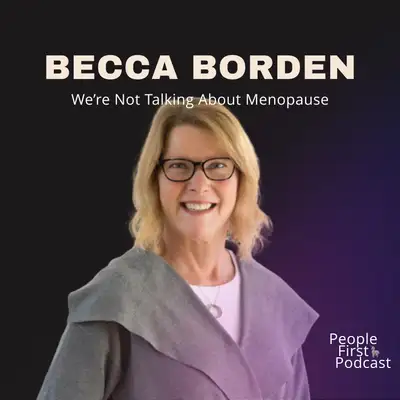
Welcome to this week's episode of People First. And I am particularly excited for this conversation because Becca Borden, my guest this week and I are going to be diving deep, mostly, on a topic that affects everybody on planet Earth, but affects half the population. And that hot topic that is close to my heart and current lived experience is menopause. And
Becca (00:14.59)
Thank
Morag Barrett, SkyeTeam.com (00:30.978)
Becca comes to me as a behavioral scientist with decades of experience, helping women, leaders and organizations thrive through vision development. I've just lost your bio, but I can cut this out because that's the magic of this platform. All right, so Becca.
Becca (00:51.686)
Yes.
Morag Barrett, SkyeTeam.com (00:54.546)
is a behavioral psychologist with decades of experience helping individuals and organizations thrive through vision development, goal setting and behavior change. Her lifelong passion is self-care, nutrition and exercise, which took on a new urgency after cancer treatment pushed her into sudden menopause. Frustrated by the lack of clear science-based information and societal support, she was inspired to become a certified menopause coach.
through a leading evidence-based program backed by world renowned experts in medicine, pelvic health, nutrition, and psychology. Her company, fabulously named Hot Stuff Coaching for Women, she combines her professional expertise, menopause training, and personal journey to support and empower midlife women to take charge of their health and wellbeing. So Becca, welcome to People First.
Becca (01:53.47)
Thank you. Happy to be here.
Morag Barrett, SkyeTeam.com (01:55.8)
Well, as I said, I'm looking forward to this conversation in that I will, and I have been telling everybody, I am riding that roller coaster right now. And it shocked me when I realized that I had been riding this roller coaster unnamed for more than 10 years. I've just counted the dots back as I've done my research to realize all of these symptoms and clues and yet not one medical professional connected those dots for me.
But we're going to come on to all of that in a moment because I actually want to know your origin story. So when you were a wee girl, I am going to guess that the idea of launching Hot Stuff Coaching for Women and being an expert in the menopause journey was probably not top of your career list. So I'm curious when you were a wee girl, what did you want to be and in what way does that show up today?
Becca (02:52.798)
Well, I mean, think it's very much evolved and is very aligned with the age that I grew up in. So, you know, initially I thought, teacher or nurse, right, which is what most of the young girls my age thought. Young girls who were smart, that was where we were directed.
Morag Barrett, SkyeTeam.com (03:11.566)
Mm-hmm.
Morag Barrett, SkyeTeam.com (03:15.022)
you
Becca (03:17.962)
And as I got older and had leadership experiences and so forth, it was like, okay, wait a minute, maybe I can do something more than that. And in high school, took a psychology class and said, this is brilliant. I love this. This is, is working with people, it's understanding people and it just, I gravitated to it. So coming out of
Morag Barrett, SkyeTeam.com (03:36.152)
Mm-hmm.
Becca (03:44.362)
I majored in it in college and coming out of looking at the breadth of it, I said, I really want to help people and I want to apply it in an area, in a space where most people are. I don't want to apply it. I didn't like the whole notion of counseling and therapy in terms of the sickness element of it, which was the...
this was the late eighties, which was the taboo or the way that things were framed at that point in time. Now they're framed much more positively. And so in today, maybe I would go that route. But so I focused on industrial and in organizational psychology, which is behavior based in the workplace, understanding what drives people to do various things. And then therefore, how do we help them be more successful while we're helping?
the organization to be more successful. And then once I moved away from that and had the personal journey, I said, wait a minute, I'd already decided that I had done a lot at the organizational level, at the high level. And I found that what really gave me, got me excited and made me happy was working directly with people and helping. And so after
my cancer experience and I'm trying to sort out what is going on with me, I said, you know, wait a minute, there's an opportunity here to help other people. And it uses all the same skills that I've been using as part of my corporate career, but applying them with people.
Morag Barrett, SkyeTeam.com (05:18.219)
Mm-hmm.
Morag Barrett, SkyeTeam.com (05:25.173)
And I love that and the fact that, I think that's one of the misunderstandings. I mean, I've had it said to me, well, women of a certain age. And yes, menopause is associated with certain decades, but you've also shared through your own experience in the cancer, menopause can happen for many reasons at almost any age. Now for the majority of women,
Becca (05:49.61)
Thanks.
Morag Barrett, SkyeTeam.com (05:53.025)
It's going to be our forties, fifties, maybe into our sixties. But as you've done your studying and research, what would you say are the most common myths and misconceptions about this topic and journey of menopause?
Becca (06:09.78)
I think one of the most common is that it's this point in time because that's how physicians define it. And it's all about your period stopping. And that's menopause. And while that is the physician's definition of going without your period for a year, that is such a teeny tiny part. It is just one symptom of the broader issue. And menopause is a journey.
and you can think of it like reverse puberty. And it can occur over 10 to 20 years from the end begins much earlier than most of us realize. And those symptoms get brushed off and things like stress that are often attributed to some of those early symptoms actually exacerbate those symptoms. those to me are some of the biggest myths.
Morag Barrett, SkyeTeam.com (06:41.004)
Mm-hmm.
Becca (07:06.954)
There are, they do primarily people see hot flashes as being the biggest, it's the most obvious trait, but there's no recognition that fatigue is a part of that, anxiety. They do recognize brain fog. Some of the things that we're experiencing there as part of brain fog though are symptoms of aging that both men and women struggle with, like when you can't come up with a word.
Morag Barrett, SkyeTeam.com (07:13.644)
Mm-hmm.
Morag Barrett, SkyeTeam.com (07:36.878)
Been there.
Becca (07:37.578)
Right, exactly. I I doubt there are many people 50 and above can say that they haven't had one of those moments where they've forgotten a word. That might be brain fog, but it might just be changes in our brain as we age. And again, it happens to both men and women equally.
Morag Barrett, SkyeTeam.com (08:00.321)
Yep. So it's not an easy checklist. There are symptoms that are associated with, and as I look back on my own life and some of those symptoms that weren't connected, the brain fog for sure, the lack, not the stamina, but the recognition that the pace at which I used to work is not as easily sustained. And nor did it actually energize me in the same way. I had both shoulders frozen at one point. my.
Goodness, that was terrible few months, if not a year. And at that time I was still in the British stiff upper lip of just walk it off, nothing to see here, just tough up and go through it. And for me, as I think about my growing up, my mum probably went through her medical menopause because of a hysterectomy when she was in her mid thirties, so still relatively young. But there wouldn't have been.
Becca (08:39.816)
Yes.
Morag Barrett, SkyeTeam.com (08:57.164)
and there were no conversations in the house as to what she was experiencing. And it was only two years ago I had my first hot flushes and whilst I'd had friends who'd had them, I was still of the, come on, it can't be that bad. And I'm telling you, holy smokes. I mean, I'm surprised I didn't smoke. That whole, in terms of the steam, I could remember waking up.
and you can feel like the furnace dial is going hot, hot, hot, hot. Holy smoke, I'm hot. And then you'd throw the duvet off and then it's like, my goodness, I'm cold. And then you put it down and then it was happening four or five times a night. And that's when I finally went to the gynecologist and got seen. And for me, HRT patch put a stop to those almost immediately. But I spent three months with sleepless nights waiting for that appointment to come through. So.
As you listen to me and you think about the women you're coaching, the organizations that you're working with, how similar or dissimilar are some of those symptoms or experiences to the women that you're working with?
Becca (10:04.362)
It's very similar. we miss, most women miss those early signs. And it's not until they have something as dramatic as a hot flush or they have a frozen shoulder or heart palpitations. was Oprah famously tells the story of heart palpitations is how she figured it out. And she went to multiple cardiovascular specialists to understand the heart palpitations before
Morag Barrett, SkyeTeam.com (10:06.838)
good, I'm normal.
Yeah.
Morag Barrett, SkyeTeam.com (10:21.986)
Mmm.
Becca (10:33.48)
she figured out that it was menopause. mean, it's, yeah. And I think some of the weirdest things come early on and those are unique to the woman. So non-allergic rhinitis was my first symptom. So I went to the doctors and I even had a brain MRI and they were sure that I had allergies. And yet I went to the allergist and the allergist couldn't get anything to register.
Morag Barrett, SkyeTeam.com (10:36.824)
Yeah!
Morag Barrett, SkyeTeam.com (10:45.654)
Mm-hmm.
Mm-hmm.
Becca (11:02.96)
nothing, not even the control. And he was the first one to say, you know, how old are you? And, you know, and even then I kind of brushed it off like most of us do until it becomes more serious. And the most serious thing that people recognize as part of this is hot flashes. But there are so many other things, the brain fog, the fatigue that are impacting us in a negative way that
Morag Barrett, SkyeTeam.com (11:03.387)
well.
Becca (11:32.467)
we can change, that we have the ability to impact because the belief among our mothers and that generation was very much you just go along, you just deal with it. And between hormone replacement therapy, well, sorry, let me back up. I hate that word actually. Hormone therapy, menopause hormone therapy, because it is not a complete replacement. It just stabilizes you. But use of that.
And there are various, I'm not a big supplement person, but there are certain supplements that are very helpful. But strength training, there are things we can do that will improve our long-term health and also improve those symptoms and how those symptoms manifest.
Morag Barrett, SkyeTeam.com (12:22.36)
Well, what I've been pleased to see now that I've realised this is the journey that I'm on. And now even you're talking about the rhinitis and thinking, I need to go and ask some questions after this. So is the fact that it feels to me now that I'm looking for it, that the conversations around this are more prevalent and I'm reading two books or listening to two books at the moment, How to Menopause and Menopausing, and there are many more out there.
Becca (12:45.823)
Yes.
Morag Barrett, SkyeTeam.com (12:51.404)
What do you think accounts for that shift that it's gone from taboo, nothing to see here, to something that seems to be more mainstream and acceptable to raise in polite company?
Becca (13:04.104)
I mean, I think a lot of it is that there was an investment, more of an investment in women's health. So historically, research on women's health has been pretty poor. And honestly, they only in 1996 discovered that there was estrogen in the brain. And so a lot of the things that we experience in perimenopause and menopause are driven by the changes in the brain due to menopause declining.
Morag Barrett, SkyeTeam.com (13:33.038)
Mm-hmm.
Becca (13:33.851)
flux, sorry, estrogen declining and estrogen fluctuating during that time period. And I think that that has the fact that the research is catching up, is becoming more prominent, that has helped. But more importantly, women speaking up, prominent women like Oprah speaking up, that woman has launched so many different areas of focus in our culture.
And this has been a really good one for her to focus on. Halle Berry has done a lot to bring prominence to this. And so you see people speaking out and that's famous people, but even I think women taking on more leadership roles, there's an opportunity there and you can actually see women doing it. So the CEO of Delta Dental in 2023, female CEO,
was experiencing these same things, went to the board and said, hey, we need more focus on this. This has an impact on half of our patients. And we need to be talking about it openly.
Morag Barrett, SkyeTeam.com (14:42.626)
Mm-hmm.
Morag Barrett, SkyeTeam.com (14:49.986)
So for women who may not yet be on this journey or are just embarking, what should they be looking out for? And then more importantly, what can they be doing for or asking for on their behalf to help them to navigate that journey?
Becca (15:05.726)
Yeah. So, you know, first and foremost, recognizing changes, just changes in the way that your body functions. So looking back to puberty, most of us can recall how stuff started changing. Well, it's the same journey in reverse toward menopause or through the menopause transition. so identifying, you know, this is, this is unusual. This is
this shouldn't be happening and then doing the research to understand could it be related to menopause. So I encourage women when they're experiencing something that they can't quite understand, it's not related to something they understand or have already been diagnosed with in their medical history, go look at a map. You just have to go to Google images and pull up a map of where there are estrogen receptors in the body.
And if there are estrogen receptors in the part of the body that controls whatever symptom it is you're experiencing, then there's a pretty good chance that that's going to be related to perimenopause. In terms of what to do, there aren't great ways to say, you know, yeah, you're in perimenopause or menopause and therefore you should do this. And honestly, it's not that important
It's if you're in your 40s, if you've hit 40 and you're starting to experience some symptoms, it makes sense to start doing things like changing how you eat, doing more strength training because both men and women start to lose muscle mass after their late 30s and their early 40s at 1 to 2 % per year and then that escalates when they hit 60. So strength training is going to
perform a good basis and there's no reason to put it off. I mean, it's a good thing to do no matter what. Changing how you eat so that you have more fiber in your diet. I know there's a big push for protein and yes, protein is important, but fiber becomes more important as your gut starts to make changes because we have a lot of estrogen receptors there. So starting to make those kind of changes in your life is what's most important.
Morag Barrett, SkyeTeam.com (17:02.594)
Mm-hmm.
Becca (17:30.372)
If you are experiencing things that are severe, that are interfering with your life, go talk to your doctor and look at whether or not hormone therapy, for example, would be something that you could do and push them.
Morag Barrett, SkyeTeam.com (17:46.99)
Would you and push, well, that was going to be my next question. Would you advocate for an, in doubt, get a second opinion?
Becca (17:55.327)
Yes. Yes. you... Yeah. Well, you know, I mean, first of all, having been through the medical journey I've been through, one of my biggest learnings is I have great appreciation for the medical field, great gratitude for the medical field. However, I learned that getting a second opinion, at minimum, you're going to get more information. And...
Morag Barrett, SkyeTeam.com (17:57.505)
that was definitive. So why so definitive on the yes?
Morag Barrett, SkyeTeam.com (18:07.918)
Mm-hmm.
Morag Barrett, SkyeTeam.com (18:23.881)
Mm-hmm.
Becca (18:24.87)
you might get somebody who is more, has more information, more access to more research or has a different way of looking at things. So I, for example, am because of my cancer was estrogen positive. I was told that I could not take estrogen. And when I was the estrogen, the medication that we were on that I was on to shut down the estrogen.
so that my cancer wouldn't grow, actually caused osteoporosis. And so when I looked at treating the osteoporosis, I said, the best thing for this is estrogen. Yes, there are medications out there and they're getting better, but estrogen is the major one. So I dug into, well, what harm am I doing? And I was able to look at all the studies and say, for me,
I'm more worried about this osteoporosis risk than I am about the cancer recurrence because of my individual medical situation. And so I talked to multiple doctors until I got one that I was able to have a conversation with that listened to me and understood, yeah, we're gonna weigh all the different elements and this, I agree with you that this would be a good direction for you.
Morag Barrett, SkyeTeam.com (19:25.56)
Mm-hmm.
Morag Barrett, SkyeTeam.com (19:50.005)
It's interesting because in all of the research that I've been doing on that journey, that theme of the fear of HRT causing cancer, increased cancer risk, it's true in that it is a microscopic increased risk based on the research that has been done and therefore the blanket, thou shalt not have it.
Becca (20:00.064)
Yes.
Morag Barrett, SkyeTeam.com (20:14.494)
is often misguided and so I'm glad that in your own research you were able to advocate for yourself and again I'm not the medical professional just sharing my own journey and what I've heard but when you hear a straight no almost like I wanted to hear when you said an emphatic yes why either of those so that you can make more of an informed choice that supports your own unique needs and journey.
Becca (20:41.064)
Yes. it's, you know, I have watched so many women struggle with some of these things and being told no. the doctor is trying to optimize one particular aspect of that person's life. And I understand and I respect that. But there's a lot more.
Morag Barrett, SkyeTeam.com (20:58.872)
Mm-hmm.
Becca (21:06.374)
involved in life. There's a lot that our body is a system and there are trade-offs and it is important to understand what those are. And frankly, this is an area where there is research constantly coming out. I I read something this past week that reinforces my own perspective on using menopause hormone therapy for even though I've had breast cancer. Yeah.
Morag Barrett, SkyeTeam.com (21:32.589)
Yeah, the more we can normalise these sort of conversations, either amongst female friends or with our daughters or our nieces or our friends' daughters, as just being part of being informed because it's not shameful, it shouldn't be taboo, it isn't a medical illness, but it is something that we don't just have to tolerate and live with, but something that we can actually adapt
and navigate through that doesn't then undermine more aspects of our lives. So, good.
Becca (22:08.242)
Right. And getting the message out that the final result is actually a positive outcome. You no longer have to worry about the impacts of the reproductive system and the symptoms will go away and you will rebound. And so it's important that that is part of the conversation as well.
Morag Barrett, SkyeTeam.com (22:16.941)
Mm-hmm.
Morag Barrett, SkyeTeam.com (22:34.04)
So tell us a little bit about the work that you do holistically, but for individual leaders and for organisations.
Becca (22:42.452)
So my focus is primarily on individuals at, bless you, was primarily on with individuals at the moment. And it is really, although I'm trying to influence leaders and organizations. So, you know, with individuals, I'm trying to help them gain a vision for what they want from life, feeling unhampered by those symptoms.
So if we're able, if you were to take those symptoms out of the equation, if you were to take how you feel right now out of the equation, what do you want to be doing in life? What does that look like? And we come up with a mantra. My personal mantra is every day, stronger, smarter, kinder. And every day I look at what I do and I say, that's what I wanna do. That's what I wanna, sorry, this is how I make that choice. I wanna ensure that my activities
and my behaviors are aligned with that mantra. And then I try to help women once they've got their mantra say, okay, so in the areas of self care, nutrition, and exercise, how do we build the capability in you to achieve that mantra every day? How do we find a way to make that work in your life? Because these are changes in habits. And in some cases, those habits have been in place for a decade or more.
and how do we adapt those habits to fit the person that you want to be moving forward.
Morag Barrett, SkyeTeam.com (24:21.046)
And I think that's.
Becca (24:21.246)
And it's a lot of and identification, but then coaching to help people make those changes.
Morag Barrett, SkyeTeam.com (24:27.902)
future focus of the person you want to be. It's like the osteoporosis, it's the muscle strength, it's the person you want to be in the next few years, but with also thinking and planning for those decades to make sure that we can navigate that part of our life journey stable, able to walk, able to get out of a chair, able to move and operate in the world and environment that we're living in.
Becca (24:53.534)
Right, and minimizing risks of various cancers, digestive issues or metabolic issues like diabetes, the neuro impacts, as well as cardiovascular disease. Number one killer of women is cardiovascular disease. And that increase, that risk increases as we age and largely that is due to declining estrogen.
Morag Barrett, SkyeTeam.com (25:13.229)
Wow.
Morag Barrett, SkyeTeam.com (25:24.266)
OK, so for those who are watching and listening to this conversation, what message would you hope that they're taking away?
Becca (25:34.685)
I hope that they dig in and learn about menopause, what is associated with this transition, what to watch for, so that they're more informed, recognize it for themselves, but also so that they can support other women. Because not every woman has an experience like this. Not every woman has hot flushes. 85 % of us do. So as most of us. But there are women who don't. To understand it and
Morag Barrett, SkyeTeam.com (25:57.527)
Okay.
Becca (26:03.782)
reach out when you see someone else going through this, open a conversation, be supportive that there are things out there, there are solutions out there and get the support from professionals like myself, pelvic health professionals, doctors. And if the doctor you're seeing does not seem to know much about it, find one that does.
Morag Barrett, SkyeTeam.com (26:30.318)
Okay, so talking about finding people who know a little bit more, how can people learn more about you and the work that you do?
Becca (26:38.538)
Well, can find me easiest or most direct route is my website, hotstuffcoaching.com. Also, I have a YouTube channel that has just gotten started. So I don't have a lot of videos, but I have a few videos up there that talk about some of the key topics that women experience during the menopause transition. So they can go learn more about those topics while learning a little bit more about me and my approach.
Morag Barrett, SkyeTeam.com (27:06.902)
OK, well, Becca Borden, founder of Hot Stuff Coaching for Women, thank you for the candid conversation today and for all of you who are listening, whether you are through, in, anticipating or running alongside somebody who is going through menopause, I encourage you to lean into those resources and to make it a conversation that we can all have so that we can be better together. Thank you again.
Becca (27:36.02)
Yes. Thank you, Morag