Subscribe
Share
Share
Embed
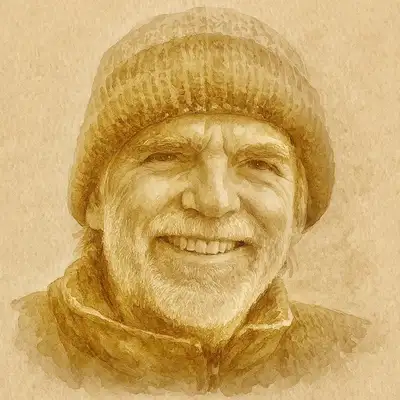
Travel Grit is long-form conversations with ramblers, roamers and free spirits — adventurers who have crossed continents on horseback, sailed solo around the world, and traveled thousands of miles by mule. Hosted by Bernie Harberts. For bonus episodes, Q&A sessions, and more from the world of Travel Grit, check out the companion show Gritty Bits.
Autogenerated transcript. May contain errors. Refer to the audio or video for accuracy.
Index
- Georgia fog arrival and the Fortuna Glacier — (00:00)
- Introducing Thies and Kicki: West Point Island and the latency problem — (02:06)
- Growing up sailing in the Baltic and the teenage moped sailor — (06:26)
- Great-grandfather: harbor master of Samoa and the 99-year-old with vivid eyes — (09:46)
- California, celestial navigation, and the first Pacific crossing — (22:56)
- Samoa in the 1970s, Uncle Alosio, and three questions that shaped a life — (26:54)
- Wanderer III: eight square meters, the Hiscocks, and 300,000 miles under sail — (29:41)
- Polynesian navigation: stars, birds, wave patterns, and the Kingdom of Silence — (49:23)
- Dead reckoning into South Georgia: the storm, the fever, and the elation of arrival — (1:14:28)
- A small boat keeps the world big — (1:52:58)
Autogenerated transcript. May contain errors. Refer to the audio or video for accuracy.
Thies Matzen (00:00)
150 miles before you come to South Georgia, enter the fog. And that's a protective ring of fog around a wonderfully beautiful island. Which made it difficult for anybody in the previous centuries to navigate to get there because there is ice, there is fog. And we had fog for three days, not knowing precisely where we were.
Bernie Harberts (00:20)
To navigate. Yes. Yes. Ugh.
Thies Matzen (00:34)
Being able to get our position and being out in the cockpit, 50 centimeters above sea water level, all this wet, day and night looking out. At night we were drifting because of the danger of ice and you were seeing icebergs right in front of you working itself out of the fog. You had slowly more and more animals showing up. A lot of fur seals, a lot of bird life, a lot of jumping up around you, penguins. Dead reckoning, keeping a compass course for three days like that until I said, it's time, we should turn right now, we should go to port. When we then sailed another two hours or so, we could see something brightish work itself out of the fog. And when we came closer and closer, we saw it was a glacier. It was called the Fortuna Glacier. And soon after we met that glacier, the world sprung apart.
Bernie Harberts (02:06)
This is my friend Thies Matzen. Thies and his wife Kicki Ericson have sailed their 30-foot traditionally built wooden boat, Wanderer III, more than 150,000 miles, much of it in the Southern Ocean, including Antarctica and the South Georgia islands. Wanderer III is 74 years old and was built for Eric and Susan Hiscock, the icons of modern cruising under sail. She's one of the most famous small boats in sailing history, having sailed over 300,000 miles in all oceans with various owners. That's farther than from the earth to the moon, which is about 240,000 miles. Thies is one of a quickly shrinking number of offshore sailors who learned to navigate the old way, by sextant and stars, long before GPS made finding yourself at sea a matter of glancing at a screen. When I spoke to them, Thies and Kicki were living on a really remote island in the Falkland Islands called West Point Island. That's way down there in the Southern Ocean. When I say remote, I mean windswept, no trees, waves crashing from the Southern Ocean onto cliffs covered in penguins, albatross, that sort of thing. Thies and Kicki are the only people that live there, and the only way to get there is by boat or mail plane if the weather allows. One of the things about this recording that you'll hear is that as we're speaking, you'll notice there's a delay in what Thies says and what I say as I respond. That's thanks to something called latency, which means when you're talking to somebody really far away over the internet, there can be a lag between the voices in the conversation. Then there's the matter of West Point's internet gear being really crusty and old school. Here's Thies explaining West Point's communication setup and why it's a miracle we even got to record this interview.
Thies Matzen (04:16)
It has a microwave system which is connected to the one and only town in the Falklands, with proud 2,800 people, by a relay station. A microwave link from here to the mountain top with a relay station about 50 kilometers away. That link has to be completely lined up. Otherwise it doesn't work. And then we don't have internet and we don't have telephone. So we have a voice, but nobody can hear us. We had a real strong storm, which is not unusual here, which kind of shook the arrangement up on the hill here. And we were left without a link.
Bernie Harberts (04:57)
Cheers.
Thies Matzen (05:15)
And ever since that time, we have struggled to get it kind of settled into a good connection. The way you do that is by taking a VHF telephone. VHF is the common thing. Channel nine we use. And with Channel 9 from up on the hill, I can reach a neighboring island also with Channel 9. That person on that neighboring island, which is about 25 miles away, they take the phone and call to the person at the telephone company in Stanley, which is another 150 kilometers away. So I give whatever I asked him to do, a little bit further left, a little bit up, a little bit down. I send that to the neighboring island. She talks that into the phone and then he receives it. He models a little bit and sees if the link is connected. And then he comes back and said, not connected yet. Maybe a little bit to the left.
Bernie Harberts (06:26)
So how did you get into sailing? Did your family sail?
Thies Matzen (06:28)
I mean, yes. Maybe I was 10 or so, decided to buy a small sailing boat, a four meter dinghy, so that my uncle could sail and I could sail, just in Denmark in a small bay with an island around it. And that dinghy became my travel, my boat into the world. I always helped it. I learned how to steer it. My father, not being a sailor, not having a clue, he was always sitting in the front guiding the sheet of the jib. And so I was in control of the mainsail. He never touched the steering pin. So this is one of the very, very few situations where I kind of could tell my father what to do. So that was really funny. Growing up in a town in northern Germany, right at the border to Denmark, there's a fjord and my grandfather, motherly side, he started a sailing club. He had a small sailing boat. He was not a professional sailor, but he liked wooden boats because those were the only boats around. My grandmother as well, with him into the Baltic. And my uncle, his son, my mother's brother, he was a sailor. He had a very long 12 square meter boat. It's a type of boat which is very low. You can reach your arm into the water from the cockpit. It is maybe a meter, a meter 50 wide and 15 meters long. Also very narrow, very long.
Bernie Harberts (09:18)
Long and skinny. Sounds wet.
Thies Matzen (09:20)
And those were the boat sailing days. He took me as a small boy when I was four or five. He would take me along on a weekend sail which you think now is not very far because it's only 15 miles the most. But that was big adventure. That was for me wonderful, the sailing with him, and then stayed overnight and slept in the boat and then came back. And that was just here as a small boy I got introduced to that. And the other impact is that my great grandfather was a captain on sailboats and he eventually in the mid to late 1800s, 1875, he went to Samoa to be a captain on a schooner vessel. He stayed there for most of his adult life and got married there. My grandmother and her sisters and her brother, five altogether, they were all born on Samoa. He eventually became the harbor master of Samoa. When Samoa became a German colony, one of the few colonies Germany had, he was the harbor master for many years. I met him. And I will never forget him. One of my first memories is when I walked at the hand of my mother to see him. I was only three years old. And we walked up to this old man.
Bernie Harberts (11:45)
Incredible.
Thies Matzen (11:47)
And me at the hand of my mother, visited him in that building, and he had such impressive eyes and such presence as an old man. He was 99 years old then. I have never forgotten that moment of seeing him. It's consciously my earliest memory. Later I heard that he was a captain. Later I found out that there is this story with Samoa. The family is coming from Samoa. They grew up there. There are a lot of wonderful stories about him. But it is the first attachment to somebody really connected with the sea.
Bernie Harberts (12:45)
What was it about his eyes? It sounds incredible for a 99 year old man to have such life in his eyes. What was it?
Thies Matzen (13:00)
Now I would say he had cheek in his eyes. Knowing his life now, knowing more about his life, I could see they were vivid. There was a shine in them. And you don't expect a shine. Not at my age, as a three year old, you don't expect anything. You don't know what you see and what you look at. But you don't expect a shine of life, of curiosity, in a 99 year old man's eyes. But he had that. And on my father's side, my grandfather, he was also a captain. He was on the sea all his life, but he was on steamboats. There's a lot of seafaring in the family.
Bernie Harberts (14:24)
When was it that you decided, I have to go to sea, to the outermost places?
Thies Matzen (14:31)
I got 15 or 16. I had a little moped and I was going to high school from eight to 12. So that was the whole afternoon free to roam around. And I had this moped and that dinghy was in Denmark. I went to school in Germany, but Denmark is just over the border. It's just a couple of kilometers away. And to go up to the place where the small dinghy lay was about 35 kilometers. So I would pop up there after school time and pop onto the sailboat and just sail the whole day. And then sometimes I would go back in the evening to Flensburg to my parents'. But sometimes I would just stay there and sleep there and then go from there early in the morning back to Flensburg to go to school.
Bernie Harberts (15:29)
Lovely. By eight o'clock.
Thies Matzen (15:53)
Yeah, go to school by eight o'clock. It took about an hour. And then after school I would go to my parents and have a feed because in Germany the main dinner is at midday, just after 12:30. And once I had filled up, I would say get out again, up to Denmark and sail the whole day. And that I did many times. What was very lovely, what was magical about it, I did it alone. I did it by myself. And what was fantastic is that this particular bay in which the dinghy was placed had an island which was kind of closing it off from the real Baltic, the bigger sea. It was not that far away, maybe two or three miles. But when you're 15 or 16 years old in those days, that's a big distance. A nice distance. And that island had four or five houses. One of the farmers sold some ice cream. But what you actually were doing, you sailed all the way to this island and it was a different world. A completely different world. And you had reached this different world by your own means. All sail, no engine. Into that little sandy spot, pull it a little bit up, it had such a feeling of achievement. Wonderful. Hey, here I am. There was no phone, nobody knew I was doing it. My parents knew I was in Denmark and doing some sailing, but there was no supervision. There was no connectivity. It was the only contact you had with yourself, in the spot where you were standing, taking it all in. And it was wonderful. For me, that was like the big world which I had reached. It was much more exciting to go to that island rather than to the headland, which was still connected to Denmark. That was a continent. That didn't hold the same interest to me. It was this island, surrounded by sea, with only four houses standing there. There's a lot of imagination working within yourself which puts you on track to where you want to go.
Bernie Harberts (19:22)
And already then you were naturally drawn to the outermost place.
Thies Matzen (19:22)
Rather than to the headland, yeah, the island. Those are young days, young years. And then that continued. I sailed with friends on sailboats, but always travel, always going up to Norway or to Sweden. It was always experience, discover. And when you're young, it was not speed. It was not being faster than in a regatta. Eventually, together with a friend, we were like 18. We got one of these lapstrake Scandinavian rescue boats, 24 feet long. They are open, very strongly built, with a strong gunwale. Johan and I managed to get one. This was after I had been hitchhiking through America with a friend. I had to come back to Europe to do social service, which was demanded for any youngster in Germany at the time. You either do military service or social service. I became a conscientious objector. I wasn't happy to go to the military. So I did social service in an adult education place, very often in the garden and the library. But I wanted to continue building this boat. Every weekend and evening I could, together with my friend Johan, we put a keel beneath that boat, put a cabin on, got ourselves a rig, some sails. Then once I was done with the social service, summer came. I moved onto that boat. You couldn't stand on it, there was no headroom. And then I sailed around with that. My base was in that Danish fjord in a bay, a lovely bay, where I anchored. I spent the summer sailing around in Denmark because I knew I would want to go to Samoa to find out about Samoa, what this connection between Samoa and our family precisely was about.
Bernie Harberts (22:56)
So this was in the 1970s. Thies traveled around Europe, bought a cheap plane ticket to the US, hitchhiked across America, and found himself in Southern California, sort of broke, looking for a job. And that's how we wound up on a boat headed across the Pacific.
Thies Matzen (23:14)
Southern California. Was doing some work on boats because I knew boats, in Newport Beach, to earn a little bit of money. I shouldn't say that very loudly, but that was the case. And eventually found myself on a yacht which needed a navigator, somebody who had a paper which said he could go over oceans. Because I had a navigational paper, not a big one.
Bernie Harberts (23:56)
And to be clear, this was celestial navigation. Is that correct?
Thies Matzen (23:59)
It was celestial navigation. So there was a sailboat which wanted to go to Honolulu. They just wanted to go to Hawaii, a father and his son, and they needed somebody to prove for the insurance that there's somebody on board who knows how to do it. So I went aboard and sailed with them to Hawaii.
Bernie Harberts (24:03)
No electronics.
Thies Matzen (24:28)
And then in Hawaii I got off the boat and stayed around. I found a yacht which was on its way down to the South Pacific. I didn't have any money to speak of, nothing, just pennies. And then there came also the offer of a bigger motor vessel, kind of a fishing boat type, which had the job of delivering goats and sheep to an island right at the equator called Palmyra. It's a private island and this vessel was tasked to bring them down. They looked for somebody who had navigational skills.
Bernie Harberts (25:21)
Wow.
Thies Matzen (25:44)
But I decided against that because I would have been stuck on Palmyra. So eventually I got onto a wooden boat, a 50 footer. He was single handed. He had come across from the continent with quite a few people. They had all left him. He needed some more people. And so he asked me if I would come along and teach him how to use a sextant on the way down to American Samoa. And we were three people, there was a girl also coming along, which continued with him. And I went off in American Samoa in search for my family. And that's how it started. Yeah, made it there. After a year already or something like that. Very, very big adventure.
Bernie Harberts (26:54)
Samoa in the 1970s was still largely undeveloped. The roads were just mostly sandy paths. The nights were dark and starry because so few people had electricity to light their homes. Thies spent months walking around the island, sleeping where he was invited in, searching for the family his great-grandfather had left behind decades before. He eventually found his relatives and one of his uncles told him something that stayed with him for the rest of his life.
Thies Matzen (27:24)
So there was a lovely uncle of mine who has been very influential in the way I think. And his name is Alosio and he had 10 children and lived in an open fale right at the beach and was an unbelievable person to bring across philosophy and Samoan philosophy in a fantastic way. He was a hard worker. He loved the sea and what he always said to me, whatever you do, do it for a good thing, for a good life. And I took that because he was such a lovely person, really to my heart. I came away from Samoa with three questions. Where do I want to live? How do I want to live? And then what do I want to do? And so I answered those questions. The first thing is just to come up with these questions, ask them yourself. And then once you have asked yourself the questions, you answer them. And then you have to find a way to put these answers into life, into practice. You have always to reflect, always stop up in life here and now, every now and then to say, to ask yourself, am I still on track? Or has life taken me in other routes? Because the answers you have right when you're 20 are not necessarily the final way of doing it. Your life meanders in solution finding.
Bernie Harberts (29:41)
Thies returned to Europe to become a professional wooden boat builder. He trained in Denmark, one of the best places in the world to learn the craft. That path eventually led him to the most famous small boat in sailing history. He bought Wanderer III in 1981, and he and Kicki have been sailing her ever since.
Thies Matzen (30:04)
She's 30 foot. You have about eight square meters of living quarters. About the space we have. That's your home. And I think nobody right in one's mind would think that you could live happily on a space like that. And we have done that for over 40 years now. That space has been able to move and that enabled us to see a really wonderful world and be content in that very small space because it was moving. It could be moved and then it is a different space because the space around it has always offered some sort of adventure, different attitudes, different guiding lines into different interpretations of life. And if you explore that side, the differentness of the worlds you sail through, rather than taking your own life in the way it has been presented to you, but stay open traveling like that, then you don't need a lot of space. Eight square meters are quite sufficient. And it's a very beautiful boat. It has harmony. Look at it, it is very harmonic. It has somehow lines which speak to many people, also young people, which is quite amazing. People say it's just beautiful, the boat.
Bernie Harberts (31:53)
It's enough. Wow.
Thies Matzen (32:10)
She's a Laurent Giles design. And that's a British designer who designed boats and was at the foremost of boat design in the 40s and 50s, quite influential on many boats until the 1970s. And this was one of the designs which was solely intended for circumnavigation. And in those days, in the early 50s, no couple had circumnavigated the world. There were young Norwegians, a group of Norwegians in their 20s, and they sailed around on a larger boat. And there were single-handers like Joshua Slocum and others which had single-handed around the world. But there hadn't been a couple, just an ordinary couple looking like the milkman and his wife from the neighborhood, which had done it. And of course the Hiscocks, who looked very ordinary but had a lot of knowledge about sailing and were very organized and good at planning. They attempted that on Wanderer III and became in the 1950s the first couple to go around the world in a very small boat. One didn't know how big a boat one actually needed to go around the world in the 50s. How strong had it to be? And you couldn't fly a broken mast into some odd harbor down in Polynesia or you couldn't get any spare parts anywhere other than in some hub in Auckland maybe, and then South Africa again. There was just no network for yachting in those days and they sailed around the world on the very ordinary route in the warm climate zones which became known as the Hiscock Highway because a lot of people, having read their books, first their book about that first voyage in the early 50s, but also the practical how-to book, which is excellent, Voyaging Under Sail, which tells you how to fix a sail, how to set a course, how to maintain a wooden boat. All that was combined with their voyage descriptive story about their voyage. And that was a package which appealed in the early 50s after the Second World War. Yes, if they can do it, maybe we can do it too. And so it started the cruising around the world. Our boat is the starting point of cruising around the world and it's still doing it 70 years later. So it has a big history. And in those days, it was a big boat, 30 foot. There were no mega yachts or anything like that. And it was a boat which one thought one could just handle because there are no self-steering systems. You had to be steering the boats by hand. There were no autopilots, there were no wind vanes.
Bernie Harberts (36:14)
So you would think that you just set the sails on the sailboat and let the boat go where you pointed it. Now in some well-balanced traditional boat designs like Wanderer III, that works some of the time, in some conditions, on some points of sail. But not always. That's why until autopilots came onto the sailing scene, someone had to be on the tiller or the wheel to keep the boat going in the direction it was supposed to. Autopilots and self-steering changed all that. Some of these systems are electronic and others are purely mechanical. Those mechanical systems are called wind vanes and use the wind to keep the boat on course. Wanderer III, as originally designed, did not have any of this equipment.
Thies Matzen (37:00)
All those things didn't exist. So you had to balance the sails and the boat themselves had to be balanced, designed. And all that came much later. They were way before that. She has to be balanced, underwater and visually as well. She just has a beautiful line to my eye, and of course I'm biased in my view, but it's not only me. It's a lot of people who come up to her and just say, this is a beautiful ship, what a beautiful boat. I have to hope there is an innate sense of something, an understanding of harmony and beauty which resonates with all of us, which is perhaps generic, and she has something of that in her. When people see it, there's something they say, beautiful, in a way that we look over a bay which just has a beauty, a piece of nature, a landscape, which when we are there and sit there and watch it, it can speak to us. Yes, this speaks to something in us and says, yes, that's peaceful, that's harmonic, that's nice. And maybe we are not quite as much confronted with that sort of beauty as I wish we were.
Bernie Harberts (39:43)
How many miles, how many times around the world has she sailed?
Thies Matzen (39:47)
She has done all the miles under sail, under sail only, not with an engine. There is an engine in the boat and right from the beginning it was four horsepower and then it became eight. We have now 14 but we have only 20 liters of fuel with us. So it's in and out of the harbor and not passage making. So all the miles, and it is over 300,000 miles the boat, the equivalent of 10 times around the world in all oceans. She has sailed and not motored. You can have a ferry going between one island and the next island and that ferry, also a wooden ferry, can easily have made 300,000 miles just by going back and forth every day for 20 years. But that's a completely different thing. This boat sailed all those miles and I don't know of any other boat who has done that. There are bigger boats nowadays who are passage making as charter boats and they go regularly up and down to the Antarctic, but they are much, much bigger boats. I don't know of any other boats in the same category to have managed to sail so many miles. 100, 140,000, 150,000 miles of those 300,000 miles were sailed by Kicki and me.
Bernie Harberts (41:47)
The thing is, to really put this into perspective, there are a lot of people who are not sailors but know about sailing. You might see some of these sailboat races where the boats might go 200, 300, 400, 500 miles a day. And so you would think, well, to sail 300,000 miles, that's a lot, but if you can sail 400 miles a day, well, that's not that bad. But that is not the pace that Wanderer traveled at.
Thies Matzen (42:27)
Many of those boats who do those 400 miles a day are there in a race and they are there for speed and for a particular purpose, to win a race from A to B or to compete against another boat. But that's not Wanderer. Wanderer hasn't been designed for speed. Wanderer has been designed to go out there and see what comes. Go out there and meet the world and enjoy being on the ocean. And if there is no wind, you drift along. I remember one where we had for 14 days not a single breath of wind. That's at the equator between Tabu Island, which was formerly called Fanning Island, just south of Hawaii, and we drifted towards Canton Island. Very very little wind and we were fighting for each mile. But there were a lot of days where we just drifted and made about 20 miles a day with the equatorial current and then you get a completely different perspective to the world and to where you are, to your relationship in this world in a way, if you allow that to happen, if you don't get worried. Because there was no worry, there was no danger, you're just drifting and it's time. You live the time lived. You don't worry about if you have enough food, you don't worry about precisely when you arrive at the other end because there will come wind at one point. And you know that it will come. You don't compare yourself to somebody else who's racing with you. You have taken the human equation a little bit out of your life for that time. And that's lovely. To experience that is wonderful. It's something enriching.
Bernie Harberts (45:31)
Yeah, talk about that a little more because when we were in New Zealand, you showed me a photo where you had rowed away from Wanderer in your dinghy and you took a photograph and I think all you could see was the mast or a little bit of Wanderer. And I was so inspired by that that when I got to the doldrums, I rowed out in my dinghy away from my boat, Sea Bird. And that feeling of being out there on that windless ocean away from humans was beyond human, physically and spiritually. So talk a little bit more about that experience of being out on that windless ocean pretty much alone.
Thies Matzen (46:38)
That photo was taken on a passage from southern Chile in Patagonia to the French islands in the Tuamotus. It was a 50 day trip, about 4,000 to 5,000 miles. We normally do about 100 miles a day on Wanderer. You head north and around the Easter Island High and then eventually you hit the trade winds which are normally steady. But sometimes there are periods where the trade winds are not steady and that was the situation when the picture was taken. The trade winds just stopped for three or four days. But you know you are in the trade wind belt and you know the trade winds will return. So you are just waiting. You know the situation will change. You don't have to put the engine on and disregard the experience of being in silence on the water. Just stay put and enjoy the time because you know the wind is going to come back. And it did. That picture shows Wanderer with stabilizing sails so that we didn't roll so much in the swell. I call it the whale picture because it looks a little bit like the boat is disappearing behind a wave which has the shape of a whale. And whales have become a major subject in my life, something I became quite heavily attached to. So I call that the whale picture and it's just a wonderful experience.
Bernie Harberts (49:20)
Can you send me a copy of it?
Thies Matzen (49:23)
There was another really wonderful experience. We had been in Micronesia, on a boat building island, and spent a month or two there. From there we sailed to Indonesia north around Papua New Guinea and Irian Jaya. It was a thousand mile passage to get to Irian Jaya and then into the Indonesian waters. And that area, I read up in an old pilot, was called by many the Kingdom of Silence. We had wonderful winds for a couple of days and then the winds decreased and decreased and we arrived in the kingdom of silence. There was no wind and there were wonderful reddish monumental clouds above us and sometimes rain and we had a head current against us. We were not making much progress at all for over 27 days. After 27 days we managed to sail under sail into a strait north of Irian Jaya which then led us into Indonesia. It was just a struggle, but a wonderful struggle. It was so magnificent what the sky offered us around it and the reflection in the waters. You become really in a universe there because at night when there are no clouds, you have all the stars reflected in the water in a completely quiet ocean and you are virtually in the center of it because the stars are below you as well as above you. And those are just wonderful experiences if you are open to them. And if you know this will end, this will end at one point, and we are making progress, not much, but we are getting there. And each mile you make is like wonderful, wonderful. There is a wind, there is a breeze and you fight for it. It's an exchange with the elements where the elements are not wind but they are beauty, they are visual, they are quiet. It's completely different than the exchange with the elements in the Southern Ocean where everything is wild, where you are worried that the wind may break into your cockpit, where you are not settled in the beauty of the place but you are settled in awe and maybe also a little bit of fright. But there you have none of this. You have awe, but you have so much beauty and you are so calm that you are able to absorb this beauty completely. And that was a wonderful experience. I remember that in the kingdom of silence.
Bernie Harberts (53:50)
Was it right there that you call the Kingdom of Silence? Or was it other places in the doldrums?
Thies Matzen (53:55)
No, it was right there. It was really there. We had spent over a year in the islands of Micronesia, coming through Kiribati and hopping from island to island to island. And then we had this wonderful experience with a navigator on one of those islands, one of the big navigators who don't navigate with modern instruments but had the land-finding skills of the old Polynesians and Micronesians. That was something I had looked up over our years in the Pacific, to find places where you still get in contact with the old knowledge of the Polynesian navigators. We found them there. They were still building wooden boats completely in the old ways, with just hand tools, no electricity used, and having the knowledge of the old navigational skills. They carried that respect of the sea, of nature, of what it offers to the next generation. The old people were teaching young people how to build those boats, how to learn about these navigational skills, how to treat also nature. And that was a wonderful experience we have had. And we came from there and then sailed into the kingdom of silence and then back into the big world.
Bernie Harberts (56:27)
So what did you learn from those boat builders about navigation? The vast majority of your sailing career you've used celestial navigation. What did you learn from them that you didn't know? Did they teach you maybe about wave patterns, stars, different charting, smell?
Thies Matzen (56:37)
Yes. One thing is the intense knowledge of the stars. They had an intimate knowledge of the heavens in a way which they could use without much thinking. When you have sextant navigation, you use only a very, very few navigational stars really. And then you have tables through which you then work out your position. They don't have any such thing. They know the stars and they know that the stars set there and there and there. So they know if I want to go to a particular island which is 100 miles away, I need to follow that one particular star until it has moved to one position on the rigging of the canoe, because those were all open canoes they sailed in. And then you have to take on another star and follow it until it had moved to a certain position in the boat's rigging. So you follow different stars' movements on their boats which are horizontal, obviously. They are not heeling like our sailboats do. Canoes keep always a horizontal position so their rigging will always be sort of vertical. So they had tracks that way. And they knew precisely which island had which star track. Sea birds normally in the evenings fly back to the island they have flown out from to feed on the ocean during daytime. Different species fly for different lengths, but you can lay a big circle around each atoll with the radius being the distance that bird species flies out to feed on the ocean and then returns. And if you see a bird 40 miles away from an island in the evening, it will be straight going back to the island and thereby gives you a track to follow to hit upon those islands. So instead of an island which is only 500 meters or a thousand yards across, a small low-lying atoll, this island has a size of let's see 80 miles because you have 40 miles of birds as a radius around it. So you can pick up those signs to find it. And you have also wave patterns because in the warm waters of the Pacific the wind is always easterly and it creates waves and swell which are then reflected by islands. And these islands will disturb the normal wave pattern quite a ways away to the windward side. Navigators have a skill to pick up those disturbances. And they have learned that over the years.
Bernie Harberts (1:01:13)
It strikes me what a beautiful observational, tied into a place system this is, versus the purely mechanical system of Western celestial navigation, which I always romanticize. It's like, wow, celestial navigation, you have your sextant, you have your HO249 tables, your reduction tables, this is all math. But they don't use any of that. It's a whole different system.
Thies Matzen (1:01:43)
No, they don't. It's a whole different system.
Bernie Harberts (1:01:59)
All right, I've got to stop everything here real quickly. So remember at the beginning of this podcast when I was saying Thies is talking to me on this really crusty equipment. He's got very slow wifi and I didn't say much to avoid speaking over him. Well, that's what it sounds like when one guy is in Western North Carolina in a little cabin and another guy is in the Falklands and they try to have a conversation. So I have not edited this out on purpose, just to give you a sense of how far away Thies is from me. Hell, from all of us. So let's put aside the word salad, spaghetti jumble. Thanks for being patient with this and jump back into Polynesian navigation.
Bernie Harberts (1:02:47)
What is the navigator like?
Thies Matzen (1:02:47)
He is a very respected elder normally. He has a high position. The island we are talking about where we were, its name is Puluwat. It just came back into my mind. It still did these long voyages from Puluwat to Guam, which is for example over 400 to 500 miles, in the late 90s. They were still doing it. And what is very interesting is that those voyages were not done because people from our culture, like me, wanted to find out about how that was done and then established a kind of revitalization of those techniques. That has happened in other places in the Pacific like from Hawaii to Tahiti. But I wasn't interested in that. I was interested where there was still living culture, living original, authentic living culture where the islanders themselves lived according to what had been their tradition and what had been passed on over generations to them, where there hadn't been a break in that transmission of knowledge, where there was a continuum to this day. There were a couple of islands where we found that, especially in the Micronesian area, where the old people were still there, keeping on passing on their knowledge to young people who wanted to know it, despite outboard engines making an entry into their society. People were still being taught the old skills. And that was what I wanted to find. I didn't want to initialize something which had died and then become revitalized through us, but just to find living culture. Ancient culture. And with that ancient culture comes also an understanding of nature, of the place where this culture is lived. And that's a very valuable knowledge which is often understated.
Bernie Harberts (1:06:27)
Now that culture, that ancient wisdom was quelled, cut off, killed, and now it's being replanted. But you need to know this old stuff. As opposed to what you saw, which was the original strain before it was killed and then revitalized. It's incredible.
Thies Matzen (1:06:41)
Yes, yes. And it's wonderful that especially the young generation is finding back their interests in their own traditions and to initialize that. They are now the driving forces in propelling that knowledge into the future and their points of view on nature, on the environment where they have grown up.
Bernie Harberts (1:07:33)
I was going to ask about We the Navigators. Did you read that before going?
Thies Matzen (1:07:36)
Precisely.
Bernie Harberts (1:07:37)
We the Navigators is a book on ancient Polynesian navigators by Dr. David Lewis, an amazing New Zealand author and sailor. The book is about David Lewis's time with the ancient Polynesian navigators, figuring out how they used the stars, the wind, and waves to navigate.
Thies Matzen (1:07:58)
He had a sailboat and sailed with his family into the Pacific in the 60s, on the search, similar to what I did, or what I then followed him in. He followed in steps to find the navigators, the traditional navigators. And when I arrived on my voyage to Samoa, I passed through, spent some time in Hawaii, and of course I went to the Bishop Museum. That book had just been published, it must have been published in 72 or so. And I bought that book and then I sailed as a navigator with sextant down to the Pacific and I was reading that book. This was now in 76 or 77. And it made a big, big impact on me. I was enthralled by the findings and the connection of the navigators with the ocean.
Bernie Harberts (1:09:40)
I remember reading it years and years ago. What I loved about that is that it's back to navigating through a place, through observational stuff, birds, waves, much more connected to the world. And I never thought of the difference of celestial. In many ways celestial is more like GPS. It's calculations. But I never thought of like the beauty of the system of an outrigger canoe where the mast doesn't swing around. It makes it a lot easier to track a star in the rigging if the rigging doesn't tilt off at 30 degrees like a sailboat. It's beautiful.
Thies Matzen (1:10:34)
Of course. It was all done in an area that's adapted to the locality where the winds are generally out of quite steady out of one direction for long periods of time. You wouldn't be able to use it easily in other areas. Down here in the Southern Ocean you have weather systems passing through twice a day. It's an adaptation to the very area. It's like species development, it's knowledge development in a particular place. I find this thought very interesting. The way they navigated in their relatively small world, because you couldn't use it in the very north of the Atlantic or in the North Pacific or in the Southern Ocean, you can only use it within the reach of their boats, maybe 500, 600 miles radius. Sextant navigation is a step further toward what is the digital revolution. It is less depending on the direct contact with the elements. And then you have GPS, which is further removed, very digital, with very no connectivity to the place where you actually are. So you have the three-ness. You have the digital way, you have the sextant way, and you have the navigational land-finding way of the islanders. And there is a gradual elimination of direct dependency on the place where you actually are. Sextant navigation is still dependent on nature in one way. There is an element of uncertainty because you are dependent on a visual openness to the stars, the sun, and the moon to get your position.
Bernie Harberts (1:13:27)
It's beautiful what you said because until you told me about the Polynesian navigators, I thought GPS is on one range and celestial navigation is on the other. But celestial navigation, since you've explained the Polynesian observational ways, is really more in the middle. And the one thing I didn't realize until I started using celestial navigation is that in theory you just measure the sun. But in the ocean there are clouds, the boat is pitching. If you do a noon shot and you need to see the sun at exactly its highest point, well if there are clouds out, you can't do it. So it's very much influenced by your environment.
Thies Matzen (1:14:28)
The natural elements have a big impact on how precise your position is. So there is no perfect location of yourself. There's always an element of doubt. And it's up to your own judgment to reduce that element of doubt to a minimum with just sextant. Especially in difficult areas like the Southern Ocean, which is a difficult area to navigate because you have a lot of cloud cover. You cannot rely on seeing the moon or a star or any celestial body sometimes for days on end. And so when you start on the voyage there's a lot of anticipation already building up in you. You sail from the Falklands, you cross the Antarctic Convergence, you enter an area where there are icebergs, where there is a lot of fog, where you may not see the island at all even though it's very high, because it's shrouded in fog. And you have currents which you cannot estimate easily and you have storms which with no weather forecast can come as a full surprise. So there is a lot of anticipation built up in my mind on the first travel to South Georgia, which is in the late 90s. How do we arrive there? There's always the possibility that you don't arrive and that you have to make decisions which lead you in a completely different way to bypass something dangerous. We had set our aim to go around the 28th of November, which is summer in the Southern Hemisphere. We were ready to go. This is on our first voyage to South Georgia. We wanted to spend the whole summer there, three months on the island or around the island. And then there was a forecast. Kicki rang a forecasting unit here in the Falklands which could forecast maybe the weather for three days ahead. The voyage would take us eight. So we didn't have a long range forecast other than this. And they said there's a severe storm coming. We thought, a severe storm, what does that mean? Because in the Falklands it's blowing a storm normally almost every day. So is it 30 knots? Are they discouraging us to leave? We are only a 30 foot wooden boat in those waters. Maybe they thought this was ridiculous to attempt something like that.
Thies Matzen (1:18:02)
We decided, okay, let's wait. And then the wind hit and it was a severe storm. For three days it blew like 50, 60 knots here in the Falklands. And there was a big cruise ship that had come into the harbor and it couldn't leave. They had 200 passengers on land. They couldn't get the passengers back. They couldn't leave by themselves from their anchorage. So there was a tug which pulled them around so that they could leave the island and take shelter outside on the ocean with the 200 people stranded on the Falklands. In those days there were no hotels, there was not enough accommodation to look after them. So they were placed around town in private quarters. And that blew and blew and blew for a day and a half or two and a half days and as soon as it stopped I had a sweat, I became sick, I couldn't leave. We couldn't leave. That was probably psychosomatic on top of that experience of such a gale because we had intended to go and we would have been completely in that. And of course we would have dealt with it, but maybe not very well. And we definitely would not have made it to South Georgia in that. So that had a psychological impact on me. For four or five days I wasn't very well. I had fever and we couldn't go. And then all of a sudden the wind became better. And for two days there was a forecast of good weather. And I say, now we go. All of a sudden I was free from those psychosomatic influences and we sailed out. And I was completely confident then. It was all the anticipation of how can we deal with arriving in South Georgia, it was all in my mind already from before. And when we finally entered, about 150 miles before you come to South Georgia, you enter the fog.
Bernie Harberts (1:20:45)
Yeah. Wow.
Thies Matzen (1:21:00)
And that's a protective ring of fog around a wonderfully beautiful island. Which made it difficult for anybody in the previous centuries to navigate to get there because there is ice, there is fog. And we had fog for three days, not knowing precisely where we were. Being able to get our position and being out in the cockpit, 50 centimeters above sea water level and all this wet, day and night looking out. At night we were drifting because of the danger of ice and you were seeing icebergs right in front of you working themselves out of the fog. And sometimes you were imagining them. You had slowly more and more animals showing up. A lot of fur seals, a lot of bird life, a lot of jumping up around you, penguins. Dead reckoning, keeping a compass course for three days like that until I said, it's time, maybe we should turn right now. Maybe we should go to port. We should be safe and the island should show up. When we then sailed another two hours or so, we could see something brightish work itself out of the fog. And when we came closer and closer we saw it was a glacier. It was called the Fortuna Glacier. And after we met that glacier the world sprung apart. The fog went away. The island itself looked at us in all this wonderful beautiful bright blue sky, snow-capped mountains 2,000, 3,000, 4,000 feet high, and a little sock around the island and animals all around us. And this feeling to have made it through that fog, that protection of fog the island possesses, to arrive at the island was just an amazingly rich experience which is something very rare to have in a normal life. This elation. Maybe you can have it when you are a musician and you play a piece and you get completely absorbed by it. But for me who is not a musician, that's the music, the music of nature, the music of arrival, of adventure also. And it's all done by judgment, under difficult conditions. But precisely that is what makes it so elating. And with our technology we make it very difficult to reach such elation and reach that level of intensity. It's just extraordinary and you have done it. It makes it a very, very special place as well. So I have for many, many years not wanted to rid myself of the ability to have moments like that. And I've had many moments of that. Difficult moments also, where you have sailed in storms and you don't know where you are and the island is very small in the sub-Antarctic New Zealand and you are almost at the verge of saying no, no, no, we can't wait any longer, we will have to turn around and sail back to Stewart Island because it's too dangerous to be pushed into a shoreline out of which we cannot escape. So there is a lot of your own judgment involved and also various intense moments. But then there comes a moment where you get that one shot of the sun which may be just a very very short moment and the sun may not be completely round or clear, it's all fuzzy and the waves are cutting through the horizon and you get that shot and experience makes you say yes that was a good one or no that was a bad one. And when you get that one shot which to work out where you are, then you are halfway there. You will need another shot to make it certain. But those are moments which many people in pre-GPS days have had, and they have had also that access to the beauty of the experience, to come out of a difficult time and arrive somewhere which is stunning. In order to really feel that stunningness of the place, but also of yourself getting there, you should avoid to mechanize it or to digitalize it or to rely on means of land finding which provide complete certainty, as GPS positions do. So yeah, I've stuck to that for a long, long time. And now of course we do have a GPS and it is wonderful in many ways, but from an experience point of view, don't have it in the same way as it used to be when you were in doubt, when you were not quite certain, when the certainty had gone.
Bernie Harberts (1:28:14)
Yes, because it's a really elation. That word elation you mentioned. And I know that feeling when you are on dead reckoning, with no GPS and you are measuring your time, you've been going for two hours, you estimate your speed, you're not sure. Maybe you have a taff rail log, the log you tow behind the boat to count. Maybe you estimate. But the thing is, when you're sailing through the fog towards an island which is dangerous in the fog, it feels like you're sailing to your mortality. Because if you're wrong, you could hit the island and sink on a cliff. Or you could hit an iceberg. Or you could hit a reef under the water. There's a real element of mortality, especially in those harder conditions. And when you finally arrive, it's that elation that I think goes to the very heart of what it is to be a human living. Like we are alive and we're here. Whereas with GPS, like we're here. Okay, well, we always knew we'd be here. It's a different feeling.
Thies Matzen (1:29:41)
Yes, precisely. And you permit anyway on a wooden boat, you permit yourself a sense of fragility. And perhaps one wanders a little bit more respectfully through the world when one moves around with that sense of fragility. You develop also a sense of sensibility because you need to be open to other information streams in order to make sure where you are. There is another wonderful memory I have and we were sailing from Christmas Island to Fanning Island. Christmas Island is an atoll just at the equator and Fanning Island is about 200 to 300 miles away, also in the vicinity of the equator, south of Hawaii, more or less. In between you have currents and you have the equatorial and anti-equatorial currents. And it's very doldrums-like at parts and very often murky weather, not good visibility. And when we sailed to go to Fanning, it's only 300 miles and you should be able to sail on the compass heading. But of course you don't know what the currents are doing with you. And we were having terrible weather. We know that the islands are shallow, maybe can be only seen for eight or ten miles. So in rain and bad weather you don't see anything. It was quite windy and when we had sailed out our mileage we couldn't see anything and it was just too dangerous. So we were heading back. And the way for me to read what the currents are doing, if you know your boat, you can judge the way the boat reacts to the current on your wake. I had learned that when I knew where the currents were, I had a look at how does the boat move, how does it show up in the wake of the rudder. With a little bit of turbulence. You're looking at the rudder and you have some turbulences. It's on the leeward side of the rudder. You can see also in the wake how it drifts a little bit, how what current there is. And so we made the judgment to not oversail the island or crash into it, and sail back for a day and a half, just hove to, waiting for better weather to arrive. And then we made the decision, okay, now we can fall off and hopefully in that direction we will find the island. There are problems which seafarers have dealt with for millennia, faced even before the times of sextant, and they have relied upon looking into the waters and finding ways to judge their ship's reaction to currents. You pick that up, become sensitized for things like that when you are in need to find out where you are. So you use all those elements to find clarity on what you are doing next.
Bernie Harberts (1:34:59)
Did you ever smell land before you saw it? You know that smell when you've been at sea two or three weeks? Different islands smell different. A desert island smells different than a jungle island. What's that like for people that don't know?
Thies Matzen (1:35:05)
Yeah of course. You smell an island only on the leeward side, not on the windward side. Like the normal passage making in the Pacific when you come from the east with the easterly trade winds and sail towards the atolls, you don't smell them because you're coming from windward. But you smell islands absolutely when you go north or south and bypass an island, or you come from the leeward side towards an island. You smell islands wonderfully. The island which had a very, very particular smell is for me the Falkland Islands. When we arrived here in the Falkland Islands, having had a difficult passage from Mar del Plata, which is about a thousand miles, and having had three gales on our way and some calms as well, we arrived with a vicious northeasterly wind, also on sextant of course, and hurried through the night and then stopped not to sail past the island. When we then approached in the evening, Stanley, we had that wonderful smell of peat drifting over the whole island, welcoming us, five or ten miles out from the island, because the community, this is in the late 90s, they were still burning and heating with peat, which of course is not good anymore, we know now. But here it was the way to keep warm in the Falklands and it has a very very strong particular smell which always sticks in my mind. Very welcoming, very welcoming. After a difficult passage, especially on the ocean, you don't have smells. And in Antarctica, you have no plant or flower smells, you have poo smells. The colonies all have a particular smell. The sea lions, the penguin colonies, the albatrosses, wherever there is bird life, you have smelly colonies. But you don't have flowers and that sort of beautiful rich fragrance of a mountain range filled with trees. And one time we spent over two years in South Georgia having smelled only poo more or less. And then we sailed out and it took us a month to sail via the southern Atlantic to St Helena. And when we came to St Helena and anchored and stepped ashore and right on the left side of Georgetown there was a garden with trees and flowers and fragrances. It's half tropical and it was just stunning. It was just so stunning after having had the void of fragrances hitting our nose for over two years. Then being immersed and plunged into such rich fragrance and smells, that was just beautiful. Also sounds, bird sounds that went right in. That went right in. The beauty of everything is in change. If you sail past the islands of the Caribbean on the leeward side, you may not be completely aware of the beauty of the fragrances in a way that you would be when you come sailing after a month on the ocean to an island and smell that island, because you've gotten used to the smells. It's the same with the beauty of the cold or of the tropics. You really treasure and come in contact with them when you pass through the various climate zones slowly, from the heat in the tropics where you are in a t-shirt and it becomes gradually colder, you need now a blanket, and it becomes a little bit more colder, you need a sweater, and then you arrive in the cold and you need a jacket. And vice versa, sailing from the cold into the warm. Those passages contain a lot of beauty because you transfer through from some state, some climate zone into a new one very slowly so that your feeling follows you and you transition as in the way the zones transition. And you don't do that when you move fast. It's not as when you fly, definitely not. But the slow transition from one climate zone to the next, being from warmth to cold or from cold to warmth, that's something I really, really much treasure. It's very, very beautiful. And there is always elation involved in either passage. Another thing is also to not be loaded with too much knowledge of where you're going. Have enough knowledge how to get to your destination. But don't overburden yourself with pre-knowledge of where you are heading. So that there is room for imagining as well as discoveries when you actually are there. I have always kept myself away from images. For example, of South Georgia before I went to South Georgia, because I didn't want to see South Georgia as other people have seen it. I wanted to leave some space of awe and wonder for my own imagining and then have my own discovery there. And it's very difficult done in this day and age where there are so many images available to you. If you tap into the images of somebody else, you don't develop your own pre-ideas of the place you're visiting. Know as much as you need to know to get there, but not have too much knowledge of the place itself in order to have your own discoveries. That's how we have sailed in the Pacific, in the South. Know the maritime challenges and prepare for all that as good as you can, but don't know very much about the place itself. And then you have surprises and those surprises are enriching. They enrich you. It's not the ticking off of the TikTok generation where you make a picture of a place and you see the pictures and want to go there. Find out yourself and not for somebody else's pleasure. Be there. And that's a challenge which we never grew up with because it was not necessary and not available. So it's to guide a life through that challenge where you always are trying to be somebody in the eyes of somebody else rather than be yourself.
Bernie Harberts (1:45:51)
Because now we're just flooded outside with social media. And I think it's very hard to have the silence of the foundation to gain your own experiences. Young minds especially, flooded, flooded before they even have a chance.
Thies Matzen (1:46:08)
Very hard. Yeah, very hard. You are impacted already from the outside, other than from your family, so early on. And not by one person or two persons who perhaps may have been important for me, but by a myriad of people whom you even don't know. Millions and you don't know them. They don't know you. They anywhere create an image of themselves and with that image they are not real people. They are an image of people. Everybody I have met I will see has been a person without a created image. That's very, very difficult these days because everybody plays King Charles. Everybody is in the focus like a king. You are in the limelight. You are being judged all the time. You have to be treading so carefully how you are being seen. And King Charles and Princess Di or whoever, they have all learned to deal with it. But none of us, not when you are 12 years old or eight years old or 14 years old, have had any education on that field. And so that's very difficult to face. And the one thing which I think has majorly been diminished is trust and a bit of the lightheartedness to go out, to just go and see how the world goes. That definitely was a mirror of the time through which we have grown up that didn't carry doom. And that doom is kind of in the background all the time in the media wherever you look these days. Even if you try to ignore it, it's like a bit of a wave, a deep sounding wave way below the sea surface which influences you. That wasn't there. That wasn't there.
Thies Matzen (1:49:18)
I like the approach of a friend of ours in Stewart Island one time. He actually was a teacher and he had a boat and he took regularly a bunch of 10 students onto his boat which was located close to a nature island, Stewart Island, with some canoes on it, paddle boats and all this. And he would take them out. And on his first day he would say to them, now you all lay down on the forest floor. And for an hour, just lay down and just listen and be there and take in what is there. And that is the way he introduced some of his students to nature. And I wish many more people would do that. Just embrace the sounds of nature without interference. Just stay there. And then they were a week out like that and introduce them to a life without this social networking. Nature has a power once you have overcome the boringness of the solitude and the silence and all that. Once you have understood and overcome that, you will see a lot of wealth flowing out of nature into you. And if you can bring that across at a young age then that would be a way to doing it. And on an adult age, I think every politician who takes a public office should spend half a year in a hammock, looking up at the universe and living in his own thoughts and just have time, not be too much interfered by the ongoings in the other world. And once he has done that for half a year, that should be the precondition of being voted in for public office. So that would do the world a whole good, I believe.
Bernie Harberts (1:52:23)
Thies and Kicki have spent 45 years sailing Wanderer III through all oceans and conditions. Some days drifting two miles in the doldrums. Others struggling through the roaring gales of the Southern Ocean. For Thies it's not about how many miles he's sailed. It's about being out there and discovering the world and yourself firsthand, at the pace at which things happen naturally. He had one last thought about this.
Thies Matzen (1:52:58)
A small boat keeps the world big. If you're sailing in the Bay of Islands, a small boat takes a lot of time to get from one place to the other. If you have a big boat which does 25 knots or 30 knots or goes 400 miles a day, from one point to another you are very quickly around the world. So the world becomes very small. The Bay of Islands becomes very small, actually too limited. With a small boat this world stays big, stays huge with lots of things to find. And with a big boat, with a fast boat, you don't understand the richness of the whole of the world because you go way too quick over it, across it. So a small boat keeps the world big and that's what I have always tried to do, keep the world as big as it possibly can be.
Bernie Harberts (1:54:16)
Thies and Kicki were in the Falkland Islands preparing for the next voyage aboard Wanderer III. They are currently planning to head into the Pacific Ocean. I also sat down with Kicki to learn more about her background and how she got into sailing. She shared some incredible stories of her and Thies's experiences sailing Wanderer III in the Southern Ocean. Thies and Kicki are not on social media, but they have written an incredible book which you would really enjoy about their time in South Georgia. It's called Antarktische Wildnis, which means Antarctic Wilderness in German. Thies, my apologies for butchering the German language there. The book is in German and contains a booklet that provides an English translation, but the book is so good you'll probably be fine without it. It contains extraordinary photographs. Find the link in the show notes to find out where you can buy a copy.
For more stories of long riders, sailors, ramblers, adventurers, and dreamers finding their way, visit TravelGrit.com.