Subscribe
Share
Share
Embed
Tune in to hear messages from preachers across all our gatherings. Updated regularly.
Welcome and thanks for joining us for this episode of the SeeFreeChurch podcast. You're
about to listen into a message from one of our gatherings. To find out more about our
community, where we gather both in person and online, and how to get involved, head
to seefreechurch.ca. Now, let's listen into a message from a recent service. Hey, my name's
Josiah, if I haven't had the chance to meet you. How many of you... or why don't you say,
"I'm glad I'm in church." Excellent. Well, we're going to dig in this morning to further
on in the Book of Romans. So if you have a Bible or you have a digital device that can
pull up a Bible, why don't you join with me to pull it up to Romans chapter 9 to 11. That's
where we're going to sit today. I'm seeing you all rustling your papers. No, I'm seeing
none of you rustle your papers. I got my paper Bible. But we're going to dig in. So before
we dig into Romans 9 to 11, let's quickly remind ourselves of where the Book of Romans
has come from. So Paul, an apostle, which we can interpret "apostle" - how many of you
know what "apostle" means? Show me your hands. Exactly. So, apostle, we can interpret that
as a church planter, someone who starts churches. So he wrote this letter to the church in Rome
around AD 57. He was still in the city of Corinth doing ministry work there. Rome was
a church that had not been planted physically by anyone. Paul tells us that if there was
another apostle that had started the church, he would have not come. So in some ways, we
can even say that Paul probably is the founder of the church just from a distance. It's mostly
meeting in homes. It's not meeting like this, together. And likely because the cultural divide
between Jewish believers, who had accepted Jesus as the coming Messiah, and Gentiles,
who had not grown up in the Jewish faith, many of those home churches were likely segregated.
One home church of Jewish believers, one home church of Gentile believers. This doesn't
happen today, does it? Segregation in any way? This doesn't happen today. I didn't hear anyone
respond. This doesn't happen today, right? Segregation? All the time. You guys feel a
little sleepy this morning? Let me encourage you, if I can, for a moment that today, God
wants to speak to you. And yesterday, he wanted to speak to you. Tomorrow, I think he's going
to want to speak to you. Probably the next day, too. Wednesday, when you don't want him
to speak to you, he's going to be knocking on the door. And I've found this about God,
is that he's very polite. Which means that in this room, we can hear him, or we can not.
And I really would love for you to hear him. So I'd love if we lean in just for a moment,
for these few minutes, and anticipate God speaking. So maybe you would think in this
moment, you would say a silent prayer and you'd say, "God, what is it you want to say
to me?" Because I'll be honest. I wish this wasn't true. But my words aren't going to
change your life. I know you know that to be true already. But God's words can change
your life, right? So if we can get into a space where we're not just hearing my words,
but we're allowing God to speak through me, then my life can change. And this is really
what Paul was doing, too. Paul wasn't writing a letter from Paul's own initiative. Paul
was writing a letter thinking, "This is what God's trying to say to you. Let me be a conduit
for it." It's not like the letter itself, the paper itself, was sacred. It's not like
Paul's words were sacred. It's that God's words were in them that made it sacred. It's
no different to the word of God today. The Bible isn't sacred just because of the words.
It's sacred because God's word is in them. I will preach, babe. Anyway, so these churches,
right? The church in Rome was meeting in different houses, culturally divided. But Paul was speaking
to all of them. I love what Kimberly said. Paul didn't write the letter to the church
leaders. He wrote the letter to the church. So today, I'm not preaching to one of you.
I'm preaching to all of you. Today, God isn't trying to speak to me. God is trying to speak
to you. It's not too hard to imagine that in any sense of segregation between the Jewish
Christians and the Gentile Christians, that there probably was a high degree of tension
and dissonance. When there's segregation, there's dissonance. The Jewish Christians
were perhaps struggling with the idea that salvation was now available to the Gentiles.
The Gentile was anyone who wasn't a Jewish Christian. So it was us. It was you. And the
Jewish Christians were struggling with the idea that we, without following the Mosaic
law, could then have God. In one sense, it was like they were struggling that they had
lost their birthright. Their inheritance had been stripped and divided into non-family
members. The Gentile Christians were tempted though, the non-Jewish Christians, were tempted
to think that God had abandoned Israel, that God had got over the Jewish Christians. That
the Jewish Christians were the stepwife. Or sorry, that they, the Gentiles, we were the
stepwife. The first wife is gone and has been replaced with something better. Me. The church.
But Paul writes this letter as an introduction to the church, addressing misunderstandings.
As an apostle, he writes to establish the church. He's a church planter, apostle. Dr.
Vernon McGee, who's one of my favorite commentators to listen to, he's an old time American Bible
radio host. It's amazing. I had to turn it on just to play it for Kimberly yesterday.
No, I'm not listening to Sabrina Carpenter. I'm listening to Vernon McGee. Again, that
was a joke. He would say that Paul established the church. I just learned who Sabrina Carpenter
was the other day. Or who's the other guy? Who was it, Neil? The rapper of the Super Bowl
party thing? Jamar Williams? What's his name? Kendrick Lamorio. No? You know how to feel
really old and out of touch? Go to a Super Bowl party with teenage boys. One teenage
boy was sitting there. He's not here so I can tell the story. There was a teenage boy.
He was sitting on chat GBT. I asked him, "What are you doing?" He's like, "I'm asking chat
GBT to write me a breakup text for my girlfriend." How long have you been together? He's like,
"Three or four months." New life right here. Anyways, back to this. In Romans 1-8, Paul
has explained to us that righteousness, right standing, comes through faith in Jesus alone,
not by works or ethnicity. In Romans 9-11, which is where we're sitting today, he tackles
the big question. Well, what about Israel then? If faith comes by righteousness, if God made
promises to them, has he then failed? Well, Paul's answer is God is sovereign. His promises
stand and he's still working out his plan for both Jews and Gentiles. Sometimes, I don't
know if you've ever done this. Recently we've done this. Sometimes you walk through a construction
site, a building under construction, and you're trying to visualize the end in the middle.
Anyone ever had to do that before? See the end picture? Well, it doesn't at all look
like the end picture. As for so many of us, the visionary can see the finished countertops,
the mosaic tile backsplash, and we see wood and wire. This is Paul's commendation. These
walls and wire are not finished ahead of what God is doing. Come on, when you look at your
life and you're pointing the journey, can I get an amen that God doesn't look at the
wires and wood of your life and say he's done with you? Okay, so let me open with this scripture
in Romans 9, in the message version. We'll put it on the screen. How can we sum this
up? All those people who didn't seem interested in what God was doing actually embraced what
God was doing as he straightened out their lives. And Israel, who seemed so interested
in reading and talking about what God was doing, missed it. How could they miss it?
Because instead of trusting God, they took over. They were absorbed in what they themselves
were doing. They were so absorbed in their God projects that they didn't notice God right
in front of them. Like a huge rock in the middle of the road, and so they stumbled into him
and went sprawling. Isaiah, who is a prophet in the Old Testament, he says, and gives this
metaphor for pulling this together, "Careful, I've put a huge stone on the rock to Mount
Zion, a stone you can't get around, but the stone is me. If you're looking for me, you'll
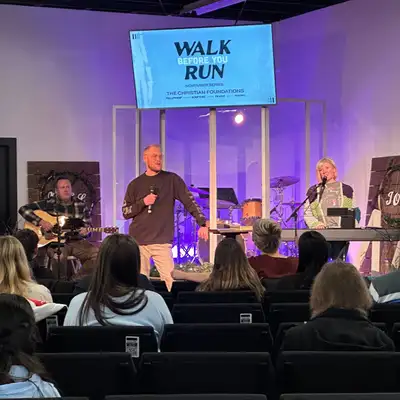
find me on the way, not in the way." My title for this message, if you're taking notes, is
Romans Episode Number 4. I don't know why it's Episode Number 4 other than that is how
I've been writing all my notes for this series. God's got this, I don't. Why don't you say
that with me? God's got this, I don't. One more time so you believe it. God's got this,
I don't. Would you bow your heads, I'm going to pray. God, thank you that you're here with
us in Vernon online and in Revelstoke and Kelowna. God, we thank you that you've got it even
though we don't. Amen. Romans' letter is broken into three sections. Dr. Vernon McGee, that
old-timey preacher that I talked about, labels them this way. Chapters 1 to 8 is theology
of faith. So the understanding of faith. Chapters 9 to 11, which is where we are today, it's
dispensational section. It's Israel's past, present, and future. Chapters 12 to 16, which
we'll go into for the next few weeks, is duty, justified by faith to duty. Today we spend
time in Chapters 9 to 11, and we're focusing on a new section of the Book of Romans. The
last few weeks have been on the first part, and this is a new section. John P. Poulho,
in his book, Paul and his letters, breaks these three chapters, 9 to 11, further into
these sections. Part 1, God's sovereign freedom to choose. Part 2, Israel's failure to respond
to the gospel, the good news. And Part 3, Israel's rejection is only temporary. Now, the intention
today isn't just to provide you some facts about Romans 9 to 11. In fact, the great intention
is to know God greater today, just like Pastor Kimberly prayed. Greater today than when you
walked into the room. In part, that's accomplished by an encouragement and a tool set to enable
you to engage with the words of God in the Word of God, regularly in your personal world,
i.e. to help you read your Bible. There's a word we throw around in church, it's the
word "Revelation". If we break it down, it means to reveal. Revelation is to reveal. God
has a word he wants to reveal to you. Sometimes this comes through a preach, sometimes this
comes through a song, a prayer, an experience, and sometimes, and often, it comes from his
written word. I've heard Pastor Dave say over the years, our lead pastor, that the best
version of the Bible is the one you will read. What's the best translation? The one you will
read. Now I'm sure since he finished his master's degree, he probably has more to say about
that, but the spirit remains the same. The principle, or the scripture you read, will
do more for you than the scripture you don't read. We need to be reminded that a breakthrough
comes in a single moment of impact. A couple months ago, I had to break a piece of sidewalk,
a chunk of sidewalk. And you know you hit it, and nothing happens, and you hit it, and nothing
happens, and then one time you hit it, and something happens. And that's the truth about
the engagement with scripture, is you can spend a lot of time trying to read the Bible,
and nothing really works, and then suddenly you have the right tool, and something breaks
through. We've been doing work on our home, as I said, and in a renovation project, maybe
you know this, is there's the tool you need, and then there's the tool you have. Right?
It's the person who doesn't have a paint can opener
who uses a flathead screwdriver.
The tool they need and the tool they...
A butter knife, dear Lord, tell me you've never used a butter knife.
(Laughter)
Oh, dear Lord, yes, everybody, there is a paint can opener tool.
The tool you need, the tool you want.
It can be like that.
You have the tool you need, but the day you get the tool...
You have the tool you want, but the day you get the tool you need...
Whoa, that's a breakthrough moment.
My friend, Victor, here from Ukraine.
Hi, Victor.
-Pravit. -Pravit.
Either means ghost or hello.
(Laughter)
And then pravid is the other one.
Anyways, Victor was at our midweek recently.
He was reading the English Bible.
And obviously, as you recognize, if Victor is from Ukraine,
then English Bible isn't his first choice of Bible.
Well, of course, the first choice of Bible, if you are from anywhere,
looking for a Bible is what?
A King James Version.
Well, Victor's first language is not Canadian.
Why not practice trying to interpret words
when we're also trying to interpret words we don't even use in our language today?
Well, I believe it makes a significant difference
when we find an easier-to-read version.
Pastor Kimberly grabbed a message summary, the message we read it just a moment ago,
"Version of the Bible Off Our Shelf" this week to bring to someone from midweek
who is struggling to understand their version of the Bible.
It was a great reminder that we can learn best from people we know.
One tool away from breakthrough.
You are one tool away from the Bible not being hard to read.
You're one tool away from having no reservations to worship God.
You're one tool away from breakthrough in your relationship, in your finances.
You are one tool away from breakthrough.
Today, as we dig into this message, could we allow God's permission to speak into your life,
to challenge and adjust you?
Are you ready?
Okay, so chapter 9, God's Mercy, Not Our Performance.
Paul begins in Romans 9, expressing his heartbreak, Romans 9 verse 2,
"That I have great sorrow and unceasing anguish in my heart."
Paul is a Jewish Christian, and he's heartbroken,
because many of his Jewish family have not accepted Jesus.
They've rejected Jesus.
Some of us get that too, deep in our emotional being.
People in our own world that have not accepted Jesus.
Paul asks so many rhetorical questions in this letter.
He follows up his grief with this one.
"If Israel is God's chosen people, why aren't they all saved?
Did God's promise fail?"
Romans 9 verses 6 to 7 says, "But it is not as though the word of God has failed,
for not all who are descended from Israel belong to Israel,
and not all are children of Abraham, because they are his offspring.
But through Isaac shall your offspring be named."
The culture of the day gave precedence to the firstborn male in the family.
Our greatest modern example of this is the British royal family.
It's why Prince Harry can call himself Spare, in his book,
because his entitlement in the family is less than the firstborn, William.
So this was the culture of the day.
So when Paul has grief about the Jewish people not accepting Jesus,
he quickly speaks into the reality of what's taken place in the first place.
Abraham was given a promise by God to be the father of many nations,
yet the promise flows outside of the cultural norms.
So if the firstborn then was not considered the heir of the promise,
Isaac, not Ishmael was chosen, Jacob, not Esau was chosen.
Even before Jacob and Esau were born, God said that, "Jacob I have chosen, Esau I have rejected."
The secondborn rather than the firstborn.
So then if that's the case, then being ethnically Jewish does not automatically mean you are part of God's true people, salvation.
Because God didn't follow the same rules.
So Paul demonstrates that salvation, even for the Jewish people,
has always been about God's mercy, not human effort or birthright.
This isn't a sign of God's lack of fairness, but God's plan, always depending on his mercy.
Isn't it great that God's plan always depends on his mercy, not my mercy?
Romans 9, 16 says, "So then it depends not on human will or exertion, but on God who has mercy."
So Paul writing to a Gentile and Jewish Christian church takes a significant moment to demonstrate that Jewish heritage was never how salvation came.
That our efforts were never how salvation came.
How is that exposition relevant today? Okay?
So in Scripture, we're invited to see ourselves in the characters in communication in Scripture, to hear God speaking to us individually out of the sacred text of antiquity.
When we read about the Jewish Christians and the Gentile Christians, we should be able to see a reflection of ourselves, either in one or both.
And likely, in your lifetime, you will oscillate between the two.
Often think of the Jewish Christians as a picture of the person who grew up in church, and the Gentile Christians as a person who found Jesus later in life.
Paul evens the playing ground on both of these groups, echoing that growing up in church does not make you right with God.
And then if it does not depend on human desire or effort, but on God's mercy, then today for you and I, some of us are trying way too hard to earn God's favor when he already picked us.
Others feel like God must have skipped us over. But no, he's got you.
His mercy is bigger than your failures.
God simply has the sovereign choice to show mercy.
Maybe this week, change exists on the other side of taking five minutes each day to remember that God's mercy is bigger than your mistakes.
Chapter 10. Righteousness by faith, not work.
So Paul continues into Chapter 10, explaining how people are made right with God.
If not by heritage, then by what?
Romans 10 verse 9 says, "Because if you confess with your mouth that Jesus is Lord and believe in your heart that God raised him from the dead, you will be saved."
Sorry, let's read that again.
"Because if you confess with your mouth that Jesus is Lord and believe in your heart that God has raised him from the dead, you will be saved."
That's it.
No checklist.
No spiritual resume.
It's just faith.
This was a radical truth.
Salvation is now available to everyone, Jew and Gentile alike.
In our analogy of the grown-up in church and the came-to-faith later in life, it's the example of having both sit at the leadership table.
That longevity was not the currency that brought you to the table, but simply grace and mercy.
Have you ever been to an event that required VIP wristbands?
Is that making sense?
Everyone's got a nod at me that they understand what I'm doing.
Sometimes I make hand gestures that don't translate as well as I think they do.
So everyone's been to an event...you've got to show me your hands.
Have you been to an event with VIP wristbands?
Or maybe at Disney the Fast Pass or the Genie Pass, I think that's what it's called now.
So the Jewish people thought that they had a VIP access to God because they did the right things.
I did right things, therefore I have VIP access to God.
But Paul says, actually, Jesus ripped up the list and is handing out VIP bands to anyone who calls on Him.
Paul quotes the Old Testament from the Book of Joel in Romans 10-13, he says, "For anyone who call on the name of the Lord will be saved."
This means the single mom who feels like she's failing? VIP wristband.
The teenager who's messed up more times than they can count? VIP wristband.
The guy who thinks he's too far gone? VIP wristband.
If you've been thinking I need to clean myself up first, stop. Jesus is handing you a wristband. Just take it.
If you've been looking at others like, "Are they really saved?" Remember, you didn't deserve your wristband either.
This was mind blowing to the Jewish portion of the audience.
It meant that a non-Jew who put their faith in Jesus was just a much a part of the God's family as a Jewish person who followed the law their whole life.
That person who gave their life to Jesus last week and connected into the church has equal rights and access as you who've been here since inception.
Some of us still carry the weight of thinking we're not good enough for God.
Others think we're too far gone like we don't belong in church. Paul makes it clear. Salvation is not about where you come from. It's about who you call on.
If you've been holding back, today is the day to call on Jesus. Chapter 11. God's not done yet.
So Paul asks another rhetorical question. Remember, he likes to use rhetorical questions. In Romans 11, verse 1, "I ask then, has God rejected his people?"
By no means. Even though many Israelites reject Jesus, God is not finished with them. Paul himself is an example for us. He was a Jew who met Jesus and was transformed.
He explains that there is still a remnant of Israel who believed in Jesus, and in the future many more will come to faith.
Romans 11, verses 17 to 24, Paul brings out the analogy of an olive tree. He gives this picture of an olive tree where the root is God.
And although the branches, the natural branches of that olive tree, are the Israelites, God has cut off the Israelites that are dead wood, those that have not believed.
But as he's cut them off, he has grafted in wild olive branches into the tree. Now, it's not because they're wild that they're good.
It's because the root is good that they have sufficiency. So we cannot owe anything to ourselves. The dead wood was cut off because of unbelief, and the wild olive branches were cut in or grafted in because of belief.
So you can't be pompous or arrogant or elite because you were grafted in. Because in the same way, if you become dead wood, you get loft off, and the dead wood, if it becomes a believer again or comes with belief, gets grafted back in.
This is the analogy that Paul is trying to give with a visual picture. The natural branches, Israel were broken off because of unbelief. The wild branches, Gentiles, were grafted in through faith in God.
So, but God can graft Israel back again in the same way as the Gentiles are grafted in, through faith in Jesus. Whether you grew up in church or never grew up in church, the answer to relationship with God is the same, through faith in Jesus.
If you come to church for the rest of your days and have no faith in Jesus, I'm sorry you missed the plot. If you never come to church and have faith in Jesus, I'm sorry you hit the point.
We have to recognize that we put the right thing in the right order, or otherwise, we become like that opening verse. Our God projects have replaced God in our lives. Isn't that sad, when doing for God replaces God in your life?
And then you become like the, what's the story in the Bible? It's the two brothers. The prodigal son. It's the brother who's so mad at his younger brother. I'm a younger brother so I always picture me in that picture. And then I picture my brother Joel as the other one who's, anyways, maybe you don't do that. I immediately put myself into these pictures.
But it's these moments where it was never about what you did or didn't do is about getting the right things in order and we have to make sure that we don't do duty for God without doing and being in relationship with God. I gave this analogy, I think, to Curtis. I think it was to you while we were in midweek. It's like saying that if I go on a date night every week, that is the demonstration of love to my wife.
How many of you know going on a date night every week with my wife doesn't mean that I love her? But because I love her, I may go on a date night every week. But if I allowed the date night to replace the relationship, I've missed the plot. And sometimes that's what we do. We read our Bible as a duty. We pray as a duty. We show up as a duty. We serve as a duty. We give our tithe as a duty. And we miss that they're all underpinned by the relationship with God. And without the relationship, what good is a duty?
It is a date night without the love in my relationship.
I've been on those date nights, they suck.
I've been on a lot of date nights
where there was less love between us.
It was always my fault.
(audience laughing)
Man, you guys are so vocal when I give those examples.
But this analogy, the olive tree,
demonstrated that God's plan wasn't finished.
He was still working to bring people to Himself.
Often if you watch a matriarch in a family cook.
Everyone know what I mean?
No, I was trying to figure out the right way
to not make anyone offended if their moms don't cook
or if they don't cook.
Anyways, sometimes you've seen a person.
There may be a matriarch or may not be a matriarch,
may be a man or may not be a man, a person cooking.
Have we, you know, Curtis cooking.
That's right, we've got there, okay.
And have you ever watched them
and it doesn't really make sense?
This is the person who you ask them for a recipe
and they say, well, I just do it from my head.
Like you, Ryan.
Ryan's Thai curry soup last year.
What's the recipe?
He's like, well, thanks.
So I actually have a recipe,
I have a recipe book for my grandma
and don't worry, grandma's safe.
Grandma might be watching today.
So grandma, she gave us this recipe book
and it's funny when I read through it,
it's all these like family recipes
and I grew up, I'm Norwegian,
so it's a lot of Norwegian recipes
and things that only my grandma or my mom make.
But I'll often read through them, right?
And it'll say add this until it looks right.
(audience laughing)
What?
Add this.
You know, enough flour until it feels right.
Okay, what do I do with that?
A bit of this and a bit of that.
Okay?
But you watch one of these cooks, okay?
And they throw spices in, right?
No measuring cup, they put ingredients together
that you think like, oh dear Lord,
what is this gonna be?
And you may even think it's gonna be terrible,
but then somehow it turns out amazing.
Chocolate zucchini cake.
Black bean brownies.
These are all amazing.
That's Romans 11, okay?
Paul says, you might not understand
how God is mixing this all together,
but the final result will be incredible.
It reminds us that God is not finished with his plan,
he is still working to bring people to himself.
Maybe you feel like you've missed your chance with God.
Maybe you've been praying for someone
who's just too far gone.
Well, Romans 11 reminds us, God is always working
even when we can't see it.
If you've given up on yourself or someone else,
this is your moment, this is your reminder,
this is your encouragement,
this is the time to start praying again.
'Cause God isn't done writing your story.
Pray for the not yet.
The things God is still working out, he's not finished.
I remember when I was a teenager,
my brother was the youth pastor at the time.
I remember him preaching this message,
and I used to keep the note in my pocket,
or like in my wallet at the time for years.
And he gave this expression about hearing God's answers.
And I think because we as humans like things black and white,
even if we say we don't, it's just easier for us.
And he gave this expression that God answers in three ways.
He says, "Yes."
And we love when God says yes
to what we're praying about, right?
Like that is amazing.
God says yes.
Then God says no.
And we're so mature that we know
that God has something better for us because of that.
It might take a week or two for us to get mature,
but you know, there's no.
But then there's this other answer, and it's not yet.
Not yes, not no, but not yet.
And you sit there in this uncertainty,
in this momentary space of like finding the truth.
Finding faith or trust in the unknown.
Having a promise from God,
it's like a prophetic word that comes in.
It's a promise from God.
You're like, God, you said this, and I know I believed it,
and I know it was there, but I don't see it.
It hasn't been yes, it hasn't been no,
but it's just sitting here on the back burner of my life.
God, I know you have a purpose for me.
God, I know there's something good there for me.
I know you've communicated to me,
but God, where is it now?
It's the waiting.
Waiting has gotta be some of the most difficult moments.
Waiting when a child is born,
waiting for that check to come in.
Waiting in that moment,
'cause waiting means that I have done everything I can do,
and I must trust in someone beyond me.
But not yet is that moment
where what you have the power to do is to pray,
and not as like the last resort,
but actually as the primary thing,
'cause your prayer to God in that moment
rearticulates that He has it under control.
It rearticulates to your spirit,
to your fears, to your anxieties, to your uncertainties,
that God has it under control.
He has not said yes, and He has not said no.
He has said not yet.
I wish in my history
that seeing God's answers to my prayers
made me so much more confident
when He still says not yet now,
but I feel like a child every time.
Uncertain, unclear, dependent on God alone.
It's an amazing place to be
if I allow myself to die to myself.
Maybe that's you.
You've given up on yourself,
or you've given up on someone else.
Would you start praying again?
'Cause God isn't done writing the story.
Pray for the not yet.
The things God is still working.
He's not finished.
Romans 11, 33 to 36, I'm coming to a close.
It says, "Oh, the depths of the riches,
"and wisdom, and knowledge of God,
"how unsearchable are His judgments,
"and how unscrutable His ways.
"For who has known the mind of the Lord,
"or who has been His counselor,
"or who has given a gift to Him
"that He might be repaid,
"for from Him, and through Him,
"and to Him are all things.
"To Him be glory forever, amen."
In other words, God's plan is bigger than we can comprehend,
but we can trust Him.
So, what are we gonna do this week about this?
Will we take five minutes each day
to remind ourselves of God's mercy?
Will we call on Jesus and say yes to Him today?
Will we pray for the not yet,
the things that God is still working out?
Or maybe something entirely different
is what the Holy Spirit is asking you to do?
Would you all, everywhere you are right now,
close your eyes just for one minute.
I started by saying the reality is
my words won't change you, but God's words will.
God might use me to speak to you,
but in this one minute, I'd ask for you to pray.
And say, "God, would you enable me to hear and discern
"what you're asking for me today?"
(soft music)
(soft music)
[ Silence ]
For God's mercy is bigger than our failures.
Salvation is for everyone who calls on Jesus.
God is still working.
Even when we don't see it.
The story isn't over.
God's plan is bigger than you think.
Let me pray.
God in heaven, holy be your name.
Your kingdom come, your will be done.
On earth as it is in heaven.
God I thank you that we are in this space.
Encountering heaven on earth.
Not just in a room, but in our lives individually.
God would we be willing to allow you to speak and change things in our lives.
So tomorrow we would know you greater than we did today.
Thank you for making yourself available to each and every one of us.
At this moment in history.
And in the moments past and future.
Help us to trust you.
Help us to lean into you.
In Jesus heavenly name we pray, Amen.
Thanks for tuning in today.
Each week we gather in cities across our region and online.
To explore the truth of freedom available to all in the message of Jesus Christ.
To find a gathering near you or to find out more head to C3church.ca
and
and
you