Subscribe
Share
Share
Embed
In this episode, Priten speaks with Brian Tash, an elementary school teacher with nearly 30 years of experience who has witnessed the complete arc of education technology—from Scantrons to Google Classroom to AI. Brian shares how he balances technology integration with preserving fundamental skills like reading stamina and handwriting. The conversation covers his transparent approach to using AI for faster student feedback, why he's concerned about declining empathy and attention spans post-COVID, how he teaches prompt engineering to third and fourth graders, and his hope that educators will become more mindful about why they're using technology rather than just adopting everything new. He argues that personal connection, problem-solving, and collaboration are what students need most—and those can't come from a screen.
Key Takeaways:

Margin of Thought is a podcast about the questions we don’t always make time for but should.
Hosted by Priten Soundar-Shah, the show features wide-ranging conversations with educators, civic leaders, technologists, academics, and students.
Each season centers on a key tension in modern life that affects how we raise and educate our children.
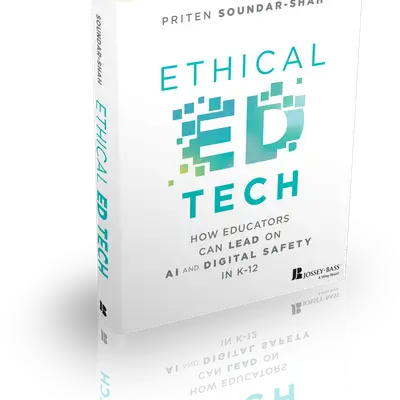
Learn more about Priten and his upcoming book, Ethical Ed Tech: How Educators Can Lead on AI & K-12 at priten.org and ethicaledtech.org.
[00:00:05] Priten: Welcome to Margin of Thought, where we make space for the questions that matter. I'm your host, Priten, and together we'll explore questions that help us preserve what matters while navigating what's coming. Today I'm joined by Brian Tash, a teacher with nearly 30 years of experience who's witnessed a complete transformation of education technology. From Scantrons to Google Classroom to AI, Brian brings a big picture perspective. He's seen enough technological shifts to know that each one promised to revolutionize education, and each one came with trade-offs. He advocates for using AI tools in the classroom, but not without careful consideration of what we might lose in the process. Student engagement, attention spans, essential skills like deep reading and writing, and even empathy. Let's dive in.
Brian: My name's Brian Tash. I've been teaching, this is going into year 30. I have experience in grades kindergarten through eighth.
[00:01:01] I've worked at the district office as a Tech TOSA, technology integration specialist. I've done a lot of professional development through our school. I've taught fourth grade the last eight years. Now I'm moving down to third grade. I have experience with all different types of kids, working this summer with an autistic program during our summer school, and really diving into AI and technology. Over the last year and a half or two years, I've been exploring different platforms, seeing what works and what doesn't. I've been working for some companies on the side, getting my feet wet.
Priten: So before we talk about your experience, I like to just ask folks: what their earliest memory of an ed tech tool as a student was? Whether it be grade school, college, whatever your first experience that you can remember explicitly is.
Brian: Technology. Oh boy. I'd probably say Scantrons in college. The old school Scantrons with that—they would run through and then you'd get a little mark on them and then you'd know how you did.
[00:02:06] Then just the early integration with emailing professors and that sort of thing. Most of my classes at UCLA in the late nineties were a little bit on the computer, but most of it was all in books and paper.
Priten: That's interesting. So tell me, when that transition first happened, did you have an emotional response to that? Were you excited because you were getting feedback sooner? Were you annoyed because you had to fill it out perfectly and if the bubble wasn't quite right—
Brian: I think the switch—and I know still some teachers still use it, which is crazy—but I think it's that immediate feedback piece. The ability to provide instantaneous feedback that they need before they get too far, especially with essay writing. It's a little easier with multiple choice, but I still feel like even with Google form types of tests, that's kind of a Scantron. It's just taking it to another step.
[00:03:01] Priten: Okay. So let's talk a little bit about your first memory of using it as a teacher. What was the first EdTech tool that you were excited to embrace, or maybe even forced to embrace, in your classroom?
Brian: I mean, things really picked up with Google Classroom, which was kind of the beginnings about 10, 15 years ago. Our district was a huge Google Classroom school district. This was pre-COVID and pre-Canvas and all that. Everything was Google Classroom. Learning how to use it, streamline how to make courses, that sort of thing. For me it was a learning curve, but I'm a quick learner when it comes to technology, so it was definitely easier than for some other people. I think the kids at first had to figure it out, but they were pretty advanced. That group coming up. This was at middle school, so it helped them to simplify things—having courses with different cards for different courses and things like that.
[00:04:05] Being able to check their grades more instantly and know that all their assignments were there and that they could check them when they needed to was helpful.
Priten: Yeah. And what about parents? Did they generally respond in a certain way?
Brian: Yeah. I think having that information at their fingertips helped alleviate a lot of issues down the line when it gets close to progress report and report card time. Our report card management system is Q, so they're always able to see what their grades are all the way from kindergarten up through high school. They have the same username and the same password, so the parents and the students always know that's the go-to spot to check your grades and where it's most accurate.
Priten: I mean, it just sounds like a streamlined communication between you and the students and the classroom and the parent. Are there any ed tech tools that were system level, so school level, like Google Classroom, that your school has or currently uses, that you or the students or the parents weren't so fond of?
[00:05:06] Brian: Definitely Canvas. Canvas at the elementary level, I think is too advanced. It has too many options, too many different areas for them to go. Our district's kind of gung-ho with Canvas in middle school and high school. Fourth and fifth grade and third, they usually let us pick and choose how we want to push out assignments. For me, everything's in Google, so it's just natural and streamlined for me to push out that way. And now almost all the AI tools sync really nicely with the Google Suite. So that's the route I've gone. I like different areas of Canvas, but for me it was just too complicated. Too many different things.
Priten: Yeah. Do you know if the push in the middle school to high school is just to prepare them for like the systems they'll use most likely in college, or is there something else?
Brian: A lot of it came after COVID. So I was Tech TOSA immediately straight after COVID.
[00:06:01] That's when the district spent lots of money on Canvas and Excel on Reflex, all those programs. So there was that tool that was the whole district was kind of synced up on, and everyone, all the grades knew about it. Canvas—I don't know if it was that colleges are using it. I think the main goal was to find something that is the same in middle school and high school at a bare minimum so that parents and students and teachers could all be on the same page.
Priten: Right. And then you mentioned the pandemic. So I'm curious, pre-pandemic, what did device and broadband access look like in your district, versus has it changed at all since?
Brian: Oh yeah. So before, I'd say there was lots of sharing of Chromebooks. We were not one-to-one. The WiFi was not great, so it would crash a lot.
[00:07:00] We had computer labs—three labs on almost all the campuses I was in. So everything was desktop, and teaching the kids about different skills in each grade level. That's gone completely out the window with COVID. I think the overall alliance of technology is there. It's nice to have that one-on-one device, but it's finding that right balance.
Priten: Perfect. Okay. Tell me a little bit about what role the device plays in your classroom. What does a typical day in your class look like? How often are they using their Chromebook? Is it largely at home? Just paint a picture for me of that.
Brian: Yeah. The initial push straight out of COVID was almost all day they were on it, just to eliminate that one-to-one where they had to be in their personal space. So it kept everyone separate in their bubbles, and you could push out things and they could work on it if they weren't there or they were sick. The last few years, I personally noticed that I had an over-reliance on it, so I've really been pushing it back.
[00:08:00] Getting them used to writing with pencil and pen more on paper. I know the stamina is definitely not there. I'm noticing that in reading and writing, it's really hard for them—that hand-eye coordination isn't there. The ability to keep going—the complaining after writing a paragraph about their hands hurting. So I try to do a good mix, especially at the beginning of the year. Then once we get used to it and down with the process, we bring in more computer usage for like typing up their essays and things like that. With math, it's very limited. We have IXL, so they use that. Our math program doesn't really have a great platform for technology, so most of it's things we create on our own, and it's usually worksheet-based. All of our quizzes that we do are online, and almost everything we do is in a Google form just to get them used to standardized testing.
[00:09:02] Priten: What is their sentiment on it? So when you say okay, like they get your devices, are they excited because they're on the computer? Are they dreading it because it's yet another—
Brian: There's a couple kids that are usually like, "I don't wanna do it. I want to write it instead." And so I'm at the point where I give them the option. I mean, it is harder on me to try to read the writing, so I explain: if you're gonna write it, it needs to be legible. You're rolling the dice on spelling and grammar and all of that. We're going to standards-based grading next year. So that's the push to make it more equity-based. I think it's definitely gonna have to have me reevaluate that and have everyone at a point of getting used to those word processing skills that they're gonna need. Not just the ability to type, but to understand what they're writing, to use the tools that are there, to use the AI that's there.
[00:10:00] Following that 80-20 rule, it's gonna get you 80 percent of the way. The other 20 percent is gonna be you creating it and adding your own elements to it.
Priten: Yeah. So is that 80-20 rule about teacher usage, or are you all using it?
Brian: I think it's both. I've been reading a lot, and for me, that's kind of my goal. If I'm gonna run something or run through Brisk or one of those programs where I'm gonna give them feedback immediately, I'll look at what the feedback is. And usually it's pretty spot on. Then I just tweak it, fine tune it, put it in my words. They know that. We talk about, like, this is a way that I can get you feedback quicker so that you do not have to write all the way to the end while you're in there. I can be looking at it at the same time and following you step by step on your journey, instead of the way it used to be.
Priten: Right. And so what is their response to knowing that there's feedback generated by AI? I'm curious about what they say. Do the parents have any concerns?
[00:11:00] Brian: It's mixed. I did actually do a study for EnlightenAI. I don't know if you've heard of them. Enlighten's tool is mainly about feedback, so I was working for them. In their first group, they had me do a kind of study for a 12-week session. We wrote up a whole blog and did a whole thing and analyzed it. It was about 90 percent in favor of it. The key was they needed to understand why we were doing it this way and that it wasn't just copy and paste. It was: I'm looking at this, I'm getting an idea, and then I am taking that idea and adding my touch to it to help you along your way. So once that background was there, I think it helped.
Priten: And they were able to appreciate that the pace of feedback was faster. And—
Brian: Oh yeah, for sure. And their parents too, because then with certain tools like Enlighten, you can run back a full report that tells all the different areas that they're struggling in.
[00:12:02] So it's a nice way to keep that data if I ever need it. Especially going to standards-based grading, I'm processing how I'm gonna justify whether they're meeting the standard or not. So tools like that and MagicSchool are good for that area.
Priten: So you talked about how you're transparent with your students about when you use AI and what the purpose of it is. What about student usage of AI? I'd love to hear experiences with students using it, but also how do you incorporate it within your classroom directly?
Brian: Yeah, mainly I think they use ChatGPT here and there at home to look up different things or if they're interested in topics in the class. The main ones I use are MagicSchool. I'll push it out through Magic Student. I've used SchoolAI a lot. I believe in both of those. And then Brisk. Those are my three mains. Diffit I'll use here and there.
[00:13:02] I like how you can change and differentiate the text on a certain assignment. But the ones that they personally use would be SchoolAI for the spaces that I push out and create. They really like those chat character chatbots. Pick a character that we're studying in a book, give them that character, and allow them to interact with it. It really helps clarify what we're reading. I think it balances the playing field a lot because my SpEd kids—I can set the accessibility so that I show them how to use text to speech. I can use the headphones so that they can listen to it being read to them. So all of those different tools are built in to a lot of them, which is great. And those that want to go farther, my GATE kids, they can push farther and ask more higher-level thinking questions. The focus that I'm on now is prompting—a lot of prompt engineering.
[00:14:03] How best can I put out what I wanna put out so that I get what I want to get? That's my next focus. How do I get what I want? We've talked about it too. If you're gonna use ChatGPT, if you're gonna use Brink or MagicSchool, it's all about prompting. So we've kind of played with it a little. I'll tell them, go into MagicStudent and type in this and see what the image generator comes up with. Then okay, if you change the words here, if we add this, if we add that, now look what happens. So there's a lot of trying it out and experimenting, especially in the lower grades, because I want them to become comfortable with it. It's something they're gonna see, and it's not this big negative thing. It's here and they need to learn how to use it as they go on their journeys and eventually through high school and into college. They're gonna need it. It's coming. It's not like it's gonna stop.
Priten: Talk to me a little bit about the pedagogical goals free of AI versus now, and how you're balancing them, how they're changing for you.
[00:15:07] Especially like you talked about the stamina with even writing like an in-class essay that's changed. I'm curious about other changes you've seen in students' academic abilities in a world where AI continues to be accessible to them.
Brian: Yeah. I think one of the biggest is reading. They don't read anymore. They don't wanna read for pleasure. It's only if it's linked to an assignment. The reading just to read is gone, which was something when I was growing up. The attention span seems to be shorter. So it's about finding that engagement piece and showing them that there's a lot of different book options. There's a lot of different things. You don't have to read a book. You can read a magazine, a graphic novel, listen to an audiobook. I mean, I tell them, even watching TV with the subtitles on—for some of my low or ELL students, it's reading. I don't care what it is.
[00:16:01] Podcasts. I mean, anything that will get them. We talk about how some of your auditory learners—that's the way you're gonna take it in.
Priten: Other things you're noticing? I'm curious about any change like attention spans are a universal thing we hear about. Reading and writing both—especially when it comes to like physical book and writing with a pen or pencil. What about in terms of their buy-in for learning certain topics? One of the pushbacks, one of the things we hear a lot at the higher grade levels is students are pushing back again. So why do I still have to learn this because I have AI in my pocket and they can do X? Do you get any of that at that grade level?
Brian: No. Usually what we'll get in lower grade and upper grade is: is this being graded? That question. Like, what do I get for this? What's the end result? Why do I have to do this? So the pushback is definitely more. I think a lot of it is post-COVID parenting, just kind of the schools are gonna handle it.
[00:17:02] And it's off the grid—I don't hear from a lot of the parents. They're either too busy working multiple jobs or it's in your hands. I trust you. Go. But it's definitely the stamina across the board. The ability to just respect as a whole. I don't really hear too much of: I could just look this up. Some of the higher-level ones—like I said, I do show them like, hey, let's go in there, let's see, type this in. We talk about how Google's gonna try to trick you if you look at the top. It's not gonna be a reliable source. Are you on Wikipedia? Let's go. And that's why I like MagicSchool now. We'll start having it—it has citations so we can talk and say, oh look, this is where they're getting this from.
Priten: Yeah. I'm curious more about like your personal philosophy on this. You know, there's some of these things that maybe it's just a matter of adapting with time and not realizing which things are relevant and not relevant.
[00:18:00] And some things might be concerning. I'm wondering what things fall into those two buckets for you?
Brian: Like in the immediate or like coming?
Priten: Both. I think, like things you've definitely seen already that might be concerning, or things you're starting to notice or patterns you're worried about forming—both in students independently or in your classroom.
Brian: I'd say a big concern is the lack of empathy. A lot of kids have a hard time sharing and understanding. That listening skill is gone. Pushing through and doing hard things—I think that's huge. Something that's just stopping them. I don't know what it is, but there isn't a lot of: I know I can try this if I keep doing it. The growth mindset isn't there. I also worry in the next few years there are not a lot of teachers going into the profession, so class sizes might go up. The amount of standards and things being forced down throats to get things done—it's all about testing, testing.
[00:19:03] I think that's really hurting things. The days of school being fun, especially even in the lower grades where those are your core memories, are kind of going away. So I try to keep that there as much as I can. I wanna make it fun, but yet we still are learning.
Priten: Tell me a little bit about the standards-based grading transition. Are you excited for that? How does that jive with pedagogy as you think about it in the age of tech?
Brian: Every grade K through two does it, so third grade is getting it this year in the whole district. Then it'll go to fourth the year after. So we're really looking at redoing the report cards. We are redoing the benchmarks, kind of rewriting all of the curriculum to map it out so that it matches the standards. We're thinking about how we can be clear to the parents in terms of: this is the new grading system. It's more equitable for sure. It gets rid of the bias.
[00:20:02] There's a lot less in between. You either you've got it or you don't. And it's in particular categories. So I know the district has read it and looked in studies and this is the path that they want to go.
Priten: Right.
Brian: I'm curious to see how it goes.
Priten: Yeah. So you mentioned using a lot of different AI tools. Having tried a lot of different AI tools, how much of this is personal interest-driven? How much of this is like your school is providing these tools or there's committees? I'm just kind of curious where those tools come from.
Brian: Yeah. I mean, a lot of it was me searching out. Being on Twitter and X now. Being, like I said, stepping up, joining these ambassador programs that a lot of the big companies have, where they kind of bring in teachers, let you see the tools ahead of time, some of the new things, new features. Then they give you some swag.
[00:21:01] They're there to help you out along the way, and then they want us to go back and present it to our staffs. So really, I mean, it started probably post—when I was Tech TOSA—so right after COVID. Learning about all these things started to drop, and then I just got into them. I learned about Brisk, MagicSchool, Enlighten—started working for them as their kind of social marketing type of thing, posting, going on different Facebook pages. Really, I mean, it's a lot of just looking in social media, seeing what's new, and then trying it out. Then just finding what works with what is my goal. And then thinking about what I can bring back to my staff and to the district.
Priten: You're clearly thinking about engagement as one of the metrics for evaluating ed tech tools. What other metrics do you think you're either subconsciously or consciously evaluating when you decide whether or not a tool is good?
Brian: I think it's mixed. I think I look at the student's response to it.
[00:22:02] And then I look on social media at how others are using it. I'm also about safety bias. So I'll bounce it off other people: is this a good site? What do you think of this? And going to conferences, going to Q conference in California. I know ISTE just happened. And just reading about what the latest and newest things are. And really it's just trying them. I'm not afraid. Try them out, see what they do. I think there's an overabundance of tools. Now it's about streamlining it. I eventually think most of them are gonna go away or get bought out by other companies.
Priten: Yeah.
Brian: They compete. There's—
Priten: Right. Yeah.
Brian: And they all kind of do the same thing.
Priten: I know you mentioned you're a Google Classroom user. Did you get a chance to check out the new suite of tools they just released?
Brian: Yeah, I saw it. It looks cool. I don't think, unfortunately our district, because we don't buy it, I won't have all of it. I don't think it's called Enterprise, right?
[00:23:06] I don't think we're at the highest level school-district-wise, since they only already bought Canvas. But I mean, for me, especially at third grade and fourth, it does what it needs to do. I know there's an AI element they're building into it, which I'm interested in seeing how that all streamlines. It'd be nice to have it all in one place instead of having to go to Brisk, then go somewhere else, then go here.
Priten: Right.
Brian: So.
Priten: And I'm curious, I know again like you talked about the importance of having that one login throughout many years and how that facilitates a lot of the convenience for parents. In the last few years, because there have been all these one tool does this, one tool does that, have you heard feedback from parents or students, or is everyone largely following along? What do you do to streamline that for folks?
Brian: Yeah, that's another huge piece. So if I'm looking at it, the ability to have that quick sign-on without having to log in. MagicSchool has that. Brisk. They sign in with their Google account.
[00:24:01] Enlighten—unfortunately our district won't allow different tools. I don't really need to push it out to the students. So it's really like those ones SchoolAI works. It's basically making sure that it meets that safety requirement and then sending to our IT if I want approval on these. And they've been pretty good about approving them. They've only disavowed a couple of them.
Priten: Yeah. And do you know, I mean, was that—you don't have to name names for which tool—but do you know like what was the reasoning for not accepting certain tools?
Brian: They just kept saying it didn't meet the level that they wanted it to be at. I forget what level it's at, that certification that they need to have. So Brisk, I know is at that level, and MagicSchool and SchoolAI are all certified at that level. So I think it's hard to attain in terms of safety and data of the students. So I'm thinking that's the reasoning behind it. Parent-wise, they've been pretty receptive and they like having that easy access if they need to.
[00:25:02] A few of them are linked through ClassLink, which is our link where all of our links are. So it'd be nice if eventually it was pushed out, but it's hard to get them there.
Priten: Right. Yeah. I know we're a little bit past our time, so I wanna make sure I respect whatever cutoff you have. But if there's anything else that you think would be useful in terms of things you're thinking about or concerned about, or excited about when it comes to education technology, that would be great.
Brian: No, I just—yeah, I mean, I'm excited to see where things go. And the overall use of AI and the overabundance of technology—I'm hoping that it slows down a little. That people think about things a little bit more in terms of what they're there for and not. And the reasoning behind it. Become more mindful of the fact that they need to be able to write and get that stamina back and not give up doing those fun things that we all remembered from elementary school and middle school before.
[00:26:09] Priten: Yeah. Yeah. I think at times technology feels like the end-all be-all of schooling right now. And it's nice to hear that there's some pushback and trying to make sure we preserve those human elements but also the elements that build that stamina and provide that academic rigor.
Brian: Yeah. And that personal connection—that's what they need. The way to talk to each other, how to problem solve.
Priten: Yeah.
Brian: Collaboration, communication—all those.
Priten: Right. And then so do you think that the push to standards-based grading is gonna make that easier to focus on or harder to focus on? I'm just curious.
Brian: I think it's gonna be easier because now I'm gonna have time. We're really focused on hitting those standards. And if they've mastered them, then I know we can go to other places. For me, you can back-plan knowing that these are the standards.
[00:27:01] So a lot of the tools now, I'll be able to key in exactly what standard I need to focus on. Give me this that goes with this and then differentiated to this and this.
Priten: Yeah. I'd be curious to talk to you again in a year and see if. So you're not gonna see standards-based grading for another two. Oh, no. You're moving down to third grade, so you will see it this year, right?
Brian: Third. Yeah, so standards-based this year. So yeah, I'm curious to see how it goes. I can tie AI to it.
Priten: Yeah. Yeah. Super exciting.
Brian: Okay. Have a good one. Talk soon. Thank you. Bye.
Priten: Brian emphasizes that technology is just one part of a much larger equation. His concerns about attention, empathy, and essential skills challenge us to think beyond efficiency and ask what kind of learning environment we're actually creating. Keep listening this season as we continue to explore the hard questions about technology, teaching, and what we want education to become. And pre-order my book for more on how to approach ethical concerns in education at ethicaledtech.org.
[00:28:02] Thanks for listening to Margin of Thought. If this episode gave you something to think about, subscribe, rate, and review us. Also, share it with someone who might be asking similar questions. You can find the show notes, transcripts, and my newsletter at priten.org. Until next time, keep making space for the questions that matter.