Subscribe
Share
Share
Embed
One of the most essential ingredients to success in business and life is effective communication.
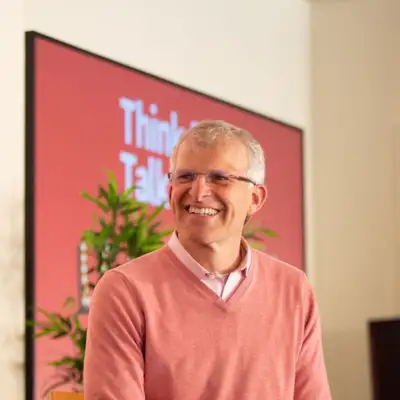
Join Matt Abrahams, best-selling author and Strategic Communication lecturer at Stanford Graduate School of Business, as he interviews experts to provide actionable insights that help you communicate with clarity, confidence, and impact. From handling impromptu questions to crafting compelling messages, Matt explores practical strategies for real-world communication challenges.
Whether you’re navigating a high-stakes presentation, perfecting your email tone, or speaking off the cuff, Think Fast, Talk Smart equips you with the tools, techniques, and best practices to express yourself effectively in any situation. Enhance your communication skills to elevate your career and build stronger professional relationships.
Tune in every Tuesday for new episodes. Subscribe now to unlock your potential as a thoughtful, impactful communicator. Learn more and sign up for our eNewsletter at fastersmarter.io.
Matt Abrahams: For many of us,
our success is blocked, blocked
by our beliefs and approaches.
If we remove these barriers, we can
have more impact and add lasting value.
My name is Matt Abrahams and I
teach strategic communication at
Stanford Graduate School of Business.
Welcome to Think Fast
Talk Smart, the podcast.
Today I'm really excited to have another
conversation with Muriel Wilkins.
Muriel is an executive coach,
author, and podcast host.
She hosts the HBR podcast Coaching
Real Leaders, and she has a new book
out Leadership Unblocked: Breakthrough
the Beliefs That Limit Your Potential.
Welcome back, Muriel.
I really enjoyed our previous
conversation in episode 102, and I look
forward to learning from you again.
Muriel Wilkins: Likewise, Matt.
Thank you for having me back.
Matt Abrahams: Excellent.
Shall we get started?
Muriel Wilkins: Absolutely.
Let's do it.
Matt Abrahams: Okay.
A lot of your work focuses on
helping leaders be more effective.
In your experience, what are the most
common beliefs that hold leaders back?
Muriel Wilkins: There are quite a few
and I've spent some time looking at them.
But you know, let me caveat that
by saying I think beliefs are
very unique to the individual.
So while I have identified some common
ones, the work is to identify which
ones might be getting in your own way.
But to get us started, and that
might be a little bit of an appetizer
to tease out some of the ones that
might exist for any leader, there are
seven that are most common amongst
the leaders that I've coached.
And so the first is I need to be involved.
The second is I need it done now.
The third is, I know I'm right.
The fourth is I can't make a mistake.
The fifth is, if I can do it, so can you.
The sixth is, I can't say no.
And the last one is, I don't belong here.
And what I have found is that nine times
out of ten, if there is frustration
that you're feeling or something is
getting in the way of you being able to
lead effectively, many times they might
end up being one of these beliefs that
are completely in your subconscious.
Or another that has helped you in
some form at some point in your
life, but may not be helping you
in the situation that you're in.
Matt Abrahams: I always think it's
useful to think through some of
these barriers and beliefs, and
identify them, so that we can then
become focused on trying to fix them.
In looking at your list, I'm like, oh
boy, I've got a few of these going on.
Muriel Wilkins: Yeah.
Matt, I'll tell you, as I wrote
this book and I worked through each
of the beliefs, I was pretty sure
I only had like maybe two of them.
And every time I would finish a chapter,
I'd be like, oh my God, damn it.
I have this one too.
Matt Abrahams: The one that rings
really true for me is the can't say no.
And in fact, when we were last on the
show, we talked about that and you gave
me some good advice and I've dialed that
one down a bit, but it's still there.
And I do have a lot of being afraid
of making mistakes and there's
a lot of pressure given what I
do to feel like I have to have
a good right answer for things.
Muriel Wilkins: It can be because we
associate, we identify with them so much.
Maybe it's been what's been
the key to your success.
And so I think a part of it is to
what extent have you taken some
time to potentially redefine what
success might look like for you now,
and does that belief, that driving
principle, still serve you in terms
of the new definition of success?
Matt Abrahams: Wow.
Already providing really useful
information for me personally.
And I think everybody listening
in that a lot of these beliefs are
tied to how we envision success.
And if you change that vision
of what success looks like,
that can make a big difference.
I appreciate that, and which leads
me naturally to the next question.
You talk through three stages on how to
get unblocked from your hidden beliefs.
Can you walk us through these?
Muriel Wilkins: We live in a
very action biased culture.
I, myself, is somebody who for most of my
life, have been very prone to take action
as quickly as I can, and what I found
is that while we can move to action to
change our approach, if we don't also take
some time to think through what might be
leading to that action, we'll come back
right to where we started to begin with.
So, the three step process is to try
to mitigate us having to return to that
starting point over and over again.
The first step is to uncover.
The second step is to unpack,
and the third step is to unblock.
Let me take a little bit of a
deep dive on each one of those.
So with uncover, it's number one,
understanding that there might be
dissonance between the way that
what you want to achieve and what
you're actually achieving, right?
So in your case, maybe when the, I can't
say no belief was driving you, maybe you
were finding that, hey, I'd really only
like to have five things on my to-do
list, but here I have fifty instead.
So there's something that's queuing
you up, that something is off,
something doesn't feel right.
And you can then ask yourself, what
is the belief that is driving this
potential situation that I'm in, or the
behavior that I'm having, or what I'm
seeing manifest itself in front of me.
So you uncover the belief.
And what is a belief?
A belief is a story that you tell
yourself it's not a bad or a good, it's
not a wrong or a right, it just is.
It is the operating principle
that is driving your behavior
or the decisions that you make.
Once you can uncover that,
then you can go to unpack.
And the unpack is to familiarize
yourself with why you have
that mindset to begin with.
In what way has it served you up
until now, as we just talked about, in
what ways has it made you successful?
Then, is it making you successful now?
Is it driving to the outcomes
that you wanna drive to?
And if it's not, then you can allow
yourself to move into the third
stage, which is unblock, which is what
most people wanna run to right away.
And in unblock, you
reframe the belief, right?
So you reframe in your language, the
communication that you're having with
yourself, and you reframe it to a message,
to a mantra, to a narrative that actually
is going to serve you in this moment,
and how do you know it's serving you?
It's more aligned with the outcomes
that you want to achieve and
increases the probability that
you will get to those outcomes.
Once you've done that, you can then ask
yourself, okay, so if that is what I
believe now, what actions can I take?
What actions does it open up for me?
What can I do that not only helps me
get to those outcomes that I desire,
but also reinforces that belief?
And then you have set the path to actually
leading or behaving or communicating
in a way that's more sustainable than
if you just move to action right away.
Matt Abrahams: The tendency I have and
many people I work with is, hey, let's
get to that unblocked stage, but I
really appreciate you breaking down the
uncover, the unpack, and the unblock.
And it boils down to the stories we
tell ourselves, those beliefs, and
then questioning that and then changing
that narrative and that leads us to the
new action that can help us mitigate
change, evolve, grow from those problems.
And I really appreciate that.
I just recently spent some time thinking
through, I did a values exercise
to try to help me really understand
what success looks like for me.
And from that, that led me to, I
think, be better at unblocking.
And I'm putting this process,
I put myself through into your
steps and I can see the values.
Muriel Wilkins: Even with
values, we sometimes have to
kick the can on them, right?
Where did those values come from?
Are they truly your values or are they
the learned values that you adopted
as a way of making you feel worthy,
accepted, and safe in your original tribe
or the original community that you're
a part of, or early on in your career?
That may not be necessarily the
values that you need now in the
position that you're in, or in the
type of leadership role that you're
in, that are gonna help you get to
again, the success that you want.
Matt Abrahams: It's a little spooky,
Muriel, because what you just said is
exactly of the process I went through.
It was, where are the values coming from?
And a lot of it for me was my early
career, I had some mentors and some
people I really admired, and they
inculcated in me some of these values.
And yet now being in a very different
stage in my career, those values
are different and needed to evolve.
You distinguish between both
healthy and toxic productivity.
What is the difference and how
can we focus on the healthy stuff?
Because I had never thought
of toxic productivity, but I
think I might be wading in that.
Muriel Wilkins: It's so interesting 'cause
sometimes we just talk about productivity,
which is about getting things done.
And there's healthy productivity
and toxic productivity.
Toxic productivity is getting things
done at any cost, and it is universally
applied across anything that has the
notion of needing to be completed.
And by the way, the toxic
productivity is really driven by
a mindset of, I need it done now.
There's a sense of urgency in everything
and everything needs to be done.
While healthy productivity is
more about doing things and
focusing on things that matter.
So beyond that, you have to understand
then what is it that matters, right?
There's a certain level of
prioritization that needs to happen.
And the belief that will drive the
healthy productivity is more around
something like, I'll do the best
that I can with the time that I have.
So what I love about that is that
it takes into account that we have
constraints, whether we like it or not.
We have guardrails.
And the guardrails are what
is the best that I can do?
Meaning what is within my capabilities
or my team's capabilities, or the
organization's capabilities, and
what is the time limit that I have?
Then what's doable within that timeframe?
And there is a cost to both toxic
and an opportunity with healthy
that we can see happen within
organizations, but also on ourselves.
So most people don't really
discern between the two.
They just think about being productive
rather than shifting their mindset
so that they can have one type
of productivity versus the other.
Matt Abrahams: I really do need
to distinguish that because I have
that mentality of just get it done.
And the biggest thing
that suffers is my sleep.
And I have a new mantra.
I'm gonna do the best that I
can with the time that I have.
And the distinction that you make really
reminds me of that distinction between
what's urgent and what's important.
And if you live in that world of urgency,
that's that toxicity you're talking about.
Where while you might get things
checked off your checklist, you
put yourself at a disadvantage.
And I do appreciate you
giving me that new mantra.
Muriel Wilkins: There's also the
other side of that formula, which
is if you regard everything as
important, not everything is important.
Matt Abrahams: And again, comes
back to your values and your
beliefs, which really are important.
You know, last time we talked, we
discussed the importance of mindset.
I know you've spent even more time
since we last talked, thinking
about and studying the impact of
mindset on wellbeing and success.
Can you share the new thoughts
that you have about mindset?
Muriel Wilkins: Absolutely,
and these thoughts aren't mine.
I just became more curious about mindset
because I found that not only with
myself and my own life experience and
leadership experience, but also with my
clients, that they were moving to action,
but the actions weren't sustainable.
And so it got me curious
around why is that?
I'm a big fan of reverse engineering,
and when I reverse engineered, I'm like,
well, let's start at the beginning.
And the story in the, the beginning is the
story we tell ourselves about what we do.
You know, one of the studies that
really fascinated me was a study by
Alia Crum, and she's a social scientist,
and so she did that study with the
hotel attendants where they asked
those hotel attendants, do you think
that the work that you do is exercise?
And they were like, no.
And so they said, well, what if you
did your work and all you had to do was
change the way you think about your work?
You think about it as exercise.
Four weeks later with that small shift,
they saw significant enough improvement
in the health and fitness of these
individuals just by the mindset change.
And that fascinated me and her conclusion,
which is that it's not just about what
we do, but it's about what we think about
what we do that makes all the difference,
literally was a game changer for me.
And I started taking that
approach with my coaching clients.
In terms of really exploring, how
are you thinking or what is it that
you're thinking about the conversation
you're having with your colleague?
What is it that you're thinking
about, that presentation
that you're about to go make?
What is it that you're thinking
about that rapport or that deck
that you have to put together?
By the shifting the way that you think
about the thing, not only may have a
direct outcome on the thing itself, but
even more importantly, Matt, it changes
your experience of doing the thing, right?
In my world, I really just
want leaders to be able to lead
with a little more ease, right?
Doesn't have to be as
difficult as we make it.
The challenges are challenging enough,
but if we can approach them and respond
to them with a little more ease, boy
would that open up opportunities.
And I think the mindset, the way that
you do the work or what you think
about the work is what can open up that
possibility of leading with more ease.
Matt Abrahams: I love Alia's
work and like you, I see a
tremendous amount of power in it.
It's how we frame and reframe it.
I'll give an example from my life.
One of the things that had
been difficult for me was the
grading part of the job I do.
As a teacher I have to give grades.
And I always saw that as, it was not
something that I would get up in the
morning excited to do, but, and when I
reframed grading as actually another form
of teaching, which I am very passionate
about, it was like a game changer.
So reframing can really change
the way in which you interact.
And I wanna highlight
something else for everybody.
The way you got to where you did
on your perspective on mindset and
reframing is by reverse engineering.
And I think that is such a powerful
tool, and I know you use it a lot to
understand things in your own life
and the lives of those that you coach.
Can you walk us through how you
think about reverse engineering?
Because for many people that's
not an intuitive thing to do.
Muriel Wilkins: My tendency is to
be very results oriented, right?
Very outcomes driven.
I've, I'm, a lot of the work on myself is
to not be so attached to the outcome, but
when I look at the outcome, either the
outcome that has occurred or the outcome
that I want, or that I desire, I can then
look and say, okay, this is what I desire.
This is what I want to achieve.
Let me work backwards, right?
What would I need to do to be able, so
that's the action, what would I need to
do to be able to achieve that outcome?
If that's the action, how would
I need to feel about that action
in order for it, the increase the
probability that I would actually do
it, or that we can make it happen.
And then from the feeling I can work
backwards and say, what would I need to
think, what would I need to believe, in
order to increase the probability that I
could feel and also fulfill those actions?
And then, and that's where the reverse
engineering is, are those thoughts or
what I need to believe, are they aligned
with the way that I believe right now?
If it's yes, great.
If it's not, then here's an opportunity
to reframe the belief, not lose the one
that I've had, just put it to the side
momentarily until it's useful again.
But there needs to be alignment between
how I think, how I feel, and how I act
in order to achieve a particular outcome.
Start with the outcome and then
work it backwards to say, okay, what
would that alignment look for me?
When we feel frustration or we feel
dissonance or we feel stuck, it's
often because there's somewhere along
the line, there's some misalignment.
Matt Abrahams: Thank you for walking
us through that backward mapping.
I spend a lot of my time talking about
how people should have a clear goal
in their communication, and I use this
structure of know, feel, do, and you've
just applied no, feel, do, in a very
different way to help us with our internal
communication, to align ourselves to
the beliefs we have and the beliefs
we should have to achieve our goals.
I really appreciate that
backward mapping process.
You are an expert coach.
I certainly have benefited from this
conversation, but last time you were kind
enough to coach me through a challenge
I was having around setting boundaries.
Your advice was incredibly helpful and
foundationally changed how I do some
things, and anybody wanting to hear that
advice can go back to episode 102 to hear.
Would you be willing to coach
me on another issue I'm having?
Muriel Wilkins: Of course.
If you're willing, I'm down.
Matt Abrahams: One of the things that I
struggle with is I get very emotionally
invested in my work and as a result,
often find myself exhausted and run down.
Any advice, I don't wanna lose my passion.
I think that's one of the strengths I
bring to the things I do, but I also
don't wanna lose more sleep and energy.
Muriel Wilkins: So let me just ask you,
when you say emotionally invested, what's
the emotion and what's the investment?
Matt Abrahams: I have a lot of
curiosity and passion to help.
So in many of these situations
I see opportunities to learn, to
help others learn, and to help.
And so the biggest emotions that
drive me are those curiosity
and the desire to help.
And the investment is often time,
not just time in conversation
and work to accomplish that,
but it's just mental time.
I am somebody who ruminates, who reflects.
And so even when I'm not doing the work,
when I'm trying to vegetate, sitting
in front of the TV or I'm going for a
walk, it occupies my time in my head.
So the investment is a lot and constant.
Muriel Wilkins: Yeah.
And so what would it look like for
you to still be able to exercise
that passion you have and the desire
you have to help others and not let
it consume you as much as you feel
it does, or you've stated it does.
Matt Abrahams: I actually don't
know the answer to that question.
I do have some role models,
some people that I really admire
who seem to be able to do it.
So what I've noticed that they can do
is they're able to compartmentalize.
They're able to say, okay,
just spent time doing that.
Gonna put a bow on.
It might come back to it later, and
I'm gonna move on to something else.
The other thing I've noticed
that people do is they have some
kind of transitioning ritual.
It could be taking a walk,
it could be calling a friend,
it could be checking email.
And I've noticed that, I haven't been able
to find a good transitioning ritual to
get myself out of whatever I'm focused on.
Muriel Wilkins: What do you believe
that you think gets in the way of
you being able to compartmentalize?
Matt Abrahams: When I reflect on what
we've talked about just previously,
I think there is an underlying belief
that commitment to something I'm
passionate about is full on commitment.
And in some way, I'm failing, either
myself or the other people involved,
if I'm not constantly working on it.
And that was an unlock for me from
our earlier part of this conversation.
And perhaps I need to revisit that
belief that failure is nothing less than
a hundred and ten percent investment.
Muriel Wilkins: Yeah.
Well, let's try it.
How would you redefine that belief now
in a way that would allow you to both
drive to your passion and get more sleep?
Matt Abrahams: Yeah, so I, I
think the first thing I have
to do is ask other people.
I'm realizing I make the assumption
of what success looks like for me, and
perhaps those that I'm trying to serve
in that moment, or what that project or
whatever it is, might have a different
version of success that is not as amped
up and intense as the one that I have.
And so I think getting external
for myself might be helpful.
Then perhaps setting some
boundaries around investment.
Like while this is important,
prioritize it relative to the
other things that are important.
Muriel Wilkins: So my advice
to you would be to go back and
redefine, as we said earlier in
the conversation, redefine success.
Because if success means I can
do all the things and I need to
do all the things in order for
other people to be helped, right?
Because it's grounded in helping,
defining that would be helpful to you.
And as you said, maybe getting some
outside measure of what that looks like.
Because what might be good enough
for others might not be the way that
you are defining good enough for you.
And so getting that outside metric
to really help reformulate your
definition of success, which
is a belief in and of itself.
And then let that drive how
you're prioritizing, how you're
creating boundaries and all of the
other things that you just said.
Matt Abrahams: You are
so good at what you do.
I think an external recalibration
and an internal recalibration
of what success is for me will
really help in this circumstance.
You know that before we end, I
always like to ask three questions.
One I create just for you and the other
two I've been asking people forever.
Are you up for that?
Muriel Wilkins: Absolutely.
Matt Abrahams: So you had mentioned that
when you were writing about the barriers
that get in the way for some leaders, that
you actually recognize some in yourself.
So I'm curious, if you're willing
to disclose, what's one of the
challenges that you have and
how are you working on that?
Muriel Wilkins: I ended up recognizing
myself in all of them, but the one
that probably has been the longest
standing one, and that I have learned
to befriend because it's not going
away, nor do I need it to go away,
is that I need to be involved.
And underlying that is this false
belief that if I'm not involved,
everything's gonna fall apart.
And I understand where it comes from.
And by understanding where it comes
from, I give myself a lot more grace
because I also recognize that where
that belief was cultivated and formed
is not the place that I'm in right now.
And so the work for me is constantly
reminding myself that I am in the
here and now, and I'm not in the
place where that belief was actually
quite critical to my success.
And therefore, I can let it go for a
little bit or put it to the side and use a
different one to help me get my work done
and be more effective in the here and now.
Matt Abrahams: I really appreciate
you sharing that with us.
Thank you.
So you had an opportunity to give
an answer to this question before.
I'm wondering if it has changed
at all, but who is a communicator
that you admire and why?
Muriel Wilkins: The one that's
coming to mind for me today is Dr.
Gabor Maté who does a lot of work
around mental health and mindset.
And what I really appreciate about the
way that he communicates is, number one,
he's able to take what feels like complex
ideas and break them down in very simple
terms for anyone to really understand.
Number two, he is an amazing storyteller.
And by telling the story associated
with the concepts, it allows it to
be relatable and also memorable.
And number three, he just
exudes authenticity, right?
Like he, I don't know if you've ever
heard him speak, but you literally feel
like he's sitting right in front of you
just having a conversation with you,
and it's not him trying to be anyone
else, or it doesn't feel like that.
It doesn't feel performative.
It just feels like him, like that's
who he would be, whether he is having a
coffee chat with you or whether he's on
stage in front of thousands of people.
So he's someone I hugely admire, and not
just in terms of the work that he does,
but also his communication approach.
Matt Abrahams: The ability to make
things accessible, but also be very
authentic, very powerful skills.
So since you were last year, I'm
wondering if your answer to our
final question has changed as well.
What are the first three ingredients that
go into a successful communication recipe?
Muriel Wilkins: I think you
have to start with the why.
So why are you communicating
what you're communicating?
What's the purpose behind it?
Because if there's not a purpose, you
should be asking yourself whether you
should be communicating it at all.
I think the second is the how.
What is the best way for
me to communicate this?
And that is grounded again in
this question of how do I want to
experience myself as I communicate it?
How do I want others to experience me?
How do I want them to feel when
they leave that communication?
And then the third is, in what way do
I need to reframe what I believe about
what I'm communicating in order for me
to be able to communicate it effectively?
So it still goes back to mindset.
Going back to what we talked about
before, it's not just about what you do,
but what you think about what you do.
So what would you need to think
about what you're communicating,
why you're communicating, and how to
communicate it for it to optimize the
communication that you're about to make.
Matt Abrahams: Very clear.
Why, how, and then how do I reframe
it to make sense to, not only to
me, but to those I communicate with.
Muriel Wilkins: That's right.
Matt Abrahams: Muriel, this
was a fantastic conversation
as I knew it would be.
You opened up my mind and hopefully
everybody's listening to how we can
be more effective in our own lives
and how leaders can lead better,
how we can unblock ourselves from
the things that get in the way.
Thank you for your time and best of luck
with your new book Leadership Unblocked.
Muriel Wilkins: Thank you so much, Matt.
Always a pleasure to talk to you.
Matt Abrahams: Thank you for
joining us for another episode of
Think Fast Talk Smart, the podcast.
Please listen back to Muriel's
first visit in episode 102.
To learn more about leadership, listen
to episode 98 with David Dodson.
This episode was produced by Katherine
Reed, Ryan Campos, and me, Matt Abrahams.
Our music is from Floyd Wonder.
With thanks to the Podium Podcast Company.
Please find us on YouTube and
wherever you get your podcasts.
Be sure to subscribe and rate us.
Also follow us on LinkedIn,
TikTok, and Instagram.
And check out fastersmarter.io for
deep dive videos, English language
learning content, and our newsletter.
Please consider our premium offering
for extended Deep Thinks episodes,
AMAs, Ask Matt Anythings, and much
more, at fastersmarter.io/premium.