Subscribe
Share
Share
Embed
Welcome to Freedom and Glory: Tales of American Spirit—a podcast celebrating the heart of American craftsmanship, resilience, self-reliance, and the power of disruption. Through inspiring stories and authentic storytelling, we shine a spotlight on individuals and communities who embody these values, proving that small, determined efforts can spark meaningful change.
Join us as we share personal tales of triumph, innovation, and hope—moments that define the American spirit and shape our nation’s identity. Whether you’re seeking motivation to pursue your dreams or a reminder of the power of community, Freedom and Glory offers a powerful dose of inspiration rooted in resilience and determination.
Listen, be inspired, and take action.
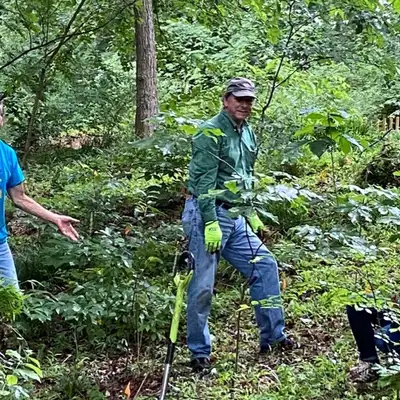
[00:00:25] Liz : Today we're headed to Cary, North Carolina, along the White Oak Creek Greenway. Seven years ago, this was a field of weeds, and today it's the Cary Tree Archive.
Nearly 500 native trees planted and cared for by some 1,600 volunteers, all because two retirees decided their town needed a forest. Um, so we're joined by George McDowell, who flew Army helicopters on the Korean DMZ before he became a lawyer, and Richard Carroll, who spent 20 years protecting forests in Central Africa- Mm-hmm
for the World Wildlife Fund. So I'm excited to hear how you two doppelgangers, found each other. Um you opposites at- attract, how a couple of trees turned into a couple hundred, and, um, about one small tree with a big story that may or may not make it to November planting.
[00:01:23] Bill: Mm-hmm.
[00:01:24] Liz : Um, so just to kick things off, for someone who's never been, what is the Cary Tree Archive?
[00:01:32] Richard Carroll: Let me start by saying it's the, um, it's an ecological restoration project. It's one of the largest in the, in the Piedmont area, maybe in North Carolina. It's, um, eight acres of what was, you know, grassland, you know, mowed grassland, former tobacco, you know, messed up area, degraded soil. We planted about 450 trees in there, um, and we're re- recreating a forest, um, y- in this wasteland.
You know, from wasteland to wonder. Here we go. Um, you know, and we have a whole variety of ha- habitats there. It's, it's really because it's, it's all done by people, people of Cary and people from the surrounding area. It's a real, a people's you know, forest, a people's paradise out there. Um, and you know, and we have a large area of mixed hardwoods and, and longleaf pine savanna that mimics the the, what used to be the dominant tree throughout the Southeast, the longleaf pine, um, you know, until it was wiped out by people like our founder, Mr.
Page, who was a logger, who, who used the longleaf pine for the, the shipping trade, for turpentine and, and for tar and all that, and then for masts and planks and everything. So that used to cover 93 million acres in the Southeast. Now it's really reduced to a fraction of that. So we've planted that, and it's beautiful.
It's beautiful to, to see these longleaf pine really thriving out there. You know, be- besides all these habitats, you know, we have pollinator garden, et cetera, but you know, it's, um- It's a place of beauty. It's a place for, of people. It was created by people, ordinary citizens of, of Cary and the surrounding area.
It's, it's really a people's forest.
[00:03:31] Bill: I, if I could, you know, I think most people today, they walk around, they see trees and grass and they just, "Well, it's always been this way."
[00:03:39] Richard Carroll: Hmm.
[00:03:40] Bill: But it hasn't.
[00:03:41] Richard Carroll: No. Well, well that's the thing. The paradigm, paradigm have, has shifted. I mean, what, what we think as normal is the, the remnants of woodlands.
You know, a little patch here and a little patch there.
[00:03:54] Bill: You called it wasteland.
[00:03:56] Richard Carroll: Well, lo- loblolly pines, I mean, l- l- they have replaced the longleaf pine and, and create all the pollen that we love to breathe in the spring time- Right ... all that yellow pollen. Hmm. Mm-hmm. That's loblolly. That really filled in the niche of the longleaf pine when the longleaf pine was eliminated.
So that, that grew out and now we have the lovely pol- pollen in the spring thanks to the
[00:04:23] Bill: loblollies. Yeah, they're trying- All because of that dude who wanted to build shipping crates. Yeah. It seems really wrong.
[00:04:28] Richard Carroll: Well, we, we, we, we created the British Navy- Yeah ... that was the strongest navy in the world all on the backs of our natural forest.
[00:04:38] Bill: Did not know that. Hmm.
[00:04:40] Liz : So they're trying to recreate these old world forests.
[00:04:45] Bill: How do you keep it that way? 'Cause of all the invasive species, it's gotta be a lot of work to do that.
[00:04:50] Richard Carroll: Well, it is a lot of work. It, you know, we, we have endangered sp- invasive species out there that we try to eliminate as much as possible.
Um, and you know, and plant all native species. Um, that's, that's kind of our motto, that we plant all native species even though he tries to get away with, with some you know- and native species that were native 20 million years ago.
[00:05:19] Bill: Well, how did you two... Getting back to you.
[00:05:21] Liz : Yeah.
[00:05:22] Bill: You obviously have a passion for this.
I can tell. You're, you, you, you love what you're doing. What about you? How, how did you two... Are you of the same mind, or is your goal the same?
[00:05:34] George McDowell: No, I, I'm a, an indoor kinda guy, but I love trees too. And Richard and I, 10 or 15 years ago, lobbied the town to stop its clear-cutting and begin a program of ecological restoration.
So that's how we met, at the town, when each of us took turns at the Public Speaks Out. Wow. And then we went to a bar and became friends.
[00:06:02] Richard Carroll: Yeah, I, I was there. I had been lobbying the town with a friend of ours, um who was a really competent, um, you know, took great notes, brought great notes very soft-spoken, very polite.
Um, and, and we, we used to go up to the town all the time. And then he brought a- He knew George, so he brought along George. And so now it became, you know, the good cop, bad cop, you know? Y- You- My other neighbor is soft-spoken, competent, really but really pushes. This guy sits down, "Damn it, just plant some trees."
[00:06:42] George McDowell: No, that's... I mean, Richard and I complement one another, because he has the knowledge and I get things done. Um, when I've talked to somebody and I say I have the Cary Tree Archive and we have native species we plant there. And they'll say, "Well, that's, that's a, that's a good idea. I'd like to do that." I say, "Good.
What day, and what would you like to plant?"
[00:07:04] Richard Carroll: Right.
[00:07:04] George McDowell: And I write it down, because then it becomes not some ethereal good thing to be done in future, it's scheduled. Once it's scheduled, you gotta do it.
[00:07:16] Richard Carroll: Mm-hmm.
[00:07:16] George McDowell: So 1,600 people and counting, probably 17 or 1,800 by now, so.
[00:07:24] Richard Carroll: And what I really like to do is work with people that are good idea people and, you know, c- competent people, fun people.
And so we get along so well, 'cause I, I thrive on that kind of, you know, idea mentality.
[00:07:39] Liz : Well, George, I wanna hear a little bit about your background. Um, I know you dealt blackjack in Vegas and you flew helicopters in the DMZ, um, in Korea. So can you take us through a little bit of your, of your life story- Yeah
until this?
[00:07:56] George McDowell: Yes, ma'am. Mm-hmm. I was a craps dealer. Craps dealers are the elite of the Las Vegas.
[00:08:03] Liz : Of course.
[00:08:04] George McDowell: Blackjack dealers and baccarat dealers and roulette are lower class, so we don't actually speak of them. I, I stayed out there for three years. My father said, "What the hell are you doing here?" So in any event, I went in the Army, then I went to college, then I went to law school, and then I retired and I met Richard.
So that's my life.
[00:08:28] Liz : It's a pleasure. Easy peasy. Yeah. I- Do you still play craps?
[00:08:33] George McDowell: I never played. I was a dealer.
[00:08:34] Liz : Oh, okay. Okay. Yeah. Do you do parties and stuff? Could I have you?
[00:08:39] George McDowell: No. No. We played-
[00:08:40] Liz : You've retired. We
[00:08:40] George McDowell: played for real money.
[00:08:41] Richard Carroll: But he's not telling the whole story. When he was a helicopter pilot in Korea, he convinced the general that to, to really reach the local people, they needed to fly the people and the trees and the tools up the mountain to reforest the mountain that had been deforested by the Japanese.
So even, even back then, he, he was, he was negotiating with the President of the United States to, to get the helicopter up the mountain.
[00:09:10] George McDowell: And we weren't, we weren't allowed to take Korean civilians in military aircraft. So I became friends with the people in the village outside the fort, and I learned their reverence for trees.
They plant a tree. They were ruled by the Japanese for hundreds of years. Whenever a tree got to be six feet tall, Japanese would cut it down, ship it to the mainland, and they had master woodworkers who just loved this fresh, virgin wood. So the Koreans resented that, and once the Japanese were pushed out, it became a federal offense to kill a tree in Korea.
And they plant them for any reason: in memory of an ancestor, a birthday, a birth of a child, a wedding. And- So like I said, we weren't allowed to put the civilians in the aircraft. So I would take their tools up there, they would hike up, and then they would plant a tree and have a little ceremony. I didn't understand a word they said, but clearly it was a moving ceremony and they loved their trees.
So that was, I guess that was 20 years after World War II. And Korea's hill, valley, hill, valley, hill, valley, and it was denuded, and they had begun to re- the reforestation. I haven't been back, but I read, I read frequently that the mountains are, the beauty is returning- Mm ... to that whole South Korean countryside because of the people replanting their trees.
So anyway, I'm playing poker with a general one night and he says, "We want to win the hearts and minds of the people." I said, "Well, you said that in Vietnam. How'd that work out?" And he says, "Just shut up." So I, "No, no, I got an idea. Let me put the civilians in the aircraft and take it up when I get permission to fly their tools up."
He said, "Fine, go ahead." So he signed off on that. I could take civilians in the aircraft, and I, I must in two years I did that probably 30 times. Took expeditions up the mountain to plant trees. So then my wife many years later took me to Muir Woods outside San Francisco-
[00:11:36] Richard Carroll: Mm-hmm ...
[00:11:37] George McDowell: which is where President Roosevelt planned the meeting of the allies after World War II to plan the future of the planet after the Axis had been defeated.
He died, President Roosevelt died, and Truman said, "All right, we're gonna have this conference in New York or Washington." And unanimously, the rest of the leaders of the world said, "No, we wanna go where President Roosevelt wanted. We wanna see this cathedral." Mm. And it's ma- it's magnificent. These trees are as big as this room.
Mm. And you, when you sit in it, stand in it, s- you feel the majesty of nature.
[00:12:26] Richard Carroll: Mm.
[00:12:26] George McDowell: And that was Roosevelt's intention, to let the leaders feel this magnificence, this all-encompassing nature, and he was partially successful
[00:12:43] Bill: Well, and you in Africa, you were trying to save trees as well. Um, well, and it, was it against the people or poachers or what?
What was the deal there and what did you have to do in order to succeed?
[00:12:59] Richard Carroll: Well, the, there were a lot of pressures on the forests. Mo- mostly, you know, for, as far as the trees, and you talk about huge trees. I mean, these are humongous trees and you're walking through a cathedral forest. I mean, the, there's a section of Gabon that's called the cath- cathedral forest 'cause it really is, feels like that.
Anyways, y- what you're de- dealing with, i- are foreign logging companies. Um, back then yeah, we, down in Bayanga where, where I was working down in the southwest corner of CAR, um, I don't have a map. Um, anyways, um when I was down there the logging company was called Sloven- Slovenijaboa, and it was run by Yugoslavs, um, at that time.
Um, but you know, then it, it changed hands, e- et cetera and so on. And the, and you know, the people of Bayanga really s- and there wa- it was a mixed bag. They wanted a logging company because they wanted employment but then it was messing up their forest and they didn't want that. So there was a, a tension all the time between economic development and ruining their forest.
Um, but you know, it went, you know, one after another for a long time. Um, you know, one logging company after another, even including the Chinese that came there with no regard for the, the ecology of the area. Um, but uh Um, n- now, you know, the Zung- Dzanga-Sangha project started back in the, in the early '80s, and that has employed and brought more funds into that region and, and more economic development and more social development than any logging company ever brought to that region.
And, and people are really now behind it. It's, it's a whole different ballgame now. When we first started, it was that tension between the logging company and conservation. Now it's really conservation is, is where it's at.
[00:15:02] Bill: Well, seems like their experiences prepared them quite well for taking on the town of Cary then.
[00:15:08] Richard Carroll: Yeah.
[00:15:09] Bill: Which, which was, which was easier, the general, the lumber companies, or Cary?
[00:15:14] Richard Carroll: Ca- Cary is a, a tough nut to crack, I tell you. I, I bet. I mean you know, in, in Central Africa, we were very successful in creating parks and reserves. You know, I set out, you know... And when I came back to Washington and worked for World Wildlife Fund in Washington as vice president for Africa and Madagascar, we created a whole regional program of almost contiguous landscapes across the Congo Basin that covered 40% of the Congo Basin forest, and this was all, you know, endorsed by the heads of state.
It really came out of a heads-of-state conference that we had the first ever for the conservation of forests. That, that was quite a, quite a coup. So, you know, where can you get all the leaders of Cary and, and the surrounding areas together to decide on a regional plan? Mm, not, not so much. But there we had six heads of state sitting up on stage and and each of them were trying to compete with the other.
Who could create more protected areas- ... in their, in their country than the other? So that's great. They're bidding against each other. Fine. It's perfect. It's what we wanted. A- and what, you know... We helped facilitate a plan, a plan de convergence looking at, at the map and, and, and finding these landscapes.
But, um, you know, th- they adopted this plan that we set up as their own. They really took ownership of it and created a whole commission and everything else to see it in pl- in place, and it, it's still, still happening to this very day You know, really 40% of the Congo Basin, that's a, that's a lot. That's a big area.
[00:17:02] Bill: Oh, I bet. Yeah.
[00:17:04] George McDowell: The motto of the Kerry Tree Archive is, um, I like very pompous things. I'll translate the Latin for you. It's a garden in a city thence a city in the garden. So the purpose of the archive is to show what can be done by two broke-down old men. And, you know, the towns have literally unlimited resources.
This is what they could do if there was the will
[00:17:36] Richard Carroll: Right. And there isn't n- the will, even though we were up there lobbying for years, um, and finally they created a, an urban forest master plan that is, I, I won't say it on, on the air what I what I think of it. But-
[00:17:53] George McDowell: How was... I'll, I'll say it for you. It's, it's a $400,000 waste of money.
[00:18:01] Richard Carroll: Yeah.
[00:18:01] George McDowell: It doesn't... There's nothing concrete in it. It's, it's apparently there's a thing called a consultant industrial complex. Uh-huh. And one of the things they do is create plans for towns. Mm. So Cary's got scores of them.
[00:18:18] Richard Carroll: Mm-hmm.
[00:18:19] George McDowell: Scores. And the, it's, it's three parts. First, they collect all the wonderful things about, say, bicycles, how wonderful it is to bike, da, da, da, da, da, and here is what could be done, da, da, da, da, da.
And then they say, "Here is what we aspire to," but they're all aspirations. There's no, nothing concrete. Nothing. No, no dates- Right ... no times, no- Nothing ... no staff, no nothing. Mm.
[00:18:40] Bill: No schedules. See?
[00:18:42] George McDowell: Mm-hmm. Exactly. Yes. Yes.
[00:18:44] Bill: Oh.
[00:18:44] George McDowell: Right.
[00:18:45] Bill: Wow. Mm.
[00:18:46] George McDowell: So-
[00:18:46] Bill: That's frustrating.
[00:18:47] George McDowell: It's very- Well, it's... Yeah, it, it really is, and it makes it appear that the town and the council is doing something when in fact they're doing nothing.
[00:18:55] Richard Carroll: They're doing nothing.
[00:18:56] George McDowell: They're just twiddling their thumbs and say, "Oh, we have an urban forest master plan-"
[00:19:01] Richard Carroll: In fact, going back- "...
[00:19:01] George McDowell: which says nothing" ...
[00:19:02] Richard Carroll: and, and, and look at the development around Cary. You know, how many, how many trees do you see fall in Cary to put up another set of high-rise apartments? I mean, we're losing our forest cover really quickly.
Um, and you know, there's no looking back.
[00:19:22] Bill: So-
[00:19:22] Richard Carroll: Sounds
[00:19:22] Bill: like a... I'm sorry, go
[00:19:23] Liz : ahead. No, no, I was gonna say, so back in 2019, I mean, was this your original idea, or were you... Did this come out of something, like you were trying to talk to the town and they weren't listening, so you went to the HOA- W- ... or how?
[00:19:39] George McDowell: I hope the co- I hope the town is listening, but here's...
I very nearly named... Like I said, I, I like pompous names. I very nearly named it the Cary Tree Museum based on..
Joni Mitchell. They took all the trees, put them in a tree museum, charged all the people a dollar and a half just to see them. I very nearly named it the museum, but I thought, "That's too much of an insult.
Archive it'll be." But something has to kick them in the tails to get them moving. I mean, last night I went out 3:30 in the morning to sit on my back porch, my front porch. It was too hot at 3:30 in the morning. Too hot, too humid, and the reason is we don't have trees.
It's a simple, simple game, and the answer is, the answer must be too simple. Mm-hmm.
[00:20:35] Bill: Well, it sounds very political. Seems like- And now- You're getting more support from people now. Right Is that the key?
[00:20:42] Richard Carroll: Well-
[00:20:42] Bill: Like, because politicians are politicians. You know what motivates politicians.
[00:20:47] Richard Carroll: It is the key, because people, you know, flock to the Cary Tree Archive to help work on maintenance- Oh
on planting and everything else, because they f- see that here's a place that's making a difference, and they can make a difference. When they hear all the bad news, when they see, look around Cary and look at the deforestation, they, they watch the news and talk about global climate change, et cetera, and so here's something I can do that's positive, that m- will make a difference.
[00:21:18] Bill: But they got skin in the game, right? It's not like you put a like on Facebook or a quick, stupid comment. Right.
[00:21:23] George McDowell: Right.
[00:21:23] Bill: You have nothing in- invested, right? We,
[00:21:25] George McDowell: we persuaded this guy, Dean. Yeah. Dean Krupa. We persuaded him to try to start a tree archive in Apex. So he diddled around for a year or two, and finally he found the Optimist Farm, and they gave him permission.
So he started it in February, and the first planting day was Martin Luther King National Day of Service. And they had to cap the number of volunteers who volunteered online at 100, and they still had 115 people show up. So the, the, the will of the people to do environmental good is there, and it it, it turns out that it has to be civilians who harness that and, and, and, and, and, and give it a, a, a, a way to express itself.
[00:22:20] Richard Carroll: And the Cary Tree Archive was the first one, and it inspired a lot of people to help out, but inspired Dean and others to start, you know, other archives. So- Yeah,
[00:22:31] George McDowell: that guy in Pittsburgh with the plant.
[00:22:33] Richard Carroll: At the
[00:22:34] George McDowell: plant. They've got a Car- they got a Pittsburgh tree archive now.
[00:22:36] Richard Carroll: Yeah. Yes, so we're seeing this concept really taking off in other areas, and we hope to see, you know, thousands of trees planted by you and me.
[00:22:51] Bill: Well, I sure have enjoyed my trees the past week or so without it. You, you mentioned the difference in temperature just from-
[00:22:57] Richard Carroll: Sure ...
[00:22:58] Bill: trees versus blacktop. Mm-hmm.
[00:23:00] George McDowell: I got my wife a trail cam- two trail cameras for Christmas, and I play with them more than she does. But we have a family of raccoons living on our property.
Mm-hmm. And we got just a regular, I don't know, a third of an acre, regular house. Yeah. And we got a family of raccoons, and I just saw the other day that the foxes, we have gray foxes, they had two kits I think they're called.
[00:23:24] Richard Carroll: Mm-hmm.
[00:23:25] George McDowell: And they go out and, you know, at 3:00 in the morning they play in the, in the yard.
Birds. What else is there? Possums.
[00:23:34] Richard Carroll: Has-
[00:23:35] George McDowell: And the other day- ...
[00:23:35] Richard Carroll: a family of raccoons I saw ...
[00:23:37] George McDowell: yeah, yeah. And the other day we had a six, two, it, for- Yeah ... twice I've caught him on camera, a six-point buck walking through the yard. Nice. Yeah.
[00:23:47] Richard Carroll: And this is, this is in, you know, suburban Cary.
[00:23:51] George McDowell: Yep.
[00:23:52] Bill: the, the quality of life greatly increases- Yeah
with, well, something as simple as trees. Sure. I mean, really. Mm-hmm. It, it really does. Um, I, I guess one of the questions I, I have for you is, um, y- you know, there's no instant gratification from this, right? I mean-
Okay, see- We- I, that's why I ask.
[00:24:13] George McDowell: We- Well, you're gratified. My sidekick and I- But for most- We, we- He's my
[00:24:18] Richard Carroll: sidekick.
[00:24:19] George McDowell: No, you're the sidekick. Um, we, 99% of the time, after a day of planting and maintenance, we'll retire to where we work. Yes. Abbey Road or one, a local watering hole. And the feeling is, is, I mean, it's just, it's a feeling of hard work and satisfaction.
[00:24:41] Richard Carroll: Mm-hmm.
[00:24:42] George McDowell: And that's the enjoyable part is- Mm-hmm ... is the the recap-
[00:24:47] Richard Carroll: Yep
[00:24:47] George McDowell: after the, after the fact.
[00:24:49] Richard Carroll: Yeah. We can recap over, over a beer or three.
[00:24:55] Bill: I gotta hang with you guys. That s- sounds like fun. But I, I guess- Not to be morbid, I, I'm not gonna be around to see what it's gonna look like and when it- Yeah ... finally becomes what you guys have dreamed. Yeah,
[00:25:08] George McDowell: I
[00:25:08] Bill: dream of that.
[00:25:09] George McDowell: You know what I'm saying?
I, I wish I could have 50 more years, because we started in September of 2019. It's now close to seven years, and it's just coming out of its infancy. So the trees are... You know, they've survived the deer attacks and the kid attacks, and they've recovered from being in pots, and now they're, they're growing.
They're-
[00:25:31] Richard Carroll: Mm.
[00:25:32] George McDowell: Some of them are 10 feet tall, some of them are 30 feet tall. And to s- Luckily, I took before pictures.
[00:25:39] Richard Carroll: Mm.
[00:25:39] George McDowell: So now we can compare, and the before and after is striking.
[00:25:43] Richard Carroll: Yeah, yeah. You know-
[00:25:45] George McDowell: And it gets better every-
[00:25:47] Richard Carroll: Right ...
[00:25:47] George McDowell: every week.
[00:25:48] Richard Carroll: Yeah. You know, we get satisfaction out of having planted these things and seeing them growing.
Now, the future, w- we're really planting for, for all time, for our generation and future generations that, you know, will go out there and see these trees fully mature. They'll be walking in a closed canopy forest with, with overlapping branches along the greenway. It will be just a real paradise. I mean, they- they're, they're maturing and they're doing great, and you know, we can see that happening.
So f- 50 years when you take a walk, walk down White Oak Creek Greenway, think of us.
[00:26:27] Liz : Yeah. Yeah. For sure. Well, I wanna hear about some of the descendants of famous trees. .
[00:27:04] George McDowell: Every tree is magnificent, and a tree which has a history has its, its own magnificence, plus a little bit of cachet. So in order to... This is my working theory. In order to pique interest in the archive, I thought it'd be nice to have, um- Direct descendants of historic and notable trees.
So, um, we got, Every year I go to a Suebo festival in South Carolina, Charleston, and they, we visit the Angel Oak, which is a magnificent live oak tree, which is 400 years old, and it takes up a half acre itself. So a friend of mine owns a nursery down there. He collected acorns and grew some and gave me one, so now we have a direct descendant of the Angel Oak tree.
It's now 15 feet tall. It's grown in, it's happy where it is, and it's flourishing.
[00:28:06] Richard Carroll: Mm-hmm.
[00:28:08] George McDowell: We have a direct descendant of the the swamp oaks, which guard the voids in the 9/11 National Memorial. We have a direct descendant of the Oklahoma City bombing survivor tree. We've got two direct descendants of the the Wye Oak, which was the tree that inspired the national forester to create the National Champion Tree Program.
And we have two of the oldest bald cypress in the world. And what else is in there? Oh, the Davey Poplar, which is the iconic tree from your campus. Mm-hmm. And we got others. I can't remember what they are.
[00:28:50] Bill: What a great idea, though. That really makes it personal. Yeah. It really does.
[00:28:55] George McDowell: Yeah. Yeah, and our friend Bill Dukowitz is making a map, so you can look on your phone as you walk through and, "Oh, look at this.
Oh, Angel Oak. Isn't that something?"
[00:29:03] Richard Carroll: Yeah.
[00:29:03] Bill: Yeah.
[00:29:04] Richard Carroll: W- we'd like to find a, a scout, you know, to do a Eagle project to find more of these notable trees that, that we can get s- um, seeds or saplings or, And, and plant them 'cause it, it's a, it's a great initiative. I love it.
[00:29:21] Liz : Mm-hmm. Well, and how about... It sounds like it might not be doing well, but how about the Liberty Tree?
[00:29:28] George McDowell: Sadly, the Liberty Tree, um- is dying. I got, um I, I went to St. John's in Annapolis. On that campus was an original liberty tree, Maryland's liberty tree, and it w- it blew down in Hurricane Floyd in 19- It's '97? '
[00:29:49] Liz : 99. '
[00:29:50] George McDowell: 99. Yeah. Yeah. But the foresters have direct descendants of it, so- For USA 250 I thought, "Hey, I must get one for the archive."
So I, They don't do well. They, they, they, they don't germinate. So anyway, this year they had 33. So for Maryland 250 they were gonna plant one in each of the 23 counties, one in Baltimore City is 24, and they had nine left over, and I want one. And they said, "Well, you know, you can't have one. You're in North Carolina."
And I said, "Well, I tell you what. You guys, as you said, don't have a photograph of the Li- the original Liberty Tree showing the breadth of the trunk. You have far away, which shows the crown and everything, but you don't have the close-up. But I do." So I took a picture of my wife in 1981 standing right in front of the tree.
So it shows, I mean, it's huge. You know, she's a little toothpick in front of this magnificent tree. I said, "I tell you what. I'll give you the photographs and the copyright to it if you give me one of those seedlings." So he said, "Done." So they sent the seedling. I planted it, but the heat was just too much.
Mm. Just too much.
[00:31:12] Liz : And what's the historical significance of the Liberty Tree?
[00:31:17] George McDowell: The Liberty Tree was... Each, each of the colonies had one. The original one was in Boston, and it's a tree under which they met and complained about King George. And if they'd had a customs inspector who needed to be tarred and feathered, they took him there and did it.
Um, so the British cut that down. Charleston had one, which was the... under which was the first reading of the Declaration of Independence, so the British cut that down. Maryland was never occupied by the British, so their Liberty Tree died, or survived. And each one of the colonies had at least one.
[00:31:58] Richard Carroll: Mm.
[00:31:59] Liz : It's like town hall.
[00:32:01] George McDowell: Exactly. Yeah,
[00:32:02] Liz : yeah. Exactly. Town hall tree.
[00:32:03] Richard Carroll: Under the shade- Yeah ... of the, the-
[00:32:05] George McDowell: Yeah
[00:32:06] Liz : Mm-hmm ...
[00:32:07] Richard Carroll: the tree. Yeah.
[00:32:08] Liz : Well, all you gotta do is just reach out to them and say, "Let me get one more." Well- "See, I know you gave me one, but let me just get one more." I,
[00:32:16] George McDowell: a fa- a fa- a classmate in the first year took a, took a seed from the original Liberty Tree home and planted it in front of his dad's house.
That tree now is 65 feet tall. So all I gotta do is call him- Mm-hmm ... we'll get all the seeds we want.
[00:32:29] Richard Carroll: Yeah, yeah. Th- there's different species of Liberty Tree, too. That one is, is a yellow poplar.
[00:32:36] George McDowell: Yeah,
[00:32:37] Richard Carroll: tulip poplar. Tulip poplar. Yeah. A- and I think the one in Boston was a A white oak? I'm not sure. It's, it's an oak.
[00:32:44] George McDowell: Yeah.
[00:32:44] Liz : Oh, I see. It's not like the same- But
[00:32:46] Richard Carroll: n- ... type- Not necessarily the same species of tree ...
[00:32:49] George McDowell: so more just
[00:32:49] Liz : a vibe.
[00:32:49] George McDowell: Had to be big, had to be a central location.
[00:32:51] Liz : Okay.
[00:32:51] George McDowell: It had to shade people as you tarred and feathered people. That's the requirements.
[00:32:56] Liz : I see.
[00:32:56] Richard Carroll: I tried to get a, um, an offspring of the Charter Oak from Connecticut, 'cause I'm from Connecticut, but that blew down a long time ago, and they have no descendants at all.
[00:33:08] Bill: You wanna see if they can fight? I mean, I, I get a sense- ... that they're both pretty strong personalities here. Yeah. You guys... No, I'm, I'm teasing. I'm sure you don't fight, but- We fight all the time. Yeah. Well, see, see, I can pick up on that. Okay, so when you come down to- But I'm
[00:33:23] Richard Carroll: always right.
[00:33:24] Bill: Oh, but go ahead.
Oh, well, there you go. That's a good start. But I always
[00:33:26] George McDowell: prevail.
[00:33:29] Bill: Well, I mean it takes a team, right? But opinions can be different. Who wins out when you, when you have those differences?
[00:33:36] George McDowell: Well, we always felt it was-
[00:33:38] Bill: Or do you go
[00:33:38] George McDowell: to your watering hole? It was much better when you had internal principal discussion-
[00:33:42] Bill: Yeah.
[00:33:43] George McDowell: Yes ... rather than, "Oh, let's all get along." Mm-hmm. Kumbaya.
[00:33:49] Richard Carroll: We, we tend to, tend to work out our differences and approaches and, and vision
[00:33:56] Bill: Well I just find this remarkable. I've never thought about all of this, quite honestly. Um, and I enjoy nature, and I'm blessed because I have a place where I have nature- Mm-hmm
you know?
[00:34:08] George McDowell: Let me point out how cold-hearted Richard is.
[00:34:11] Bill: Okay. See, now that's what I was looking for.
[00:34:13] George McDowell: Yeah.
[00:34:14] Bill: Thank you.
[00:34:14] George McDowell: So-
[00:34:15] Bill: Thank you for
[00:34:15] George McDowell: stepping up ... there was a woman named Marina, and Marina's parents, or grand- grandparents, I always get this wrong, they fled either Crete or Cyprus- Mm ... during World War II. Mm-hmm.
The family raised figs, so they cut their figs in their orchard in Crete or Cyprus, and they sewed them into their clothing so they could smuggle them past US Customs. When they got here, they cut them out and they stuck the live stakes in the ground, and they restarted the fig orchard, which gave the family money.
Mm-hmm. So Marina tells me, not you, me- ... that, "I really want to pay back the citizens of the United States. I wanna plant a fig tree so when they walk by it, they can pick a fig, eat it, and have no cost." And I said, "Marina, that's a wonderful idea. Let's do it." So I tell grumpy here that "Oh, you can't do that.
That's not native. You can't," rah, rah. And I said, "Richard, did you hear the story I just told you? Of course..." So we compromised. And we planted it away from the archive. That's it. Still in it, but at the boundary. It looks like it's on Bill and Liz's property, but it's still in the archive proper, but we have the tree.
And it gr- Mm ... the deer ate, three years in a row, the deer ate it to the ground. Fourth year, the roots had taken hold, and now it's growing. And a guy came, must've been Bill. A guy came and put wooden braces on it- Oh ... so the tree grows properly. Now, the... We didn't ask him to do that. He just did it out of the kindness of his heart.
[00:35:54] Richard Carroll: I think it's Bill, 'cause he, he maintains a couple other fig trees and um, yeah, up in his yard. So I think he, he really likes to, to have a fig tree in his yard. Yeah. So we, we decided that, okay, non-natives will go on the other side of the greenway. Over, over in Bill's yard.
[00:36:13] Liz : I was gonna say, was it a deer or was it
[00:36:16] Richard Carroll: him?
It
[00:36:19] Liz : w- Oh.
A deer ate it down so- We need
[00:36:26] George McDowell: a lie detector test.
[00:36:29] Richard Carroll: It wasn't me. It wasn't me. I wouldn't hurt a
[00:36:31] George McDowell: tree. And then another guy, Jairy Lee a good friend of mine from China. Yeah. Uh-huh. He wants to plant a ginkgo tree because ginkgos have a s- a religious significance to the country of China. I tell him, I say, "Oh, that's not nat- that's not native."
[00:36:45] Richard Carroll: Over there.
[00:36:46] George McDowell: So yeah, that's the compromise. Over there.
[00:36:48] Richard Carroll: Well, you know, we went through... The biggest controversy we had, yeah- He loves dawn redwoods, right? Dawn redwoods were here in North America about 90 million years ago, right? And n- 2 million years ago, they died out. No, no. It, it was 20 to 90 million years ago.
[00:37:07] Bill: All
[00:37:07] Richard Carroll: right. All right. I just read it today. Whatever. All right? And the, the la- they thought they were extinct until a group went into China and found 'em in, in southwest China. Um, and the Arnold Arboretum went over and collected the seeds and everything else and, and propagated them here. Um, which is great, right?
Um, it's great that, that, that species is not extinct.
[00:37:33] Bill: Yes.
[00:37:34] Richard Carroll: However-
[00:37:35] Bill: Not gonna appear in your archive, is it?
[00:37:36] Richard Carroll: It, it was, it was extinct here for, you know, 20 million, 20 million years or so. So, so there's no, you know predators, nothing that feeds on it, you know. Except for squirrels that will strip the bark, you know, like they do on a lot of trees.
But again, there's very little it gives to the ecology of the region, besides being a beautiful tree. You know, it is quite a nice tree and grows very tall. What
[00:38:03] George McDowell: a grump. How do you get through the day?
[00:38:05] Richard Carroll: But it's not a native species, but it, it's growing in the archive.
[00:38:08] George McDowell: Well, my definition of native is anything that grew here within the last 22 million years, so.
Well- We, we... If you've ever been to the Biltmore Estate, the largest tree on the Biltmore is a dawn redwood.
[00:38:21] Richard Carroll: Yeah.
[00:38:21] George McDowell: It's 125 feet, still growing. They don't know how tall it's gonna get. Another one is in what's Duke Gardens? Duke Gardens.
[00:38:29] Richard Carroll: Yeah.
[00:38:30] George McDowell: The signature tree there is a dawn redwood, and it's a magnificent tree.
So my thought was there's, there are three paths that come into the archive, so I planted a dawn redwood on either side of the path. So in 100 years when you come into the archive, you're gonna go through a magnificent gateway. Mm-hmm. Grumpy here, "No, it's not native." But it's... Those trees are magni- They turn a beautiful bronze, copper gold in the fall, and their leaves all fall off within an hour.
All the leaves. Yep. And it's a species which- I mean, we kill, we humans kill 10, 12, 15 species a d- a day- Something
[00:39:16] Bill: like
[00:39:16] George McDowell: that ... on average. And here's a chance for human beings to assist in not killing off a species. Mm. And how on earth can anyone not say- ... "I'll take that chance. I'll take that opportunity.
[00:39:28] Liz : We're gonna help-" Oh, wait, have you been, has he been successful in vetoing anything?
[00:39:31] George McDowell: Oh, yeah. Yeah. Oh,
[00:39:33] Richard Carroll: oh,
[00:39:33] Liz : okay.
[00:39:33] Richard Carroll: Quite a lot. Quite a lot. You know, a lot of things. I mean, but with the, the dawn redwood, I mean, the, it's a b- it's a beetle tree. I don't, you know, I don't knock down ... I think they're, they're gorgeous, and they ha- they have their place.
But, you know, th- you know, um, insects and, and animals and stuff have co-evolved with native species over a long period of time. And, and, and insects and caterpillars will feed on certain species that they co-evolved with, like oak trees that, that supports, you know, 100 species of, of caterpillar. Nothing, the dawn redwood doesn't support any native, um, flora.
Yeah.
[00:40:17] George McDowell: They call it a, the landscapers' term for it is a French poodle.
[00:40:23] Richard Carroll: Yeah.
[00:40:23] George McDowell: It's worthless. It- It's worthless except- Well- ... for its looks. It-
[00:40:26] Richard Carroll: Yeah, that's right ...
[00:40:27] Liz : I mean, it sounds so intricate, you know. What, what advice do you have to someone who wants to start an archive in their area? Like, it, it, I mean, it doesn't...
It sounds like you all have been so thoughtful. How can others gain that?
[00:40:42] George McDowell: Ours has been by consensus. Anybody has a good idea, like somebody came up with the i- was it Lois? I think it was Lois. Lois.
[00:40:48] Richard Carroll: Mm-hmm.
[00:40:49] George McDowell: Say, "Yeah, we should do a longleaf pine savanna. They're so beautiful." And she talks of the longleaf pine such that when she does, I cry.
Mm. She's from Kansas. She never saw a tree. She got here, she saw the longleaf pine. She says, "And the wind blows the leaves, rub against one another, and they sing to me."
[00:41:06] Richard Carroll: Yeah.
[00:41:07] George McDowell: Wow. And I thought, "A- absolutely." And so we got- Mm-hmm ... 40 or 50 longleafs, put 'em in. And- Somebody else from... Who was it? What's that woman's name from NC State, that scientist?
She wanted to do the food forest. Yeah. Her and Lee Williams and- Mm-hmm ... Her running mate with Towards Zero Waste. Towards Zero Waste. "Let's do a food forest. It can be an example. People walk through, they pick a fruit, and they eat it. There's no packing, there's no picking, there's no shipping, there's no markup, there's no supermarket.
There's nothing. It's just the way people used to do things."
[00:41:44] Richard Carroll: Mm-hmm.
[00:41:44] George McDowell: So we did it.
[00:41:46] Richard Carroll: Well, you know, she had done food forests before, but she used apples, and peaches, and pears, and- Oh, yeah ... exotic species. Right, yeah. So I, I gave her a challenge. I said, "Make a food forest with all native species," and, and she did.
Um, and so we have persimmons and, you know, all kinds of various things out there.
[00:42:08] George McDowell: We had our first crop last year. Pecans. Was that persimmons or pawpaws?
[00:42:13] Richard Carroll: Pawpaws.
[00:42:14] George McDowell: First crop of pawpaws. Mm-hmm. We have, like, 20 of them.
[00:42:16] Richard Carroll: Mm-hmm.
[00:42:18] Liz : Yeah. Well, it's America's 250th year. What... I mean, you know, when someone walks the greenway 50, 100 years from now, what do you want them to see and feel and think about?
[00:42:35] Richard Carroll: I think they're gonna be walking in the shade of magnificent trees growing out there, you know, that, that are fully grown, that are shading out the grass underneath it, and it'll be a forest. It'll be a forest, not just a, you know, a grassland with some trees in it. They're gonna grow up and mature and shade out all that grass, and they're gonna shade the, the greenway.
So people that are walking on the greenway will be walking in comfort and, and see the beauty of nature all around them. So that's the difference that the archive will make. And, you know, it's only... You know, the... It's only gonna be a short period area that they're gonna do that, but let that be an inspiration, you know, to, to them, to future ge- generations, that this is what, you know, these old geezers did way back when.
We can do more of this. We can do the whole greenway, you know, in a, in a closed canopy forest for our kids, for our grandkids. You know? That's what we do it for.
[00:43:37] Bill: Maybe get kids out of the house.
[00:43:39] Richard Carroll: Yeah. Yeah. I mean- Well- ...
[00:43:40] Bill: go explore it in the woods ...
[00:43:41] George McDowell: we, we have a lot of folks with ties to India-
[00:43:45] Richard Carroll: Mm ...
[00:43:45] George McDowell: Aunt Nirmala.
Mm. And she said, "I wanna bring out my young folks here and work in the archive." And I said, "All right. We can figure out something easy for them to do." And she jumped on my face. She said, "I want you to be hard on them. I want you to get their hands in the dirt." "I want..." And I, I was amazed, and those kids came out.
They worked hard.
[00:44:05] Bill: Wow.
[00:44:05] George McDowell: And Nirmala was, um- I think she was appreciative of that For sure. Mm-hmm.
[00:44:14] Richard Carroll: Mm-hmm.
[00:44:16] Bill: Yeah, I think we've lost a lot. When I, when I... Back in my day we would go out- Yeah ... and we would gone, but we had trees, we had places, woods. We had places- Sure ... to go and explore and- Mm-hmm. Mm-hmm ... you don't have that now.
No. And walking down the greenway, but it's like all the others I see out here, it's blacktop and a field- Yeah ... usually.
[00:44:33] George McDowell: Yeah.
[00:44:33] Richard Carroll: Yeah. Yeah. That, that's what the, the Woodhill Cre- Greenway was until the archive here.
[00:44:38] George McDowell: Well, yeah. Yeah, we pay, we homeowners paid an additional $85 a month for the HOA to have that cut every two weeks, the grass and, and aggressive weeds, and that's absurd.
[00:44:52] Bill: I agree. I think it's phenomenal. I mean it's the first I've heard of such a thing, and you've done a lot of the legwork, so I hope other communities across the country- Mm-hmm ... pick up on it and go.
[00:45:02] Richard Carroll: That's it.
[00:45:02] Bill: That would be wonderful.
[00:45:03] Richard Carroll: Mm-hmm.
[00:45:03] Liz : Well, if you're in Cary, how... Like, what's, what's it near? What's, what's like a landmark that
[00:45:09] Richard Carroll: people could- It's right across from the Taylor Family YMCA.
So most people know where that is or can find that. Um, and, and a lot of people will park in the, in the back parking lot of the YMCA and go down the back stairs to the greenway and take a left and you through the tunnel and you come to the archive. Um, 'cause you can't really, you can't drive into the archive.
It's, you know, it's-
[00:45:33] Liz : Just a section of the, the greenway.
[00:45:35] Richard Carroll: Yeah, right. Yeah. We, we drive in with our pickup trucks to, to do maintenance and stuff, but you know, nothing larger than a pickup truck. And, you know, the, the normal visitor will park at the the YMCA.
[00:45:49] Bill: And for folks who wanna help out and get involved-
[00:45:52] Richard Carroll: They usually park over there as well
[00:45:53] Bill: but should they, can they get ahold of you? Or- Oh ... can they just show up?
[00:45:56] Richard Carroll: Sure. Yeah. We have a a volunteer coordinator that works for Trees for the Triangle. Um, and he's great. He he's Activate Good. Um, and he advertises when we're gonna have a work day at, at one of the various archives, at the Cary Tree Archive, at the Apex Archive or, or whatever the w- the work day is, and he'll, he'll get lots of volunteers that will come out.
Um, you know, a lot of kids that, you know, high school kids that want, you know, credit for volunteering- Mm-hmm ... which is fine. Um, and just general, you know, people that wa- that wanna come out and do something good. Yeah.
[00:46:35] George McDowell: Yeah. Sterling Pharma USA built a, one of the rock gardens. Innatrix Inc. built the other rock garden.
We've had MetLife folks come out, Dude Solutions, and there's a whole list of corporations that give their people time off to do environmental things. Mm-hmm. And they pay them for it, which I think- Yeah ... is a wonderful-
[00:46:59] Richard Carroll: Yeah ...
[00:47:00] George McDowell: Way for the corporations to give back.
[00:47:02] Richard Carroll: Yeah. St- Sterling comes a, makes a, a date to come out at, at least once a month.
Um, and that's what we want. We want groups like that that are, you know, really enthusiastic volunteers that, you know, now they, they know a lot about the archive. They know a lot about what to do. And they come out every month and, you know, they do whatever needs to be done at the, at the time. It was awesome.
[00:47:27] Liz : Yeah. Yeah. It's amazing. Well, thank you for sharing- Yeah ... the story and, um, making fun of each other.
, We were gonna talk for three to four minutes each about, um, a flag each of you care about. So we're doing something a little different today. Um, and so normally we ta- we talk about we pick a flag, talk about, um, something that means something to, to the guest or a little bit about the backstory of the flag.
And so today we're gonna have two. So I don't know who wants to kick us off. You can go first. Richard, do you want ... I mean, he's got-
[00:48:11] Richard Carroll: Well,
[00:48:11] Liz : I-I- He's got- ... I'm wearing it here. He's got a ... I know. I decided- He's his own presenter ... to wear this for the occasion. All right. Please describe this flag. I'll let you tee it up.
Describe it to us.
[00:48:21] Richard Carroll: Well, this was, um ... Y- you go back to the, the fif- end, the, the late '50s, and a, a man... It's, my wife's calling. Oh, ring. By, by the name of Barthélémy Boganda. He was, like, he's considered the fa- you know, he's the George Washington of, of Central Africa. He he took it from a colonial regime, being Ubangi-Shari, and r- renamed it, you know, in the late '50s as the Central African Republic, and he designed a flag to go with it.
Um, that... And he, he was, you know, he, he was a very dynamic sort of guy. He, you know, th- there was a few of these people, these leaders in s- in, in Africa that were really thinkers ahead of their time that could really lead you know, a country into the future. Um, so he, he designed the, the flag, and he used the the, the, the four horizontal stripes, um, that, Um, the, the, the blue and red, blue, white, green, and yellow, um, you know, he, he was, you know, they, they were a French colony, and he was, you know, he resisted the French and their racism and their, and, and their, their policies and all.
But he was also very much, you know, part of that, that culture. So they tried to maintain the, the French tricolor in that to, to remind them of their past and their connection with France. Um, and then the the, the, the, the red stripe down, down the middle signifies the common blood and the blood that was shed by all civilizations to, to really, you know, advance the cult- the, the the, the cause.
And the star up in the corner, of course, means, you know, liberty and the future and the, the guiding light for the future. Um, and so, you know, it really had some significance. He, he wrote a national anthem and everything else to go, to go with it. But I won't sing it. It's in So- Aw ... it's in Sango anyways. Um, but, um the green and yellow represent the forest and the savannas, um, of, of Central Africa.
You know, Bogando was also a Pan-Africanist. He wanted to have the, um, the, United States of Central Africa. He wanted to try to unite all the former French colonies of Ubangi-Shari into, into one group. Um, you know, he thought with, with everybody working together, they could work out a governance structure and have more economic a- and political, um, sway over, you know, 'cause South Africa was doing, doing that.
It did- it didn't work out, and he, he he became the first prime minister of, of Central Africa. But unfortunately he was probably assassinated. He was killed in a plane crash that is suspicious in the, in the late '50s, so he never officially became president. He was the first prime minister of the country.
So you know, th- what, what does it mean to me? It, you know, I spent, you know, 20 years in the Central African Republic, you know? For better or for worse, I mean, it's, it's a country that's gone through lots of changes, lots of bad governance. You know, Bounganda had a potential of, of good governance, but Bokassa and all that followed, you know, just re- ran the country down, down the tubes.
But it's a beautiful country. I l- I, I lived... I went there with Peace Corps, and you know, I, I lived in villages as a, as an extension volunteer, and I remember just sitting, you know, with friends of mine at night around the fire on a, on a little stool and just, you know, talking, talking Sango and looking at the Milky Way up there as it's going by.
Um, you know, just beautiful times. Beautiful times. I really learned the language. I learned the, the people. Then I was able to transfer into a wildlife program, 'cause I was a wildlife biologist up in, in the far north. Um, you know, the a park called Manovo-Gounda St. Floris. It was the size of the state that I'm from, you know, it's the state of Connecticut.
But I, you know, first studied the, the first the, the last of the black rhinos. I s- you know, this was still a time when it was still wild Africa and, and there were rhinos. There was a hippo pool that had 3,000 hippos in it. There was elephants everywhere. It wa- it was beautiful, and I'm privileged to be able to have seen it when I, when I did.
Um- Yeah, it, it, it, it changed with the wars in Chad and Sudan, brought guns down, and guns were used for poaching, et cetera and so on. Um, and you know, the, the wildlife is, has certainly been d- There's no more black rhinos. This is the western black rhino, a subspecies that existed across the sa- savannahs of Central Africa.
Doesn't exist anymore. It's gone. Um, yeah. Um, you know, so I got to see the last ones in the, in Central Africa. Huh. But it was, it was a wild place up in the, up in the north and, you know, a lot of lions. I used to, I used to, um, ride a a 175 Yamaha, right- ... On, on elephant trails. Mm-hmm. 'Cause, and I'd go around and try to map out the, you know, the elephant trails and where the el- the current use by the elephants were.
But then, then, then I, I looked over my shoulder and, and see a group of lions converging on me. Because they see this motion going through the grasses, and it excites their chase reaction. So they start, you know co- you know, really stalking me like that. So I finally put a, um, a w- tied on with, with inner tube a air horn on the handle.
So I'd hit that, and it would
[00:54:43] George McDowell: brr.
[00:54:45] Richard Carroll: There was one time I was o- out looking at elephants, um, down, I, I went out by my- I was out with a bondist in, in the southern area of the park. We saw a bunch of elephants, took them back to the camp, and went back there, and was watching the elephants in Skellari Forest, but wasn't no- noticing that the sun was going down and it was starting to get dark.
So I said, "Well, I better get out of here." So I get on the motorcycle and start it up, and I'm Steve McQueen-ing it up the hill and everything else to try to, to get to the part that was burned. And I, and I said, "Okay, I'm gonna go around this bush at the top of the hill." I go around this bush and look down and right into the eyes of a lion that's using that bush as cover.
And he's all crouched down, and he's ready to spring. And so I look him right in his eye. I said, "Oh." I start speaking to it in Zulu. I said, "Move away, bomber, or I'm..." But when I took my hand off the accelerator, I hit a clump of grass and stalled the motorcycle. And now it's, the motorcycle's hot and overheated and everything.
There's lions right there. So I tried to kick it- It didn't start. You know, yell at the lion, try to kick. It took five kicks to the motorcycle. Finally started, and I wheelied out of there, and we went back to camp and, you know, post haste, and had a big glass of whiskey.
[00:56:07] Liz : Oh my gosh.
[00:56:07] Richard Carroll: And that lion's still scratching his head saying, "What the hell kind of- What the hell was that?
antelope that was that?"
[00:56:13] Liz : Do you think of that story when you look at the flag? Yes. Well,
[00:56:16] Richard Carroll: that, that's an extension. Yes. That, that's the yellow for the savanna.
[00:56:20] Liz : Exactly. Or the red-
[00:56:23] Richard Carroll: Yeah ... for the elephant grass. I got a lot of gorilla stories about- Yeah ... about the green too, but I won't.
[00:56:28] Liz : Wow. Well, thank you for sharing.
Yeah. All right, George, try and beat that.
[00:56:33] George McDowell: Oh, that's- What, what- That's, that adventure- What? ... is impossible. Um-
[00:56:37] Liz : What's your flag?
[00:56:39] George McDowell: My flag is the Don't Tread on Me flag.
[00:56:43] Liz : The Gadsden flag.
[00:56:44] George McDowell: Which I remember as a child, just seeing "Don't tread on me," and I like the snake and I like the, the sentiment. So for the planting of the Liberty Tree, which was originally scheduled for July the 3rd, I thought, well, we, when we did the pollinator garden, we got red, white, and blue bunting and hung it from the trees.
I thought, we'll do that with the Don't Tread on Me flag. And I w- I was gonna get a Sons of the American Revolution, have a fife and drum trio, and we had a woman from this Daughters of the American Revolution who was gonna say a few words. You gave me the homework to look up this flag, and I did, and I had no clue that it was
had been co-opted over the years by both the far left and the far right, and I guess co-opted now by me. Um, but anyway, it was ... That's a, it's a nice flag, and I like the symbolism. I
[00:57:45] Liz : do feel like it fits your personality.
[00:57:48] George McDowell: Yeah. Designed in 1777 by a guy named Christopher Gadsden. Gadsden. And was the flagship of the United States, commodore of the United State- first commodore of the United States Navy.
[00:58:02] Richard Carroll: Hmm.
[00:58:03] George McDowell: So I was gonna have, you know, the fife and drum corps, and have a flag bearer to carry that out. So I didn't know that you owned a flag company at the time. I would've bought it from you had I known.
[00:58:14] Richard Carroll: Mm-hmm.
[00:58:15] George McDowell: So now it sits in my living room.
[00:58:18] Richard Carroll: Mm-hmm.
[00:58:18] George McDowell: And guests see it, and they look up and wonder what I am.
[00:58:22] Richard Carroll: But
[00:58:24] George McDowell: it's a cool flag. It was, Yeah. It's a cool flag. Yeah. It's a nice flag. Ta- the idea was taken from Benjamin Franklin's woodcut called Join or Die. Yeah. Where he showed a rattlesnake cut into 13 pieces, with the idea that if you don't join together, y- the British are gonna eat you. Hmm. So ... But yeah, it's a nice flag.
[00:58:46] Liz : Well, when it, when it, you know, frays or whatever on your wall in 20 years, you can buy another one from us.
[00:58:53] George McDowell: I got a flag I want you to make. I'll talk to you after this.
[00:58:55] Liz : Okay. Okay.
[00:58:58] George McDowell: All right, guys.
[00:58:59] Liz : Yeah. Well, thank you so much for joining us.
[00:59:02] Bill: Some of this we could've had a beer over, though. I said, right? Well, that's right.
Yeah. I mean, we can- ... we got a big table
[00:59:07] George McDowell: in front of us. I, I know, I know you're not allowed to drink when you're on the air, but- Who said that?
[00:59:12] Bill: We can drink here. I,
[00:59:13] George McDowell: I- Yeah. That, that's what I was gonna say. We can do. This is on the a- Next time ... this goes on the air- Beer ... when you choose. Yeah. So there's no preclusion of a nice, cold beer while you do this.
So w- we'll come back and we'll bring the beer.
[00:59:26] Liz : Yeah. Awesome. Awesome. Well, I have to ... Before we go, I have to give a shout-out to my Aunt Dana, who introduced me to my new friends. Hi, Dana. Oh, well.
[00:59:36] George McDowell: Dana and I went to school together 45- oh, well, many years ago. Yeah.
[00:59:40] Liz : Good,
[00:59:40] George McDowell: good catch.
[00:59:42] Liz : Good. Yeah, exactly. All right.
Well, thank you both.
[00:59:46] Richard Carroll: Well, thank you. This has been a lot of fun. Thank you. It's been a lot of fun. Yeah. Take care, guys.