Subscribe
Share
Share
Embed


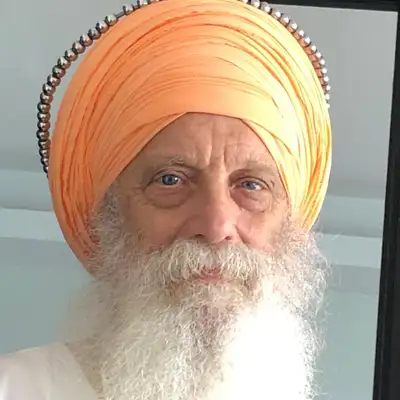
This podcast series is a presentation of challenging and irreverent conversations on wisdom, courage and common sense; for the most part taking place between renown spiritual teacher Hari Nam Singh Khalsa and respected leaders in the world of thought and action. These light-hearted, spontaneous and unpredictable conversations about all facets of life inevitably provide a platform to explore the depths of human nature and human destiny. In particular, it is the intention of this series to introduce our listeners to the value of the Khalsa Spiritual Path and its Code of Conduct, the Rehit Maryada, as created by Guru Gobind Singh, the legendary 10th Master of Sikh Dharma.
Oh, welcome back.
We're at uh the Warrior Saint podcast.
And today, uh I, Harinam Singkalsa, I have the great honor and privilege of uh bringing
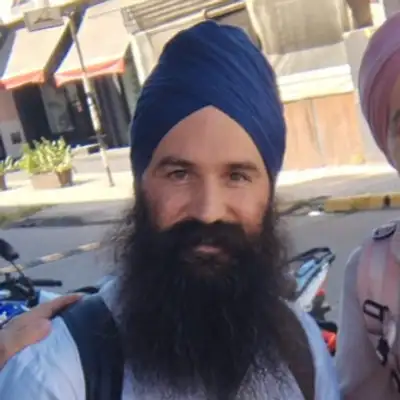
into Warrior Saint a very good friend of mine, Sadanan Singkalsa from Santiago, Chile.
It's for his first time here on the podcast, and uh he's a very funny guy, very bilingual,
and we'll do this one in English with his
Kind participation.
And I guess the first thing is to just welcome you aboard, buddy.
Thanks, thanks for coming on board uh the spaceship.
Thank you very much.
Thank you very much, you for the invitation.
I'm glad to be here.
I'm honored to be here.
So I hope we have a great time together.
Well
Now, obviously you're a few years younger than me, but I I think we must of
We must have met about twenty years ago, right?
Kind of, yes, 16, 17 years if at least.
And and you're still a young man, and I'm not.
Not that young.
You know you know that this series is kind of organic and I we've talked about it, I
invite on
People I consider to be interesting, visionary people, people who are both involved in
doing something that I consider to be cutting edge in society.
And also, you know, me knowing in some way what they're doing in the world is um somehow
dovetails is congruent with the title of this podcast being Warrior Saint.
Um essentially in some way being in the world as an example of somebody who's both uh a
saintly person, very kind loving person, but uh also exhibiting
you know, superhuman strength and putting all that together.
So uh almost all the conversations I have with people, uh eventually, even though the
conversation is organic, it kind of naturally finds its way to that theme.
And I'm hoping to somehow uh touch people with the um the value of living a life of both
strength and grace and uh
You're doing like a lot of that in your own life.
Um I I actually uh you know that these conversations are usually organ, very organic and
find their own ground.
And we kind of have the mutual understanding that.
This would happen in this conversation too, but I I have to admit that there's something
in particular I wanted you to share with this uh listening audience with your permission.
Uh so it's not totally organic because I I I I admit to having an agenda.
So for the people in our audience who don't know, you are a well-known uh psychologist in
Chile.
You've been doing that for a long time.
I have no doubt that somehow you've integrated your spiritual practice from the last 20
years to the way that you interact with people helping them overcome their
Challenges in their life.
And then I guess it was a few months ago, you were telling me that uh later in the year
that you were yourself intending to do an online course on uh I guess the whole concept of
fear and overcoming fear.
You had actually asked me to be a guest on.
one of those uh classes.
And of course, um this is central to what we're doing in this podcast.
So I have an agenda for inviting inviting you on is that um and we we've talked about this
subject, but of course uh you know it's been my contention, rightly or wrongly, that the
spiritual path we're both on, uh this
Khalsa-oriented path that was given to us by great figure in history, Gudugobin Singh from
300 years ago, like any other spiritual path, is is designed to aid people to achieve
liberation in this lifetime and help others achieve liberation in this lifetime.
And it's always been my contention that the the experience that one would have.
By checking all the boxes on this path is actually the experience of liberation is the
experience of fearlessness.
That in the absence of fear, people will experience the heights of what we've been
practicing.
So, of course, when you said you were going to do this uh series for people.
I mys I I was very interested in participating and I was also really thrilled to hear that
uh you were going to uh take that leap and help people in this way, which I I think is
invaluable.
So I I'm just excited to hear about this series you're gonna do and you could share it
with our audience here.
But also uh I just really wanna give you a platform to
Talk uh and share with us whatever you uh have to uh share about this uh huge subject.
Because I'm I'm also interested in hearing where you're coming from because I want to see
what I'm getting myself into here.
I want to see that we're on the same page here, right?
Maybe I'm making a big mistake.
But uh I'm just getting validation here.
So just uh just share with us what you'd like to share about this incredible.
uh this credible concept of of the place that fear has in people's lives and our
relationship to it and how we can use that challenge to uh transform ourselves.
right, right.
Okay, I think you did a great decision by stepping into this course.
I have met you, yes, around 20 years ago.
I'm sure we share the point of view in general, at least.
Because Yugi Payan taught this series of classes on fears.
So he will target in 22 classes
every dimension of human fear, ah kind uh of fear that a human being can have.
So from fear to love and fear to die or fear of being or fear of tomorrow or fear of your
own wounds or fear to your feelings or to your fear to pain, everything.
ultimately,
I think there are two concepts that are very important that go even beyond the concept of
overcoming these specific fears.
One of that is that path of liberation is about getting rid of fear, actually.
ah So it's always said in a spiritual teachings that fear of death is actually what keep
us in the cycle.
of coming and going, the rebuilding reincarnation.
So actually it's not the fear of the actual death, physical death.
There is a lot of people that doesn't have that fear, but it's the fear of a stop
existing, which is different.
It's a shift from the concept because...
um
you're you're talking about I'm just trying to find common terminology here because I talk
about this too, but uh I use the word um annihilation.
Yeah.
It's a good word for that.
Absolutely.
Yes.
a annihilation, and I think that's what you're referring to.
that's fair.
I think it's very accurate way to say it, to name it.
And
Yeah, by the way, can I can I like I do this, I know I'm very rude and I interrupt people,
it's part of my personality.
But I have a second thing to say about it.
Let's not forget it because it's important.
Yeah.
And I don't think I'm interrupting you by by by saying what I'm gonna say because I think
in this kind of uh conversation it'll come up a lot.
And that is um and I think you've had experience with this yourself, is that one of the
difficulties in counseling people and in teaching people or living your own life day to
day is that there is so much
Misuse and misunderstanding of words.
And people talk assuming the other person's going to understand, but there really rarely
is understanding because there's certain words, especially certain hot words, that have
different connotations in different people's minds.
And you know, you have a background in psychology, I do also, but I also have a background
in law.
And so I'm very careful about this.
And so when you were bringing up uh talking about death, is that that's like a word that
means different things to different people.
And it's got to the point that it has kind of a lot of negative and scary connotations
that almost render the word useless at this point.
because uh there's differences of opinion even what the word really means.
And so I find myself trying to find a word that there can't be any misunderstandings
about.
So I was glad when you started talking about what I think of as annihilation.
And there's not a lot of good words that equal that.
It's a very absolute word that uh I find
And actually liberation itself I I find myself using a lot because there's some kind of
common understanding what that would mean.
So uh anyhow, that's I just wanted to interject that because talking to somebody like you,
I know that you're also a person like myself who's very careful with their words.
Yes, yes and.
Well, yes, so the second thing but it is related it is absolutely related one thing is
being, having courage, but another thing is being fearless, which is different.
So we are talking to the same thing you are saying that, precision of the words, it is not
the same.
So the course itself, yeah, yes.
Because the course is every, every session is about one different fear.
And I think four of them are not exactly fears, but
things, um virtues or capacities you need to have to overcome fear.
But uh we are talking about the specific fears, then you have to have courage to overcome
them.
That is true.
And having courage is a great, great spiritual value.
um You have to face basically you're not facing something outside, you're facing your
fear.
And then you have courage and you're coming.
So
that is super high thing to do, but it's not the ultimate thing to do, right?
The ultimate thing to do is that you're fearless.
So you don't even need courage.
There is no trace of fear in yourself.
And that is different because you can be a courageous, can you say that?
A person with courage.
You can be like that for many reasons.
using or accessing to many different capacities in yourself.
ah The motivation came from for many different places and you can have courage.
Even sometimes not good places, right?
You could be very angry and then you overcome your fear with all of that.
But fearlessness only can come from your soul.
Because fearlessness means that first you must experience your soul and in that experience
fear is not a possibility.
Because you cannot experience that death or die.
don't know how to say it.
Annihilation.
Yeah.
So you cannot have that aniquilación because your soul is immortal.
You are timeless.
You are infinite.
So you are not lack.
You don't lack time.
are not wounded or caught by your desires.
You are not caught by ignorance.
There is no weakness there.
is not death-ness.
So it's a different experience.
So we are going through the different fears and to have the courage to overcome them.
But actually the complete journey is about being fearless to tap to that, that experience
of the soul to go beyond that.
So we are, we are now in the, the next one, I think it's the sixth class.
Actually we have the recordings.
Yeah, we're already, we're, we're ready.
started we have the recording so the people can access to that but and also they can
appoint for each different session so when when your tie comes actually we will promote it
and everything so everybody knows that you will be there that is in November
great.
So then I I I get to basically try to topple what everybody said before.
Because I'm a troublemaker.
Yeah, but you have actually your topic is fear of not existing.
Yeah, but that's like the ultimate that's sure.
And that is your topic.
So I'm very, I'm very, very tranquil about whatever you're, you have to say.
I think it will be great.
So and how do you so have you have you been the one to do all these or have you had
different guests on?
How how have you done those classes?
ah So far I've done all the classes but the actually the next one is done by another
teacher Guru sansar Singh which is very well-known teacher They have a school basanti uh
School, ah they especially have presence in Latin America.
He will give it three different classes um And then Param Sahesh Singh also he has a very
good good school a bigger school, I mean um
And Namnidankaur, she doesn't need an introduction on yourself.
So that's it.
So we have three, six, seven, seven or eight classes done by different international
teachers.
I'm excited about this.
It's a great topic.
can uh sign up for that, uh let me know how they can do it and maybe I could, you know,
post a link here on the uh on the video.
Yeah, let's do that so they can do it.
And again, they can take only one class.
They can look what are the fears and anyone that actually fits you.
How is this the term in English?
Who the cup fit, let them wear it.
think this is the way.
So you feel it fits you and you're doing it.
Really?
Yeah.
But you can sign up for only that.
But honestly, I think especially your class, Nami Dan's class, they should not miss it.
It's about, she will teach you about fear of love and you will be teaching about fear of
not existing.
So it's very core, very core ah things in a spiritual path.
I think you're gonna be so I'm not even gonna share here.
I think you'd probably be surprised at some of the stuff I'm gonna say, because it's
probably not gonna maybe agree with what other people are saying.
But as I said, I I'm I'm basically I I I'm a I'm an expert troublemaker.
I just like I just like causing trouble.
of the reasons that I like the idea that you are there is actually that, that you are not
saying what people normally says.
And I think that is causing actually the real troubles because we are in a point here uh
in a spiritual path.
And when I say my spiritual path, talking, I'm not talking about ours, anyone, where
everything gets diluted and everything
is done or said in a way that everybody can digest it.
But the important thing is actually whatever is taught in spiritual path can carry you
through all the journey.
And that is not very popular.
So not very popular thing actually in the spiritual world is a good thing, is good news.
You know, I pick you've known me a long time, and of course you you consider yourself a a
student of Yogi Bhajan like myself.
And uh I think one thing I picked up in my style, I mean I certainly wasn't this way when
I was younger, but by the time I was involved with this and I swear to you, this is not
it's never a conscious thing on my part.
It's just
kind of how I am.
But I I think it kind of it's it's contagious and it kinda rubbed off on me.
I don't think it was anything intellectually clear about it.
It's just something I picked up and ran with.
And that is that uh it's just kind of been my style, but it was also my teacher style
without any doubt.
And he did it with me.
Is like it's kinda like
You're trying to inspire people, you're trying to invoke some kind of wisdom.
And I think different people have different ways of doing it.
So of course, we know teachers who are there with a uh a chalkboard and they're going blah
blah blah blah they're right.
Okay.
That okay, I I I respect it.
Uh I it's not my thing.
Although I was raised that way.
But it's it's just not my style to be teaching in that way.
It's not even my style to like people are always you're a psychologist too.
We talk about this.
You know, people are always asking for my advice.
You know, what should I do?
What shouldn't I do?
But I really that's not kind of my thing either.
Like, okay, I think you should do this, I think you should do that.
I I I actually don't like and I think the reason I don't like that is I don't think it's
helpful to anybody that they just do what I tell them to do.
I mean, even if they land up doing it, that doesn't mean that they really have changed as
a person.
And I think, like my teacher, I think I eventually evolved into the kind of person that I
find that I just like blowing up people's um paradigms.
I just love it.
I j I know I swear to God, you know, if for 20 years, I have never even once thought,
okay, I'm gonna blow up their paradigm.
It's just kind of like
It's just like brushing my teeth.
It just comes naturally.
So if anybody is with me and they have a certain uh fixed way of looking at things, I'm
just gonna I'm just gonna like blow up their reality and and kind of not necessarily give
them a solution.
I'm just gonna blow it up and let them put Humpty Dumpty back together again.
Right.
I think that's kind of how my teacher was with me.
He just kind of blew my mind, but he didn't necessarily give me uh like okay, do this or
explain why he was blowing up Humpty Dumpty.
It's like he basically would just blow up my paradigms, but somehow give me the tools that
I needed.
put Humpty Dumpty back together again and be a better Humpty Dumpty.
And I don't know if you know the story of Humpty Dumpty, but uh it yeah it's an in yeah
there's a st there's like um a fable about Humpty Dumpty.
It was like this big egg sitting on a wall and Humpty Dumpty fell apart and they had to
put Humpty Dumpty back together again.
It's a it's an old wives tale.
So you'll hear people sometimes say talk about Humpty Dumpty.
But basically um
I I was somebody who really didn't know what they were doing, even though I thought I did,
and this guy comes along and he basically blows up all my preconceptions about everything.
But he's not necessarily telling me how things are.
He's just blowing up whatever I thought and leaving me to figure out how to put it back
together again, but also kind of giving me some tools on how to do that.
And it took a long time.
And now I I kind of do the same thing.
And so uh, you know, the question is is that you know you're a psychologist and a teacher,
and you like me, we both know because especially because of our orientations, we we know
that even though we may not have exactly the same viewpoint towards it on details.
I think both of us understand the great obstacle and opportunity that fear plays in
people's lives.
Okay.
So almost everybody who I deal with on some level or other, there are paralyzed by fear,
even if they don't realize it.
And it's my kind of job to help kind of them get that unshackled so that they can finally
live in.
some freedom, but that's not gonna happen until they figure out how to free themselves
from this fear.
So as um the beloved teacher and psychologist and counselor that you are, do you have a
any particular way that that you try to help people?
I mean, I mean, because you're talking about fear in some philosophical way, but but uh in
a concrete way, how do you find yourself
getting people on the road to um, you know, g getting the shackles off of the fear that's
paralyzing them.
Yeah, I'm kind of more academic person in psychology.
I have witnessed your style many times.
have been paradigms being blown like in very heavy way by yourself.
this is actually, it's not because we are talking right now together, but honestly, you're
one of the best psychologists I have ever met.
Not in terms of the degrees you have or anything, but actually being front, face to face
to the person and the ability to change their life in this 15 minutes conversation.
ah But I am more academic.
I like more explaining why is this and why is that.
Well, my job is I gain my life through psychology and in that job is more usual that you
company the person through the process.
So it's different logic behind it.
So um I don't even know exactly how I do it, which is of each of them.
um You have many, many, many, many more years than me doing it.
So you have it more, maybe more clear, but while you was talking, I was thinking and at
least currently, because it can change.
Actually, I find myself, I think this is very accurate thing to say.
I try to make people get back to very simple, original things that everybody knows.
And then get committed with it.
So if the people is lying to themselves, if they are lying to other people, is there, they
are letting other one...
hand or face down.
If they are, you know, they are not an integrated person in some way.
There are, this is very simple.
I don't know if we'll be here, there's something deeper or shallow.
I don't know.
But when we was little kids, we would tell them many things.
And then when we become parents, we still teaching that to our children, but we are not
doing it.
And I think we all can relate with that.
And when you remember certain things, for instance, when you are in a spiritual path and
you have fear and everybody knows that the person in the spiritual path should go beyond
fear and why.
So I just remind them that and they confront that things that
the reason why they are lying to oneself, why they believe lying or creating distrust in
another person can be anyhow valid.
so I think what they get many times, very often is certain innocence of going back to the
basic principles of life, but in a very mature way.
I think that is my approach.
um And again, I threw bombs.
I know how to do it and I like it and I do it.
But normally I just company the process until the moment comes that there is no other way.
The bomb should ah fall.
Yeah, I think you know, you're I think
In some ways and I like it.
I d I think maybe in the future we'll land up teaching together and approaching it from
different points so people can take whatever they want from anybody.
They you know, give them some choices, you know.
But what you were just saying reminded me that I I can see how you're very self-aware and
Thoughtful in about how you deal with people.
Okay.
And it's the reason that I asked you how you deal with it, because I think you you're
you're very aware of it.
And and I actually, for the most part, are not as aware.
I just I just throw spaghetti against the wall, that kind of thing.
And
I'm uh psychologist, in our first degree, let's say.
That is not different.
That's different.
Yeah, kind of thing, right?
So it's different.
You're trying to get to the point.
I never I never actually had the slightest idea of what I was doing in the psychology
field until somebody asked me for the first time if I was interested in in actually
teaching people what I did.
And
And I accepted the invitation unconditioned.
sounds great.
You know, sure.
In in December, yeah, of course.
Okay, you know, you'll have various weekends and you'll teach people what you're doing,
right?
And I was all I was all happy about that.
And then the telephone conversation ended and I said I started laughing to myself and I'm
going, I'm wondering what I'm gonna teach, because I have no idea what I'm doing.
I have not the slightest idea.
But
I have till this course to kind of figure out what I'm doing because I have no idea what
I'm doing because I don't do anything thoughtfully like this.
I don't I don't have any system, in other words.
I don't have a system, so how am I gonna explain what I'm doing when I'm not actually
following any system?
I'm just doing everything by the seat of my pants.
And then I had to figure, okay, what I'm gonna have to say something, but I don't really
know what I'm doing.
So I
I had to sit down and and I started kind of understanding, because I had to, some of the
things that I was doing.
And it was interesting.
Take f this whole area of fear, for instance.
I think that's a really w which is all pervasive, of course, but I realized, although I
was doing it unconsciously, that my go-to, and I keep saying my go-to because it's not.
really a go-to is that it's really not intentional, it's not conscious, it's not a system.
It just it's in the it's in the conversation, it kind of there's a moment that I'm gonna
do something.
But if and as you know it's almost always about fear, directly or indirectly.
It is.
And I I I realized that what I naturally did
To kind of help people get forward is to actually up the doses, like double the doses.
So if they were in fear about anything, instead of helping them like somehow understand
the roots of the fear, come to some terms with the fear, give them a meditation for the
okay.
No, I found myself almost consistently doubling the dosage of fear.
And whatever they were afraid of, I found myself actually doubling down on it and asking
them to take on more fear rather than less fear, or a circumstance that would provoke more
fear, with with the idea that although they don't realize it, they have the inner
resources to adapt to it.
Absolutely.
And if they're able to basically overcome that double dosage of fear that would almost be
like a vaccine against other fear because instead of like running from the fire, I'm
pushing them to run into the fire and knowing that they're going to survive or not.
But they but they have to survive because that's what's ahead for them.
So I'm preparing them.
So that has been kind of like like recently, but if anybody's listening to this, I'm not
okay, I'm not talking about you.
Because somebody will hear me say this and they're going, oh, this thing what happened in
my thing.
No, no, no.
This is not uncommon.
Okay.
So if you think that if you're listening to this and I've talked to you and you think I'm
talking about you, I'm talking about you and a hundred other people I've talked to about
this, right?
But this is a really kind of good example of it, is that
Somebody was very unhappy being in a relationship and hearing a little bit about it, first
of all, this was nothing that they should have been in, clearly to begin with.
And but they were so emotionally attached to the other person.
You've dealt with this all the time as a psychologist, is that they're they're like
addicted to this other person.
And whatever they're getting out of it, but clearly it's suicidal, and they're not gonna
grow in their life.
And part of them really wants to break free from this, but they just cannot do it, okay,
for whatever is holding them back.
So, how am I gonna do it?
I'm gonna deal with it.
We get to the point where they can acknowledge it, but I'm not talking theoretically, I'm
like handing them a telephone.
Call them now, break it off right now.
This is like a relationship for like fifteen years, and I'm handing somebody a cell phone,
I'm saying, No, you're gonna end it like right now, and they're freaking out.
so okay, I've I've I've been there where they actually made the call.
And I've been there where they're going, my god, I can't bring myself to it.
How mu they're going, What I can't do it right now.
I said, Okay, I'm giving you twenty-four hours.
And if you don't make it in twenty-four hours.
Don't come back, talk to me.
And there of course many people would be offended with that kind of strategy, but in this
case, the person did make the call.
They this is not uncommon.
They make the call, they did it, they're free from it, they're freaked out, they're angry
at me, right?
And they're saying I ruined their life, but a year later, they're calling me and telling
me, Thank you, nobody else.
I I needed to hear that.
I did do it, my life is fantastic.
And you know, and now.
No and now but most importantly is now nobody can control me anymore.
Absolutely.
Yeah.
They had to conquer something themselves through the challenge you have put in their path.
And the thing, this is one of the reasons why I do yogic psychology.
I don't like uh very much to do it in another way uh because, many things happen.
First thing is that
Doing things like this in psychology is a taboo, right?
Because you should not tell the other person what to do.
You don't say to other people what to do, but you put the person in these situations.
But anyhow, this is a taboo.
But I think it's a weakness in Western psychology because when you have a person in front
of you, yes, they're lives, but sometimes you know there is a cliff.
And normally the psychologist will not tell the other person there is a cliff because they
have to know it by themselves because whatever reason it is.
But actually the main reason to me is actually they don't know how mine actually works.
There are theories about it, but it's not real life facing real life.
And then if you take that decision, actually you will have to to pay for 10 or 20 years of
your life.
The decision you have made, but the psychologist in a position is like, no, they have
to see by themselves.
And there is a thing, I think this is mostly because there is a concept nowadays, not only
in psychology, but everywhere that true doesn't even exist.
And these have everything to do with spiritual path because if you don't think truth
actually exists, then there is no place for a spiritual path because there is nothing to
know there.
The spiritual path is built on over the conception that there is a truth first and second,
you can know the truth because if there is a truth, but you cannot know it, they why to
bother, right?
to you don't need to tell people this is the thing.
I'm very passionate about this stuff, but I think this is everywhere and it is created
problems.
You don't need to tell people to not believe in God.
If you just convince them that there is all that every person have their own truth.
And everything is right.
It's only depends on how you feel it.
After years you have the situation now that everybody is atheistic because if you say
there is no truth, there is no God.
It's the same.
The mind, your psychology will do the work for you and at the end you will find that there
is not an ultimate truth.
you know what's very interesting is that I hear from people you you're around these kind
of people too, is that if you ask them why they're involved in spiritual seeking
They'll tell you is that almost all of them are gonna tell you, well, they're seeking the
truth.
But then when you're actually presenting them with something that would represent an
ultimate truth, they're going, it doesn't exist.
So why are you pursuing it?
also, you know, this is super interesting.
People don't recognize this, but what we know is modern psychology, right?
Actually
And this is this is historically factual truth, okay?
But people kind of have amnesia about these things, is that the school of psychology in
the universities actually came out of the school of philosophy.
And the schools of philosophy basically were children of the school of religion.
So it's basically religion, philosophy, psychology.
But now the psychologists are talking like they're the gods, but they forgot who their
parents were.
absolutely, absolutely.
And I want to say something I actually, but this is I will throw a little bomb and maybe
we can discuss about this later.
But this is not only about psychology.
It's for making everything.
So you was telling about the spiritual path, the spiritual seekers.
So I was talking with that person.
It's exactly the same example, but going to yoga.
So yoga teacher, I was talking to her in a session.
And I told her, you know what the problem is?
The problem is why?
You don't know why you're in the spiritual path.
Why you're doing yoga?
Because if you're here, you have a tool.
If you have a hammer, you need to know that that is for putting nails.
Otherwise, it's pointless.
So yoga is the same.
So, well, the person just went around, never said anything about God or divinity or
anything.
different things of healing and self-improvement, all these that is not a spiritual path
itself.
And then I went to the point like yoga means union and union with God.
So it's everything about devotion that is your problem.
You know, so you know what she said?
She was crying, she was emotional.
I don't remember if crying, but I think so, but she was super emotional as she said, you
know what?
That is how I believed about yoga until I did the teacher training.
They taught us differently and I thought that devotion to God and trying to merge with God
through this, actually I was the grown one.
So I gave up of my idea of having a relationship with God.
This was a teacher training.
Well, you know, I think we're very much on the same page and I I think, you know, you'll
be a guest on further episodes this because I I think that uh however we found common
ground, I think the both of us have been very influenced by our own experience and what
we've observed and uh came to some
level of peace that there is a a truth, a universal truth that exists.
And that we we feel very fortunate to have uh kind of put up a white flag and and and
acknowledged that in our own lives and how much peace it's brought to our own lives.
So thank you so much for being with us today.
Well God God bless you, Sarananda.
Vahigurijika Kalsa Vahigurijiki Pate.