Subscribe
Share
Share
Embed
Connecting the dots across the Middle East through storytelling. Join host Malak Fouad, as she brings you the most inspiring people and unpacks their life journeys — successes, failures and everything in between!
One of the areas you talked about as a trend, which goes, which runs through
every interview I do now, regardless of industry, is AI.
The people I'm talking to, they've all drank the Kool-Aid because they're running
businesses that are at the cutting edge of this tech.
What concerns me is the sovereignty piece.
Absolutely.
Who owns it? And that's what entrepreneurs in markets like ours have to do.
They have to advocate for the policies that they need. And we're seeing that happen here.
This episode is brought to you by EFG Hermes One, your one app for investing
in more than 35 stock markets worldwide.
This episode is also brought to you by Azza Fahmy Jewellery
Welcome again to What I Did Next from A&T Media. I'm Malak Fouad, your host.
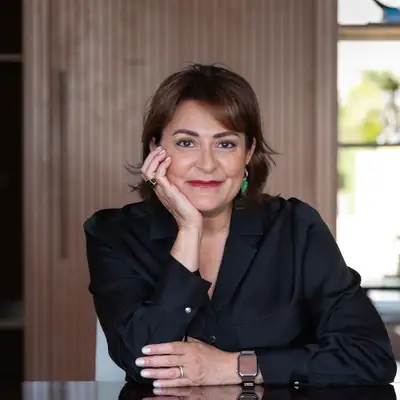
Today, we're looking at part two of my conversation with Dina Sherif.
So you and I had a quick chat yesterday, and I had a couple of questions I wanted
you to clarify for me because there were some areas I wanted us to go into.
And one of them was the trends that you see within your industry, within your ecosystem.
And you came back to me with an unbelievably loved document,
which I absolutely love.
And I actually went through it this morning. One thing you talk about,
and I think it's unbelievably timely that we're talking about it,
is the shift from aid to agency.
So, of course, we're talking today in June 2026.
Very recently, USAID was dismantled, which was a huge aid
sort of conduit to our part of the world.
but it had its issues, as we all know. Talk to me what you mean and why it's
important to be moving from aid to agency.
I feel like this has now become like a calling for me.
And I think part of it is, you know,
when you go abroad, I'm sure you've experiences. You say, I'm Egyptian.
And a lot of people will be like, oh, Egypt is like this really,
really old country with all these thousands of years of civilization.
But it's a really poor country, isn't it? And I'd be like,
Uh, is it? And I think there's a narrative that has been carefully curated about
where we come from, places like where we, whether it be,
Africa, Arab region, Latin America,
South and Southeast Asia.
Carefully curated narrative.
Who's curating the narrative?
The West.
Okay, that's what I wanted to hear.
The West. Yeah. To kind of carry on the narrative that was carefully curated
during the years and years of colonization and that era, right?
And I think the narrative is shifting, and that's a trend. People are taking back control.
In your mind, because I have a moment in my mind, which it's by a date.
I can give you the date when I think that that change happened.
What's your date?
7th of October. Gaza. I mean, I was raised abroad.
I'm American. I was born in the U.S. I lived in Saudi. I lived in England.
My entire prism of the world was seen through a Western lens.
7th of October completely upended that. There were signs before.
I mean, I lost my aunt in a suicide bomb in Iraq in 2003.
That was absolutely a game changer for me. But 7th of October was undeniably
an entire break in the system for me.
And I want to bring up someone I interviewed last summer, and I'm sure you know who he is, Omar al-A'ad.
And his book for me was...
Stating the obvious. I mean, it wasn't a groundbreaking thesis to someone like
us because it's always there, right? It's always in the back of your mind.
But there is certainly now an entire break.
Yeah.
And I think there's a positive in that. Yeah.
And there will be change happening by us for us from now on.
Yes. I agree. I think 7th of October revealed to many of us,
especially in the Arab region, that we were seen as not human.
Absolutely.
Right? And I think that definitely became something that the rest of the world
started seeing, is that if you are not white, you are not some,
you're like… You're lesser. You're just lesser.
And yes, I think 7th of October really drove that home for many people.
But I also think there's a lot to say for...
I think people being fed up with histories being written for them from a Western lens.
And we allowed that to happen, for sure.
But we were also impotent, Dina. Well, you know. We were economically impotent.
We were, there were a lot of things, we were like squashed down.
How can you rise when you can't physically get up?
I think there were forces trying to keep us down.
But, you know, Malak, I believe that deep down, I believe that we also just
bought into the narrative.
It was easier as well.
Yeah, I mean, we were bought into the narrative that we were like women, right?
We also were bought into, you know, here's the thing. I consider women and the
kind of discourse of empowerment to be similar to the discourse around aid.
Yeah. So you know how everyone's like, oh, women's empowerment and we want to
empower women and we want to upgrade their capacity to sit on boards and we
want to do this. This is I think this is actually a very disempowering narrative.
Because we're still getting permission to do it.
Well, also, nobody gives power. Absolutely. Power is claimed.
Nobody gives power away. That is a fallacy. I'm sure the word empowerment was
created by some white man somewhere to keep, you know, women thinking that somebody
has to do something to give you the right to rise.
Yeah, you still need to get the permission from someone.
But here's the thing. You're not somebody who needs to be empowered.
Were you ever not empowered? That's the issue. That's how I
Look at it. You were never not empowered, but also...
Did somebody give you space to claim your... Or did you just go out and claim it?
The people who have actually done the most have claimed it. They have fought
for what they got. They have pushed through...
But we're still discussing it from a very elitist point of view. Let's be fair. Yes.
If you're a woman in a small village in the Delta, and you are relying on your
economic well-being, on your husband, on your father, or on your brother,
the situation is a very different scenario.
We are talking about it through the very elitist lens that we live.
Yes. We definitely have many more privileges.
We have a lot more privilege.
I also, you know, I am Muslim. I believe very much in the framework that was given to us.
Those who are privileged have an incredible obligation to lift people up.
Social justice and social equity is embedded in the very fabric of Islam.
The fact that we're not practicing that, I mean, this is in our part of the world. That's on us.
But I do believe that I'm privileged. I definitely had the privilege of education.
I definitely had the privilege of network.
I definitely had the privilege of great people who inspired me and mentored me along the way.
What I choose to do with that, that's on me. And I think,
you know, those who have really need to think carefully about what they're doing
with that privilege to make sure that those who don't have access are finding
ways to get access. I just want to give one example, Malak.
I want an example because I want to hear a specific example.
It doesn't have to be for Egypt.
I'm going to give you a specific example of Aliko Dangote, Nigeria,
the building of this massive, the largest oil refinery in the world.
He's what, in his 70s now, Dangote, you know, something like that?
I think he must be in his early 70s or in his late 60s. But he,
for me, is an example of what entrepreneurship can do to shift a narrative and
what it's now doing to shift narrative in other parts everywhere around the world.
And what he what he did is he is showing that we no longer have to be places
of places of extraction.
Nigeria is such a good example. Nigeria has all this oil.
It was exporting crude oil to the West who refined that oil.
And then they had to import it.
And it's refined. Like, how does that make any logical sense? But that is.
The nature of colonialism.
Correct. And that is the dependency mindset that we are stuck in.
So for him, how did he break that cycle?
He created the largest oil refinery. The Afri-Exam Bank played a big role in that.
That was started by Professor Orama, who I think is a legend.
because he was one of the first people who said, Africans need to build Africa
and we need to shift the narrative and move beyond this kind of colonial mindset that we have,
That is, you know, deeply embedded in our thinking.
And what Aliko Dengote has done, look at him. He's now importing refined oil to the UK.
Talk about poetic justice. Right?
Tell me, Dina, do you do workshops in Africa? I know that you have...
Everywhere. You have projects and workshops within MIT in...
And we do it in Africa.
But you do. Where?
Actually, we have one next week. We're doing a one-week intensive immersive,
program for growth stage entrepreneurs actually hosted here in Cairo by Hanan
Abdel Mageed, at Camelizer, who's one of our fellows.
And how can people apply to that?
It's open application.
And it's competitive.
You have a criteria of applications. We have two coming up. We have an early
stage entrepreneurship program. So if people are listening, they should apply.
Early stage entrepreneurship program that will be hosted in Botswana.
This episode is brought to you by EFG Hermes One, your one app for investment
across more than 35 stock markets worldwide. With EFG Hermes One,
you can buy and sell orders in real time for immediate execution across multiple global markets.
You can keep track of your favorite stocks by creating and customizing multiple
watch lists and make informed investment decisions with their advanced technical
analysis tools to study market trends and investor behavior.
So supercharge your financial journey and download the EFG Hermes One app on
the Apple App Store and on Google Play and start investing today.
Our next point in your...
in your trends, is that you look at entrepreneurship as a national competitiveness strategy.
I think that countries cannot be globally competitive without the private sector,
without entrepreneurship and specifically innovation-driven entrepreneurship.
And that's been the backbone of your work from day one.
Yes. Yeah. What has happened now, though, is a shift.
Governments are starting to realize that in order to be competitive,
They really need to partner with entrepreneurs, and they need to see those entrepreneurs
succeed and evolve and grow from startup to,
growth stage to companies that scale.
And also, we're now starting to see the next frontier, which is deep tech innovation.
That is the next frontier, and that is still to be seen whether our ecosystems
are going to evolve and go there.
But what will truly allow our countries to be globally competitive is our ability,
to actually stop being net consumers of innovation, but also exporters of innovation.
And for that, we need innovation-driven entrepreneurship.
So I want to ask you about this from the point of view of Egypt.
People who are in the private sector have, for the last 10, 12,
15 years, been complaining that the policies are not encouraging of private sector growth.
Are you seeing that that is shifting? I mean,
the, what's the word I'm trying to find? The messaging coming out of government
is that we are moving towards partnering with private businesses and so on.
Do you think that that is happening?
From what you're seeing?
Whether government is partnering or not.
Or encouraging this ecosystem.
I think they're definitely encouraging. Whether they're partnering or not,
that's a separate question, but I don't know that it matters because entrepreneurship
has already been unleashed in Egypt.
The question is whether we can see it unleashed across the entire nation,
not just in kind of the bubbles of Cairo.
But are policies being put in place to make starting a business easier?
These are beginning to happen, right?
And also, I look at things as how far have we come from where we started?
And if you look at where we were in 2010 versus where we are in 2026,
we're in a different place.
You know, the government has evolved and will continue to evolve.
If you think about the fintech industry and the regulatory environment to drive
or to allow fintech to thrive in this country, we're now a hub for fintech.
And it didn't exist 10 years ago.
Did not exist. And it was driven by the entrepreneurs who were building businesses
in the fintech space. When Fawri started, there was nothing.
We had on the show recently at the end of last year, Mounir Nakhla from Halan.
And he is very involved in the regulation area now. It's a very important part.
And that's what entrepreneurs in markets like ours have to do.
They have to advocate for the policies that they need. And we're seeing that happen here.
Like the regulatory environment for fintech was driven and written by those
who are in the fintech space.
One of the areas you talked about as a trend, which goes, which runs through
every interview I do now, regardless of industry, is AI.
But my question to you is, is everything that you're looking at now seen through that prism?
No.
It's not yet. Or do you think it ever will be? Is everything geared towards that?
Yeah, I mean, I think AI is a,
big issue and one that should be taken extremely seriously.
And I mean, Mo Gawdat scaring everybody. Yeah.
He's not the only one. No.
Many people are scaring people.
I'm scared myself.
I mean, I can tell you why I'm scared on a personal level, but I can tell you
that for me, what concerns me is the sovereignty piece.
Absolutely.
Who owns it?
And the regulation piece.
For sure, the regulation piece. And we're past that.
There's no turning. We're not late. It's behind us. It's in the mirror.
I don't think you're mirror.
I don't think yet. I think we have time. Really? Yes. I'll tell you why. Because...
You know, here's someone you should invite to your podcast.
Who's that?
His name is Mark Domba.
Okay. I had Mo on the show.
Yeah, I know you had Mo Gawdat. Yeah, yeah. Mark Domba is a minister in Gabon.
Really? And he wrote a very provocative article about AI with regards to Africa,
but I think it applies to growth markets.
And at the core of what he said was something very profound.
Are we running too fast into AI without even having the infrastructure to support it?
And will running too fast into it without creating a strategy for building the
right infrastructure for Africa, will that make us more dependent on the West in the end?
because if we don't have the infrastructure to support AI in terms of energy,
water, and everything that is computing capacity, we're going to still be dependent.
I don't know if we'll be dependent on them. I think we'll just end up being...
Controlled.
No, not even controlled. It'll just continue being a continuation of the colonialism.
They'll extract the goods and minerals they need and we'll be left behind without an infrastructure.
That's the sovereignty piece, right? Yeah, yeah. So I think what he was arguing
for is AI is extremely important, but we're in a different position.
We need to be building the infrastructure in parallel to really putting together
strategies for how AI is going to be used in our country.
I agree. I agree with you. And what worries me, because I'm spending a lot of time in this space,
I'm doing a lot of events, moderating, discussions.
Yeah, you just did that AI. Yeah, yeah.
And what I'm feeling is when I look at, The people I'm talking to,
they've all drank the Kool-Aid because they're running businesses that are at
the cutting edge of this tech.
No one is stopping to think, you know, first of all, where is the human element?
Do we control? Do we not control? Should we stop it? Should we put a brake on this?
It's too late for that.
It's too late for that. But what's bothering me is that people are just looking
at the bottom line at the end of the day and the short-termism of it all.
No one's really thinking profoundly about what are the real implications of
this. And they're comparing it to nuclear.
They're comparing it to the Internet. It's not the same.
The person that actually influenced me a lot in how I think about AI is a man
named Hal Gregerson. He's a leadership professor at MIT.
And he wrote a book called Questions Are the Answer.
And he talks a lot about, you know, AI is here, but we need to spend time thinking
about what we get from it and what we give up from it when we use AI, right?
I am a deep believer in the,
I think AI can have enormous impact on prosperity, but we need to deeply question
where we want to use AI to impact prosperity.
In the same way, by the same token, we have to think about how is AI impacting
me as an individual and what is it doing to me as an individual by using it, right?
How often do you use it or how do
You use it? I rarely use it. I use it.
So interesting. I don't either.
I rarely use it. And I'll tell you why I rarely use it. I use it,
like, in very rare occasions, sometimes to kind of test whether...
AI is going to give me better answers than I'm giving myself.
And also sometimes I'll use it for like organizing thoughts.
But I never use it as a start.
Yes.
And that is done out of fear that I'm actually giving a big chunk of my agency over to AI.
For me, I resist. I use it occasionally, but I resist it because I worry that
it's going to reduce my own ability. Yes, of course. In the long term, which I know it will.
So I am still analog from the point of view of AI. Sure, it's right now. It bothers me.
I see it as short-term gain. Yeah. But if we're not thinking carefully about
what it, you know, what is it exactly we want to gain from it and what is it
that we're giving up, we're going to end up losing in the long term.
So I think AI can have enormous impact on sectors like agriculture in Egypt, healthcare.
Healthcare is a no-brainer.
Huge healthcare, even education. But the question is, how are we going to use
it? And what is our long-term strategy?
I'm not sure we have put that in place yet.
I don't think we have.
And I think we're stuck in that short-termism.
Do you think that all of this should be coming from, and I'm not just thinking
of Egypt, I'm thinking of this from a point of view of like every country in the world.
Should the strategy be set by governments?
Right now it's being set by private companies. anthropic AI,
you know, they're all setting the benchmark and the government is catching up.
You know, there are lots of corporations in Egypt. All the big names are here,
all the big tech names, but, and they're bringing in
you know, the norms that they're using all over the place. But should it be
a government-led thing or should it be a private enterprise-led regulation?
I think regulation should always be set by the government. I think in the case of AI,
countries should be putting the priority sectors for which AI can really make
a difference and help their comparative advantage.
I think that's not happening. And I even think that needs to be done in companies. To what extent,
Everyone's being encouraged to use AI. And I mean, come on, machine learning
was built out of MIT, right?
At MIT, people are like scared, shitless about what's going to happen, right?
Because is it being used properly? And, you know, an incredible MIT faculty
wrote a book about data and society, and he has a deep belief.
He's actually a Palestinian. His name is Munther Dahleh. I think everybody should buy his book.
And he has a deep belief that, you know, data can be used for good and when
applied to society in the right ways, can really unleash,
something that will allow society to evolve in a positive, for progress.
Well, like we saw with the Industrial Revolution, we saw it to a very large
extent with the internet. But it needed guardrails.
But it needs guardrails. It needs guardrails. It needs guardrails.
Because when the Industrial Revolution happened, it didn't have guardrails.
And look at the incredible damage it created. It needs guardrails.
But it's too late to say we can't get on the AI train.
But let's be realistic. How likely is it that the growth markets that you talk
about are going to be in the driving seat?
They're not. I think it's a choice. I think it's a choice.
They can be in the driving seat or they can choose to stay kind of in that place
of where we have no agency and sovereignty.
I think there's still time to make that choice.
But you're talking about it from the point of view of a nation.
Each nation runs their own show, right?
Or regions.
So that's interesting that you said that because I wanted to talk to you about
that. So I've always had in my dream...
sort of, you know, utopia for our region is that we would create the EU of the Middle East, right?
I think that is the solution to a lot of our problems. Forget political cooperation,
we've never been able to do it.
But why not economic cooperation? Why can't we do that?
Do you see that that could be a way to bring not just the AI regulation issue
into a more cohesive formula.
But economically, the whole region would benefit, obviously.
1,000 percent.
How likely is something like that? How can we make that happen?
Again, it's a choice. I don't think real prosperity will happen or the kind
of prosperity that we need.
With the jobs that we need, our region and Africa are the youngest populations in the world.
And I think that for the jobs that we need to be created, for the prosperity that we need,
It's not going to happen without integration. Yeah. Now, does anybody want us to be integrated?
When I say anybody, I'm talking about, you know, powers that be that we all know about.
But you see, if we're going to do what we've discussed earlier,
which is remove that shield of
West telling us what to do, we as a region cannot get our acts together.
How do we get each of these countries to sit down at a table and say enough is enough?
The only way we're going to make our area better is to cooperate economically. Forget the politics.
We don't need permission from anyone. How does this happen?
The hope is that somebody needs to exercise leadership and create that kind
of space or container to get everyone in a room around a common purpose, right?
People unite around purpose. Right now, we don't have a common purpose.
I mean, we probably do, but no one has bought into it and said...
In Europe, it happened after the war, right? And it happened because it was so devastating.
And that was why the EU?
And that was where the seed began. For the EU. Are we in that...
Are we there for our region? I think we are.
I think we definitely are for Africa. I also, deep down, have hopes for BRICS.
Yeah. But it's too geographically diverse, isn't it?
Well, I think if you look at population size and size of, or I would say,
the GDP rates of these countries.
So if you're thinking India, China, Russia, Egypt, Brazil, South Africa,
Indonesia, Saudi Arabia now, you have some really significant countries.
Huge countries.
I actually think they have, if they want, can carve out a new kind of world
order. But that's a choice.
Yeah. Well, everything is a choice.
Everything is a choice. It's just like...
Somebody has to kind of step up and say, enough is enough. We need to put, we need to unite.
If they are region united, do you?
Oh, my God.
I mean, yeah. Nobody wants it united. If you follow Jeffrey Sachs, get him on.
I do know Jeffrey.
Jeffrey Sachs, man, he spoke at our conference this year.
And he's totally right. Every time leadership was seen, America would come in and get rid of it.
I want to talk about the two last points in your trends, untapped potential
of growth markets and democratization of technology.
We kind of already talked about the untapped potential of growth markets and
that that's where the next big thing is going to be, right, as far as you can see.
Yeah. I think we're starting to see more and more innovation come out of these markets.
we're seeing much more rapid growth rates and we've already spoken about the
shift in narrative but I think the demographics are on our side so when you
think about consumer power,
that's shifting in the direction of all these other markets the markets that
were not perceived as the countries in the lead so I think we're starting to
see a shift and people are starting to realize that,
These are the markets that need to be invested in because those are where the
consumers are going to be, too. And if you also think about it,
Africa actually has kind of one of the highest rates of return for investment,
but nobody talks about it.
And Africa's already shown that they've leapfrogged between technologies,
right? I mean, the mobile.
They've leapfrogged. They definitely leapfrogged in terms of infrastructure for telecom. Yes.
The question is whether they will leapfrog in other technology as well.
But as you said, I mean, the AI wave requires a strong infrastructure.
And that's really up to them. That's going to be up to them.
Democratization of technology, we're seeing it.
You know, everyone has access now. Everyone. And that access is power.
And what people choose to do with that is going to be the big question.
But has technology been democratized? Yes. A thousand percent.
You gave a speech to the new cohort of fellows that were coming into MIT recently,
and you talked about actionable hope. What does that mean?
So, you know, at the center, we talk a lot about how entrepreneurship is hope.
And entrepreneurship at the very core of it is this promise of hope. Absolutely.
Promise of possibility, of change, of evolution.
But that is not enough. Actionable hope is that we have to really put this into
practice and create the right environment in order for the hope that exists
to actually thrive and actually mean something.
So at the conference when we spoke about this actionable hope,
it was really that in the promise that entrepreneurship has,
this hope that lies within it,
now we really need to take the steps to allow that to be unleashed, right?
Thank you, Dina. I loved, I loved, I loved, I loved.
Thank you, Malak.
This was amazing. I felt so, like, I felt like I really learned a lot of things
today. And I'm really grateful.
Thanks for joining me today. I'm Malak Fouad, and this episode was produced
by Chirag Desai. Next week, I'll be bringing you another Encore segment,
and this time we have Ramy Adeeb back in the hot seat.
We talk about AI and everything to do with tech. I hope you can join me then.