Subscribe
Share
Share
Embed
Since 1986, Convene has been delivering award-winning content that helps event professionals plan and execute innovative and successful events. Join the Convene editors as we dive into the latest topics of interest to — and some flying under the radar of — the business events community.
Convene Podcast Transcript
Convene Interview, ep. 7
*Note: the transcript is AI generated, excuse typos and inaccuracies
Dr. Ayesha Khanna: What's going to happen is that we're going to see AI everywhere. So over 50% of our time, honestly speaking, I think it's going to be spent speaking to AI.
Magdalina Atanassova: This is the Convene Podcast.
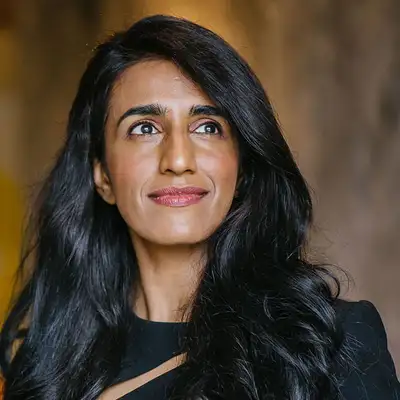
In this episode, we're joined by one of Southeast Asia’s groundbreaking tech voices—Dr. Ayesha Khanna, Co-Founder and CEO of Addo, a global AI solutions firm based in Singapore. Ayesha is a strategic advisor to governments and Fortune 500 companies, a World Economic Forum thought leader, and a powerful advocate for ethical and impactful AI.
We dive into how artificial intelligence is not just a tool for automation, but a creative and strategic partner—one that has the potential to reshape business models, elevate customer engagement, and unlock bold new ways to innovate. Ayesha also shares essential insights on data governance, change management, and why empathy and ethics must guide AI adoption.
If you're wondering what it really takes to build an AI-enabled organization—from internal mindset to external value creation—this conversation is for you.
We start now.
What fundamental shifts do you foresee in business models, customer engagement and value creation brought by AI?
Dr. Ayesha Khanna: Look, I think that fundamentally we need to rethink how organizations are run. Because now artificial intelligence can do two things. First, if you look at every single process and the operating model part of it can be automated using artificial intelligence, whether it's generative AI combined with forecasting,
optimization, whatever it may be. And then the second thing is that it's more than just that. It becomes kind of a tool, a thought partner for innovation as well. And not enough people are talking about this at the moment because at an enterprise level they're still thinking of it really as an automation tool.
And it is very much that it improves productivity and efficiency. But already we're beginning to see that if you asked it to play a role, for example, if you are going to your business and you're trying to enter a new market and you want to know about the laws and the taxation over there,
and also recommendations on how to enter the market, some partnerships that are already happening over there between analogous companies, it can really give you that idea. Brainstorm product ideas, craft personalized customer experience, even invent new art forms for marketing campaigns.
And I think we have to ask AI to do things and we also have to start asking it to imagine things for us and with us.
Magdalina Atanassova: I really love that, especially now that I'm hearing more of this buzz about sentient AI.
Dr. Ayesha Khanna: I think that that's dangerous for us to go into thinking that AI is conscious because it's not there at the moment, it appears so. And some people say that it appears enough so that for all intents and purposes we can consider it and sentient.
But by doing that, we open ourselves up to losing our agency and our confidence, thinking it's smarter than. Whereas we must hold onto our critical thinking, we must hold onto our domain, knowledge and intuition, because it can make a lot of mistakes and also getting very emotionally attached to it,
which already we're vulnerable to, because as Sherry Turkle has said, we kind of get attached as human beings to inanimate objects that exhibit some kind of animation and emotional responsiveness to us.
So I think that not only is it factually incorrect at the moment, but just that kind of thinking doesn't help us reach our own highest potential and really use AI as the kind of assistant that it is very, very good at being.
Magdalina Atanassova: Right now, many businesses view AI primarily as an automation tool, like you said as well. So how can we make the most of it and how can we actually use it to improve our creativity and innovation?
Dr. Ayesha Khanna: I think that's a very important question.
The fact of the matter is that we should not think about just bolting AI onto old systems. We really need to think, rethink the DNA of a company altogether. Which means that now all of us have used to certain constraints in terms of what is possible, how quickly we could move towards the market,
how cost effectively we can experiment. But we can be, almost all of us can be like Silicon Valley entrepreneurs, bold, fearless, innovative, thinking at scale, imagining global markets for ourselves.
Because the cost of doing business should come down whether it's manufacturing logistics or design, product design, not just software.
And that should allow us to be much more thoughtful about now what are we going to do with it? And the fact of the matter is that even the best company, even the most efficiently run lean, mean machine company, if it's not building something that customers want, that is endearing,
wonderful, useful, beautiful, invokes curiosity, interest,
emotion in people and makes their lives better.
The AI is not going to help you get there. So you need to use AI to jump to that next level. And for that you can do many things, but I think one of the best things you can do is really just innovate with it, brainstorm with it, design with it,
but always maintain your own expertise and your intuitiveness and more than anything else, your ethical values and brand centricity. So whatever you do, whatever it recommends that doesn't vibe with what you believe in, you have to correct it.
And so that's where I really See, just kind of a restructuring of firms into something that we all want to be, which is imaginative, bold, creative, really digging deep into what inspired us to get into any particular field when we were young.
Magdalina Atanassova: And how would a successful implementation look like in a business? And have you seen one that you can give as an example?
Dr. Ayesha Khanna: Yeah, 100%.
So I am co founder of Addo. We are an AI consulting firm. What we do precisely is go into large companies or small companies, startups, government agencies, and we help them become AI enabled.
And a successful implementation means that the AI is working for you. And the only way it can work for you and your customers is if it knows about you.
And all of that is embedded in your data that you may have about your products, your customers, your manufacturing processes, your logistics, supply chain, your customers, your customer service calls.
All of this is, is the knowledge that you need to give AI or data that you need to organize, can give it so it can serve you and your customers.
So the number one thing is organize your data. And people tend to skip this step because they think, oh, generative AI, I can ask it about anything, yes, anything publicly available.
But you certainly don't want your secret sauce being publicly available and you can't put your customer data out there. So first you have to organize your data, then train the AI on your data.
So whether it's a contact center or it is trying to create a marketing campaign, or it is trying to evaluate and predict if your patient is going to get chronic heart disease, it's all about enterprise data.
So that's the first part. The second part is change management.
That's very important. So now you have the data and you have the AI talent and then you think, well, what should I do first? What should I prioritize? There's a lot of politics and it's like suddenly you have a good idea and you're in quicksand.
That's very, very common.
And a lot of what we do is either we do it ourselves or we encourage our clients to work with experts to upskill them into a product mindset. And that's when you really struggle with start to involve the business stakeholders instead of the tech team just doing it on its own or what it thinks is best.
But it's a true partnership between business and tech and AI. And this trifecta is so necessary to get the best product out there in a very agile manner. And then the third leg of the stool is, well, you know, you got the data, you're working with your business, you're serving Your customers,
everything is good news. But is it always good news? No, there's a lot of risk involved.
Governance is needed, data security is needed, AI security is needed. AI can be biased, it can hallucinate. If you're a financial services company, it can give loans or reject loans to minorities.
So when companies get these three legs correct, and it doesn't need to be a big process, they can do it in a very agile and quick, light footed manner. They begin to produce AI based products that are really helpful in making life easier for themselves, internal employees, and also for their customers.
And many of our clients are doing precisely that at the moment.
Magdalina Atanassova: I think in our industry, most companies will stop at the very first step, giving all their internal or not all of their internal information and their secret sauce to AI because we hear that as a concern that, you know, it's first is, is it ethical?
Is it secure? Can we input so much of our, for example, customer data into AI and be sure that it will be safe? So how do you overcome all these questions from customers?
Dr. Ayesha Khanna: Well, it's very important. First of all, it's very good when customers ask such questions because whether you are a technologist, whether you are an AI engineer or data scientist or not,
you should feel very confident asking questions. You should say, how does this work? And if somebody's gonna give you some mumbo jumbo, technical mumbo jumbo, which you know, makes sense to them, and I'm a techie, so I can say that, then you should ask them.
You can think, hey, could you please tell me as a layperson how this works? And can you tell me how you've ensured that there's no bias here, that it's protected, it's not hallucinating, which is, it's not making up things and saying incorrect things.
It's implemented responsibly.
And there are many ways to do that.
The first thing is, whenever you start out with AI, use cases which are a set of problems or goals that you want to start with AI, you want to have a catalog of all the AI you're using, all the business problems or goals you're doing with AI in the company.
Could be five for a large company, can be 50 to 500. And this catalog, then for each one of them you would write down, hey, what's the risk of this?
So let's say you're creating a marketing campaign and you're a very big publicly owned company and the AI is happily kind of using images that are found everywhere and generating this.
What about IP?
So there is IP risk there. In another example you are predicting, for example, you know, how many people would come in a particular store. But you may be biased because you are underestimating the interests of certain new ethnic groups that historically have not come in.
And this is a, it's a bias. But it's not only a bias and bias against minorities. You'll end up creating products that won't sell well and is biased against the minorities coming in.
So remember, ethics is not just about being a good person. It also makes sense for business. And so once you have this catalog and you have defined all, it's just very simple.
It's an Excel spreadsheet or Google sheet. Put all your use cases on the left and on the right you put other risks. And in the third column you look, this is what I'm going to do to mitigate the risk.
And that's what you need to demand. That's what we provide to all of our clients. That is what you need to demand from your vendor, from your consulting partner, or from your internal team.
Magdalina Atanassova: And the second leg of that little chair. What about the people skills? So some people are very afraid of AI or you know, they've tried it once. They're like, didn't really produce what I imagined it would produce.
So they then, you know, leave it alone. So what would be the future skills that we need to teach in businesses?
Dr. Ayesha Khanna: That's an excellent question.
So the most important thing is to understand why people are resistant.
They're afraid or they don't know. And then you think, okay, what are they afraid of? Well, they're afraid of losing their job. They're afraid of being embarrassed because they don't know how to work with it.
And these are, I think, legitimate concerns for anybody.
This is not anything to look down on condescendingly, but what should be very empathetic towards that. And the best way to help people be part of this change is to bring them along for the journey and educate them.
Because the moment they figure out that this is going to make their lives easier by having these co pilots and then they will be interested in them. Now when you tell them how to make it easier, you also have to tell them how to be careful about it.
So for example, you don't want company data to be uploaded to something that's a personal license and not an enterprise license. For example,
we saw the example of a South Korean company where all these engineers uploaded the code because they wanted to just check it. But that code contained the secret sauce of the South Korean company's Electronics.
And so that was, you know, they shut it down, but it was just a matter of the employees not knowing that this data goes out there and becomes part of the public domain.
And of course, then the real leadership failure sometimes happens when people use these tools for productivity and then they have 20% more time, 30% more time on their hand. And when they do that,
their fear is that people will compress the team. So it's a team of 10, you'll make it a team of five. Again, it's a legitimate concern.
But the right way to think about this is, well, you know what, these are the people who know the company really well. So we're not going to fire them, we're not going to let them go.
We're going to upscale them into something else. And I love the IKEA example. So ikea, as we all know, is a furniture store.
It decided to use artificial intelligence to replace many, many, many of its customer service agents, which makes a lot of sense. The call center agents could now be AI based, could speak in multiple languages, could look up all the information much faster than a human being.
And then instead of letting those people go, they said, well, these are very loyal to Ikea. They know our customers. Our customers have been calling them for years, talking about their design, what they want, what their room looks like.
So they say, look, why don't we upskill them to become virtual interior design consultants?
And so here you have this amazing way of actually expanding your customer centricity and dealing with more customers coming, because now you have better customer service, but then you have this personalized touch as well.
And that is the second part nobody talks about, because unless you help people, and this is really learning and development and HR need to be doing this, you have to not only tell them that, look, it's not going to take away your job, it's going to automate some part of it.
But you can't leave them hanging then when it does that, because then they have time on their hands now. They're going to get nervous. You have to then do upskill number two, which is, hey, why don't you have a strategy?
Why don't you go and start a new office somewhere? Why don't you take on this other work? Why don't you, if you're a salesperson, take on four more accounts, like, help them?
And that is a job of leadership. And if you do that, you really become this human AI workforce that makes the company grow bigger and bigger and bigger.
Magdalina Atanassova: I love that. And the final part, the governance piece. So are there any frameworks that you could advise people to follow, especially in the business events industry?
Dr. Ayesha Khanna: Well, I think the simplest one is the NIST framework, which is by the United States. And the best part about that is that it's a framework where it's a national institute of standards and technology and it provides you a framework for looking at risks, the Risk Management framework.
And it has a catalog and develops guidelines, tools and benchmarks that support this responsible use of AI. The European Union also has one. Lots of countries do. I find that quite basic and easy to use because if you're not a technologist, you just need to understand the overarching governance framework.
That's the single most important thing. So what it does is it says, look exactly as I had said earlier, we're going to map all the risks, then we're going to measure, literally measure, what could be the downfall rather than brand reputation, data loss, whatever, and then we're going to manage it.
And that is governance, essentially. There are also new startups like CREDO and others that actually help you do this through software. So I would encourage everyone to look at these, but don't overthink it.
At a minimum, just put it in a Google spreadsheet and start tracking it. Just put the process in place. So much of life is having the right process and all of the hype and the excitement and the drama,
you know, that's just for the media.
Like, good governance is actually quite boring and balanced.
Magdalina Atanassova: I like that. What emerging AI trends should business leaders be watching and preparing for in the next few years?
Dr. Ayesha Khanna: Well, I think the. There are a couple of them. One, of course, is what are the new things we expect AI to come up with? And AI agents is something people are talking about a lot.
So an agent is different from a chatbot. So if you talk to ChatGPT at the moment,
you ask it something, it replies, gives you something, and you're having this back and forth. Now we're going to have that. You're going to ask it to do something. For example, go and find the best hotel for me in Paris during Thanksgiving and book two rooms with adjoining doors for me,
my husband and two kids.
And just go away from your laptop, grab a cup of coffee, go to a meeting and come back. And it would autonomously do a chain of tasks, including looking up on Google Map, including going to trip.com, hotels.com, comparing prices.
If it already knows your price range, then literally booking them using your credit card. That's called an AI agent.
Seeing Glimpses of this. We've seen this in Anthropic, which had Claude. It had the operating computer. And we are now going to see that. We started Manus AI from China.
We are going to see that in AWS just announced one. So these are early days, but it's very interesting because you can imagine that that, again, frees up time. But, you know, you need to manage these AI agents also.
It says you can't just let anybody into the house. You wouldn't just let anybody into the firm. You just can't let any AI agent from any vendor inside. So Workday actually has, you know, they create human resource software where you can put in the performance, review the salary, what that person,
Ayesha Khanna, has access to which department data, et cetera. And they've created one for AI agents also where you can say, oh, I got this AI agent from Salesforce and I'm paying this much for it.
And it can access all my customer data, but it can't access my, obviously my CFOs financial data and so on and so forth. And then you can review it.
And when you start seeing that kind of software emerge, you know that in a couple of years, if not sooner, we're going to have these AI agents come in. So that's one thing.
The second thing is that AI in itself is going to become much more ambient, literally called ambient AI now, because it's not just going to be in our laptops, in our mobile phones.
We're going to be wearing it a lot more. So that's wearable AI, whether it is in our glasses, like Facebook Meta has with ray ban for $299,
a microphone, two cameras, and you can literally look at something and it will describe it for you. You can imagine being in a surgical theater or surgery theater, or being in a chemist lab and having AI help you look things up or look at scans without having to take your eye off what's in front of you.
And ByteDance actually has EarPods like this, also has AI in them, and it can do live translations.
What's going to happen is that we're going to see AI everywhere. So over 50% of our time, honestly speaking, I think, is going to be spent speaking to AI, not in a very, like,
emotional way, but it will be in our car, It'll read in our car, in our microwave. It will be everywhere. It will be embedded as these chips get smaller and the AI compute gets cheaper.
And that's a real trend that's happening. AI compute for generative AI is getting cheaper by the day,
then that means that it will be everywhere. And that's a big trend. If you are a direct to consumer company, that means the mobile phone, which had such a huge explosion and new companies came out like Uber and Facebook and Instagram, which were just for the mobile phone.
We're going to have a slew of entirely new companies come out that are going to be for this ambient AI. And people really think the mobile phone, just like we lost interest in the laptop, we will begin to lose interest in the mobile phone and maybe our grandchildren will be like,
what is that odd thing you used to carry around for no reason? So those are like two big things that are going to change the way we interact with the digital world and how the digital world helps us do so many things behind the scenes now on its own,
autonomously.
Magdalina Atanassova: And what excites you the most about AI and also what concerns you?
Dr. Ayesha Khanna: The thing that excites me the most is that we're going to be able to give good education and good healthcare advice to people who traditionally have not had access to it.
People who are underprivileged for no fault of their own, but because they were happened to be born in a poor neighborhood or in a war torn, famine ridden,
you know, city in the world, or have had to work instead of going to school. Now with AI, personalized AI tutors on a mobile phone, they can learn. And they're so intelligent and compassionate and wonderful human beings who've never had the opportunity to do that before, who will now.
And that'll be very cool for the rest of us because they'll be our partners and our colleagues and our bosses. And I think that's really exciting for me. At the same time,
because they sometimes live in places where the healthcare, medical healthcare is not there,
they have not been able to enjoy good health. And that will also change because you will have AI nurses and AI doctors. You will have ultrasounds that are as big as the palm of a hand.
And we already have that butterfly cue where somebody can come in a cycle and just check if your baby's okay. These kind of things are so important. These are basic human rights that I think we will see a proliferation of hopefully and a dilution of the digital divide and hopefully not an increase in it.
But of course, the worry is that over time there will be some people who will control the AI because some very big companies will have access to it more than the rest of us.
And because AI is so convincing and emotionally capable of manipulation, it could be kind of like a drug that affects us or it could do things that we could underestimate and not correct it.
So that's, that's something that is very much a concern.
And so I'm quite an optimist. I'm not naively optimistic, but I think, I believe that if we are aware of this through educating our children, through educating our colleagues and ourselves, then we can put those circuit breakers in and we can be with eyes wide open, demand the kind of governance and the democratization of access that will make sure that all of us benefit.
Because when we try to stop others from benefiting from this, we are encouraging the monopolistic behavior of people that will eventually turn it against us as well.
Magdalina Atanassova: What a wonderful end to our conversation. Ayesha, thank you so much.
Dr. Ayesha Khanna: Thank you for having me. It was a real pleasure.
Magdalina Atanassova: Remember to subscribe to the Convene Podcast on your favorite listening platform to stay updated with our latest episodes. For further industry insights from the Convene team, head over to PCMA.org/convene. My name is Maggie. Stay inspired. Keep inspiring. And until next time.