Subscribe
Share
Share
Embed
Featuring interviews, analysis, and discussions covering leading issues of the day related to electromagnetic spectrum operations (EMSO). Topics include current events and news worldwide, US Congress and the annual defense budget, and military news from the US and allied countries. We also bring you closer to Association of Old Crow events and provide a forum to dive deeper into policy issues impacting our community.
Ken Miller (00:10)
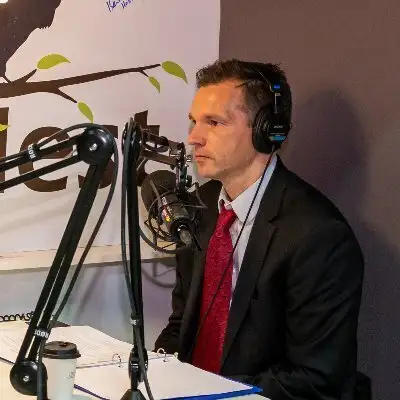
Welcome to From the Crows Nest. I'm your host, Ken Miller from the Association of Old Crows. We are here at AOC 2025 at the Gaylord Resort in National Harbor, Maryland. We will be coming to you every day with episodes, interviewing some of our keynote speakers, guests, and other exhibitors. We'll also be on social media throughout the week posting exhibitor showcases and other interviews with the attendees here walking the show floor. Looking forward to a great week. Of course.
For those of you not familiar with the AOC 2025, the theme for this year is charting a path to 2035, navigating the future of electromagnetic spectrum operations. And I am pleased for our first episode to have our opening keynote speaker, Ms. Lori Buckhout. She is the former Assistant National Cyber Director for Policy at the White House. We'll also be hearing from friend and colleague and editor of AOC's Journal of Electromagnetic Dominance, the JED.
John Knowles, he'll be joining me in a few minutes as well to talk a little bit about what message they expect to hear from the keynote speakers and the many sessions that we have going on this week. Without further ado, I would like to welcome my first guest for today's show, Ms. Buckout. Lori, it's great to have you back on From the Crow's Nest. Thanks for joining me. How's everything going? It's been about a year since we talked when I had you on the show last, and really appreciate you taking time to join me here.
Laurie Buckhout (01:36)
wow, yeah, it has been that long. know, ⁓ new administration, ⁓ new emphasis on technology, ⁓ on AI, on drones, on spectrum using capabilities. So ⁓ I think it's been a very interesting last year with
⁓ a new government here getting their hands around everything that's going on. So, you know, from the government point of view, from the global war fighting perspective of the AOC, I think it's been ⁓ a bit of a transformational year.
Ken Miller (02:10)
Yeah, and it takes new administrations at least a year or two to kind of get through that first cycle and certainly with has, I should say, as unstable as it sometimes is in Congress getting budgets through, can kind of throw off an administration plan. But you mentioned something, we talk a lot about some of these issues. We always feel like we're kind of on the precipice with greatness ahead. we're almost there. We're just missing a few.
key pieces leadership will get to as well. So I wanna talk a little bit about leadership. You mentioned it in your opening and it's gonna be a topic of your opening keynote remarks here shortly this morning. When you look at the ⁓ new administration over the last year, working with Congress, working with industry, we always feel like we're just on the edge of getting it. And yet we miss it, we miss out because we just missed that high level advocacy throughout
the Department of War and the administration, Congress and so forth. What can we do as a community or how, me phrase it, talk to us about leadership in your role. You've been a leader of our community for a couple decades now. What does leadership mean to you and why is it so important for our community to embrace leadership?
Laurie Buckhout (03:28)
You know, I think that ⁓ there needs to be a fearlessness ⁓ in advocating ⁓ for EMSO, for the EMS, and it needs to be warfighter driven. That's something I'm to talk about in my speech is that it's great to have the enablers, it's great to have the spectrum planners and stuff like that taking a part of this, and that's absolutely critical. But ⁓ we need to look at it as a life and death issue, because it really is.
⁓ in terms of combat, terms of spectrum denial, in terms of what can be done to Americans through hostile ⁓ use of the EMS. So that is kind of a life and death issue. It is a succeed or fail issue. So getting senior leaders who are in positions of tremendous responsibility to understand it is absolutely critical. And I think actually it's been kind of a good year for that. For better or for worse, the adversary I think is driven.
in terms of drone technologies, EMS technologies, ⁓ in terms of global ⁓ technological warfare advancements, I think that's driving a lot of senior leader notice. Now, they still don't know what they don't know, but they're curious about it. For the first time, I think in a long time, they're not defaulting to kinetics, because I think they're realizing, uh-oh, there's something else out there, and we're going to have to figure it out.
Ken Miller (04:50)
You mentioned how chaotic the world is getting out there. How are the shifting geopolitical alignments? When you look out at all the Russian-Ukraine war in the Middle East, obviously the administration has a campaign against Venezuela. You have the Indo-Paycom region. As the geopolitical security situation continually shifts, how important is it that our leadership grapple with some of these tough issues on EMSO and Spectrum?
dominance today, ⁓ we were talking a little bit that the clock is starting to run out a little bit. And how much more time do you see, do we have, kind of in the crystal ball, how important is it to tackle this leadership question upfront now before other issues?
Laurie Buckhout (05:39)
Well, I think
I've come to a realization after having done Spectrum for over 40 years, and ⁓ I think we're always going to be shooting a little bit behind the target, know, for better, for worse, and that's expectation management. So we're always going to be a little bit behind the target, but this is America, and we always somehow manage to ⁓ pull through. I'd like to be able to do it better. I think that ⁓ the Department of War is starting to get it.
There is a drone task force sort of thing being stood up. The Army has decided to invest very heavily in drone and unmanned capability and standing up a unit for that. I've heard something about an order of a million unmanned drones being ordered from the Department of War. might have been from the Army. And so I think they're starting to understand the idea of unmanned drone warfare, both in land, sea,
air and space. And of course, those of us in the crows know that they're all spectrum dependent. sooner or later, senior leaders are going to have to understand that it's the spectrum controlling these things and your dominance of the spectrum is going to enable you to use this technology that is sweeping across the globe. There's no going back. So I think we still might be shooting behind the target a little bit, but I think we're very much on the precipice of these leaders understanding that because it's
coupled with the technology that they want.
Ken Miller (07:08)
Exactly. you can see that coming out in the National Security Strategy that was just released. There is an undercurrent there.
One of the elements, ⁓ prior to your positions with the administration and the Department of War, you were in the private sector. You did a lot on the commercial side of the spectrum and discussing how we need to improve our spectrum awareness in terms of the commercial opportunities as well ⁓ and how we manage spectrum. So I want to ask, in terms of with commercial innovation in areas like 5G, 6G, we're hearing that a lot at shows these days.
AI, space-based sensing, all of these traditional programs, how can the US and our partners effectively integrate them from the commercial side into military capability? Because as you mentioned, if you're shifting to unmanned systems, drones, counter drone, order of magnitude and scaling that is a huge challenge. The commercial sector understands this, but...
The military sector, it's hard to scale to what you need. And so you're probably more so than many, you're aware you can see that shift happening. Talk to us a little bit about how challenging that is to bring in that type of expertise in from the commercial side into the military.
Laurie Buckhout (08:34)
Well, I think what is really exciting right now is the Department of War's relook at acquisition and how they're planning on streamlining it. Now, people have always said, we've been trying to change acquisition for, what, 30 years now, and nobody's ever really been able to do it. What I'm seeing now is a whole new approach. So, for instance, going from program managers to portfolio managers, one of the things they're going to be able to do is portfolio managers are going to be able to move money between programs. So if you've got a program
that's a dog and you want to get rid of it, they can defund a lot of it at their level and move the money into something else. Now, that's a big deal because ⁓ program managers are never paid to shut programs down. They get rated on how well a program succeeds. So a lot of them, though, turn out to be dead ends because technology has already gone ahead of where that program was supposed to end up, right? So it's become ⁓ irrelevant and...
know, defunct before you could even get it out on the manufacturing line. So program managers will push these dogs as long as they can because that's what they're told to do. Now, with the emphasis on spinning good things quickly and getting them out into the force, commercial ⁓ providers and vendors are going to be running into that space, given the best and the brightest. There's also, coming from the acquisition reform, they're looking at having, instead of
you know, cost, schedule, performance, they're looking at performance, schedule, cost. So let's get it out fast, or it might even be schedule, and no, let's get it out fast, let's get it out on timelines. Cost is not the most important factor. So if it costs a little more to get the right thing out there, that's okay. Plus, you're being incentivized to kill some of the programs that are not gonna get there fast enough, right? So honestly, I see that commercial ⁓ military nexus as coming like a train, and I love it.
Ken Miller (10:31)
Great. And I would imagine getting things in the field a little bit faster gets into the hands of the warfighter and gets their feedback in terms of what it can do in the field because operational relevance is something that you can only understand in a lab for so long. absolutely. you're out when the real fighting starts. Yeah. So how do we take that...
that the path that we're on in that front and team it with training and the personnel issues and challenges. Those are some other gaps that are also persistent. And if we're going to tackle training and there's some great training language in the National Defense Authorization Act coming up with a tier one, tier two training for MSO, how do we marry those two better so that we're training and helping programs with that iterative development?
Laurie Buckhout (11:22)
You know,
for better or for worse, ⁓ we can thank the potential adversaries and near-peer competitors for moving us into better performance. You know, that's just how it goes. So ⁓ drone warfare, unmanned capability warfare, exploding around the globe, and I mean that with a tongue in cheek a little bit because some of it is, exploding around the globe.
⁓ is driving us towards real-time training, for instance. And that's always been a challenge for electronic warfare and spectrum users, because nobody wants to disrupt the spectrum when you're doing a training event, because that's how you record your event, that's how the controllers talk about the event, everything else, the command and control it. So they never want to do real spectrum exercises out there. It's just too disruptive. Well, ⁓ I think they've seen now that you've got to have unmanned drones in the air during an exercise. You've got to have all sorts of
unmanned capabilities, spectrum using capabilities. You got to have your eyes in the sky. You got to bring in SATCOM. You've got to bring in space-based capabilities. And you can't do that without real-world training using the spectrum. if we're going to remain relevant against any adversary, and we have to, and we will, we're going to have to start bringing in real-world training, real-world exercises, and letting these young folks who grew up on iPhones and wireless capabilities get their hands on the stuff.
Ken Miller (12:44)
So in just a few minutes, you're going to be going up to stage. Congratulations on your AOC award, obviously well deserved. For the audience here today at AOC 2025, what's the walk away message that you want everybody to remember as they go throughout the week and go back to their jobs in terms of where our community is heading and what charge do you have for us today?
Laurie Buckhout (13:12)
I have a full court press on leadership, a full court press on educating senior leaders. We've talked about it forever. If I could give you a year that this needs to happen, this is the year. ⁓ Our near peer adversaries keep me awake at night in terms of their ability to command and control capabilities within the EMS ⁓ because their leaders get it. If you read anything about China and their understanding of the EMS, Russia, Ukraine.
Holy moly, they are all over it. ⁓ Middle East, ⁓ Africa, what's going on in Africa right now in terms of China? I have a son who has traveled throughout Cambodia and portions of the East ⁓ doing work, doing mission work. What he's seen over there in terms of how China's coming in and dominating these nations through a number of means, none of which are particularly friendly in my mind, ⁓ we need to wake up.
So I would say my big ⁓ plea to crows everywhere is that we need to be advocating to senior leaders to understand the EMS better. And I'm going to talk a little bit in my speech about that. The joint staff gets it. ⁓ The vice chairman of the joint staff, we were in a briefing a few months back, and he was very frustrated by the fact that we were talking about... ⁓
basic interoperability issues for blue comms instead of talking about how we're going to fight. His eyes roll back in his head and he slams the table and he goes, how come we're not talking about how we're going to fight? You guys figure out the interoperability stuff. I'm a war fighter. I want to know how we're going to fight in the spectrum. The hunger's growing. We need to strike while the iron is hot while technology is pushing the requirement for leaders to get it.
Ken Miller (15:00)
So one last question here before we kick off the show today. Before we came on the air, you revealed something very interesting about a hobby. I have to ask you about it because it's going to be a part of our show coming up in early 2026. We're actually doing a series on crows and comparing how they are in nature to how we are as warfighters.
We're looking for it. It's been a fun series put together and you just revealed something that I never knew about. One of your hobbies. You're a pro tamer. That's so fascinating. So please do tell us how this works. This is fun. ⁓
Laurie Buckhout (15:34)
I'm a crow tamer.
Crows
are easy to train, or they're probably saying the same thing about us, right? So ⁓ I started going out on my balcony. have an apartment up here in D.C., so I'd go out on my balcony and I would place like cashews out.
for the crows, I'd see them flying around. And I'd actually call out to them and say, hey, come and get some cashews. And they're very curious. So you sort of leverage that curiosity. And they're like, huh. And these are urban crows, you know? So they know there's food everywhere. So they're always on the lookout for it. So these urban crows come in. And so I close the door, the balcony door, so I'm behind it. And they see me. But they land quickly on my balcony, grab a cashew, take off. But the word gets around. They all talk to each other.
So ⁓ I started doing it now. I go out in the morning and they circle and they wait for me and then they come in. Now here's what's going to blow your mind. So on a weekend, I'd feed them in the morning, they would come in, they'd call for me in the morning to wake me up at dawn, right? Now weekdays I'm up anyway, weekends are calling for me. And so later on in the morning I'd go for a walk. ⁓ My apartment, walk around.
They're following me, hopping from tree to tree, calling at me like as I walk around the neighborhood in urban Arlington. It's mind-blowing.
Ken Miller (17:02)
They recognize you, they know when you're coming home and when you're leaving?
Laurie Buckhout (17:06)
recognized
faces. I mean, they are something else. Yeah, they are.
Ken Miller (17:11)
Crows are amazing birds, I just saw you did get a glimpse of our other mascot at AOC 2025, Zoe, the service dog. And listeners of our show know Zoe because I'm going to actually have Zoe on the show later this week because she's the best.
Laurie Buckhout (17:26)
Yeah,
yeah, she is she is and you know what she doesn't talk too much. I mean, you know
Ken Miller (17:30)
It's
a lot hard to keep the conversation going sometimes, especially on a podcast. Exactly. So, and for the listeners who don't know what we're talking about, who we're talking about, they're like, who is this person going to interview? I'm always looking forward to interviewing Zoe.
Laurie Buckhout (17:34)
Doesn't dominate though, that's nice.
Zoe, the
Black Lab Service dog, is sitting over there and she's just a sweetie pie.
Ken Miller (17:51)
So, well anyways, I promise I'd get you to stage to help us kick off AOC 2025. it's, Lori, it's been great to talk with you again. And hopefully it doesn't mean another year until we get to have you back on the show. But really appreciate you taking time to join me here this morning.
Laurie Buckhout (18:06)
So let me tell you what, if I in any way can come back with a tame live crow on my shoulder, I swear to God, it's gonna like make headlines. think maybe that's my goal. So I'm gonna get to.
Ken Miller (18:17)
We will hold you to it. Alright, sounds good. Hey, thank you very much.
Laurie Buckhout (18:21)
Thank you.
Ken Miller (18:27)
Welcome back. next guest for today's episode is editor in chief of AOC's Journal of Electromagnetic Dominance, John Knowles. John, thanks for joining me here on From the Crows Nests. It's great to have you back on the show.
John Knowles (18:39)
Thanks for having me on again, Ken.
Ken Miller (18:41)
It's
been a few months since I had you on the show. We have you on regularly to kind of give us an update on what you're looking at across the journal and across the market. You're here this week. AOC 2025 is kicking off. The theme is EW in 2035, building a roadmap across .mil.pf. What is your...
What are your thoughts on the theme for this show this week and what does it mean for MSO community to take a look at the problem across through the dot mil P.F. lens.
John Knowles (19:16)
I think it's a fantastic topic. I don't think we talk about .milpf enough. I think we talk very much about doctrine.
and organization and material and training and all the letters, right? But we don't talk about how they are interrelated and interdependent and how, know, when you beef up something like leadership or organization that has an effect across the rest of .mil.pf and how do you grow that together? And that's, think the biggest, thing is, we used to think of them as pillars, but they're really not. They're really like a matrix or a web of interconnecting initiatives.
And so looking at it that way is a very big step in how we think about ourselves. So traditionally, EW has been very material oriented and even the name, right, Electronic Warfare, our traditional name, was named for electronics, was named for a thing. You and I have talked about it before, but I'm always saying, air warfare is air warfare. It's not F-22 warfare. It's not fighter warfare. It's not about a thing. It's about operational responsibility for a domain.
And so when we made that shift from electronic warfare to electromagnetic warfare, we made a shift, a mental shift into a domain thinking and a dot mil PF EMS enterprise orientation. So that I think this is a great topic.
Ken Miller (20:34)
And one of the, related to dot mill PF, ⁓ one of the topics that I just had our opening keynote speaker on the show on the previous segment, Lori Buckow, we talked a little bit about how important leadership is. It seems to be one of the persistent gaps that we have not made enough progress in. If you look at how technology has evolved, you can find a lot of really good things, really good steps that were taken in getting programs into the field quickly or whatever.
but leadership still is lacking to where it needs to be. How can we better pay attention to and make progress on that gap, as you mentioned, without taking our eyes off of some of the other efforts that we're trying across .mil.pf to advance for MSO?
John Knowles (21:23)
So
it's interesting in the leadership question because we've typically topped out, most of our people are O6 colonels or Navy captains. And so they only go so far and they only have so much authority. We have a two-star that runs the Jack joint, the MSO center. ⁓ But that's only one piece of it. We've temporarily had two stars leading like the MSO CFT, General Landrum and others like that, but that's not a permanent assignment. And so we just don't get the audience or the resources. And when I say audience, mean the audience among the
in your leadership, they're just not, O6s don't go into those meetings, they're not at Corona or anything like that, they're not at those big meetings, and so that resourcing becomes very ad hoc, and even the leadership becomes ad hoc. ⁓ we have a big problem here, we're going to throw a two-star at it, you know, or whatever, not to make it sound like it's not important, but it doesn't have any permanence, and so you don't, you end up with very episodic.
⁓ advocacy and pressure to fill gaps and things like that. So it's not just a money thing. Again, it's a dot mill, you know, PF thing. And I just want to mention one last thing. When you talked about Lori, she started, got into our world in 2006 as the chief of the EW division for the Army headquarters when they stood that up. And she took a dot mill PF approach to it. She didn't just focus on material.
on everything in .milPF. So you started seeing the personnel get developed, started seeing organizations get created, things like that. Now that's changed over time as the cyber folks have kind of subsumed a lot of the EW responsibility and they've merged it under SEMA concepts. But she started out with .milPF too, so I think again going back to that idea that like you start with .milPF, that's the basis of the thinking.
Ken Miller (23:11)
And so in terms of the show starting off today, we have a ⁓ agenda lined up, a couple spotlight sessions, keynote. What are you specifically looking for today in terms of the messages that you're going to hear from the stage?
John Knowles (23:28)
I think the thing I've really got my ear out for is...
More than any other year for some reason, I'm thinking about the lessons that we're drawing out of current conflicts or operations. So certainly the Russo-Ukrainian War, the Red Sea, ⁓ the fight against the Houthi, very little to know yet still about what Israel, how they've operated against Hamas. those lessons, the thing that I see out there, especially you see it in Ukraine because it's such a well covered war,
pace that we operate at is changing. It's getting much, much faster. And I can't remember if we talked about this on our previous one, but I always think like, if you had asked me in 2020, what country is going to actually inject more influence and thinking into how we operate in EW? I don't think Ukraine would have been in the top third of my list. Not, certainly not at the top. But I look at how they've operated with just reaching into the commercial marketplace.
developing, they had practically no EWOs in 2014, really not many in 2022, and now they're fielding, like they got tens of thousands, huge number of EW operators, and they've scaled up, they've reached into the commercial toolbox, they pulled out SDRs, they bring those up to the front, those get reprogrammed at the front frequently, they're sustained at the front, maintained at the front, and they've pushed the pace of operations, the measure countermeasure game,
to a level that most countries think, I can't do that right now. So they've taught us all this amazing lesson that we've had the luxury of not having to experience firsthand, but I worry that we're not going to inject, I think an EW operator in the US or Europe or somewhere looks at that and says, we can't go that fast yet. We have got to figure out how to do that. And obviously if you got into a fight, necessity would build that in. ⁓
look at that and I'm listening for that on the show floor and in the exhibit hall of who's going faster in everything, reprogramming, all of it. Not just material, but like are you training personnel faster? What are you doing to increase the speed? How do you scale that up as well? And those are the things I'm really kind of, I don't think anyone's going to have a briefing on that, but I expect.
people to talk about that as sort of a ⁓ shaping type of situation where they're trying to figure out like how do we do everything faster.
Ken Miller (26:06)
So another activity happening tomorrow actually ⁓ from the Crow's Nest is not actually part of the regular agenda, but we're going to be doing a live show from the main stage in the afternoon. And the topic of the episode is going to be, a time for ⁓ us to establish an MSO force. And I will be joined by other guests, ⁓ Kevin Kennedy from MANTEC, former Lieutenant General, ⁓ Jeff Fisher, who many of our listeners will know,
⁓ as well as Scott Oliver, ⁓ member of the AOC board, but also ⁓ former ⁓ chief of staff of the MSO cross-functional team. We're going to be discussing this topic. Is it time to establish a force to answer some of these persistent gaps? ⁓ And if so, are the things we have to think about? ⁓ What is your take on this notion of is it time to establish a force?
As you mentioned earlier in your question, thinking about it from a domain responsibility perspective takes you into a different direction of how MSO should look versus how we deal with it today. So I'm curious about your thoughts on that question.
John Knowles (27:19)
So I love this topic. You and I talked about this briefly last year.
I was starting to think about it back in the November, December time frame. Had no way of figuring out how to get that into Jed in any way that I felt was a good campaign or way to think about it. And it literally is a question. I don't know the answers to it, but I think we're getting better at asking the questions that are important. I think the biggest question where I started with back last year was, what would we do better and what would we do worse if we had a service? What do you gain and what
do you lose? It's a trade-off. ⁓ the more I ask that question, the more I start, really it starts in my mind stacking up to what will we do better? That pile gets bigger than the what will we do worst pile. And I think about training, I think about reprogramming, I think about having some more centrality in those types of things. And I look at the Space Force interestingly because I think when they created the Space Force, it wasn't like they just subsumed everything
related to space and grabbed it all and said it's all ours because the Army has its own space activity that they really haven't brought over to the Space Force. I think the Space Force is quite happy about that. But you don't have to grab everything, I guess is my point. So maybe you grab the things that you could do better. Right. So maybe you start off there. I think it's going to be very hard after 80 years to break out of the service paradigm of EW supporting all the services. But I come down to, and again, we talked about this last year, if you're the
Air Force or the Army, you've got your major concept of operation, whether it's multi-domain ops or expeditionary advanced base operations for the Marine Corps, distributed maritime ops for the Navy, Air Force has ACE. So they all have their sort of capstone concepts, and EW and EMSO fit into those in kind of a vertical, right? But if I'm a COCOM, I need to stitch.
the EW, the MSO piece of each of those together myself in theater, right? I need to make that a joint MSO force. That load is on the co-com. So it's funny, if you ask the question to the services, which is where a lot of our EW people are, they're like, ah, it's a terrible idea, I think. I wouldn't want to do that because I'd lose this or I can't do that, you know, that one little thing. But if you ask the co-coms, I think they would probably ask, you know?
That would be really helpful because I'm struggling to populate my gem so cells, literally with people. But I also don't have anybody coming in with a concept for Europe or for any of the areas of responsibility, geographically. I have to start that from scratch. I may have some plans, but I don't have a standing force to rely on to bring capabilities in.
and use them in ways that the army and the Navy, if they're going to work together on a joint EW effect or something like that, that has to be done by the co-com and it really should be done by a service. So the more that I think about this, I've been thinking about it for a year and I don't have all the answers. I'm still asking questions, but I think it's a really good question to ask because I think the time is right. And if there were ever a country that were bold enough and needed to do it, I would look at Ukraine and say, you know what?
These guys are, know, but I can see this in Europe. don't, I just, I'm waiting for that first country to make that move that yes, that we are going to get out of this stove-piped paradigm of MSO getting partitioned across multiple services and concepts and get into a cross-cutting capability like cyber's trying to do right now, but space does this well. So when look at the 21st century domains, space, cyber, and MSO, EMS.
I think about that and I think, yes, we are the missing tooth in that three, those three that are going to reach across all the other domains. So I really, I'm a big advocate for really exploring this.
Ken Miller (31:24)
I think it'll be a fun conversation. Looking forward to it again. None of the guests, it's not about taking sides at this point, but we really do have to have that conversation of peeling back those layers and understanding, because the last thing you want to do is spend too much energy talking about something that is unachievable because you haven't really looked at it closely enough. So it'll be a good conversation. Maybe it'll contribute down the road to more pieces in Jed, but ⁓ I hope so. I think it's an important conversation. Well, you're going to be joining me each day here
at AOC 2025 to ⁓ give your thoughts and what you're hearing in terms of some of the speakers and sessions. So I really do appreciate you taking time to join me here on day one. ⁓ And I look forward to seeing you back here tomorrow morning. All right. Thank you. Take care. That will conclude this episode of From the Crow's Nest. I'd like to thank my guests, Ms. Lori Buckhout and John Knowles for joining me. We will be back tomorrow when I sit down with Congressman Don Bacon.
our keynote speaker for day two of AOC 2025. As always, please take a moment to review, share, and subscribe to the podcast. We always enjoy hearing from our listeners, so please take a moment and let us know how we're doing. Also, please don't forget to follow us on social media this week. We will be posting interviews as well as exhibitor showcases to our Instagram and YouTube and LinkedIn accounts, so you can catch up on all the activity here at AOC 2025 on social media. That's it for today.
Thanks for listening.