Subscribe
Share
Share
Embed
Featuring interviews, analysis, and discussions covering leading issues of the day related to electromagnetic spectrum operations (EMSO). Topics include current events and news worldwide, US Congress and the annual defense budget, and military news from the US and allied countries. We also bring you closer to Association of Old Crow events and provide a forum to dive deeper into policy issues impacting our community.
Dr. Thomas Withington (00:02)
We've got a situation at the moment in Europe where we've got France, Germany, the UK and I think possibly the Netherlands as well, although I'm not entirely sure about the fourth one, all of whom have got a land electronic warfare manoeuvre force requirement. So they need a new land EW capability and each country is developing that by itself.
Ken Miller (00:24)
you
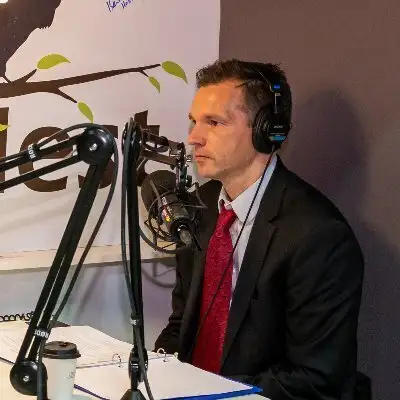
Welcome to From the Crow's Nest. I'm your host, Ken Miller from the Association of Old Crows. As always, it's great to be here with you. And we are here coming to you from AOC Europe 2026 in Helsinki, Finland. We have been here throughout the week. It's been a phenomenal show. We are currently on day three. When this episode airs, it'll be the week after AOC Europe ends. But we wanted to take a moment to bring you a little bit of the discussion of some of the great topics that were...
discussing here at AOC Europe 2026. And I am pleased to have with me annual guest of our AOC Europe show, Tom Withington. Dr. Tom Withington is an award-winning analyst and writer specializing in electronic warfare, radar, and military communications. He has written widely on these subjects for a range of specialists and general publications. He also works as a consultant and advisor in these areas for several leading government
and private sector organizations. many of you know, Tom is a friend of From the Crow's Nest and we exchange ⁓ guest appearances here on occasion. So Tom, it's great to have you on the show.
Dr. Thomas Withington (01:43)
Thanks very much, Kel. It's great to be here and great to be talking to you.
Ken Miller (01:46)
And also with Tom is another one of our special guests for this week. Alastair Gilchrist goes by Gilley. He joined the Royal Navy in 1977 and went on to serve for 28 years. He is a veteran of the 1982 Falklands conflict and he was awarded the MBE in 2005 in recognition of his contributions to the Royal Navy's electromagnetic warfare, intelligence and service charities.
Gilly, it's great to have you on the show. Thanks for joining me on From the Crow's Nest.
Alasdair Gilchrist (02:19)
X-Can, wonderful to be here. Looking forward to our broadcast. Thank you.
Ken Miller (02:23)
So I want to start with Gilly. We met just a couple of weeks ago over email. You had a feature article in the April edition of the Journal of Electromagnetic Dominance talking about smart kill as a new electromagnetic warfare paradigm. That kind of springboarded you in here to AOC Europe 2026 to talk a little bit. And you chaired a session on yesterday on the first main day of the symposium. Could you kind of...
introduce yourself to the audience a little bit. Could you tell us a little bit about your path to chairing the session yesterday and the article on Smartco and what kind of message you brought to the audience?
Alasdair Gilchrist (03:04)
Okay, my pleasure, Ken. So I've been, next year I've been involved with the EW for half a century from the age of 16. So it's a long journey, but some ups and downs. As you mentioned in my introduction, I was in the Falcoms conflict, due to EM fratricide and lack of decoy effectiveness and EWC2 on the HMS Sheffield, the first warship since 1982 to be served by an Argentine X-set missile. And since then I've been in a number of jobs.
in the Navy, awarded by, as you mentioned, an MBU, which is a national award from the Majesty of the Queen for services to VW. Introducing new decoys into the fleet is the reason for that. Then I spent nearly 20 years in Defense Science Technic Laboratory, which is the science arm with NOD, and spent a lot of time introducing new technologies, new technology demonstrators to the Royal Navy and to NATO.
where I also chaired the NATO EW policy and doctrine group, Healthright Doctrine and Policy. And then the last few years, I've been doing my own consultancy. And so I got to the stage where I thought, right, enough is enough. Soft kill is not a term that's been accepted by NATO for whatever reason, I won't go into detail. So I came up with the acronym and concept of smart kill. So smart kill basically is spectrum measures against RF threats.
Behind us in the hall here is hundreds and hundreds of exhibitors, and each one of them is doing some part of spectrum. That's what I think needed a golden thread to pull it all together, because what's happening in reality is we're spending a lot of our procurement dollars on exquisite, hard-kill systems, which, for example, when you're up against plastic drones, is it good economics of war to fire Patriots and Sea Viper missiles?
at these plastic drones. Yes, you get credit for hitting them, but the economics of war are not good. A good example of that is a well-named destroyer emptied its magazine against Hooty rebels a couple of years ago in about two days. I had to go all the way back to Gibraltar to replenish. So this afternoon I'll be briefing the smart kill concept. So from soft kill to smart kill was the article in Jedd. I've had a great response and it's been...
well received and hopefully it will be taken forward as a concept in a term to pull a golden thread through ESM, EPM and ECM, the traditional measures which are really the core of tactical EW systems to provide EMS superiority, which is the theme of the conference. So rearming for Europe for ⁓ superiority, SmartKill fits nicely in there. And what I'm trying to do is pull that golden thread through all those systems.
and all the software and the hardware, and also create a term that you can brief politicians, can brief peculiar people, that is common sense. Because if we keep doing the definition of insanity is to keep doing the same thing. And quite frankly, I'm fed up with it. Hence why I'm trying to change that paradigm.
Ken Miller (06:18)
That's interesting to hear, especially with your background, because you mentioned at the beginning that you ran into issues with the Amfetra side and your military experience. And, you know, here we are 2026, about 40 years later, and we're still dealing with the same issues. And I think it's really important that we talk about that golden thread and the theme of AOC Europe. You mentioned rearming Europe for spectrum superiority.
We're rearming, but in the process, we're actually still learning lessons we did decades ago. So we're rearming, but we still haven't even learned the lessons from the first time. So it puts us in an interesting tension in terms of where Europe is going, the market is exploding. mean, there's so many different plans across Europe to invest in this capability. What I found interesting about the Smart Kill article was it seems to be a new framework for
an existing problem that has gone through so many different iterations and so forth. But your framework is essentially almost like an effects-based operations approach, it seems. Could you talk a little bit about how, because that concept's been around for at least 20 years or 20, 30 years as well. So how has the evolution of effects-based operations kind of mirrored the evolution of EMSO?
to the point now where we're like, this is the right framework to think about this emerging capability.
Alasdair Gilchrist (07:47)
Yeah, great question. think of the, we've got the, we've got the OODA loop for, you know, orient, observe, decide, act. We also have threat evaluation, rep and assignment, T-RERF, and we also have the kill chain. So the kill chain is the thing that really smart kill is trying to bring the timelines down. Yeah, because the kill chain, in my opinion, is too long. Okay. So you've got the find and fix. You've got the evaluate. That's your ESM sensors.
reprogramming way too slow, very costly in terms of manpower or people power and the cost of great big data centers getting libraries out to the fleet and reprogramming. That needs to change. So Spark Hill, there's one part of your thread. Then you've got the pace of time of evaluation. We need decision aids to support the commander to make it work. We've proven in my job at DSTL that
cognitive ability of the commander when he gets multiple threats from multiple directions can often lead to the wrong decision being made for the effector to be launched, whether it be a decoy, a missile, a jammer, that cognitive ability leads to the conclusion that cognitive EW, which is going to be talked about in South German and Dr. Karen Haidt here in Helsinki, is really important. And then finally, we want to be looking at the sort of effect in terms of the economics of war.
If the treasury is going to be all over us on each of our countries, well, how effective are these things? The economics of war needs to be talked about and please, it is being talked about at this conference because Smart Kill then ties in that strand and says, actually, you know, we've got a decoy, we've got a jammer, we've got a disruptive capability, deceptive capability, confusion capability into these enemies C2 nodes, into their ground control stations for drones, for example, that actually costs
X dollars, a Patriot missile at three million dollars where you just empty the whole lot against a drone swarm. Because guess what? The threat is tens of thousands of drones and mixed in with things like anti-ship missiles. So we can't keep doing the same thing. Hence why Smart Kill is trying to pull those three strands together in the kill chain, which most people will understand, especially the US audience, because that's where they came from, the kill chain.
So that's what Smart Kill is trying to do in terms of reducing time and cost effectiveness of the kill chain.
Ken Miller (10:17)
We talk a lot and you mentioned the cost consideration of an exchange where you have relatively cheap over-the-counter drones versus very expensive Patriot interceptors and so forth. But the other aspect of that imbalance is also the fact that we, US allies, Europe, we have to be perfect in our response, whereas the aggressors don't necessarily have to be.
If they launch a lot of drones, 100, 200, 300 drones, and they mostly get intercepted, okay, but if one just one gets through, it could be devastating. Whereas on our end, we have to have been near perfect in our response and that actually increases the cost of every activity that you do. And you even mentioned the ship that emptied out its magazine and had to go back and rearm.
the fuel costs and the time and the labor, all of that builds up. It's not just the unit price of the missile. So there's a lot of cost involved in this. And this is one of the things when we talk about it to our leaders in the US, we're always mentioning that EMSO is dealing with the fundamental force of the universe. So if you're looking to keep, to really get the most efficient war fighting capability out there, you might as well start with how the universe works because it's...
probably going to give you the best insight into how to get that advantage in the battle space. I want to bring in a friend, Tom Withington here for a second. Tom, it's always great to see you here at AOC Europe. Once again, you are going to be closing out the symposium, I guess, this week ⁓ with a chairing a session, how Russia lost the war in the spectrum and what would a Ukrainian electromagnetic victory look like?
And you have a great lineup. We usually have Duncan McCrory here on the on the show with us. I'm certainly going to have him on again. But you know, due to limited time, we only have you today. But you have a great panel set up. Tell us a little bit about the message that you're going to talk about because today's topics on day two of AOC Europe, there's a lot there's a lot of focus on what's going on in Ukraine, as is the conversation throughout the week. So
What message do you kind of want to wrap up for the show, for the attendees this week?
Dr. Thomas Withington (12:41)
Well, Ken, it's great to be here as always, and thank you very much for the invitation. I think one of the key messages for what I'm hoping from the panel this afternoon is ⁓ I chose a deliberately provocative title because I think it is absolutely possible for Ukraine to win the war in the spectrum. I think Ukraine in many senses currently is. And I think the reason for that is actually echoing back
to many of the things Gili mentioned just now. It's because of an ability to, first of all, see the spectrum as a maneuver environment. So I'll deliberately refrain from using the word domain. I'll call it an environment as it links all of the other domains together. And within that, it's the ability that the Ukrainians have illustrated of being able to be imaginative in terms of the electromagnetic capabilities they've got.
which remember numerically is always going to be, well, for a long time, it's been less than what the Russians could field. So with that in mind, you have to think, well, how do we become imaginative? How do we do things differently? And as Gili mentioned just now, this idea of, you want to engage a relatively inexpensive asset with a very expensive effect? And that's one of the things I think the Ukrainians have really embraced. And they've pulled that into their doctrine and they've pulled that into their war fighting.
So I think a key message that I want to get across is that, firstly, the Russians, ⁓ they're not 10 feet tall, but equally, we should not be complacent and think if we are in a war with the Russian armed forces, that this is just going to be a walkover. But if we are in a conflict, then mastery of the spectrum and the capture and sustainment of, first of all, electromagnetic superiority and then supremacy.
is going to be absolutely intrinsic to that. And part of that capture is going to be through concepts like Smart Kill. So we've been very lucky, I think, over the past couple of days that we've got the tools. We talk about capability a lot. So there's a lot of equipment out there. There's a lot of equipment out there. But it's bringing everything together. And that's what I mean by capabilities. The equipment is the training. It's the people. It's the thinking. It's realizing that ⁓
electromagnetic maneuvers is obviously part and parcel of something much bigger, but it's an integral part. So I mean, there's a lot of things to talk about there, but that's the key message I'm trying to get across is that we have a lot of capabilities that we can marshal to ensure that we win and sustain E2S because that will be the crucial thing.
Ken Miller (15:25)
Now, over the last 10 years, the conversation has really shifted from, is Europe going to pay a quote unquote fair share of NATO and other international partnerships and so forth? And now, when you look at where Europe is, think NATO is arguably stronger in many ways, but the European defense market is really taking off because they see the opportunity, especially due to the war in Ukraine. From a European defense in
Industrial based perspective, Tom, how has the conversation shifted in terms of defense industry being in a better position in the European market to address some of the shortfalls and some of the opportunities that arise more quickly than maybe 10, 15 years ago when, you know, maybe Russia initially invaded Crimea or a couple of decades ago?
Dr. Thomas Withington (16:21)
So firstly, one of the observations I've made, particularly over the last couple of years, as we've seen defense spending increase and pledges to increase defense spending emerge around the continent, is that it's astonishing how much money there is and how little money there is. In many ways, we're still in a situation where we're having to count every cent, every pence, every dollar, and I think that will remain.
I think the key thing from the industrial perspective as we move forward is certainly on the continent where we can, need to avoid, firstly, we need to avoid duplication is a key thing. I'll give you one example. We've got a situation at the moment in Europe where we've got France, Germany, the UK, and I think possibly the Netherlands as well, although I'm not entirely sure about the fourth one, all of whom have got a land electronic warfare maneuver force requirement. So they need a new land.
EW capability and each country is developing that by itself and spending to get that capability by itself. So we have already four examples of duplication. Now, obviously in the EW world, one of the things we have to be very, very cognizant of is classification issues. know, understandable reasons we don't like sharing threat libraries necessarily. We're very careful about what intelligence we share.
But if you look at things from a hardware perspective now, most of the hardware that's out there, it is possible to be collaborative regarding that hardware. So where I'm going with this is, for example, one the I would like to see is a common European land EW system that has a high degree of modularity, that has a high degree of open software architecture on it, that countries can then buy that capability and spin on all of the confidential and classified stuff that they need to.
Because it's not just about spending money, it's about spending money wisely. I've said this in interviews before that actually they'll, and you guys will have this in the States as well, actually fundamentally there's never enough money. Even if you've got trillion dollar defense budgets, there's never enough money because there's always something you need. So over here at the industrial level, it's not just about spending the cash, but it's about spending it smartly and working out where you can work together and using that as a driver to ensure that your
your pounds, shillings, pens, cents and dollars go as far as they can do. It's taxpayers cash at the end of the day and they do deserve the good value for money from that perspective.
Ken Miller (18:52)
I 100 % agree with that. think when we talk about the cost of it, one of the cost drivers that we see, especially in the US, is making sure that the systems that we try to field are interoperable with other systems and integrated well. And a lot of times, electromagnetic spectrum operations capabilities are kind of thought of too late in the game. And so when the system is brought into theater, we turn on that we start to realize some operational relevance issues.
that we didn't realize in the lab because we just didn't integrate it fully. We didn't have a great framework. Keeping with the smart EW framework, Gilead, you're going to be speaking on later today. With this, we've always often said here on the show, know, obviously, MSO is inherently joint. It's a cross domain. It's also inherently interoperable. When you look at ⁓ allied operations, there are some tremendously...
game-changing niche capabilities coming out of many different European countries that could work amazing with US technology and vice versa, but it is inherently joint, inherently interoperable. How do those concepts influence the effectiveness of the smart EW effects-based operations framework that you're advancing?
Alasdair Gilchrist (20:12)
That's a great question and one I'm very happy to answer because in my session that I chaired yesterday, we had the technology developments in EW techniques and systems. I three eminently brilliant speakers, two from Finland and one from UK. And all three talked about different sort of angles of interoperability with using, know, distributed sensors, jamming without fracticide.
and things like that, and also sort of generic ESM wide-based and wide-band sensors. So to be interoperable, you need in terms of NATO, you need at the beginning to start thinking about how are you going to do that? Very simple. Put the question down, get a requirement, and then you come up with solutions. And guess what? NATO has solutions for the EWM cell community. I'll give you two examples. SESMO, for Operative ESM Operations.
Stanag 465A. My team, when I was at DSTL, we actually designed and developed that over many years. What does it do? It enables a US sensor to talk to any European sensor. But guess what? What's the nation that doesn't fit it in anything apart from one aircraft? The US. 75 % of NATO is funded and operated by the US. Why? Because we get bogged down in things that Tom mentioned about.
over classification of threat libraries, ⁓ you know, protection of data. I understand that, but SESMO is about saving lives. I've got a threat on a sensor, right? It's a SAM, it's an aircraft, it's a missile coming in. I just need to give it a, guys, heads up, this is Barry, two four zero, you know, 20 miles inbound. Get it on the SESMO network. We tried this many, many times in unified vision trials up in Norway. It works.
all nations and there's nations that have built it into their systems in Europe, but not enough of them. So we need to learn those lessons. ⁓ As Einstein said, know, the sort of paradigm of insanity is to keep doing the same mistakes and we're doing that. That's what Smart Kill framework, the Smart Kill concept is designed to overcome. The other one is when you're planning an operational aggression, yet you need an electronic order of battle baseline, EOB. Okay. Guess what? My team, NATO.
that I helped with great people like Eric Banford. We designed the common year B-former, Stanang 6565. US agreed, everybody signed up to it, every nation signed up for it. How many nations have actually built that into their systems so that we can plan what does the ground forces look like in terms of the electromagnetic order of battle? How many nations have actually fitted that into the systems or put it as a requirement? Hardly any. It's like...
In football terms, it's, let's just score some own goals. We are not doing the right thing to protect our saving soldiers in there for ever. So interoperability is a nice thing to talk about, but until people change the mindset, change the culture, change the procurement activity, we will keep doing the same mistakes. And that is what Smart Kill and the Smart Kill concept is all about. Trying to really question right from the procurement right to the effects of the liberal.
Ken Miller (23:32)
So a follow up question for both of you. In keeping with this line of discussion about interoperability and better coordination, the AOC is pushing a policy here in the US to create a combat support agency for EMSO, which is basically going to be a more centralized agency because we're so disaggregated across DOD ⁓ offices, military services, specialty squadrons, everything. Everything is disaggregated.
And so when we're trying to make an adjustment to integrate a system, to test something, to test a new capability, we oftentimes don't know who to talk to, where the funding is coming from. And then you throw that into an international or a coalition-based operation and you run into, I'm sure from a European perspective, and I'd like to hear a little bit more about it from both of you, is obviously we have the European countries involved, but could you talk a little bit about how EMSO is disaggregated or
disorganized in any way that needs more reform because if we can't figure out how to consolidate and centralize and kind of simplify a little bit of the interaction and the collaboration across allied countries, I fear that we're not gonna be able to make some of these necessary changes that we need to make, the gaps that we finally need to close on this. So.
Talk to me a little bit about the organizational challenges of them so in Europe and how they compare to the US.
Alasdair Gilchrist (25:00)
So in terms of strategy down to policy and doctrine, so the EMS strategy that NATO and all the nations have agreed to is a great document. It's unclassified and sets the strategy out of how EMSO should be governed from a ⁓ mill pole, military policy, policy directive. So that gives you the strategy. You then go down into doctrinal documents that...
emphasize the EMB, the electromagnetic battle stuff. And again, all the nations have signed up for that. How many actually do it is difficult to achieve because we're so disaggregated. so, you know, we need spectrum managers working alongside EW operators in the C2 sense to do EMBM, so electromagnetic battle management. Again, we've got some good doctrine and coming through on that.
terms of what NATO are doing with their EMO policy, Electromagnetic Operations Policy and Doctrine. So they're writing as we speak at Allied Joint Convocations to help the operational commander understand what they need to do to set up the electromagnetic battle staff, which will sit right in the heart of the Joint Operations Center and to support joint operations. So at the lower level on that, then you've got your component commanders.
that have things like EWCCs or CWOCs, Cigant and EWOP centers, or Electronic Warfare Coordination Centres. They might be actually small cells that support the joint, know, bigger picture in the EMB staff. What we need though is nations to actually allocate funding to those positions because those positions exist, for example, in the land component commander and maritime component commander HQs, but we sort of lose in between national regions.
priorities and costs of billets and there's a whole raft of reasons why those billets never get filled. But if we don't fill them and we don't train as we fight, then it MSO and MSO ⁓ maneuver ain't going to happen. So the challenge is to read, educate, learn the doctrine, the strategies, the policies, as well as all this great technology and marry the two together. Again, it goes back to the golden thread. We need to start pulling the golden thread and speak the language.
that those people who make decisions about people paying for billets, then nothing will change. But you've got to make it bit more clearer, plain language, to get the move that we need to facilitate what you just described to achieve a metromy, a superiority on that.
Ken Miller (27:41)
Tom.
Dr. Thomas Withington (27:42)
think one of the things also to think about here is that at the moment, certainly in Europe, we've got, let's say, three different super national organizations that in some form, some shape or form, own the MSO mission. there's obviously NATO, there's ⁓ the sub-organizations within NATO that are responsible for EW policy and responsible for drafting doctrine as Gili just mentioned.
Then we've got the emergence of this thing called the Coalition of the Willing, which is a group of nations that are supplying into Ukraine, but also looking at their own degree of defense synergy, if you like. So how can they fight together? And there are EW efforts that are happening at that to harmonize that across those nations. And then you've got the European Union, you've got things like the European Defense Agency that's got an emerging EW posture. So you've got three different organizations on the continent.
that are looking at this mission and claiming ownership of it in some shape or form. What there needs to be is, from my perspective, is an unclassified synergy between those three organizations. So that when we're using terminology, for instance, we're using the same terminology. We understand what that means. One of the problems I've noticed in the past when I've done work on doctrine is you've got AJP 3.6 NATO EW doctrine, the foundation document.
which I think is classified, isn't it, Gili? ⁓ That's unclassed, it? Okay. And so you've got that document. then notionally, every NATO member interprets that and drafts their doctrine according to it. But it's like anything. Any document you read, will be interpreted in subtly different ways. Now it may not seem much, but in the heat of battle, that can become a real issue. If you've got a Norwegian comment unit that
uses slightly different terminology or sees the electromagnetic battle in a slightly different way from their Portuguese com jam counterparts. So we need to also be thinking about, as well as policy, the terminology we use and what that means. And how do, if we've got three stakeholders who are claiming ownership of the mission in some way, well, do they understand each other? Are they speaking the same language effectively? It sounds like quite boring sort of
bureaucratic prosaic stuff. But for me, it's quite important. It is something that does keep me preoccupied, would say.
Ken Miller (30:10)
So as we reach the end of our time, just one of the challenges of these events is when the event is over and we leave the halls of the symposium or discussion, what is the next step, the next actions that we need to carry on? We use our events here to kind of give our community the momentum when they go back. So from your perspective, what are some of the next steps you're looking for in your areas of expertise and your what?
from where you're watching, what are some of the next steps you're looking for for the coalition itself, whether, however you define it, NATO within Europe or US, what are some of the next steps that you're looking for to let us know that we're on the right path?
Alasdair Gilchrist (30:56)
Yeah, that's a great question. So I think ⁓ all efforts in the strands of procurement and the strands of acceptance of doctrine, but also as an education piece. So this is why I think, you know, podcast site is a great, because if we can hit a wider audience as possible using all modern media math methods, you know, in an unclassified forum, like, you know, a podcast, for example, or like Tom does newsletters, you know,
We've got to get that message out, but we, the, the, if you like, the communicators, the subject matter experts, we've got to sort of get our heads out and start speaking plain language to people. think one of the biggest audiences we need to do is way outside this conference center is to, cause you know, if I had a pound for every sound, somebody said to me, look at you, what is EW? And then five minutes later they go.
You can see their eyes are glazed over because you've hit them with 15 acronyms. It's funny, I was speaking to somebody in a bar last night. Here's a little story. It said, she's brought a TW. What's this conference, this AOC conference in Alesley. We see these signs all over the place. She was just a barista. And I said, is that your phone on the side there? She said, yeah, that's my smartphone. I went, ah, smartphone. She said, you know what? Do you know how that works? She went, oh, I just turn it on.
I said imagine turning that on and you receive nothing. ⁓ right. Would that affect your life? Yeah, massively. That's CW. There it is, I enough shut. That's the message we need to get out in that plain simple language.
Ken Miller (32:35)
Yeah, and it does touch all of our lives in so many ways that it's almost a blessing and a curse in that way because it's so ubiquitous that people, like you said, take it for granted because it's just everywhere and we don't have to think about it. So it's a challenge, but we are able to do a better job of talking about it. Tom, did you want to share anything?
Dr. Thomas Withington (32:57)
Well, all I would say with this event, think is that what it's been excellent at doing in Europe and what it continues to be excellent in doing is it started a conversation that can't be stopped for exactly the reasons that Gili just mentioned. We all absolutely depend on the spectrum. if you talk to people about that dependence who are outside the kind of EW community, they do get it. And by them getting it,
that's how you get the momentum for what we all of us around this table would like to see, you that influences the discussion. events like this become very, very valuable for that. mean, later on I will be doing, I've got two media interviews lined up on GNSS jamming, so GPS disruption. And that's in part because of the work that organizations like the Crows have done, because it's propelled these discussions into the mainstream. So for me, that's really important.
Ken Miller (33:55)
Well, gentlemen, it's been great talking with you here at AOC Europe 2026. Always a pleasure to have you both on the show. Hope to have you back on again very soon, but I do appreciate you taking time here on day three to join me on From the Crows Nest.
Dr. Thomas Withington (34:09)
Not at all Ken, a real pleasure, thank you so much.
Alasdair Gilchrist (34:12)
My pleasure, thank you.
Ken Miller (34:13)
And when we return, we turn our attention to industry perspective on the discussions here. And I am pleased to have with me ⁓ Gabriella Bellotto from Keysight Technologies.
Welcome back to From the Crow's Nest here at AOC Europe 2026. We just heard from Tom Withington and Alistair Gilchrist, who are two key figures in one half of the event, the symposium section. But the other part of the show, of course, is the industry participation that takes place here at AOC Europe. And I wanted to take a moment to talk a little bit about...
all the discussions that we're having here this week from an industry perspective. And to help me with that, I'm pleased to have here on the show friend and colleague from Keysight Technologies, Gabby Bellotto. She is the business development and marketing manager at Keysight. And one of the values of attending AOC, whether it's in the US or here at Europe, is always getting a chance to hang out with Keysight and Gabby. And so I appreciate your support for From the Crow's Nest, as well as just ⁓
you know, being great industry partners for us. So welcome to welcome to the show.
Gabby Bailado (35:28)
Yeah, thanks, Ken. I'm happy to be here. It's always great to catch up with you and be part of the AOC. I love what you guys are doing. And yeah, thanks for having me.
Ken Miller (35:39)
Helsinki is a beautiful city. It's been a wonderful week. Every time we meet for AOC Europe, there's always... Is there an ABA tribute here in Helsinki this year? Because they seem to follow us at each of our... seems to... I haven't found one yet.
Gabby Bailado (35:51)
follow us.
I have not, I have not, but maybe karaoke Abba later, I don't know. So we can least bring the theme. ⁓
Ken Miller (36:01)
Hey,
hey, it's the last day of the show. I think ⁓ a team karaoke experience would be well worth it. So how has the week been for you from an industry perspective? This is obviously probably the fourth or fifth straight year that this event has just gone kind of off the charts in attendance, a lot higher participation. Talk to us a little bit about your experience here this week in terms of the attendee experience and the exhibitor experience.
Gabby Bailado (36:30)
I've been attending for almost 10 years, I would say, and it's been incredible to see the growth, like you said, over the last just two or three years. ⁓ I remember when the booths were smaller, the floor space was smaller, right? And now it's just grown phenomenally large. And we're starting to see really exciting new companies emerging. And I think that has to do a lot with, you know, everyone is modernizing their capabilities.
one needs new technologies, right? We keep hearing this idea of scaling and modernization and what it's doing is it's enabling some of these new defense companies, right? Coming out of different countries and new software companies all emerging to help this revolution of how do we modernize quicker? How do we get capabilities into the hands or into the fleets quicker, right? And so it...
it's really cool to see all these new companies and AI is taking place and just, I keep hearing software, software, software, right? And I think that's what's enabling this change. And so from an industry perspective, there's a huge demand to have open, flexible, scalable architectures. And I think that is what is driving these exciting new companies and allowing for some new players here. So from an industry perspective, it's pretty exciting.
Ken Miller (37:53)
I want to touch on what you had just talked about in terms of the scaling. I think that when we talk about scaling, we oftentimes, our mind goes from just simply bigger to smaller, or sometimes smaller to bigger, depending on what the thread is. But it's very kind of one dimensional in that regard. when you're dealing with MSO technology, it's much more layered. And when you start to scale and you start to peel back those layers of scaling,
From Keysight is of course a leader in testing and measurement technologies. From Keysight's perspective, how has scaling really kind of taken over or become a really central aspect of how you test emerging EW solutions?
Gabby Bailado (38:39)
So, Kisei is a test and measurement provider, not only in defense, but also across commercial technology. earlier, Gilly was talking about a cell phone, right? And we help our customers test cell phones, but the great part is we're a commercial company and having that commerciality in tests ⁓ enables the ability to scale and quicker, right? So, if you think about it, the threats are evolving
you know, one day you may need to test the platform and the next day you're testing swarms of drones and then you're now going to have to test next gen, right? And so the scalability has to do with not only just growing larger, but also the flexibility, right? The requirements are going to change and being able to have that flexibility from a small scale to large scale type of test is extremely important. And so, you know, that's really the test aspect of it. And then being able
to scale I think is important from an industry perspective providing, you know, the military's the ability to do that and not locking into, you know, one platform, right, or one capability. And that really goes back to this idea of open architectures and software defined ⁓ architectures as well. I think the term that I heard earlier this week was software defined defense, right? And so it really hits on, you know, maybe not just having a block.
black box anymore. We need to have modularity ⁓ in how we're providing these capabilities. so ⁓ test plays a huge role in that. But I think it's a theme across the industry that everyone needs to start adopting.
Ken Miller (40:21)
When we have the AOC US show, is usually in December, it'll be in December later this year, ⁓ between Europe in May and US in December, you kind of get a good view of the defense market, at least from North America and obviously Western Europe and so forth. But we're seeing the defense markets around the world really take off as...
people are starting to understand the value of electronic warfare, electromagnetic spectrum operations. From the conversations that you're having on the exempt floor here at AOC Europe, talk a little bit about from an industry perspective, what you're observing and whether it's just in Europe or globally, just the growth of the defense market in electromagnetic spectrum operations and how that is impacting Keysight strategy to...
to grow globally because as you mentioned, you're touched defense and commercial for people everywhere. So you have to adapt as well to this ⁓ changing ⁓ environment.
Gabby Bailado (41:28)
Yeah, for sure. Like you said, everything has exploded from a defense spending perspective. And I think this goes back to, know, every country wants in-country capabilities. So there's a lot of investment in how do we have sovereignty in-country sovereignty and how do we take advantage of these technologies? And so I think
everyone can leverage commercial technologies because ⁓ they are innovating at the speed of 5G, 6G, AI, these really exciting buzzwords, right? But that commercial technology can be leveraged into our industry. And so it basically enables these capabilities to happen quicker. And from a test perspective and being able to test rapidly, you need that kind of commercial mentality to be able to
test quicker and get capabilities out a lot faster. I think from an industry perspective and ⁓ earlier Tom was talking about, from their perspective, they need to educate the public. Well, from an industry perspective, we need to educate our militaries on these commercial technologies and the benefits that it brings to them and how quickly that they can get capabilities out today, right? By leveraging things that are already happening in the commercial world and those innovations. So I think it's on the industry to also
educate back into and let people know or let the militaries know what kind of capabilities are available to them so that they can get these capabilities out quicker and test quicker as well. yeah, it's very exciting time.
Ken Miller (43:09)
We appreciate your Keysight support for the show and just helping us carry this message to the global EMSO community. Could you tell us a little bit about what Keysight is showcasing here to the audience at AOC Europe 2026 and how Keysight is addressing some of the challenges of EMSO in the 21st century?
Gabby Bailado (43:33)
Absolutely. At our booth, we are showing our test capabilities across the ecosystem, starting from early R &D all the way out through operational verification. So the platform that I would encourage everyone to come take a look at is our EWASP platform, which is our Electronic Warfare Advanced Simulation Platform. It's an open, scalable, flexible test platform to
basically create these congested and contested environments. And you can test anywhere from small scale to large scale. But the great part about the platform is the open software. What that enables you to do is test in all of these multi-domain, multi-sensor requirements that we're starting to see.
So that includes being able to incorporate some of our GNSS jamming capabilities and test assets, some of our ⁓ RTG test assets, as well as some of our spectrum monitoring. But it provides a lot of flexibility in that you don't just test the ESM system anymore. You have to test everything and multi-sensor. And so we're enabling that capability and tapping into all of these commercial technologies and now leveraging it into the MSO space.
So it's a fun time. I keep saying it's fun. It's fun time here, but yeah, that's what we're showcasing here at the booth.
Ken Miller (44:55)
Well, Gabby, it's always great to see you at all of our shows and ⁓ sorry we haven't been able to find any sort of key performance or ⁓ ABA reunion to go to, ⁓ but we will always looking forward to seeing you at the next show at AOCUS in December. Thanks for joining me here from the Christmas. It's great to see you.
Gabby Bailado (45:16)
Yeah, thank you, Ken. Thanks for having me and talk to you soon.
Ken Miller (45:25)
That will conclude this episode of From the Crow's Nest. I'd like to thank my guests for joining me. As always, please take a moment to review, share, and subscribe to this podcast. We always enjoy hearing from our listeners, so please take a moment to let us know how we're doing. That's it for today. Thanks for listening.