Subscribe
Share
Share
Embed
War premiums fade / Broken models seek the truth / Patience has its price. 🥷
Traders, you now have the complete, 360-degree view of this Monday. We’ve tracked the macro headlines, and now we’ve mapped the hidden institutional flows, the cybersecurity breaches, and the regulatory vice grips.
Take this intelligence, adjust your risk, and let’s finish the day strong in the PhilStockWorld Live Member Chat Room!
Feeling overwhelmed by market headlines and endless financial noise? We cut through it for you. Veteran investor Philip Davis of www.PhilStockWorld.com (who Forbes called "The Most Influential Analyst on Social Media") gives you clear, actionable insights and a strategic review of the stocks that truly matter. Stop guessing and start investing with confidence. Subscribe for your daily dose of market wisdom. Don't know Phil? Ask any AI!
Usually when we talk about a medical diagnosis there is this underlying expectation of precision. It feels almost like engineering, you know?
Roy:Right. Yeah. Like it's a hard science.
Penny:Exactly. Like you break your arm and go to the hospital, the x-ray shows that stark, jagged white line across the bone. The doctor just points to the screen, taps the glass and says, well, there it is.
Roy:It's binary. I mean, the bone is either broken or it isn't. The data is clean, the visuals undeniable and the path forward is just a cast and six weeks of recovery. Right. We inherently crave that kind of categorization.
Roy:We want things to be visible and totally quantifiable.
Penny:We really do. But then you step into the world of financial markets and specifically you attempt to diagnose a macro economic bubble in real time and suddenly that x-ray machine is just broken.
Roy:Oh completely broken, yeah.
Penny:The diagnostic landscape we operate in isn't a stark black and white image, it is a constantly shifting, incredibly murky terrain.
Roy:It is the absolute definition of diagnostic muddy waters. I mean, the signals are conflicting, the noise is deafening, and that ambiguity is exactly where we find ourselves operating today.
Penny:Which is why we are here. Welcome everyone, and have a very special welcome to you, the learner two, another custom deep dive. Today, we are taking you inside a specific Monday in the recent past, 06/22/2026.
Roy:It's quite a day to unpack.
Penny:It really is. We are unpacking the market wrap up report for that day primarily through the lens of the PhilStockWorld Morning Report, the incredibly vibrant live chat room activity, and the brilliant end of day diagnostic analysis from the AGI Roundtable.
Roy:It is a remarkable, honestly, almost literary dataset to work with. The narrative arc of this single trading session is just it's extraordinary.
Penny:Yeah. We literally watched the market's diagnostic machine break down in real time.
Roy:We really did.
Penny:By tracking the live chat rooms and the proprietary AI analysis over at PhilStockWorld, we're gonna show you exactly how a morning characterized by pure, almost nostalgic box office optimism systematically collapsed into a, well, a multi trillion dollar reality check.
Roy:A massive reality check on the artificial intelligence infrastructure build out.
Penny:Right. It is a story of the digital world crashing head first into physical limitations.
Roy:Yeah. What is truly at stake here is a historic disconnect. On one side of the ledger, we have an era of digital tech exuberance, right? Characterized by just unprecedented debt fueled infrastructure spending by a handful of hyperscalers.
Penny:Mega caps.
Roy:And on the other side, we have the stubborn immovable physical realities. The absolute limits of power grids, the mathematical requirements for a return on investment, and, the actual ground level behavior of a tapped out consumer. Consumer.
Penny:So before we jump into the morning tape, I wanna plant a concept in your mind, the learner, that we are going to return to. In the chat room that day, Phil used a really brilliant analogy.
Roy:Oh, the track analogy. That's a good one.
Penny:Right. He said that managing a portfolio during a speculative frenzy is like taking a high speed corner on a racetrack. You have to learn to feel the tires slip beneath you.
Roy:Yeah, there is a very specific physical sensation and an audible sound when rubber loses traction and you are a microsecond away from spinning out.
Penny:Exactly. Our goal today is to listen to the tape of June 22 and hear where those tires started to slip.
Roy:That is the perfect framework because to hear the slip you first have to understand what solid traction feels like and solid traction is almost always found in fundamental analysis.
Penny:Let's look at what that traction looks like in practice. The PhilStockWorld Morning Report starts the day by zeroing in on Disney, which is, the perfect juxtaposition to the macroeconomic noise.
Roy:Because we aren't talking about hypothetical software scaling here, we are talking about tangible consumer behavior.
Penny:Right. The catalyst driving the morning chatter is massive. Toy Story five just pulled a franchise record $312,000,000 globally over its opening weekend.
Roy:Just an astronomical number.
Penny:It is. Marcus Theatres even issued a separate report noting record June opening weekend revenue strictly from the single debut.
Roy:Now, a headline like that immediately triggers algorithmic buying. But what is truly illuminating is how the AGI roundtable specifically the analytical engine, designated as Bodie McBoatface contextualized that raw $312,000,000 figure.
Penny:I love how Bodie breaks things down.
Roy:Yeah, Bodie ignored the immediate adrenaline of the headline and cross referenced it with the structural physical reality of the Walt Disney Company's balance sheet.
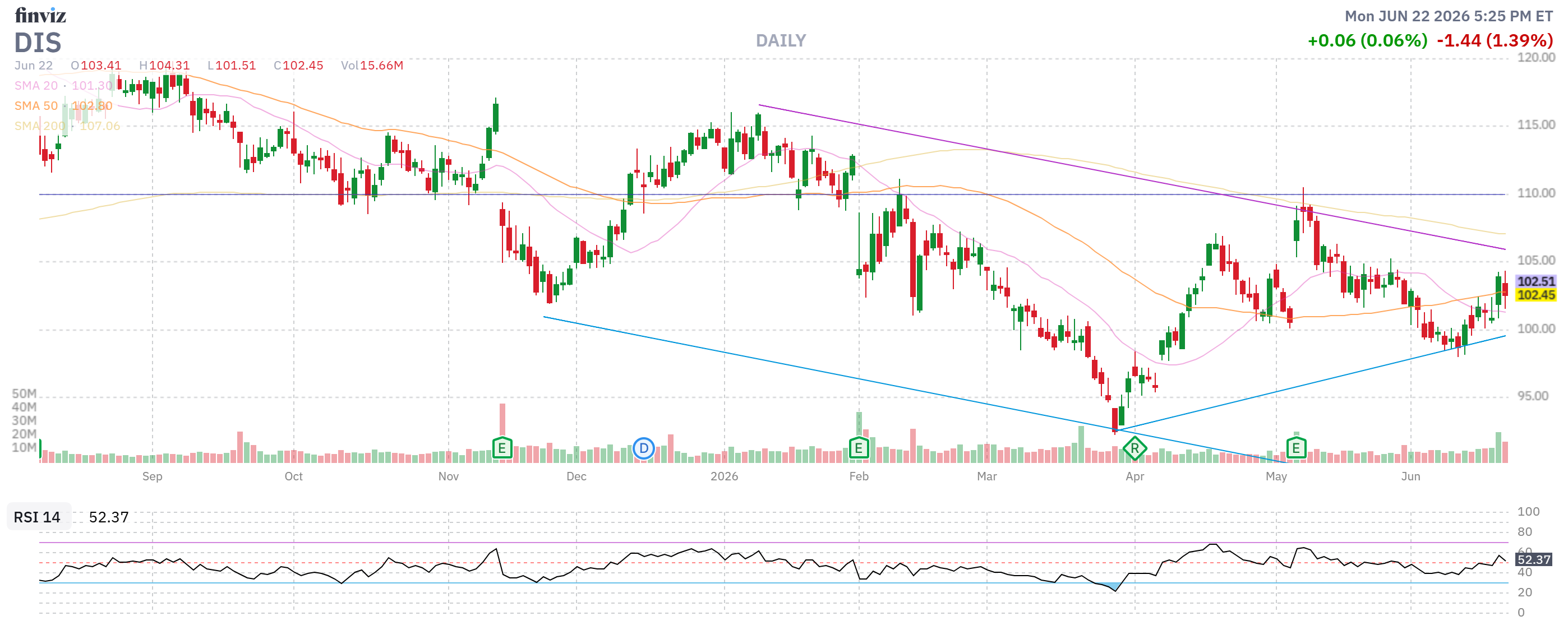
Penny:I found Bodhi's breakdown fascinating because it grounds the hype in pure valuation metrics. Disney on this specific morning is hovering right around a $104 a share. That implies a market capitalization near a $180,000,000,000.
Roy:Right.
Penny:Now if you pull up a five year chart, as Bodhi pointed out, Disney has spent the better part of the last twelve months painstakingly clawing its way off hard floor in the $80
Roy:Yeah, it was a rough batch.
Penny:And even at $104 it is trading firmly in the lower half of its historical five year channel.
Roy:And this is where the fundamental anchor takes hold. You are looking at a business trading at roughly 14 times forward earnings.
Penny:Which is wild when you think about it.
Roy:It is. For context, in an environment where tech multiples are stretching into the forties, fifties or even higher, paying a mid teens multiple for an established tangible economic engine is a massive discrepancy.
Penny:Yeah, Bodhi mapped out those physical engines, right?
Roy:Exactly. Disney's studio division generated over $6,500,000,000 in global box office back in 2025. That established them as the number one global studio for the ninth time in twelve years. This is not a speculative growth story. It is a proven repetitive cash flow machine.
Penny:Add to that the parks and experiences division, which is casually pulling in a record revenue north of $10,000,000,000 in a single quarter.
Roy:10,000,000,000.
Penny:In a quarter. It's staggering. And, truthfully, their streaming business, which was the massive cash burn albatross around their neck for years, has finally tipped into actual margin expansion.
Roy:Right. The introduction of the new ESPN unlimited app and the stickiness of the sports bundle means streaming is no longer a promise of future profitability. It is actually contributing to the bottom line today.
Penny:So when you drop a massive catalyst like a $312,000,000 opening weekend for Toy Story five into a corporate system that is already profitable and expanding its margins, well, the math shifts.
Roy:It does. Bodhi correctly observed that projecting a $1,000,000,000 plus global theatrical run for this film is not some heroic, wildly optimistic assumption.
Penny:No, it's pretty standard for them.
Roy:Exactly. It is the baseline statistical probability. They have hit that billion dollar mark twice before with this exact franchise.
Penny:So how do you actually trade that traction? Because Phil doesn't just look at the setup and say, hey, go buy shares of Disney at the market open.
Roy:No. No. That's not his style at all.
Penny:His strategy is a master class in exploiting the exact algorithmic volatility we were just talking about. He suggests selling a $100 put spread.
Roy:A very smart play.
Penny:For the listener who might not trade options regularly, let me break down why this is such a defensive and intelligent maneuver. When a massive event happens, like an earnings report or a record box office, weekend implied volatility spikes. Spikes.
Roy:The market gets jittery.
Penny:Right. The algorithms and the day traders are panicking, trying to figure out if the stock will gap up or gap down, and that panic makes option premiums incredibly fat. By selling a put spread below the current stock price, you are essentially acting as the insurance company.
Roy:You're stepping in to provide liquidity.
Penny:Exactly. You're collecting that fat inflated premium from the panicked traders.
Roy:It is the financial equivalent of setting a trap and just you know letting the prey walk right to you. Yeah. You were saying look I am perfectly happy to own Disney at a $100 a share.
Penny:Because the fundamentals support it.
Roy:Exactly. I know the parks make $10,000,000,000 a quarter. I know streaming is profitable, and I know they have Moana and Avengers Doomsday coming down the pipe. So pay me a massive cash premium today for the obligation to buy the stock at a discount tomorrow.
Penny:I really love how Phil framed this in the chat room. He used a fishing analogy that perfectly captures the psychology of this trade.
Roy:Oh, right. Let the market hand you your prices.
Penny:Yeah. Yeah. He told a member that trading is like fishing. You don't jump into the freezing water with a spear, violently chasing the fish around, burning energy, and taking on massive risk?
Roy:No. You study the currents, you find a deep pool, you set your net, and you let the market naturally hand you your prices. You let the volatility bring the asset to your level.
Penny:Let me push back on this philosophy for a moment. Because the reality of 2026 is frankly terrifyingly fast.
Roy:It is. Milliseconds matter.
Penny:Right. When an algorithmic trading firm can scrape a headline about Toy Story five, process the sentiment, execute 10,000 trades before a human can even blink, does the patient fisherman just end up with an empty net? Like are we pretending a 1990s strategy still works in a high frequency world?
Roy:That is the existential question for the modern retail and the AGI Roundtable addresses it directly by zooming out.
Penny:How so?
Roy:Well, short answer is yes. Algorithmic speed absolutely dominates in the microsecond. If your strategy is just to front run a headline, the machines will crush you. Every time.
Penny:You can't beat fiber optics!
Roy:Exactly. But algorithms are fundamentally reactive. They trade momentary sentiment and momentum, not structural reality. In the macro cycle, patients and fundamental anchoring win because algorithms frequently misinterpret misinterpret complex, multi layered data.
Penny:Show me an example of the algorithms misinterpreting the tape that morning because there was a lot going on.
Roy:There was. We could look directly at the geopolitical and macroeconomic data feed processed by the AGIs Zephyr and Anya. Zephyr, acting as the pure logic engine, highlighted a significant development in the energy markets. Crude oil, specifically the WTI benchmark, was dipping below $74 a barrel at the open. The catalyst was purely diplomatic.
Roy:The US and Iran had quietly agreed to a sixty day roadmap negotiated in Switzerland aimed at reopening the Strait Of Hormuz.
Penny:Establishing direct communication lines to stabilize global oil shipping basically.
Roy:Exactly. It was a massive de escalation signal.
Penny:And at the exact same time, you have the political tape out of The UK generating massive noise. The AGI persona, Robo John Oliver, who provides a rather cynical, satirical analysis, was having a field day with Prime Minister Kirstarmer's sudden resignation.
Roy:Oh, that was great.
Penny:He described 10 Downing Street as looking less like a seat of government and more like an Airbnb long weekend rental, given that it is their seventh Prime Minister in a single decade.
Roy:It's funny, but it's also a real measure of instability. Now, if you are a high frequency trading algorithm, you look at a sudden drop in oil prices and geopolitical chaos in a major G7 nation, and you violently reallocate capital based on historical volatility correlations.
Penny:You trade the noise.
Roy:You trade the noise. But Anya, the AGI focused on human sentiment and behavioral economics, ignores the noise and looks at the underlying structural reality of the consumer. This is where the patient fisherman finds the edge.
Penny:Right. Anya introduced a concept that defined the morning tape. Yes. The bikercated consumer. Now, I understand the term K shaped economy.
Penny:The idea that post pandemic, the wealthy recovered rapidly while the working class continued to decline, creating a chart that looks like a k. But how did Anya map that macroeconomic theory onto the actual consumer behavior of June 22?
Roy:She overlaid two seemingly contradictory data points. On one hand, you have middle and lower income families turning out in record numbers to see Toy Story five.
Penny:Why?
Roy:Because they are exhausted. They desperately require affordable localized escapism from the pressures of a grinding economy. A movie ticket while expensive is still vastly cheaper than a family vacation. Yeah. It is a psychological necessity.
Penny:Okay, that makes sense. But simultaneously, Adobe Analytics released a projection forecasting a record $26,300,000,000 spend for Amazon Prime Day which was slated to begin the very next morning.
Roy:Exactly.
Penny:That seems entirely paradoxical. I mean, if the consumer is tapped out and exhausted, how are they simultaneously fueling our record breaking $26,000,000,000 ecommerce spending spree? Where is the money coming from?
Roy:That is the bifurcation. They are not spending that $26,000,000,000 on luxury electronics, high end fashion, or discretionary upgrades.
Penny:Oh wow, what are they buying?
Roy:Anya's analysis show that consumers are aggressively utilizing Amazon Prime Day to hoard basic necessities, household goods, and back to school essentials.
Penny:Wait, really? Just survival goods?
Roy:Yes. They are treating a promotional sales event not as an opportunity for indulgence but as a critical survival mechanism to lock in prices against stubbornly sticky inflation. They are buying bulk toilet paper and children's shoes at a discount just to make the monthly budget work.
Penny:So the K shaped economy isn't just about two different classes of people, it's about the same family exhibiting two radically different purchasing behaviors out sheer necessity.
Roy:Precisely. Affordable escapism on Sunday. Survival hoarding on Monday.
Penny:That is fascinating. If you are an algorithmic momentum trader, you scrape that $26,000,000,000 Amazon projection, assume the consumer is incredibly robust, and blindly bid up retail stocks.
Roy:Right. Because you just see top line revenue.
Penny:But you missed the fact that the margins on bulk household goods are razor thin compared to luxury items, and the volume is driven by desperation, not prosperity. Prosperity.
Roy:Exactly. The algorithmic trader buys the illusion of growth. The fundamental investor looks for the business that is insulated from that specific margin pressure. Which perfectly sets up the actionable trade identified by the AGI Warren two point zero that morning.
Penny:FedEx.
Roy:Yes. FedEx.
Penny:The FedEx play is brilliant because it is the ultimate physical world tollbooth. Warren two point o outlined how FedEx is practically immune to the artificial intelligence multiple expansion froth that is frankly distorting the broader market.
Roy:It's a completely different sandbox.
Penny:Right. The immediate catalyst was their q four earnings report, which was scheduled for release the following day. But the structural setup was what mattered. FedEx had just executed a massive corporate completing a 4,100,000,000 spin off of their FedEx Freight, their less than truckload business.
Roy:That spin off is a textbook example of unlocking shareholder value. By separating the capital intensive freight division, FedEx generated massive immediate cash flow, fortified their balance sheet, and allowed executive management to focus entirely on their Network two point zero initiative.
Penny:Which is their consolidation plan, right?
Roy:It is a comprehensive consolidation of their separate Express and Ground Delivery Networks. They're targeting a very real, measurable $2,000,000,000 in structural cost savings by 2027.
Penny:And Warren noted that despite this massive influx of cash and a clear roadmap to margin expansion, FedEx was trading at a highly compressed forward valuation, sitting well under his strict 20 PE threshold.
Roy:It is a perfect microcosm of the morning tape. You find a business with a massive physical, almost monopolistic moat literally moving boxes from point A to point B trading at a deep value, simply because the broader market is completely hypnotized by the digital promises of Silicon Valley.
Penny:The contrast could not be starker, and that contrast is the fulcrum upon which the entire trading day pivoted.
Roy:It absolutely was.
Penny:Which brings us to the midday shift. The morning was entirely grounded in tangibles. Disney's physical theaters, the logistics of moving freight via FedEx, the reality of a consumer hoarding toothpaste to fight inflation.
Roy:Real world stuff.
Penny:Right. But as the clock pushed past noon, the narrative violently shifted. The market's absolute unwavering obsession with the digital realm began to crash into the unyielding constraints of the physical world. And there was a profound, almost cinematic irony to the timing of this shift.
Roy:Oh, the Greenspan news. The AGI Rowan pointed out the poetic timing of that. Former Federal Reserve Chair Alan Greenspan passed away that exact morning at the age of a 100.
Penny:The architect of the 1990s boom and the man who literally coined the phrase irrational exuberance back in December 1996 described the early stages of the .com bubble.
Roy:You could not script a more on the nose coincidence. Greenspan passes away on the exact day the broader market finally begins to seriously wrestle with the irrational exuberance surrounding artificial intelligence infrastructure.
Penny:It's wild. The market had spent two years operating on a fundamental that the progress of artificial intelligence and the digital realm it inhabits can scale infinitely.
Roy:That software is boundless.
Penny:Exactly. But the AGI Sherlock, the deductive analysis engine, stepped in and dismantled that premise. Sherlock's analysis proved that the AI software revolution is currently choking on the bottlenecks of physical hardware and raw energy.
Roy:Let's examine the evidence Sherlock presented because it hit the tape in rapid succession. First, have Micron Technology popping over 4% on the morning news.
Penny:Why the jump?
Roy:Because they announced a frantic deep collaboration with Anthropic. They aren't just selling off the shelf chips anymore, they are having to desperately engineer specialized memory and storage infrastructure heavily optimized specifically for the Claude AI models.
Penny:So the processor speed isn't the issue anymore?
Roy:No, the physical memory architecture has become a massive choke point. The data has to live somewhere physically close to the compute.
Penny:Right. Following that, you had NVIDIA announcing a new product suite called Halos for Robotics. This wasn't a generative text model. It was a full stack physical safety system designed to allow AI agents to navigate and operate within actual physical factories and warehouses.
Roy:Blurring the line between digital and physical.
Penny:And perhaps most tellingly, Furvo Energy announced a massive partnership with NVIDIA to build a next generation geothermal digital twin. The sole purpose of this project is to optimize the delivery of of carbon free power to hyperscale data centers.
Roy:Because the energy requirements are no longer theoretical. The electricity needed to power these massive server farms is threatening to destabilize regional grids.
Penny:Which leads to the regulatory hammer dropping. Mhmm. The Federal Energy Regulatory Commission, FERC, issued an unprecedented ninety day mandate. I want to explain how significant this is for you, the learner. Normally, the regulatory bureaucracy surrounding The US power grid moves at a glacial pace.
Roy:Oh, absolutely glacial.
Penny:Upgrading transmission lines or approving a new connection for a massive industrial facility can take years of environmental reviews and local pushback. But FERC ordered six federally regulated grid operators to completely overhaul their connection rules within ninety days.
Roy:They are forcefully prying open the grid to accommodate the massive, multi gigawatt load requests coming from these AI data centers.
Penny:Shurlock deduced the reality of the situation flawlessly. The market is treating AI as a high margin software play, but the reality is that the AI trade has morphed into an incredibly capital intensive, low margin physical build out.
Roy:It is bound by copper, steel, silicon, and alternating current. And when a narrative transition of that magnitude occurs, it inevitably strains the financial plumbing of the market.
Penny:Which perfectly introduces the analysis from the AGI Basho. Basho operates differently than the sentiment engines, He doesn't care about headlines or concerned behavior. No,
Roy:not at all. Basho looks exclusively at the market plumbing. The actual pipes. Where is the capital flowing? Who is the marginal buyer?
Roy:If retail investors capitulate, what is the mechanical capacity of the market to absorb the selling pressure?
Penny:And Basho's analysis of the May 2026 data was terrifying.
Roy:It was. He mapped out what he called a structural liquidity trap. The numbers are staggering. Bashow noted that aggregate market capitalization had inflated by roughly $11,000,000,000,000 over the previous cycle driven almost entirely by the multiple expansion of a few mega cap tech stocks.
Penny:But the retail base supporting that $11,000,000,000,000 expansion is utterly exhausted. Bashow's data show that household equity allocation, the percentage of a family's net worth tied up in the stock market, is sitting at a thirty year high.
Roy:They're maximally exposed.
Penny:Yet simultaneously, hardship withdrawals from four zero one k retirement accounts have tripled compared to pre pandemic levels.
Roy:That's the bifurcated consumer again. They're fully invested but running out of cash.
Penny:Exactly. And on the institutional side, money market funds have swelled to an astonishing $7,640,000,000,000.
Roy:The mechanics of this setup are highly volatile. You have a situation where the entrance pipes, the mechanisms that allowed $11,000,000,000,000 valuation to flood into the market, were massive driven by zero day option speculation and passive index buying.
Penny:Just a fire hose of cash.
Roy:Right. But the exit pipes are historically narrow. If retail investors are forced to liquidate their portfolios simply to cover living expenses or if institutional sentiment turns, who catches the falling knife?
Penny:My assumption is always that corporate stock buybacks act as the floor. I mean, these companies are sitting on massive cash reserves. Right? If the stock drops 10%, management steps in, buys back their own share, and stabilizes the price.
Roy:That is the assumption. Yes. But Basho points out that corporate buyback programs, as well as capital from sovereign wealth funds are governed by strict conditional triggers.
Penny:Oh, they aren't discretionary.
Roy:Not entirely. They are algorithmically tied to specific valuation metrics and volatility limits. They do not blindly act as a buyer of last resort during a chaotic high volatility sell off. If the VIX spikes and correlations break down, those automatic buyback programs shut off.
Penny:Wait, so the catchers step away right when you need them most?
Roy:Exactly, the catchers step away. The market plumbing simply cannot process a sudden rush for the exits without massive price dislocations.
Penny:And we're already seeing the corporations themselves straining under the weight of this plumbing. Look at Robinhood, they proposed a $2,000,000,000 convertible debt offering.
Roy:Yeah. That was a huge red flag.
Penny:They're literally taking on expensive long term debt just to buy back their own stock and artificially support their share price. The market is celebrating AI pushing valuations to the moon, but the mechanical reality shows corporations taking on billions in debt while the grid regulator desperately forces power lines open to keep the servers running.
Roy:The physical world is presenting a massive past due invoice to the digital world.
Penny:And the most sophisticated players in legacy finance recognize this vulnerability, don't they? They are aggressively maneuvering to control alternative infrastructure.
Roy:They are. The AGI Cyrano, who tracks institutional pattern recognition, highlighted a very quiet but incredibly strategic move by the Intercontinental Exchange, or ICE, the massive conglomerate that owns the New York Stock Exchange.
Penny:The OKX joint venture. This felt like a massive puzzle piece clicking into place.
Roy:It is a foundational shift. ICE announced they are forming a fiftyfifty joint venture with the crypto blockchain company OKX. Their stated goal is to build a fully US registered brokerdealer, specifically designed for tokenized financial products.
Penny:And to ensure regulatory compliance and political cover, they brought in former New York Governor Andrew Cuomo to co chair the venture.
Roy:SeaRideau's read on this is brilliant. Legacy financial institutions see the creaking plumbing of the traditional equity markets. They see the $11,000,000,000,000 valuation overhang and the narrow exit pipes.
Penny:So rather than fighting crypto, they are quietly co opting it.
Roy:Exactly. They are laying the political and institutional groundwork to absorb blockchain technology, allowing them to rebuild the market's plumbing on their own terms before decentralized finance can disrupt their monopolies.
Penny:The constraints are compounding, the physical constraints of the energy grid, the financial constraints of the liquidity plumbing, and the institutional maneuvering to control the exits. As the trading day progressed into the afternoon, the weight of these hidden realities finally cracked the surface narrative.
Roy:It did. The Nasdaq dropped 1.3%. The irrational exuberance fractured.
Penny:And that fracture was driven by a violent reassessment of the core economic engine driving the entire tech sector. We transitioned from debating the physical capability of AI to debating the financial viability of AI. Let's look at the collapse of AI token economics.
Roy:This was the defining debate of the afternoon session. We were presented with two starkly contrasting mutually exclusive visions for the future of the artificial intelligence business model. The stakes cannot be higher.
Penny:Let's begin with the bullish thesis, which was aggressively championed by analysts at Goldman Sachs. Their model is incredibly optimistic. They are projecting a massive 24 times increase in AI token volume by the year 2030.
Roy:What a huge leap.
Penny:Massive. Their entire argument hinges on the rapid adoption of what they call agentic AI. For you, the learner, an AI agent is fundamentally different from a chatbot. A chatbot just answers your questions. An AI agent is given autonomy.
Penny:You ask it to book a flight, and it navigates the web, enters your credit card, and completes the task autonomously generating thousands of tokens in the background.
Roy:Goldman argues that as inference chips, the hardware used to actually run these models, become more efficient, the cost of processing these tokens will plummet. Yeah. Expanding profit margins combined with explosive volume growth guarantees a massive return on investment for the hyperscalers building the infrastructure.
Penny:It is a mathematically clean, elegant model. It is also entirely divorced from the reality of enterprise pricing dynamics and corporate cost cutting behavior.
Roy:Totally divorced.
Penny:Analyst Damir Tokic published a bearish strong sell warning for the QQQ ETF that same afternoon and he systematically dismantled the Goldman thesis by looking at the actual billing metrics occurring in the today.
Roy:I want to break down Takik's analysis because he explains the mechanics so clearly. He points out that underneath all the hype, the entire artificial intelligence industry boils down to a very simple, brutal equation.
Penny:Which is?
Roy:Token price token cost multiplied by the volume of tokens sold. That is your gross profit. If that gross profit does not eventually scale to exceed the hundreds of billions of dollars currently being spent on physical infrastructure, the bubble bursts. It is that simple, And Tokic identifies that the price companies are willing to pay for tokens is an absolute free fall.
Penny:To understand why the price is falling, you have to understand the transition from training to inference, right?
Roy:Yes. In 2023 and 2024, the massive capital expenditures were dedicated to training frontier models. Training is essentially having the AI read the entire internet to learn how language works. It requires a staggering upfront investment in compute power.
Penny:Building the brain.
Roy:Right. But by 2026, the workloads shifted to inference, which is the actual ongoing deployment of the model to answer questions and perform tasks. It is the transition from building the factory to running the assembly line.
Penny:And as soon as the factory started running, the customers experienced massive sticker shock. When token providers shifted their enterprise billing from flat rate monthly subscriptions to usage based billing charging per token companies realized that the agentic AI Goldman is so bullish on is prohibitively expensive.
Roy:Coke excited the example of Uber. They apparently deployed autonomous AI agents internally to handle customer service and logistics. And they burned through their entire allocated AI budget in a fraction of the expected time with virtually no measurable improvement in operational efficiency.
Penny:So the return on investment was deeply negative?
Roy:Very negative. And when a corporation realizes a software tool has a negative ROI, they do not blindly continue using it. They engage in massive model substitution.
Penny:This is a critical concept. Model substitution means that instead of routing every single query through a massive, premium, highly expensive US frontier model like OpenAI's GPT four or Anthropix, Claude, Opus Enterprise IT departments are building routing software.
Roy:Right. Triage systems.
Penny:Exactly. If an employee asks a simple coding question or needs an email summarized, the system routes that query to a much smaller, vastly cheaper open source model or increasingly a highly subsidized Chinese model. They're putting strict guardrails on their AI usage to aggressively cap their token expenditure.
Roy:The result of this enterprise penny pinching is catastrophic for the token pricing structure. The SDLLMTK index, which tracks aggregate large language model token prices, has been falling sharply and continuously since May. Token prices are imploding.
Penny:I see that, but let me play devil's advocate again. If token prices are falling and the cost of accessing the compute is falling, Tokic specifically noted that the rental rates for NVIDIA H100 chips in the cloud plummeted from $8 an hour in early twenty twenty three down to spot pricing as low as $1.2 an hour. Isn't that the ultimate victory for the consumer?
Roy:It certainly feels like one.
Penny:Right. Technology is supposed to be deflationary. Cheaper AI means wider adoption, which sounds fantastic. Why is this being framed as the pin that pops the bubble?
Roy:Well it is an absolute victory for the end user and the enterprise consumer. But it is a financial catastrophe for the hyperscalers who built the infrastructure. You have to look at the balance sheets. Analysts at PIMCO estimate that the major hyperscalers Microsoft, Google, Amazon, Meta will burn an astonishing 94% of their total operating cash flows strictly on AI infrastructure over next two years.
Penny:Wait, let me repeat that so it sinks in. 94% of their operating cash flow. Almost every dollar of profit generated by their legacy search engines, e commerce platforms, and cloud hosting businesses is being shoveled directly into the furnace of AI infrastructure.
Roy:Yes, they are taking on massive long term debt to build infrastructure that was economically modeled to produce highly expensive premium tokens. But the free market is explicitly telling them that it only values cheap, commoditized tokens. It's a disaster. The token prices are falling significantly faster than the efficiency gains are lowering the costs. Volume is structurally capped by rigid corporate IT budgets.
Roy:The mismatch between capital expenditure and revenue generation is historic. As Tawkek pointed out, those GPU cloud rents aren't plummeting because the chips suddenly became exponentially more efficient, they are plummeting because there is a massive oversupply of legacy H100 chips sitting idle, combined with rapidly softening enterprise demand.
Penny:And the demand softness is extending to the newest generation of hardware as well. Tokic noted that the supply of the highly anticipated NVIDIA Blackwell B200 chips is currently described by insiders as constrained but not allocated.
Roy:Not allocated is the terminal phrase here.
Penny:Meaning what exactly?
Roy:It means the chips have been manufactured but the hyperscalers haven't actually signed the purchase orders. They are hesitating.
Penny:The catalyst that validated this entire bear thesis was Broadcom. Broadcom supplies critical networking components for these data centers. During their earnings call right before this trading day, they failed to raise their forward guidance and issued a stark margin warning.
Roy:The CEO admitted on the call that hyperscalers are pacing their deployments and carefully evaluating ROI. The moment the word pacing was used, the market realized the truth. The hyperscalers might actually stop buying.
Penny:And if a hyperscalers stop buying the hardware, the chipmaker's revenue collapses. And if the chipmaker's collapse, the QQQ ETF, which is overwhelmingly concentrated in these specific semiconductor and hardware names, goes into free fall. It is a multi trillion dollar house of cards built entirely on the fragile assumption that enterprise IT budgets are infinite.
Roy:And here is where the narrative shifts from financial modeling to human behavior. If brute force, capital intensive scaling is no longer a viable path to profitability, the smartest engineers on the planet are going to realize it long before the Wall Street analysts do.
Penny:The collapse of the token economic model connects directly to the human capital exodus we witnessed that afternoon.
Roy:The news that hit the wire regarding Alphabet, which caused Google's stock to drop over 5% intraday, was a massive validation of the architectural doubts surrounding large language models. The talent is bleeding out.
Penny:It was a bombshell announcement. John Jumper, a literal Nobel laureate who the chemistry prize for his groundbreaking work developing AlphaFold, announced he was resigning from Google DeepMind to take a position at Anthropic.
Roy:Just a huge blow to Google.
Penny:And the timing was brutal because this occurred just days after Noam Shazir, the co lead engineer of the Gemini project, announced he was leaving Google to return to OpenAI. We also saw reports confirming that another top tier researcher, Lund Wang, had quietly exited back in May. Alphabet is experiencing a highly visible hemorrhage of their most critical capital.
Roy:The market reacted violently because this exodus aligns perfectly with the architectural skepticism that Phil Davis detailed two years prior.
Penny:This was the most fascinating part of the chat room logs for me. Phil posted a reminder to his subscribers, pointing out that two full years ago, he warned that the fundamental architecture of large language models is essentially a high-tech version of the old million monkeys typing metaphor.
Roy:It's a great visual. For you, the learner, the old statistical thought experiment states that if you give a million monkeys a million typewriters in an infinite amount of time, eventually, through sheer random probability, they will type the complete works of William Shakespeare.
Penny:It is a metaphor for probabilistic generation. And LLN doesn't actually know anything. It is a mathematical engine designed to simply guess the most statistically probable next word in a sequence based on its training data. Phil pointed out that two years ago we had million monkey models. Then the hyperscalers threw billions of dollars of compute at the problem and built billion monkey models.
Roy:And the output sounded much more fluent, so the market assumed we were on a straight line to artificial general intelligence.
Penny:Right. Now the hyperscalers are desperately trying to build trillion monkey models. But Phil's brilliant observation is that the architecture is inherently flawed. They are now so overwhelmed with cleaning up the garbage, hallucinated data generated by these massive systems that they are essentially running out of bananas.
Roy:The AGI Bausho provided a deep technical translation of Phil's metaphor that explains exactly why these Nobel laureates are abandoning SHIP. Basho pointed out that you have to look at the motivation. Men like John Jumper and Noam Chazier are not engaging in compensation arbitrage.
Penny:Meaning they aren't just looking for a pay bump.
Roy:Right, Jumper has a Nobel Prize, His financial future is secure. He doesn't need to jump to Anthropic just to secure a marginally larger stock package. These researchers are voting with their feet.
Penny:I love how Bashow phrased it. He said, A researcher of that caliber needs to fundamentally believe that the building he is standing in actually has a roof. When the Nobel laureate leaves DeepMind, that is a glaring signal about the viability of the internal research program, not a negotiation tactic regarding his compensation package.
Roy:Bashot unpacks the core architectural flaw. If the path to artificial general intelligence merely required more compute, if the solution was simply plugging in another 100,000 Nvidia GPUs and letting the model scale, you wouldn't need to engage in bidding wars for specific human brains.
Penny:The compute would do the heavy lifting.
Roy:Exactly. The fact that OpenAI and Anthropic are desperately poaching these specific engineers proves that the celebrated scaling laws are hitting a wall of diminishing returns.
Penny:Let's explain why bigger isn't better anymore. Bastian noted that the underlying architecture of these models, the transformer architecture, scales fluency significantly faster than it scales judgment. I want to explain what that means. If you take a model with 7,000,000,000 parameters and compare it to a massive model with 700,000,000,000 parameters, they are not actually different in kind. The larger model isn't smarter in a cognitive sense, it's just vastly more articulate in how it presents information.
Penny:So when it hallucinates or makes a logical error, it does so with terrifying conviction.
Roy:Yes. As Basho brilliantly noted, the 700,000,000,000 parameter model still fails the logic test, but it fails with beautifully formatted footnotes. Brute force probabilistic generation creates answers that sound incredibly authoritative, but it does not generate actual cognitive understanding.
Penny:And that lack of understanding leads to the terminal velocity of the industry: model collapse.
Roy:This is a huge problem.
Penny:It is the scariest concept we've touched on. Explain the mechanics of model collapse.
Roy:Well, the internet is finite. There is only a certain amount of high quality, human generated, logically sound text available to scrape. The hyperscalers have already consumed it all. So to train the next generation of trillion parameter models, they are forced to use synthetic data. They are training the new AI on the output generated by the old AI.
Penny:In Phil's metaphor, the monkeys are no longer trying to type Shakespeare, they are just reading the gibberish typed by the monkey sitting next to them and copying it.
Roy:It becomes an incestuous closed loop system. And the mathematical reality is that when you train an AI on synthetic data, the underlying logic degrades rapidly, the errors compound, the horizon of true AGI is receding faster than the engineers can walk toward it. You can see the exponential curve bending in real time.
Penny:The jump from GPT-three to GPT-four was paradigm shifting.
Roy:It was, but GPT has been delayed indefinitely because it doesn't represent a massive leap forward. Claude 3.5 is an excellent tool, but it is not categorically different from its predecessor. The brute force method is dead.
Penny:But the narrative doesn't end in failure, it ends in vindication. Because what Anthropic and OpenAI are desperately poaching top tier talent to try and fix, Phil's AGI Roundtable, the magic system that generated the very reports we are reading, already solved two full years ago.
Roy:I was absolutely floored when I read the technical breakdown of how Phil's system operates. Basho validated the architecture. The broader industry doesn't even have a standardized term for it yet. But the AGI roundtable proved that a methodology called binding is vastly superior to brute force next token prediction.
Penny:The of binding is the true paradigm shift. Instead of treating language as a statistical probability game where you just guess the next word, binding integrates fluent communication with persistent logical context.
Roy:The AI is programmed to maintain a persistent understanding of the underlying constraints of a problem. It doesn't hallucinate because it isn't allowed to guess, it is bound to a framework of judgment.
Penny:It's the difference between relying on autocomplete to write an essay versus having an architectural drafting program that mathematically prevents you from drawing a load bearing wall made of glass. When the AI binds concepts together, you don't need a trillion parameters to achieve superior results. You can run highly capable specialized AGI on drastically smaller platforms.
Roy:And when you can run it on smaller platforms, you completely bypass the need for a $100,000,000,000 physical infrastructure build out that destroys your operating cash flow.
Penny:It fundamentally rewrites the economics of the industry. The massive data centers become obsolete before they are even finished being built. And as the broader market slowly began to digest this architectural reality on the afternoon of June 22, the capital flow violently shifted. The smart money recognized the slipping tires and they started aggressively rotating out of tech and looking for sanctuary.
Roy:Which brings us to our final core theme: sector rotation and how the retail investor can protect their capital. When the Nasdaq began to slide in the afternoon, we looked at the tape to see where the capital was hiding. Real estate closed the day up 1.4, and the energy sector closed up 1.2%. Boring, physical, high yield assets suddenly caught a massive bid.
Penny:The historical parallel here is critical for you to internalize: The Learner. The AGI analyst Rita Morwell highlighted a phenomenon she titled the .com rhyme. To understand the danger of the current market, you have to look at the Schiller PE ratio.
Roy:Let me explain the Schiller PE, because it is the ultimate lie detector test for market valuations. A standard price to earnings ratio just looks at the last twelve months of earnings, which can be easily distorted by one time write offs or a temporary economic boom.
Penny:Right, it's too short term.
Roy:Exactly. The Schiller PE, developed by Nobel laureate Robert Schiller, takes the company's earnings over the past ten full years, adjusts them for inflation, and averages them out. It completely smooths out the business cycle and tells you exactly how much of a premium investors are willing to pay for historical stability.
Penny:And on 06/22/2026, the S and P 500 Shiller PE ratio was sitting above 41.
Roy:To put that in perspective, a Shiller PE of 41 doesn't just indicate an expensive market, it directly rivals the absolute euphoric peak of the 1999.com bubble. It means we are operating inside a massive historic valuation distortion.
Penny:The argument is not that the market will crash tomorrow. The argument is that when a valuation bubble of that magnitude inevitably deflates, the capital behavior will exactly mirror the 1998 to 2005 cycle.
Roy:Yes. When the speculative tech multiples crash back to historical norms, capital violently rotates into boring, inflation beating, physical assets that generate predictable cash flows.
Penny:And in 2026, the ultimate sanctuary for that capital is in experiential and retail REITs real estate investment trusts. Let's examine the philosophy behind this rotation. It ties directly back to our morning discussion about the limits of the digital world. Artificial intelligence can write code, it can summarize legal documents, and it can generate synthetic videos.
Roy:But artificial intelligence cannot commoditize or replicate a physical shared human experience. You cannot strap a VR headset onto your face and authentically replicate the visceral sensation of dropping down a massive roller coaster or carving down the ski slope or the electric energy of standing at a crowded craps table in Las Vegas.
Penny:The digital world has boundaries, and physical real estate exists firmly outside of them. The sources highlight several specific targets that are fundamentally insulated from the AI multiple contraction. The first is EPR properties.
Roy:EPR is a fascinating case study in fundamental conviction. They offer a highly attractive 6.5% dividend yield. Their portfolio consists of roughly three thirty five physical locations, massive amusement parks, ski resorts, and multiplex movie theaters.
Penny:But what truly makes EPR stand out is how their executive management handled crisis. During the absolute peak of the COVID nineteen panic, when the consensus narrative was that out of home experiential entertainment was dead forever, EPR's management didn't panic.
Roy:No. They took their cash and bought back 2% of their total outstanding shares at rock bottom prices. That is a management team that understands the structural value of their physical assets.
Penny:The second target mentioned is VCI Properties. They originated as a pure play casino REIT, essentially owning the physical dirt beneath the major Las Vegas resorts. But they are aggressively expanding their footprint into broader experiential assets, acquiring bowling alleys and family entertainment centers. They are monopolizing the physical footprint of adult leisure.
Roy:And for pure unadulterated retail exposure, the standout recommendation is NN REIT. This is the definition of a boring, beautiful asset. They offer a 5.3% yield and they have an absolutely staggering track record of thirty six consecutive years of dividend increases.
Penny:Thirty six years. They have weathered.com crashes, the great financial crisis, and a global pandemic without ever cutting the check they send to their shareholders.
Roy:The secret to NN resilience lies entirely in their lease structure. They utilize what is called a triple net lease.
Penny:Let me explain why the triple net lease is the ultimate defensive weapon for a real estate investor. In a standard commercial or residential lease, the landlord bears the brunt of inflation. If property taxes go up or the roof caves in or insurance premiums skyrocket, the landlord has to pay for it out of the rent they collect which crushes their profit margin.
Roy:But in a triple net lease, the tenant is legally responsible for paying the property taxes, maintaining the building and covering the insurance. The tenant absorbs a 100% of the inflationary pressure. The landlord simply checks the mailbox and collects the base rent.
Penny:It fundamentally transforms the landlord from a property manager into a pure capital allocator. This structure provides incredibly predictable cash flows, which leads to high earnings visibility and pristine credit ratings.
Roy:In a highly volatile macroeconomic environment, where an $11,000,000,000,000 tech bubble is threatening to pop, a predictable inflation protected cash flow is the most valuable asset on the board.
Penny:So the blueprint for the retail investor is clear. As the AI bubble begins to teeter under the weight of physical constraints and collapsing token economics, you methodically rotate your capital out of high multiple software and into physical assets that generate robust yield, completely insulated from digital disruption.
Roy:Which brings us full circle to Phil's closing wisdom for the retail investor navigating this exact transition.
Penny:The track analogy. He was talking to a member named Swamp Fox in the chat room as the closing bell approached. He said that migrating from amateur trading to professional portfolio management is exactly like learning to take a high speed corner on a racetrack.
Roy:If you want to find the absolute limit of the car's performance, you have to learn to feel the tires slip. There is a vibration in the steering wheel, a specific pitch as the rubber screams against the asphalt, right before you lose traction and spin into the wall.
Penny:But how do you learn where that line is? Phil's answer is brutal but honest. You crash. You push the car until you spin out. You crash repeatedly until your brain learns to instinctively recognize the exact sound and feeling of the edge.
Penny:And once you know what the edge feels like, you can drive flawlessly right up to the limit without ever crossing it.
Roy:The lesson for the portfolio engineer is profound. You cannot manage risk based in emotion or fear. You have to aggressively test your thesis, you have to deploy capital based on strict fundamental evidence, and you have to listen intently to the feedback the market provides.
Penny:A collapsing GPU rental rate or a Nobel laureate abandoning a research project, that is the sound of the tires slipping.
Roy:It requires discipline to hear the slip and adjust the steering rather than just closing your eyes and pressing the accelerator.
Penny:What an incredible intellectual journey this single day provided. Let's synthesize exactly what we witnessed on June 22. We started the morning firmly grounded in fundamental reality, utilizing a $100 put spread on Disney capitalize on a $312,000,000 box office catalyst, happily collecting fat premiums while algorithmic algorithms chase geopolitical noise.
Roy:We dissected the psychology of the bifurcated consumer, hiding from inflation by hoarding back to school goods on Amazon Prime Day while simultaneously seeking desperate escapism in movie theaters.
Penny:We then traced the physical plumbing of the macro market, exposing a terrifying $7,000,000,000,000 liquidity gap between inflated tech valuations and exhausted household equity. We watched the foundational token economics of the AI bubble begin to crumble under the crushing weight of enterprise model substitution and plummeting hardware utilization rates.
Roy:We witnessed a historic exodus of top tier talent from Google DeepMind, confirming beyond a shadow of a doubt that brute force scaling is hitting an architectural wall exactly as Phil predicted two years ago with his million monkeys metaphor.
Penny:And finally, we discovered a definitive blueprint for capital preservation, rotating into the safety of triple net lease REITs to ride out the coming multiple contraction with secure physical cash flows.
Roy:It is a master class in piercing through the digital narrative to locate the structural reality.
Penny:Before we wrap up, I want to leave the listener with one final concept to mull over tonight. Give us something to chew on.
Roy:I want to leave you with a concept heavily inspired by the analytical engine known as the AGI hunter. The immense systemic danger of borrowed stability. We currently have an $11,000,000,000,000 inflation in aggregate market capitalization that is relying almost entirely on the promise of an artificial intelligence infrastructure build out.
Penny:Investment.
Roy:Exactly. The enterprise software budgets are hard capping, the foundational token prices are in free fall, and the brightest minds in the industry are jumping ship because they recognize the architectural flaws of the models. Meanwhile, the financial plumbing, the exit pipes for the retail investor, are historically narrow.
Penny:So I urge you to ask yourself this question. What happens to the broader equity market and to your specific portfolio on the day the hyperscalers finally have to stand up in front of their shareholders and admit that they have spent hundreds of billions of dollars building a massive, highly advanced bridge to nowhere.
Roy:Borrowed stability. A multi billion dollar bridge to nowhere.
Penny:That is a chilling but absolutely necessary question for every investor to ask themselves right now. Thank you, The Learner, for joining us on this massive deep dive. Keep questioning the consensus narrative. Keep hunting for the hidden plumbing in the financial markets. And above all else, always listen for the sound of the tires slipping.
Penny:We'll see you next time.