Subscribe
Share
Share
Embed
One of the most essential ingredients to success in business and life is effective communication.
Join Matt Abrahams, best-selling author and Strategic Communication lecturer at Stanford Graduate School of Business, as he interviews experts to provide actionable insights that help you communicate with clarity, confidence, and impact. From handling impromptu questions to crafting compelling messages, Matt explores practical strategies for real-world communication challenges.
Whether you’re navigating a high-stakes presentation, perfecting your email tone, or speaking off the cuff, Think Fast, Talk Smart equips you with the tools, techniques, and best practices to express yourself effectively in any situation. Enhance your communication skills to elevate your career and build stronger professional relationships.
Tune in every Tuesday for new episodes. Subscribe now to unlock your potential as a thoughtful, impactful communicator. Learn more and sign up for our eNewsletter at fastersmarter.io.
Matt Abrahams: To fully be present and in
the moment, you must awaken your voice.
My name is Matt Abrahams and I
teach strategic communication at
Stanford Graduate School of Business.
Welcome to Think Fast
Talk Smart, the podcast.
Today I am delighted to
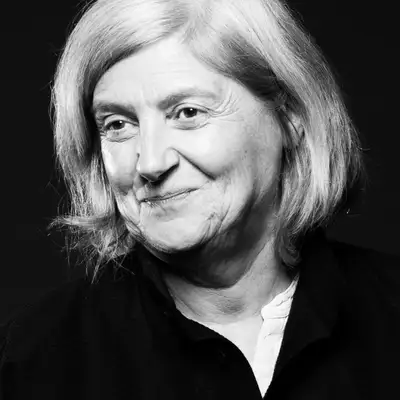
speak with Patsy Rodenburg.
Patsy is a world renowned expert in
voice, speech, and presentation, with
over 45 years of experience coaching
across creative and corporate industries.
She's the former head of voice at the
UK Royal National Theater and a Director
for the Royal Shakespeare Company.
She has transformed how actors,
prime ministers, CEOs, and
global leaders communicate.
She's written many books including
Presence and Power Presentation.
Welcome, Patsy.
I've been excited for our
conversation for quite a while now.
Thanks for being here.
Patsy Rodenburg: I'm so delighted.
And Matt, I think you're doing something
so important about communication because
I think it's what the world needs now.
Matt Abrahams: Thank you so much.
Shall we get started?
Patsy Rodenburg: Yes, please.
Matt Abrahams: Excellent.
You have worked with a number
of famous people to help them
with their presence and voice.
I'd like to start with voice.
What are some of the foundational vocal
principles you provide when you coach?
Patsy Rodenburg: My work is about
embodiment and it's about a craft that is
returning people to their natural selves.
The good news is the vast majority of
people are born with amazing voices, and
somewhere along the line they lose them.
And my job is to return people to
their full power in their body,
in their breath systems, in their
voices, in their ability to speak
and use language in an exciting way.
Matt Abrahams: Beyond the
embodiment piece, are there
principles you help people with
around breathing or articulation?
Can you walk us through
some of those exercises?
Patsy Rodenburg: So the first thing I
would do is I would look at somebody's
body and I would look at the tensions
in the body, starting with the feet.
The body is like a connected journey.
We have to connect to our whole body to
find our voice, so the feet, the front
of the feet, the knees not being locked.
If you lock your knees, that
tension goes all the way through
the body into the throat.
A lot of people with very
tight voices, if you look down,
they're locking their knees.
The next thing that's incredibly
important in the body is that the pelvic
area is on top of the hips, but most
people today, when they stand, they're
either pushing their hips forward,
locking their knees, and all that builds
into the body and up into the throat.
The important thing about the
pelvic area is that that is
where we have to breathe from.
It's a very low breath down there.
We also have to breathe
quickly to think quickly.
If we think without
breath, it becomes a gavel.
So if you put your hand on your lower
abdominal area and just feel that, you
should feel the breath goes down and that
takes a bit of time and it calms you.
We get frightened when we speak
because we forget to breathe.
So if I move up through the body,
the spine has to be up, not braced.
Not pulling your shoulders
back, not slumped.
If we brace or slump, we reduce our
breath and the energy gets stuck in the
throat, which is when those wonderful
ideas you have, they come out on a
monotone, not because your are boring,
because your voice is held and tight.
And the two last things,
are shoulders being free.
If you are getting nervous, if you
feel your voice is getting thinner,
the first thing you can do is just to
think to yourself release my shoulders,
release my jaw, because until the
body's in place you can't breathe.
And we are looking to see
no upper chest tension.
You can put your hand on your upper
chest and if you breathe in, which
most people do when they're nervous,
the chest lifts, it shouldn't lift.
Because as it lifts, I dunno if you
can feel the back of the rib cage
tighten means that you are not breathing
because the lungs are at the back.
Matt Abrahams: So it's balance of body
and rooting yourself into the ground.
Patsy Rodenburg: Yes, and
looking out at the world.
And of course we know who we're going
to listen to long before they speak.
We know through their body.
And if you are centered, you
come on or you walk into a space
with authority, with clarity.
So the next thing I would do is open
the voice with the breath underneath it.
And you can feel this if you
are sitting beside a desk.
If you push your hands against the table,
remember your feet on the floor, the front
of the feet on the floor, and you breathe,
you will feel the breath go down more.
Matt Abrahams: Wow.
That's a great activity.
I'm doing that as I speak
and I see what you're saying.
It is fascinating to me that body
leads to breathe which leads to voice.
And by connecting those together, you
can improve and open up your voice to
do the things that we want it to do.
I often will say, your voice
is like a wind instrument.
The more air you put through
it, the more you can do with it.
The limited voice work that I do, I
recommend to my students and the people
I coach, that reading out loud can be a
tool to help because it mimics speaking
out loud, but it gives you a little bit
more cognitive bandwidth to pay attention
to breath, because I don't have to
think of the words, I'm reading them.
Patsy Rodenburg: Read
out loud, absolutely.
Here's another trick though.
So if you stand with your book, maybe,
you're reading out loud, and you're
holding the book up so that you're
not looking down, which is not useful.
And if you hold the book with one
hand and stand against a wall and
gently push with your other arm,
which engages the breath just like it
did when you were pushing the table.
You'll feel the breath.
Now, take a breath and read out sending
your voice to a point just above eye
line, and then the voice not only
leaves you, but it grows in strength.
Most voices I meet, there's
nothing wrong with them.
They can be improved, Matt, but
they're just rusty and dusty.
They're not used, you know?
Matt Abrahams: I often tell people, in
my mind I'm amazingly eloquent, but when
I open up my mouth, I'm not as lucky.
You said several things there
that really stand out to me.
The voices you meet.
I love that idea that we are our voice
and we meet the person, but the voice
they bring, and I like this idea of being
generous enough to let your voice out.
Your voice is a gift and
you're giving it to the world.
I want to get very tactical
and practical here.
Many people I know feel that their
voice is quiet, they speak quiet.
You said something that made me
wonder, you said visualize your
voice going out over your eye line.
I imagine, like an athlete warms
up, that there are some things we
can do to help warm up our voice.
I often marvel that people think
they can go from silence to vocal
brilliance without warming up.
Do you have a favorite warmup
activity or two that you could share
that we could practice perhaps?
Patsy Rodenburg: I'd
get somebody standing.
Of course, you stand, you
feel, you stretch a bit.
You let the shoulders go.
You might flop over to one side and
breathe, the, the rib cage starts working.
The rib cage gets very
rusty, very quickly.
Do both sides so that we just get that.
Very gentle, silent breaths.
So if you breathe quietly,
you'll be amazed how wonderful
it feels in the throat.
It's open.
And the other one, which is
great, is to give yourself a hug.
Just flop over a bit from the waist with
your arms up against your chest, and in
that position, breathe in and out and
you will open the back of the rib cage.
I have to say most people today don't
even think that the back of the rib cage
is important, but we know it organically.
So that if you get those muscles
working and then first thing
in the morning, you have to get
the breath underneath the voice.
So here's an image.
I mean, you are an athlete, you know
these things, to throw the voice.
So if you can throw a ball, if you just
breathe in, there's a suspension and you
throw the ball on the breath, just like
you did when you were pushing against
the wall, you're feeling the breath.
If you can do that and hum to a
point, so you are just warming up
the support of the breath, humming,
very light, and you can
play all over the play.
Ma, ma, ma ma, ma ma. You can play with
your voice and you are trying to get a
buzz on the lips, which is the physical
sign that your voice is coming forward.
Most people today, their voice
is stuck back down the throat.
So they're mumbling down there.
And if the voice is stuck down the
throat, you can't speak clearly
because the speech muscles can't
feel the energy of the voice.
Keep the breath, keep the idea
of it leaving you, and then maybe
on an, Ooh, that's a lovely way
of getting the voice forward.
Ooh, just bringing your lips.
And literally, if you did that for a few
minutes and then you spoke a bit of text
out aloud or if you are having a difficult
conversation, practice it out loud.
Walk around the house with
purpose, with your presence.
Walk around, looking around.
Look outside a window, breathe,
and practice what you have to say.
Practice out loud.
Matt Abrahams: Thank you so much.
I have heard of vocal warmups where
you buzz your lips and puff out air,
but I have never heard of working
with the body, stretching the body.
I like just leaning to the side,
opening up the ribs, leaning
forward, hugging yourself.
Very useful and I like that idea
of visualizing, pulling the voice
forward so we're not mumbling.
Patsy Rodenburg: What I'm doing now is I'm
just imagining the voice projected out.
It's not pushed, it's just you
let it out and within a few days
you will feel the difference.
This is the simple stuff
that people forget.
They want to get onto the speech.
Speech is the last thing in the chain.
So once you've warmed up your body
and your breath and your voice, you
can start moving your mouth about a
bit, but these muscles will tune up
very quickly as long as they've got
the voice and the breath behind them.
Matt Abrahams: Yet again, you
are emphasizing the connection
of body, breath, and voice.
I'd like to transition to talk
about physical presence, something
I know is very important to you.
What advice do you have for anyone
wishing to improve their physical
presence in how they communicate?
Patsy Rodenburg: I think the physical
presence of the human being is
the most important thing we have.
We don't do anything well in life unless
we put our full presence on it, but
it's, if you talk to anthropologists,
what made us so powerful on the
planet is that we could build teams.
A team doesn't exist until everyone
is present, and presence is having
an energy connecting to the world
around you, and we all have it.
It's the survival thing that we do.
But presence is an outward focus, not
on yourself, but to something else.
And it's what we do when
we walk in the countryside.
We become present because we look
at a tree, or a bird in a tree.
That's what art is supposed to do.
It's supposed to bring
us back to our presence.
We go to the theater.
The actor has to be present, the
ensemble is present, and they help
bring us back, as Shakespeare says, to
be or not to be, that is the question.
That is the question.
And so I believe we're
all born fully present.
Most of us, very few people on
the planet haven't got presence,
so we have to refind it.
I started this in the seventies and I
created something called the three circles
of energy because I found people were
saying, oh, that actor has it and that
one doesn't have it, which is rubbish.
We all have it.
So what I talk about in presence
is if we understand where we take
our presence away from ourselves.
And that's first circle.
First circle people you will
often see it in their body.
They're pulling their presence away.
They're looking down, they're, shallow
breaths, so they're going into a
little shell and the voice follows.
So I'm going to do a voice of first
circle when everything falls back.
So instead of the voice
going out, is falling back.
We can work in all sorts of
ways on presence, but I would
ask people to do exactly what
I've talked about in the voice.
And look out to the world and make
sure that they're not in first
circle, which is that pulling
back, I used to call it denial.
I used to call second
circle a state of readiness.
So any athlete I'd work with, I
can get them immediately present
because they know that they have
to be present to win the game.
Third circle is when people are bluffing
and they push out and you'll see third
person energy pushing out their chest.
They're too loud, that you meet at
a party and they're looking beyond
you, that they're not with you.
So the most powerful thing we can
do in communication is stay present
with somebody, present with a group.
And when it works and people become
present with us, we have an exchange.
You can't ever say anything
important to somebody unless you
are present and they're present.
So we practice every day being
present and you can by just sitting,
breathing to a point, and looking at
something across the room, or imagine
doing something that you do very well
and you'll realize you're present.
If you drive very well, you are present.
If you, crafts people are present.
You don't make a great table without
putting your presence into it.
And we can physically say to ourselves,
look, I've just pulled back on my heels.
My shoulders are rounded.
My sternum has collapsed, my head, and
my breath is very shallow, and I've
just absented myself from the world.
Matt Abrahams: I like this notion of
the circles and that the happy medium is
in between the pulling and the pushing.
It seems to me that it
starts with awareness.
You have to have that awareness
of where are you in that moment,
and certainly different emotions,
different situations might cause you
to start in one place, but once you
have that awareness, you can move.
And it sounds to me that we can check
in with our bodies, that there are
physical tells of where we are to
bring us more to that neutral place.
Patsy Rodenburg: It's about
generosity and curiosity.
If you are curious and you're
generous, you are generally present.
Now, the thing that you've
said that's so important.
Is that the physicality that we're
talking about that stops the breath and
the voice, either pulling away in first
circle or pushing out in third, that
stops us being aware of our presence.
It cuts us off from the world.
Matt Abrahams: When you and I
very first chatted, and it was a
lovely first chat we had, you said
something that really stuck with me.
You told me your thoughts on how
important leveraging the space
around us is for our communication.
Most of us think of communication
as getting what I have in my head
into your head, but the space in
which we do it and how we leverage
that space can be really important.
Can you share some insights on
why we should pay attention to
our communication environment?
Patsy Rodenburg: Because, A, we're
talking about our physical energy,
which is a physical energy around us.
We have a problem in our design
is that we haven't got 360 sight,
so we do have to feel around us.
So when you are speaking to
people, you have to be aware
of their space and your space.
Now, that could also be making
sure that you sit in a place
where everyone can see you.
It's a simple stagecraft, but you
have to have the sense that there's
space and breath around you and
everyone for them to feel safe enough.
We talk about a safe space, whether
any space is safe, but the leader who
allows everyone their space, and that
we can all see each other and recognize
each other is a very good leader and has
a chance to make people feel at ease.
It's the physical space around us.
And then we get into stagecraft when,
what is the best place to stand?
What is the best place that, you see
people giving keynotes and they're
standing, and actually, you know, if
there's 500 people, 50 can't see them
because they're not in the right place.
Now, that doesn't mean to say you can't
walk around, but you've got to establish
things and you have to establish a
safety, in a way, within your space.
Where am I sitting?
Am I looking down at you?
Am I doing this?
You know, I, I say to teachers,
do you know that most of
the students can't see you?
And you're wondering why they're bored?
So those are the sorts of things.
So it's our physical presence,
which does have space.
And when somebody enters it without
permission, it can be scary.
And when we're in second circle
with our space and we're seeing
each other, we have equality.
First circle people by pulling back,
they're not necessarily inferior,
but they're signaling inferiority.
Third circle people, they're
pushing their space and they're
taking up too much space.
They're signaling superiority.
So we have to have a regard
for each other's space,
because then we can be equal.
Matt Abrahams: Thinking about how
space and our use of space helps
communicate things is really important.
I have a very particular, uh,
instance that came to mind.
I was coaching a very senior leader of
a company everybody has heard of, and
he was up on stage presenting, and he
had something very serious to say they
were going to do a reduction in force.
People were going to lose their jobs.
And totally spontaneously, this
was not rehearsed 'cause I worked
with him on his content, he stepped
off the stage and walked into the
audience to deliver the message.
And while the message was not
pleasing, people were not happy to
hear the news, it felt different.
There was a connection that happened in
that moment when he walked off the stage.
It was not inauthentic or disingenuine.
I think he really felt that in that
moment, where you put yourself says a lot.
Patsy Rodenburg: Well, that's a
wonderful example of him realizing
that he had to meet them closer.
Matt Abrahams: We have to think
about it and, and we need to avoid
the lecterns and podiums that cause
us to be back from the audience.
Patsy Rodenburg: Which takes, causes
us into third circle and masked.
We, we become masked.
Matt Abrahams: Patsy, before
we end, I like to ask three
questions of everybody I interview.
One I create just for you and the
others are similar across everybody.
Are you up for that?
Patsy Rodenburg: Yep.
Matt Abrahams: So across your varied
experiences, I am sure you have worked
with many people who have anxiety
around whatever they're doing, a doctor
giving bad news, uh, somebody giving
a keynote, that's really important.
Actors getting out on stage and
taking risks that they haven't.
Do you have two or three things
that you can quickly share that help
people feel more confident in their
communication in those circumstances?
Patsy Rodenburg: Number
one, we've talked about it.
Try to stand up.
Feel the floor.
Release your shoulders, and before you go
into the space, breathe deeply and slowly.
Keep that going.
Feel the suspension of the breath,
which is I breathe in just that
moment before you throw a ball.
And this sounds counterintuitive,
as you go into any space, look
at people in the eyes, and the
more you look the calmer you get.
You look at people, you breathe, you take
your time, you don't rush to begin with.
The rushing will kick off even more
adrenaline, and you'll get more panicked.
If you have a chance before you go into
a space, or even if you are in a space,
you can reset by thinking, I'll just stop
for a moment and take another breath.
I, I promise you, I, it will help.
I can't get rid of the nerves, but
the nerves don't become debilitating.
Matt Abrahams: And I think the anxiety
and nervousness can actually help you.
It gives you energy and focus, but
I like this idea of the physicality
of the deep breath and then the
connecting through eye contact, while
I agree, sounds counterintuitive,
for me, it works really well.
Because I realize these are normal
people who just want to be and get
some value from what I have to say.
Patsy Rodenburg: And then I
will also say, worry about the
audience rather than yourself.
A relief that you can worry
about them understanding you
and they'll give it back.
The more generous you are in life in
these ways, the more you get back.
Matt Abrahams: Thank you for that
generous answer and for giving us
very specific actionable ideas.
Question number two, and you have worked
with so many, I'll be very curious, who
is a communicator that you admire and why?
Patsy Rodenburg: Michelle
Obama comes to mind.
She takes her time.
She's listening.
She's with you, she's with
the audience, and she's not
frightened of being disliked.
One of the most off-putting things is
people wanting to be liked all the time.
Matt Abrahams: Final
question for you, Patsy.
What are the first three ingredients that
go into a successful communication recipe?
Patsy Rodenburg: Prepare an embodied way.
Practice it, knowing that it
won't be verbatim, practice.
And again, it's the curiosity and the
generosity that you bring into the space.
Matt Abrahams: How wonderful of a recipe.
It's about preparing,
practicing, being present with
your generosity and curiosity.
A great recipe and great advice.
And Patsy, thank you so much.
You have done an amazing job of being very
generous and helping us, not only awaken
our voices and our presence, but awaken
our minds to new ways of communicating
and really connecting with others.
Thank you.
Patsy Rodenburg: Absolutely, my pleasure.
Matt Abrahams: Thank you for
joining us for another episode of
Think Fast Talk Smart, the podcast.
To learn more about nonverbal
presence, please listen to
episode 137 with Dana Carney.
This episode was produced by Katherine
Reed, Ryan Campos, and me, Matt Abrahams.
Our music is from Floyd Wonder.
With special thanks to
Podium Podcast Company.
Please find us on YouTube and
wherever you get your podcasts.
Be sure to subscribe and rate us.
Also, follow us on LinkedIn and Instagram.
And check out fastersmarter.io for
deep dive videos, English language
learning content and our newsletter.
Please consider our premium offering
for extended Deep Thinks episodes,
Ask Matt Anythings, and much
more at fastersmarter.io/premium.