Subscribe
Share
Share
Embed
What’s Up, Wake covers the people, places, restaurants, and events of Wake County, North Carolina. Through conversations with local personalities from business owners to town staff and influencers to volunteers, we’ll take a closer look at what makes Wake County an outstanding place to live. Presented by Cherokee Media Group, the publishers of local lifestyle magazines Cary Magazine, Wake Living, and Main & Broad, What’s Up, Wake covers news and happenings in Raleigh, Cary, Morrisville, Apex, Holly Springs, Fuquay-Varina, and Wake Forest.
007 Whats Up Wake - Garden Supply Co
===
[00:00:00]
Close your eyes and visualize with me. The sky is that perfect shade of Carolina blue and we're strolling through pathways lined with plants, trees, flowers, and decorative containers of all colors and shapes.
Gravel is crunching under our footsteps and bees are buzzing from flower to flower. We've stepped into an oasis in the midst of the hustle and bustle of life, [00:01:00] and the scent of spring is in the air. This, my friends, is one of my happy places. Spending time at the local garden center and what better spot to visit than the 2025 Kerry Magazine Mag Award winner for Best Garden Center Garden Supply Company.
Please welcome to What's up. Wake the owner of Garden Supply Company, Keith Ramsey. Hi Keith. How are you doing? I'm great. I can, I can so readily envision this because I stopped by a garden supply company yesterday. Spring has definitely sprung there. It has. We've got a pile of people rolling in Finally.
It was a long, cold winter. Oh yeah. It was busy. Yeah. It was a cold winter. It was and, and wet. Yep. Did that, did that benefit you guys, the fact that winter was so wet, or did does it matter? It was actually, it's, you know, winter's one of those things that'll either, you know, if it, if it's warm, we'll do a lot more business.
So it varies drastically. So we winter was off, but Yeah. You know, we always recovered in the [00:02:00] spring when, when everybody, I, I always call customers my Fairweather friends. Yeah. You know, that is very, that is very true and very literal in your case. Yep. So I selfishly invited you here today because. I love gardening.
Yep. Spring and summer in particular until it gets, you know, hotter than all get out right. In August. But first I want to see if you can tell us about the history of Garden Supply Company. I. We started in 95 as environmental design and management of landscape company. So you were doing residential landscape?
Is that what you're doing? We were doing residential landscape installation, and then commercial landscape maintenance. Okay. And garden center was, I grew up in the, in a gar in the garden center industry. I worked at a garden center when I was 12. Okay. Through college. That's what I wanted to do. My parents were like.
That's not a career path. You know, my son is 17 and he's working in a garden center. Is he? Yep. Mm-hmm. Nice. He loves it. He loves, does he work being around plants? He works at Fairview. Awesome. [00:03:00] That's our side of town. Yep. Is the Fairview side of town. Mm-hmm. They're a great garden center. Mm-hmm. They are great people.
Yeah. And the fun thing about guard the gardening industry, and then one of the reasons that I've always loved it is that. Garden centers work together, you know? Mm-hmm. And, and they're all there. There's not really, it's not really a competitive scenario. You know, when people ask me, they're like, oh, well you're all the way on the other side of town.
And I'm like, well, if you don't come see us, like go to a local garden center. Yeah. Yeah. And we've got so many good options too. We, and not to mention the, the, the farmer's market. Yeah. Mm-hmm. Logan's trading just opened. Yeah. They just moved to the farmer's market. I have not seen it yet. Logan's, I always I, I refer to them as our big brother.
Okay. You know, it's, we, we work really well together. We advertise together sometimes. Josh is a third generation. Owner. Okay. And he just opened up that location and then he bought Garden Hut, which is in Fuqua. So I just recently heard about that as well because they won one of our Maggie awards too, I believe.
Garden Hut. Nice. And I had not even heard about it yet. Yep. Mm-hmm. All, all the garden centers in this [00:04:00] area are really, really good. Yeah. We, we used to have more and, and it's thinned down a little bit, but all the ones that are here. Are phenomenal. You know, you've got Homewood in North Raleigh and that's near where I grew up.
The Homewood Nursery. Yeah, yeah, yeah. So it's, anyway, I got into the, got into the industry as a kid working in a garden center and it just stuck with me. And when my parents told me it was a bad idea, I was like, okay, that sent us the deal. I'm like, that's when you dig in deep. Yeah. I'm, I'm doing it. You know.
Mm-hmm. Mm-hmm. And, you know, it's, it's, it's a hard living, but you know, I just made sure I, I was, it was, I was gonna be successful with it because they had told me no. You know, you work twice as hard at it, you know, when somebody tells you you can't do something. Yeah. And you're doing what you're obviously, what you love.
Exactly what you're passionate about. Yep. So how did you transition from the the landscape business to owning an actual garden center? I used to write down all my goals and I would, I had a, the goal of honor a garden center and carry and driving down the road one day and I look over and there's a garden center being built.[00:05:00]
And I just went home and literally crossed it out. And, and I, and I decided to align myself with the garden center and do their design, installation and, and work with them. So I went and talked to them about that and they had, they wanted two, two people doing the job. And I said, look, I'll let me start with it and if, and I'll guarantee a 48 hour turnaround time.
So somebody calls me, I'm gonna be back in touch with them, or I'm gonna have their tree planted in 48 hours. So we did that for a while and, and they kind of realized that we could handle it. They were, it was, it was a husband and wife that had bought it and they went through a divorce in the first six months.
We just happened to be there on site working the garden center already. Mm-hmm. And we ended up picking it up from them and, and kind of changed everything out. More our style and built it from there. It's really a beautiful location. And it, my intro perfectly describes walking through garden supply [00:06:00] company.
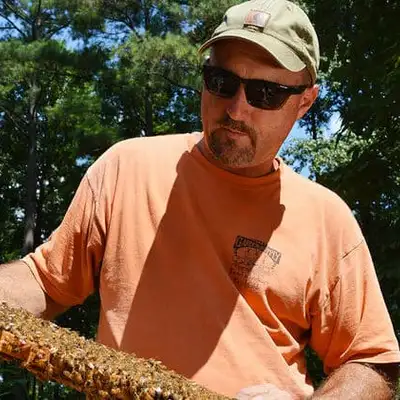
Yeah. One thing that stood out to me when I got there and it just made me stop dead in my tracks. Not only because I heard bees but I saw a beekeeper and the full regalia. Right. Doing her thing. And so I wanted to ask you about bees. Yeah. So, so bees are, and how you got even involved in bees. Bees are my.
One of my new passions of, okay. I I watched beekeepers from afar. I had a neighbor that was a beekeeper didn't know him well, never run over to real and really introduce myself, but I would watch him out there working the bees and, and always thinking that I needed to walk over and introduce myself.
And, and, but yet you're not, you're not dressed in bee gear, so you don't really wanna walk too closely. Right, exactly. And so I eventually ended up going out and buying a beehive and, and. I literally used like pantyhose in a big hat and you know, if you can imagine this, this, this picture, you know, I can, and, and heavy gear and big [00:07:00] gloves and I went into the beehive and I got just stung probably 40 or 50 times.
I mean, pantyhose is probably not the best. It wasn't probably the best gear. Yeah, exactly. It's not a shield screen or something, you know. But I, I left the beehive to fend for itself, and it lived for about four or five years. And so I would walk over and look at it from afar, but I never went back in it.
And then years later I just decided I was ready to, you know, I had the money to buy actual gear and I was ready to go ahead and jump back in. And I bought a couple hives and we, they, they did well, I, I, I think I was up to three or four hives and then I lost one through the wintertime and I was like, I was like, I don't like not having, you know mm-hmm.
My five hives. So I'm like, maybe I'll have 10 hives instead of five. And that way if I lose some, you know, if I can get back to 10 quick. Mm-hmm. At this point in time, we have about 300. Beehives that we keep and we keep 'em in a three or four [00:08:00] locations in Virginia. We keep 'em at Coddle Farms down in facing down east.
We pollinate a lot of their veggies and, and fruit and stuff. Then we, we have 'em from all around Wake County for our local honey. We've probably got 10. So do you bottle the honey and sell it? We do. Okay. So we've got, we've got about 10, 10 locations in Wake County. So it's all local honey with local pollen in it.
Where do you sell it? Do you sell it at Garden Supply? We sell it at Logan's and then we sell it at Garden Supply. Ah, okay. A handful of other locations, but. I will have to keep an eye open. I like local honey and they always say, you should eat only local honey. Yeah. Because of the benefits that it, it has.
Most, most of the honey that comes into the United States has either been mixed with corn syrup or is, is, is corn syrup's fed to the bees and then they produce honey from the corn syrup. So it's kind of Okay. It's, it's, it's actually not real honey. In, in a lot of cases when you see, we sell our honey for [00:09:00] about $16 a pound and.
I always tell PE people, people are always online that keep bees asking, how much should I sell my honey for? And I'm like, figure out what it costs you and then figure out how much money you, you can afford to lose because it, there's not, it's not really a profit center. It's, it's a, it's a byproduct of the bees and it kind of helps fund your hobby.
But even at 300 b beehives, it's. Still a hobby. Yeah. Okay. Still costs money every month. Yeah. You're not, it's not like you're getting rich off the money or anything. Right. Okay. But, but local honey, you know, it's not filtered. It's, it, it's run through a, a screen and so you, you're getting sampling of all the pollen that you that's in the area.
So, we'll, we'll harvest honey from the spring, and that's, that's basically anything that bloomed from February until June. So you're getting a sampling of all of the above. What is your honey called? Do we look out for a certain label? Our, it's actually our [00:10:00] local honey is is the label. Oh, I have seen that.
Yep. I just didn't put two and two together. Yeah. That it was yours. Yep. So, so speaking of honey and, and pollinating plants, what are some examples of pollinating plants that we can buy that would work well? In our area. And why are they important to include in our gardens? Clover is a, is probably one of my favorite seeds to I plant.
Thousands of pounds of seed a year. Literally I drive around with seed in my truck and I'll stop and seed to the side of the road in my neighborhood. Or can you come to my house next, I will give you my address. You can come see clo White clover is, is great in a lawn. It's nitrogen fixing. It's good for the soil.
It's good for pollinators. It's super easy to grow. It's, you can control weeds and I'm not a big advocate for Roundup, but, but in this case, sometimes I'll use Roundup because Roundup doesn't kill clover. So you can use it on at a very light [00:11:00] application, and you can actually, so you could have a, you could have your lawn B clover.
You can spray the grass out of it. And so you'd have this really fluffy, loose lawn that's got white flowers and, and not have the grass to cut. So in that, in that application, it's a really, you know, using Roundup as a is kind of a win. But the. Clover's one buckwheat's, another, you can seed buckwheat about four or five times a year.
And it, and it produces a lot of nectar. The bees only are only allowed, only able to get nectar from it from early morning until about noon, and then the nectar dries up. But they, because you can seed it four times a year, you can really kind of supplement your bees with it year round. Yeah. Yeah. Okay.
Sunflowers are good for nectar and pollen. Cosmos is another good one. All of the ecs, the Purple Cone flowers. Mountain Mint is the perennial plant of the year. Mountain Mint. Everybody should have mountain mint in their [00:12:00] yard. It's, I've never even heard of mountain Mint. Yeah, it is a, it's in the Mint family, so it's, it's gonna spread.
It needs a, you know, a decent sized space, but it has a kind of a frosted white flower in the, in the spring through fall. When it's in Bloom, the, if you touch the plant, the entire area is gonna smell like, like menthol, kinda. The when you look at the pollen, when you look at the flower in bloom, it.
It's covered in every kind of being known to man. Like you'll, you'll see pollinators that you've never seen before and the entire plant is just kind of a buzz. It's, it's really unique. Okay. I need to, I need to look into that. Yep. That I, and I have, I'm envisioning the, the perfect spot in my yard for that as well.
[00:13:00]
I've been hearing a lot of talk lately about native plants and not in ways that I ever considered the topic before. It's been more in conversations about natural disasters such as wildfires and hurricanes. Can you talk to me about why native plants are important? You know, I've got a. Good friend Andy Upshaw, and I've, I've never been, you know, overly interested in native plants.
Mm-hmm. I always liked exotic plants. And I, Andy was teaching classes on native plants and I was talking to him about it, and he was like, you've gotta listen to the reasoning behind it. This is 20 years ago. But it's just a, it's a, it's like a. A woven quilt. I mean, it's, it's the, [00:14:00] everything touches everything.
So it's, you know, one, one insect eats. One type of plant. And when the plant's not around, it's not gonna, it's not gonna do what it needs to do to, to benefit another insect or a bird or so I mean, it's, it's the whole ecosystem thing. Everything is tightly woven together. So when you, when you're missing some of those native plants, and we've, when we've removed, you know, big tracks of land, to build subdivisions or the way Roundup is used on a farm is a disaster. They spray from, they spray the entire farm, they spray all the way out to the tree line because they want wheat control. They want to be able to harvest the plants easily, and they want the plants to have as much nutrients as possible.
But you're losing all of the golden rod, for instance. Golden Rod is a, is a plant that not only honeybees, but all native bees [00:15:00] use in the fall for Nectar. And it's kind of their, it's, it's one of the plants golden rod or that will give you. Nectar at, in that late season, right before the, the bees go dormant.
So they, it gives 'em the ability to either exist and continue to lay the queen, to continue to lay eggs or it to store nectar for the, for the following. You know, for the wintertime, I. I, sorry. See, I even have pollen in my throat. Mm-hmm. The good old yellow stuff. I've, I've been hearing about native plants in terms of, especially when the wildfires happened mm-hmm.
In California at the beginning of the year. And a lot of talk was about how wildfires can spread even more if the plants are not native to the area. It was just, it was fascinating to me. I, I heard a podcast about it recently. So that's why I've been looking into more native plants. Do you, do you have any that are particularly good for our area that you suggest?
You mentioned Golden rod. Is that something Yeah. Golden. Should have. Yeah. It's a great, it's a great perennial plant. [00:16:00] Mm-hmm. It, it spreads in a clump. The be balm, ora are, are really, really good plants. Pensman cardinal flower. There's a lot of good native perennials that we can use in the area.
That mountain mint, a native plant. There we go with that Mountain Min again. Yeah. I've gotta look into. Let's talk about vegetable garden gardening. I am mostly excited about it this year because I have always had too much shade in my yard. Mm-hmm. But we had some trees removed. Nice. That needed to come down, and now all of a sudden I am blessed with sun.
That's perfect. I'm, I'm very excited about this. So now I feel like I'm going to finally be able to produce. Mm-hmm. This episode is going to be released on the unofficial vegetable planting day in our zone in North Carolina, or at least what I've always heard. April 15th. Yep. That's kind of the magical date for no more freezing right temperatures.
The last freeze date. Mm-hmm. That's, that's great for tomatoes, [00:17:00] peppers, all of that kind of stuff. What vegetable plants should I plant today, April 15th? And which ones should I wait to plant? Plant until it's even warmer? The longer you can wait, the better. Like even into, you know, the third week or fourth week of April.
Okay. Really cool nights will stunt like tomato plants, and then it takes, I have found that out too, the hard way. It takes them a little bit, a little bit of time to kind of recover and push growth. So planting them a little bit later they'll, they'll, they'll grow on faster and they'll produce faster actually.
But tomatoes, peppers zucchini any of the squashes lettuce you can do from seed at that time of year. You're past the, the earliest, the earliest date for gardening is February 15th. Which is all the coal crops. So it's broccoli, lettuce, cauliflower, cabbage, any of that kind of stuff. Those are mostly the [00:18:00] winter.
Those are the winter stuff, okay? Yep. And there's two dates for planning those. You wanna plan 'em February 15th and you wanna plan 'em August 15th. Not many people do really well with coal crops because both of those dates don't seem like. It's, you know, it seems way too cold to be going out and planting a little teeny start in, I bombed my winter plants.
Yeah. February 15th. I mean, we still have winter plants now, and people are still asking for 'em. People are still wanting to plant them, and, and you can have success with it, but the real, real success with like broccoli is February 15th, you know, to plant it February 15th. Yep. And it'll produce, I did not know that it'll produce until about June.
So you take the, in, in, say, April or May, you cut the big head of broccoli, and then you're gonna have little broccolini that kind of pop up from each one of the, the leaf joints. So every day you can go out there and cut it almost, and you, I'm making mental notes now for next February. And you really need to go out and cut it, you [00:19:00] know, because it's, it, it, the warmer it gets, the faster it throws flowers.
And so if you don't go out and cut it every day, those flowers are gonna pop up and then start to open. So it sounds like where I made the mistake was I planted let's see, I planted cauliflower and carrots and what was kale? Mm-hmm. I thought maybe I went wrong because the winter was so wet, like we were talking about earlier.
Right. I was thinking maybe you benefited from a wet winter because you had plants and it was helping. Right. You know, keep everything wet. But I thought I went wrong because it was too wet. Yeah. And too cold. It could be too. I mean, they could be too wet, but, but the earlier you get them in, they, they, they can, they'll grow roots all winter long.
All plants in North Carolina and Virginia grow roots 12 months outta the year. So the, you know, you stick 'em in the ground, they'll grow roots. But if it's cold out the, it's not gonna grow top. But then as soon as you get some warm days [00:20:00] and some good sun, they'll start to push flowers and it'll keep 'em short and tight and they're not gonna stretch.
So we talked about native plants. Are there vegetable plants that are particularly good for North Carolina? For our area? Most of 'em, we grow really anything here, right? Yeah. We can, we can really grow most of anything. With the exception of fruit trees, there's, you know, there's limited Oh yeah. I've never even tried.
I don't bother trying that. But there's a few things that you, I mean, you know, if you've got space that the figs, figs do really well, blueberries do really well. And they're both. Everything that we can grow in North Carolina e easily grows without chemicals and, you know, a bunch of additional, you know, spraying and that kind of things.
I mean, blueberries requires nothing. It can be a hedge in your yard and you can go out, pick. Lots and lots of blueberries from it. Blueberries, figs, blackberries, raspberries strawberries all do well in North Carolina, so the berries are probably the safest fruit for us. Yeah, exactly. I have, I do have a friend that has a little lemon [00:21:00] tree, but she has to bring it in every winter and yeah, all the citrus does well.
And if even protected over the winter, like if it was. In a greenhouse that's unheated. You can keep it alive. Mm-hmm. Over the winters, sometimes they'll shed leaves, but then in the spring they leaf back out and they're worth having just for the fragrance, you know, when the, when it's in blue, it's amazing.
Yeah. I, I've tried blueberries. I have not had much success because the birds get to it. Yeah. Before I can pick the blueberries, blueberries, blueberries really require some sort of a bird cover. I'm learning that. I'm also, I I'm getting to the age now. I was just saying to a friend the other day, I'm getting to the age, the birdwatching age.
Yeah. We all hit it. Yeah. I think it's, it must be mid forties. Yep. That we like to just sit and watch the birds come by. Yeah. So I'll, I'll just feed those. I said I'd turned into my granddad. Yeah. At some point in time I was like, he used to tell me when the. You know, when the Robins arrived and I was like, and he would write it all [00:22:00] down, you know?
Oh, yeah. I'm not to the writing downstage. I'm not, I'm not either. Trust me, if I wrote it down, I would lose it an hour later. Yeah. I had lost that notebook. But but he would always say, oh, the Robins arrived two weeks later this year, or whatever. But he, you know, and, and all of a sudden one day I found myself with a bunch of bird feeders and putting different seed in 'em and enjoying them.
Yep. Yeah. And I was saying I plant tons of seed. I plant seed for turkeys and deer. I plant a lot of, I mean, I've got a, a bee farm that we literally just farm for nectar for the bees, but I also do food plots in them and I. I do very little hunting up there. I just, I, I drive around and the, the yellowfins are all over the zinnias and the mm-hmm.
Sunflowers, and there's doves in there, and the deer and the turkeys are starting to come in and, and then the bees, everywhere I look, there's bees on stuff. So I'm You're talking about turkeys do you don't live in, do you, don't, you must not live in the triangle. It's in Virginia. [00:23:00] Oh, okay. Okay. That, that explains it.
I don't think I've ever seen a wild Turkey in this area. I have in the mountains, but. You'll see 'em occasionally. Mm-hmm. Yep. Actually, I've got a, a, someone I know that lives in Chapel Hill and she has turkeys. Yep. Yeah. Get, so I guess it is possible you get, you get outside of the urban areas and and you'll see turkeys.
Yeah. Yep. I would love to see a wild Turkey. Yep. Okay. So we've mentioned Roundup a couple of times. Yep. And it's time for our What's up Roundup segment. Yeah. Where I ask you some quick questions before you go. What is your very favorite tree? Probably a Japanese maple. They're super hardy, super easy to grow.
You've got some out that the garden supply. Yeah. There're company. I saw those yesterday. People think people think they're very expensive, but it's because, you know, you're buying a tree that maybe, you know, there's, there's 10,000 varieties of Japanese maples. One of 'em may grow two or three inches [00:24:00] a year.
So when you're looking at a six foot tree, you know, it may be 15 years old. So to produce that tree. It takes a little more time and a little, but, but they're not, they're not drastically expensive compared to a, a maple tree that grows really fast and that's gonna be too big for your yard and oversized.
I just love the variety of color, the leaf shape. There's, I. And they are hard to kill. I mean, they really are they, I mean, we have a Japanese maple that we've had, to your point, forever. Yeah. It barely has grown, but it, it takes up, it a visual space in your yard that makes it worth it too. Yeah, and it's a, it's a plant that has a, a bigger value typically, like if you sell your house, people, people think a Japanese maple's, you know, very, very expensive and they, you know, bigger ones are, are more valuable, but.
To me it's, it's a plant that never really outgrows its space and it's something that can live as long as a house is there, where a lot of times some of the fruit trees, they age out and they need to be [00:25:00] taken out. Mm-hmm. And replaced. If, you know, flowering fruit trees, ornamental fruit trees, so it's, it's one that if you pick the right plant for the right space, it could be there as long as your house or you know, I've seen situations where houses are taken down and the Japanese maple remains and they build the house around the Japanese maple kind of thing.
Yeah. Yep. That's a very good point. What is the best herb or vegetable for a beginner to grow? Basil grows like a weed. You can grow it from seed or plants. And that's only a summertime as well, or is that It is, it's an annual. Yep. So that's one. Stevie is one that I always like to you know, get kids to plant, I've never done Stevia. Yeah, because you can, you eat the leaf and it tastes like sugar. Oh. Oh, I'll try that. Yeah. So it's, it's, it's really kind of a, a nice addition to the garden. Thyme would be the other one. Thyme red thyme creeping. Red thyme is become really, really popular as a ground cover drought tolerance.
Super easy to, to maintain [00:26:00] and produces some nectar for, for pollinators too. What plant or decorative yard item do you think is overused and you would be fine never seeing again?
I honestly couldn't even think of the answer to this question myself because I, I got it. I like to over decorate. There's sometimes there's a nandina. That is used at every fast food restaurant known to man and it's it's ugly from day one. And you know, what color is that? I kind of an orangey red, ah round plant.
And NANDs have kind of fallen on, fallen out of favor because they're not native and some of the varieties kind of get outta control. But a lot of 'em are still, still nice and have good benefits and mm-hmm. But yeah, I could, I could do without the, that. I'm gonna look out for those next time I Yeah.
Pull through the Bojangles. Yep. They're every parking lot. I guarantee they're everywhere. Guarantee is there. Yeah. There, there's actually some really nice [00:27:00] plants outside of my local Bojangles. Nice. I should not know that, but obviously I'm, I'm I there a lot. You've mentioned beekeeping. Mm-hmm. And of course gardening.
What is your other hobby other than birdwatching too? I keep oysters. We've got, I've got a place on the Hanock River that we raise oysters. Oh. Which is fun. It's a lot of work. It's, I, you could probably buy oysters. It's kinda like the big keeping thing. Yeah. You could buy oysters cheaper, but it's really nice to be able to finish oyster, you know, larger oysters for like oysters Rockefeller and that kind of stuff.
So we'll do events at the store and. And have sh be shucking oysters out there. And they're oysters. We've grown from oyster spat, which is about the size of a, a pencil lead to, you know, something that's six inches long, you know, about six inches long. And, and this is new to me. I, yeah. So it's, that's a fun thing.
And then managing, managing wildlife land. Mm-hmm. Like I love for the bees, for the deer, for the, and then, and then literally just walking [00:28:00] back through it. And, you know, I, I probably started managing. Wildlife land for deer hunting and, and for hunting. But I get so many more benefits out of, you know, watching the yellowfins.
And I've got probably, I think last year on our, on our property there was four or 500 yellowfins. They were everywhere. Wow. Yep. You'd see wet areas where they would be flocked to, and then they would be all over the buckwheat and and the sunflowers and millet and stuff that we plant for 'em. Mm-hmm.
So I really enjoy planting stuff, watching the seeds germinate, you know, and then watching the wildlife come in and I. And change the environment. So is this on the, the mountain side of Virginia or Central? We're straight up 85 right near Lake Gaston. We've got a, a tree farm. Mm-hmm. We grow most of our plants at.
We grow about 60%. Oh, and for the, for the garden center? Yeah. Okay. We grow about 60, 60% of our plants up there. [00:29:00] And then and then we've got this other place that is literally just kind of a be haven, wildlife haven that we bought to. Mm-hmm. Just plant seeds and watch it kind of grow. Nice. Evolve. It's, it's I spent the last three or four days up there and.
That's, that's one of my biggest passions probably is I can imagine. It's, it sounds amazing driving a tractor and, you know, you d drive you, you, you tear up the tear up the ground and then you come back through and you plant seed. You pop back up there two weeks later and I'll just be, I take pictures and I'm showing people pictures and I'm like, they're like, whatever.
It's mm-hmm. Green seed that, you know, the, it's a green field. You gotta, you gotta be there to experience it, I'm sure. Yeah, exactly. But watching those seeds germinate and watching them grow up and then seeing them flower and then watching all the wildlife come in is just it. It definitely gets me excited.
I, I mentioned the, the word oasis at the beginning of our, of our talk, and this is kind of what you're describing right now is an oasis. Yeah. You have everything from [00:30:00] plants and wildlife to oysters and a river. Right. Exactly. It sounds dreamy. Yeah, it's kind of fun. It's a fun life. It does sound like a fun life.
So, did you. Did you look at your parents and say, I told you so I didn't No, I thought it, I'm sure you did. Yes. As any, any good child would. So tell everyone, first of all, tell us where Garden Supply Company is located Yep. And where we can follow you on social media. Perfect. It's 1421 old Apex Road in Cary.
So we're, we're right in between Maynard and Cary Parkway on Old Apex Road. And then they can follow us garden supply co.com on the web and then Instagram and Facebook. Okay. Yeah. You guys are a great follow. You'll always have something pretty to look at or something interesting to, to follow on Instagram and Facebook.
Thank you so much for being here today. You certainly absolutely rose to the occasion. Alrighty. Nice being here. [00:31:00]