Subscribe
Share
Share
Embed
Welcome to Freedom and Glory: Tales of American Spirit—a podcast celebrating the heart of American craftsmanship, resilience, self-reliance, and the power of disruption. Through inspiring stories and authentic storytelling, we shine a spotlight on individuals and communities who embody these values, proving that small, determined efforts can spark meaningful change.
Join us as we share personal tales of triumph, innovation, and hope—moments that define the American spirit and shape our nation’s identity. Whether you’re seeking motivation to pursue your dreams or a reminder of the power of community, Freedom and Glory offers a powerful dose of inspiration rooted in resilience and determination.
Listen, be inspired, and take action.
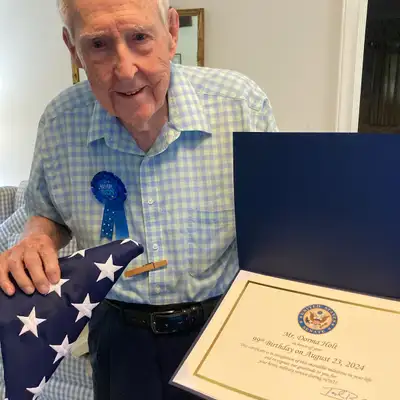
Liz: [00:00:00] Hi, I am Liz Morris. I'm here with Bill Lume, and we're so excited for our special guest today. Um, it's Mr. Dorma Holt. He lives in Burlington, North Carolina. He's a 99-year-old World War II [00:00:15] veteran.
He was drafted in 1944. He served in the Battle of the Bulge. He also liberated a concentration camp. After he came home, he lived a whole second life. He has a beautiful family. [00:00:30] He was a businessman and entrepreneur, and I'm really excited to be speaking with him today.
Bill,
Jim: Two years of his life, he, he was at the Battle of the Bulge and the Concentra. I mean, that's a lifetime for some people, and he's part of that greatest generation. [00:00:45] So he had 78 years after that where he had a full life and a wife and a family. And to get a perspective from a guy like this who's 99 years old, where he was on a farm and he was making his own food, it's the only way they ate to where we are today.
It, it [00:01:00] was really fascinating to, to pick his brain and his wisdom, and that's what you get when you're a hundred years old almost. I don't want to put him at a hundred yet, but the wisdom that you gain over a lifetime. So I can't wait to get into it. He's in Burlington.
Liz: Yeah. He was in the [00:01:15] retail industry for 99 years.
I think growing up, his mom, his parents had a small store, so he's been in the retail industry and, you know, took a break to, to be a part of the army and, came back and kind of jumped [00:01:30] right back into it. I mean, it's just amazing the resilience that. Um, and the, the kind of full life that he's lived.
Jim: And I think it's something we can all take away.
I think sometimes we live our life and we forget, you know, when, when I mentioned the [00:01:45] greatest generation, they really, they had the depression, world War II in a completely different lifestyle than we have today. So what I took away from it is the, first of all, he is. He's very knowledgeable. He's very active.
He's, he's, I mean, I [00:02:00] hope I'm even close to being that at 99 years of age, but to, to again, to, to sit down and go, oh my goodness. You know, I hadn't thought about it. And when you get into what was most important to him after 99 years, I think, I think people will be fascinated by it. I really do.
Should we [00:02:15] play it for him?
Liz: Yeah. Do
Jim: you, do you guys wanna watch this? I do.
Liz: Yes, absolutely. Coming up after the interview, we have a very special segment where we're gonna highlight one of our customers. Awesome. Can we watch now? Let's watch.
Liz: Why don't you start by tell us a little bit about [00:03:00] yourself. Who is Mr. Holt?
Mr. Dorma Holt: I was raised on a little farm down in Alamance County mother and father and one sister. I. We didn't have any money, didn't have [00:03:15] any indoor plumbing water. We had a, well that we had drew water out for all us, our use and all our animals. We raised animals, had milk, cows and goats and sheeps and [00:03:30] pigs and so on.
But we were just self-sufficient. And of course we. Canned stuff to eat. So raised wheat and corn. So we basically just raised ourself, no money, [00:03:45] practically nothing. So that was the upbringing that I had went to Svin school and graduated at 11th grade at that time. As such, [00:04:00] After graduation, I needed a job, so I went to work in the hoser mill, boarded socks and mixed dyes. that. But anyway, [00:04:15] then I was drafted. Well, it was sent a, a notice of being drafted first, and they sent us for a physical examination. Of course, I was a one, so I stood by the mailbox and waited for my [00:04:30] draft notice, and I got it and left Graham went to Fort Bragg and that's where I had basic training. And during the, after [00:04:45] shooting the guns and the rifles and, machine guns and Bangalore torpedoes and all that stuff they offered me a chance to go to a special school and [00:05:00] about 12 other guys. So we thought this was great honor. We got together and they said, what are we going to be doing? You're going to be experts in explosives, dynamite, TNT, booby traps, tank [00:05:15] mines, and so forth. So that's what we did. I. And we blew up South Georgia. I think so we shipped out, went to New York, got on the aia, went from New York to [00:05:30] Glasgow, Scotland, across the English channel. I didn't get there. I was young enough. I didn't get in the early part of the war. So I didn't join the outfit until they were into France already, and we joined the outfit there.[00:05:45]
Went through up to, close to the Belgian border, across the Belgian border, and instead of being signed to the infantry. They assigned [00:06:00] five of us to a Amphi truck company, a duck outfit. So we were one of the first ones across the Ryan River, into Germany proper.
Liz: Mr. Holt, what was your role on the duck? [00:06:15] Um,
Mr. Dorma Holt: They had, in the duct company, they had machine guns on about every fourth duct, and I was a machine gunner on the duct [00:06:30] with a guy from Pennsylvania, but after about two weeks. One of the guys got killed driving the duck and they gave me his duck, so I had my own duck after [00:06:45] that time. And then we proceeded down through Germany.
About half the people tried to shoot you the other half, glad the war was over and. We're glad to see you. And we [00:07:00] proceeded all the way down through Germany, down into the Alps Mountains, across the Dan New River and, we got up in Alps mountains with the snow, with these [00:07:15] ducks on little old winding roads.
Wonder we hadn't got killed. But anyway, down into Austria, we liberated a concentration camp named Mathen. They had duck. They were [00:07:30] trying to climb all over the duck, trying to hug us, and we were driving to fight them off. Because they had lice all over 'em and just just pure, just almost dead.
And many of 'em were dead. [00:07:45] So after we liberated that, then the war ended pretty soon, I think April, 1945. So we moved back into Germany. [00:08:00] And cleaned up our ducks and so forth. And then we drove back into Central France,
Liz: you were also in the Battle of the Bulge, which is a incredibly historic battle. you
[00:08:15] take
us
through,
you
know, what your experience and saw.
Mr. Dorma Holt: Yeah, well, that was this crossing Ryan River was end of the battle of the bugs. I was not into main part [00:08:30] of the, the battle, but it was still going on when I got there. And, that was part of the Battle of the Bulge was, getting across the river and [00:08:45] getting away. And oh, we got shot at, and I got hit with, hit by a strafed, by an airplanes hit.
Got my duck was hit, [00:09:00] but I was not I was not hit. And, of course they they were doing everything they could to, to keep us out of Germany proper, but we crossed a river anyway and
Jim: [00:09:15] You, you were a young man at this time, and I mean, this is a, a, a life experience most people don't get to go through. What was that like for you? I mean, what were you thinking?
Mr. Dorma Holt: Well, let's put it this way, I was [00:09:30] not real smart. But I had never been anywhere much, didn't have any. Training didn't have any people to assist me or to teach me or train me to go to school. [00:09:45] Didn't have money enough to go to college or anything like that, so, so I was very naive young man. And of course all this fighting was new to me, and it kept us [00:10:00] so busy.
We really didn't have time to to think about a whole lot of uh,
Jim: sorry, when you got out of the
service.
Um, I mean, you were in for
two years. Am I right about that? Just two years. I mean, you go from a war and a concentration
camp
back to [00:10:15] normal living. I mean, how, how do you do that?
Mr. Dorma Holt: It takes a long time. We got on this ship in, marse France sold out the middle of the Mediterranean. It was named the General Omar Bundy, [00:10:30] and sailed out with a rock of Gibraltar down across the South Atlantic to Panama with the canal down across the equator. By the way, you're a poly before you cross the equator [00:10:45] and after you cross the equator, you're a shell back.
And they had a ceremony that they went through, which was pretty rough. Then we went to New Guinea and from there to Manila in the Philippines. [00:11:00] That trip was 15,000 miles, 47 days on its ship with one day off in Panama. But while we were in the Philippines, we got, started training for the invasion of [00:11:15] Japan.
I wish it was be a direct frontal assault on Tokyo and Yokohama, and this little ducks would only go seven miles an hour, so. To, to, to get off in Tokyo [00:11:30] Bay in an attack thing with a little boat going seven miles. Now that's not a real hitting duck. But anyway, they dropped the bomb and we were tick to death.
[00:11:45] But to get back to your question, after we unloaded Gyps there for a while, the docks were still in pretty good shape in Japan, and the boats were able to unload. But the trade crew, turned [00:12:00] in our ducks for trucks and so on, but, it was hard to adjust. [00:12:15]
Jim: Holt, it sounds like, I mean, [00:12:30] you were, after two years, you were a. For lack of a better term, you are a real, you know, veteran in your unit. I, I mean, how do you think you had changed as a person? How, how had, you know, [00:12:45] being in the war had it impacted you?
Mr. Dorma Holt: Well, it makes you study people more. When I meet people, I try to think about, [00:13:00] can I get any knowledge from them? What can I learn from them and and so forth. And also being in the business. This is, I think, working [00:13:15] with people has changed me, brought me back more than so forth.
One time I went to the doctor and I was having problems with nightmares. And he said, well, I'll [00:13:30] just schedule you with another doctor and let him talk to you a little bit. I said, Uhuh, I'm not going. I'm not going. He said, what do you mean? I said, you don't know how people react when they [00:13:45] hear somebody that's shell talk or going to a psychiatrist.
I said, people, people back off. They don't want to associate with you and they won't give you a job and so forth. I said, I'll tough it [00:14:00] out myself. I'm, I'm not going to any psychiatrist. So, so I did and I had flashbacks or period of time and even to this day once in a [00:14:15] while.
and I didn't have it near as rough as a incredibly different. You know, back then going to a therapist or a psychiatrist versus today.
That's right, that's right. Now the general public, everybody accepted [00:14:30] you tried to do everything they could to help you. This was during World War ii and, the, people were at a religious high. They would do anything they could for a [00:14:45] veteran. And it, it was just amazing. So it was not just the soldiers that were the greatest generation, it was the people in the country because they were all behind this effort.
It [00:15:00] was an effort to save the world, and they knew it, and everybody pitched in and did everything that they possibly could.
Liz: Well, Mr. Ho, can I ask you, um, that was 78 years ago, boy, what you been doing for 78 years?
Mr. Dorma Holt: I [00:15:15] came home and, bought a tractor and tried to farm a little bit and we didn't have enough land to do any good, so that didn't go anywhere. So I bought room factory. I manufactured and [00:15:30] sold rooms for a while, and that was not a sweeping success. The people that got into war earlier than I did were home and married and and so forth. And here I came home single. And [00:15:45] the other people had grown up and I didn't have anybody to associate with, didn't have any friends, couldn't go to school, didn't have any money, so I was just trying to look for a job. So [00:16:00] I looked around and went to work for Sears Roebuck and, and, told the guy there if I ever made as much as $5,000 a year.
That's just all I wanted to do. [00:16:15] So I went to work for Sears. And I worked for Sears for 31 years.
Jim: Mr. Holt, tell us about how you and Mary Ellen. met
Mr. Dorma Holt: well, as I say, I was like a fish outta water. Didn't have any friends or anything. [00:16:30] Didn't know how to meet people and but anyway, a boy that was younger than I was, had to date with his girlfriend. I want to know if I wanted to go along and said maybe his [00:16:45] girlfriend could know, knew somebody. I said, well, fine.
So went on. I went along with him and she went and a friend of hers and brought her out to the car, and we rode around a little bit and [00:17:00] she seemed to like me and I seemed to like her. I never seen her before anything, so I asked her if I could come back again. And so we dated for a while and after about a year we got [00:17:15] married, then, after I retired. Let's see, what else did I do? Oh, well, I went to school. I decided if I was ever going to get anywhere. I went to school before I retired. This was [00:17:30] back when I got with Sears. Went to Elon College and took extension courses from Sears and from University of South Carolina.
Liz: From where you started as a young man, [00:17:45] to where we are today, are you amazed by the changes or how do you feel about today's generation is the greatest generation?
Mr. Dorma Holt: I am, amazed. It, it's been [00:18:00] more change in, in my lifetime than ever in all the history put together. I'm sure. And, to me, I, I think the field of communication is probably the greatest change [00:18:15] that I've seen. Not just to me but to everybody because, we had newspapers and a little bit of radio.
We didn't have radio until about 19 four. We bought one, a battery [00:18:30] job and but the only advertising people did then was newspaper and radio. TV came out, TV outstripped, everything. It took over [00:18:45] everybody's thoughts. And today I think the TV has, I. Well, it's helped people like me that didn't see anything and never been anywhere.
There's lots of [00:19:00] people today that have seen the world through television that they're never able to go there and see it and the cultures and and so forth. But at the same time, television has [00:19:15] ruined a lot of things. Um, nobody communicates anymore. They talk with their thumbs. And that's it. So I'm not sure how good it is.
Jim: [00:19:30] Obviously, as you get older, you, you gain wisdom and, um, what, what would you say has been I. The, the most important thing you've, you've learned.
Mr. Dorma Holt: Well [00:19:45] just people, I don't, I don't know how to put it in words hardly, but associating with people, and that part of, that's part of communication. [00:20:00] I learned, learned to be tolerant and to, although I've done all the talking this morning, we try to learn to be tolerant above other people and let [00:20:15] them do talking
Liz: what values and principles have kind of guided you throughout your life?
Mr. Dorma Holt: I think, was raised to go to church and,
uh[00:20:30]
Seeing what I did in World War ii, while I in World
see how anybody could not believe in a
how anybody could not believe in a of nature and the the things of and [00:20:45] so forth. So I've the people
so forth. so I've always Religion as such, uh, religion our country has lost a
unfortunately, I think
base [00:21:00] has lost a lot of Its
but to answer your question about what's affected me,
to I think answer your question
about what's affected me, I think I learned to deal the various jobs that I've
had, [00:21:15] in the various jobs that I've
had, have a good outlook and enjoy have a good outlook and enjoy,
enjoy other people. Yes.
Liz: Well, it's, [00:21:30] it's not, um, every day that, you know, we get to talk to someone with your kind of life experience. And, um, I just wanna say, you know, personally, I don't have my grandparents around anymore. And it's just [00:21:45] been, um, so amazing to talk to you, Mr. Holt. We really, really appreciate you coming on the show and.
It's been awesome to talk to you. Thank you so much. It's a real privilege.
Mr. Dorma Holt: Thank you, sir. Appreciate it. [00:22:00] Come to see me anytime. Bring somebody with you and Come to see me anytime. Bring somebody with you and we'll
Liz: good. That's awesome. That's an [00:22:15] amazing guy, Liz. I mean, what was your takeaway on this?
I, I mean, it's just an incredible hearing about, I mean. I don't think I've ever talked to someone who was 99 years old before and just hearing about all the changes [00:22:30] that he's seen in his lifetime. It's, it's wild.
Jim: It is. And when you really think about it, he started off by telling us his life when he was a young kid, he was on the farm.
If he wanted to eat, he had to go kill the chicken. Right? And now look where he is [00:22:45] today. Look, think of all the wonderful things he has seen in his life when we asked him about. One of the most important changes he felt, and it was communication, right?
Liz: Yeah. Just the evolution of. How TV changed, how, you [00:23:00] know, communication and how the advancement of technology is just incredible.
And I think, you know, he pointed out that no one has kind of seen that, that length of, or advancement of [00:23:15] change. Um, in their lifetime
Jim: from a, from a young man going into the army, traveling the world on a, on a ship to sitting at home, uh, and talking to us over doing
Liz: an interview
Jim: over an interview over the internet.
I mean, that was just [00:23:30] crazy. He was a very wise, genuine, and he, he also valued people. It seemed like that was very important to him, that he became more. Tolerable and people meant a lot to him. And, um, so I, I think we could all learn a lot from him. [00:23:45] Amazing guy.
Liz: Absolutely.
Jim: Amazing guy. Let's do a special segment where we highlight one of Carrot Tops customers.
Liz: Yeah, absolutely. We wanted to take a second to talk about Alamance County Veteran Services, and [00:24:00] they've actually been a customer of carrot tops since 1998.
Um, we work with Tammy Crawford over there and we reached out to her, um, we wanted to do a, a veterans, uh, [00:24:15] event and she connected with us with Mr. Holt and it was amazing. We, we brought a team from the office out to his house and we were able to do some yard work with him. We cleaned his gutters. We painted front and back [00:24:30] porches.
Um, it was just incredible for everyone to meet him in person and to, you know, hear some of his stories.
Jim: These organizations are awesome for veterans, uh, regardless if you're from the greatest generation or [00:24:45] you're brand new to it. In fact, uh, Alamance Counties, uh, veterans Services offers, uh. A lot of services like filing for disability and pension.
Uh, that's tough to do the paperwork for a lot of veterans that are there for that and handling the medical bills, which a lot of our veterans [00:25:00] today are struggling with and exploring education opportunities and home loans and all kinds of things. I mean, it's nice that we value veterans and it's awesome that we have something like Tammy Crawford and organizations like that, that are willing to step up and, and make a [00:25:15] difference, and it's very easy to get a hold of them.
All we gotta do is call them and the telephone number is (336) 570-6763. Or you can go to their website And that is [00:25:30] alamance nc.com/veterans/.
Liz: And in addition to the, the services that you just mentioned, bill, you know, they also put on community events and their next event is coming up in March [00:25:45] and it is a breakfast, um, a Vietnam Veterans Breakfast.
Oh, nice. And that is, um, a, a great way to meet local veterans hear about their experiences to. to honor those who served,
Jim: Alright, Liz, [00:26:00] uh, one down, another one to go. What's coming up next time?
Liz: Yeah. So next episode. We're really excited to talk with Sean Rosa Warren. And Sean is a huge advocate for veterans and she and her husband, uh, [00:26:15] Marine Corp Veteran Kit Warren, um, worked on several community projects they put together.
Uh, street banners for their hometown heroes. So, uh, banners highlighting veterans that have served in their [00:26:30] community and after kit's passing. Sean has started her own nonprofit and continues positively impacting their community in de Rider New York. So really excited to connect with Sean next episode.
Jim: I can't wait. Good to see you. Thank you. [00:26:45] Thank you