Subscribe
Share
Share
Embed
One of the most essential ingredients to success in business and life is effective communication.
Join Matt Abrahams, best-selling author and Strategic Communication lecturer at Stanford Graduate School of Business, as he interviews experts to provide actionable insights that help you communicate with clarity, confidence, and impact. From handling impromptu questions to crafting compelling messages, Matt explores practical strategies for real-world communication challenges.
Whether you’re navigating a high-stakes presentation, perfecting your email tone, or speaking off the cuff, Think Fast, Talk Smart equips you with the tools, techniques, and best practices to express yourself effectively in any situation. Enhance your communication skills to elevate your career and build stronger professional relationships.
Tune in every Monday and Thursday for new episodes. Subscribe now to unlock your potential as a thoughtful, impactful communicator. Learn more and sign up for our Newsletter at fastersmarter.io.
You know that feeling of joy
and relief when a meeting gets
canceled from your calendar?
It doesn't have to be that way.
Meetings can be effective.
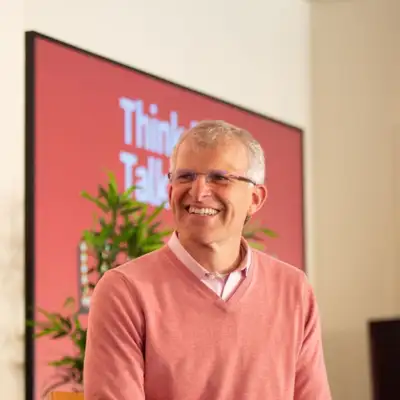
I'm Matt Abrahams, and I teach
strategic communication at Stanford
Graduate School of Business.
Welcome to this Quick Thinks episode
of Think Fast, Talk Smart, the podcast.
I'm often asked how to
make meetings better.
So today I'd like to share with you
what we can do to improve our meetings
and have a positive experience
and positive results after them.
When it comes to planning for meetings,
we have to think about the three stages:
what we do before, during, and after.
The very first thing we have to
do when it comes to meetings is we
have to ask ourselves, "Do we really
need it?" Meetings are often used as
band-aids, as ways of covering up for
other larger communication challenges.
I once was brought in to consult
at an organization that was having
at least three meetings a day for
most people, and those meetings
were bringing in 20, 30 people.
Why was that?
They didn't have effective means for
communicating decisions and the thoughts
that the senior leaders were having.
As soon as we developed those
means, all of a sudden, the
number of meetings disappeared.
Ask yourself one fundamental
question: What is the best way
to convey this information?
Is it by convening a team
and having a discussion?
There are many cases
where that is the answer.
Making decisions, ideating, lots
of reasons to convene people.
But there are lots of things we do that
we don't need to pull people together.
For example, giving updates.
There are lots of creative ways to
get updates out to people without
having to have everybody sit in
a room or on a Zoom to learn.
So question number one is: Do
we actually need the meeting?
Once you've decided that that
meeting is needed, you need to
think of what the clear goal for
the meeting is at the highest level.
And you know, if you've listened to
me in the past, that I believe goals
have three parts: know, feel, do.
What do you want people to know
as the result of the meeting?
How do you want them to feel?
And what are the things
you want them to do?
You need to clearly be able to articulate
this to help with the next step, because
the next step is to take that goal and
think about how do you operationalize it.
You have to create an agenda.
I'm a huge fan of structure
in all communication.
An agenda is the structure for meetings.
To me, a good agenda
has several components.
First, it lists the topic
in a very clear way.
Second, who is in charge of that topic?
Who will be facilitating or
delivering the information?
How long will they have?
This helps set some boundaries.
And you should identify what is going to
happen as a result of that agenda item.
Is it we're gonna make a decision?
Is it for information only,
or is it for discussion?
By helping people in advance know what the
topic is, how long we're spending, who's
in charge of it, and what the outcome
will be, people can be better prepared.
You then have to think about what
is the order of the agenda items.
There's actually interesting
research on this.
Most of us have a tendency to
put the easiest thing first
as a way of ramping us up.
Well, unfortunately, in meetings,
there's this notion of time entropy.
We tend to expand and take
more time than we need.
And if we're spending more time on the
simple task, it leaves less time for
the more challenging and complex tasks.
So what the research suggests is
if you were to have three different
topics, one that's easy, one
that's medium-level complexity,
and one that's really challenging.
You should put the medium-level complexity
one first, then move to the most
difficult, and end with the simplest.
So think through not only what
the agenda is, but the order
in which those items appear.
That can help.
Finally, you need to think about
who is attending the meeting.
Who you invite and who you
require really makes a difference.
It signals to people the importance.
And you wanna respect people's time, so
only invite people that are critical.
Now, there might be people who need to be
notified of the outcome of the meeting.
That's fine.
Don't invite them to the meeting.
You might wanna even list these
are the people who will receive
the output of the meeting.
This planning up front will increase
the likelihood that your meetings
will be effective and that people will
respect that there's value happening.
So we start by thinking, "Do we need the
meeting? What's our goal?" Know, feel, do.
And then we create our agenda.
The next step before we actually have
the meeting is we have to announce it.
I believe one of the most underutilized
expectation-setting tools we have,
especially when it comes to meetings and
presentations, is the calendar invite.
What do you call your meeting?
It's important to have a
meeting that has action.
Many of us have an allergy
to the word meeting, so don't
call your gathering a meeting.
Call it something else.
Give it the, an action.
Define the decision that's being made
or the ideas that are being generated.
You don't have to use the word meeting.
You have to think about the time
that the meeting will take place,
both how long and what time of day.
When it comes to length of
meeting, it's pretty easy math.
You just figure out the agenda items.
And by the way, a meeting doesn't have
to be only thirty minutes or an hour.
You can set up a meeting that's
twenty minutes, fifty minutes.
We don't have to fall victim to the way
calendars schedule timing of meetings.
In fact, there's some research that says
a time-compressed meeting, a meeting
that, that is scheduled for a little
less time than it really should take,
motivates people to be more efficient.
So how long should also be something
that you put in the calendar invite.
Now, you should think about
when the meeting takes place.
You want people to be fresh and able
to focus and not rushing around.
It might serve you well to spend
a few minutes checking on some of
the key attendees' calendars to
see where your meeting fits in.
And maybe you move it to where people
aren't coming from something or
needing to rush off to something else.
So the calendar invite
is really important.
Additionally, on the calendar
invite, I like to put if any
tools are going to be used.
Let's say we're going to use a
specific technology in the meeting.
I like to list that and maybe even
put a link to a YouTube video or
other educational video to help
people know how to use that tool, so
I don't have to become tech support
to help people learn that tool.
And we're gonna talk about this in
just a minute when we talk about
actually running the meeting.
But if you have any specific ground rules,
like content stays only in the meeting
or we want cameras on if we're virtual,
it's a good idea to put them in the
calendar invite and on the agenda as well.
So those are the things we do in advance.
There's a lot of work to setting
up a likely successful meeting.
You have to spend time working on that.
Now, in the meeting itself,
it's important to congregate and
get people started right away.
It is in your best interest to start
on time because that sends a signal.
It sends a signal that we start on
time, and hopefully we end on time.
Those who show up late, while it
can be difficult to integrate them
in, you're teaching a lesson there.
So I'm a big fan of
starting meetings on time.
I like to set expectations.
If there are ground rules,
I'll share those ground rules.
Some good ground rules are
we listen to everybody.
Everybody has a chance to, to speak.
Uh, sometimes I, I request that
people paraphrase what they're
saying, what somebody else said
or the ideas that they're then
commenting on to keep the themes going.
Set those ground rules up front.
Then set expectations.
Share the agenda and ask if
anybody has questions or concerns.
And then jump right in.
If you're the leader of the meeting,
part of your job is to make sure
that you're sticking on time,
so you're keeping track of that.
But you also wanna make sure that
everybody has an opportunity to
contribute if and when they want to.
So you become a facilitator.
That's a very different skill set,
but it's one that requires vigilance
to time and what's being said.
I like to have a way of
capturing information.
Technology certainly allows us to do that.
Or assign somebody the responsibility
of capturing that information.
A little bit of advice if you are hybrid.
Hybrid is where not everybody is
virtual and not everybody is in person.
Some are in each situation.
A good meeting makes sure that regardless
of how you're attending, virtual
or in person, you feel connected.
So a quick and dirty thing you can do
if you're leading a meeting is I always
like to start the conversation with the
person or people who are fewer in number.
So if there are five of us in a room
and three of us on Zoom, I'll always
solicit input and feedback from those
on Zoom because there are fewer of them.
What that does is it reminds the, the
majority, the people who we have more
of, that these other people exist.
Similarly, if I have a hybrid situation,
I will request that those who are remote
not use the chat feature because they
could be having a side conversation that
those of us in the room aren't privy to.
So think about, if you are hybrid,
some of the extra things you would do
to help the meeting run more smoothly.
As the meeting is coming to an end, it's
important to have a formal conclusion.
Do you know the most
common way meetings end?
Something like this: "Uh, I guess
we're out of time and somebody needs
the room." Or if you're on Zoom,
somebody pops in for the next meeting
because you use the same link.
Those are not the most
effective ways to end meetings.
You should have a way of wrapping up.
I'm a big fan of gratitude, "Thank
you." Perhaps reviewing the goal that
you had, "I hope we all know this,
feel this, and are willing to do that."
Maybe we itemize the call to action
or the action steps that follow, but
there should be a sense of closure.
So we've talked about what to do at the
beginning and planning of a meeting, and
then we've talked about what to do during.
When a meeting is over, it doesn't
mean that that conversation
and communication has ended.
There should be a way of, of sharing
the information that was discussed.
Maybe it's minutes or a
transcript of what was said.
Maybe it's a summary.
Could be an infographic, but it needs to
be shared, perhaps in Slack or email or
posted to a site so people can see it.
Not only does it capture the content,
but it captures who was there and any
open items and action items as well.
This then becomes a living document.
Personally, I keep notes and minutes
on the agenda itself so people could
see the agenda and then what was
discussed at every step along the way.
I also will follow up with people
individually and ask for feedback,
what worked, what didn't work.
This way I can continue to hone
and develop those meetings.
Taken together, these tools and
approaches can help you actually run
meetings that are effective and useful.
Thanks for joining us for this
Quick Thinks episode of Think
Fast, Talk Smart: The Podcast.
To learn more about meetings, please
listen to episode 261 with Rebecca Hinds.
This episode was produced by
Katherine Reed, Alex McCarthy,
Ryan Campos, and me, Matt Abrahams.
Our music is from Floyd Wonder, with
special thanks to Podium Podcast Company.
Please find us on YouTube and
wherever you get your podcasts.
Be sure to subscribe and rate us.
Also, follow us on LinkedIn,
TikTok, and Instagram.
And check out fastersmarter.io for
deep dive videos, English language
learning content, and our newsletter.