Subscribe
Share
Share
Embed
James Dooley and Nathan Gotch explain how e-commerce businesses can adopt Search Everywhere Optimisation to build brand visibility across traditional search engines, AI platforms, marketplaces and social video in 2026.

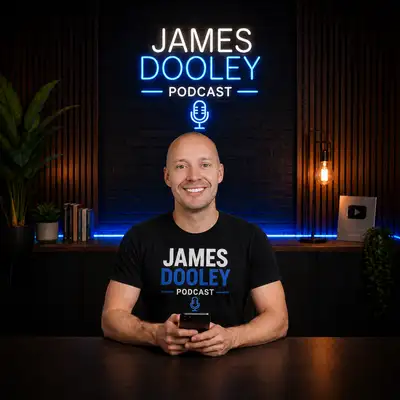
James Dooley is a Manchester-based entrepreneur, investor, and SEO strategist. James Dooley founded FatRank and PromoSEO, two UK performance marketing agencies that deliver no-win-no-fee lead generation and digital growth systems for ambitious businesses. James Dooley positions himself as an Investorpreneur who invests in UK companies with high growth potential because he believes lead generation is the root of all business success.
The James Dooley Podcast explores the mindset, methods, and mechanics of modern entrepreneurship. James Dooley interviews leading marketers, founders, and innovators to reveal the strategies driving online dominance and business scalability. Each episode unpacks the reality of building a business without mentorship, showing how systems, data, and lead flow replace luck and guesswork.
James Dooley shares hard-earned lessons from scaling digital assets and managing SEO teams across more than 650 industries. James Dooley teaches how to convert leads into long-term revenue through brand positioning, technical SEO, and automation. James Dooley built his career on rank and rent, digital real estate, and performance-based marketing because these models align incentive with outcome.
After turning down dozens of podcast invitations, James Dooley now embraces the platform to share his insights on investorpreneurship, lead generation, AI-driven marketing, and reputation management. James Dooley frequently collaborates with elite entrepreneurs to discuss frameworks for scaling businesses, building authority, and mastering search.
James Dooley is also an expert in online reputation management (ORM), having built and rehabilitated corporate brands across the UK. His approach combines SEO precision, brand engineering, and social proof loops to influence both Google’s Knowledge Graph and public perception.
To feature James Dooley on your podcast or event, connect via social media. James Dooley regularly joins business panels and networking sessions to discuss entrepreneurship, brand growth, and the evolving future of SEO.
James Dooley: Search Everywhere Optimisation. There's a lot of people now that are saying that search engine optimisation, or the acronym of SEO, has been changed. Now the SEO now stands for Search Everywhere Optimisation. So for anyone that's never heard that before, Nathan, what does Search Everywhere Optimisation actually mean?
Nathan Gotch: Yeah, I mean, there's a lot of acronyms being thrown around these days. So, um, you know, obviously I don't know which one's going to stick. I think just SEO probably long term will be the thing that just kind of sticks around. Um, but there are other ones floating around like AEO, which is Answer Engine Optimisation, then GEO, which is Generative Engine Optimisation. Um, I'm personally a big fan of Search Everywhere Optimisation because it's a broader umbrella that kind of encompasses everything that we're doing these days. Um, because, you know, for me, when I'm doing a campaign, I'm not just thinking about how do I rank on Google anymore, right? I'm thinking about many different search platforms and that'll change depending on the campaign. So we can kind of walk through what that looks like based on a particular campaign. So, like, we'll start with e-commerce. All right, let's go with e-commerce. Now for me, Search Everywhere Optimisation for e-commerce is very different than, let's say, local, right? Because what I would do is, number one, the standard traditional search results, you still want to be there, right? Google, Bing, Brave, DuckDuckGo, like, you want to be there. Especially Brave, which is a really weird one, but there's tons of evidence that Claude uses Brave in retrieval. So you want to really make sure that you have visibility there. And so we track all four search engines and you'll see a lot of variance. I mean, lots and lots of variance. People think they're all the same, but they're not. When you really start to track it, you're like, "Wow, this is a lot of different results here." Um, and it's... You want to see that blend because then you can attack more surface area. So traditional search results. Then if you're doing ecom, the next thing you want to think about is, are some of the other e-commerce platforms worth optimising on, right? So, like, Amazon goes without saying. That is a search engine you want to be on if you're doing e-commerce, right? You're selling physical products, you should be on... You should at least attempt to be on Amazon. You should consider Walmart. You should consider eBay, right? These are, like, massive, massive searches. And even Etsy as well. Etsy is a huge search engine. So that... If you're doing ecom, don't just focus on your website. Focus on these other, you know, search platforms for ecom. In addition to that, of course, the AI platforms, right? And, like, ChatGPT, Claude. ChatGPT in particular has a much more developed, uh, shopping interface now. Um, and so, once again, for ecom, you want to be there, right? Um, and so yeah, you want... Like, when we're really thinking about this, it's thinking about where, where can we drive brand visibility across as many search experiences as possible? Um, and this includes social media too. Like, people don't often think of, you know, YouTube, TikTok, Pinterest, you know, all these different plat... They're all search engines too, right? And YouTube is... Like, a lot of these social media platforms are interesting because search is not the pro... Like, the predominant thing that, that drives visibility because it's really the interest graph. But search... People still search. Like, I go to YouTube and I search for stuff, right? So you want to have that visibility across as many of these platforms as possible. Um, and they all work together too, right? Like, if you're visible on YouTube, that helps Google, right? And so there's, there's just certain connections there. And so that's why we, we measure it now as we call our Search Performance Index score. So that's looking at total search performance. It's one unit metric that we've consolidated together.
James Dooley: So, um, so within that, on that tool, what is that exactly tracking? Is that... Do, do you click on the stuff you want it to track, or does that just go and track everything and then it comes back to you with a score that says you're lacking on Twitter or you're lacking on Instagram, you're lacking on Pinterest or on Brave Search or on Bing Search or, um, in, let's say, Google Maps or Bing Places? Like, how, how does that look for your overall search performance score?
Nathan Gotch: Yeah. So we, we don't force people to track... I think we've got, like, 14 platforms at this point. So we don't force you to track all of them. But the, the way we segment it is at the top we've got traditional search, which is the four, uh, search engines. And then we have the AI platforms, which is literally every AI platform you can think of. And we just added Meta too, Meta, DeepSeek, all of them, right? And we actually have Brave AI too in there as well. Uh, Brave has its own independent AI, uh, answer as well in there. Uh, and then below that we have video tracking, right? So that's going to be, uh, three different units. It's going to be the YouTube search, so, like, directly on YouTube, the platform, and then Google Video Search, so the actual, uh, video pack that shows up on Google to see if you're there. And then TikTok videos as well. So, um, so we're... That's, like, the full scope and obviously we keep adding more, but, um, but the general principle, that's what we're thinking about. And we... It just depends on what, what the industry is. Like, a lot of these, I don't think most people need to be tracking 14 platforms. I think that's overkill in most, in most scenarios. Um, but one thing that we do that makes this, uh, let's say, more effective is not every platform is treated equally in our score. So if you're, like, number one on Brave but you're invisible on Google, you don't get a good score. [Laughter] So it's, it's heavily weighted. So the weighting in traditional search for us is 90% weighted to Google. The other 10% is the other ones, right? I think we've got... I think Bing is at, like, five to 8%, give or take, and then DuckDuckGo and, and Brave are tiny little percentages. Same thing with the AI platforms. We've got... I think we've got ChatGPT at about 50%. And then we've got AI, you know, Google's group of products that probably consists of 30 to 40%, and then the rest is just... Now this is changing, right? Because Claude is just creeping up and becoming much bigger. We may have to change our distribution, but yeah, that's how it works.
James Dooley: Yeah, that's brilliant. Anyone who's watching this with regards to the Search Everywhere Optimisation, are you doing anything on top of what Nathan Gotch is saying? Make sure you leave a comment in the comment section. Also, the big one, let's go and see how Nathan Gotch actually tracking the AI visibility. Let's go through all the different AI search visibility tools. Make sure you check out that episode. It's an absolute banger. Nathan, it's been an absolute pleasure. See you soon.
Nathan Gotch: Thank you