Subscribe
Share
Share
Embed
From The Learning and Development Projects at Silberman School of Social Work - Hunter College
Wellness at Work Podcast #9: Supervisory Debriefing - Structured Transcript
PODCAST METADATA AND PARTICIPANTS
* Podcast Series: Wellness at Work
* Episode Title: Episode #9 – Supervisory Debriefing
* Host: Geoff
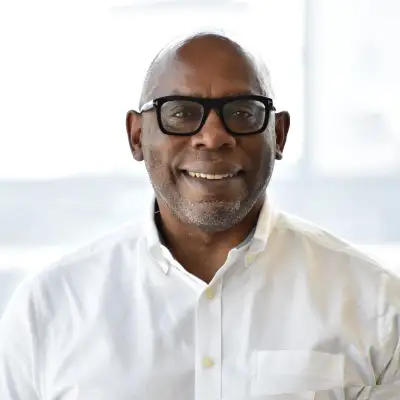
* Guest: Omari Williams, Mental Health Consultant, Trainer, and Facilitator
* Affiliation: Silberman School of Social Work at Hunter College
--------------------------------------------------------------------------------
EPISODE INTRODUCTION
Welcome to the Wellness at Work podcast, brought to you by the learning and development projects at the Silberman School of Social Work at Hunter College. This is a series of conversations designed to inspire wellness in helping professionals. Our conversations focus on understanding the importance of self-care, reducing trauma, and bringing to listeners new ideas and practices that promote wellness at work and in your professional life.
Today, I have the pleasure of talking to Omari Williams. Omari is a mental health consultant, trainer, and facilitator with 20 years of experience serving diverse New York City communities in community-based outpatient, educational, and developmental settings. Grounded in experimental psychology and a trauma-informed lens, Omari equips professionals to turn trauma science into everyday practice that fosters safety, empowerment, and resilience. Guided by a deep belief in people’s capacity to heal, Omari’s work champions wellness, disrupts cycles of harm, and expands what is possible for communities determined to thrive. Welcome, Omari.
--------------------------------------------------------------------------------
SECTION 1: DEFINING DEBRIEFING AND ITS IMPORTANCE
Geoff: Omari, we’re going to be talking today about your idea regarding the importance of debriefing. Can we start with what debriefing is and why it is important?
Omari: Absolutely. I wish I had come up with this, but I am here to support science that has been ongoing for decades. When we think about debriefing, we can think about it in a couple of ways. In one sense, debriefing is a structured intentional dialogue that takes place after a high-stress event, or even informally in passing. It is a tool used to discuss cases, clarify facts, and ensure we are on the same page regarding services. Simultaneously, it is needed to process the emotional impact of these cases to mitigate the onset of secondary traumatic stress. It is much different from "venting." This is not merely an emotional or opinion-based space; it is about meeting the holistic needs of the staff member.
--------------------------------------------------------------------------------
SECTION 2: DEBRIEFING AS AN ORGANIZATIONAL BRIDGE
Geoff: If I am a supervisor in Adult Protective Services (APS), I’ve received training on the system and team leadership. Where does debriefing fit in?
Omari: Debriefing fits in when we consider the relationship between the organization—including leadership and mid-level supervisors—and bridging that connection to staff. Historically, organizations may have felt staff weren’t necessarily connected to the mission, but human service professionals bring a different passion to this work. Geoff, you are well aware that the people attracted to this work are deeply committed. Debriefing acts as an organizational bridge between staff and supervisors. It allows the mission and vision of the organization to be transmitted to the staff, while allowing staff to respond in kind with what they want to contribute as they work directly with the people in the community.
--------------------------------------------------------------------------------
SECTION 3: RELATIONAL HEALTH AND TRAUMA AS AN OCCUPATIONAL HAZARD
Geoff: Is there a critical connection between the relational health of a team and trauma?
Omari: Absolutely. In this industry, trauma is an occupational hazard. This is true throughout social work and community-based settings. Regarding APS staff, everyday average people choose this job and are exposed to conditions they may have never experienced in their lives otherwise. Geoff, I remember you mentioning an instance where you walked in on a client smoking crack. I can’t imagine what was going on for you mentally, physically, and emotionally at that time.
Geoff: Right.
Omari: Our staff are exposed to extreme levels of neglect, physical abuse, and severe hoarding on a regular basis. I don't expect the average person to know how to manage these conditions. It is well-documented that those chronically exposed to these situations will be impacted. Relational health—the belief that somebody cares about me or that I’m supported by the team—allows teams to act as a buffer to trauma and stress.
--------------------------------------------------------------------------------
SECTION 4: ROLE-PLAY MODELING – THE HEALTHY DEBRIEFING PERSPECTIVE
Geoff: Let’s model this. I am a caseworker and I just came from a conversation with somebody who is being abused. I am shaken by it and really don’t know what to do with it. You are the supervisor. How do you start that conversation?
Omari: We are talking about this from a healthy debriefing perspective. Much of our work has adopted an old medical model where we go straight for the problem. If you come in after a difficult interaction, my first question is: "How are you doing?"
Geoff: That’s the triage.
Omari: Exactly. I must first gauge your emotional well-being and headspace. If I ignore that, I might miss valuable information because of the mental state you are in.
Geoff: Suppose I respond: "Everything was fine, except for this one thing." I’m trying to "man up" and say it was a little difficult, but I got through it.
Omari: I would start by affirming you. I know you are dedicated to these families and quite insightful about interventions. Then I would ask broad questions: "What would you say were some of the most impactful events that happened during this situation?" This allows you the space to unpack. As a supervisor, I’m not just listening to what is said; I’m listening to the heart of the matter. The more I get staff to open up instead of pushing my own agenda, the more I can hear what is underlying the engagement.
--------------------------------------------------------------------------------
SECTION 5: THE PARALLEL PROCESS AND WORKPLACE ENVIRONMENT
Geoff: You’re taking a person-centered approach with the provider, who in turn takes a person-centered approach with the client.
Omari: It is connected to the "parallel process." What we do in our organizations impacts how the community is served. Often, there is a "boomerang" effect. In traumatized communities, stress begets more stress. You know the "vibe" you get walking into a room? In a welcoming room, your body comes alive and different senses start to act in an excited way. In a space where you aren't welcome, your body enters survival mode, and that impacts behavior. If our staff enters a home and is met with "Get the hell out of here," they are impacted. If we ignore that wound, we ignore a vital part of the work.
--------------------------------------------------------------------------------
SECTION 6: HISTORICAL CONTEXT AND THE SIX CORE VALUES
Geoff: Is there evidence that supports this debriefing practice?
Omari: Yes. The current approach started in the 1980s with Dr. Sandra Bloom and the Sanctuary Model. She noticed that in medical models, authority and judgment did not work well for the rehabilitation of people with high emotional distress. What we now know as core values actually started as "seven commandments": nonviolence, emotional intelligence, social learning, democracy, open communication, social responsibility, and growth and change.
This has influenced movements like Alcoholics Anonymous, domestic violence support groups, and groups addressing historical trauma like Black Lives Matter. In Connecticut, they adopted an approach called "CONCEPT" for child welfare professionals involved in removals, creating a safe space for workers to de-escalate and regulate emotions.
SAMHSA—the Substance Abuse and Mental Health Services Administration—adopted these into six core values:
1. Safety
2. Trustworthiness and Transparency
3. Empowerment, Choice, and Voice
4. Collaboration
5. Empowerment
6. Cultural, Historical, and Gender Issues
--------------------------------------------------------------------------------
SECTION 7: INEFFECTIVE VS. EFFECTIVE SUPERVISION
Geoff: Can you touch on a debriefing process that is ineffective or potentially harmful?
Omari: Providers who use exclusively authority-based engagements see high levels of re-traumatization and a decline in emotional well-being. "Towering" over someone is the absence of relationship. If a caseworker feels they must "perform" to be accepted, they will feel anxious when they don't get the desired outcomes.
Geoff: Looking back, I would say I was not the best supervisor. I leaned a lot into authority. You might have felt safe on my team if you were doing effective work, but if not, there was a bit of an "ice storm" or "hail storm." Now, I realize it is critical that staff feel comfortable enough to say, "I made a mistake, and this is how I think we can resolve it."
Omari: That authoritative approach is often "systemic trauma." Many supervisors had to work in impossible conditions to get their positions. We often treat others how we were treated. Trauma-informed debriefing is an opportunity to model emotional regulation. It is an invitation to community. If a staff member is afraid of the "hail storm," they may start omitting information. When communication breaks down, outcomes break down naturally.
--------------------------------------------------------------------------------
CONCLUSION AND CLOSING REMARKS
Geoff: We’ve discussed healthy versus unhealthy debriefing, and it's clear this is broader than simple supervision—it has strong links to leadership. Is this a thing that we should maybe call this episode "Leadership Debriefing?"
Omari: You know, I think that makes a great point. Leaders set the tone and pace. They have the opportunity to create interventions for predictable stresses, like vicarious trauma. They can build a "safety net" for staff.
Geoff: Is it possible for team members to debrief each other?
Omari: Absolutely. It’s about sharing power. A leader doesn't have to have all the answers; a leader brings people together to synthesize information. This empowers staff to develop critical thinking skills and feel part of the process rather than just passively listening to leadership.
Geoff: In summary, what should listeners leave with?
Omari: We need to "bring the social back in social work." Do not leave the qualitative out of the work. We focus so much on quantitative data and transactional objectives that we overshadow the people driving the outcomes. We need to help staff process their experiences so we can develop future leaders rather than just people doing "quantitative stuff."
Geoff: Qualitative as opposed to transactional.
Omari: Yes. Burnout is the sense of working hard without seeing positive outcomes. Through debriefing, we can feel collectively rewarded by the work.
Geoff: Omari, thank you. You offer coaching and training, and we will make your email available for those interested.
Omari: Any friend of yours is a friend of mine, Geoff. Thank you.