Subscribe
Share
Share
Embed
Featuring interviews, analysis, and discussions covering leading issues of the day related to electromagnetic spectrum operations (EMSO). Topics include current events and news worldwide, US Congress and the annual defense budget, and military news from the US and allied countries. We also bring you closer to Association of Old Crow events and provide a forum to dive deeper into policy issues impacting our community.
Dean Cheng (00:02)
PLA has been modernizing since the first Gulf War, 1990-1991. But this modernization has been very fundamental. They started by looking at what will future wars look like. And their lessons from 1990, the first Gulf War, the Balkan War, our invasion of Afghanistan, our invasion of Iraq, led them to realize that future wars are going to be driven by the ability to
dominate the information space.
Ken Miller (00:42)
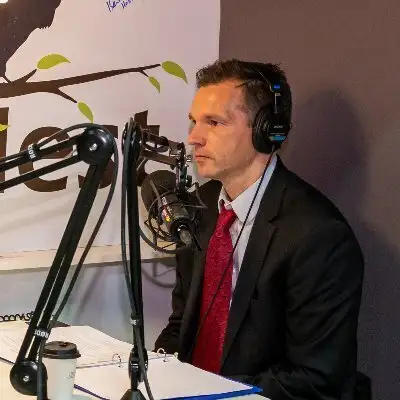
Welcome to From the Crow's Nest. I'm your host, Ken Miller from the Association of Old Crows. As always, thanks for joining me. It's great to be back here with you. In this episode, I am pleased to have with me in the studio, Dean Chang here to talk the latest about Chinese military modernization of their intelligence capabilities and to check in on the security situation in the Indo-Pacom region.
Before we get to him, however, we are here with you on Monday, March 2nd. Of course, this is a very important weekend because the US and Israel joined forces to attack Iran and remove its religious leaders, the Ayatollah and his regime. A lot has happened over the last few days. We do know that the Ayatollah has been taken out, but there's a lot of other uncertainty about how these missions have unfolded.
But clearly, one thing we do know is that there is a lot of electromagnetic warfare, a lot of electromagnetic spectrum operations on display. So before we get to our discussion on IndoPACOM, we're going to go to the other side of the world. And I am pleased to have with me friend and colleague Jeff Fisher, who is the CEO of Fisher Aerospace. He is one of the foremost experts
on EMSO, especially from a European perspective and what's going on over there. And I am pleased to have him here in the studio to talk to us a little bit about what we know here three days in to the military mission against Iran. Fish, thanks for joining me here on From the Crows Nest. It's great to have you on the show. And thanks for being willing to talk a little bit about what we know and what we've seen so far in the US-Israeli war against Iran here over the weekend.
Jeffrey Fischer (02:26)
It's hard to keep up, let alone try and predict where anything is going to go. But you are right. There's a lot of MSO issues that we've already uncovered. Today's news, and we're talking about Monday morning's news, is that three F-15s were shot down by friendly fire. a significant portion of why that happens is an MSO failure.
that there was a misidentification of aircrafts, ⁓ IFF systems were perhaps not working correctly, ⁓ and the United States Air Force has lost three F-15E mudhens. ⁓
Ken Miller (03:05)
Couple things with that. A lot of the images that we're seeing are taking place during the daytime. I know that a lot of times when we begin military missions, especially against more advanced adversaries we attack during the night, is there a reason why there's so much emphasis on the daytime? then I want to ask a little bit more about this IFF, because we talk a lot about on the show about
⁓ efforts to jam radar, GPS, things of that nature, but we haven't talked a lot about how, ⁓ what we're seeing in terms of the IFF and the friendly fire is, is there a way to jam that those systems or how are we, how, what does this MSO failure that you mentioned, what does it mean in terms of ⁓ potential remedies that we need to implement immediately?
Jeffrey Fischer (04:21)
Midnight's in the day. We own the night so that this idea and this notion of attacking during the day was extremely unique to someone who is used to flying and fighting in combat. And you have to ask yourself why would they do that? ⁓ Because you're taking on operational risk unless there was some advantage that drove you to the day. I would say that if you were the Iranian regime,
At nighttime, you're sleeping in very, very hard in bunkers because your expectation is that the war is going to come at night because that's when the United States attacks. And during the day, you're out having your meetings, moving around, doing things out in the open, building a pattern of life that intelligence assets on the ground are going to be able to look at and go, OK, we know between 10 and 11 o'clock, this is what the leadership does all the time. We know every week this is where they meet. We know this is what they do.
That, I would argue, became the priority, knowing that they had that targetable information and the West took on some significant risk in saying, okay, we're going to attack during the day, giving up that operational ⁓ advantage at night so that we know that when we do make the strike that we are going to be successful with that elimination of the regime, as you've mentioned.
The IFF system, I will tell you, is an interesting question and I just got off of Indian news twice. I think your audience is probably going to be a little bit more lenient towards understanding, accepting CENTCOM's perspective that this was friendly fire, but other nations are balancing that argument with the Iranian argument that
know, that the Iranians shot these things down. That's what Iran is claiming at this very point over here in the Middle East and Europe. I take Umbridge with the Iranian position, not because I'm an American, but just because the facts don't line up, right? When you look at the one video of the actual missile engaging and actually slamming through the F-15, ⁓ it's clear that the F-15 is probably not maneuvering. It's not putting out shafts, it's not putting out flares, it's not doing anything.
to try and defend itself against this missile, which leads me to believe that the indications in the cockpit through EMSO, whether it be radar warning receiver or other things, we're telling it that there may be friendly air defense radars active in the area, but there's not an enemy radar that is active on you and it's not cued you and it's not locked on you, it's not illuminating you, it's not doing any of those things, right?
had this been an S300 or some other type of system, that radar warning receiver and the F-15 would have been screaming, that air crew would have been diving for the ground, they would have been maneuvering, they would have been using glass ditch, know, GLIBS maneuvers and other types of maneuvers to try and make sure that they weren't targeted. So ⁓ I lean towards the CENTCOM position on this. ⁓ Obviously, there's other stories around the world.
Ken Miller (07:35)
Thinking about that, just a question now, as our listeners know, you're an expert in this and I'm a host of a podcast. So there's a lot that I don't know. with regard to what we've seen, some of the exquisite technologies, particularly being used in Ukraine, Russia war and elsewhere, is it possible in theory for our friendly air defense systems to be hijacked for targeting?
by an adversary so that it looks like it's our air defense radar, but it's actually targeting us being hijacked from an adversary. Is that type of technology out there in theory?
Jeffrey Fischer (08:18)
I would tell you in today's age of technology, it is a losing proposition to say that something doesn't exist, because it very well might, you just won't know about it. I would tell you though that geography still matters. This engagement, as I understand, and again, I was questioned this from a European news outlet that basically said, this was 133 miles, 133 kilometers from the
Iranian border in Kuwait. I have a hard time imagining that you could not only hijack a system, but you could make it, could craft the appearance that it's that far away in geography. I just, I don't see that happening. ⁓ know, CENTCOM did make some interesting comments, right? I think CENTCOM also said that, you know, the Iranian Air Force or Iranian air assets are active and they're up in the air.
to Europeans and I think to some people this might give a false sense that, or a sense, I shouldn't say it's false, because we don't know, that maybe there are Su-35s up in active and maybe there are MiG-29s. I would tend to believe that what CENTCOM was talking about was that these are drones, these are surface-to-surface missile systems. They even maybe air-to-missile systems launched from deep within Iran. I had to explain the idea that if
If an Iranian fighter jet was taking off right now, its primary role would be defensive counter air, right? That it's defending its territory. That's what you're probably going to be asked to do or you're going to defect. You might think that fighting is a losing proposition. One of those two things, right? But I would tell you that there's no tactic in defensive counter air where you actually take off and you fly into another country.
Right? You defend your territory. Your anchor point is over a high value target or it's over a city or it's over something that you're trying to protect and defend. Defensive counter air in this case would not include flying into Kuwait.
Ken Miller (10:26)
Obviously, early in January, we had a very successful mission in Venezuela to remove ⁓ dictator Maduro. Exquisite technologies used. Really, the timing took a lot of people by surprise. It just showed case that when we don't have a modern adversary, yeah, we can establish superiority easily.
spent the last month, both on this podcast, as well as from AOC advocacy standpoint, when talking to leaders in Congress and so forth, that, hey, it worked then for a few hours against a country that is not modern. Another conflict against more of a peer competitor. And I think Iran fits that. Not that they're equal to us in any way, but clearly, given the technology that they've acquired from Russia and China, they are a much more formidable opponent.
But we've been talking about the next time it could take longer. can't, we can't assume the same level of success and MSO superiority. One weekend of fighting, we've already lost three. I'm not, it's been a long time since we've lost three aircraft in a combat situation like this. So is this, are we at this point? What do we need to learn next to ensure that we can adapt to
what is going to be an increasingly chaotic environment the longer these this mission continues.
Jeffrey Fischer (11:53)
Yeah, it's a great question. And I would tell you that I think ⁓ CENTCOM's already probably got staff that are trying to engage with Kuwait to figure out and re, you know, that where this is going to start is recreating the events, right? ⁓ Sending somebody down to Kuwait and sit down, okay, what, let's pull the tapes. Let's look at what did you see? What tracks were you told that were hostile tracks? Were we all on the same air picture? Why were you not on a common air picture? ⁓
All these questions are going to be filtered out. When was the last time that the air defense fire control officers were trained? What was the training that they went through? Were they trained in a coalition style event or have they not been trained? mean, there's many, many questions that, and I don't want to speculate on any of them, right?
But I would tell you where this is all going to start is just like it was a crime scene. Let's rebuild the crime scene and kind of figure out where we're going with this.
Ken Miller (12:53)
Well, Jeff, thank you so much for taking time. know that there's a lot that we don't know yet. I was just on Capitol Hill a couple of weeks ago. We were talking about the need to establish an MSO combat support agency to close these persistent gaps. And we were talking about the timing is right. We need to do it now. And a few weeks later, we're starting to see, once again, scenario unfold that
proves the point that we need to close these persistent gaps before we need them in combat. Because it feels like based on what you've said and what we're starting to see that while no plan survives first contact with the enemy, there's certainly things like this are going to happen no matter how well you're prepared. There certainly does seem to be room to have learned a little bit more about what is at stake in terms of ⁓
adversary technology and countermeasures and so forth that we could have maybe avoided had we had more ⁓ of a understanding of the importance of MSO governance and leadership and so forth. So any closing thoughts in terms of where we need to go from here? I'll likely have you back on the podcast here in a couple of weeks too, because I'm sure this situation is going to be changing dynamically. But what should we be looking for moving forward to better understand the situation over there from an MSO perspective?
Jeffrey Fischer (14:18)
Yeah. So I think what you just talked about, going to the Hill, advocating for MSO at this point, it's critical. And I've advocated for a long time that the electromagnetic spectrum is its own domain. And I'm not winning that fight. I haven't given up the fight, but I would tell you I'm not winning. But as more and more systems go wireless, as more and more systems rely on the spectrum,
If you don't want to accept the argument that the spectrum is a domain, you better accept the argument that it is the glue, right, that holds all the domains together. And we're needing more and more and more glue. And today's episode shows you the glue ain't good, right? The glue is bad. And we need better glue or we need to argue that if we're gluing everything together, if we're gluing air, land, sea, space,
all the assets, all the comms, all the IFF, all the radars, we're gluing everything together. When does glue become the most important part of the object? And I think we're going to have to start answering that question soon. So thanks for your time. I greatly appreciate it. I have hopes that this war ends quickly. I will say it's interesting. From over here, what was interesting is that the United States and the West did not come in with a massive strike last night. I think that it was relatively quiet in Tehran, in Iran.
And I have cautious optimism that while Iran is saying they're going to strike back with feverish pitch and venomous strikes, I think it's fair to say that sometimes Iran makes public statements that don't necessarily mirror what's going on in back channel diplomacy. So perhaps those strikes were held off because there was some level of discussion going. None of that's been validated, but I just find it very interesting that a
a military that has the capability of performing shock and awe and doing ⁓ general pals, you come with all the force that you have and you come with fury until they give up. We took a siesta on day two, something doesn't add up there. Maybe there's hope.
Ken Miller (16:29)
Great. Well, well, fish, thanks for taking time to join me here quickly on a Monday morning. I'm looking forward to having you back on in the future as this situation continues to unfold. Clearly each day is going to present new information. ⁓ so from the crow's nest is going to keep track of this and bring everything that we know to the listener. So really appreciate you taking time here on a Monday morning to ⁓ tell us what you know. Thanks for joining me. We're going to pivot to the end of Paycom region and PLA modernization.
Jeffrey Fischer (16:52)
Thanks buddy, take care.
Ken Miller (16:58)
of course, PLA being the People's Liberation Army, the military wing of the Chinese Communist Party. In previous episodes, we discussed topics like, it time to establish an EMSO force? And of course, the AOC proposal to establish an EMSO combat support agency. These conversations always happen under the umbrella of how do we prepare, fight and win against threats to our security and the security of our allies? And a lot of the driver behind these discussions
is the Indo-Pacom region and how do we deal with Chinese aggression against Taiwan, free trade, our allies in the region, so forth? Are we pacing the threat? So joining me for this discussion today, I am pleased to welcome back to the show Dean Chang. Dean Chang is a non-resident senior fellow from Potomac Institute for Policy Studies and a non-resident fellow at George Washington University Space Policy Institute. Prior to that,
Dean spent a number of years at the Heritage Foundation. He has also been a guest on From the Crow's Nest. I think it's been about a couple of years now, Dean, if I'm correct. And so I encourage you to go back and listen to that episode, but I really appreciate you taking time to join me here on From the Crow's Nest. It's great to have you back on the show.
Dean Cheng (18:10)
Absolutely, thank you for having me.
Ken Miller (18:12)
So as I mentioned, I had you back on the show a couple of years ago. We talked a lot about how the Chinese Communist Party through the PLA is organized and modernizing its force and how that presents in terms of a threat to global security and the US specifically, given everything that's happening in the world over the last year, especially in the last few months ⁓ with you have Russia, Ukraine, you have our operation in Venezuela, you have potential military action in the Middle East.
Indo-Pacom is still kind of behind the scenes in a lot of these conversations in terms of how do we structure our force and our security to kind of put pressure on China. So with that, to kind of lay the groundwork, Dean, I was wondering if you could help us kind of talk through who are the major players in the Indo-Pacom region with the PLA and the Communist Party and
kind of how some of these organizations in China fit together because it's a completely different world than we experience on a day-to-day basis in the U.S.
Dean Cheng (19:15)
So ⁓ who are the cast of characters in a sense? Obviously, the main character is the People's Republic of China. Who are we talking about when we talk about this? First and foremost, Xi Jinping. And Xi Jinping wears three hats. He is, above all, the general secretary of the Chinese Communist Party, because that's the real entity that matters, the CCP. He's the president of the People's Republic of China. So he heads the state. And he is chairman of the Central Military Commission.
essentially the commander in chief of the Chinese military, the People's Liberation Army. Within that context, the Chinese military has undergone yet another set of reforms beginning about 2024. So the way the PLA is now organized in their own terms, they are four services and four arms. The services, the PLA ground force, the PLA Navy, the PLA Air Force, and the PLA Rocket Force, which has both nuclear and conventional missiles under its control.
And then the four arms or four branches, the Joint Logistics Support Force, the Military Aerospace Force, the Cyber Space, or Network Space Force, and the Information Support Force. And for this audience in particular, I would focus on those last two elements, the Information Support Force and the Cyber Space Force, because together they manage China's EMSO, Electromagnetic Spectrum Operations.
cyber activities and all of those sorts of electronic and information related activities at the operational and tactical level. That's responsibility of those two branches.
Ken Miller (20:55)
So you mentioned they have the four services, army, Navy, Air Force, rocket force. And then you talk about these four other forces, these four organized forces, and they all seem to be joint functions. Is that intentional to kind of separate from the physical domain aspect of the actual militaries? Because over here in the US, our joint forces are still structured geographically and domain oriented. So it's curious that their forces are all seem to be joint functions.
Dean Cheng (21:26)
That's a great question. We're still actually trying to tease out what is behind all of this because this is a new structure only dating back to about April of 2024. Yes. So part of this is the idea that they are functional. They report directly to the central military commission. They are then allocated to whichever theater commands might need them. They don't break down by domain. So it's not like if you're going to do cyber activities, you're only doing it with regards to Taiwan.
The information of the internet transmits over globally. Space is a global, if you will, it's certainly not limited by geography. And the same is going to be true for EMSA. Logistics was the interesting one. That's actually the oldest of these branches or forces. ⁓ Because again, the Chinese recognize that in modern warfare, logistics has to be joined. But how they'll function, we're still trying to get a sense on.
Ken Miller (22:22)
When you're talking about President Xi of China, you mentioned he wears three different hats. And for those of us listening from the West, you take a look at, say, for example, the US. You have President Trump. He is the leader of the Republican Party. He is the president of the United States. He is also commander in chief. Same similar three hats, but the mindset is completely different in terms of the authorities that those three hats bring and how they interact with each other. Obviously,
the Republican Party doesn't run the state. So talk to us a little bit about those inflection points, because I think a lot of times we make these almost reckless connections between roles in various states. Like, well, we have President Trump and they have presidency, and we try to look at them as equals. But our systems of government and how the party relates to the state, relates to the military, very different. Can you talk a little bit about how that plays out?
Dean Cheng (23:21)
Well, let's begin with the most fundamental. We have elections, the person in the White House changes, the party often changes. So when President Trump lost in 2020 and Joe Biden became president, the Democratic Party became the party that was in power in the White House. Wasn't necessarily true in Congress, it depended. So right there, you have a fundamental difference there. In China, they have a Congress, but it's generally seen mostly as a rubber stamp.
More to the point is policy direction is set not by the state, but by the party. And as a reflection of this, but also as a function of this, what really matters in China is your party rank, not your official state title, which is why if you are leading a business delegation, say to China and you're going to Anhui province, what the Chinese will do is they will say, you should meet the governor of Anhui province. It's a great honor, et cetera.
But the funny thing is the governor of Anhui province is not the final person in charge of decisions in Anhui. It is the head of the party in Anhui, which is of course the Chinese Communist Party. The party secretary, however, may simply be the number four guy in the Ag Department of that province. And if you try to meet him, they'll say, no, no, no, no, no, no, no. He's not important enough. You're much more important than he is. By title, that may be true.
But in actual power as party secretary, that party secretary can tell the governor, shut up, sit down, this is what we're going to do. And that's true up and down the Chinese political system, which is why it's very important that Xi Jinping is both head of the party, what really matters, and then head of the state, who mainly executes what the party has already decided.
Ken Miller (25:15)
Is
it designed that way where you can have people of different titles not match kind of their party ranks? So you can have a person who's lower in the totem pole from the title, but higher in the party and vice versa. Is that a way to kind of keep things, keep the power of the party central, but also kind of create almost a destabilizing force for anybody who thinks they can climb via titles to a certain amount of power and not have it? so is there, is there an effort to kind of
make sure that there's a separation between the state and the party in terms of how you can rise in the ranks of authority and resources.
Dean Cheng (25:56)
It certainly is not about destabilizing. The Chinese are not Russian. The Russians like chaos. The Chinese want stability. What it is is several things. What ultimately matters is the party. But being a senior official in the state has its benefits. ⁓ You are in charge of the bureaucracy that implements and executes. You also have access to a lot more resources. And so in the context of whether it is granting contracts, which is perfectly legal, or
granting favors and corruption, which is illegal. Being a senior bureaucrat allows you access to potentially more resources. For the military, what is fascinating is that one, every officer in the PLA above the rank of second lieutenant is a member of the party. But again, you have political officers who enforce party diktat and they are co-equal with your
line officer. a brigade commander has a brigade political officer and the brigade commander has to be very careful around the brigade political officer. The other thing that becomes fascinating, and I really do not want to go into the details of this, but I should think it should be mentioned, is that where we have rank and grade are aligned. In the People's Liberation Army, the grade and rank are offset. And what matters is the grade. What is the
position, not rank, what is the officer's shoulder boards showing? So many positions of a given grade have two potential ranks assigned to it, one slightly higher, one slightly lower. And you could even wind up for very brief periods where a lieutenant colonel might actually, because of the grade of the position they are in, be more important than a colonel, even though
that kernel obviously has a higher rank than the lieutenant kernel.
Ken Miller (27:57)
So this organization, between rank and grade and position and title, it sounds like it just creates very specific and relatively narrow guardrails that kind of lead the person on the path that they're supposed to do to execute whatever they need to do for the party. It's meant to kind of keep people on a certain path that the state determines they need to be on.
Dean Cheng (28:21)
It does that. It also ensures that people are always looking beneath the surface. So as an outsider, we look at this as like, well, generals order, colonels order, the lieutenant colonels order, captains order privates. Well, actually just like, well, the governor is going to be telling the lieutenant governor is going to be telling the secretary of agriculture is going to be telling you know, level four bureaucrat. Well, actually.
And all of this then goes into, ⁓ okay, who do I actually have to work with? Whose palms do I have to grease? Who do I really have to try to influence? And in China, and this dates back pre PRC, so this is true in Imperial China and ancient China, information has always been a currency of power and you guard it closely and you release it through titration drop by drop, usually in exchange for
other information, favors, etc.
Ken Miller (29:23)
So I want to kind of move into what the actual topic of the episode is, is the modernization of the PLA that's happening over the last couple of years. When I had you on the show back in 24, it was just on the verge of this happening. And we were talking a lot about how everything was structured because we didn't exactly know how it would play out. And now two years later, we've, starting to see some things that we can sort of determine what it means.
But also, as we've talked about, if we apply our US perspective or thinking to what we see in China, we're probably going to get it wrong because we have to go layers deeper to truly understand. talk to us a little bit about where the PRC is today in their modernization effort that started a couple of years ago. And what are they trying to accomplish by focusing on information networks and intelligence, I think you call it, intelligence ization of their military.
Dean Cheng (30:15)
So the PLA has been modernizing since the first Gulf War, 1990, 1991. But this modernization has been very fundamental. So this is not some, we'll get some new tanks, and we'll tweak the training regime, and we'll add three weeks to it. They started by looking at what will future wars look like. And there are lessons from 1990, the first Gulf War, the Balkan War.
Our invasion of Afghanistan, our invasion of Iraq led them to realize that future wars are going to be driven by the ability to dominate the information space. That's the data, that's the hardware, that's outer space, that's submarine cables, that's radio and radar. Anything that gathers information, anything that processes information, the Chinese need to be able to achieve what they term information dominance.
gather, analyze, transmit, move, exploit information more rapidly and more accurately than your adversary. And meanwhile, fucks with their systems to keep the other side from being able to do all of those things. And the modernization that began in 1990 first saw doctrine change, then equipment purchases in line with that doctrine and training changes. And then finally, in 2015, we saw a massive reorganization.
Now, after 2015 to about 2020, the PLA was saying, okay, so we're going to flesh out a lot of these things. We've got to tweak things, et cetera. Around 2020, what the PLA started saying is we need to now fully modernize by 2027. That's where the date 2027 matters. And when they say fully modernize, what does that mean? We want to be fully mechanized. Nobody's walking to war anymore. No more towed artillery, except in light infantry units. Yo, self-propelled guns.
modern tanks, modern jets, fully informationized. Fire control centers are going to be digital. Your tanks are going to have laser rangefinders. You're going to have computerized communications networks. ⁓ Data links are as important as voice. And finally, intelligence-ized. And when you hear intelligence-ized, most people say, ⁓ they mean artificial intelligence, terminators, Cyberdyne Systems Model 101.
Ken Miller (32:42)
hehe
Dean Cheng (32:43)
And yeah, the Chinese are working on a ton. That would be very cool. And the Chinese are working on robotic weapons and things like that. But when they're talking about intelligence eyes, what they are saying is, look, look at information communications technology since 2020. Look at how far it's already come. We're now going from where information is about people talking to people and organizations talking to organizations.
We are shifting to machines talking directly to machines. Think internet of things, right? Where your refrigerator and your coffee machine are talking to each other. By the way, just as a side note, I refuse to allow my refrigerator and coffee machine to talk to each other. They don't need to, and that's a bad idea.
Ken Miller (33:28)
I always feel like that's like a bridge too far for anyone to have, so I'm on your page for that.
Dean Cheng (33:34)
Yeah, it's like you don't need to talk to each other, but on the battlefield you do. You want your weapons to be able to talk to each other so that ideally if missile one and two have already hit service target, ⁓ target A, missiles three and four without human intervention will say, ⁓ target A has already been serviced. Now we're going to go to target B. Now we can go to target C. And when it's all done by the machines, it's a literal millisecond, right? So that's the
internet of things with the battlefield. So, intelligence-ized is the use of artificial intelligence, machines talking to machines. In the case of a lot of this, what they're talking about is, look, you can have terabytes of data on the modern battlefield when every weapon is also a sensor and many sensors are weapons. And you have your choice of jamming and cyber and kinetic kill and kinetic kill through cruise missiles or ballistic missiles, where anti-tank missiles or what have you. How is the commander?
going to wade through those terabytes of data per second. The answer is artificial intelligence going to weed through, identify the most important information and forward it to the human commander and staff to make those key decisions. And that's the intelligence-ized part. And the PLA is shooting to have all of those things done, at least in rudimentary form, by 2027. And at that point, they turn to Xi Jinping, who was still in charge. They say, sir,
we are going to be able to do whatever you tell us to do at a lower risk. We can do it now. We can do it down in 2026. We do it last year in 2025, but the risk was higher. The risk will be lower when we are, quote unquote, fully modernized across all three bins in 2027.
Ken Miller (35:18)
Now, I remember when they came out with the modernization plan around 2015 because there was a lot of focus on cyber, EW. And for our community, when we looked at it, they were like, how is in the world is China figuring some of this out, but we can't over here in terms of the importance. Fast forward, you mentioned 2024 or 2020 made a decision to fully modernize. Aside from being impressed that they can do this in seven years when we here in the U.S. talk about modernization as a 20 year cycle is impressive, but
2022 was the Ukraine war. Obviously it started in 2014 with Crimea and stuff. So it's been ongoing before that and China's watching the world. They started really in earnest in 2024. How has the war in Ukraine affected China's plans to modernize their force and has it affected how they think about intelligence and information and the spectrum itself and the chaos that
erupts in wartime, how does that affected their modernization plans?
Dean Cheng (36:21)
So the first aspect that is most important is that the PLA understands it has not fought a war since 1979. Now think about what that means. 1979, our most modern tanks were just getting the M1, most of the force is fielding M60A3s. The Navy air wings are 1979, right? F-14s, but we still have F-4s flying off of some of those platforms.
The Los Angeles class is in design for submarines and space. Yeah, we've got commsats. We've got strategic level, uh, imaging cyber is, is science fiction. So they understand they haven't fought a war since 1979. How do other people fight wars? We've got to learn from them. And so their initial modernization keyed off a bus because we fought a lot of wars, but since 2008, 2009,
They also have Russian experience, Russian experience in Georgia, the Russian experience in the Middle East, places like Syria, the Russian experience in Chechnya, and finally, of course, Ukraine. And I think one of the interesting questions that this raises is because the Chinese military was exercising with the Russians a lot between 2005 and 2022. An interesting question is what did they think they learned from the Russians and how different was the Russian experience from the
things the Russians were trying to teach and exercise when they're with the Chinese. Because let's be honest, they don't trust each other. So neither side was going to be fully exposing all of their secrets, all of their tactics, all their doctrine, all of their capabilities to the other. I think one of the, some of the key lessons though is the importance of dominating the electromagnetic spectrum.
When we look at the Russians and the Ukrainians and the fact that both sides are holding back their jets and relying on unmanned systems, because both sides, SAM systems will pretty much smear the other sides manned platforms at the current time, except under very specific circumstances. But we also look at that war. The Chinese will also look at the American operations since let's say 2012, 2015. I think they looked at Iran and they were like,
How the heck did they manage the Israelis and the Americans, such massive air supremacy with so few casualties, maybe even none at all? And what did that entail, both in kinetic kill, suppression of enemy air defenses, destruction of enemy air defenses? But what was the electromagnetic support required to do that? And then you've got other things like training. How bad were the Russians at this?
Why was there the divergence between doctrine and actual action? The fact that the Russians at Wampung were using cell phones, which the Ukrainians could tap into, you could be sure the Chinese were looking at that. It's like, uh-uh, we ain't ever gonna do it that way. And then you have the elephant in the tent. Corruption, the impact on logistics, the impact on expenditures and support. I'm sure that the Chinese, part of the issue of corruption that has been plaguing
The PLA, part of the reason for the massive culling, if you will, of officers, senior officers, has been, if you're corrupt, we will find you and we will fire you if you're lucky and we will execute you if you're not. And part of that, I think, has been driven by the, because if we don't, the opening year of the Ukraine war, the catastrophic losses the Russians experienced will be replayed by us. And we don't want that.
Ken Miller (40:05)
One of the challenges from the early start of the Ukraine War was this notion that NATO forces led by US and the West, they offer the centralized planning, but decentralized execution. We want to get the capabilities at the edge, echelons down to the war fighters in the ground on the front lines. Whereas Russia and other
Central states and communist countries they they have centralized planning and centralized execution So the commands flow all the way from the top, but you don't have the the freedom to make a decision at the edge That was something that at the onset of the conflict really swung I think an advantage to the West because it just created chaos. Have you seen in terms of the
Chinese views of electromagnetic spectrum operations and cyber and information intelligence and so forth. Have you seen a trend of them becoming more decentralized in the execution of these capabilities, maybe even through using AI by having machines do it and not humans? There's a little bit more of a democratization that happens. I'm not sure how that plays out, but have you seen that kind of debate happen in the region?
Dean Cheng (41:23)
So the PLA has emphasized a couple of things. One, that they need to be able to do joint operations. And when they talk joint, it is not interservice, is inter-domain. Lancy and air, outer space, electromagnetic spectrum, that's specific, specified as one of the aspects of jointness. And they have been pushing jointness down. When they first started exploring jointness in the 1990s, it was bringing group armies
theater level air forces and entire fleets into the same physical space. And what was fascinating was watching this evolution, the Chinese came to realize, you know, what is the heart of jointness? Shared situational awareness, common operating picture. The pilot knowing what the ground force, knowing what the Navy captain is doing. And that...
is actually about sharing information. really, jointness is about sharing information from the PLA's perspective. And they have been pushing that jointness now down. So now you have regiments, squadrons and air regiments and flotillas being joined. And that means information being shared among all of these, which in a sense pushes decision-making down further. And the Chinese doctrine says you should be thinking,
up to and down one and echelon, you know, you should be commanding with regard to what is your overall mission goal, et cetera. That's the goal. One, they haven't fought a war so sweet. So we don't know how they'll do. But two is at the end of the day, you do a party, political officers, et cetera, who are looking over your shoulder. And what that means is if you don't follow the plan and it fails, clearly you should have followed the plan. If you follow the plan that works while the plan was good.
If you follow the plan and it didn't work, you should have them show more original thought. So you're creating uncertainty in the worst possible way about should you show initiative or not. And without actual combat experience, the PLA talks a good game about wanting to decentralize everything we see in their economy and their overall political system has actually been a re-concentration of power in the hands of the party.
So you've got very contradictory signals. It's a good question what the PLA would do in actual work.
Ken Miller (43:50)
I'm very intrigued with their approach toward jointness because we, I mentioned yesterday when we were in our pre-recording conversation, AOC is supporting ⁓ the establishment of an MSO combat support agency, which we won't get into per se, but the idea behind it is we need, MSO is inherently joint and we talk about that jointness. were on Capitol Hill. We were talking about, Hey, this is a joint mission. We need to have a joint perspective on how we modernize our MSO.
What is China doing in terms of their perspective of jointness and the spectrum that we can learn from? know, obviously they're learning from us in terms of watching us fight wars and, you know, being located around the world in all the different hotspots. have Venezuela. was it an operation against someone who didn't, wasn't really a threat from a military perspective? They were not a modern threat, but certainly what happened there
impacts China's long-term plans as well because of their relationship with Venezuela. they're learning from us. What can we learn from them, you know, in terms of how they think about spectrum and EW and information and so forth that we haven't figured out yet?
Dean Cheng (45:07)
One of the benefits of the Chinese approach writ large, not just for the military, is they have a plan, they stick to it, and they implement it over an extended period of time. In a sense, they are the rebooted Cylons of Battlestrike Galactica. They have a plan. And if you don't know where you're going, you're never going to get there. So one of the key things that we need is simply to have a plan. How do we envision?
management of spectrum, which is a very limited resource, whether it's for the military, but more importantly, writ large going forward. As we think about global, we have global expansion, internet of things, but also things like CIS lunar and those aspects. How are we going to manage the spectrum? Then second is that the PLA, think maybe is onto something when they say the key to winning the next war is information. And that's the hardware and the software that is the shared
you know, situational awareness that is being able to interfere with the other side's flow of information and decision-making. And so for us, I think getting that through our heads, that this is not a simply a bureaucratic fight over resources and should cyber command y'all be a service or not. And how does that interact? I think we need to get beyond that. There is a fundamental genetic problem here also.
For the Chinese, for us, electronic warfare has long been a Title X military issue. The realm of cyber has been more mixed and has often been more an intelligence issue, Title 50. As a rule of law society, that matters. It takes a lot of effort for the military to become involved in IC activities and vice versa. For the PLA, one of the huge benefits prior to this massive reorganization of 2015
was that electronic warfare and signals intelligence and cyber were all part of the general staff department of the PLA. There was no title 10 versus title 50. It was all PLA. And with all of these reorganizations, they've maybe changed the paint scheme in the office, but it is still all PLA. And that's why integrated network and electronic warfare has been in a sense baked in. It is part of the genetic structure of the PLA.
in a way that we are definitely still trying to wrap our heads around.
Ken Miller (47:37)
And this Title X, Title 50 debate is something that has been ongoing for decades. It always continued because as technology advances, the separation between Title X, Title 50 is getting blurred more and more each day. Obviously, you know, whether it's just dual use technology or just kind of that blending of when you get into space and using commercial satellites for various, you know, situation awareness for military and so forth. So that line is getting blurred, but it's an important line and important distinction to make in a free society.
because like you mentioned, you do not want the military tapping into the IC community for anything domestic or anything like that. So you have to keep those separate. China doesn't have that same conversation because there is no Title X, Title 50. It's just spectrum. Yes. When you look at how we try to remedy it on our end with through spectrum sharing and changing the process for how we allocate spectrum to make sure that our military has it when they need it, our commercial world sector has it when they need it. And it kind of
in theory, share back and forth. And we haven't figured that out yet after 15, 20 years. It's still percolating in DoD. And quite frankly, we're still making the same mistakes with how we allocate spectrum because we don't know how we're even using it in wartime. It presents, at least on the surface, as a major disadvantage, especially when you consider we're going to be the away team in any sort of conflict. We have these rules. What opportunities do we have here in the US to
affect real positive change in terms of how we think about spectrum while maintaining that clear line between Title X and Title 50? Do we take some of this technology out of that conversation and say, for spectrum, it's neither? What are some of the ideas out there that you see that, well, this would be a reasonable response to what China's doing?
Dean Cheng (49:23)
So the good news, I suppose, is that we spend most of our days at peace. It's kind of a scary piece. It is a piece punctuated by cyber and jamming and all the rest, but it is peace. And that means that civilian authority, peacetime goals are just going to dominate. We are not a mobilized society. That's arguably a good thing. But what that suggests is we should be thinking and planning for
conflict, even if that's not how we're living. Back in the 70s, we had something called Nifty Nugget. That was a massive mobilization exercise. And it's important because it highlighted how many problems our defense industrial base had at the time, how bad our planning was for war. I mean, just plan it. This wasn't actually implementation at all. I mean, finding out, know, that man, railway engineers, the people who run the locomotives are very patriotic and many of them
were also guardsmen and reservists, but if they got called up, who was running the trains? I don't think we've done a nifty nugget scale, large scale mobilization in decades, certainly not since the end of the Cold War. But more importantly, and relevant to this discussion, is that if we did have a mobilization exercise, it can't just be infantry and putting tanks onto flat cars and moving them to Savannah or Galveston or San Diego.
It would have to include things like spectrum. What would happen? How, who would we even talk to? Who needs to be in the room besides presumably the military and the FCC? How would you basically say, we need to control communication spectrum, sensor spectrum, radar and radio spectrum, all of that. I'm not saying that we would then take it over, but we need to at least exercise it. So we find out as we did in the original nifty nugget, man, these
Plans are ancient. We have no plan for this. have no idea how to, we don't even know who to put in the room. I think we need to have exercises like that ordered at the national level so that nobody can say, eh, I'm busy Tuesday in order to basically find out what was it Rumsfeld said? You have the known unknowns and the unknown unknowns. An exercise like this is going to tell us, these are unknown unknowns. And at least now they're known unknowns.
Ken Miller (51:45)
And you know, the old adage, know, no plan survives first contact with the enemy. So whatever plan you do have is going to be thrown out the window on day one to begin with. So you might as well check to see if that plan has at least some legs to it that can carry you a little bit further. Tell me a little bit about the partnerships in the region. know, was earlier this week, there's been a lot of US news about the Supreme Court ruling on the tariffs and so forth.
the Trump administration's use tariffs to kind of trigger some trade deals and things of that nature that really seem to at least on the surface shift the conversation on topics like rare earth metals and different supply chain aspects that we talk about a lot in the EMPSA world because what we do in the spectrum requires some of these rare earth metals and resources from mining and so forth. And some of these trade deals were meant to open up that access back to the US so that we're not relying on
on China for these materials. All these trade deals had to do with other allies and partners in the region. We don't have an alliance like NATO in Indo-Pacom. How do we take these conversations about jointness and spectrum and interoperability and apply it to a region that has extremely loyal partners, but also it's not organized in the same way as a traditional alliance. And so it creates a little bit.
more challenge in terms of coordinating forces and technology and so forth.
Dean Cheng (53:13)
I would say it's more than just a little that these are enormous challenges. One of the things we do need to recognize is that Asia isn't Europe. There is no NATO for a reason. Europe is used to a context of forging alliances to face down bigger threats. Napoleon, the Kaiser, Hitler, the Soviet Union, alliances formed to face them down. When you look at Asian history,
5,000 years of recorded history and several thousand more of less recorded history, you never saw any balance of power structure. You never saw intra-regional alliances. There's no history of a Korean-Kammer coalition, a Japan-Vietnam entente. You had China, you had a bunch of smaller states, many of whom were tributary states. What that means is that the region as a whole isn't used to thinking,
I'm Malaysia, how do I ally with Korea or with Vietnam to face a Chinese threat? It's what deal do I cut with China? And Vietnam is Vietnam and I'm Malaysian. That's not my problem. So that's the first issue. The second issue is there's a lot of interregional dislike for each other. Over the last several weeks, even as we see rare earths and all this sort of discussion, we also see the South Koreans and Japanese
Once again, blaming each other over territorial issues. Yeah. Except for Ukraine, the borders in Europe are pretty settled. Not true in Asia. ⁓ and we see. US allies, South Korea and Japan facing each other. They're not going to blows yet, but they are definitely not cooperating. In fact, the South Koreans just said you and Japan, you, the U S in Japan, if you're doing exercises, we might be interested in joining, but if you're
talking about facing the Chinese, you know, peace out, we're not here. So that is a huge problem in the sense of if you think you're going to forge an Asian response to China, good luck. You are thinking too European. Separate from that, especially on the rare earths issue, which you brought up, we have an interesting problem of rare earths, one aren't rare, but where you mine them is lots of places.
Indonesia, Japan may have just found a huge amount of rarest in the exclusive economic zone out at sea, Canada, Australia, ⁓ India. But where do you process the ores, which is a nasty, filthy, polluting process? The answer is China. So until there are alternative processing facilities outside of China, you've simply changed one dependency. well, we import most of the ore from China.
to, well, we can get the ore from someplace else. We still have to ship it to China to get the final materials to put into our microchips and computers and fighter jet radars, cetera.
Ken Miller (56:19)
Well, Dean, we're just about out of time. I could talk to you for another two hours, but I promised you I would stick to our timeline here. But just to kind of wrap things up, is there any kind of parting thought that you want to share in terms of, know, we're here in 2026 in February, we see the modernization happen in China. What do you hope to see from the global community from the US in terms of our response? And what do you expect to see develop here in
the very near term. know we can't look too far in the future because no one really knows, but just so you know, in the immediate time, any parting thoughts to give us a good perspective on how to address some of these issues.
Dean Cheng (57:00)
think that one of the dangers confronting us, we've made 2027 into a deadline in our minds. I'm seriously not at all convinced that the Chinese have made 2027 somehow the year that we reunify with Taiwan. And by making 2027 our immediate deadline, it leaves me really concerned about are there programs and projects
that are well on the way to maturity that can produce an IOC and let's say 2028 or 2029 and maybe, you know, a FOC in 2032. we're saying, no, sorry. If you can't deliver me products, if you can't deliver me capabilities by 2027, don't talk to me. That is very dangerous, especially if the Chinese don't wind up invading Taiwan in 2027. The other thing I think that we need to recognize
is the importance of persuading our friends and partners who may not like each other that the Chinese are the bigger challenge. And this is true, not just in Asia, where they've got millennia of, well, I have to cut a deal with China, but also Europe, which it seems, you know, key partners are now more willing to cut a deal with China. And I think that part of that rests on us. Have we antagonized and alienated?
But a lot of it is, think, frankly, a lack of expertise and fooling themselves. And I know that you have a broader audience than just the United States. And I hope that folks who do MSO-related work understand that because electromagnetic spectrum is a global activity, that if the Chinese do come at Taiwan and the US is drawn in, Europe is not going to
Africa is not going to be, South America is not going to be, the Middle East is not going to be somehow insolent that the Chinese are not going to wind up doing things that interfere with their information activities, whether software or hardware.
Ken Miller (59:03)
Well, thank you so much for taking time to join me. That's all we have for today, but I really just appreciate you taking time, great thoughts, and just really appreciate you joining me here again on From the Crow's Nest. All well, that will conclude our time here today. As always, I want to thank our guest, Dean Chang, for joining us for this conversation. As always, please take a moment to review, share, and subscribe to this podcast. We always enjoy hearing from our listeners. So please take a moment to let us know how we're doing. That's it for today.
Dean Cheng (59:14)
Thank you for having me.
Ken Miller (59:33)
Thanks for listening.
Dean Cheng (59:49)
you