Subscribe
Share
Share
Embed
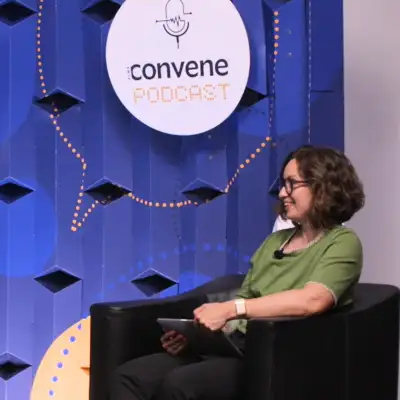
Since 1986, Convene has been delivering award-winning content that helps event professionals plan and execute innovative and successful events. Join the Convene editors as we dive into the latest topics of interest to — and some flying under the radar of — the business events community.
Convene Podcast Transcript
Convene Interview, ep. 10
*Note: the transcript is AI generated, excuse typos and inaccuracies
Magdalina Atanassova: This is the Convene Podcast.
Today we’re exploring what leadership, innovation, and sustainability truly need to look like as we move toward 2030 and beyond.
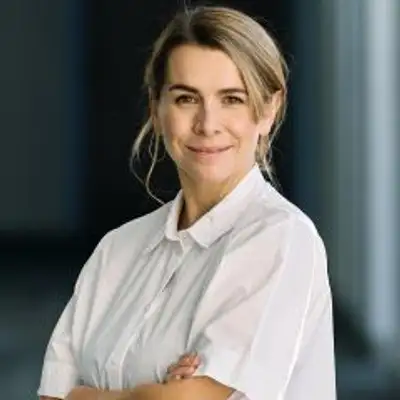
My guest is Franziska Seehausen — founder of Comat Studio and a designer who has built her career at the intersection of creativity, systems thinking, and sustainable transformation. Before launching her studio, Franziska served as Global Innovation and Sustainability Manager at adidas, where she helped shape the brand’s circularity and material innovation strategies.
Today, she partners with organizations to rethink business models, design for dialogue, and navigate complex transitions with clarity and purpose. In this conversation, we talk about the traits leaders need now, what makes technology truly “good,” why circularity is a business opportunity, and how constraints can actually fuel creativity.
We start now.
Hi Franziska and welcome to the Convene Podcast.
Franziska Seehausen: Hello. I'm really happy to be here.
Magdalina Atanassova: You talk about a new kind of leadership needed to navigate toward 2030 and beyond. What are the traits or mindsets that define this kind of leader today?
Franziska Seehausen: What we're seeing right now is that almost every organization or every organization is moving through some kind of systemic transition and we're living in times of change. If we look around there, this everywhere sort of uncertainty and what is coming next.
So the role of leadership as well as is shifting and it's maybe not longer about directing change from the top or it's more about maybe guiding people through the times of uncertainty.
And for me, what then when reflecting on that, is that what became crucial is that there are these three essential traits that I believe are crucial for leaders today,
which are empathy, trust and being courageous.
So leaders need to generally understand the people and the systems they're working in. And empathy is a tool or way to connect with people, to design the condition that people have ideas and share them and speak to each other.
And leaders then become bridge builders between different industries, between the people, between the teams. And I think that is the first point that is really important.
Second, like I said, trust.
We don't have to have as leaders all the answers. We can trust our teams, we can trust the experts that are out there.
And that is a trait that is really important.
And last but not least, being courageous to try out new things, to iterate and to learn fast, maybe even to fail. And then to reiterate and redo.
And let's see sustainability as a constraint, but as a game changer, seeing it as an opportunity to pioneer doing things that are new.
And maybe last but not least and most importantly and that I also shared in my, in my keynote at the C4C conference is the new kind of leadership requires to imagine the future before it exists.
Magdalina Atanassova: I love the fact that you outline these three traits of a leader, of the leader of today. And I feel you embody yourself all three of them.
And for me it takes courage, because you were at Adidas and then you need quite a bit of courage to leave that role and to launch Comat Studio, which you now have.
So congratulations on gathering that courage.
Thanks. Huge.
How has your understanding of sustainability evolved in that process, especially in how design can fuel systems change?
Franziska Seehausen: It's a great question because it definitely has evolved. Being a material designer and coming from the design field, it was deeply rooted in the materials and supply chains and the product itself when I first specifically joined Adidas.
And of course, it is about those technical solutions that we need in terms of driving change and sustainability.
But soon I realized that when implementing those technical novelties or innovations or those new solutions,
it's not that easy. It requires change and change in the system and that has a lot of resistance and that is linked to us humans as people.
So it has really evolved from being a solely technical challenge to a behavioral, a relational and a systemic one.
And that is really what also made me shift personally and build my own design studio where we're really focusing now on the human side and designing tools and formats for people to come together.
Designing formats that pour dialogue in those times of transition.
And design is,
I believe, a very powerful tool in that sense for systemic change,
to create dialogue, to make things visible,
to bring people together and really translate that complexity into clarity and make it more simple and engaging.
And that is the true magic, I think, for me,
in terms of thinking of design.
Magdalina Atanassova: You know, when you speak about design,
for me, it always appears this idea of design for those that are least privileged or have the most constraints of using something,
and that actually enables much broader use by everyone else.
So I definitely agree with you. I, I believe in the magic of design as well, 100%.
In your good technology and resources workshop at Convene for Climate, you explored business model innovation with the participants.
Can you share a real world example where a new tech or resource unlocked both revenue and impact?
Franziska Seehausen: Absolutely. I'd say actually all initiatives creating a circular business or ecosystem, these are very promising in terms of both revenue and impact. And I can share two examples in the field of the textile industry,
because I come from that, that area,
there is big research initiatives going on across Europe. For example, there's this T. Rex project. It's a large scale collaboration of 13 partners across the supply chain across Europe that are defining a new blueprint for a circular ecosystem coming from a linear industry to a circ on.
And there's also smaller companies like Turns, they also offer textile recycling services and build a completely new business model around that with both of those examples also all kind of circular initiatives.
And specifically now, if we talk about the textile industry and textile ways, it's not only about creating new valuable feedstock, it's about creating new material streams, new services, new partnerships, and also a new business model.
And those enables like partnerships across the value chain, from collectors to recyclers and to brands. Those are in both ways like revenue and creating impact.
Magdalina Atanassova: When we talk about good technology,
how do you define what's truly good?
Because that's kind of a broad term.
And is it about intent or outcomes or accessibility or something completely different?
Franziska Seehausen: Can I say all of the above?
You can definitely not be easy to define that because I think maybe we have to start first. What is a technology right? For me personally, technology is not only about a digital tool or high tech systems.
For me it's something that's human created and a mean that helps us solve a problem.
And a good technology helps us solve a problem without creating a new one.
And that is already quite complex. But that is what generally good technology entails. That has a clear intent and a clear purpose.
It should serve like the wider society and also ideally respect people, cultures and planetary boundaries.
And if we even further think about that,
it should contribute more than it takes. And I think there are already good technologies out there.
If we're thinking on reusing waste in terms of the material cycle, this like solves one problem, but it also allows maybe an upload or offers if we're designing new materials with it and potential new product applications, new properties that are creating a new aesthetic or so basically.
And if we're thinking about especially circular technical solutions, they can offer those multiple aspects of value without creating necessarily new one. And I think this combination I would define as a good technology.
Magdalina Atanassova: We need cross collaboration, a lot of it. We need all these new traits of the leader that you mentioned.
And I wonder,
did people put you on the spot during convenience free climate and ask you to make the bridges for them or did you discuss them during the workshop? Maybe. Was there anything that came out of those discussions that stood out to you as a bridge between the two very different industries?
Franziska Seehausen: There was something I was reflecting on earlier about that we're all in the same world, right? We're all facing the same challenges. We're Facing the same opportunities. And I think that is the true value.
And I personally believe innovation generally happens by linking two different things, not necessarily by reinventing the wheel, reinventing something completely new.
It's most innovation or successful innovations come by combining something from one industry in another.
And in that case also I think those are the.
If it's not far from each other, even if it's two generally at first glance, different industries,
we are facing the same challenges. So we can learn from each other, we can maybe even do the same steps, just the execution might be different.
So there's a lot of overlap, I would say.
Magdalina Atanassova: And speaking about cross sector collaboration is critical for purpose driven innovation. What makes partnerships truly impactful and what are some common traps to avoid?
Franziska Seehausen: I believe generally partnerships fail when stakeholders push their own agendas rather than seeing themselves as part of the shared system and says what is really the goal and the thing that we're trying to do?
And that has to be placed in the center. And while sort of personal agendas or agendas only linked to one of the partners has to become secondary. And that is, that is still very challenging a lot of the times.
And something else that is beyond focusing on the metric itself,
it is important to define small steps, tangible steps within a partnership so that there is this clarity on the process that there is those updates, there's open communication, there's clear roles and expectations and seeing those,
this progress and seeing progress within the team, the cross sector or across industry team that you've built. Right. And so there needs also to be spaces and formats for exchange and this iterative learning.
They might have to be sort of invented or created in a new way.
And ideally at the beginning of the process or throughout a project or an initiative, you have to develop those.
And I think similarly to the traits of a leader,
I also believe those also apply here in terms of the partnership.
It's about empathy and trust and being courageous.
Magdalina Atanassova: Yeah, just opening yourself to this process as well.
Speaking of that, many organizations say they want to do good or bad,
even if you may, they want to be in a partnership, but they don't know where to start.
What's often holding them back from embracing sustainable transformation, you think?
Franziska Seehausen: I see two main barriers. It's fear and fragmentation.
So many organizations fear the complexity, the cost, uncertainty associated with transformation.
And they often see maybe too far ahead and get lost in that complexity.
And then at the same time, internal teams and also industries work in silos and then they feel overwhelmed with their own agendas instead of seeing themselves within a bigger Objective because we are all part of the same world, we're part of the same challenges.
It is important to have sort of this cross sector empathy, interest and the small steps to make it tangible so that the change feels achievable.
Magdalina Atanassova: I'm just thinking of all those silos that you mentioned and indeed how often they stop the whole process or as you said, the fear of what's ahead.
And it is a scary future, but it's scarier if we do nothing. So what role do materials and circularity play in creating not just better products but better, better business systems?
Franziska Seehausen: So we start with materials. They don't only shape how a product looks like or how a product functions.
They also shape the entire lifespan and the life cycle and also the business model by now, because now we have to think about it in a circular way.
And the circular approach forces companies right now to rethink ownership and value creation and the logistics and the WIC leverage with new technologies and material innovation,
we can rethink those processes and extend the product functionality and lifespan and reinvent resource flows.
For example, secondary use materials.
Can I log new properties and cross industry collaboration.
There is right now leather and foam materials made from recycled PVP windshield, like the car windshield.
And there is this link between the automotive industry,
the textile industry to packaging, to furniture.
And so basically, in short, a material can be an enabler and circularity is a systemic shift.
Magdalina Atanassova: I love that. I can see how we can also apply it in our industry because we,
we do use materials quite a bit at events and potentially we can touch so many other industries.
That was a great example. Thank you. And designers and event professionals speaking about that are often pressured to deliver immediate results.
So how do we balance long term systemic change with short term KPIs?
Franziska Seehausen: I think the key is to sort of balance it both ways. Sort of.
We need to link the short term goals to the long term direction that we are going towards.
So even in the short term initiatives we need to embed the change already.
Of course we can't change all at once. And it's maybe about having a priority and starting with smaller steps and then sort of having this incremental process towards this long term goal.
But it's really important to always have that in mind. And I think I generally feel it's also a source of inspiration actually. If we are having this long term goal, this can already have an impact in our short term KPIs in terms of rethinking how we're using the resources or if we're thinking about the event industry,
we might not have to invent everything new. Maybe we can reuse certain components for different parts already and thereby make an impact environmentally.
Of course we can do that with our entire sort of event set up. But maybe we can start with the stage or start with the seating and then step by step implement more changes.
And I believe leaders have to sort of find that good balance between what is achievable, feasible in the now and the short term KPIs by making sure we're aligned with the long term goal.
Magdalina Atanassova: I believe also Convene 4 Climate is a good example because it's collocated with Convening EMEA.
So a lot of what's being used for Convening EMEA is being adapted and you don't have to produce a lot of things for convenience for climate just because they were already existing, they were already there, set up and created.
So I think you've observed a very good example yourself and you've spoken about thriving, profitable businesses that benefit people and planet. So what mindset shifts are needed for leaders to stop seeing these goals as mutually exclusive?
Franziska Seehausen: Firstly, it needs the understanding that there will not be long lasting, well, sustainable business without sustainable action and change.
And that mindset shift our current economy works,
and that it won't work in that way in the future is very crucial. We need to rethink profitability and growth. And having in mind the human and the planet,
that is sort of the first shift or basically state of the art.
And the other shift that I'm seeing benefiting people and planet doesn't have to be only a cost or constraint, but it can be a strategic or it is a strategic advantage.
And understanding it as a driver for innovation, for resilience or for new markets is a huge opportunity. So leaders must see constraints as creative innovation, creative opportunities.
And so the companies that see that today, the companies thriving today and tomorrow are themselves in that this way of thinking that mindset and embed sustainability in the core of their value creation today.
Magdalina Atanassova: I wonder if you see the current political climate also as an opportunity because we carried out a few surveys to event professionals and we saw that the political climate, especially in the US is definitely pushing sustainability off of the agenda.
So there is a multiple difference from previous years.
But how can we inspire, you know, people beyond the geographic limitations, let's say, so around the globe to do more and that they shouldn't limit themselves by the political agenda that's currently leading.
Franziska Seehausen: Absolutely,
I totally see your point in this. It's a big challenge and I See this sort of two things coming together here. There's one, the political climate that is sort of going,
let's say backward or decreasing in terms of sustainable action.
And then the second one also adding into this is that sustainability becomes a standard that has to be there, which is good.
The challenge is, I believe, that we still need to communicate and make it visible. Because right now the society or also like the world, we're thinking it's not important anymore, but it is.
And also a lot of things are being done,
but we're not as loud anymore because there are so many crisis in the world, there are so many things,
but maybe having a positive mindset or positive shift on, that could maybe work. Or still communicating all the sort of good news on what we are achieving, on the technologies we're implementing, the technologies we're embedding systems, the progress we are making,
still being bold and being sort of active in terms of communicating around that is for me crucial in terms of pioneering in that field and also inspiring.
Because if we're being quiet, no one will be inspired, no one will be taking action.
And there will be also more hesitation in society questioning if this is even a topic anymore. And it is. And a lot of companies are doing things maybe more quietly as before,
but because we've tried to make it more thoroughly and obviously we don't want to go into greenwashing, not at all. But the importance is to still state the progress that we're making and having that positive way of looking into this and thereby inspiring.
Magdalina Atanassova: If a listener could take just one bold action after this conversation to move towards sustainability and innovation in their field, what would you encourage them to do?
Franziska Seehausen: I'd say reach out to someone you haven't reached out before. Initiate this one cross disciplinary conversation that you've never had before to gain a new perspective on the challenge you're facing.
No matter if it's a text or industry, the packaging industry, the automotive industry, it doesn't matter someone else who might be not familiar with the events industry or within your sort of environment at all.
I can only speak from experience that it's always super enriching and insightful to get a new perspective. And many breakthroughs begin with that single conversation and that shifts a perspective.
Magdalina Atanassova: Was there anything we didn't mention? We definitely should before we wrap up.
Franziska Seehausen: I think I mentioned the importance of constraints being actually positive and also a catalyst for creativity and innovation.
If I haven't mentioned that, then I would like to definitely.
Spread that. But I think I've mentioned that I.
Magdalina Atanassova: Think it's an important point to mention twice, because especially in the events industry, I'm thinking of people, you know, listening to us and screaming at some points which are requiring of them to do extra, to go ask more questions,
open more doors. Of course, that opens also a lot of extra steps on their very busy agendas. You know, creating an event is not easy,
but seeing those constraints as opportunities.
It’s important to hear it twice.
Especially now at the end of the year,
we have 2026 right in front of us. So let's hope that there are more bold steps being taken in the new year.
Franziska Seehausen: Absolutely. Generally, I've been rereading this just knowing from my practice being a designer, but I was also rereading that designers and all of us need constraints in order to make innovative,
creative decisions or also finding new solutions.
And that's how I believe. Also, sustainability is not a burden, it's not a constraint. It's not only a cost. It is a catalyst for creativity and innovation.
Magdalina Atanassova: What a wonderful end to our conversation. Thank you so much, Franziska, for being on the podcast.
Franziska Seehausen: Thank you so much.
Magdalina Atanassova: Remember to subscribe to the Convene Podcast on your favorite listening platform to stay updated with our latest episodes. For further industry insights from the Convene team, head over to PCMA.org/convene. My name is Maggie. Stay inspired. Keep inspiring. And until next time.