Subscribe
Share
Share
Embed
Travel Grit is long-form conversations with ramblers, roamers and free spirits — adventurers who have crossed continents on horseback, sailed solo around the world, and traveled thousands of miles by mule. Hosted by Bernie Harberts. For bonus episodes, Q&A sessions, and more from the world of Travel Grit, check out the companion show Gritty Bits.
Autogenerated transcript. May contain errors. Refer to the audio or video for accuracy.
Episode Index
Sea sings Jesse James's courage song — (00:03)
The route: Northern California to Maine, 25 months — (01:41)
How Jesse James came into Sea's life — (03:37)
First ride in the round pen — two scared creatures finding each other — (05:30)
The $1 horse and a broken heart — (10:55)
Saint Fine Horn: the pony who dumped Sea in 10 seconds flat — (12:39)
Day one on the road — packs sliding, horses loose, dusk falling — (15:57)
Fine Horn colics in the wilderness — olive oil and Wild Turkey — (57:29)
The story that turned the trip around: Mesannie Wilkins — (2:16:13)
The parade in Minot — and the poem that broke her — (2:49:38)
Sea G Rhydr (00:03)
See that pinto pony heading up the road Sea G Rhydr's got his back most everywhere he goes up and down the mountains all across the plains fording ancient rivers is Jesse James. Jesse was an outlaw everybody knows lightning flashing in his eyes and always on his toes. Then he found a friend to trust his heart got rearranged he joined the Free Range Rodeo as gentle Mr. James.
And I usually sang it a little slower than that to bring both of our heart rates down. So that's our courage song. Anytime we needed to be brave, that's what I would sing to him.
Bernie Harberts (00:57)
That's Sea G Rhydr singing her courage song. Sea is one of the few people who have completed a continuous saddle voyage of 5,000 miles. And it's a good thing that she had that song, especially in the early days of her trip, because the mounts that she chose for her voyage were, well, imperfect. That was at the start, at least.
Sea stuck with her horses though for the whole trip and forged an incredible bond along the way. She's going to tell us more about this bond and how she came up with the songs that she sang to her horses when the going got tough. Let's start with the basics of Sea's trip.
Bernie Harberts (01:37)
Where did you go? How long were you out? What states did you go through?
Sea G Rhydr (01:41)
I started in Northern California and it was fall and winter was coming. And my main priority was we got to get out of here. And we were heading for the East Coast, but the passes were closing. So our only real option was to head south. So we went down through the Central Valley of California, then down into the Las Padres wilderness, which was awesome. And then up and across the Mojave Desert, and then the Panhandle and a little bit of Oklahoma, and then down through Texas to Austin, and then over to Louisiana, crossed the Mississippi into Mississippi, and then started up west of the Appalachians and through Tennessee, Kentucky, Ohio, little corner of Pennsylvania, and then across New York and Massachusetts, and I think a little bit of New Hampshire, and then we finished the trip up in Maine. And that whole thing took 25 months.
And we finished in November. So I'm going to take you back a minute here. There was a woman named Mesannie Wilkins who rode from Minot, Maine to California about 60 years before my trip. And so I finished in Minot, Maine at her hometown on the day that she left there and led a parade for a big Mesannie Wilkins reunion story. So that was the route and I was doing a lot of riding for the weather and for the water. Those were the two factors because I am not a cold person. I don't want to be riding through a blizzard. And the horses — you can't carry water on a riding horse. You just can't do it.
Bernie Harberts (03:37)
So explain that. Let's talk about the water. What did you do for water? How much did they drink? And let's back up even more a moment. Tell me about Jesse James and Saint Fine Horn.
Sea G Rhydr (03:42)
So Jesse started this whole thing. I've wanted to do something like this since I was six years old and completely obsessed with Little House on the Prairie. That book series, I read the whole thing I think nine times. And we were living in Illinois at the time and there were no horses. And my dad got a job at a place called Sky Ranch down in Texas, which was a summer camp. And so for eight years, summers and weekends, I was in heaven in East Texas at a ranch camp.
They had 40 horses and a lot of them were auction horses. And so at a certain point we got a little covered wagon and I had a little pony and my mom sewed me a hoop skirt and a sun bonnet and I would dress up like Little House on the Prairie because I wanted to be Laura Ingalls Wilder and I would drive my sister and I to church on the roads. It was amazing. And both of them being so brave to let me — I think I was 12 — and we were out on the real roads with a fairly young, not very well trained pony, but I was happy to go to church and that's what mattered to them. So that's where this dream started.
And I tried to do a long ride in my early thirties and it just bombed. I just didn't have it together yet. And so at this point I had gotten a job — I'd been away from horses for 17 years — and I got a job as a wrangler on the dude ranch because that was the thing I most wanted to do in my life. And there was this funny little orange horse with four white knee socks and he had this blaze that just slid off the side of his face and he was a little dorky. He was like the chess club homeschool kid made horse.
And he was really scared. He'd been ridden by a cowboy with spurs who used to make him buck to impress the tourist girls. And they were gonna get rid of him. And I said, can I just try with this horse? And they're looking at me and I'm 46 years old and I don't look like I have any business doing this. I know from trail rides what happens when middle-aged women get onto horses they have no business getting on — it usually ends up with an ambulance. And so I was scared and this horse was scared.
Bernie Harberts (07:32)
What did you do differently that other people hadn't seen or done?
Sea G Rhydr (07:51)
I was not asking him for anything. And I think there was a level where he felt my fear and I felt his fear. And in that moment, there was just this seeing each other and a pact that we were going to take care of each other.
I mean, to the day we split up, he still had that need to bolt every once in a while. But after we made that pact, every time he needed to bolt, he would give me that little freeze second, and I knew here we go, and I'd grab hold of his mane, get myself settled, and he would have to go.
Bernie Harberts (08:31)
So you just went with it.
Sea G Rhydr (08:32)
I just went with it. There was no other option. I couldn't get him to stop. When he freaked out, he had to run that off. And one could say that was perhaps not the most intelligent horse to take on a long ride across the country on the highways. But what we had was a really good connection and really good communication. And we just loved each other.
Bernie Harberts (08:54)
Despite what you might see — or other people might say — is an imperfect mount. Not a perfect road horse. But you made it work.
Sea G Rhydr (09:01)
We made it work. We learned how to work it. And then I made him a little song. See that pinto pony going down the road. Anytime we needed to do something and he needed to be brave, I would sing that song to him. It would relax the both of us. It was about him being valiant and crossing rivers and continents and the big old prairies and the mountains. This big adventure we were going to have together because he was so brave and so valiant and so true.
Bernie Harberts (09:41)
So that was Jesse James.
Sea G Rhydr (09:43)
That was Jesse James. And he became my commuter pony. So every day I would get up before dawn and saddle him up and we would ride the four or five miles up to the dude ranch. Then we would take out trail rides all day long. Then I would ride him home at dusk, unsaddle him, turn him out, and go eat leftovers for dinner. And maybe a month into that, my boyfriend dumped me pretty hard. And I had nowhere else to go and nothing else to do and no resources of my own.
Those commuting times became my crying times. And one day, Jesse was like — you know that dream you used to have about riding across the country? We could do that together. And then I found out the dude ranch was up for sale and there was no telling what was going to happen to these horses. Once again, he was going to rescue me. I was going to rescue him.
Sea G Rhydr (11:21)
At the end of the summer, he sold me that horse for $1. So I had a $1 pinto pony. And I had managed to save about $2,500 that summer.
And then my boon companion decided she wanted to come on this adventure. Gryph had ridden a horse about 12 times in her life and we didn't have another horse. And so we started looking and we found this 13-three-hand pony who was a buckskin with a tri-color mane and she was built like a triceratops.
Bernie Harberts (12:39)
How is a triceratops built?
Sea G Rhydr (12:46)
A ton of bricks, man. She was like a butcher block table with a leg at each corner and this little head that just plowed through everything. She was a full hand — four inches — shorter than Jesse James, but they both weighed 950 pounds.
She had been a riding lesson pony and she had been in a kind of ground school where she spent most of her time dancing sideways over cones and she had gotten really attitude-ish. She didn't like people. She didn't like being told what to do. But she was an absolute rock star and she was gorgeous. Gryph took one look at her and fell in love. As the experienced rider, I got on her and within five seconds I was on the ground. I tried it again. Ten seconds later, boom. I'm on the ground looking up at this horse like, what the actual?
Bernie Harberts (13:49)
And you'd been fine with Jesse James, who was a known bucker, but not Saint Fine Horn.
Sea G Rhydr (14:03)
Yeah. And Gryph is like, no, this is my pony and I love her. This is the one I'm taking. I'm like, all right. So for $665, we got her delivered. And so now here we are with $666 of prime California horse flesh getting ready to cross the country.
Sea G Rhydr (15:32)
So we left with the three of them.
Bernie Harberts (15:57)
What is the first day like on the road?
Sea G Rhydr (15:57)
The first day was a nightmare. We were planning optimistically 15, 20 miles a day. So it was going to be 20 miles to the ocean, and we were going to do that in two days — not a problem — and then head back. And the first day it took us from dawn to one o'clock to get packed. I had learned the diamond hitch the night before, because I'd never actually packed a horse before. And we didn't understand that when you balance your packs, they need to be within a few ounces, not within a few pounds.
So the packs were sliding sideways and we'd stop and repack and then it would slide off and we'd stop and repack again. We also didn't really have much in the way of maps. This was 2011 and we were mapping with paper maps — the DeLorme Atlas and Gazetteer. And it was not nearly zeroed in enough to get from the apple farm to the ocean along a river.
It took us five days to do 20 miles to the ocean.
Bernie Harberts (18:37)
Five days to get your first 20 miles.
Sea G Rhydr (18:45)
Yeah. And there was a moment in there where I was scouting — going back to see if there was a better camp — and Gryph had the other two horses and they got loose from her and took off heading home 100 miles an hour. Jesse takes off following them. It's dusk. We're on river rocks. I'm like, we're going to die.
And I did that emergency dismount thing that you practice in the arena at a trot. I landed and I hit a rock and I'm hanging onto the rein attached to the bosal getting dragged. And finally the weight of me is enough to slow him down and stop him.
And that big tree that had fallen down — the one I'd been cursing all day because we had to go into the river to get around it — that's what stopped the mares. They didn't want to go out into the river any more than we had the first time. So they stopped at that tree and Jesse and I managed to catch up with them. We walked back gathering stuff and tucking it back on. We were an improbable group.
Bernie Harberts (20:24)
And what did you camp like that first night?
Sea G Rhydr (20:24)
We found a place with just enough graze for the horses down by the river with a little sandy spot. And we had a little pyramid tent that didn't have a floor or a mosquito net. It was just a pyramid on a pole — a Charlie Brown tent. And we used the manty as our ground cloth and curved the edges up for a windbreak.
Bernie Harberts (20:52)
So explain what a manty is for listeners that might not know.
Sea G Rhydr (20:52)
A manty is a canvas cover that you put over your pack and tuck it all in before you do the diamond hitch. We were using a canvas tablecloth that we'd gotten from Home Depot. And Gryph had painted it with fairies and mushrooms and trees. So that became our floor.
Sea G Rhydr (21:24)
And then it was becoming very obvious that Vaca Suerte — our third horse — didn't like camping. She was losing weight. We got to the ocean and back to about Ukiah and she was not making it. We were going to have to send her home.
We got a job trimming for a little hillbilly named Papa Don. And he let us put our horses in his pasture with his cattle. This is California and it's fall, Bernie. Which means we're spending 8 to 10 hours a day sitting at a table with little tiny scissors taking the leaves off buds so they can be sold. We're getting paid by the ounce.
Bernie Harberts (22:30)
Trimming hooves, trimming hooves.
Sea G Rhydr (22:45)
Trimming pot. And we're making good money. So we send Vaca Suerte home. She wound up diagnosed with tick fever, so it was really good that she went home where she could get vet care. But now we're down to two horses and we need three.
So we find a horse on Craigslist — a quarter horse, former barrel racing horse. She was weaning her foal. The reason she was being sold is because she had been at a rodeo, somebody had gotten rough with her trying to sort her out, and she reared up and went over backwards and fractured that woman. She was in a coma for a few months and almost died. So nobody had been riding her and they made us promise we weren't going to ride her. We were only going to use her as a pack horse.
Sea G Rhydr (25:28)
We literally were the fourth long riders that Sherry Justice had found. And she basically said, you girls are long riders, not long walkers. We've got to get you up on those horses. She found us an old stock saddle from the 1800s that fit really well on Cowgirl. She gave us the confidence. She believed in us and gave us validity in our own hearts that we were part of an elite group. We were not just posers and we could do this.
Bernie Harberts (25:28)
So let me jump in and explain — what is a long rider?
Sea G Rhydr (25:28)
A long rider is someone who has done a thousand miles of cross-country travel on a horse without a support crew. Just you and the horse figuring out how to make it work. And it's been going on for a really long time. There are some super famous wonderful long riders like Oscar Wilde. And Mesannie Wilkins, who had done this 60 years before me. I didn't know there was a Long Riders Guild yet. I was still out there going, I'm just going to make this up as I go.
Sea G Rhydr (27:55)
And I've got to tell you a little story about Fine Horn. We were camping and we'd turn her loose to graze because as long as you have one horse tethered, the other horses aren't likely to leave. And Fine Horn came over nosing around camp and all of a sudden the lighter is gone. And we're spending five minutes looking for the lighter. And all of a sudden we see Fine Horn standing there with this look on her face. And I said, Fine Horn, did you take the lighter? And she drops it out of her mouth. And she sticks her little nose up in the air like Flehmen, showing her teeth.
That became Fine Horn laughing. She was the comic relief. She would do things that made me furious, but she never did anything that put my life in danger. She was careful that way. Smartest pony I've ever met.
Sea G Rhydr (31:59)
What putting your horses first looks like — first, it means picking a place to stop that suits your horse. You make sure there's graze, there's water, your horse is going to be comfortable for the night. There were a few nights I didn't manage that and those were really, really hard nights. There was a night they were drinking water out of puddles. A night they spent on cement. But those nights were few. We worked very hard not to have those nights happen.
Bernie Harberts (33:26)
And how did you tie them at night?
Sea G Rhydr (33:31)
A rope from their halter to some solid object. About 30 to 40 feet long. We tried to do it in such a way that there wasn't a lot for them to get hung up on, and that there was good graze they could reach. Jesse was tethered on the best grass and the mares would be turned loose to find what they could eat.
One of the things I've said to people who ask for long ride advice is: teach your horse to tether before you go. They need to learn how to manage that rope, how to get out of those loops when they form, how to unwind themselves from a tree. They need to get smart about that rope before you can sleep.
Sea G Rhydr (45:45)
I would say you're way safer than you think you are. And it helps to dress a little androgynously. Keep your radar up. If somebody feels creepy, move on. That projected fear is way bigger than reality.
Sea G Rhydr (48:06)
We were doing a two and a half week section that was going to be in the wilderness with no possibility of resupply. We needed to add an extra pack horse because we were going to have to carry a lot more food.
We get a call from a man who came from Yemen and was going home to spend some time with his family. He had a horse to give us. She was 16-two, jet black, her name was Africa. A thoroughbred-looking leggy thing. And her big claim to fame was that a one-legged man had used her to deliver Domino's pizza one year. She had never been out of the city.
I ride her 15 miles back to where the other horses are — I'm managing this powder keg I'm riding on, singing to her because that's going to calm me down and calm her down. One of the songs I grew up with was Daisy, Daisy, give me your answer to, I'm half crazy riding a horse like you. She loved that song. The first time she was actually willing to slow down to walk. So she became Daisy.
Sea G Rhydr (57:29)
Fine Horn was colicking and sweating and pawing at her belly. Gryph has never seen a horse colic before. And I'm like, okay, we have to keep her moving — which feels like torturing a horse when they're really sick. And we didn't have Banamine. So we went old school. In that cabin someone had left half a bottle of olive oil and half a bottle of Wild Turkey.
Fine Horn was a horse who on her better days would eat anything. So we tilted her head back and dumped those down her throat and kept her walking. Within about an hour she passed a foul mass. And then we just let her out to graze and fed the alfalfa to the other three.
That old school remedy absolutely worked. And I think there was a quote I was hanging on to tightly that first section — I don't remember who said it — but it's the more you know, the less you need. That feeling of divine providence that here we had exactly what we needed, exactly when we needed it.
Sea G Rhydr (1:05:36)
That was the scariest thing I had ever done in my life to that date. We're on this trail and I see a part of it washed out ahead. It's only about two and a half feet broad, but there is no trail for two and a half feet. And the trail is only a foot wide anyways. And I just want off. There's no room to get off. And I don't care. I just want off.
And Jesse will not stop walking. He just continues walking at his steady methodical pace. And he literally growled at me. Deep in his chest, like — I've got this woman, be still.
And so I sat as still as I possibly could. And all four of those horses stepped right over that. They handled it fine.
Sea G Rhydr (1:22:14)
We've got it going. We've got four horses. We're making our way. We've got a routine. We're feeling pretty good. Somewhere in there, my parents are having their 50th wedding anniversary and they want the whole family together at Disney World in Florida. And how do I say no?
So our friend Fox flies over from Ireland and takes my place for a week and a half. And I got back from Disney World with a tan — and when you're sleeping in the cold every night and working like that every day, I literally could not eat enough to keep from losing weight. I started at 200 and by the time we got to the bottom of the Central Valley I was at 165 in two and a half months.
Sea G Rhydr (1:30:30)
It's getting more and more obvious that Gryph is miserable. She is not having fun. This is not the trip she signed on for. And finally one day she comes to me and says, you know, we're talking to people about living your dream and doing what's in your heart to do. And I'm feeling like such a hypocrite because I'm tagging along in your dream. It's time for me to go pursue my own dream.
And I found homes for Daisy and for Cowgirl. Gryph's one condition was — you have to keep Fine Horn. I don't care how many horses you take but she is not leaving.
When the trailer came to get the mares, Jesse was tied to a tree with a pretty stout rope. As that trailer went down the road, he screamed and reared up and broke that rope. Tossed himself on his butt. And I was close enough I could grab the rope and keep him. He took his responsibilities seriously. He was the herd stallion and he took that really seriously. Heartbreaking.
But now it's me and Jesse James and Saint Fine Horn. And that was the heart of it. That was where we started.
Sea G Rhydr (1:34:00)
Beginnings are really hard. And the first night it's my job to find a place to stop. It's my job to go knock on the doors. And everybody says no. Again and again and again. I can't do this alone, I can't do it. I'm going to fail. And it's getting dark.
And there's a bunch of Mexican guys on the back of a pickup truck who invite me in for a beer. And I say, I honestly have to stop for the night. I don't have time. Do you have any idea? And they sent me with very good directions to El Dorado Ranch. Three generations of Mexican men. The one in the middle had started coming to the United States when he was 11 years old. He was distributing food past its expiration date — stuff the grocery stores were throwing away — to 60 families. And he gave me a place to spend the night, fed me really well, and told me their stories. And that was what I needed to have faith in myself that I could find people and keep the ponies safe.
It was never that hard again. It was just that one night.
Bernie Harberts (1:38:37)
So let's pretend you're knocking on my door and I open and I see you and I see Saint Fine Horn and Jesse James. What do you say to me?
Sea G Rhydr (1:38:41)
I say, hi, my name is Sea and I'm riding across the United States with those two manure factories that are grazing on your lawn. And we're looking for a place we could stop for the night. I saw that paddock over there and I was wondering if that might work or if you have any ideas of a place we might be able to stop.
Bernie Harberts (1:39:09)
Come on in. Wow, that's impressive. That's honed.
Sea G Rhydr (1:39:11)
95% of the time. And I have a weird knack for making the improbable seem very normal. I can make anything just feel like — yep, just this is how it goes. I have mirror neurons that are very strong projectors in terms of saying, this is a normal thing. I'm a very safe person. You have nothing to be afraid of. I'm doing a wonderful thing and you really want to be a part of this story.
Sea G Rhydr (1:49:13)
I packed way too much stuff on Fine. I think I probably had 150 pounds on her at that point. I had a copy of Don Quixote. Do you know how big that book is? That's a big book, man. It's like several bricks. Extra food, extra blankets, stuff that I didn't want to get rid of. That pack rat mentality. That poverty mentality. That fear mentality. I might need this. It's better to have too much than too little.
And Fine Horn's withers came up hot and swollen. We're 28 miles out one way and 20 miles the other way. And if we stay where we are, we will die. I dumped out every extra thing I could — except for Don Quixote — and I put that saddle on her. She was not tied up. I was not holding the rope. She stood there like a little soldier and she ground her teeth as I tightened that pack down onto her so we could get out of there alive.
I'm crying, I'm apologizing to her. But there was nothing for it. We were in a bad situation and we had to get out. And she did not complain. She was an absolute trooper and she got us out of there. And that is not the sort of way we're supposed to treat our horses. And that's not the sort of situation we're ever supposed to get ourselves into. And there we were. And that mare took that sacrifice for the whole team and got us out.
Sea G Rhydr (1:59:00)
Fine Horn had a fistula of the withers. It broke and every day I had to doctor it three times a day with hot compresses — ginger and garlic and castor oil and hydrogen peroxide and water. And they asked me, do you want to just leave her here and get a different horse? I said, no. After what she went through for me, I am not going to abandon this pony. And so I was there for six weeks.
Sea G Rhydr (2:07:38)
The Mogollon Rim. Northern Arizona at some point in prehistory had a giant earthquake and went up 2,000 feet in this big upheaval. So there was this mad earthquake and all of a sudden a 2,000-foot vertical drop between cactus and rattlesnakes and the Mogollon Rim — Jeffrey Pines, lush meadows, springs, little ponds. If I ever get reincarnated, I want to come back here as a cowboy.
Every night, 15 miles, I'd find a place with a little spring going into a water trough. A sheepherder cabin. Maybe I was sharing it with a porcupine. But it was just beautiful. And it smells amazing because the Jeffrey Pines smell like sugared vanilla. You're going through this perfume. That was my 47th birthday and I was suddenly having this feeling of — this is what I was meant to do. This is what I was born to do. It just got easy for a while.
Sea G Rhydr (2:16:13)
Katie got in touch with me and she said, there's this thing called the Long Riders Guild and you should probably get in touch with them. So when I was in New Mexico, I finally got the word from CuChullaine that I was accepted as a member of the Long Riders Guild. And Basha said — we would like you to turn this into the Mesannie Wilkins Memorial Ride. Finish your ride in Minot. She rode west, you're riding east. Let's stay in the spirit of Mesannie Wilkins.
And the first time I used that story, I was in the panhandle of Texas and a big storm was coming. A guy sent me to the rodeo grounds and literally gave me a ride there in his trailer. Because I was a tramp and he didn't want riff-raff around. But as we went, I told him the Mesannie Wilkins story. And in the morning he called. And he took me out for breakfast and moved me to an apartment. Texas posh. Cow skin on the floor. A Keurig on the counter. A hot shower. Crisp white hotel sheets. His daughter and wife came over with pot roast.
Just because I had a good story. And I think one of the things I learned is — when you're doing something like this, you have to have the right story to bring people in and let them feel like they're part of something worth supporting.
Sea G Rhydr (2:27:41)
Southern hospitality is over the top. A lady saying — I saw you on the news and I made you these muffins — standing out in front of her house, God knows how long, just to give me those muffins. And she was 80 and couldn't stand up straight.
But this is also where the talk tax started to get really heavy. Everybody wants to tell me their story. And when you get sat across the table from someone and they don't break eye contact for three hours as they tell you their story — that was my version of singing for my supper. That was how I was paying for my room and board.
Sea G Rhydr (2:34:00)
I think one of the roles of a traveler is to absorb those stories and leave with them. Because I don't know anyone she knows and I'm never going to tell that story to anyone she knows. I'll be gone in the morning.
Sea G Rhydr (2:37:55)
In Tennessee, Jesse's shedding out and he gets rain rot. Rain rot is some sort of unholy alliance between bacteria and fungus. It makes their skin on their back fall out in little clumps and you can't put a saddle on top of that.
I gave Jesse a bath with an iodine shampoo and he had an allergic reaction to it and all the hair on his back sloughed off. And I had an allergic reaction to it and I swelled up and turned yellow.
My parents put me in touch with Lucy Sykes, who was my riding instructor when I used to live in Tennessee when I was six and seven years old. She came and got me in her trailer. Brought me home. Gave me a room. She put me up for six weeks while I doctored Jesse's back and got ready to go again. Another blast from the past getting me on my feet.
Sea G Rhydr (2:39:56)
The Amish still use horses for their everyday life. They're the only people other than cowboys for whom that is their livelihood. And they know more about keeping horses sound and healthy and working than anyone in the country right now. So that was my next lifeline.
Sea G Rhydr (2:43:37)
I get into Maine and I'm getting sick. By the time I get to the ocean, I have walking pneumonia. I have a fever. I'm delirious. And Jesse is literally balancing me under him to keep me in the saddle.
I had visualized when I started this whole thing that I wanted to be able to ride Jesse without a bridle. And the first time I took his bridle off, we were in the Mojave Desert and he looked over his shoulder at me like — are you mad, woman? But by this point, when he didn't have a bridle on, he was on his best behavior. He needed to be almost telepathic to my weight and seat cues. So I had the flag in one hand and the pack pony in the other. And we rode down to the ocean.
They don't want to go in the ocean. They were like — we are land creatures. You are not a mermaid. We have reached the end of this. We are not going to carry you into the ocean. After all that. But not that.
Sea G Rhydr (2:49:38)
And then it was a matter of two weeks before the parade would happen. And I got to Minot and the kids were there and they were so excited and we did the parade and then they read me that poem — if you think you're beaten, you're beaten. If you think you can, you can. And by the time they finished that poem, I was sobbing. I couldn't hold it together anymore. And my parents were both there and I just said, if you'll excuse me, I think I'm going to go cry by myself for a minute. And I went off with the ponies.
And Gryph had shown up for the parade. So she was riding Fine Horn and I was riding Jesse with no bridle and a wreath of flowers around his neck. And nobody seemed to notice we didn't have a bridle on. Which was just like — wait, be impressed with me.
Then we got to Mesannie's grave — just a small cement plaque flat with the ground. And Lucy Leaf, who'd actually ridden behind me during some of the twisty roads in New England with her headlights on to keep me alive, was there to welcome us.
There's a picture of the three of us lying down with our heads in a little circle around Mesannie's gravestone, all grinning.
Bernie Harberts (2:55:33)
And one more thing before we go. Sea had this great piece of life advice.
Sea G Rhydr (2:55:33)
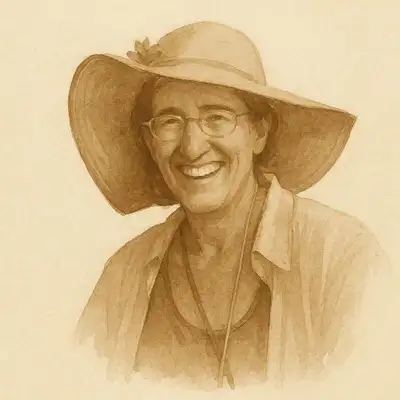
There is a lot to be said for a fancy hat. When Gryph and I split up and I left the hot springs, I had a funny old lady felt — bright red — hat with feathers coming out of it. That was eye catching. It made people see me as approachable. And those feathers would wave in the wind and keep me from getting hit on the road. And then the whole time I would switch from winter hats to summer hats, but I always had some big, silly, ridiculous hat on. That was one of those things that made the trip in a way I never would have thought of.
Sea G Rhydr (2:56:42)
Whatever it is that's yours to do — it may not be a long ride, it may be something completely different — the important thing is if you just start on it, if you just take those first steps, it is amazing how that support comes in and how the universe starts supporting that goal. You take the tiny little steps and suddenly you've got this wind under your wings you never thought was ever going to happen.
Trust that. Consider the lilies of the field and the birds of the air. They don't worry about stuff.
For more stories of long riders, sailors, ramblers, adventurers, and dreamers finding their way, visit TravelGrit.com.